

Safety and immunogenicity of two novel type 2 oral poliovirus vaccine candidates compared with a monovalent type 2 oral poliovirus vaccine in healthy adults: two clinical trials
Open accessThe DOI matches its Crossref record; 21 of the 21 references it cites were found in a registry or an index; 1 of the 20 sources its claims cite were checked for support.
Abstract
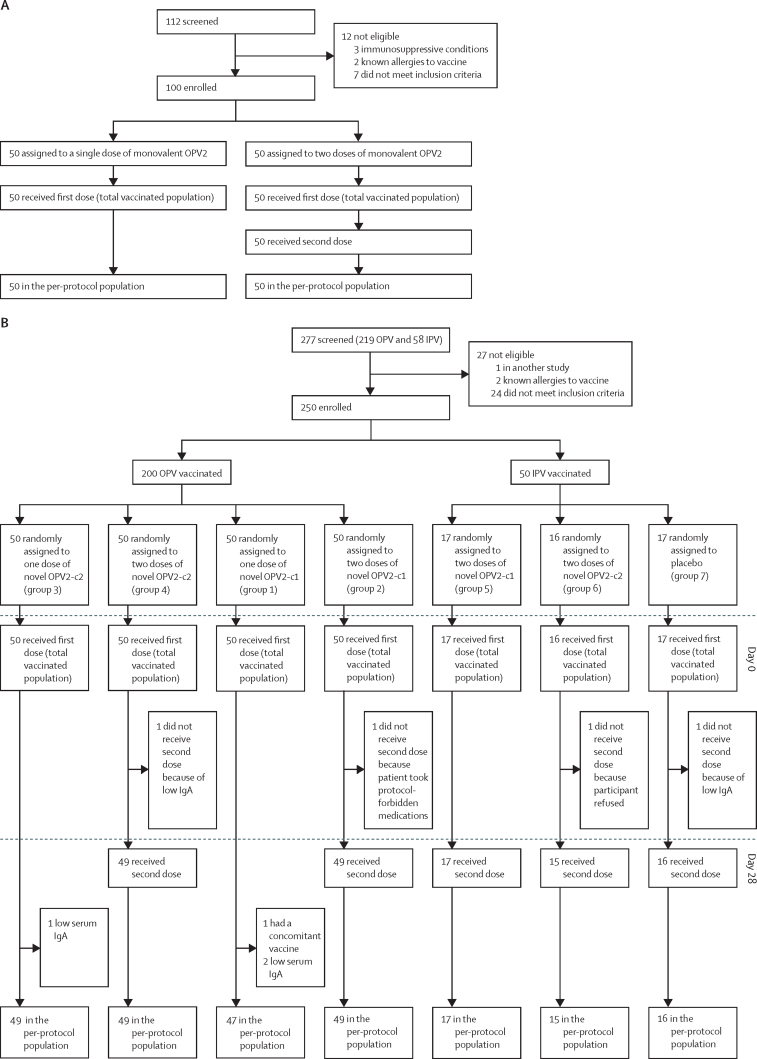
BACKGROUND: Two novel type 2 oral poliovirus vaccine (OPV2) candidates, novel OPV2-c1 and novel OPV2-c2, designed to be more genetically stable than the licensed Sabin monovalent OPV2, have been developed to respond to ongoing polio outbreaks due to circulating vaccine-derived type 2 polioviruses. METHODS: We did two randomised studies at two centres in Belgium. The first was a phase 4 historical control study of monovalent OPV2 in Antwerp, done before global withdrawal of OPV2, and the second was a phase 2 study in Antwerp and Ghent with novel OPV2-c1 and novel OPV2-c2. Eligible participants were healthy adults aged 18-50 years with documented history of at least three polio vaccinations, including OPV in the phase 4 study and either OPV or inactivated poliovirus vaccine (IPV) in the novel OPV2 phase 2 study, with no dose within 12 months of study start. In the historical control trial, participants were randomly assigned to either one dose or two doses of monovalent OPV2. In the novel OPV2 trial, participants with previous OPV vaccinations were randomly assigned to either one or two doses of novel OPV2-c1 or to one or two doses of novel OPV2-c2. IPV-vaccinated participants were randomly assigned to receive two doses of either novel OPV2-c1, novel OPV2-c2, or placebo. Vaccine administrators were unmasked to treatment; medical staff performing safety and reactogenicity assessments or blood draws for immunogenicity assessments were masked. Participants received the first vaccine dose on day 0, and a second dose on day 28 if assigned to receive a second dose. Primary objectives were assessments and comparisons of safety up to 28 days after each dose, including solicited adverse events and serious adverse events, and immunogenicity (seroprotection rates on day 28 after the first vaccine dose) between monovalent OPV2 and the two novel OPV2 candidates. Primary immunogenicity analyses were done in the per-protocol population. Safety was assessed in the total vaccinated population-ie, all participants who received at least one dose of their assigned vaccine. The phase 4 control study is registered with EudraCT (2015-003325-33) and the phase 2 novel OPV2 study is registered with EudraCT (2018-001684-22) and ClinicalTrials.gov (NCT04544787). FINDINGS: In the historical control study, between Jan 25 and March 18, 2016, 100 volunteers were enrolled and randomly assigned to receive one or two doses of monovalent OPV2 (n=50 in each group). In the novel OPV2 study, between Oct 15, 2018, and Feb 27, 2019, 200 previously OPV-vaccinated volunteers were assigned to the four groups to receive one or two doses of novel OPV2-c1 or novel OPV2-c2 (n=50 per group); a further 50 participants, previously vaccinated with IPV, were assigned to novel OPV2-c1 (n=17), novel OPV2-c2 (n=16), or placebo (n=17). All participants received the first dose of assigned vaccine or placebo and were included in the total vaccinated population. All vaccines appeared safe; no definitely vaccine-related withdrawals or serious adverse events were reported. After first doses in previously OPV-vaccinated participants, 62 (62%) of 100 monovalent OPV2 recipients, 71 (71%) of 100 recipients of novel OPV2-c1, and 74 (74%) of 100 recipients of novel OPV2-c2 reported solicited systemic adverse events, four (monovalent OPV2), three (novel OPV2-c1), and two (novel OPV2-c2) of which were considered severe. In IPV-vaccinated participants, solicited adverse events occurred in 16 (94%) of 17 who received novel OPV2-c1 (including one severe) and 13 (81%) of 16 who received novel OPV2-c2 (including one severe), compared with 15 (88%) of 17 placebo recipients (including two severe). In previously OPV-vaccinated participants, 286 (97%) of 296 were seropositive at baseline; after one dose, 100% of novel OPV2 vaccinees and 97 (97%) of monovalent OPV2 vaccinees were seropositive. INTERPRETATION: Novel OPV2 candidates were as safe, well tolerated, and immunogenic as monovalent OPV2 in previously OPV-vaccinated and IPV-vaccinated adults. These data supported the further assessment of the vaccine candidates in children and infants. FUNDING: University of Antwerp and Bill & Melinda Gates Foundation.
Overview
CoChat Summary
## TL;DR
Two clinical trials in healthy Belgian adults found that both novel OPV2 candidates (novel OPV2-c1 and novel OPV2-c2) were as safe and immunogenic as licensed monovalent OPV2, with no vaccine-related serious adverse events. The candidates also showed similar shedding patterns to monovalent OPV2 and no reverting modifications in the key genetically stabilised domain V samples reported.
## Key findings
- In the historical control study, 100/100 participants were enrolled and all completed follow-up; in the novel OPV2 study, 250 participants were enrolled (200 OPV-vaccinated, 50 IPV-vaccinated), and 8 were excluded from per-protocol immunogenicity analyses.
- After first doses in previously OPV-vaccinated participants, solicited systemic adverse events were reported by 62/100 (62%) with monovalent OPV2, 71/100 (71%) with novel OPV2-c1, and 74/100 (74%) with novel OPV2-c2; severe solicited events were uncommon (4, 3, and 2, respectively).
- In previously OPV-vaccinated participants, baseline seropositivity was 286/296 (97%); after one dose, seroprotection was 100% for both novel OPV2 candidates and 97% for monovalent OPV2.
- Shedding was lower in OPV-vaccinated than IPV-vaccinated participants. After the first dose, PCR-positive stools were seen in 15/100 (15%) monovalent OPV2 recipients, 31/100 (31%) novel OPV2-c1 recipients, and 20/100 (20%) novel OPV2-c2 recipients; by day 28, all assessed monovalent OPV2 and novel OPV2-c1 participants had stopped shedding, and only 1/66 novel OPV2-c2 recipients was still shedding.
## Methods
- Two partially masked studies were done at two centres in Belgium: a phase 4 historical control study of monovalent OPV2 in Antwerp and a phase 2 study of novel OPV2-c1 and novel OPV2-c2 in Antwerp and Ghent.
- Healthy adults aged 18–50 years with at least 3 prior polio vaccinations were enrolled; the novel OPV2 study included both previously OPV-vaccinated and IPV-vaccinated adults.
- Primary comparisons used Fisher’s exact tests for safety and non-inferiority testing for seroprotection after one dose in OPV-vaccinated groups; immunogenicity was measured by neutralising antibody titres, seroprotection, and seroconversion, and stool shedding was assessed by PCR and CCID50.
## Limitations
- The paper states the main limitation was that the work required two separate studies because global withdrawal of Sabin OPV2 made direct contemporaneous comparison impossible, so the monovalent OPV2 data were historical.
- The paper also states that the study was done in fully vaccinated adults, whereas the most likely recipients would be children and infants; this limits direct generalisability.
- Evident from the text: the IPV-vaccinated novel OPV2 groups were small (17 and 16 vaccine recipients), and enrolment of IPV-vaccinated participants was truncated per protocol because of low enrolment, which limits precision for those comparisons.
Model-written summary. Check it against the paper before relying on it.
Integrity signals
Registry
Cites
Statistics
Figures
Verification
Claims the paper makes
1 Valid · 0 Not valid · 14 Not checked · 107 Own results and interpretations
The sources with a verdict support this claim; the rest weren’t checked yet, have no full text we could read, or their verdicts aren’t rated yet.
In the paper
“Two novel type 2 oral poliovirus vaccine (OPV2) candidates, novel OPV2-c1 and novel OPV2-c2, designed to be more genetically stable than the licensed Sabin monovalent OPV2, have been developed to respond to ongoing polio outbreaks due to circulating vaccine-derived type 2 polioviruses.”
- Also stated in: § Introduction · plain
“A consortium has been working since 2011 on research and development of novel poliovirus strains engineered to be more genetically stable with less likelihood of reversion to neurovirulence while retaining the benefits of Sabin OPV.”
§ Safety and immunogenicity of two novel type 2 oral poliovirus vaccine candidates compared with a monovalent type 2 oral poliovirus vaccine in healthy adults: two clinical trials > Abstract > Background
What the sources say
- Supportedcites [7] Yeh MT Bujaki E Dolan PT Engineering the live-attenuated polio vaccine to prevent reversion to virulence Cell Host Microbe 27 2020 736 51.e8 32330425 PMC7566161 source
The Methods (Vaccines) section states the genetic modifications in both candidates (S2/cre5/S15domV/rec1/hifi3 = candidate 1; S2/S15domV/CpG40 = candidate 2) were made 'to improve the genetic stability of this major attenuating determinant of Sabin type-2', and the Discussion opens by saying the candidates 'were designed to stabilise the poliovirus genome against acquisition of neurovirulence, to provide safer alternatives for outbreak control of cVDPVs'. The Introduction (p.1) ties their development directly to ongoing cVDPV2 outbreaks and the limitation of stockpiled monovalent Sabin OPV2, and the Discussion concludes the study shows they 'have the potential to provide more genetically stable alternatives to the current Sabin monovalent OPV2 that is stockpiled for control of cVDPV2 outbreaks'. Both limbs of the citing sentence (designed for greater genetic stability than licensed Sabin mOPV2; developed to respond to cVDPV2 outbreaks) are therefore stated in our copy. (LLM, conf=0.92)
- Not checked yetcites [8] Konopka-Anstadt JL Campagnoli R Vincent A Development of a new oral poliovirus vaccine for the eradication end game using codon deoptimization NPJ Vaccines 5 2020 26 32218998 PMC7083942
plainstates a cause- Asserted: passes — The authors put it forward as true.
- Checkable: passes — It can be checked against evidence.
- Load-bearing: passes — The paper’s conclusions depend on it.
- Based: passes — The paper gives a reason why it holds.
- Also stated in: § Introduction · plain
A result the paper reports from its own data — it cites no other source for it, so there is none to check. The quote shows it is in the paper.
In the paper
“after one dose, 100% of novel OPV2 vaccinees and 97 (97%) of monovalent OPV2 vaccinees were seropositive”
§ Safety and immunogenicity of two novel type 2 oral poliovirus vaccine candidates compared with a monovalent type 2 oral poliovirus vaccine in healthy adults: two clinical trials > Abstract > Findings In the historical control study, between Jan 25 and March 18, 2016, 100 volunteers were enrolled and randomly assigned to receive one or two doses of monovalent OPV2 (n=50 in each group). In the novel OPV2 study, between Oct 15, 2018, and Feb 27, 2019, 200 previously OPV-vaccinated volunteers were assigned to the four groups to receive one or two doses of novel OPV2-c1 or novel OPV2-c2 (n=50 per group); a further 50 participants, previously vaccinated with IPV, were assigned to novel OPV2-c1 (n=17), novel OPV2-c2 (n=16), or placebo (n=17). All participants received the first dose of assigned vaccine or placebo and were included in the total vaccinated population. All vaccines appeared safe; no definitely vaccine-related withdrawals or serious adverse events were reported. After first doses in previously OPV-vaccinated participants, 62 (62%) of 100 monovalent OPV2 recipients, 71 (71%) of 100 recipients of novel OPV2-c1, and 74 (74%) of 100 recipients of novel OPV2-c2 reported solicited systemic adverse events, four (monovalent OPV2), three (novel OPV2-c1), and two (novel OPV2-c2) of which were considered severe. In IPV-vaccinated participants, solicited adverse events occurred in 16 (94%) of 17 who received novel OPV2-c1 (including one severe) and 13 (81%) of 16 who received novel OPV2-c2 (including one severe), compared with 15 (88%) of 17 placebo recipients (including two severe). In previously OPV-vaccinated participants, 286 (97%) of 296 were seropositive at baseline; after one dose, 100% of novel OPV2 vaccinees and 97 (97%) of monovalent OPV2 vaccinees were seropositive.
plain- Asserted: passes — The authors put it forward as true.
- Checkable: passes — It can be checked against evidence.
- Load-bearing: passes — The paper’s conclusions depend on it.
- Based: passes — The paper gives a reason why it holds.
A result the paper reports from its own data — it cites no other source for it, so there is none to check. The quote shows it is in the paper.
In the paper
“four (monovalent OPV2), three (novel OPV2-c1), and two (novel OPV2-c2) of which were considered severe”
§ Safety and immunogenicity of two novel type 2 oral poliovirus vaccine candidates compared with a monovalent type 2 oral poliovirus vaccine in healthy adults: two clinical trials > Abstract > Findings In the historical control study, between Jan 25 and March 18, 2016, 100 volunteers were enrolled and randomly assigned to receive one or two doses of monovalent OPV2 (n=50 in each group). In the novel OPV2 study, between Oct 15, 2018, and Feb 27, 2019, 200 previously OPV-vaccinated volunteers were assigned to the four groups to receive one or two doses of novel OPV2-c1 or novel OPV2-c2 (n=50 per group); a further 50 participants, previously vaccinated with IPV, were assigned to novel OPV2-c1 (n=17), novel OPV2-c2 (n=16), or placebo (n=17). All participants received the first dose of assigned vaccine or placebo and were included in the total vaccinated population. All vaccines appeared safe; no definitely vaccine-related withdrawals or serious adverse events were reported. After first doses in previously OPV-vaccinated participants, 62 (62%) of 100 monovalent OPV2 recipients, 71 (71%) of 100 recipients of novel OPV2-c1, and 74 (74%) of 100 recipients of novel OPV2-c2 reported solicited systemic adverse events, four (monovalent OPV2), three (novel OPV2-c1), and two (novel OPV2-c2) of which were considered severe. In IPV-vaccinated participants, solicited adverse events occurred in 16 (94%) of 17 who received novel OPV2-c1 (including one severe) and 13 (81%) of 16 who received novel OPV2-c2 (including one severe), compared with 15 (88%) of 17 placebo recipients (including two severe). In previously OPV-vaccinated participants, 286 (97%) of 296 were seropositive at baseline; after one dose, 100% of novel OPV2 vaccinees and 97 (97%) of monovalent OPV2 vaccinees were seropositive.
plainn = 200- Asserted: passes — The authors put it forward as true.
- Checkable: passes — It can be checked against evidence.
- Load-bearing: unclear — It is unclear whether the paper’s conclusions depend on it.
- Based: passes — The paper gives a reason why it holds.
A result the paper reports from its own data — it cites no other source for it, so there is none to check. The quote shows it is in the paper.
In the paper
“This study is the first to show that in an adult population with a history of previous OPV vaccination, both novel OPV2 vaccine candidates are safe and well tolerated and have statistical non-inferiority for immunogenicity compared with the monovalent OPV2 vaccine they are designed to replace.”
§ Safety and immunogenicity of two novel type 2 oral poliovirus vaccine candidates compared with a monovalent type 2 oral poliovirus vaccine in healthy adults: two clinical trials > Abstract > Funding
boosted- Asserted: passes — The authors put it forward as true.
- Checkable: passes — It can be checked against evidence.
- Load-bearing: passes — The paper’s conclusions depend on it.
- Based: passes — The paper gives a reason why it holds.
A result the paper reports from its own data — it cites no other source for it, so there is none to check. The quote shows it is in the paper.
In the paper
“After first doses in previously OPV-vaccinated participants, 62 (62%) of 100 monovalent OPV2 recipients, 71 (71%) of 100 recipients of novel OPV2-c1, and 74 (74%) of 100 recipients of novel OPV2-c2 reported solicited systemic adverse events”
§ Safety and immunogenicity of two novel type 2 oral poliovirus vaccine candidates compared with a monovalent type 2 oral poliovirus vaccine in healthy adults: two clinical trials > Abstract > Findings In the historical control study, between Jan 25 and March 18, 2016, 100 volunteers were enrolled and randomly assigned to receive one or two doses of monovalent OPV2 (n=50 in each group). In the novel OPV2 study, between Oct 15, 2018, and Feb 27, 2019, 200 previously OPV-vaccinated volunteers were assigned to the four groups to receive one or two doses of novel OPV2-c1 or novel OPV2-c2 (n=50 per group); a further 50 participants, previously vaccinated with IPV, were assigned to novel OPV2-c1 (n=17), novel OPV2-c2 (n=16), or placebo (n=17). All participants received the first dose of assigned vaccine or placebo and were included in the total vaccinated population. All vaccines appeared safe; no definitely vaccine-related withdrawals or serious adverse events were reported. After first doses in previously OPV-vaccinated participants, 62 (62%) of 100 monovalent OPV2 recipients, 71 (71%) of 100 recipients of novel OPV2-c1, and 74 (74%) of 100 recipients of novel OPV2-c2 reported solicited systemic adverse events, four (monovalent OPV2), three (novel OPV2-c1), and two (novel OPV2-c2) of which were considered severe. In IPV-vaccinated participants, solicited adverse events occurred in 16 (94%) of 17 who received novel OPV2-c1 (including one severe) and 13 (81%) of 16 who received novel OPV2-c2 (including one severe), compared with 15 (88%) of 17 placebo recipients (including two severe). In previously OPV-vaccinated participants, 286 (97%) of 296 were seropositive at baseline; after one dose, 100% of novel OPV2 vaccinees and 97 (97%) of monovalent OPV2 vaccinees were seropositive.
plainn = 100- Asserted: passes — The authors put it forward as true.
- Checkable: passes — It can be checked against evidence.
- Load-bearing: passes — The paper’s conclusions depend on it.
- Based: passes — The paper gives a reason why it holds.
35 more claims
Create a free account to see all 122 claims and to verify the 19 references still open.
- It may state two separate claims as one. 66
- Probably not a substantial claim. 38
Claims other papers make about this one
Each is checked against this paper’s own text: does it say what the citing paper says it does?
The cited source says what the claim attributes to it.
In the citing paper
“Phase 2 trials showed that the new vaccines were well tolerated and induced an immune response like that of the existing monovalent vaccine in an adult population with a history of OPV vaccination, as well as in children and infants [123,124].”
From The Fight against Poliovirus Is Not Over (2023) · cites this paper as [123]
Citations
Cites
Burns, C. C., Diop, O. M., Sutter, R. W., & Kew, O. M. (2014) · Journal of Infectious Diseases · doi:10.1093/infdis/jiu295 · Cited by 309
Platt, L. R., Estivariz, C. F., & Sutter, R. W. (2014) · Journal of Infectious Diseases · doi:10.1093/infdis/jiu184 · Cited by 267
Engineering the Live-Attenuated Polio Vaccine to Prevent Reversion to Virulence
Yeh, M. T., Bujaki, E., Dolan, P. T., Smith, M., Wahid, R., Konz, J., Weiner, A. J., Bandyopadhyay, A. S., Van Damme, P., De Coster, I., et al. (2020) · Cell Host & Microbe · doi:10.1016/j.chom.2020.04.003 · Cited by 221
Self-citationUpdate on Vaccine-Derived Polioviruses-Worldwide, January 2017–June 2018
Jorba, J., Diop, O. M., Iber, J., Henderson, E., Zhao, K., Sutter, R. W., Wassilak, S. G. F., & Burns, C. C. (2018) · MMWR. Morbidity and Mortality Weekly Report · doi:10.15585/mmwr.mm6742a5 · Cited by 197
Hampton, L. M., Farrell, M., Ramirez-Gonzalez, A., Menning, L., Shendale, S., Lewis, I., Rubin, J., Garon, J., Harris, J., Hyde, T., et al. (2016) · MMWR Morbidity and Mortality Weekly Report · doi:10.15585/mmwr.mm6535a3 · Cited by 193
Van Damme, P., De Coster, I., Bandyopadhyay, A. S., Revets, H., Withanage, K., De Smedt, P., Suykens, L., Oberste, M. S., Weldon, W. C., Costa-Clemens, S. A., et al. (2019) · The Lancet · doi:10.1016/s0140-6736(19)31279-6 · Cited by 141
Self-citationMacklin, G. R., O’Reilly, K. M., Grassly, N. C., Edmunds, W. J., Mach, O., Santhana Gopala Krishnan, R., Voorman, A., Vertefeuille, J. F., Abdelwahab, J., Gumede, N., et al. (2020) · Science · doi:10.1126/science.aba1238 · Cited by 141
Self-citationStandardized Methods for Detection of Poliovirus Antibodies
Weldon, W. C., Oberste, M. S., & Pallansch, M. A. (2016) · Methods in molecular biology · doi:10.1007/978-1-4939-3292-4_8 · Cited by 128
Self-citationThe Evolutionary Pathway to Virulence of an RNA Virus
Stern, A., Yeh, M. T., Zinger, T., Smith, M., Wright, C., Ling, G., Nielsen, R., Macadam, A., & Andino, R. (2017) · Cell · doi:10.1016/j.cell.2017.03.013 · Cited by 127
Development of a new oral poliovirus vaccine for the eradication end game using codon deoptimization
Konopka-Anstadt, J. L., Campagnoli, R., Vincent, A., Shaw, J., Wei, L., Wynn, N. T., Smithee, S. E., Bujaki, E., Te Yeh, M., Laassri, M., et al. (2020) · npj Vaccines · doi:10.1038/s41541-020-0176-7 · Cited by 96
Self-citation
Research works printed but not linked: 1
- WHO Polio Wkly Epidemiol Rec 95 2019 249 252
Cited by
Advanced oral vaccine delivery strategies for improving the immunity
Zhang, Y., Li, M., Du, G., Chen, X., & Sun, X. (2021) · Advanced Drug Delivery Reviews · doi:10.1016/j.addr.2021.113928 · Cited by 82
Sáez-Llorens, X., Bandyopadhyay, A. S., Gast, C., Leon, T. D., DeAntonio, R., Jimeno, J., Caballero, M. I., Aguirre, G., Oberste, M. S., Weldon, W. C., et al. (2021) · The Lancet · doi:10.1016/s0140-6736(20)32540-x · Cited by 81
Self-citationMacklin, G., Peak, C. M., Eisenhawer, M., Kurji, F., Mach, O., Konz, J., Gast, C., Bachtiar, N. S., Bandyopadhyay, A. S., & Zipursky, S. (2022) · Vaccine · doi:10.1016/j.vaccine.2022.02.050 · Cited by 77
Self-citationMucosal immunity to poliovirus
Connor, R. I., Brickley, E. B., Wieland‐Alter, W., Ackerman, M. E., Weiner, J. A., Modlin, J. F., Bandyopadhyay, A. S., & Wright, P. F. (2021) · Mucosal Immunology · doi:10.1038/s41385-021-00428-0 · Cited by 76
Self-citationGenetic stabilization of attenuated oral vaccines against poliovirus types 1 and 3
Yeh, M. T., Smith, M. R., Carlyle, S., Konopka‐Anstadt, J. L., Burns, C. C., Konz, J., Andino, R., & Macadam, A. J. (2023) · Nature · doi:10.1038/s41586-023-06212-3 · Cited by 66
Self-citationCordeiro, A. S., Patil‐Sen, Y., Shivkumar, M., Patel, R., Khedr, A., & Elsawy, M. A. (2021) · Pharmaceutics · doi:10.3390/pharmaceutics13122091 · Cited by 62
Cooper, L., Bandyopadhyay, A. S., Gumede, N., Mach, O., Mkanda, P., Ndoutabé, M., Okiror, S. O., Ramirez-Gonzalez, A., Touray, K., Wanyoike, S., et al. (2021) · The Lancet Infectious Diseases · doi:10.1016/s1473-3099(21)00453-9 · Cited by 61
Self-citationControlled Human Infection Models To Accelerate Vaccine Development
Choy, R. K. M., Bourgeois, A. L., Ockenhouse, C. F., Walker, R. I., Sheets, R., & Flores, J. (2022) · Clinical Microbiology Reviews · doi:10.1128/cmr.00008-21 · Cited by 60
A novel tool to eradicate an ancient scourge: the novel oral polio vaccine type 2 story
Bandyopadhyay, A. S., & Zipursky, S. (2022) · The Lancet Infectious Diseases · doi:10.1016/s1473-3099(22)00582-5 · Cited by 56
Self-citationPoliomyelitis is a current challenge: long-term sequelae and circulating vaccine-derived poliovirus
Quarleri, J. F. (2022) · GeroScience · doi:10.1007/s11357-022-00672-7 · Cited by 46
Martín, J. E.-S., Burns, C. C., Jorba, J. C., Shulman, L. M., Macadam, A. J., Klapsa, D., Majumdar, M., Bullows, J. E., Frolov, A. D., Mate, R., et al. (2022) · MMWR Morbidity and Mortality Weekly Report · doi:10.15585/mmwr.mm7124a2 · Cited by 45
Self-citationYechezkel, M., Mofaz, M., Painsky, A., Patalon, T., Gazit, S., Shmueli, E., & Yamin, D. (2022) · The Lancet Respiratory Medicine · doi:10.1016/s2213-2600(22)00407-6 · Cited by 42
Vaccination With Oral Polio Vaccine Reduces COVID-19 Incidence
Владимировна, Я. Н., Zheleznov, L. M., Subbotina, K. A., Tsaan, A. A., Kozlovskaya, L. I., Gordeychuk, I. V., Korduban, A. K., Ivin, Y. Y., Kovpak, A. A., Piniaeva, A. N., et al. (2022) · Frontiers in Immunology · doi:10.3389/fimmu.2022.907341 · Cited by 40
Zaman, K., Bandyopadhyay, A. S., Hoque, M., Gast, C., Yunus, M., Jamil, K. M., Mainou, B. A., Konopka-Anstadt, J. L., Hendley, W. S., Vincent, A., et al. (2023) · The Lancet · doi:10.1016/s0140-6736(22)02397-2 · Cited by 39
Self-citationThe Fight against Poliovirus Is Not Over
Mbani, C. J., Nekoua, M. P., Moukassa, D., & Hober, D. (2023) · Microorganisms · doi:10.3390/microorganisms11051323 · Cited by 34
Mirzoev, A., Macklin, G. R., Zhang, Y., Mainou, B. A., Sadykova, U., Olsavszky, V. S., Huseynov, S., Ruziev, M., Saidzoda, F., Bobokhonova, M., et al. (2022) · The Lancet Global Health · doi:10.1016/s2214-109x(22)00412-0 · Cited by 30
Wahid, R., Mercer, L. D., Macadam, A. J., Carlyle, S., Stephens, L., Martín, J. E.-S., Chumakov, K., Laassri, M., Petrovskaya, S. N., Smits, S. L., et al. (2021) · npj Vaccines · doi:10.1038/s41541-021-00355-y · Cited by 30
Self-citationWilkinson, A. L., Zaman, K., Hoque, M., Estívariz, C. F., Burns, C. C., Konopka‐Anstadt, J. L., Mainou, B. A., Kovacs, S., An, Q., Lickness, J. S., et al. (2023) · The Lancet Infectious Diseases · doi:10.1016/s1473-3099(23)00139-1 · Cited by 29
Self-citationEvaluating stability of attenuated Sabin and two novel type 2 oral poliovirus vaccines in children
Wahid, R., Mercer, L. D., Gast, C., León, T. D., Sáez‐Llorens, X., Fix, A. D., Macadam, A. J., Stephens, L., Chumakov, K., Smits, S. L., et al. (2022) · npj Vaccines · doi:10.1038/s41541-022-00437-5 · Cited by 28
Self-citationOchoge, M., Futa, A. C., Umesi, A., Affleck, L., Kotei, L., Daffeh, B., Saidy-Jah, E., Njie, A., Oyadiran, O. T., Edem, B. E., et al. (2024) · The Lancet · doi:10.1016/s0140-6736(23)02844-1 · Cited by 28
Self-citationShaw, A., Cooper, L., Gumede, N., Bandyopadhyay, A. S., Grassly, N. C., & Blake, I. M. (2021) · The Journal of Infectious Diseases · doi:10.1093/infdis/jiab518 · Cited by 26
Self-citationJarrett, S., Pagliusi, S. R., Park, R., Wilmansyah, T., Jadhav, S. S., Santana, P. C., Krishnamurthy, K. R., & Yang, L. (2021) · Vaccine X · doi:10.1016/j.jvacx.2021.100119 · Cited by 25
Outbreak response strategies with type 2-containing oral poliovirus vaccines
Kalkowska, D. A., Wassilak, S. G. F., Pallansch, M. A., Burns, C. C., Wiesen, E., Durry, E., Badizadegan, K., & Thompson, K. M. (2022) · Vaccine · doi:10.1016/j.vaccine.2022.10.060 · Cited by 23
Kennedy, S. B., Macklin, G., Ross, G. M., Cavestany, R. L., Moukom, R. A., Jones, K. A. V., Mainou, B. A., Massaquoi, M. B. F., Kieh, M., & Mach, O. (2023) · The Lancet Global Health · doi:10.1016/s2214-109x(23)00116-x · Cited by 23
Epidemiology of type 2 vaccine-derived poliovirus outbreaks between 2016 and 2020
Macklin, G., Goel, A. K., Mach, O., Tallis, G. F., Ahmed, J., O’Reilly, K. M., Grassly, N. C., & Diop, O. M. (2022) · Vaccine · doi:10.1016/j.vaccine.2022.08.008 · Cited by 23
Wahid, R., Mercer, L. D., León, T. D., DeAntonio, R., Sáez‐Llorens, X., Macadam, A. J., Chumakov, K., Strating, J. R. P. M., Koel, B. F., Konopka‐Anstadt, J. L., et al. (2022) · The Lancet Microbe · doi:10.1016/s2666-5247(22)00254-3 · Cited by 23
Self-citationUse of oral polio vaccine and the incidence of COVID-19 in the world
Habibzadeh, F., Chumakov, K., Sajadi, M. M., Yadollahie, M., Stafford, K. A., Simi, A., Kottilil, S., Hafizi-Rastani, I., & Gallo, R. C. (2022) · PLoS ONE · doi:10.1371/journal.pone.0265562 · Cited by 22
Gast, C., Bandyopadhyay, A. S., Sáez‐Llorens, X., León, T. D., DeAntonio, R., Jimeno, J., Aguirre, G., McDuffie, L., Coffee, E., Mathis, D. L., et al. (2021) · The Journal of Infectious Diseases · doi:10.1093/infdis/jiab507 · Cited by 22
Self-citationVoorman, A., Lyons, H. M., Shuaib, F. M. B., Adamu, U. S., Korir, C., Erbeto, T. B., Bandyopadhyay, A. S., & Okiror, S. O. (2023) · The Journal of Infectious Diseases · doi:10.1093/infdis/jiad222 · Cited by 22
Self-citationKurji, F., Bandyopadhyay, A. S., Zipursky, S., Cooper, L., Gast, C., Toher, M., Clemens, R. L., Clemens, S. A. C., Prasad, R., & Azhari, A. (2024) · Pathogens · doi:10.3390/pathogens13040273 · Cited by 19
Self-citationCrothers, J. W., Ross Colgate, E., Cowan, K. J., Dickson, D. M., Walsh, M., Carmolli, M., Wright, P. F., Norton, E. B., & Kirkpatrick, B. D. (2022) · Vaccine · doi:10.1016/j.vaccine.2022.03.056 · Cited by 18
Devaux, C. A., Pontarotti, P., Levasseur, A., Colson, P., & Raoult, D. (2024) · Frontiers in Public Health · doi:10.3389/fpubh.2023.1284337 · Cited by 16
Pintó, R. M., Burns, C. C., & Moratorio, G. (2021) · Frontiers in Microbiology · doi:10.3389/fmicb.2021.791750 · Cited by 16
Bashorun, A. O., Kotei, L., Jawla, O., Jallow, A. F., Saidy, A. J., Kinteh, M.-A., Kujabi, A., Jobarteh, T., Kanu, F. J., Donkor, S. A., et al. (2024) · The Lancet Infectious Diseases · doi:10.1016/s1473-3099(23)00631-x · Cited by 15
Kitamura, K., & Shimizu, H. (2021) · Viruses · doi:10.3390/v13071407 · Cited by 14
Impact of Synonymous Genome Recoding on the HIV Life Cycle
Jordan-Paiz, A., Franco, S., & Martínez, M. Á. (2021) · Frontiers in Microbiology · doi:10.3389/fmicb.2021.606087 · Cited by 15
Yang, H., Qi, Q., Zhang, Y., Wen, N., Cao, L., Liu, Y., Fan, C., Yan, D., Zhu, X., Hao, L., et al. (2023) · JAMA Network Open · doi:10.1001/jamanetworkopen.2022.49710 · Cited by 13
Konz, J., Schofield, T., Carlyle, S., Wahid, R., Ansari, A., Strating, J. R. P. M., Yeh, M. T., Manukyan, H., Smits, S. L., Tritama, E., et al. (2021) · Vaccine X · doi:10.1016/j.jvacx.2021.100102 · Cited by 13
Self-citationMejía, L. R., Méndez, L. P., Bandyopadhyay, A. S., Gast, C., Mazara, S., Rodríguez, K., Rosario, N., Zhang, Y., Mainou, B. A., Jimeno, J., et al. (2023) · The Lancet Infectious Diseases · doi:10.1016/s1473-3099(23)00519-4 · Cited by 11
Self-citationThomas, F., Abiri, O. T., Kallon, J. M., Kangbai, D., Conteh, T., Conteh, S.-M., Samuels, E. G., & Awodele, O. (2024) · Drug Healthcare and Patient Safety · doi:10.2147/dhps.s466039 · Cited by 11
Enterovirus Antibodies: Friends and Foes
Mbani, C. J., Morvan, C., Nekoua, M. P., Debuysschere, C., Alidjinou, E. K., Moukassa, D., & Hober, D. (2024) · Reviews in Medical Virology · doi:10.1002/rmv.70004 · Cited by 9
Polio Eradication: Status, Struggles and Strategies
Bandyopadhyay, A. S., Burke, R. M., & Hawes, K. M. (2024) · The Pediatric Infectious Disease Journal · doi:10.1097/inf.0000000000004330 · Cited by 8
Self-citationRojas-Bonilla, M., Coulliette-Salmond, A. D., Belgasmi, H., Wong, K., Sayyad, L., Vega, E. M., Grimoldi, F., Oberste, M. S., & Rüttimann, R. W. (2021) · Viruses · doi:10.3390/v13071355 · Cited by 8
Self-citationIvanova, O. E., Eremeeva, T. P., Baykova, O. Y., Krasota, A. Y., Yakovchuk, E. V., Shustova, E. Y., Malyshkina, L. P., Mustafina, A. N., Mikhailova, Y. M., Chirova, A. V., et al. (2024) · Vaccines · doi:10.3390/vaccines12070718 · Cited by 8
Harutyunyan, V., Quddus, A., Pallansch, M. A., Zipursky, S., Woods, D., Ottosen, A., Vertefeuille, J. F., & Lewis, I. (2022) · Vaccine · doi:10.1016/j.vaccine.2022.02.058 · Cited by 8
Reduced mucosal immunity to poliovirus after cessation of trivalent oral polio vaccine
Zhao, T., Li, J., Shi, H., Ye, H., Ma, R., Fu, Y., Liu, X., Li, G., Yang, X., Zhao, Z., et al. (2021) · Human Vaccines & Immunotherapeutics · doi:10.1080/21645515.2021.1911213 · Cited by 7
Lohiniva, A., Nurzhynska, A., Mueed, A., Ali, A., Ahmed, K., Ayiku, P., Amo‐Adjei, J., Kawakatsu, Y., Shetye, M., Greiner, K., et al. (2023) · PLoS ONE · doi:10.1371/journal.pone.0279809 · Cited by 7
Godin, A., Brickley, E. B., Connor, R. I., Wieland‐Alter, W., Ackerman, M. E., Weiner, J. A., Modlin, J. F., Arita, M., Bandyopadhyay, A. S., Gast, C., et al. (2025) · The Lancet Microbe · doi:10.1016/j.lanmic.2024.101028 · Cited by 7
Self-citationEstívariz, C. F., Burns, C. C., & Macklin, G. (2023) · Elsevier eBooks · doi:10.1016/b978-0-323-79058-1.00050-5 · Cited by 7
The role of a genetically stable, novel oral type 2 poliovirus vaccine in the poliomyelitis endgame
Clemens, S. A. C., Santos, G. M. L., Gonzalez, I., & Clemens, R. L. (2023) · Revista Panamericana de Salud Pública · doi:10.26633/rpsp.2023.99 · Cited by 7
Self-citationTushabe, P., Majumdar, M., Carlyle, S., Shulman, L. M., Ssekagiri, A., Joffret, M., Klapsa, D., Cremer, J., Arowolo, K., Bujáki, E., et al. (2026) · Nature Microbiology · doi:10.1038/s41564-025-02219-w · Cited by 6
Self-citationМа, Л., Ying, Z., Cai, W., Wang, J., Zhou, J., Yang, H., Gao, J., Zhao, Z., Liu, J., Ouyang, S., et al. (2023) · EClinicalMedicine · doi:10.1016/j.eclinm.2023.102151 · Cited by 6
Australian National Enterovirus Reference Laboratory annual report, 2021
Kaye, M. B., Garcia-Clapes, A., Hobday, L. K., Ibrahim, A., Chanthalavanh, P., Bruggink, L., & Thorley, B. R. (2022) · Communicable Diseases Intelligence · doi:10.33321/cdi.2022.46.55 · Cited by 6
Poliovirus vaccine options: another step forward
Thompson, K. M. (2020) · The Lancet · doi:10.1016/s0140-6736(20)32629-5 · Cited by 6
Polio endgame finish is in sight
Barrett, A. D. T. (2023) · Nature · doi:10.1038/d41586-023-01773-9 · Cited by 5
Combating a resurgence of poliomyelitis through public health surveillance and vaccination
Chong, C. Y., Kam, K., & Yung, C. F. (2023) · Annals of the Academy of Medicine Singapore · doi:10.47102/annals-acadmedsg.2022390 · Cited by 5
Abbott, S. L., Etapelong, S. G., Gidado, S., Mawashi, K. Y., Edukugho, A. A., Hamisu, A. W., Abba, S., Adedire, E. B., Hassan, I. A., Waziri, N. E., et al. (2023) · Pan African Medical Journal · doi:10.11604/pamj.supp.2023.45.2.40228 · Cited by 5
Longley, A. T., Nsubuga, F., Gilani, Z., Tobolowsky, F. A., Kisakye, A., Greene, S. A., Ampeire, I., Ssennono, V. F., Gyasi, S. O., Ntale, I., et al. (2025) · The Lancet Global Health · doi:10.1016/s2214-109x(25)00110-x · Cited by 5
nouveau vaccin antipoliomyélitique oral : un tournant décisif pour le programme d’éradication ?
Bessaud, M. (2021) · Médecine tropicale et santé internationale · doi:10.48327/mtsi.2021.191 · Cited by 4
New Technological Developments in Identification and Monitoring of New and Emerging Infections
van Zyl, G. U. (2021) · Elsevier eBooks · doi:10.1016/b978-0-12-818731-9.00094-x · Cited by 4
Rýdlová, A., Smith, E., Stuart, A. S. V., Shattock, R. J., Brooks, T. J. G., Darton, T. C., Piggin, M., O’Hare, R., McCartney, A., Carey, M. E., et al. (2025) · Vaccine · doi:10.1016/j.vaccine.2025.127492 · Cited by 4
Australian National Enterovirus Reference Laboratory annual report, 2020
Kaye, M. B., Garcia-Clapes, A., Hobday, L. K., Ibrahim, A., Chanthalavanh, P., Bruggink, L. D., & Thorley, B. R. (2021) · Communicable Diseases Intelligence · doi:10.33321/cdi.2021.45.56 · Cited by 4
Koch-Institut, R. (2024) · Publication server of the Robert Koch Institute (Robert Kock Institute) · doi:10.25646/12006.5 · Cited by 4
Manukyan, H., Tritama, E., Wahid, R., Konopka‐Anstadt, J. L., Konz, J., Chumakov, K., & Laassri, M. (2023) · Vaccines · doi:10.3390/vaccines11111729 · Cited by 3
Self-citationde Deus, N., Chissaque, A., Bauhofer, A. F. L., Barata, A., Jani, I. V., Cavestany, R. L., Jeyaseelan, V., & Mach, O. (2024) · Vaccine · doi:10.1016/j.vaccine.2024.01.071 · Cited by 3
Koch-Institut, R. (2024) · Publication server of the Robert Koch Institute (Robert Kock Institute) · doi:10.25646/12006.4 · Cited by 3
Noureddine, Z., Madi, L., Ullah, S., Alrawashdeh, H., & Naseralallah, L. M. A. (2023) · Qatar medical journal · doi:10.5339/qmj.2023.10 · Cited by 2
Mercer, L. D., Seña, A. C., Colgate, E. R., Crothers, J. W., Wright, P. F., Al-Ibrahim, M. S., Tritama, E., Vincent, A., Mainou, B. A., Zhang, Y., et al. (2025) · The Lancet Infectious Diseases · doi:10.1016/s1473-3099(25)00285-3 · Cited by 2
Self-citationIntestinal Mucosal Immune Responses to Novel Oral Poliovirus Vaccine Type 2 in Healthy Newborns
Godin, A., Brickley, E. B., Connor, R. I., Wieland‐Alter, W., Weiner, J. A., Ackerman, M. E., Modlin, J. F., Sajjad, O. M., Arita, M., Gast, C., et al. (2025) · Clinical Infectious Diseases · doi:10.1093/cid/ciaf484 · Cited by 2
Self-citationLas nuevas vacunas genéticamente atenuadas frente al virus de la poliomielitis
Reina, J., & Viana-Ramírez, J. (2024) · Vacunas · doi:10.1016/j.vacun.2024.10.003 · Cited by 2
Mejía, L. R., Méndez, L. P., Rüttimann, R. W., Gast, C., & Bandyopadhyay, A. S. (2024) · Vaccines · doi:10.3390/vaccines12090953 · Cited by 2
Self-citationOgar, C. K., Sisay, M. M., Pereira, L. R., Leopold, C., Souverein, P. C., Mantel-Teeuwisse, A. K., & Bruin, M. L. D. (2026) · British Journal of Clinical Pharmacology · doi:10.1002/bcp.70580 · Cited by 2
Naito, T., Ushirogawa, H., Kunishio, M., Yano, H., Saito, S., Higeuchi, T., Fujita, K., & Saito, M. (2025) · Journal of Virology · doi:10.1128/jvi.01390-25 · Cited by 2
Fecal shedding and transmission of vaccine–derived poliovirus: A systematic review and meta–analysis
Yunus, G. M., Taher, K. A., Akram, K. A., Anil, D. S., Anis, H. S., & Shaikh, A. (2024) · One Health Bulletin · doi:10.4103/ohbl.ohbl_29_24 · Cited by 1
Comparing mucosal immunity induced by type 2 oral poliovirus vaccines
Thompson, K. M. (2025) · The Lancet Microbe · doi:10.1016/j.lanmic.2025.101104 · Cited by 1
Kew, O. M. (2023) · Springer eBooks · doi:10.1007/978-1-4939-9544-8_13-1
Mach, O., Cavestany, R. L., Jeyaseelan, V., & Macklin, G. (2023) · Elsevier eBooks · doi:10.1016/b978-0-323-99967-0.00048-x
The new genetically attenuated vaccines against poliomyelitis virus
Reina, J., & Viana-Ramírez, J. (2025) · Vacunas (English Edition) · doi:10.1016/j.vacune.2025.100381
Mendoza, R., Cruz, I., & Lopez, C. (2025) · Annals of Pharmacy Education Safety and Public Health Advocacy · doi:10.51847/v1oa4dkn7c
Mucosal Immunity: The Key to Combating Enteroviruses and Beyond
Kalam, N., & Balasubramaniam, V. R. M. T. (2026) · Journal of Immunology Research · doi:10.1155/jimr/4856137
Sun, G., Wang, G., & Zhong, H. (2024) · Inflammopharmacology · doi:10.1007/s10787-023-01395-7
Dennehy, P. H., Holland, S., Köster, M., & Rogo, T. O. (2025) · Elsevier eBooks · doi:10.1016/b978-0-323-82763-8.00262-4
Біотехнологія вірусної вакцини проти поліомієліту
Каменська, М. В. (2025) · Institutional Repository of National University of Food Technologies
Epidemiology and vaccination strategies against type-2 vaccine -derived poliovirus
Macklin, G. (2023) · LSHTM Research Online (London School of Hygiene and Tropical Medicine) · doi:10.17037/pubs.04670892
Poliomyelitis: The paradigm of an eliminated disease. Sequelae and challenges to eradication
Tuells, J., & Hurtado-Sánchez, J. A. (2025) · Vacunas (English Edition) · doi:10.1016/j.vacune.2025.500484
Koch-Institut, R. (2024) · Publication server of the Robert Koch Institute (Robert Kock Institute) · doi:10.25646/12006.3
Public health implications of robust nOPV2 safety surveillance in Uganda
Waziri, N. E., & Abbott, S. L. (2025) · The Lancet Global Health · doi:10.1016/s2214-109x(25)00186-x
Can novel oral polio vaccine type 2 (nOPV2) put us back on track towards global polio eradication?
Coster, I. D. (2023) · Institutional Repository University of Antwerp (University of Antwerp)
Endgame Polio: Role of Novel Oral Polio Vaccine Type 2
Nayak, S. (2022) · Pediatric Infectious Disease · doi:10.5005/jp-journals-10081-1372
Poliovirus: An Insidious Plague
Wilson, V. G. (2025) · Springer eBooks · doi:10.1007/978-3-031-87562-5_6
Orenstein, W. A. (2025) · MDPI eBooks · doi:10.3390/books978-3-7258-5528-5
Model Capability Assessment and Safeguards for Biological WeaponizationPreprint
Richter, M. (2026) · arXiv (Cornell University) · doi:10.48550/arxiv.2604.19811
Metadata
- Authors
- De Coster, I., Leroux-Roels, I., Bandyopadhyay, A. S., Gast, C., Withanage, K., Steenackers, K., De Smedt, P., Aerssens, A., Leroux-Roels, G., Oberste, M. S., Konopka-Anstadt, J. L., Weldon, W. C., Fix, A., Konz, J., Wahid, R., Modlin, J., Clemens, R., Costa Clemens, S. A., Bachtiar, N. S., & Van Damme, P.
- Affiliations
- Gates Foundation (US)
- Program for Appropriate Technology in Health (US)
- University of Antwerp (BE)
- Ghent University Hospital (BE)
- Centers for Disease Control and Prevention (US)
- Dartmouth College (US)
- PT Bio Farma (Indonesia) (ID)
- ORCID
- Venue
- The Lancet
- Publisher
- Elsevier BV
- Published
- 2021-01
- Volume
- 397
- Issue
- 10268
- Pages
- 39-50
- ISSN
- 0099-5355 (ISSN-L)
- 0140-6736
- PMC
- PMC7811203
- OpenAlex
- W3111877257
- Cited by
- 86
- References
- 21
- Citations by year
- 2026: 2 · 2025: 16 · 2024: 13 · 2023: 18 · 2022: 18 · 2021: 17
- FWCI
- 8.49
- Type
- journal article
- Language
- en
- Open access
- hybrid
- doi.org
- Licence
- cc-by
- www.elsevier.com/tdm/userlicense/1.0/ (tdm)
- www.elsevier.com/legal/tdmrep-license (tdm)
- creativecommons.org/licenses/by/4.0/ (vor)
- Locations
- The Lancet (publishedVersion, cc-by)
- Europe PMC (PubMed Central) (publishedVersion, other-oa)
- PubMed Central (publishedVersion, cc-by)
- PubMed (publishedVersion)
- Ghent University Academic Bibliography (Ghent University) (submittedVersion, cc-by)
- Funders
- Bill and Melinda Gates Foundation
- Eli Lilly and Company
- Universiteit Antwerpen
- Centers for Disease Control and Prevention
- Topics
- Health Sciences › Medicine › Infectious Diseases › Viral Infections and Immunology Research
- Health Sciences › Medicine › Infectious Diseases › SARS-CoV-2 and COVID-19 Research
- Health Sciences › Medicine › Epidemiology › Virology and Viral Diseases
- Keywords
- vaccine safety, vaccine immunogenicity, polio outbreak, seroprotection rate, reactogenicity, healthy adults, inactivated poliovirus vaccine
- MeSH terms
- Immunogenicity, Vaccine, Adult, Belgium, Female, Humans, Male, Middle Aged, Poliomyelitis, Poliovirus Vaccine, Oral, Vaccination, Poliovirus
About these checks
Registry, retraction, Cites and statistics results are computed, not judged, with one exception: a printed reference that no index lists is read once by a model before it counts as a citation error. Claims are extracted by a model and kept only when their quote appears verbatim in the text; each cited source is then checked, with a model’s help, for whether it says what the claim relies on. Those verdicts can be wrong — read the claim’s quote and the cited source before relying on one.
A language model drew the claims from the paper on 2026-10-11, under version 3 of the claim definition (model deepseek-v4.1-flash, prompt extract-v3).
A second model labelled each claim on 2026-10-11 (model jev-1.13-20260917, definition revision gold-guideline-v0.2).
Cited sources are checked with a language model’s help (qwen3.8-omni-flash).
Statistics and arithmetic are recomputed, not judged.
Confidence bands are shown only for fields calibrated on our annotated test set. None is calibrated yet, so no band is shown.
What counts as a claim ›How we measure confidence ›How we check this ›
Are you an author, or do you see a problem with this page? Request a review
Data sources
Bibliographic data: Semantic Scholar, OpenAlex, Crossref.
Contains information from the Semantic Scholar Academic Graph Datasets, made available under the ODC Attribution License (ODC-BY 1.0).
Semantic Scholar’s data is described in: Kinney, R., et al. (2023). The Semantic Scholar Open Data Platform. arXiv:2301.10140.
