

Global burden of bacterial antimicrobial resistance in 2019: a systematic analysis
Open accessThe DOI matches its Crossref record; 48 of the 48 references it cites were found in a registry or an index; 2 of the 44 sources its claims cite were checked for support.
Abstract
BACKGROUND: Antimicrobial resistance (AMR) poses a major threat to human health around the world. Previous publications have estimated the effect of AMR on incidence, deaths, hospital length of stay, and health-care costs for specific pathogen-drug combinations in select locations. To our knowledge, this study presents the most comprehensive estimates of AMR burden to date. METHODS: We estimated deaths and disability-adjusted life-years (DALYs) attributable to and associated with bacterial AMR for 23 pathogens and 88 pathogen-drug combinations in 204 countries and territories in 2019. We obtained data from systematic literature reviews, hospital systems, surveillance systems, and other sources, covering 471 million individual records or isolates and 7585 study-location-years. We used predictive statistical modelling to produce estimates of AMR burden for all locations, including for locations with no data. Our approach can be divided into five broad components: number of deaths where infection played a role, proportion of infectious deaths attributable to a given infectious syndrome, proportion of infectious syndrome deaths attributable to a given pathogen, the percentage of a given pathogen resistant to an antibiotic of interest, and the excess risk of death or duration of an infection associated with this resistance. Using these components, we estimated disease burden based on two counterfactuals: deaths attributable to AMR (based on an alternative scenario in which all drug-resistant infections were replaced by drug-susceptible infections), and deaths associated with AMR (based on an alternative scenario in which all drug-resistant infections were replaced by no infection). We generated 95% uncertainty intervals (UIs) for final estimates as the 25th and 975th ordered values across 1000 posterior draws, and models were cross-validated for out-of-sample predictive validity. We present final estimates aggregated to the global and regional level. FINDINGS: On the basis of our predictive statistical models, there were an estimated 4·95 million (3·62-6·57) deaths associated with bacterial AMR in 2019, including 1·27 million (95% UI 0·911-1·71) deaths attributable to bacterial AMR. At the regional level, we estimated the all-age death rate attributable to resistance to be highest in western sub-Saharan Africa, at 27·3 deaths per 100 000 (20·9-35·3), and lowest in Australasia, at 6·5 deaths (4·3-9·4) per 100 000. Lower respiratory infections accounted for more than 1·5 million deaths associated with resistance in 2019, making it the most burdensome infectious syndrome. The six leading pathogens for deaths associated with resistance (Escherichia coli, followed by Staphylococcus aureus, Klebsiella pneumoniae, Streptococcus pneumoniae, Acinetobacter baumannii, and Pseudomonas aeruginosa) were responsible for 929 000 (660 000-1 270 000) deaths attributable to AMR and 3·57 million (2·62-4·78) deaths associated with AMR in 2019. One pathogen-drug combination, meticillin-resistant S aureus, caused more than 100 000 deaths attributable to AMR in 2019, while six more each caused 50 000-100 000 deaths: multidrug-resistant excluding extensively drug-resistant tuberculosis, third-generation cephalosporin-resistant E coli, carbapenem-resistant A baumannii, fluoroquinolone-resistant E coli, carbapenem-resistant K pneumoniae, and third-generation cephalosporin-resistant K pneumoniae. INTERPRETATION: To our knowledge, this study provides the first comprehensive assessment of the global burden of AMR, as well as an evaluation of the availability of data. AMR is a leading cause of death around the world, with the highest burdens in low-resource settings. Understanding the burden of AMR and the leading pathogen-drug combinations contributing to it is crucial to making informed and location-specific policy decisions, particularly about infection prevention and control programmes, access to essential antibiotics, and research and development of new vaccines and antibiotics. There are serious data gaps in many low-income settings, emphasising the need to expand microbiology laboratory capacity and data collection systems to improve our understanding of this important human health threat. FUNDING: Bill & Melinda Gates Foundation, Wellcome Trust, and Department of Health and Social Care using UK aid funding managed by the Fleming Fund.
Overview
CoChat Summary
TL;DR
This systematic analysis estimates that bacterial antimicrobial resistance was associated with 4·95 million deaths and directly attributable to 1·27 million deaths globally in 2019. The highest attributable death rates were in western sub-Saharan Africa, and the burden was dominated by a small set of pathogens and pathogen–drug combinations.
Key findings
- In 2019, there were an estimated 4·95 million (95% UI 3·62–6·57) deaths associated with bacterial AMR, including 1·27 million (95% UI 0·911–1·71) deaths attributable to bacterial AMR.
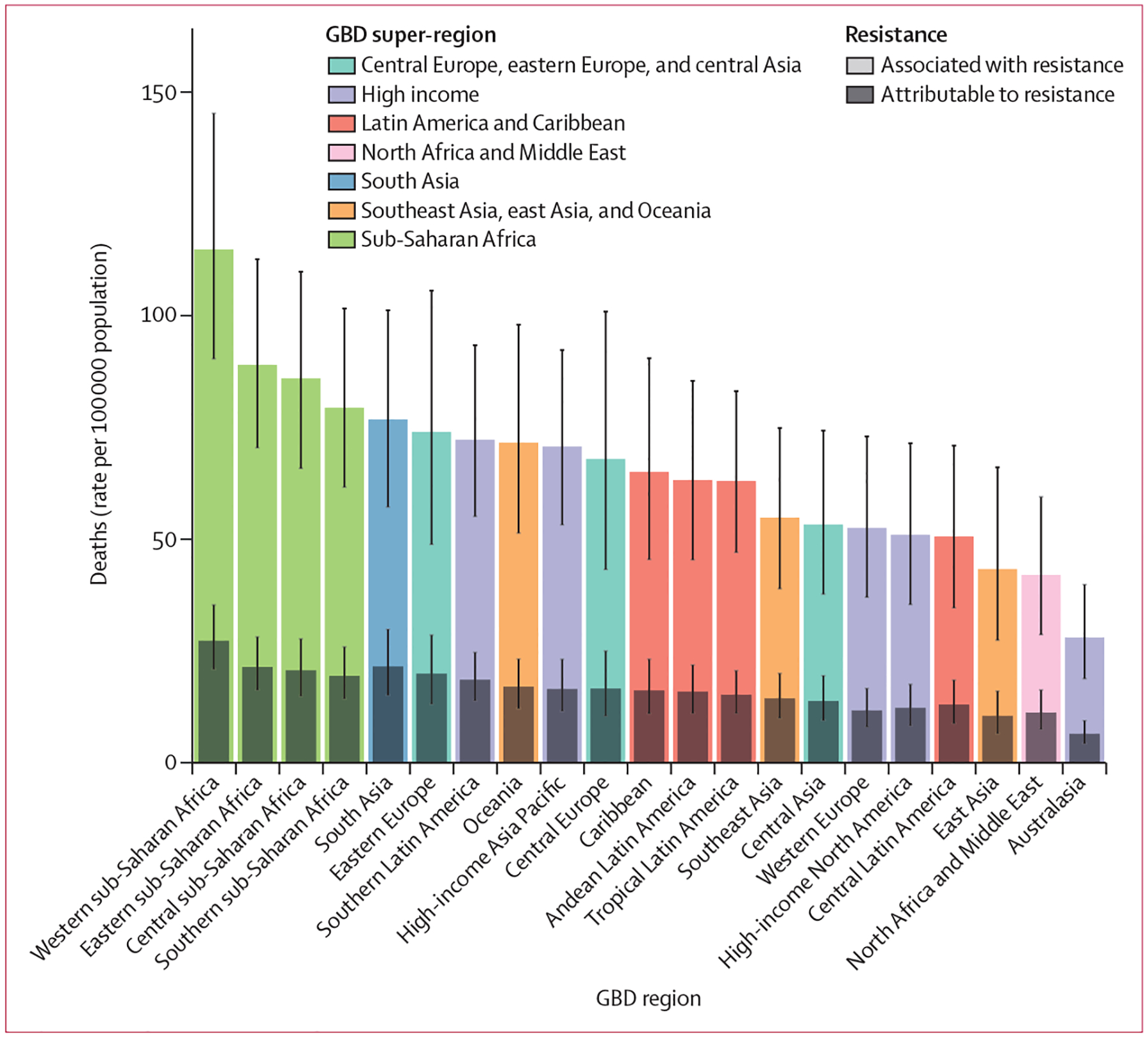
- The all-age death rate attributable to resistance was highest in western sub-Saharan Africa at 27·3 deaths per 100 000 (20·9–35·3) and lowest in Australasia at 6·5 deaths per 100 000 (4·3–9·4).
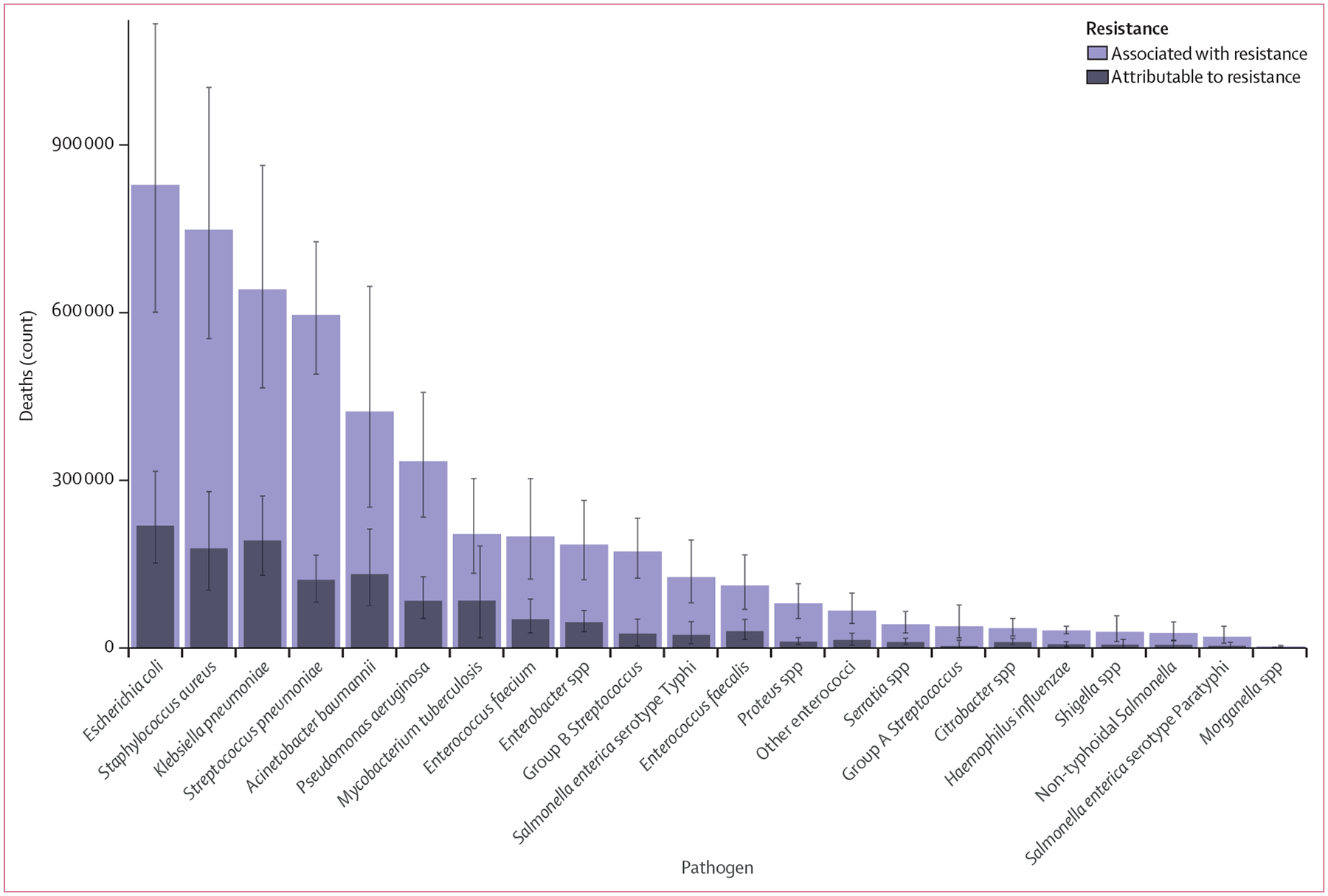
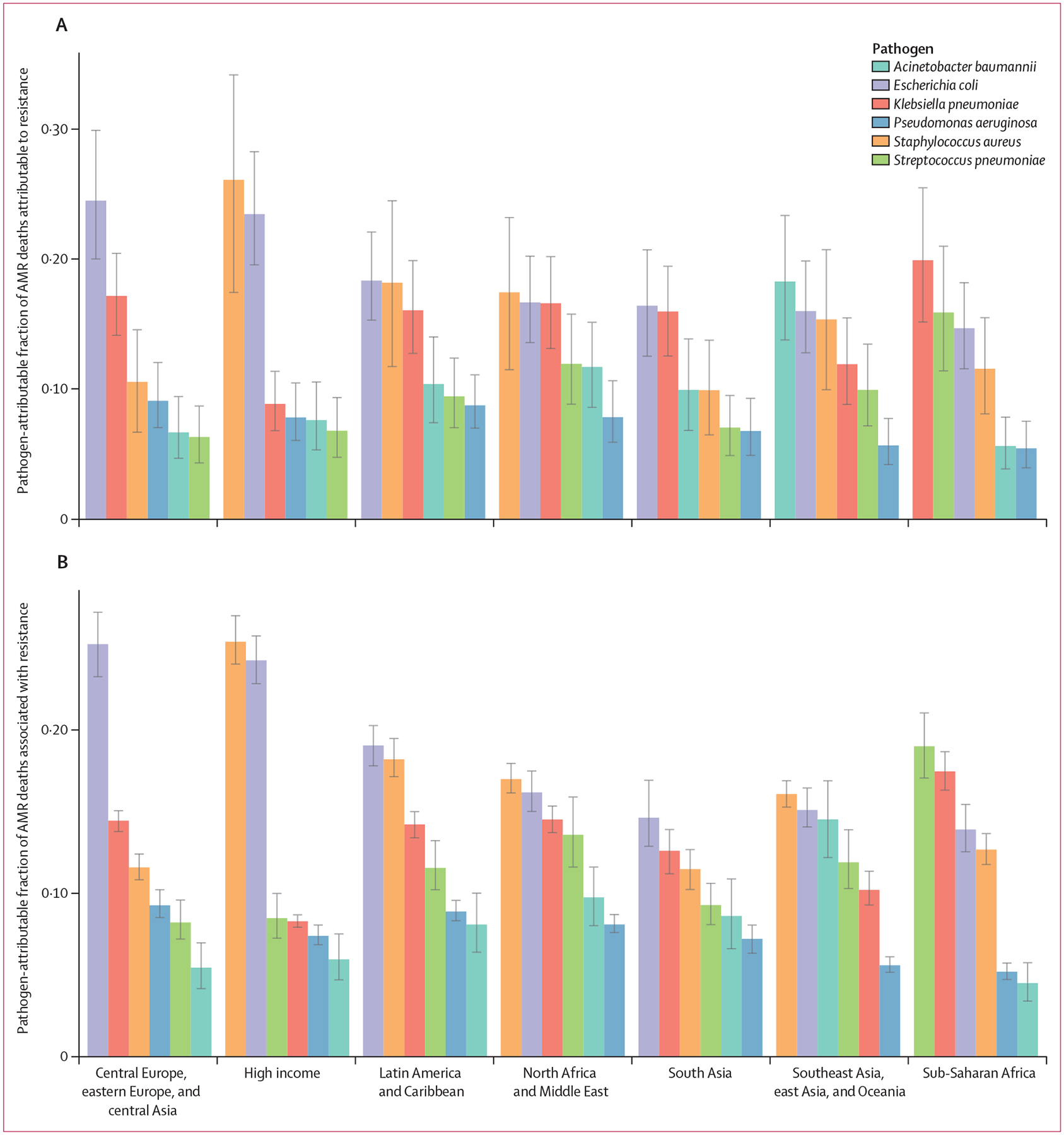
- Six leading pathogens—Escherichia coli, Staphylococcus aureus, Klebsiella pneumoniae, Streptococcus pneumoniae, Acinetobacter baumannii, and Pseudomonas aeruginosa—were responsible for 929 000 (660 000–1 270 000) deaths attributable to AMR and 3·57 million (2·62–4·78) deaths associated with AMR.
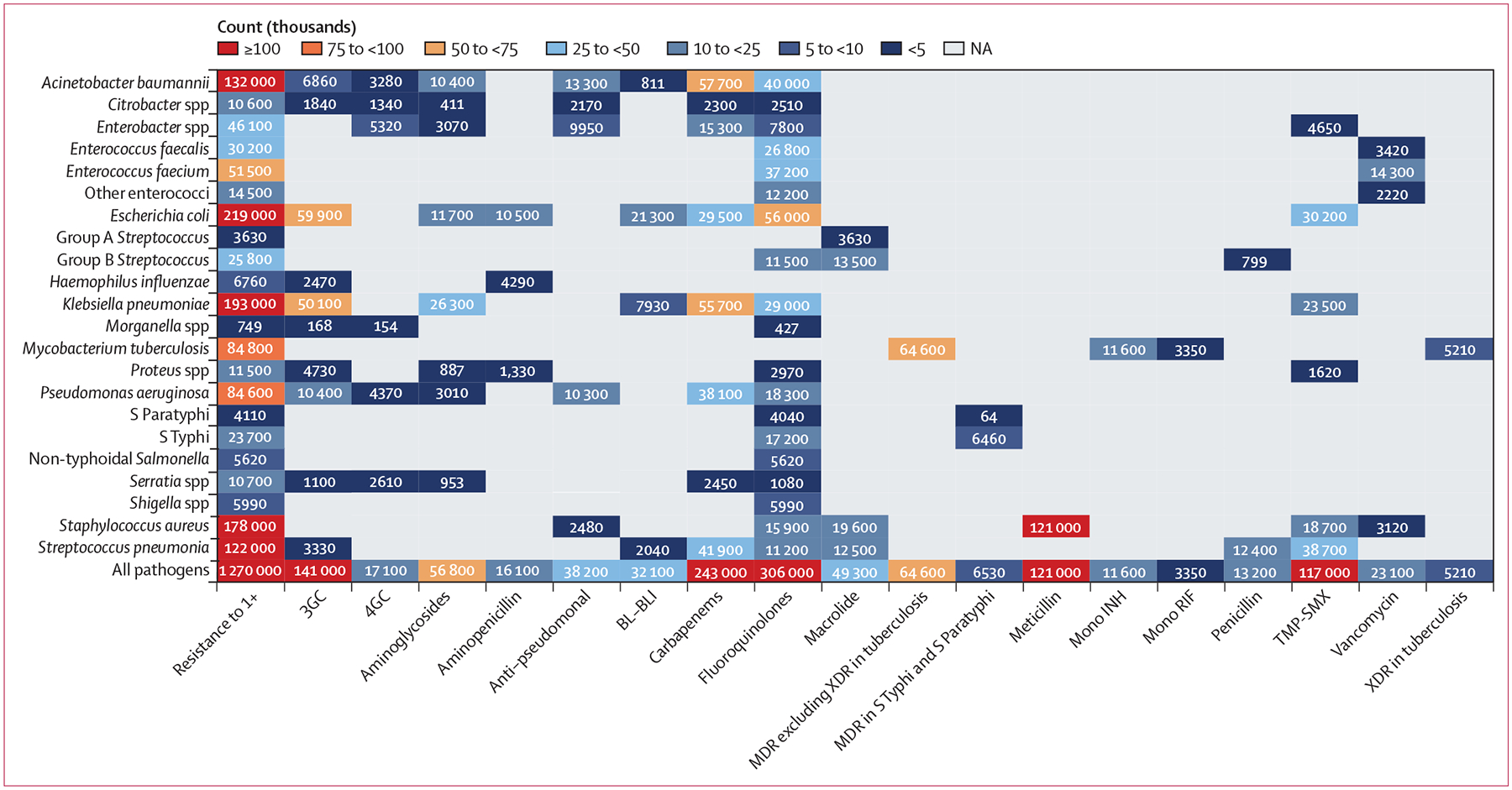
- Meticillin-resistant S aureus was the only pathogen–drug combination with more than 100 000 attributable deaths; six more combinations each caused 50 000–100 000 attributable deaths, including MDR excluding XDR tuberculosis, third-generation cephalosporin-resistant E coli, carbapenem-resistant A baumannii, fluoroquinolone-resistant E coli, carbapenem-resistant K pneumoniae, and third-generation cephalosporin-resistant K pneumoniae.
Methods
- The study estimated deaths and DALYs attributable to and associated with bacterial AMR for 23 pathogens and 88 pathogen–drug combinations in 204 countries and territories in 2019.
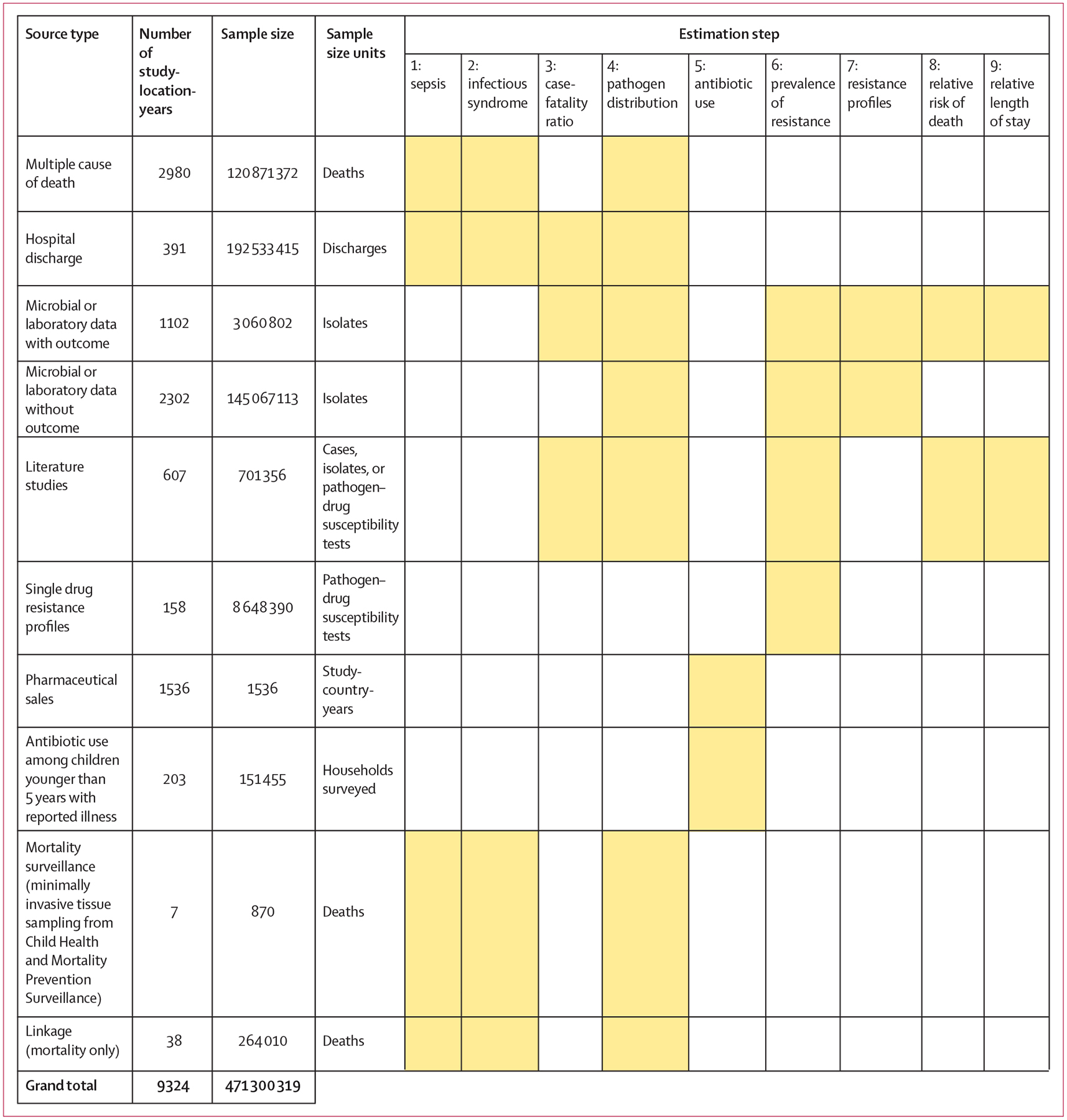
- Input data came from systematic literature reviews, hospital systems, surveillance systems, and other sources, covering 471 million individual records or isolates and 7585 study-location-years; predictive statistical modelling was used to produce estimates for all locations, including those with no data.
- The approach used five broad modelling components and two counterfactuals: deaths attributable to AMR (drug-resistant infections replaced by drug-susceptible infections) and deaths associated with AMR (drug-resistant infections replaced by no infection); 95% uncertainty intervals were generated from the 25th and 975th of 1000 posterior draws, with out-of-sample cross-validation.
Limitations
- The paper states that the most important limitation was sparse data from many LMICs on pathogen distribution by infectious syndrome, prevalence of resistance for key pathogen–drug combinations, and deaths involving infection, plus severe scarcity of data linking laboratory results to outcomes; 19 of 204 countries and territories had no data for any modelling component.
- The paper states that it assumed the relative risk for each pathogen–drug combination and the correlation structure of resistance between drugs were the same in every location, age, and infectious syndrome, which might underestimate AMR burden in LMICs; it also assumed MDR relative risk equal to the highest individual drug relative risk, likely underestimating MDR relative risk.
- The paper notes potential bias from combining and standardising heterogeneous data, possible misclassification of community-acquired versus hospital-acquired infections, lack of a universal laboratory standard for resistance versus susceptibility, and selection bias in passive microbial surveillance data; the text also makes evident that these data gaps and assumptions limit comparability and precision.
Model-written summary. Check it against the paper before relying on it.
Integrity signals
Registry
Cites
Statistics
Figures
Verification
Claims the paper makes
0 Valid · 2 Not valid · 24 Not checked · 66 Own results and interpretations
The cited sources that could be checked couldn’t confirm or dispute this claim.
In the paper
“Compared with all underlying causes of death in GBD 2019, AMR would have been the third leading GBD Level 3 cause of death in 2019, on the basis of the counterfactual of no infection; only ischaemic heart disease and stroke accounted for more deaths that year.”
§ Global burden of bacterial antimicrobial resistance in 2019: a systematic analysis > Discussion
What the sources say
- Could not verifycites [14] Vos T, Lim SS, Abbafati C, Global burden of 369 diseases and injuries in 204 countries and territories, 1990–2019: a systematic analysis for the Global Burden of Disease Study 2019. Lancet 2020; 396: 1204– 22. 33069326 PMC7567026 sourceExperimental — accuracy not yet measured
Our copy of the GBD 2019 diseases-and-injuries Article reports Level 3 cause rankings for 2019 (Abstract > Findings; Results > Global trends, e.g. 'Ischaemic heart disease and stroke were ranked first and second' for older age groups and figure 2's leading 25 Level 3 causes of DALYs), but no passage addresses antimicrobial resistance or a counterfactual of no infection, and no death-count ranking placing AMR third appears. Searches for 'antimicrobial resistance AMR counterfactual of no infection attributable deaths', 'counterfactual of no infection', and 'leading Level 3 causes of death 2019 ischaemic heart disease stroke ranking' returned only DALY-ranking, methods (Data processing, cause levels) and reference-list passages. The claim therefore cannot be checked against this source; our copy neither states nor contradicts it, and it names no alternative work for the AMR counterfactual result. (LLM, conf=0.70)
hedged- Asserted: passes — The authors put it forward as true.
- Checkable: passes — It can be checked against evidence.
- Load-bearing: passes — The paper’s conclusions depend on it.
- Based: passes — The paper gives a reason why it holds.
- Rests on 4 assumptions not shown here.
- Could not verify
The cited sources that could be checked couldn’t confirm or dispute this claim.
In the paper
“To account for bias in resistance data provided by tertiary care facilities, we adjusted tertiary rates of resistance by crosswalking them to data from non-tertiary and mixed facilities using MR-BRT as described in the appendix (pp 45–48).31”
§ Global burden of bacterial antimicrobial resistance in 2019: a systematic analysis > Methods > Estimation steps five to seven: prevalence of resistance by pathogen
What the sources say
- Could not verifycites [31] Murray CJL, Aravkin AY, Zheng P, Global burden of 87 risk factors in 204 countries and territories, 1990–2019: a systematic analysis for the Global Burden of Disease Study 2019. Lancet 2020; 396: 1223– 49. 33069327 PMC7566194 sourceExperimental — accuracy not yet measured
Our copy of the GBD 2019 87-risk-factors paper contains no passage on antimicrobial resistance data, tertiary vs non-tertiary/mixed facility sources, crosswalking, or MR-BRT; searches for 'tertiary crosswalk antimicrobial drug resistance', 'MR-BRT meta-regression Bayesian robust triangulation', and 'bias adjustment source type hospital surveillance' returned only generic exposure-modelling text (Methods, 'Estimation of the distribution of exposure for each risk by age-sex-location-year') and the Limitations discussion of non-reference-method bias corrections for exposure measurement. The closest content — 'Corrections for non-reference method exposure measurements have been revised using network or related meta-regression' (Abstract) and 'we implemented more explicit corrections for bias associated with non-reference methods of exposure measurement' (Discussion > Limitations) — concerns risk-exposure measurement modes, not resistance rates from tertiary care facilities, so it neither supports nor contradicts the specific attribution. (LLM, conf=0.72)
plainstates a cause- Asserted: passes — The authors put it forward as true.
- Checkable: passes — It can be checked against evidence.
- Load-bearing: passes — The paper’s conclusions depend on it.
- Based: passes — The paper gives a reason why it holds.
- Could not verify
A result the paper reports from its own data — it cites no other source for it, so there is none to check. The quote shows it is in the paper.
In the paper
“our analysis showed that AMR all-age death rates were highest in some LMICs”
§ Global burden of bacterial antimicrobial resistance in 2019: a systematic analysis > Discussion
plainstates an association- Asserted: passes — The authors put it forward as true.
- Checkable: passes — It can be checked against evidence.
- Load-bearing: passes — The paper’s conclusions depend on it.
- Based: passes — The paper gives a reason why it holds.
- Rests on 4 assumptions not shown here.
A result the paper reports from its own data — it cites no other source for it, so there is none to check. The quote shows it is in the paper.
In the paper
“In 2019, meticillin-resistant S aureus was the one pathogen–drug combination in our analysis with more than 100 000 deaths and 3·5 million DALYs attributable to resistance (figure 6; appendix pp 121–22, 129).”
§ Global burden of bacterial antimicrobial resistance in 2019: a systematic analysis > Results
plainstates a cause- Asserted: passes — The authors put it forward as true.
- Checkable: passes — It can be checked against evidence.
- Load-bearing: unclear — It is unclear whether the paper’s conclusions depend on it.
- Based: passes — The paper gives a reason why it holds.
A result the paper reports from its own data — it cites no other source for it, so there is none to check. The quote shows it is in the paper.
In the paper
“Six more pathogens were each responsible for between 100 000 and 250 000 deaths associated with AMR: M tuberculosis, Enterococcus faecium, Enterobacter spp, Streptococcus agalactiae (group B Streptococcus), S Typhi, and Enterococcus faecalis.”
§ Global burden of bacterial antimicrobial resistance in 2019: a systematic analysis > Results
plainstates an association- Asserted: passes — The authors put it forward as true.
- Checkable: passes — It can be checked against evidence.
- Load-bearing: unclear — It is unclear whether the paper’s conclusions depend on it.
- Based: passes — The paper gives a reason why it holds.
29 more claims
Create a free account to see all 92 claims and to verify the 31 references still open.
- Probably not a substantial claim. 26
- It may state two separate claims as one. 41
Claims other papers make about this one
Each is checked against this paper’s own text: does it say what the citing paper says it does?
The cited source doesn’t support the claim as written.
In the citing paper
“making antibiotic resistance the leading cause of death around the world (Murray et al., 2022).”
From Review of emerging contaminants in green stormwater infrastructure: antibiotic resistance genes, microplastics, tire wear particles, PFAS, and temperature (2024) · cites this paper as Murray et al., 2022
Checked by a reasoning model — may be wrong.
Experimental — accuracy not yet measuredThe source backs part of the claim, not all of it — or backs it for a different population, condition or comparison.
In the citing paper
“unnecessary broad-spectrum exposure contributes to selection pressure for antimicrobial resistance, one of the leading global threats to health (2).”
From Day-4 antipseudomonal and anti-MRSA de-escalation was not associated with higher mortality in critically ill patients with sepsis (2026) · cites this paper as [2]
Experimental — accuracy not yet measuredThe source backs part of the claim, not all of it — or backs it for a different population, condition or comparison.
In the citing paper
“Resistance develops when microorganisms become less susceptible or unresponsive to agents previously effective for treatment, leading to therapeutic failure, prolonged disease, and increased morbidity and mortality 12-14 .”
From Outpatient Antibiotic Prescribing and Stewardship in South India: AnalysisUsing WHO/INRUD Indicators and AWaRe Classification (2026) · cites this paper as [14]
Experimental — accuracy not yet measuredThe source backs part of the claim, not all of it — or backs it for a different population, condition or comparison.
In the citing paper
“In 2019, sub-Saharan Africa (SSA) had the highest mortality rate (23.5 deaths per 100,000) attributable to AMR compared to other regions.”
From Antimicrobial Resistance Rates and Surveillance in Sub-Saharan Africa: Where Are We Now? (2022) · cites this paper as [8]
Experimental — accuracy not yet measuredThe source backs part of the claim, not all of it — or backs it for a different population, condition or comparison.
In the citing paper
“Globally, Western SSA had the highest death rate attributable to AMR, 27.3 deaths per 100,000, followed by Eastern, Central, and Southern SSA (Table 1).”
From Antimicrobial Resistance Rates and Surveillance in Sub-Saharan Africa: Where Are We Now? (2022) · cites this paper as [8]
Experimental — accuracy not yet measured
12 more claims about this paper
Create a free account to see every claim other papers make about this one.
Citations
Cites
The third international consensus definitions for sepsis and septic shock (Sepsis-3).
Singer, M., Deutschman, C. S., Seymour, C. W., Shankar-Hari, M., Annane, D., Bauer, M., Bellomo, R., Bernard, G. R., Chiche, J.-D., Coopersmith, C. M., et al. (2016) · JAMA · doi:10.1001/jama.2016.0287 · Cited by 28,250 · cited 3×
“…of death that are themselves infectious, all deaths were assigned to their single corresponding infectious syndrome (eg, the GBD cause “lower respiratory infections” was assigned to the infectious syndrome “lower respiratory infections and all related infections in the thorax”; appendix pp 21–23).”
Vos, T., Lim, S. S., Abbafati, C., Abbas, K. M., Abbasi, M., Abbasifard, M., Abbasi-Kangevari, M., Abbastabar, H., Abd-Allah, F., Abdelalim, A., et al. (2020) · The Lancet · doi:10.1016/s0140-6736(20)30925-9 · Cited by 19,358 · cited 8×
“14 Given the strong relationship between antibiotic consumption levels and the proliferation of resistance, we modelled antibiotic consumption at the national level to use as a covariate in the stacked ensemble model of prevalence of resistance.”
InfluentialSelf-citationMurray, C. J. L., Aravkin, A. Y., Zheng, P., Abbafati, C., Abbas, K. M., Abbasi-Kangevari, M., Abd-Allah, F., Abdelalim, A., Abdollahi, M., Abdollahpour, I., et al. (2020) · The Lancet · doi:10.1016/s0140-6736(20)30752-2 · Cited by 9,854 · cited 3×
“22 We describe data inputs for each of ten estimation steps in greater detail in the following subsections and in the appendix (pp 17–18, 31, 34–35, 44, 54).”
Self-citationAngus, D. C., Linde-Zwirble, W. T., Lidicker, J., Clermont, G., Carcillo, J., & Pinsky, M. R. (2001) · Critical Care Medicine · doi:10.1097/00003246-200107000-00002 · Cited by 8,503 · cited 1×
“In the appendix, we present the equivalent AMR findings for DALYs instead of deaths (pp 124–29), as well”
Rudd, K. E., Johnson, S. C., Agesa, K. M., Shackelford, K. A., Tsoi, D., Kievlan, D. R., Colombara, D. V., Ikuta, K. S., Kissoon, N., Finfer, S., et al. (2020) · The Lancet · doi:10.1016/s0140-6736(19)32989-7 · Cited by 7,971 · cited 3×
“For datasets where isolates could not be uniquely identified across pathogen–drug combinations, such as some antimicrobial resistance surveillance systems, some isolates might be double counted.”
Self-citationThe epidemiology of sepsis in the United States from 1979 through 2000
Martin, G. S., Mannino, D. M., Eaton, S., & Moss, M. (2003) · New England Journal of Medicine · doi:10.1056/nejmoa022139 · Cited by 5,841
Antibiotic resistance threats in the United States, 2019
(U.S.), C. F. D. C. A. P. (2019) · doi:10.15620/cdc:82532 · Cited by 5,782 · cited 1×
“In the appendix, we present the equivalent AMR findings for DALYs instead of deaths (pp 124–29), as well”
Antibiotic resistance-the need for global solutions
Laxminarayan, R., Duse, A., Wattal, C., Zaidi, A. K. M., Wertheim, H. F. L., Sumpradit, N., Vlieghe, E., Hara, G. L., Gould, I. M., Goossens, H., et al. (2013) · The Lancet Infectious Diseases · doi:10.1016/s1473-3099(13)70318-9 · Cited by 4,439 · cited 1×
“In the appendix, we present the equivalent AMR findings for DALYs instead of deaths (pp 124–29), as well”
Antimicrobial resistance: a global multifaceted phenomenon
Prestinaci, F., Pezzotti, P., & Pantosti, A. (2015) · Pathogens and Global Health · doi:10.1179/2047773215y.0000000030 · Cited by 3,296
Cassini, A., Högberg, L. D., Plachouras, D., Quattrocchi, A., Hoxha, A., Simonsen, G. S., Colomb-Cotinat, M., Kretzschmar, M. E., Devleesschauwer, B., Cecchini, M., et al. (2019) · The Lancet Infectious Diseases · doi:10.1016/s1473-3099(18)30605-4 · Cited by 2,945 · cited 2×
“In the appendix, we present the equivalent AMR findings for DALYs instead of deaths (pp 124–29), as well”
Self-citation
Research works printed but not linked: 2
- O’Neill J. Antimicrobial resistance: tackling a crisis for the health and wealth of nations. London: Review on Antimicrobial Resistance, 2014.
- National Office for Animal Health. NOAH response to final O’Neill AMR review report July 2016. Middlesex: National Office for Animal Health, 2016.
Cited by
Items 18,701–18,800 of 20,460
Warang, A. D., Samant, S., & Sinha, S. (2026) · International Journal of Drug Delivery Technology · doi:10.25258/ijddt.16.42s.50
Chaloob, R. (2026) · Academia Open · doi:10.21070/acopen.11.2026.13937
ПЕРЕБОЙЧУК, І. А., Трущенкова, Л. В., & СЛОБОДЯН, Н. О. (2026) · Вісник соціальної гігієни та організації охорони здоров я України · doi:10.11603/1681-2786.2026.2.16399
Multiplexing antibiotic screening assay in droplet microfluidics
Hengoju, S., Martin, K., Scherlach, K., Roth, M., & Rosenbaum, M. A. (2026) · Scientific Reports · doi:10.1038/s41598-026-55537-2
Alta discrepancia diagnóstica en enfermedades infecciosas detectadas por autopsia
Cisneros-Aréchiga, A. G., & al., E. (2026) · Revista Médica del Instituto Mexicano del Seguro Social · doi:10.5281/zenodo.19099661
Padmaja, P., & Rani, M. E. (2026) · International Journal of Drug Delivery Technology · doi:10.25258/ijddt.16.43s.36
Ranga Reddy Burri, M. (2026) · Canadian Journal of Infection Control · doi:10.36584/cjic.2026.001.02.17.21
Boateng, K. A. (2026) · International Journal of Chemical and Biological Sciences · doi:10.33545/26646765.2026.v8.i1a.210
Research progress on postoperative infection after thyroid cancer surgery
Zhang, Y. L., & Wang, J. (2026) · Journal of clinical technology and theory. · doi:10.54254/3049-5458/2026.34224
Enghardt, M.-L., Winterfeld, A., Pahlow, S., Silge, A., & Popp, J. (2026) · Analytical and Bioanalytical Chemistry · doi:10.1007/s00216-026-06558-3
Altavilla, S., Loconsole, D., Pietro, N. D., Memmola, R., Sivo, D., & Gennaro, F. D. (2026) · Microorganisms · doi:10.3390/microorganisms14061262
ARMOR (Antibiotic Resistance Modelling through Omics and Resistance-gene analysis)Preprint
Ahmad, A., Anas, M., & Saleem, M. (2026) · Research Square · doi:10.21203/rs.3.rs-9898333/v2
Arkut, A., Ulucayli, S., Sütçü, H., & Avcı, M. Z. (2026) · Antibiotics · doi:10.3390/antibiotics15060569
-, A. R., Biswal, S., Gurjar, V. K., & Parmar, D. (2026) · Natural Product Research · doi:10.1080/14786419.2026.2683117
Pola Penggunaan Antibiotik dan Resistensi Bakteri di Rumah Sakit: Literature Review
Riana, I., Safitri, K. A., & Apriansyah, M. (2026) · Obat · doi:10.61132/obat.v4i3.2255
Knowledge, Attitude and Practice of Nursing Students on Antibiotic Use and Resistance in Bangladesh
Hasan, M. M., Khan, M. A. S., Hossian, M., Barsha, S. Y., Haque, M. M. A., Joya, J. M., Rahman, L., Nurunnabi, M., Mishu, T. Z., Afroz, S., et al. (2026) · SAGE Open Nursing · doi:10.1177/23779608261458015
Regulating the Irregular: Phage Therapy and the Case for a Regulatory Sandbox Approach in Australia
Rizzi, M., Stick, S. M., Hancock, D. G., Kicic, A., & Karpievitch, Y. V. (2026) · Pharmaceutical Medicine · doi:10.1007/s40290-026-00614-0
Joshua, D., Seni, J., Rahimi, H., Ally, M. S., Omar, M., Ali, F., Joshi, J., Ali, S. M., Poulsen, A., Lund, S., et al. (2026) · BMC Pediatrics · doi:10.1186/s12887-026-07096-8
Gomes, T. L. M., de Paulo, E. L., Batista, V. E. L., da Silva, T. M., Martins, A. C. M., & Fonseca, J. D. F. (2026) · Revista fisio&terapia. · doi:10.69849/1f2ytt74
Lan, Q. I. N., Li, X., Sun, J., Li, Y., Li, A., Xing, X., Wen, C., Chen, Y., He, Y., Wang, J., et al. (2026) · International Journal of Pharmaceutics · doi:10.1016/j.ijpharm.2026.127047
Maharani, P., & Baskaran, C. (2026) · INTERNATIONAL JOURNAL OF LIBRARY AND INFORMATION SCIENCE · doi:10.34218/ijlis_15_02_003
Molecular Basis of Angicin ActivityPreprint
Vogel, V., Rodríguez, A., Kruszewska-Naczk, B., Mauerer, S., Olari, L., Köhler, J., Yadav, P., Apolloni, J., Read, C., Walther, P., et al. (2026) · bioRxiv (Cold Spring Harbor Laboratory) · doi:10.64898/2026.06.03.729741
Broomand, A., Pereboom, M., Mullahzada, A., Amirtharajah, M., Wagan, J., Hanna, D. A., Ross, L., Khalife, M., Chavez, M., Martino, C., et al. (2026) · BMJ Global Health · doi:10.1136/bmjgh-2025-023240
Cai, J., Wang, H., Li, M., Peng, D., Cheng, H., & Yao, B. (2026) · Protein Expression and Purification · doi:10.1016/j.pep.2026.106957
Xie, Y., Jin, X., Wang, H., Yan, S., Liang, J., & Peng, Y. (2026) · PubMed Central · doi:10.11817/j.issn.1672-7347.2026.240264
Zafar, M., Unnisa, F., Kingrani, B., & Suvo, M. S. H. (2026) · Microbial Bioactives · doi:10.25163/microbbioacts.9110743
Melindah, T., Roza, R. M., Delva, E., Ni Ny. Wedarthani Achintya, A., Azizah, N., & Paramita, D. A. (2026) · Jurnal Ventilator · doi:10.59680/ventilator.v4i1.2475
Mezher, M. J. (2026) · Journal of Medical Genetics and Clinical Biology · doi:10.61796/jmgcb.v3i7.1786
Cruz, J. D. L. P., Montiel, M., Toaquiza-Vilca, B., Debut, A., Fonseca, Y., Cornejo, X., & Vielma, J. E. (2026) · Nano-Structures & Nano-Objects · doi:10.1016/j.nanoso.2026.101713
Satrio, A. T. (2025) · Walisongo Repository (Walisongo State Islamic University)
BacteReason: A Reasoning Model for Antimicrobial Resistance PredictionPreprint
Oikawa, Y., Kawashima, S., Kinjo, A. R., Demizu, Y., Tamura, R., & Tsuda, K. (2026) · bioRxiv (Cold Spring Harbor Laboratory) · doi:10.64898/2026.06.04.730229
Шипицына, И. В., Стогов, М. В., Shastov, A. L., Киреева, Е. А., & Осипова, Е. В. (2026) · Traumatology and Orthopedics of Russia · doi:10.17816/2311-2905-17837
Zachariah, R., Wilson, N. C., Altaf, A., Khogali, M., Halleux, C., & Grivna, M. (2026) · Eastern Mediterranean Health Journal · doi:10.26719/2026.32.5.233
Ortega-López, Y., Molina‐Cabrillana, J., Sempere-Alcocer, M. A., & Lopez-Gigosos, R. M. (2026) · Antimicrobial Resistance and Infection Control · doi:10.1186/s13756-026-01774-z
Rana, K. S. P., Goyal, P., & Kabra, R. (2026) · International Journal of Drug Delivery Technology · doi:10.25258/ijddt.16.48s.95
O conceito de saúde única e o farmacêutico : a abordagem no ensino multiprofissional
Alponti, A. L. B. (2024) · doi:10.11606/003303043
Aluzaite, K., Chandler, C., Allel, K., Cameron, E., Cocker, D., Desbois, A., Dewé, T., Hegewisch-Taylor, J., Hoyle, D., Laird, S., et al. (2026) · LSHTM Research Online (London School of Hygiene and Tropical Medicine) · doi:10.17037/pubs.04682153
Self-citationde Lima, L. D. F. F., Santos, M. C. A., Alvizi, E. B., Maruo, M. V., Gomes, L. D., de Deus, A. P. S. M. F., FIGUEIREDO, P. H. D. S., Martins, I. L., Buosi, J., de Freitas, P. S. A., et al. (2026) · Seven Editora eBooks · doi:10.56238/sevened2026.015-062
Gavankar, R., & Verma, D. R. (2026) · International Journal of Drug Delivery Technology · doi:10.25258/ijddt.16.50s.130
Okunolа, A. M., Dennis, E., & Hille, M. M. (2026) · One Health · doi:10.1016/j.onehlt.2026.101473
Boitumelo, D. M., & Mathew, E. M. (2026) · Research Journal of Pharmacy and Technology · doi:10.52711/0974-360x.2026.00349
Costing of AMR can Incentivize Responses to One Health
Kumar, P. (2026) · Annals of Global Health · doi:10.5334/aogh.5355
Patel, A. S., & Shinde, S. (2026) · JOURNAL OF ADVANCE AND FUTURE RESEARCH · doi:10.56975/jaafr.v4i6.511247
Hottell, N. (2026) · Carolina Digital Repository (University of North Carolina at Chapel Hill) · doi:10.17615/g1x7-re08
Dole, P. P., & Pawar, S. K. (2026) · International Journal of Drug Delivery Technology · doi:10.25258/ijddt.16.51s.137
Social Influence on Self-Medication Practices
Jumoke, O. I., & Bello, C. B. (2026) · ABUAD Journal of Biomedical & Clinical Sciences · doi:10.53982/ajbcs.2026.0101.05-j
Antimicrobial stewardship strategies and programs in the outpatient settings: a scoping review
Landsteiner, A. M. K., Narayan, M., Byrd, J., Yang, S., Ullman, K. E., Sowerby, C., Zerzan, N. L., Kalinowski, C., Drekonja, D. M., Wilt, T. J., et al. (2026) · Antimicrobial Stewardship & Healthcare Epidemiology · doi:10.1017/ash.2026.10741
Infeksjoner og krigsmigrasjon: erfaringer fra Ukraina
Steinert, A. S., Grimnes, G., Berg, R. C., & Skogen, V. (2026) · Michael · doi:10.5617/michael.13331
Ou, M., Luo, Y., Sun, X., Luo, S., & Feng, M. (2026) · Frontiers in Medicine · doi:10.3389/fmed.2026.1734675
Marangon, A. C., dos Santos, I. D., Celestino, J. T., das Neves, F. W. O., Delmondes, M. B. S., & da Costa, R. S. L. (2026) · Scientia Generalis · doi:10.22289/sg.v7n1a65
Early cell-wall stress signatures enable 20-min ATR-FTIR discrimination of MRSA and MSSA
Hudson, W., Nelson, M., Taylor, C. C., Marchesani, A., Sil, D., Dutta, C., Gilbert, E. S., Hastings, G., & Jiang, Y. (2026) · Scientific Reports · doi:10.1038/s41598-026-57254-2
Tang, M., Raboisson, D., & Lhermie, G. (2026) · Social Science & Medicine · doi:10.1016/j.socscimed.2026.119501
Hua, M., Ding, S., Yao, X., Zhao, Y., & Wang, L. (2026) · Bioresource Technology · doi:10.1016/j.biortech.2026.135155
Editorial for the Special Issue “Microbial Biofilms: Latest Advances and Prospects”
de Vasconcelos, M. A., & Teixeira, E. H. (2026) · Processes · doi:10.3390/pr14121913
Bacteriophages and Antimicrobial Resistance in Agricultural Products
Ramos‐Barbero, M. D., & Muniesa, M. (2026) · The handbook of environmental chemistry · doi:10.1007/698_2026_1262
SEPSE POR MICRORGANISMOS MULTIRRESISTENTES: DESAFIOS CLÍNICOS E ABORDAGENS TERAPÊUTICAS
BORTOLI, G. P. (2026) · Editora Pasteur eBooks · doi:10.59290/8092120201
Rawat, S., -, K. J., & Khatana, D. K. (2026) · International Journal For Multidisciplinary Research · doi:10.36948/ijfmr.2026.v08i03.81224
Afriana, S. R., Nugroho, W. S., & Suwito, W. (2026) · Veterinary World · doi:10.14202/vetworld.2026.2450-2462
Shaale, M. M., Mushanyu, J., Nyabadza, F., & Nuugulu, S. M. (2026) · Applied Mathematical Modelling · doi:10.1016/j.apm.2026.117134
Can combined biomarker testing shape the future of primary care antibiotic prescribing?
Llor, C., & Kjær, N. K. (2026) · The Lancet Regional Health - Western Pacific · doi:10.1016/j.lanwpc.2026.101904
Alharbi, M. O., Alhowaity, M. S., Alfurshuti, R. N., Al-Mulhim, A., Dossari, M. A., Mohammad, W. S., & Al-Hadbi, M. S. (2025) · The Review of Diabetic Studies · doi:10.70082/nkr21v95
ADMINISTRASI DAN KEBIJAKAN KESEHATAN
Zulkifli, Z. (., Santri, P. Y. (. V., Kasjono, H. S. (., Maramis, J. (. L., Tahulending, A. (. A., Ispandiyah, W. (., Imbar, H. (. S. )., alfiah, N. (., Kirana, T. (. A., Bidjuni, M. (., et al. (2026) · Neliti
Alasiri, A. (2026) · Biochemical and Biophysical Research Communications · doi:10.1016/j.bbrc.2026.154156
Omwega, M. T., Gachoya, M., Nyasinga, J., Georges, M. O., Kigen, C. K., Marucha, K. K., Nyamweya, S., Odoyo, E., & Musila, L. A. (2026) · Microbiology Spectrum · doi:10.1128/spectrum.04096-25
Self-citationFerreira, J. C., Oliveira, M. D. S., Ferreira, C. M. P. P., de Almeida, M. B., Rodrigues, H. A., Boakari, Y. L., & Aldrovani, M. (2026) · Animal Reproduction · doi:10.1590/1984-3143-ar2026-0001
SUPERBAKTERIYALARGA QARSHI KURASH: FAGOTERAPIYA VA CRISPR-CAS9 TEXNOLOGIYASINING ISTIQBOLLARI
Anvarjonovna, P. S. (2026) · Science and Technology in the Modern World · doi:10.70413/zdift-v05-i18-s52363
Hammad, M., Arif, R., Fardoos, S., Shakoor, K., & Nasir, A. (2026) · PLoS ONE · doi:10.1371/journal.pone.0347223
Mutaab, W. Q., & Shaker, R. J. (2026) · Al-Bahir Journal for Engineering and Pure Sciences · doi:10.55810/2313-0083.1133
MexXY-OprM efflux pump mediates resistance to odilorhabdins in Pseudomonas aeruginosa
Racine, E., Pantel, L., Maurent, K., Fuchs, H. L. S., Sarciaux, M., Houard, J., Hinkelmann, B., Attwood, M., Muller, C., Guénard, S., et al. (2026) · Microbiology Spectrum · doi:10.1128/spectrum.00466-26
Allawande, S. J. (2026) · International Journal of Biological and Biomedical Research · doi:10.54660/ijbbr.2026.2.3.35-40
Controllable latent diffusion of SELFIES for the targeted design of E. coli antibiotics
Zaiter, L. (2026) · International Journal of Computing and Artificial Intelligence · doi:10.33545/27076571.2026.v7.i6a.340
Krishna, M. B. M., Kommalapati, V., Poosarla, C., Kattappagari, K. K., Kantheti, L. P. C., & Bhavani, M. (2026) · Journal of Indian Dental Association · doi:10.33882/jida.15.ida-10
Raina, D. J., Priya, S., & Sharma, J. G. (2026) · International Journal of Drug Delivery Technology · doi:10.25258/ijddt.16.55s.33
Papaj, K., JANDOO, J. K., Skalski, T., KUBASIK, I., Carrara, A. C., Smolarczyk, R., Golec, M., Mielczarek, P., Krakowska, A., & Góra, A. (2026) · Acta Poloniae Pharmaceutica - Drug Research · doi:10.32383/appdr/219760
Ibrahim, A. H. (2026) · Osol journal for medical sciences. · doi:10.69946/ojms/2026.04.01.04
Bejarano, J. I. C., Alanís, D. P., González, E. A. L., González, M. A., Padilla, L. O., Feregrino, R. R., Pacheco-Rosas, D. O., Rodríguez, M. C., González, S. P. C., Arteaga, M. B., et al. (2026) · Revista chilena de infectología · doi:10.4067/s0716-10182026000200119
Critères de choix d’antibiotiques - mise à jour 2026
Cohen, R., Grimprel, E., Rybak, A., Hau, I., Madhi, F., Ouldali, N., & Raymond, J. (2026) · Journal de Pédiatrie et de Puériculture · doi:10.1016/j.jpp.2026.04.001
Murillo-Torres, M., Díaz-Díaz, S., & Rodríguez-Martínez, J. M. (2026) · Cell chemical biology · doi:10.1016/j.chembiol.2026.05.010
ANTIMICROBIAL STEWARDSHIP IN NEONATAL AND PEDIATRIC CARE: BALANCING INFECTION CONTROL AND RESISTANCE
Moirangthem, B., Prasad, S. S., & Gupta, A. K. (2026) · International Journal of Drug Delivery Technology · doi:10.25258/ijddt.16.56s.52
Corpuz1, I. C., & Merced, J. J. D. (2026) · International Journal of Nursing Healthcare and Hospital Administration · doi:10.66206/eduheart.ijnhha.42
Ultrafast Laser Surface Processing for Medical Implants Functionalization
Toiwiya, H., Guignandon, A., Dumas, V., & Sedao, X. (2026) · IGI Global eBooks · doi:10.4018/979-8-3373-4104-0.ch009
Zhou, J., Lin, X., Zhang, Y., Qiu, L., Liu, S., Zz, W., Zhou, Y., Pan, N., Qiu, C., & Shi, J. (2026) · Frontiers in Microbiology · doi:10.3389/fmicb.2026.1694247
Nwubuma, F. A., & Jung, K. (2026) · International Journal of Research and Innovation in Social Science · doi:10.47772/ijriss.2026.100600060
Анатольевич, Д. Р., Івлева, О. В., & Улизько, С. І. (2026) · Аграрний вісник Причорномор я · doi:10.37000/abbsl.2026.119.04
Liu, L., Chang, Y., Gu, X., & Xu, W. (2026) · Journal of Global Antimicrobial Resistance · doi:10.1016/j.jgar.2026.06.004
Kaftandzieva, A. (2026) · Academic Medical Journal · doi:10.53582/vdcfhh53
Li, Y., Huang, H., Luo, B., Wang, R., & Zhu, Z. (2026) · Journal of Hazardous Materials · doi:10.1016/j.jhazmat.2026.142756
Abraham, S., Lee, Z. Z., Jordan, D., Stegger, M., Saidenberg, A. B. S., Lugsomya, K., Lee, T., Mukerji, S., Price, L., Nairn, K., et al. (2026) · Journal of Antimicrobial Chemotherapy · doi:10.1093/jac/dkag196
Luz, E., Righi, R. D. R., Silva, S. E. D., Abrahão, M. T. F., Madril, P. J., Freitas, M. D. L., de Mendonça, M. S., Raposo, L. M., Stelet, V. N., ALMEIDA, A. M., et al. (2026) · doi:10.5753/sbc.19670.4
Villa, B., Phayungpong, M., Gomez, D., Gonzalez, R., Toussaint, P., Urzua, C., & Cerna, M. G. Z. (2026) · Ciencia y Frontera · doi:10.61865/j.cyfsld.2025.r7dh-md97
Ferreira, P. (2025) · RIUnB Institutional Repository (University of Brasília)
Mohammed, P. S. (2026) · Open Access Research Journal of Multidisciplinary Studies · doi:10.53022/oarjms.2026.11.2.0031
Olowomofe, O. G., & Olowomofe, T. O. (2026) · Sahel Journal of Life Sciences FUDMA · doi:10.33003/sajols-2026-0402-22
Resveratrol‐Derived Dimers With Antimicrobial and Immune‐Enhancing Activities
Johnsen, P. R., Pinna, C., Andersen, L., Christensen, M. V., Pinto, A., Dallavalle, S., Ingmer, H., & Frøkiær, H. (2026) · BioFactors · doi:10.1002/biof.70128
Peter, B., Mzula, A., & Hoza, A. S. (2026) · Journal of Applied Veterinary Science And Technology · doi:10.20473/javest.v7.i1.2026.56-63
Mathew, E. E., & Etebu, E. (2026) · Journal of applied science and environmental management · doi:10.4314/jasem.v30i3.7
König, M., Sampaio, M. D. S. N., Fachiano, L. C., da Silva, L. A., & de Oliveira, D. F. (2026) · Brazilian Journal of Natural Sciences · doi:10.31415/bjns.v8i1.238
Boletín epidemiológico semanal 23 de 2026
Pública, D. D. V. Y. A. D. R. E. S. (2026) · Boletín epidemiológico semanal · doi:10.33610/23576189.2026.23
Kumara, M. A. K. M. M., Manage, P. M., Ganepola, G. A. P., Wijerathna, P. A. K. C., Liu, W., & Yin, S. (2026) · Water · doi:10.3390/w18121519
Metadata
- Authors
- Murray, C. J. L., Ikuta, K. S., Sharara, F., Swetschinski, L., Robles Aguilar, G., Gray, A., Han, C., Bisignano, C., Rao, P., Wool, E., Johnson, S. C., Browne, A. J., Chipeta, M. G., Fell, F., Hackett, S., Haines-Woodhouse, G., Kashef Hamadani, B. H., Kumaran, E. A. P., McManigal, B., Achalapong, S., Agarwal, R., Akech, S., Albertson, S., Amuasi, J., Andrews, J., Aravkin, A., Ashley, E., Babin, F.-X., Bailey, F., Baker, S., Basnyat, B., Bekker, A., Bender, R., Berkley, J. A., Bethou, A., Bielicki, J., Boonkasidecha, S., Bukosia, J., Carvalheiro, C., Castañeda-Orjuela, C., Chansamouth, V., Chaurasia, S., Chiurchiù, S., Chowdhury, F., Clotaire Donatien, R., Cook, A. J., Cooper, B., Cressey, T. R., Criollo-Mora, E., Cunningham, M., Darboe, S., Day, N. P. J., De Luca, M., Dokova, K., Dramowski, A., Dunachie, S. J., Duong Bich, T., Eckmanns, T., Eibach, D., Emami, A., Feasey, N., Fisher-Pearson, N., Forrest, K., Garcia, C., Garrett, D., Gastmeier, P., Giref, A. Z., Greer, R. C., Gupta, V., Haller, S., Haselbeck, A., Hay, S. I., Holm, M., Hopkins, S., Hsia, Y., Iregbu, K. C., Jacobs, J., Jarovsky, D., Javanmardi, F., Jenney, A. W. J., Khorana, M., Khusuwan, S., Kissoon, N., Kobeissi, E., Kostyanev, T., Krapp, F., Krumkamp, R., Kumar, A., Kyu, H. H., Lim, C., Lim, K., Limmathurotsakul, D., Loftus, M. J., Lunn, M., Ma, J., Manoharan, A., Marks, F., May, J., Mayxay, M., Mturi, N., Munera-Huertas, T., Musicha, P., Musila, L. A., Mussi-Pinhata, M. M., Naidu, R. N., Nakamura, T., Nanavati, R., Nangia, S., Newton, P., Ngoun, C., Novotney, A., Nwakanma, D., Obiero, C. W., Ochoa, T. J., Olivas-Martinez, A., Olliaro, P., Ooko, E., Ortiz-Brizuela, E., Ounchanum, P., Pak, G. D., Paredes, J. L., Peleg, A. Y., Perrone, C., Phe, T., Phommasone, K., Plakkal, N., Ponce-de-Leon, A., Raad, M., Ramdin, T., Rattanavong, S., Riddell, A., Roberts, T., Robotham, J. V., Roca, A., Rosenthal, V. D., Rudd, K. E., Russell, N., Sader, H. S., Saengchan, W., Schnall, J., Scott, J. A. G., Seekaew, S., Sharland, M., Shivamallappa, M., Sifuentes-Osornio, J., Simpson, A. J., Steenkeste, N., Stewardson, A. J., Stoeva, T., Tasak, N., Thaiprakong, A., Thwaites, G., Tigoi, C., Turner, C., Turner, P., van Doorn, H. R., Velaphi, S., Vongpradith, A., Vongsouvath, M., Vu, H., Walsh, T., Walson, J. L., Waner, S., Wangrangsimakul, T., Wannapinij, P., Wozniak, T., Young Sharma, T. E. M. W., Yu, K. C., Zheng, P., Sartorius, B., Lopez, A. D., Stergachis, A., Moore, C., Dolecek, C., & Naghavi, M.
- Affiliations
- Kenya Medical Research Institute (KE)
- Kwame Nkrumah University of Science and Technology (GH)
- Stanford University (US)
- University of Oxford (GB)
- University of Washington (US)
- ORCID
- Murray, Christopher J L
- Ikuta, Kevin Shunji
- Wool, Eve
- Johnson, Sarah C
- Chipeta, Michael Give
- Hackett, Sean
- Kumaran, Emmanuelle A P
- Agarwal, Ramesh
- Akech, Samuel
- Amuasi, John
- Andrews, Jason
- Ashley, Elizabeth
- Bailey, Freddie
- Baker, Stephen
- Basnyat, Buddha
- Bekker, Adrie
- Bender, Rose
- Berkley, James A
- Bielicki, Julia
- Boonkasidecha, Suppawat
- Carvalheiro, Cristina
- Castañeda-Orjuela, Carlos
- Chansamouth, Vilada
- Chaurasia, Suman
- Chiurchiù, Sara
- Chowdhury, Fazle
- Cook, Aislinn J
- Cooper, Ben
- Cressey, Tim R
- Cunningham, Matthew
- Darboe, Saffiatou
- Day, Nicholas P J
- Dokova, Klara
- Dramowski, Angela
- Dunachie, Susanna J
- Eckmanns, Tim
- Eibach, Daniel
- Emami, Amir
- Feasey, Nicholas
- Fisher-Pearson, Natasha
- Garrett, Denise
- Gastmeier, Petra
- Greer, Rachel Claire
- Gupta, Vikas
- Haller, Sebastian
- Haselbeck, Andrea
- Hay, Simon I
- Holm, Marianne
- Hopkins, Susan
- Hsia, Yingfen
- Iregbu, Kenneth C
- Jacobs, Jan
- Jarovsky, Daniel
- Javanmardi, Fatemeh
- Jenney, Adam W J
- Khorana, Meera
- Khusuwan, Suwimon
- Kissoon, Niranjan
- Kobeissi, Elsa
- Kostyanev, Tomislav
- Krapp, Fiorella
- Krumkamp, Ralf
- Kumar, Ajay
- Kyu, Hmwe Hmwe
- Lim, Cherry
- Limmathurotsakul, Direk
- Loftus, Michael James
- Ma, Jianing
- Manoharan, Anand
- Marks, Florian
- May, Jürgen
- Mayxay, Mayfong
- Mturi, Neema
- Musicha, Patrick
- Naidu, Ravi Narayan
- Nakamura, Tomoka
- Nangia, Sushma
- Newton, Paul
- Novotney, Amanda
- Nwakanma, Davis
- Obiero, Christina W
- Ochoa, Theresa J
- Olliaro, Piero
- Ounchanum, Pradthana
- Peleg, Anton Yariv
- Perrone, Carlo
- Phommasone, Koukeo
- Plakkal, Nishad
- Ramdin, Tanusha
- Rattanavong, Sayaphet
- Riddell, Amy
- Roberts, Tamalee
- Robotham, Julie Victoria
- Roca, Anna
- Rudd, Kristina E
- Russell, Neal
- Sader, Helio S
- Schnall, Jesse
- Scott, John Anthony Gerard
- Sharland, Mike
- Simpson, Andrew J
- Stewardson, Andrew James
- Thwaites, Guy
- Tigoi, Caroline
- Turner, Claudia
- Turner, Paul
- van Doorn, H Rogier
- Velaphi, Sithembiso
- Vongsouvath, Manivanh
- Walson, Judd L
- Wangrangsimakul, Tri
- Wozniak, Teresa
- Yu, Kalvin C
- Sartorius, Benn
- Stergachis, Andy
- Moore, Catrin
- Dolecek, Christiane
- Naghavi, Mohsen
- Venue
- The Lancet
- Publisher
- Elsevier BV
- Published
- 2022-02
- Volume
- 399
- Issue
- 10325
- Pages
- 629-655
- ISSN
- 0099-5355 (ISSN-L)
- 0140-6736
- PMC
- PMC8841637
- OpenAlex
- W4206677002
- Semantic Scholar
- 60e8ee78a019a8e30e9f4bad58716fbe5ec535e9
- Cited by
- 16,316
- References
- 48
- Citations by year
- 2026: 3459 · 2025: 4006 · 2024: 4174 · 2023: 3176 · 2022: 1481
- FWCI
- 181.82
- Type
- journal article
- Language
- en
- Update notices
- erratum (2022-10-01)
- Open access
- hybrid
- doi.org
- Licence
- cc-by
- www.elsevier.com/tdm/userlicense/1.0/ (tdm)
- www.elsevier.com/legal/tdmrep-license (tdm)
- creativecommons.org/licenses/by/4.0/ (vor)
- Locations
- The Lancet (publishedVersion, cc-by)
- PubMed Central (publishedVersion, cc-by)
- PubMed (publishedVersion)
- LSTM Online Archive (Liverpool School of Tropical Medicine) (acceptedVersion)
- St George's Online Research Archive (St George's University of London) (acceptedVersion)
- LSHTM Research Online (London School of Hygiene and Tropical Medicine) (acceptedVersion)
- Publication server of the Robert Koch Institute (Robert Kock Institute) (submittedVersion, cc-by)
- Lirias (KU Leuven) (submittedVersion, cc-by)
- Pure Amsterdam UMC (submittedVersion, cc-by)
- Minerva Access (University of Melbourne) (submittedVersion, cc-by)
- Edinburgh Research Explorer (University of Edinburgh) (submittedVersion, cc-by)
- Universidad Peruana Cayetano Heredia Institutional Repository (submittedVersion, cc-by-nc-nd)
- Funders
- Bill and Melinda Gates Foundation (OPP1176062)
- Wellcome Trust (A126042)
- Topics
- Health Sciences › Medicine › Infectious Diseases › Antibiotic Use and Resistance
- Health Sciences › Medicine › Microbiology (medical) › Antibiotic Resistance in Bacteria
- Health Sciences › Medicine › Infectious Diseases › Antimicrobial Resistance in Staphylococcus
- Keywords
- antimicrobial resistance, bacterial infection, global burden of disease, attributable mortality, disability-adjusted life years, antibiotic resistance, infectious disease mortality, counterfactual scenarios, length of hospital stay, health care costs, uncertainty intervals, cross-validation, sub-Saharan Africa, Australasia, Western Sub-Saharan Africa
- MeSH terms
- Global Burden of Disease, Anti-Bacterial Agents, Bacterial Infections, Humans, Global Health, Models, Statistical, Drug Resistance, Bacterial
About these checks
Registry, retraction, Cites and statistics results are computed, not judged, with one exception: a printed reference that no index lists is read once by a model before it counts as a citation error. Claims are extracted by a model and kept only when their quote appears verbatim in the text; each cited source is then checked, with a model’s help, for whether it says what the claim relies on. Those verdicts can be wrong — read the claim’s quote and the cited source before relying on one.
The claim verdicts this report counts are experimental: their accuracy is not yet measured.
A language model drew the claims from the paper on 2026-11-22, under version 3 of the claim definition (model deepseek-v4.1-flash, prompt extract-v3).
A second model labelled each claim on 2026-11-22 (model jev-1.13-20260917, definition revision gold-guideline-v0.2).
Cited sources are checked with a language model’s help (qwen3.8-omni-flash).
Statistics and arithmetic are recomputed, not judged.
Confidence bands are shown only for fields calibrated on our annotated test set. None is calibrated yet, so no band is shown.
What counts as a claim ›How we measure confidence ›How we check this ›
Are you an author, or do you see a problem with this page? Request a review
Data sources
Bibliographic data: Semantic Scholar, OpenAlex, Crossref.
Contains information from the Semantic Scholar Academic Graph Datasets, made available under the ODC Attribution License (ODC-BY 1.0).
Semantic Scholar’s data is described in: Kinney, R., et al. (2023). The Semantic Scholar Open Data Platform. arXiv:2301.10140.
