

Normal Triglyceride Levels and Coronary Artery Disease Events: The Baltimore Coronary Observational Long-Term Study
Open accessThe DOI matches its Crossref record; 51 of the 52 references it cites were found in a registry or an index.
Abstract
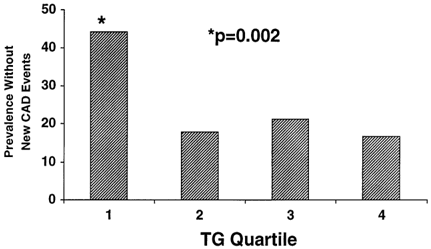
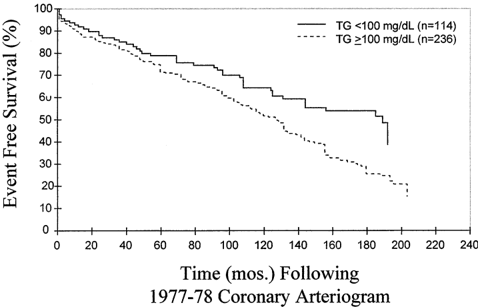
OBJECTIVES: This study sought to evaluate long-term predictors of coronary events in men and women with arteriographically defined coronary artery disease (CAD). BACKGROUND: There is conflicting evidence of the role of triglycerides (TGs) as a prognosticator of CAD, and no studies have examined the long-term outcome of "normal" levels in predicting new coronary events. METHODS: This was a retrospective cohort study that evaluated 740 consecutive patients presenting for diagnostic coronary arteriography between 1977 and 1978. Beginning in 1988, patients with arteriographic CAD (n=350) were recontacted and asked to complete detailed medical questionnaires. Case and control patients were stratified by development of new coronary events, including death from ischemic heart disease, nonfatal myocardial infarction and revascularization. RESULTS: There were 199 events during the 18-year follow-up period. The mean high density lipoprotein cholesterol (HDL-C) was significantly lower (35 vs. 39 mg/dl; p=0.002) and TGs higher (160 vs. 137 mg/dl; p=0.03) in case patients than in control patients; After adjusting for age, gender and beta-adrenergic blocking agent use, multiple logistic regression analysis revealed the following independent predictors of CAD events: diabetes mellitus (relative risk [RR] 2.1, 95% confidence interval [CI] 1.4% to 3.1%), HDL-C <35 mg/dl (RR 1.5, 95% CI 1.1% to 2.00) and TGs >100 mg/dl (RR 1.5, 95% CI 1.1% to 2.1%). A Kaplan-Meier analysis revealed significantly reduced survival from CAD events in patients with baseline TG levels > or = 100 mg/dl compared with TG levels <100 mg/dl (p=0.008). CONCLUSIONS: TG levels previously considered "normal" are predictive of new CAD events. The cutpoints established by the National Cholesterol Education Program for elevated TGs (>200 mg/dl) may need to be refined.
Overview
The claims and statistics of this paper haven’t been checked yet.
Free: it reads the open-access text and checks the first 5 claims that cite a source we can check. Create a free account to check every claim.
Integrity signals
Registry
Cites
Statistics
Figures
Verification
Claims the paper makes
The claims and statistics of this paper haven’t been checked yet.
Free: it reads the open-access text and checks the first 5 claims that cite a source we can check. Create a free account to check every claim.
Claims other papers make about this one
Each is checked against this paper’s own text: does it say what the citing paper says it does?
The source backs part of the claim, not all of it — or backs it for a different population, condition or comparison.
In the citing paper
“it is less widely appreciated that fasting levels from as low as ∼1.2 mmol/L (∼100 mg/dL) can be associated with a cluster of metabolic abnormalities that include accumulation of TRL and remnants,14 as well as increased cardiovascular disease events15,16 (Figure 1).”
From Triglyceride-rich lipoproteins and their remnants: metabolic insights, role in atherosclerotic cardiovascular disease, and emerging therapeutic strategies—a consensus statement from the European Atherosclerosis Society (2021) · cites this paper as [15]
Experimental — accuracy not yet measuredThe source backs part of the claim, not all of it — or backs it for a different population, condition or comparison.
In the citing paper
“observational studies and clinical trials 3,232,367,374 -380 that have consistently demonstrated the lowest risk of incident and recurrent CVD in association with the lowest fasting triglyceride levels.”
From Triglycerides and Cardiovascular Disease: A Scientific Statement From the American Heart Association (2011) · cites this paper as [377]
Experimental — accuracy not yet measured
Self-check
Percentages, sums and reported differences re-computed from the paper’s own numbers.
The self-check needs the paper’s full text.
Citations
Cites
Friedewald, W. T., Levy, R. I., & Fredrickson, D. S. (1972) · Clinical Chemistry · doi:10.1093/clinchem/18.6.499 · Cited by 32,423 · cited 1×
“LDL-C was estimated by the Friedewald equation (14).”
MethodThe Pathogenesis of Coronary Artery Disease and the Acute Coronary Syndromes
Epstein, F. H., Fuster, V., Badimon, L., Badimon, J. J., & Chesebro, J. H. (1992) · New England Journal of Medicine · doi:10.1056/nejm199201303260506 · Cited by 3,725
Austen, W., Edwards, J., Frye, R., Gensini, G., Gott, V., Griffith, L., McGoon, D., Murphy, M., & Roe, B. (1975) · Circulation · doi:10.1161/01.cir.51.4.5 · Cited by 3,256
High-density lipoprotein cholesterol and cardiovascular disease. Four prospective American studies.
Gordon, D. J., Probstfield, J. L., Garrison, R. J., Neaton, J. D., Castelli, W. P., Knoke, J. D., Jacobs, D. R., Bangdiwala, S., & Tyroler, H. A. (1989) · Circulation · doi:10.1161/01.cir.79.1.8 · Cited by 3,162
The Pathogenesis of Coronary Artery Disease and the Acute Coronary Syndromes
Epstein, F. H., Fuster, V., Badimon, L., Badimon, J. J., & Chesebro, J. H. (1992) · New England Journal of Medicine · doi:10.1056/nejm199201233260406 · Cited by 2,717
The pathogenesis of coronary artery disease and the acute coronary syndromes (First of two parts)
Fuster, V. (1992) · New England Journal of Medicine · Cited by 1,954
Hokanson, J. E., & Austin, M. A. (1996) · Journal of Cardiovascular Risk · doi:10.1097/00043798-199604000-00014 · Cited by 1,706 · cited 1×
“A recent casecontrol study (47) supports the meta-analysis by Hokanson and Austin (48) that TG independently predicts initial CAD events even after adjustment for HDL-C.”
ResultAtherogenic lipoprotein phenotype. A proposed genetic marker for coronary heart disease risk
Austin, M. A., King, M. C., Vranizan, K. M., & Krauss, R. M. (1990) · Circulation · doi:10.1161/01.cir.82.2.495 · Cited by 1,411 · cited 2×
“This is noteworthy because an increased prevalence of dense, more atherogenic LDL-C particles emerge as TG levels exceed 100 mg/dl (31).”
BackgroundManninen, V, Tenkanen, L., Koskinen, P., Huttunen, J. K., Mänttäri, M., Heinonen, O. P., & Frick, M. H. (1992) · Circulation · doi:10.1161/01.cir.85.1.37 · Cited by 1,329 · cited 1×
“5) exhibited the greatest reduction in CAD events with gemfibrozil (40).”
Background
Research works printed but not linked: 3
- The lipid research clinics population studies data book, vol. 1: the prevalence study. Bethesda (MD): US Department of Health and Human Services, Public Health Service; 1980 Report No. USDHHS (NIH) 80-1527.
- Pearson TA. Risk factors for arteriographically defined CAD [dissertation]. Baltimore (MD): John Hopkins University, 1983.
- Huttunen JK, Ehnholm C, Kekki M, Nikkila EA. Postheparin plasma lipoprotein lipase in normal subjects and in patients with hypertriglyceride- mia: correlations to sex, age, and various parameters of triglyceride metab- olism. Clin Sci Mol Med 1976;50:249 -60.
Cited by
Items 101–193 of 193
Alipour, A., van Oostrom, A. J. H. H. M., van Wijk, J. P. H., Verseijden, C., Plokker, H. W. M., Jukema, J. W., Rabelink, T. J., & Cabezas, M. C. (2009) · Atherosclerosis · doi:10.1016/j.atherosclerosis.2009.03.007 · Cited by 18
Acartürk, E., Çaylı, M., Akpınar, O., Attila, G., & Demir, M. (2003) · Clinica Chimica Acta · doi:10.1016/j.cccn.2003.10.001 · Cited by 15
Effect of Desirable Fasting Triglycerides on the Postprandial Response to Dietary Fat
Miller, M. J., Zhan, M., & Georgopoulos, A. (2003) · Journal of Investigative Medicine · doi:10.2310/6650.2003.33544 · Cited by 17
Self-citationTreating Patients with Hypertriglyceridaemia Saves Lives: Triglyceride Revisited
Mooney, A. (1999) · Current Medical Research and Opinion · doi:10.1185/03007999909113366 · Cited by 15
Tikhonoff, V., Casiglia, E., Virdis, A., Grassi, G. M., Angeli, F., Arca, M., Barbagallo, C. M., Bombelli, M., Cappelli, F., Cianci, R., et al. (2024) · Journal of the American Heart Association · doi:10.1161/jaha.123.030319 · Cited by 15
“…in both men and women, increasing triglycerides were associated with increased CVD risk even among those with triglycerides well below 150 mg/dL. 33 34–36 In the present study, the prognostic cutoff value of triglycerides able to identify the subjects at risk of developing cardiovascular events…”
Yamamoto, A., Temba, H., Horibe, H., Mabuchi, H., Saitō, Y., Matsuzawa, Y., Kita, T., & Nakamura, H. (2003) · Journal of Atherosclerosis and Thrombosis · doi:10.5551/jat.10.176 · Cited by 18
Combination drug therapy for dyslipidemia
Alaswad, K., O’Keefe, J. H., & Moe, R. M. (1999) · Current Atherosclerosis Reports · doi:10.1007/s11883-999-0049-z · Cited by 15
Hypertriglyceridemia: molecular and genetic landscapes
Scicchitano, P., Amati, F., Ciccone, M. M., D’Ascenzi, F., Imbalzano, E., Liga, R., Paolillo, S., Pastore, M. C., Rinaldi, A., Mattioli, A. V., et al. (2024) · International Journal of Molecular Sciences · doi:10.3390/ijms25126364 · Cited by 13
Association of Intima-Media Thickness of Carotid Arteries With Remnant Lipoproteins in Men and Women
Pitha, J. V., Kovář, J., Škodová, Z., Cífková, R., Stávek, P., Červenka, L., Šejda, T., Lánská, V., & Poledne, R. (2015) · Physiological Research · doi:10.33549/physiolres.933195 · Cited by 12
Bi, C., Wang, L., Sun, C., Sun, M., Zheng, P., Xue, Z., Shen, L., Pan, P., Li, J., Lv, Y., et al. (2019) · BMJ Open · doi:10.1136/bmjopen-2018-028652 · Cited by 15
“In addition, in a meta-analysis, TG has been identified as an independent predictor of coronary heart disease (CHD) even after adjustment for other confounders,(45) and recent observational data suggest that TG levels exceeding 100 mg/dL predict future CHD events.(46) Therefore, it is possible that our findings may ha…”
Lee, T., Hsuan, C., Wu, C., Hung, W., Tsai, I., Wei, C., Yu, T., Lu, I.-C., Chung, F., Lee, Y., et al. (2021) · International Journal of Environmental Research and Public Health · doi:10.3390/ijerph18084020 · Cited by 15
“Furthermore, QTc prolongation was shown to be an independent risk factor for CVD and mortality in the general population [16].”
BackgroundLi, X., Hong, L.-F., Luo, S.-H., Guo, Y., Zhu, C., Sun, J., Dong, Q., Qing, P., Xu, R., Liu, J., et al. (2014) · Lipids in Health and Disease · doi:10.1186/1476-511x-13-73 · Cited by 13
“The median normal value for hsCRP is 0.8 mg/L, with 90% of normal values 0.3 mg/L, and a lower detection limit of 0.2 mg/L.”
BackgroundInfluentialNormal ranges of non-fasting triglycerides in healthy Dutch males and females
VANWIJK, J., VANOOSTROM, A., & Castro-Cabezas, M. (2003) · Clinica Chimica Acta · doi:10.1016/j.cccn.2003.07.014 · Cited by 13
High Postprandial Triglycerides Serum Levels: Is Obesity a Good Predictor?
Nogaroto, V., Rodrigues, M. R. D. S., Vicari, M. R., de Almeida, M. C., Milléo, F. Q., dos Santos, F. A., & Artoni, R. F. (2015) · Anais da Academia Brasileira de Ciências · doi:10.1590/0001-3765201520130380 · Cited by 14
A Pooled Efficacy Analysis of Cerivastatin in the Treatment of Primary Hyperlipidaemia
Stein, E. A., Schopen, U., & Catagay, M. (1999) · Clinical Drug Investigation · doi:10.2165/00044011-199918060-00002 · Cited by 13
“[10-12] The primary goal of dietary and drug treatment remains the reduction of LDL-C.”
BackgroundHemostatic effects of bezafibrate and ω-3 fatty acids in isolated hypertriglyceridemic patients
Krysiak, R. G., Gdula‐Dymek, A., & Okopień, B. (2011) · Pharmacological Reports · doi:10.1016/s1734-1140(11)70588-6 · Cited by 13
Management of patients with diabetic hyperlipidemia
Knopp, R. H., Retzlaff, B. M., Aikawa, K., & Kahn, S. E. (2003) · The American Journal of Cardiology · doi:10.1016/s0002-9149(02)03385-4 · Cited by 13
Coronary Risk Factors: Influences on the Lipid Profile
Gulanick, M., & Cofer, L. A. (2000) · The Journal of Cardiovascular Nursing · doi:10.1097/00005082-200001000-00004 · Cited by 12
Triglycerides and coronary risk
Gaziano, J. M. (1999) · Current Cardiology Reports · doi:10.1007/s11886-999-0070-4 · Cited by 12
Daylong triglyceridaemia in healthy Mediterranean and northern European subjects.
van Oostrom, A. J. H. H. M., Jt, R., Carmena, R., Ascaso, J. F., & Castro Cabezas, M. (2004) · PubMed · Cited by 11
Krysiak, R. G., Gdula‐Dymek, A., & Okopień, B. (2011) · Basic & Clinical Pharmacology & Toxicology · doi:10.1111/j.1742-7843.2011.00675.x · Cited by 10
Icosapent Ethyl for Hypertriglyceridemia: Insights From the REDUCE-IT Trial
Miller, M. J. (2019) · Future Cardiology · doi:10.2217/fca-2019-0054 · Cited by 10
Self-citationInterlinkage among cardio-metabolic disease markers in an urban poor setting in Nairobi, Kenya
Haregu, T., Oti, S. O., Ngomi, N. N., Khayeka‐Wandabwa, C., Egondi, T., & Kyobutungi, C. K. (2016) · Global Health Action · doi:10.3402/gha.v9.30626 · Cited by 11
Havel, R. J. (1998) · Journal of the American College of Cardiology · doi:10.1016/s0735-1097(98)00123-5 · Cited by 10
Ahmad, I., Zhan, M., & Miller, M. J. (2005) · The American Journal of the Medical Sciences · doi:10.1097/00000441-200504000-00002 · Cited by 11
“0001); (2) triglyceride level of 100–149 and BMI 25–26.”
Self-citationUses and benefits of omega-3 ethyl esters in patients with cardiovascular disease
Marchioli, R. (2010) · Journal of Multidisciplinary Healthcare · doi:10.2147/jmdh.s4743 · Cited by 10
“The Baltimore Coronary Observational Long-Term Study was a long-term (20-year) study that evaluated predictors of coronary events in individuals who had documented CAD.(13) TG, as well as diabetes mellitus, were found to be important predictors, with a TG level 100 mg/dL increasing the risk for coronary events by 50%…”
Bloch, A. S. (2003) · Dental Clinics of North America · doi:10.1016/s0011-8532(02)00109-x · Cited by 11
“As the TG level increased, the risk that a coronary event would occur also increased [26].”
BackgroundTriglyceride as a risk factor, epidemiology
Miller, M. J. (1999) · Lipids · doi:10.1007/bf02562314 · Cited by 8
Self-citationKeenan, J. M. (2003) · Southern Medical Journal · doi:10.1097/01.smj.0000061513.59902.6a · Cited by 9
Triglycerides and Small, Dense Low-Density Lipoprotein
Enas, E. A. (1998) · JAMA · doi:10.1001/jama.280.23.1990 · Cited by 8
Bazarbashi, N., & Miller, M. J. (2022) · Medical Clinics of North America · doi:10.1016/j.mcna.2021.11.006 · Cited by 10
Self-citationMitu, F., Rezuş, E., Banu, C., Jufă, C., Mitu, O., & Dima‐Cozma, C. (2014) · The Medical-Surgical Journal · Cited by 11
Risk Factors for Development of Pre-Diabetic State from Normal Glucose Regulation
Orisaka, M., Nakai, K., Tominaga, M., & Suwabe, A. (2006) · The Tohoku Journal of Experimental Medicine · doi:10.1620/tjem.210.279 · Cited by 8
“It has also been reported that individuals with higher TG values, even within the normal range, develop cardiovascular diseases more frequently than those with lower TG values (Miller et al. 1998).”
BackgroundAbdelhalim, M. A. K., Nj, S., Alhomida, A., & Al-Ayed, M. S. (2010) · Lipids in Health and Disease · doi:10.1186/1476-511x-9-26 · Cited by 8
“Hypercholesterolemia has been associated with an increased risk of coronary heart disease [2].”
BackgroundChronic Coronary Artery Disease
(2009) · Thieme eBooks · doi:10.1055/b-0034-78064 · Cited by 7
Knopp, R. H. (2000) · Proceedings of The Society for Experimental Biology and Medicine · doi:10.1046/j.1525-1373.2000.22520.x · Cited by 8
Resource Utilisation in the Management of Dyslipidaemia
Szucs, T. D. (1998) · PharmacoEconomics · doi:10.2165/00019053-199814003-00002 · Cited by 7
“[50] Results from recent large prevention trials call into question the use of dietary intervention alone as a protection against cardiovascular events in patients with existing CHD.[29,32] Prevention programmes may be aimed at individuals with no clinical evidence of CHD (primary prevention) or at those with overt CH…”
BackgroundInfluentialEffects of dietary Chinese cured meat on lipid metabolism in rats
Xiong, M., Zhang, Y., Li, X., & Ma, C. (2007) · Food Chemistry · doi:10.1016/j.foodchem.2007.07.048 · Cited by 6
Triglycerides and Cardiovascular Disease : A Scientific Statement From the
Pennathur, S., Kris‐Etherton, P. M., Lennie, T. A., Levi, M., Mazzone, T., Ginsberg, H. N., Goldberg, A. C., Howard, W. J., Stone, N. J., Ballantyne, C. M., et al. (2011) · Cited by 6
Effect of Lifestyle Changes on Coronary Heart Disease
Herbert, P. N. (1999) · JAMA · doi:10.1001/jama.282.2.130 · Cited by 6
Ferguson, E. E. (2000) · Disease-a-Month · doi:10.1016/s0011-5029(00)90011-7 · Cited by 6
Shoji, K., Yamasaki, M., & Kunitake, H. (2020) · Journal of Oleo Science · doi:10.5650/jos.ess19201 · Cited by 5
Abdelhalim, M. A. K., Nj, S., Alhomida, A. S., & Al-Ayed, M. S. (2008) · Bioinformatics and Biology Insights · doi:10.4137/bbi.s445 · Cited by 6
“Hypertriglycerideia has associated with an increased risk of coronary heart disease (Hokanson and Austin, 1996; Miller et al. 1998).”
BackgroundBoccalandro, F., Farias, J. K. O., Boccalandro, C., & Vaisman, D. (2002) · The American Journal of Cardiology · doi:10.1016/s0002-9149(02)02440-2 · Cited by 5
Ahmad, W. M. A. W., Shafiq, M., Halim, N. B. A., & Aleng, N. A. (2014) · Applied Mathematical Sciences · doi:10.12988/ams.2014.42145 · Cited by 4
Bartual, A., González, C., Martínez‐Hervás, S., Real, J. T., García-García, A.-B., Cabezas, M. C., Chaves, F. J., Priego, M. A., Ascaso, J. F., & Carmena, R. (2006) · Revista Clínica Española · doi:10.1157/13088559 · Cited by 4
Zhang, S., Xu, T., Peng, Y., Peng, H. Y., Wang, A., Wang, G., Wang, D., & Zhang, Y. (2014) · Chinese Medical Journal · doi:10.3760/cma.j.issn.0366-6999.20131482 · Cited by 7
“Observational data also suggested that TG levels exceeding 100 mg/dl predicted future CHD events.(13)”
BackgroundFan, W., Philip, S., Toth, P. P., Granowitz, C. B., & Wong, N. D. (2020) · American Journal of Preventive Cardiology · doi:10.1016/j.ajpc.2020.100087 · Cited by 4
“This is an open access ar Earlier results from the Baltimore Coronary Observational Long-Term study suggested that TGs 100 mg/dL are independently associated with a 50% higher risk of coronary artery disease (CAD), and thus a “normal” TG level is predictive of incident CAD events [4].”
MethodImpact of Dyslipidaemia: Lessons from Clinical Trials
Brown, W. V. (1998) · PharmacoEconomics · doi:10.2165/00019053-199814003-00001 · Cited by 4
“1 mmol/L (101 mg/dl) remained free of coronary events over the follow-up period compared with about 20% of those with higher triglyceride levels.[22] Independent predictors of new CHD events, as assessed by multiple regression analysis, were diabetes mellitus (relative risk 2.”
BackgroundAmir, W. M., & Shafiq, M. R. (2013) · International Journal of Sciences: Basic and Applied Research · Cited by 4
The Role of Non-High-Density Lipoprotein-Cholesterol in Evaluation and Treatment of Lipid Disorders
Havel, R. J., & Frost, P. H. (2000) · The Journal of Clinical Endocrinology & Metabolism · doi:10.1210/jc.85.6.2105 · Cited by 4
Clark, K. L., & Merkel, L. A. (2000) · Emerging Drugs · doi:10.1517/14728214.5.1.89 · Cited by 4
“This market is likely to expand over the next decade, as more countries adapt diets similar to the Western diet; in addition, although the current guidelines label TG levels of 200 - 400 mg/dl normal, results from clinical studies will impact and challenge these levels, as recent studies suggest that the protective ro…”
BackgroundSi, S.-A., Lu, R.-N., & Zhang, G. (2025) · HORMONES · doi:10.1007/s42000-025-00645-3 · Cited by 4
Is triglyceride therapy worth the effort?
Miller, M. J. (2015) · Cleveland Clinic Journal of Medicine · doi:10.3949/ccjm.82a.13157 · Cited by 4
Self-citationBartual, A., González, C., Martínez‐Hervás, S., Real, J. T., Chaves, F. J., Priego, M. A., Ascaso, J. F., & Carmena, R. (2005) · Clínica e Investigación en Arteriosclerosis · doi:10.1016/s0214-9168(05)73306-4 · Cited by 3
Quality of erythrocyte concentrates derived from lipemic whole blood donations
de Laleijne‐Liefting, L. A. E., Lagerberg, J. W. M., & de Korte, D. (2018) · ISBT Science Series · doi:10.1111/voxs.12478 · Cited by 3
Tsuzaki, K., Kotani, K., Yamada, K., & Sakane, N. (2015) · Journal of Clinical Laboratory Analysis · doi:10.1002/jcla.21869 · Cited by 3
Chapman, A., & Miedany, Y. M. E. (2017) · Springer eBooks · doi:10.1007/978-3-319-59963-2_4 · Cited by 5
MANAGEMENT OF SELECTED LIPID ABNORMALITIES
Rader, D. J., & Rosas, S. E. (2001) · Cardiology Clinics · doi:10.1016/s0733-8651(05)70215-0 · Cited by 3
Bybee, K. A., O’Keefe, J. H., Harris, W. S., Garg, S., George, S. J., & Bateman, T. M. (2000) · Preventive Cardiology · doi:10.1111/j.1520-037x.2000.80376.x · Cited by 3
Simultaneous Evaluation of Postchallenge Glycemia and Lipidemia in Young Women
Kuzawa, K., Morita, Y., Ichikawa, N., & Naito, M. (2021) · Journal of Food and Nutrition Sciences · doi:10.11648/j.jfns.20210906.13 · Cited by 2
Coronary Heart Disease in Women: What do We Know now?
Duvernoy, C. S. (2005) · Future Cardiology · doi:10.2217/14796678.1.5.617 · Cited by 2
“There has been increasing evidence recently that triglycerides are an additional important CHD risk factor [11].”
BackgroundGiving Triglycerides Their Due
Miller, M. J. (1999) · Hospital Practice · doi:10.3810/hp.1999.09.1.162 · Cited by 2
Self-citationInvestigation of genetic markers associated to type 2 diabetes mellitus in Santarém-Pará
de Souza, A. E. S., da Silva, C. H. S., de Oliveira, R. D. C. S., Guimarães, A. P. A., da Silva, A. N. L. M., Diniz, I. G., de Oliveira, H. S. S., de Sousa, D. S., Figueiredo, F. A. D. P. L., Costa, G. D. L. C., et al. (2024) · Genetics and Molecular Biology · doi:10.1590/1678-4685-gmb-2023-0107 · Cited by 1
“Hypertriglyceridemia is the most common lipid disorder in patients with diabetes and is associated with an increased risk of cardiovascular disease (Hokanson and Austin, 1996; Miller et al ., 1998; Rosenson et al. , 2002).”
BackgroundShafiq, M., Amir, W. M., & Malaysia, T. (2013) · Cited by 1
DIABETES PREVENTION AND CARDIOVASCULAR RISK REDUCTION IN PRIMARY CARE PRACTICE
Kramer, M. K. (2007) · Cited by 1
Evaluation and management of lipid disorders
Rekhraj, S., & Hsia, J. A. (1999) · Current Opinion in Cardiology · doi:10.1097/00001573-199907000-00004 · Cited by 1
Welty, F. K. (2011) · Elsevier eBooks · doi:10.1016/b978-1-4377-1366-4.00015-9 · Cited by 2
Rao, P. A., Ramulu, P. R., Marx, K. P., Rao, B. T., & Devi, V. R. (2016) · Cited by 1
de Laleijne‐Liefting, L. A. E., Bontekoe, I. J., Lagerberg, J. W. M., & Klei, T. R. L. (2024) · Vox Sanguinis · doi:10.1111/vox.13778 · Cited by 1
“Because DEHP is a key player in the mechanism of red blood cell haemolysis during storage [13,14], it would be of interest to repeat the RCC part of this study after changing to non-DEHP PVC.”
InfluentialInvited Review: Cardioprotective Effects of ω‐3 Fatty Acids
Harris, W. S., & O’Keefe, J. H. (2001) · Nutrition in Clinical Practice · doi:10.1177/088453360101600103 · Cited by 1
Miller, C. K., Ulbrecht, J. S., Lyons, J., Parker-Klees, L., Gutschall, M. D., Smiciklas‐Wright, H., Mitchell, D. C., Covașă, M., & Hayes, M. R. (2007) · Topics in Clinical Nutrition · doi:10.1097/00008486-200701000-00009 · Cited by 2
Intermediate-density lipoprotein as an indipendent risk factor for coronary artery disease
Kurata, T., Mokuno, H., Daida, H., Kanoh, T., & Yamaguchi, H. (1999) · The Journal of Japan Atherosclerosis Society · doi:10.5551/jat1973.27.1-2_55
Update on evidence-based diagnosis and management of mixed dyslipidemias.
Medina-Ruíz, A. (2008) · PubMed
--Random Thoughts and Opinions
Kreisberg, R. A. (2000) · The Journal of Clinical Endocrinology & Metabolism · doi:10.1210/jc.85.6.2110
Therapeutic modalities following low-density lipoprotein cholesterol goal attainment
Miller, M. J. (2006) · Future Lipidology · doi:10.2217/17460875.1.2.131
“Specifically, we aim to reduce TG to below 100 mg/dl, based on observational studies [19–22] and raise HDL-C to a target above 40 mg/dl (men) or 50mg/dl (women).”
MethodSelf-citationSobrecarga oral con grasa insaturada y estrés oxidativo en sujetos con obesidad abdominal
Hidalgo, N., & Inmaculada, M. (2015) · Dialnet (Universidad de la Rioja)
A proposed scoring system for quantification of metabolic syndrome severity
Bollinger, L. M. (2008) · MOspace Institutional Repository (University of Missouri) · doi:10.32469/10355/5621
McGladdery, S. H. (2009) · cIRcle (University of British Columbia) · doi:10.14288/1.0089570
Triglycerides and Cardiovascular Disease: A Scientific Statement From the American
Lennie, T. A., Levi, M., Mazzone, T., Pennathur, S., Goldberg, A. C., Howard, W. J., Jacobson, M. Z., Stone, N. J., Ballantyne, C. M., Bittner, V., et al. (2013)
Clinical siginificance of serum lipids
Nakamura, H. (1998) · The Journal of Japan Atherosclerosis Society · doi:10.5551/jat1973.26.4-5_141
Le, N., & Brown, W. V. (2007) · Humana Press eBooks · doi:10.1007/978-1-59259-878-6_28
Deibe, F. L. (2004) · FMC - Formación Médica Continuada en Atención Primaria · doi:10.1016/s1134-2072(04)76178-2
Labrousse, F. (2002) · EMC - Endocrinologie - Nutrition · doi:10.1016/s1155-1941(02)00046-x
Triglyceride and High density lipoprotein Cholesterol ratio in Patients with Acute Coronary Syndrome
Jawameer, S. (2021) · Kirkuk journal of medical sciences · doi:10.32894/kjms.2021.170174
Karmoker, K. K., Siddika, K. A., Rahman, M. W., Datta, B., Rashid, M. B., Mallick, G. R., & Sana, N. K. (2022) · University Heart Journal · doi:10.3329/uhj.v18i2.62732
“According to the Gensini score CAD is categorized as mild (1-10), moderate (> 1050) and severe (> 50).”
MethodKamari, N., Fateh, H. L., Darbandi, M., Najafi, F., Bonyani, M., Shakiba, E., & Pasdar, Y. (2023) · Research Square · doi:10.21203/rs.3.rs-2988845/v1
Ngounou, E., van Wijk, R., & Ngouakam, H. (2023) · Journal of Biosciences and Medicines · doi:10.4236/jbm.2023.1112028 · Cited by 1
Forrest, L. M. (2011) · WakeSpace Scholarship (Wake Forest University)
Effect of Lifestyle Changes on Coronary Heart Disease
Miller, M. (1999) · JAMA · doi:10.1001/jama.282.2.130-a · Cited by 1
Self-citationMizutani, E., & Naito, M. (2026) · International Journal of Nutrition and Food Sciences · doi:10.11648/j.ijnfs.20261501.13
Rushitha, A., Indira, M., & Rajendra, C. (2026) · RMC Global Journal · doi:10.25259/rmcgj_32_2025
Metadata
- Authors
- Miller, M., Seidler, A., Moalemi, A., & Pearson, T. A.
- Affiliations
- University of Maryland, Baltimore (US)
- University of Rochester Medicine (US)
- Corresponding author
- Miller, Michael
- ORCID
- Miller, Michael
- Venue
- Journal of the American College of Cardiology
- Publisher
- Elsevier BV
- Published
- 1998-05
- Volume
- 31
- Issue
- 6
- Pages
- 1252-1257
- ISSN
- 0735-1097 (ISSN-L)
- OpenAlex
- W1491390356
- Semantic Scholar
- a2f8cbb9ccff1a0bc7062e03a8012f3533e8cf50
- Cited by
- 193
- References
- 52
- Citations by year
- 2026: 2 · 2025: 1 · 2024: 4 · 2023: 2 · 2022: 4 · 2021: 4 · 2020: 2 · 2019: 2 · 2018: 2 · 2017: 2 · 2016: 4 · 2015: 5 · 2014: 7 · 2013: 4 · 2012: 3
- FWCI
- 20.71
- Type
- journal article
- Language
- en
- Open access
- hybrid
- doi.org
- Licence
- cc-by-nc-nd
- www.elsevier.com/tdm/userlicense/1.0/ (tdm)
- www.elsevier.com/legal/tdmrep-license (tdm)
- creativecommons.org/licenses/by-nc-nd/4.0/ (vor, 311 d)
- Locations
- Journal of the American College of Cardiology (publishedVersion, cc-by-nc-nd)
- PubMed (publishedVersion)
- Funders
- National Institutes of Health (5r29hl052663-04, 5k07hl002263-04)
- National Heart, Lung, and Blood Institute (HL52663, HL02263)
- Topics
- Health Sciences › Medicine › Cardiology and Cardiovascular Medicine › Lipoproteins and Cardiovascular Health
- Health Sciences › Medicine › Endocrinology, Diabetes and Metabolism › Diabetes, Cardiovascular Risks, and Lipoproteins
- Health Sciences › Medicine › Cardiology and Cardiovascular Medicine › Lipid metabolism and disorders
- Keywords
- triglycerides, coronary artery disease, cardiovascular risk prediction, HDL cholesterol, diabetes mellitus, myocardial infarction, revascularization, ischemic heart disease mortality, long-term prognosis
- MeSH terms
- Coronary Disease, Female, Humans, Male, Maryland, Middle Aged, Retrospective Studies, Risk Factors, Triglycerides, Proportional Hazards Models, Survival Analysis, Risk Assessment
About these checks
Registry, retraction, Cites and statistics results are computed, not judged, with one exception: a printed reference that no index lists is read once by a model before it counts as a citation error. Claims are extracted by a model and kept only when their quote appears verbatim in the text; each cited source is then checked, with a model’s help, for whether it says what the claim relies on. Those verdicts can be wrong — read the claim’s quote and the cited source before relying on one.
Statistics and arithmetic are recomputed, not judged.
Confidence bands are shown only for fields calibrated on our annotated test set. None is calibrated yet, so no band is shown.
What counts as a claim ›How we measure confidence ›How we check this ›
Are you an author, or do you see a problem with this page? Request a review
Data sources
Bibliographic data: Semantic Scholar, OpenAlex, Crossref.
Contains information from the Semantic Scholar Academic Graph Datasets, made available under the ODC Attribution License (ODC-BY 1.0).
Semantic Scholar’s data is described in: Kinney, R., et al. (2023). The Semantic Scholar Open Data Platform. arXiv:2301.10140.
