

Normal Triglyceride Levels and Coronary Artery Disease Events: The Baltimore Coronary Observational Long-Term Study
Open accessThe DOI matches its Crossref record; 51 of the 52 references it cites were found in a registry or an index.
Abstract
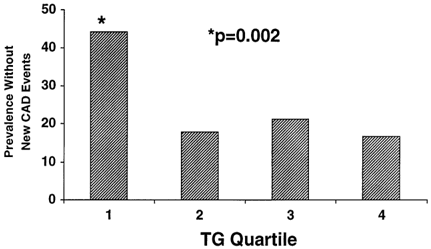
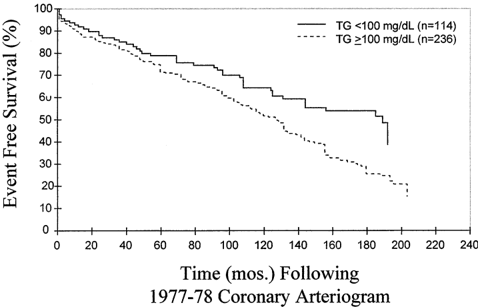
OBJECTIVES: This study sought to evaluate long-term predictors of coronary events in men and women with arteriographically defined coronary artery disease (CAD). BACKGROUND: There is conflicting evidence of the role of triglycerides (TGs) as a prognosticator of CAD, and no studies have examined the long-term outcome of "normal" levels in predicting new coronary events. METHODS: This was a retrospective cohort study that evaluated 740 consecutive patients presenting for diagnostic coronary arteriography between 1977 and 1978. Beginning in 1988, patients with arteriographic CAD (n=350) were recontacted and asked to complete detailed medical questionnaires. Case and control patients were stratified by development of new coronary events, including death from ischemic heart disease, nonfatal myocardial infarction and revascularization. RESULTS: There were 199 events during the 18-year follow-up period. The mean high density lipoprotein cholesterol (HDL-C) was significantly lower (35 vs. 39 mg/dl; p=0.002) and TGs higher (160 vs. 137 mg/dl; p=0.03) in case patients than in control patients; After adjusting for age, gender and beta-adrenergic blocking agent use, multiple logistic regression analysis revealed the following independent predictors of CAD events: diabetes mellitus (relative risk [RR] 2.1, 95% confidence interval [CI] 1.4% to 3.1%), HDL-C <35 mg/dl (RR 1.5, 95% CI 1.1% to 2.00) and TGs >100 mg/dl (RR 1.5, 95% CI 1.1% to 2.1%). A Kaplan-Meier analysis revealed significantly reduced survival from CAD events in patients with baseline TG levels > or = 100 mg/dl compared with TG levels <100 mg/dl (p=0.008). CONCLUSIONS: TG levels previously considered "normal" are predictive of new CAD events. The cutpoints established by the National Cholesterol Education Program for elevated TGs (>200 mg/dl) may need to be refined.
Overview
The claims and statistics of this paper haven’t been checked yet.
Free: it reads the open-access text and checks the first 5 claims that cite a source we can check. Create a free account to check every claim.
Integrity signals
Registry
Cites
Statistics
Figures
Verification
Claims the paper makes
The claims and statistics of this paper haven’t been checked yet.
Free: it reads the open-access text and checks the first 5 claims that cite a source we can check. Create a free account to check every claim.
Claims other papers make about this one
Each is checked against this paper’s own text: does it say what the citing paper says it does?
The source backs part of the claim, not all of it — or backs it for a different population, condition or comparison.
In the citing paper
“it is less widely appreciated that fasting levels from as low as ∼1.2 mmol/L (∼100 mg/dL) can be associated with a cluster of metabolic abnormalities that include accumulation of TRL and remnants,14 as well as increased cardiovascular disease events15,16 (Figure 1).”
From Triglyceride-rich lipoproteins and their remnants: metabolic insights, role in atherosclerotic cardiovascular disease, and emerging therapeutic strategies—a consensus statement from the European Atherosclerosis Society (2021) · cites this paper as [15]
Experimental — accuracy not yet measuredThe source backs part of the claim, not all of it — or backs it for a different population, condition or comparison.
In the citing paper
“observational studies and clinical trials 3,232,367,374 -380 that have consistently demonstrated the lowest risk of incident and recurrent CVD in association with the lowest fasting triglyceride levels.”
From Triglycerides and Cardiovascular Disease: A Scientific Statement From the American Heart Association (2011) · cites this paper as [377]
Experimental — accuracy not yet measured
Self-check
Percentages, sums and reported differences re-computed from the paper’s own numbers.
The self-check needs the paper’s full text.
Citations
Cites
Friedewald, W. T., Levy, R. I., & Fredrickson, D. S. (1972) · Clinical Chemistry · doi:10.1093/clinchem/18.6.499 · Cited by 32,423 · cited 1×
“LDL-C was estimated by the Friedewald equation (14).”
MethodThe Pathogenesis of Coronary Artery Disease and the Acute Coronary Syndromes
Epstein, F. H., Fuster, V., Badimon, L., Badimon, J. J., & Chesebro, J. H. (1992) · New England Journal of Medicine · doi:10.1056/nejm199201303260506 · Cited by 3,725
Austen, W., Edwards, J., Frye, R., Gensini, G., Gott, V., Griffith, L., McGoon, D., Murphy, M., & Roe, B. (1975) · Circulation · doi:10.1161/01.cir.51.4.5 · Cited by 3,256
High-density lipoprotein cholesterol and cardiovascular disease. Four prospective American studies.
Gordon, D. J., Probstfield, J. L., Garrison, R. J., Neaton, J. D., Castelli, W. P., Knoke, J. D., Jacobs, D. R., Bangdiwala, S., & Tyroler, H. A. (1989) · Circulation · doi:10.1161/01.cir.79.1.8 · Cited by 3,162
The Pathogenesis of Coronary Artery Disease and the Acute Coronary Syndromes
Epstein, F. H., Fuster, V., Badimon, L., Badimon, J. J., & Chesebro, J. H. (1992) · New England Journal of Medicine · doi:10.1056/nejm199201233260406 · Cited by 2,717
The pathogenesis of coronary artery disease and the acute coronary syndromes (First of two parts)
Fuster, V. (1992) · New England Journal of Medicine · Cited by 1,954
Hokanson, J. E., & Austin, M. A. (1996) · Journal of Cardiovascular Risk · doi:10.1097/00043798-199604000-00014 · Cited by 1,706 · cited 1×
“A recent casecontrol study (47) supports the meta-analysis by Hokanson and Austin (48) that TG independently predicts initial CAD events even after adjustment for HDL-C.”
ResultAtherogenic lipoprotein phenotype. A proposed genetic marker for coronary heart disease risk
Austin, M. A., King, M. C., Vranizan, K. M., & Krauss, R. M. (1990) · Circulation · doi:10.1161/01.cir.82.2.495 · Cited by 1,411 · cited 2×
“This is noteworthy because an increased prevalence of dense, more atherogenic LDL-C particles emerge as TG levels exceed 100 mg/dl (31).”
BackgroundManninen, V, Tenkanen, L., Koskinen, P., Huttunen, J. K., Mänttäri, M., Heinonen, O. P., & Frick, M. H. (1992) · Circulation · doi:10.1161/01.cir.85.1.37 · Cited by 1,329 · cited 1×
“5) exhibited the greatest reduction in CAD events with gemfibrozil (40).”
Background(1991) · Archives of Internal Medicine · doi:10.1001/archinte.151.6.1071 · Cited by 1,137
Statistical Methods in Epidemiology
(2012) · SpringerReference · doi:10.1007/springerreference_205629 · Cited by 1,124
Relation of triglyceride metabolism and coronary artery disease. Studies in the postprandial state
Patsch, J. R., Miesenböck, G., Hopferwieser, T., Mühlberger, V, Knapp, E., Dunn, J. K., Gotto, A. M., & Patsch, W. (1992) · Arteriosclerosis and Thrombosis: A Journal of Vascular Biology · doi:10.1161/01.atv.12.11.1336 · Cited by 1,122
Assmann, G., & Schulte, H. (1992) · The American Journal of Cardiology · doi:10.1016/0002-9149(92)90550-i · Cited by 872
The National Cholesterol Education Program
Cleeman, J. I. (1989) · Clinics in Laboratory Medicine · doi:10.1016/s0272-2712(18)30638-3 · Cited by 710
Hulley, S. B., Rosenman, R. H., Bawol, R. D., & Brand, R. J. (1980) · New England Journal of Medicine · doi:10.1056/nejm198006193022503 · Cited by 702 · cited 1×
“, high density lipoprotein cholesterol [HDL-C]) were entered into the analysis (3).”
MethodCholesterol and lipids in the risk of coronary artery disease--the Framingham Heart Study.
Castelli, W. P. (1988) · PubMed · Cited by 673
Fontbonne, A., Eschw�ge, E., Cambien, F., Richard, J. L., Ducimeti�re, P., Thibult, N., Warnet, J. M., Claude, J. R., & Rosselin, G. E. (1989) · Diabetologia · doi:10.1007/bf00265546 · Cited by 617
Fasting Triglycerides, High-Density Lipoprotein, and Risk of Myocardial Infarction
Gaziano, J. M., Hennekens, C. H., O’Donnell, C. J., Breslow, J. L., & Buring, J. E. (1997) · Circulation · doi:10.1161/01.cir.96.8.2520 · Cited by 609 · cited 1×
“A recent casecontrol study (47) supports the meta-analysis by Hokanson and Austin (48) that TG independently predicts initial CAD events even after adjustment for HDL-C.”
ResultSerum Triglycerides in Coronary Artery Disease
ALBRINK, M. J. (1959) · Archives of Internal Medicine · doi:10.1001/archinte.1959.00270010010002 · Cited by 460 · cited 1×
“The earliest study demonstrating this association nearly four decades ago (1) was disputed several years later (2).”
BackgroundEricsson, C.-G., de Faire, U., Grip, L., Svane, B., Hamsten, A., & Nilsson, J. (1996) · The Lancet · doi:10.1016/s0140-6736(96)91343-4 · Cited by 426 · cited 1×
“A trial evaluating bezafibrate on CAD progression in survivors of myocardial infarction found significantly reduced arteriographic progression in association with reduced TG (31%) and fibrinogen (12%) levels, despite only modest HDL-C elevation (9%) and no significant reduction in LDL-C (41).”
Background&NA; (1996) · The Endocrinologist · doi:10.1097/00019616-199609000-00019 · Cited by 417
Frick, M. H., Syvänne, M., Nieminen, M. S., Kauma, H., Majahalme, S., Virtanen, V., Kesäniemi, Y. A., Pasternack, A., & Taskinen, M.-R. (1997) · Circulation · doi:10.1161/01.cir.96.7.2137 · Cited by 388 · cited 1×
“More recently, gemfibrozil reduced TG levels 36% and retarded progression of saphenous vein bypass graft lesions in normolipidemic men (mean TG level ;150 mg/dl) with low HDL-C levels (42).”
BackgroundManninen, V., Tenkanen, L., Koskinen, P., Huttunen, J. K., Mänttäri, M., Op, H., & Frick, H. M. (1992) · Circulation · Cited by 360
Phillips, N. R., Waters, D., & Havel, R. J. (1993) · Circulation · doi:10.1161/01.cir.88.6.2762 · Cited by 344
Rapp, J. H., Lespine, A., Hamilton, R. L., Colyvas, N., Chaumeton, A. H., Tweedie-Hardman, J., Kotite, L., Kunitake, S. T., Havel, R. J., & Kane, J. P. (1994) · Arteriosclerosis and Thrombosis: A Journal of Vascular Biology · doi:10.1161/01.atv.14.11.1767 · Cited by 340 · cited 1×
“They have included the discovery of TG-rich lipoproteins in atherosclerotic plaques (4).”
BackgroundHodis, H. N., Mack, W. J., Azen, S. P., Alaupovic, P., Pogoda, J. M., LaBree, L., Hemphill, L. C., Kramsch, D. M., & Blankenhorn, D. H. (1994) · Circulation · doi:10.1161/01.cir.90.1.42 · Cited by 321
(1993) · JAMA · doi:10.1001/jama.269.4.505 · Cited by 315
Benlian, P., De Gennes, J. L., Foubert, L., Zhang, H., Gagné, S. E., & Hayden, M. (1996) · New England Journal of Medicine · doi:10.1056/nejm199609193351203 · Cited by 297 · cited 1×
“1,000 mg/dl) has with few exceptions (24) been more commonly associated with pancreatitis rather than CAD (25).”
BackgroundZilversmit, D. B. (1995) · Clinical Chemistry · doi:10.1093/clinchem/41.1.153 · Cited by 262 · cited 1×
“Postprandial lipemia may also contribute to atherogenesis (33).”
BackgroundReymer, P. W. A., Gagné, E., Groenemeyer, B. E., Zhang, H., Forsyth, I., Jansen, H., Seidell, J. C., Kromhout, D., Lie, K. E., Kastelein, J., et al. (1995) · Nature Genetics · doi:10.1038/ng0595-28 · Cited by 239
Statistical Methods in Epidemiology
Filardo, G., Adams, J., & Ng, H. K. T. (2011) · International Encyclopedia of Statistical Science · doi:10.1007/978-3-642-04898-2_547 · Cited by 236
Horowitz, B. S., Goldberg, I. J., Merab, J., Vanni, T. M., Ramakrishnan, R., & Ginsberg, H. N. (1993) · Journal of Clinical Investigation · doi:10.1172/jci116384 · Cited by 231 · cited 1×
“Both TG-rich LDL-C and HDL-C are avidly hydrolyzed by hepatic lipase; the consequences are a predominant population of small, dense LDL-C particles that are highly susceptible to oxidation (31) and cholesteryl ester poor HDL-C that may bolster apolipoprotein A-I catabolism, thereby attenuating reverse cholesterol tran…”
BackgroundTriglyceride, High-Density Lipoprotein, and Coronary Heart Disease
Rapaport, E. (1993) · JAMA: The Journal of the American Medical Association · doi:10.1001/jama.1993.03500040071040 · Cited by 224
McPherson, R., Mann, C. J., Tall, A. R., Hogue, M., Martin, L., Milne, R. W., & Marcel, Y. L. (1991) · Arteriosclerosis and Thrombosis: A Journal of Vascular Biology · doi:10.1161/01.atv.11.4.797 · Cited by 215
Huttunen, J. K., Ehnholm, C., Kekki, M., & Nikkilä, E. A. (1976) · Clinical Science · doi:10.1042/cs0500249 · Cited by 206
Gianturco, S. H., Bradley, W. A., Gotto, A. M., Morrisett, J. D., & Peavy, D. L. (1982) · Journal of Clinical Investigation · doi:10.1172/jci110590 · Cited by 199 · cited 1×
“These remnant particles appear to be avidly incorporated by macrophages in a manner analogous to modified LDL-C (26).”
BackgroundSerum Triglycerides in Health and in Ischemic Heart Disease
Brown, D. F., Kinch, S. H., & Doyle, J. T. (1965) · New England Journal of Medicine · doi:10.1056/nejm196510282731802 · Cited by 163 · cited 1×
“The earliest study demonstrating this association nearly four decades ago (1) was disputed several years later (2).”
BackgroundThe Effects of Antihypertensive Drugs on Serum Lipids and Lipoproteins I. Diuretics1
Ames, R. P. (1986) · Drugs · doi:10.2165/00003495-198632030-00003 · Cited by 160
Jemaa, R., Fumeron, F., Poirier, O., Lecerf, L., Evans, A., Arveiler, D., Luc, G., Cambou, J. P., Bard, J. M., & Fruchart, J. C. (1996) · Journal of Lipid Research · doi:10.1016/s0022-2275(20)39198-7 · Cited by 152
Drexel, H., Amann, F. W., Beran, J., Rentsch, K., Candinas, R., Muntwyler, J., Luethy, A., Gasser, T., & Follath, F. (1994) · Circulation · doi:10.1161/01.cir.90.5.2230 · Cited by 134 · cited 1×
“, remnant particles) have been shown to predict the extent of CAD (5) and progression of mild to moderate lesions (6,7), the lesions most vulnerable to plaque fissuring and rupture (8).”
BackgroundINFLUENCE OF MYOCARDIAL INFARCTION ON PLASMA-LIPOPROTEIN CONCENTRATION
Dodds, C., & MILLS, G. L. (1959) · The Lancet · doi:10.1016/s0140-6736(59)91178-x · Cited by 127 · cited 1×
“Patients were excluded if they had had a myocardial infarction within 3 months of the baseline coronary angiogram (16) or had received heparin before lipid or lipoprotein measurements (17) (n 5 205).”
BackgroundHyperlipoproteinemia and pancreatitis
Farmer, R. G., Winkelman, E. I., Brown, H. B., & Lewis, L. A. (1973) · The American Journal of Medicine · doi:10.1016/0002-9343(73)90219-2 · Cited by 117 · cited 1×
“1,000 mg/dl) has with few exceptions (24) been more commonly associated with pancreatitis rather than CAD (25).”
BackgroundLong-Term Prognosis After Myocardial Infarction in Men with Diabetes
Ulvenstam, G., Åberg, A., Bergstrand, R., Johansson, S., Pennert, K., Vedin, A., Wilhelmsen, L., & Wilhelmsson, C. (1985) · Diabetes · doi:10.2337/diab.34.8.787 · Cited by 99 · cited 1×
“The study also extends previous observations that diabetes mellitus and low HDL-C are independent predictors of CAD (22,23).”
ResultKwiterovich, P. O., Coresh, J., & Bachorik, P. S. (1993) · The American Journal of Cardiology · doi:10.1016/0002-9149(93)91002-y · Cited by 91
Wang, X. L., McCredie, R. M., & Wilcken, D. E. L. (1996) · Circulation · doi:10.1161/01.cir.93.7.1339 · Cited by 84
Hyperapobetalipoproteinemia. Plasma lipoprotein responses to oral fat load.
Genest, J., Sniderman, A., Cianflone, K., Teng, B., Wacholder, S., Marcel, Y., & Kwiterovich, P. (1986) · Arteriosclerosis: An Official Journal of the American Heart Association, Inc. · doi:10.1161/01.atv.6.3.297 · Cited by 83
Bloomfield, H. E., Robins, S. J., & Collins, D. E. (1996) · The American Journal of Cardiology · doi:10.1016/s0002-9149(96)00369-4 · Cited by 69
(1991) · Archives of Internal Medicine · doi:10.1001/archinte.1991.00400060019005 · Cited by 64
Miller, M., Bachorik, P. S., & Cloey, T. A. (1992) · Clinical Chemistry · doi:10.1093/clinchem/38.4.569 · Cited by 56 · cited 1×
“Moreover, lipid and lipoprotein measurements are variable and influenced by postprandial fat and factors affecting rheology (45).”
BackgroundSelf-citationHypertriglyceridaemia and vascular risk
Tan, K. C. B., Betteridge, D. J., Marmot, M. G., Talmud, P. J., Humphries, S. E., & Yudkin, J. S. (1993) · The Lancet · doi:10.1016/0140-6736(93)91544-v · Cited by 52
Research works printed but not linked: 3
- The lipid research clinics population studies data book, vol. 1: the prevalence study. Bethesda (MD): US Department of Health and Human Services, Public Health Service; 1980 Report No. USDHHS (NIH) 80-1527.
- Pearson TA. Risk factors for arteriographically defined CAD [dissertation]. Baltimore (MD): John Hopkins University, 1983.
- Huttunen JK, Ehnholm C, Kekki M, Nikkila EA. Postheparin plasma lipoprotein lipase in normal subjects and in patients with hypertriglyceride- mia: correlations to sex, age, and various parameters of triglyceride metab- olism. Clin Sci Mol Med 1976;50:249 -60.
Cited by
Triglycerides and Cardiovascular Disease: A Scientific Statement From the American Heart Association
Miller, M., Stone, N. J., Ballantyne, C., Bittner, V., Criqui, M. H., Ginsberg, H. N., Goldberg, A. C., Howard, W. J., Jacobson, M. S., Kris-Etherton, P. M., et al. (2011) · Circulation · doi:10.1161/cir.0b013e3182160726 · Cited by 1,871
Self-citationAdipose tissue dysfunction in obesity, diabetes, and vascular diseases
Hajer, G. R., van Haeften, T. W., & Visseren, F. L. J. (2008) · European Heart Journal · doi:10.1093/eurheartj/ehn387 · Cited by 1,410
Ginsberg, H. N., Packard, C. J., Chapman, M. J., Borén, J., Aguilar-Salinas, C. A., Averna, M., Ference, B. A., Gaudet, D., Hegele, R. A., Kersten, S., et al. (2021) · European Heart Journal · doi:10.1093/eurheartj/ehab551 · Cited by 979
“…10–13 but it is less widely appreciated that fasting levels from as low as (cid:2) 1.2 mmol/L ( (cid:2) 100 mg/dL) can be associated with a cluster of metabolic abnormalities that include accumulation of TRL and remnants, 14 as well as increased cardiovascular disease events 15,16 ( Figure 1 ).”
BackgroundInfluentialGreenland (2000) · doi:10.1161/01.cir.101.1.e16 · Cited by 924
Adipose Tissue Dysfunction in Obesity
Blüher, M. (2009) · Experimental and Clinical Endocrinology & Diabetes · doi:10.1055/s-0029-1192044 · Cited by 662
Metadata
- Authors
- Miller, M., Seidler, A., Moalemi, A., & Pearson, T. A.
- Affiliations
- University of Maryland, Baltimore (US)
- University of Rochester Medicine (US)
- Corresponding author
- Miller, Michael
- ORCID
- Miller, Michael
- Venue
- Journal of the American College of Cardiology
- Publisher
- Elsevier BV
- Published
- 1998-05
- Volume
- 31
- Issue
- 6
- Pages
- 1252-1257
- ISSN
- 0735-1097 (ISSN-L)
- OpenAlex
- W1491390356
- Cited by
- 193
- References
- 52
- Citations by year
- 2026: 2 · 2025: 1 · 2024: 4 · 2023: 2 · 2022: 4 · 2021: 4 · 2020: 2 · 2019: 2 · 2018: 2 · 2017: 2 · 2016: 4 · 2015: 5 · 2014: 7 · 2013: 4 · 2012: 3
- FWCI
- 20.71
- Type
- journal article
- Language
- en
- Open access
- hybrid
- doi.org
- Licence
- cc-by-nc-nd
- www.elsevier.com/tdm/userlicense/1.0/ (tdm)
- www.elsevier.com/legal/tdmrep-license (tdm)
- creativecommons.org/licenses/by-nc-nd/4.0/ (vor, 311 d)
- Locations
- Journal of the American College of Cardiology (publishedVersion, cc-by-nc-nd)
- PubMed (publishedVersion)
- Funders
- National Institutes of Health (5r29hl052663-04, 5k07hl002263-04)
- National Heart, Lung, and Blood Institute (HL52663, HL02263)
- Topics
- Health Sciences › Medicine › Cardiology and Cardiovascular Medicine › Lipoproteins and Cardiovascular Health
- Health Sciences › Medicine › Endocrinology, Diabetes and Metabolism › Diabetes, Cardiovascular Risks, and Lipoproteins
- Health Sciences › Medicine › Cardiology and Cardiovascular Medicine › Lipid metabolism and disorders
- Keywords
- triglycerides, coronary artery disease, cardiovascular risk prediction, HDL cholesterol, diabetes mellitus, myocardial infarction, revascularization, ischemic heart disease mortality, long-term prognosis
- MeSH terms
- Coronary Disease, Female, Humans, Male, Maryland, Middle Aged, Retrospective Studies, Risk Factors, Triglycerides, Proportional Hazards Models, Survival Analysis, Risk Assessment
About these checks
Registry, retraction, Cites and statistics results are computed, not judged, with one exception: a printed reference that no index lists is read once by a model before it counts as a citation error. Claims are extracted by a model and kept only when their quote appears verbatim in the text; each cited source is then checked, with a model’s help, for whether it says what the claim relies on. Those verdicts can be wrong — read the claim’s quote and the cited source before relying on one.
Statistics and arithmetic are recomputed, not judged.
Confidence bands are shown only for fields calibrated on our annotated test set. None is calibrated yet, so no band is shown.
What counts as a claim ›How we measure confidence ›How we check this ›
Are you an author, or do you see a problem with this page? Request a review
Data sources
Bibliographic data: Semantic Scholar, OpenAlex, Crossref.
Contains information from the Semantic Scholar Academic Graph Datasets, made available under the ODC Attribution License (ODC-BY 1.0).
Semantic Scholar’s data is described in: Kinney, R., et al. (2023). The Semantic Scholar Open Data Platform. arXiv:2301.10140.
