

Normal Triglyceride Levels and Coronary Artery Disease Events: The Baltimore Coronary Observational Long-Term Study
Open accessThe DOI matches its Crossref record; 51 of the 52 references it cites were found in a registry or an index.
Abstract
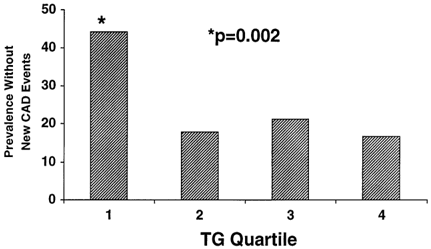
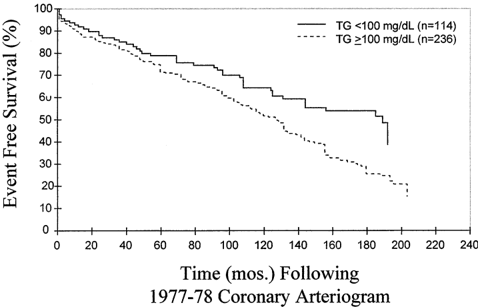
OBJECTIVES: This study sought to evaluate long-term predictors of coronary events in men and women with arteriographically defined coronary artery disease (CAD). BACKGROUND: There is conflicting evidence of the role of triglycerides (TGs) as a prognosticator of CAD, and no studies have examined the long-term outcome of "normal" levels in predicting new coronary events. METHODS: This was a retrospective cohort study that evaluated 740 consecutive patients presenting for diagnostic coronary arteriography between 1977 and 1978. Beginning in 1988, patients with arteriographic CAD (n=350) were recontacted and asked to complete detailed medical questionnaires. Case and control patients were stratified by development of new coronary events, including death from ischemic heart disease, nonfatal myocardial infarction and revascularization. RESULTS: There were 199 events during the 18-year follow-up period. The mean high density lipoprotein cholesterol (HDL-C) was significantly lower (35 vs. 39 mg/dl; p=0.002) and TGs higher (160 vs. 137 mg/dl; p=0.03) in case patients than in control patients; After adjusting for age, gender and beta-adrenergic blocking agent use, multiple logistic regression analysis revealed the following independent predictors of CAD events: diabetes mellitus (relative risk [RR] 2.1, 95% confidence interval [CI] 1.4% to 3.1%), HDL-C <35 mg/dl (RR 1.5, 95% CI 1.1% to 2.00) and TGs >100 mg/dl (RR 1.5, 95% CI 1.1% to 2.1%). A Kaplan-Meier analysis revealed significantly reduced survival from CAD events in patients with baseline TG levels > or = 100 mg/dl compared with TG levels <100 mg/dl (p=0.008). CONCLUSIONS: TG levels previously considered "normal" are predictive of new CAD events. The cutpoints established by the National Cholesterol Education Program for elevated TGs (>200 mg/dl) may need to be refined.
Overview
The claims and statistics of this paper haven’t been checked yet.
Free: it reads the open-access text and checks the first 5 claims that cite a source we can check. Create a free account to check every claim.
Integrity signals
Registry
Cites
Statistics
Figures
Verification
Claims the paper makes
The claims and statistics of this paper haven’t been checked yet.
Free: it reads the open-access text and checks the first 5 claims that cite a source we can check. Create a free account to check every claim.
Claims other papers make about this one
Each is checked against this paper’s own text: does it say what the citing paper says it does?
The source backs part of the claim, not all of it — or backs it for a different population, condition or comparison.
In the citing paper
“it is less widely appreciated that fasting levels from as low as ∼1.2 mmol/L (∼100 mg/dL) can be associated with a cluster of metabolic abnormalities that include accumulation of TRL and remnants,14 as well as increased cardiovascular disease events15,16 (Figure 1).”
From Triglyceride-rich lipoproteins and their remnants: metabolic insights, role in atherosclerotic cardiovascular disease, and emerging therapeutic strategies—a consensus statement from the European Atherosclerosis Society (2021) · cites this paper as [15]
Experimental — accuracy not yet measuredThe source backs part of the claim, not all of it — or backs it for a different population, condition or comparison.
In the citing paper
“observational studies and clinical trials 3,232,367,374 -380 that have consistently demonstrated the lowest risk of incident and recurrent CVD in association with the lowest fasting triglyceride levels.”
From Triglycerides and Cardiovascular Disease: A Scientific Statement From the American Heart Association (2011) · cites this paper as [377]
Experimental — accuracy not yet measured
Self-check
Percentages, sums and reported differences re-computed from the paper’s own numbers.
The self-check needs the paper’s full text.
Citations
Cites
Friedewald, W. T., Levy, R. I., & Fredrickson, D. S. (1972) · Clinical Chemistry · doi:10.1093/clinchem/18.6.499 · Cited by 32,423 · cited 1×
“LDL-C was estimated by the Friedewald equation (14).”
MethodThe Pathogenesis of Coronary Artery Disease and the Acute Coronary Syndromes
Epstein, F. H., Fuster, V., Badimon, L., Badimon, J. J., & Chesebro, J. H. (1992) · New England Journal of Medicine · doi:10.1056/nejm199201303260506 · Cited by 3,725
Austen, W., Edwards, J., Frye, R., Gensini, G., Gott, V., Griffith, L., McGoon, D., Murphy, M., & Roe, B. (1975) · Circulation · doi:10.1161/01.cir.51.4.5 · Cited by 3,256
High-density lipoprotein cholesterol and cardiovascular disease. Four prospective American studies.
Gordon, D. J., Probstfield, J. L., Garrison, R. J., Neaton, J. D., Castelli, W. P., Knoke, J. D., Jacobs, D. R., Bangdiwala, S., & Tyroler, H. A. (1989) · Circulation · doi:10.1161/01.cir.79.1.8 · Cited by 3,162
The Pathogenesis of Coronary Artery Disease and the Acute Coronary Syndromes
Epstein, F. H., Fuster, V., Badimon, L., Badimon, J. J., & Chesebro, J. H. (1992) · New England Journal of Medicine · doi:10.1056/nejm199201233260406 · Cited by 2,717
The pathogenesis of coronary artery disease and the acute coronary syndromes (First of two parts)
Fuster, V. (1992) · New England Journal of Medicine · Cited by 1,954
Hokanson, J. E., & Austin, M. A. (1996) · Journal of Cardiovascular Risk · doi:10.1097/00043798-199604000-00014 · Cited by 1,706 · cited 1×
“A recent casecontrol study (47) supports the meta-analysis by Hokanson and Austin (48) that TG independently predicts initial CAD events even after adjustment for HDL-C.”
ResultAtherogenic lipoprotein phenotype. A proposed genetic marker for coronary heart disease risk
Austin, M. A., King, M. C., Vranizan, K. M., & Krauss, R. M. (1990) · Circulation · doi:10.1161/01.cir.82.2.495 · Cited by 1,411 · cited 2×
“This is noteworthy because an increased prevalence of dense, more atherogenic LDL-C particles emerge as TG levels exceed 100 mg/dl (31).”
BackgroundManninen, V, Tenkanen, L., Koskinen, P., Huttunen, J. K., Mänttäri, M., Heinonen, O. P., & Frick, M. H. (1992) · Circulation · doi:10.1161/01.cir.85.1.37 · Cited by 1,329 · cited 1×
“5) exhibited the greatest reduction in CAD events with gemfibrozil (40).”
Background
Research works printed but not linked: 3
- The lipid research clinics population studies data book, vol. 1: the prevalence study. Bethesda (MD): US Department of Health and Human Services, Public Health Service; 1980 Report No. USDHHS (NIH) 80-1527.
- Pearson TA. Risk factors for arteriographically defined CAD [dissertation]. Baltimore (MD): John Hopkins University, 1983.
- Huttunen JK, Ehnholm C, Kekki M, Nikkila EA. Postheparin plasma lipoprotein lipase in normal subjects and in patients with hypertriglyceride- mia: correlations to sex, age, and various parameters of triglyceride metab- olism. Clin Sci Mol Med 1976;50:249 -60.
Cited by
Triglycerides and Cardiovascular Disease: A Scientific Statement From the American Heart Association
Miller, M., Stone, N. J., Ballantyne, C., Bittner, V., Criqui, M. H., Ginsberg, H. N., Goldberg, A. C., Howard, W. J., Jacobson, M. S., Kris-Etherton, P. M., et al. (2011) · Circulation · doi:10.1161/cir.0b013e3182160726 · Cited by 1,871
Self-citationAdipose tissue dysfunction in obesity, diabetes, and vascular diseases
Hajer, G. R., van Haeften, T. W., & Visseren, F. L. J. (2008) · European Heart Journal · doi:10.1093/eurheartj/ehn387 · Cited by 1,410
Ginsberg, H. N., Packard, C. J., Chapman, M. J., Borén, J., Aguilar-Salinas, C. A., Averna, M., Ference, B. A., Gaudet, D., Hegele, R. A., Kersten, S., et al. (2021) · European Heart Journal · doi:10.1093/eurheartj/ehab551 · Cited by 979
“…10–13 but it is less widely appreciated that fasting levels from as low as (cid:2) 1.2 mmol/L ( (cid:2) 100 mg/dL) can be associated with a cluster of metabolic abnormalities that include accumulation of TRL and remnants, 14 as well as increased cardiovascular disease events 15,16 ( Figure 1 ).”
BackgroundInfluentialGreenland (2000) · doi:10.1161/01.cir.101.1.e16 · Cited by 924
Adipose Tissue Dysfunction in Obesity
Blüher, M. (2009) · Experimental and Clinical Endocrinology & Diabetes · doi:10.1055/s-0029-1192044 · Cited by 662
ATUALIZAÇÃO DA DIRETRIZ BRASILEIRA DE DISLIPIDEMIAS E PREVENÇÃO DA ATEROSCLEROSE - 2017
Faludi, A., Izar, M., Saraiva, J., Chacra, A., Bianco, H., Afiune Neto, A., Bertolami, A., Pereira, A., Lottenberg, A., Sposito, A., et al. (2017) · Arquivos Brasileiros de Cardiologia · doi:10.5935/abc.20170121 · Cited by 633
Miller, M., Cannon, C. P., Murphy, S. A., Qin, J., Ray, K. K., & Braunwald, E. (2008) · Journal of the American College of Cardiology · doi:10.1016/j.jacc.2007.10.038 · Cited by 610
Self-citationEvidence that triglycerides are an independent coronary heart disease risk factor
Cullen, P. (2000) · The American Journal of Cardiology · doi:10.1016/s0002-9149(00)01127-9 · Cited by 462
Krämer, J., Kang, R., Grimm, L. M., De Cola, L., Picchetti, P., & Biedermann, F. (2022) · Chemical Reviews · doi:10.1021/acs.chemrev.1c00746 · Cited by 449
Onat, A., Can, G., Kaya, H., & Hergenç, G. (2010) · Journal of Clinical Lipidology · doi:10.1016/j.jacl.2010.02.005 · Cited by 421
Jin, J.-L., Cao, Y.-X., Wu, L.-G., You, X.-D., Guo, Y.-L., Wu, N.-Q., Zhu, C.-G., Gao, Y., Dong, Q.-T., Zhang, H.-W., et al. (2018) · Journal of Thoracic Disease · doi:10.21037/jtd.2018.10.79 · Cited by 288
“Furthermore, it also has been reported that both fasting glucose and TG within the high normal range may predict CVD risk (12,13).”
BackgroundThe metabolic syndrome and cardiovascular disease
Bonora, E. (2006) · Annals of Medicine · doi:10.1080/07853890500401234 · Cited by 231
“More recently, it has been reported that even mild hypertriglyceridemia can significantly increase the risk of myocardial infarction and stroke (51,52).”
BackgroundLiao, Y., Kwon, S., Shaughnessy, S., Wallace, P., Hutto, A., Jenkins, A. J., Klein, R. L., & Garvey, W. T. (2004) · Diabetes Care · doi:10.2337/diacare.27.4.978 · Cited by 218
“By uniformly applying the same values for triglycerides and HDL cholesterol, ATP III criteria may even more profoundly under diagnose insulin resistance in African Americans.”
BackgroundInfluentialPrieur, X., Coste, H., & Rodríguez, J. C. (2003) · Journal of Biological Chemistry · doi:10.1074/jbc.m301302200 · Cited by 194
The association between psoriasis and dyslipidaemia: a systematic review
Ma, C., Harskamp, C. T., Armstrong, E. J., & Armstrong, A. W. (2013) · British Journal of Dermatology · doi:10.1111/bjd.12101 · Cited by 177
Teno, S., Uto, Y., Nagashima, H., Endoh, Y., Iwamoto, Y., Omori, Y., & Takizawa, T. (2000) · Diabetes Care · doi:10.2337/diacare.23.9.1401 · Cited by 175
Psoriasis and comorbidities: links and risks
Chiu, M. W., & Ni, C. S. (2014) · Clinical Cosmetic and Investigational Dermatology · doi:10.2147/ccid.s44843 · Cited by 180
Fibrates, dyslipoproteinaemia and cardiovascular disease
Watts, G. F., & Dimmitt, S. B. (1999) · Current Opinion in Lipidology · doi:10.1097/00041433-199912000-00011 · Cited by 147
Hopkins, P. N., Wu, L., Hunt, S. C., & Brinton, E. A. (2005) · Journal of the American College of Cardiology · doi:10.1016/j.jacc.2004.11.062 · Cited by 164
Epidemiology of hypertriglyceridemia and cardiovascular disease
Austin, M. A. (1999) · The American Journal of Cardiology · doi:10.1016/s0002-9149(99)00209-x · Cited by 150
Schaefer, E. J., McNamara, J. R., Shah, P. K., Nakajima, K., Cupples, L. A., Ordovas, J. M., & Wilson, P. W. F. (2002) · Diabetes Care · doi:10.2337/diacare.25.6.989 · Cited by 132
“Many investigators have recommended more stringent criteria for the definition of hypertriglyceridemia (18); the difficulty in following this recommendation, of course, is the lack of clear-cut data showing benefit from lowering triglyceride levels in intervention studies.”
BackgroundGrundy, S. M., Bazzarre, T., Cleeman, J., D’Agostino, R. B., Hill, M., Houston-Miller, N., Kannel, W. B., Krauss, R., Krumholz, H. M., Lauer, R. M., et al. (2000) · Circulation · doi:10.1161/01.cir.101.1.e3 · Cited by 128
Self-citationGotto, A. M. (2002) · American Heart Journal · doi:10.1067/mhj.2002.130301 · Cited by 132
Serum neopterin and complex stenosis morphology in patients with unstable angina
García–Moll, X., Coccolo, F., Cole, D., & Kaski, J. C. (2000) · Journal of the American College of Cardiology · doi:10.1016/s0735-1097(99)00640-3 · Cited by 129
Garg, A., & Simha, V. (2007) · The Journal of Clinical Endocrinology & Metabolism · doi:10.1210/jc.2007-0275 · Cited by 89
Duggirala, R., Blangero, J., Almasy, L. A., Dyer, T. D., Williams, K. L., Leach, R. J., O'Connell, P., & Stern, M. P. (2000) · The American Journal of Human Genetics · doi:10.1086/302849 · Cited by 115
“Although fasting plasma triglyceride (TG) levels 1200 mg/dl have been considered to increase risk, recent evidence suggests that an even lower threshold (1100 mg/dl) could be deleterious in patients with established coronary artery disease (Miller et al. 1998).”
BackgroundCoronary atherogenic risk factors in women
Stangl, V., Baumann, G., & Stangl, K. (2002) · European Heart Journal · doi:10.1053/euhj.2002.3329 · Cited by 128
Genetically modified pigs for biomedical research
Luo, Y., Lin, L., Bolund, L., Jensen, T. G., & Sørensen, C. B. (2012) · Journal of Inherited Metabolic Disease · doi:10.1007/s10545-012-9475-0 · Cited by 125
Miller, M., Ginsberg, H. N., & Schaefer, E. J. (2008) · The American Journal of Cardiology · doi:10.1016/j.amjcard.2007.11.046 · Cited by 102
Self-citationFrom Inuit to Implementation: Omega-3 Fatty Acids Come of Age
O’Keefe, J. H., & Harris, W. S. (2000) · Mayo Clinic Proceedings · doi:10.4065/75.6.607 · Cited by 112
Reddy, K. J., Singh, M., Bangit, J. R., & Batsell, R. R. (2010) · Journal of Cardiovascular Medicine · doi:10.2459/jcm.0b013e328333645a · Cited by 113
Rosenson, R. S., Shott, S., & Tangney, C. (2002) · Atherosclerosis · doi:10.1016/s0021-9150(01)00656-6 · Cited by 106
“risk of coronary heart disease [1–3]; however, the causal relationship for triglycerides remains unclear”
BackgroundWolfe, M. L., Vartanian, S. F., Ross, J. L., Bansavich, L.-L., Mohler, E. R., Meagher, E. A., Friedrich, C. A., & Rader, D. J. (2001) · The American Journal of Cardiology · doi:10.1016/s0002-9149(00)01410-7 · Cited by 96
Berneis, K. K., Jeanneret, C., Muser, J., Felix, B., & Miserez, A. R. (2005) · Metabolism · doi:10.1016/j.metabol.2004.08.017 · Cited by 92
“abnormalities in insulin resistance and type 2 diabetes mellitus [14-16] and are associated with increased cardiovascular mortality [17,18].”
BackgroundWang, W., Basinger, A., Neese, R. A., Shane, B., Myong, S.-A., Christiansen, M., & Hellerstein, M. K. (2001) · American Journal of Physiology-Endocrinology and Metabolism · doi:10.1152/ajpendo.2001.280.3.e540 · Cited by 85
“However, recent studies have demonstrated clearly that elevated TGs increase the risk for CHD independently of HDL concentrations (22, 24).”
BackgroundInfluentialOrphan Nuclear Hormone Receptor Rev-erbα Regulates the Human Apolipoprotein CIII Promoter
Coste, H., & Rodrı́guez, J. C. (2002) · Journal of Biological Chemistry · doi:10.1074/jbc.m203421200 · Cited by 83
Knopp, R. H., Retzlaff, B., Walden, C., Fish, B., Buck, B., & McCann, B. (2000) · Proceedings of the Society for Experimental Biology and Medicine · doi:10.1046/j.1525-1373.2000.22524.x · Cited by 82
Influence of glycemic load on HDL cholesterol in youth1–3
Slyper, A. H., Jurva, J. W., Pleuss, J. A., Hoffmann, R. G., & Gutterman, D. D. (2005) · American Journal of Clinical Nutrition · doi:10.1093/ajcn.81.2.376 · Cited by 92
Onat, A., Sarı, İ., Yazıcı, M., Can, G., Hergenç, G., & Avcı, G. Ş. (2006) · International Journal of Cardiology · doi:10.1016/j.ijcard.2005.06.056 · Cited by 80
Aude, Y. W., Agatston, A. S., Lopez-Jimenez, F., Lieberman, E. H., Almon, M., Hansen, M., Rojas, G., Lamas, G. A., & Hennekens, C. H. (2004) · Archives of Internal Medicine · doi:10.1001/archinte.164.19.2141 · Cited by 76
Arca, M., Montali, A., Valiante, S., Campagna, F., Pigna, G., Paoletti, V., Antonini, R., Barillà, F., Tanzilli, G., Vestri, A., et al. (2007) · The American Journal of Cardiology · doi:10.1016/j.amjcard.2007.06.049 · Cited by 81
Diurnal triglyceride profiles: a novel approach to study triglyceride changes
Cabezas, M. C., Halkes, C. J. M., Meijssen, S., van Oostrom, A. J. H. H. M., & Erkelens, D. W. (2001) · Atherosclerosis · doi:10.1016/s0021-9150(00)00554-2 · Cited by 84
Hersberger, M., & von Eckardstein, A. (2003) · Drugs · doi:10.2165/00003495-200363180-00003 · Cited by 91
Genetic Polymorphisms of Estrogen Receptors in Patients with Premature Coronary Artery Disease
Mansur, A. D. P., Nogueira, C. C. M., Strunz, C. M. C., Aldrighi, J. M., & Ramires, J. A. F. (2005) · Archives of Medical Research · doi:10.1016/j.arcmed.2005.04.002 · Cited by 76
Metabolic Syndrome and Cardiometabolic Risk Factors
Papakonstantinou, E., Lambadiari, V., Dimitriadis, G., & Zampelas, A. (2014) · Current Vascular Pharmacology · doi:10.2174/15701611113116660176 · Cited by 68
van Oostrom, A. J. H. H. M., van Wijk, J. P. H., & Cabezas, M. C. (2004) · Drugs · doi:10.2165/00003495-200464002-00004 · Cited by 78
“[22] However, it has also been shown that, among all patients with premature CHD, 40% have normal fasting plasma lipids, [23,24] although many have impaired clearance of postprandial lipoproteins.”
BackgroundRusso, F., Chimienti, G., Riezzo, G., Pepe, G., Petrosillo, G., Chiloiro, M., & Marconi, E. (2008) · European Journal of Nutrition · doi:10.1007/s00394-008-0748-1 · Cited by 75
“[24] found that people with triglyceride levels equal to or higher than 100 mg/dl were 50% more likely than those with lower levels to suffer from coronary heart disease and related consequences.”
BackgroundFasting and daylong triglycerides in obesity with and without type 2 diabetes
van Wijk, J. P. H., Halkes, C. J. M., Erkelens, D. W., & Cabezas, M. C. (2003) · Metabolism · doi:10.1016/s0026-0495(03)00106-9 · Cited by 71
Clinical equivalence of intranasal and oral 17β-estradiol for postmenopausal symptoms
Mattsson, L. A., Christiansen, C., Colau, J.-C., Palacios, S., Kenemans, P., Bergeron, C., Chevallier, O., von Holst, T., & GANGAR, K. F. (2000) · American Journal of Obstetrics and Gynecology · doi:10.1067/mob.2000.104843 · Cited by 61
Goldenberg, N., Wang, P., & Glueck, C. J. (2003) · Clinica Chimica Acta · doi:10.1016/s0009-8981(03)00129-3 · Cited by 62
Gender differences in diurnal triglyceridemia in lean and overweight subjects
Halkes, C. J. M., Cabezas, M. C., van Wijk, J., & Erkelens, D. W. (2001) · International Journal of Obesity · doi:10.1038/sj.ijo.0801831 · Cited by 64
van Oostrom, A. J. H. H. M., Cabezas, M. C., Ribalta, J., Masana, L., Twickler, T. B., Remijnse, T. A. W., & Erkelens, D. W. (2000) · European Journal of Clinical Investigation · doi:10.1046/j.1365-2362.2000.00732.x · Cited by 64
Lipoprotein lipase and apoE polymorphisms: relationship to hypertriglyceridemia during pregnancy
McGladdery, S. H., & Frohlich, J. J. (2001) · Journal of Lipid Research · doi:10.1016/s0022-2275(20)31517-0 · Cited by 55
Sikand, G., Kashyap, M. L., Wong, N. D., & HSU, J. C. (2000) · Journal of the American Dietetic Association · doi:10.1016/s0002-8223(00)00066-3 · Cited by 51
The epidemiology of triglyceride as a coronary artery disease risk factor
Miller, M. J. (1999) · Clinical Cardiology · doi:10.1002/clc.4960221402 · Cited by 75
Self-citationWei, J., Ouyang, H., Wang, Y., Pang, D., Cong, N. X., Wang, T., Leng, B., Li, D., Li, X., Wu, R., et al. (2012) · The FEBS Journal · doi:10.1111/j.1742-4658.2011.08401.x · Cited by 50
Levy, E. H., Spahis, S., Ziv, E., Marette, A., Elchebly, M., Lambert, M. A., & DELVIN, E. E. (2006) · Diabetologia · doi:10.1007/s00125-006-0315-3 · Cited by 55
“dial hyperlipidaemia has been linked to atherosclerosis, even in fasting normocholesterolaemic subjects [7–10].”
BackgroundMetabolic syndrome: dietary interventions
Aude, Y. W., Mego, P. A., & Mehta, J. L. (2004) · Current Opinion in Cardiology · doi:10.1097/01.hco.0000134610.68815.05 · Cited by 54
Russo, F., Clemente, C., Linsalata, M., Chiloiro, M., Orlando, A., Marconi, E., Chimienti, G., & Riezzo, G. (2010) · European Journal of Nutrition · doi:10.1007/s00394-010-0135-6 · Cited by 47
“[10].”
Hypertriglyceridemia: the importance of identifying patients at risk
Kushner, P. A., & Cobble, M. E. (2016) · Postgraduate Medicine · doi:10.1080/00325481.2016.1243005 · Cited by 47
Hamazaki, T., Sawazaki, S., Nagasawa, T., Nagao, Y., Kanagawa, Y., & Yazawa, K. (1999) · Lipids · doi:10.1007/bf02562226 · Cited by 46
Antihypertriglyceridemic Effect of Walnut Oil
Zibaeenezhad, M. J., Rezaiezadeh, M., Mowla, A., Ayatollahi, S. M. T., & Panjehshahin, M. R. (2003) · Angiology · doi:10.1177/000331970305400404 · Cited by 50
Hiyoshi, H., Yanagimachi, M., Ito, M., Yasuda, N., Okada, T., Ikuta, H., Shinmyo, D., Tanaka, K., Kurusu, N., Yoshida, I., et al. (2003) · Journal of Lipid Research · doi:10.1194/jlr.m200316-jlr200 · Cited by 48
Ma, C., Schupp, C. W., Armstrong, E. J., & Armstrong, A. W. (2013) · Journal of the European Academy of Dermatology and Venereology · doi:10.1111/jdv.12232 · Cited by 54
Triglyceride and coronary heart disease mortality in a 24-year follow-up study in Xi'an, China
He, Y., Lam, T. H., Li, L. S., Li, L. S., He, S. F., & Liang, B. Q. (2003) · Annals of Epidemiology · doi:10.1016/s1047-2797(03)00069-3 · Cited by 44
Walnut Consumption in Hyperlipidemic Patients
Zibaeenezhad, M. J., Shamsnia, S. J., & khorasani, M. A. (2005) · Angiology · doi:10.1177/000331970505600509 · Cited by 50
Current perspectives on the management of hypertriglyceridemia
Miller, M. J. (2000) · American Heart Journal · doi:10.1067/mhj.2000.108001 · Cited by 43
Self-citationWang, Y., Fang, Y., Magliano, D. J., Charchar, F. J., Sobey, C. G., Drummond, G. R., & Golledge, J. (2022) · Cardiovascular Research · doi:10.1093/cvr/cvac124 · Cited by 39
“Findings from the Baltimore Coronary Observational Long-Term Study (COLTS) appear to not support our proposed hypothesis, as higher triglycerides remained a significant risk factor for new CVD events after exclusion of Type 2 diabetes after 18 years of follow-up.(43) However, the COLTS study finding may not reject the…”
ResultChoi, K., Park, M., Kim, J., Chang, J., Nam, T., Choi, S., Lee, S., Kim, B. C., Kim, M., & Cho, K. (2012) · Journal of the Neurological Sciences · doi:10.1016/j.jns.2012.04.018 · Cited by 45
“Elevated TG levels were independently associated with increased risk of mortality and recurrent CAD [11–13].”
BackgroundHypertriglyceridemia: A Review Beyond Low-Density Lipoprotein
RAPP, R. J. (2002) · Cardiology in Review · doi:10.1097/00045415-200205000-00005 · Cited by 37
“Hypertriglyceridemia thus was predictive at modest levels (as was found with COLTS), and it did not lose its significance when HDL-C was considered.”
BackgroundInfluentialTomonobu, K., Hase, T., & Tokimitsu, I. (2006) · Nutrition · doi:10.1016/j.nut.2005.04.016 · Cited by 41
“13 mmol/L based on the results of retrospective cohort study [5] and a fat-loading study [25].”
BackgroundLipoprotein(a), homocysteine, and remnantlike particles: emerging risk factors
SEMAN, L. J., McNamara, J. R., & Schaefer, E. J. (1999) · Current Opinion in Cardiology · doi:10.1097/00001573-199903000-00017 · Cited by 41
MANAGEMENT OF SELECTED LIPID ABNORMALITIES
Rader, D. J., & Rosas, S. E. (2000) · Medical Clinics of North America · doi:10.1016/s0025-7125(05)70206-6 · Cited by 36
Drug therapy for hypertriglyceridemia: Fibrates and omega-3 fatty acids
Toth, P. P., Dayspring, T. D., & Pokrywka, G. S. (2008) · Current Atherosclerosis Reports · doi:10.1007/s11883-009-0012-z · Cited by 37
Benlian, P., Cansier, C., Hennache, G., Khallouf, O., Bayer, P., Duron, F., Carrat, F., Couderc, R., Chazouillères, O., Bardet, J., et al. (2000) · Clinical Chemistry · doi:10.1093/clinchem/46.4.493 · Cited by 35
Yamamoto, A., Temba, H., Horibe, H., Mabuchi, H., Saitō, Y., Matsuzawa, Y., Kita, T., & Nakamura, H. (2003) · Journal of Atherosclerosis and Thrombosis · doi:10.5551/jat.10.165 · Cited by 35
The role of triglycerides in cardiovascular risk
Gandotra, P., & Miller, M. J. (2008) · Current Cardiology Reports · doi:10.1007/s11886-008-0079-0 · Cited by 37
Self-citationKendall, D. M. (2005) · Endocrinology and Metabolism Clinics of North America · doi:10.1016/j.ecl.2004.11.004 · Cited by 39
“Although the specific contributions of TG elevations (independent of HDL-C or LDL-C levels) as a predictor of CVD risk is somewhat controversial [12,13,21,64], most practitioners recognize this disorder as common and warranting specific treatment, particularly if TG levels are greater than 400 mg/dL.”
BackgroundDyslipidemia and the Metabolic Syndrome
Bloomgarden, Z. T. (2004) · Diabetes Care · doi:10.2337/diacare.27.12.3009 · Cited by 37
“Furthermore, the Baltimore coronary observational long-term study showed significant difference in outcome comparing persons with fasting triglycerides above and below 100 mg/dl (20), so that this lower level might be an appropriate target for persons at increased risk.”
BackgroundHypertriglyceridemia: A Review of Clinical Relevance and Treatment Options: Focus on Cerivastatin
Breuer, H.-W. M. (2001) · Current Medical Research and Opinion · doi:10.1185/03007990152005379 · Cited by 37
Hiyoshi, H., Yanagimachi, M., Ito, M., Saeki, T., Yoshida, I., Okada, T., Ikuta, H., Shinmyo, D., Tanaka, K., Kurusu, N., et al. (2001) · European Journal of Pharmacology · doi:10.1016/s0014-2999(01)01450-9 · Cited by 32
Schlitt, A., Blankenberg, S., Bickel, C., Meyer, J., Hafner, G., Jiang, X., & Rupprecht, H. J. (2004) · International Journal of Cardiology · doi:10.1016/j.ijcard.2004.05.056 · Cited by 30
Risk Factors for Atherosclerotic Vascular Disease
von Eckardstein, A. (2005) · Handbook of experimental pharmacology · doi:10.1007/3-540-27661-0_2 · Cited by 33
“In patients with angiographically assessed CHD this association may even be stronger as the prospective and multicentric European Concerted Action on Thrombosis and Disabilities (ECAT) study, as well as the Baltimore Longitudinal Heart Study identified low HDL cholesterol as the most important biochemical risk factor…”
BackgroundChronic coronary artery disease
da Luz, P. L., & Favarato, D. (1999) · Arquivos Brasileiros de Cardiologia · doi:10.1590/s0066-782x1999000100002 · Cited by 42
Krysiak, R. G., Gdula‐Dymek, A., & Okopień, B. (2011) · European Journal of Clinical Pharmacology · doi:10.1007/s00228-011-1063-y · Cited by 27
“In the Copenhagen Male Study [2], the Baltimore Observational Long Term Study [3] and the Bezafibrate Infarction Prevention study [4], which involved middle-aged and elderly men [2], subjects who underwent diagnostic coronary arteriography [3] and patients with coronary artery disease [4], respectively, the presence o…”
BackgroundReyes, G., Yasunaga, K., Rothenstein, E., Karmally, W., Ramakrishnan, R., Holleran, S., & Ginsberg, H. N. (2007) · Journal of Lipid Research · doi:10.1194/jlr.p700019-jlr200 · Cited by 25
Miller, M. J. (2000) · The American Journal of Cardiology · doi:10.1016/s0002-9149(00)01466-1 · Cited by 29
Self-citationImportance of high-density lipoprotein cholesterol and triglyceride levels in coronary heart disease
Sprecher, D. L., Watkins, T. R., Behar, S., Brown, W. V., Bloomfield, H. E., & Schaefer, E. J. (2003) · The American Journal of Cardiology · doi:10.1016/s0002-9149(02)03309-x · Cited by 26
Hypertriglyceridemia and Coronary Heart Disease
Oberman, A. (2000) · The Journal of Clinical Endocrinology & Metabolism · doi:10.1210/jc.85.6.2098 · Cited by 22
Wakatsuki, A., Ikenoue, N., Shinohara, K., Watanabe, K., & Fukaya, T. (2004) · Atherosclerosis · doi:10.1016/j.atherosclerosis.2004.07.005 · Cited by 23
van Wijk, J. P. H., Buirma, R. J. A., van Tol, A., Halkes, C. J. M., de Jaegere, P. P. T., Plokker, H. W. M., van der Helm, Y. J. M., & Cabezas, M. C. (2004) · Atherosclerosis · doi:10.1016/j.atherosclerosis.2004.08.009 · Cited by 23
Metabolism of Triglyceride‐Rich Lipoproteins and Their Role in Atherosclerosis
Tanaka, A., Ai, M., Kobayashi, Y., Tamura, M., Shimokado, K., & Numano, F. (2001) · Annals of the New York Academy of Sciences · doi:10.1111/j.1749-6632.2001.tb03942.x · Cited by 20
Age- and sex-related changes in fasting plasma glucose and lipoprotein in cynomolgus monkeys
Yue, F., Zhang, G., Tang, R., Zhang, Z., Teng, L., & Zhang, Z. (2016) · Lipids in Health and Disease · doi:10.1186/s12944-016-0280-x · Cited by 23
“In fact, highest levels of fasting TG and lowest levels of HDL-C have long be regarded as potent cardiovascular risk factor in patients with and without diabetes mellitus [31 – 34].”
Low admission triglyceride and mortality in acute coronary syndrome patients.
Khawaja, O. A., Hatahet, H., Cavalcante, J. L., Khanal, S., & Al-Mallah, M. H. (2011) · PubMed · Cited by 20
Do Estrogen Receptor β Polymorphisms Play A Role in the Pharmacogenetics of Estrogen Signaling?
Nott, S. L., Huang, Y., Fluharty, B. R., Sokolov, A., Huang, M., Cox, C. R., & Muyan, M. (2008) · Current pharmacogenomics and personalized medicine (Online)/Current pharmacogenomics and personalized medicine · doi:10.2174/187569208786733820 · Cited by 21
Pharmacodynamics of Oestrogens and Progestogens
Lignieres, B. D., & Silberstein, S. (2000) · Cephalalgia · doi:10.1046/j.1468-2982.2000.00042.x · Cited by 19
Geluk, C. A., Halkes, C. J. M., de Jaegere, P. P. T., Plokker, T. W. M., & Cabezas, M. C. (2003) · Metabolism · doi:10.1016/j.metabol.2003.08.008 · Cited by 18
Frontini, M., Srinivasan, S. R., Elkasabany, A., & Berenson, G. S. (2001) · Atherosclerosis · doi:10.1016/s0021-9150(00)00538-4 · Cited by 22
Insulin sensitivity in type 2 diabetes is closely associated with LDL particle size
Krayenbuehl, P.-A. (2008) · Swiss Medical Weekly · doi:10.4414/smw.2008.12124 · Cited by 16
Distribution and Cardiovascular Risk Correlates of Serum Triglycerides in Young Japanese Adults.
Nakanishi, N., OKAMOTA, M., Makino, K., SUZUKI, K. S., & Tatara, K. (2002) · Industrial Health · doi:10.2486/indhealth.40.28 · Cited by 17
Metadata
- Authors
- Miller, M., Seidler, A., Moalemi, A., & Pearson, T. A.
- Affiliations
- University of Maryland, Baltimore (US)
- University of Rochester Medicine (US)
- Corresponding author
- Miller, Michael
- ORCID
- Miller, Michael
- Venue
- Journal of the American College of Cardiology
- Publisher
- Elsevier BV
- Published
- 1998-05
- Volume
- 31
- Issue
- 6
- Pages
- 1252-1257
- ISSN
- 0735-1097 (ISSN-L)
- OpenAlex
- W1491390356
- Semantic Scholar
- a2f8cbb9ccff1a0bc7062e03a8012f3533e8cf50
- Cited by
- 193
- References
- 52
- Citations by year
- 2026: 2 · 2025: 1 · 2024: 4 · 2023: 2 · 2022: 4 · 2021: 4 · 2020: 2 · 2019: 2 · 2018: 2 · 2017: 2 · 2016: 4 · 2015: 5 · 2014: 7 · 2013: 4 · 2012: 3
- FWCI
- 20.71
- Type
- journal article
- Language
- en
- Open access
- hybrid
- doi.org
- Licence
- cc-by-nc-nd
- www.elsevier.com/tdm/userlicense/1.0/ (tdm)
- www.elsevier.com/legal/tdmrep-license (tdm)
- creativecommons.org/licenses/by-nc-nd/4.0/ (vor, 311 d)
- Locations
- Journal of the American College of Cardiology (publishedVersion, cc-by-nc-nd)
- PubMed (publishedVersion)
- Funders
- National Institutes of Health (5r29hl052663-04, 5k07hl002263-04)
- National Heart, Lung, and Blood Institute (HL52663, HL02263)
- Topics
- Health Sciences › Medicine › Cardiology and Cardiovascular Medicine › Lipoproteins and Cardiovascular Health
- Health Sciences › Medicine › Endocrinology, Diabetes and Metabolism › Diabetes, Cardiovascular Risks, and Lipoproteins
- Health Sciences › Medicine › Cardiology and Cardiovascular Medicine › Lipid metabolism and disorders
- Keywords
- triglycerides, coronary artery disease, cardiovascular risk prediction, HDL cholesterol, diabetes mellitus, myocardial infarction, revascularization, ischemic heart disease mortality, long-term prognosis
- MeSH terms
- Coronary Disease, Female, Humans, Male, Maryland, Middle Aged, Retrospective Studies, Risk Factors, Triglycerides, Proportional Hazards Models, Survival Analysis, Risk Assessment
About these checks
Registry, retraction, Cites and statistics results are computed, not judged, with one exception: a printed reference that no index lists is read once by a model before it counts as a citation error. Claims are extracted by a model and kept only when their quote appears verbatim in the text; each cited source is then checked, with a model’s help, for whether it says what the claim relies on. Those verdicts can be wrong — read the claim’s quote and the cited source before relying on one.
Statistics and arithmetic are recomputed, not judged.
Confidence bands are shown only for fields calibrated on our annotated test set. None is calibrated yet, so no band is shown.
What counts as a claim ›How we measure confidence ›How we check this ›
Are you an author, or do you see a problem with this page? Request a review
Data sources
Bibliographic data: Semantic Scholar, OpenAlex, Crossref.
Contains information from the Semantic Scholar Academic Graph Datasets, made available under the ODC Attribution License (ODC-BY 1.0).
Semantic Scholar’s data is described in: Kinney, R., et al. (2023). The Semantic Scholar Open Data Platform. arXiv:2301.10140.
