

The DOI matches its Crossref record; 27 of the 29 references it cites were found in a registry or an index.
Vaccine efficacy against persistent human papillomavirus (HPV) 16/18 infection at 10 years after one, two, and three doses of quadrivalent HPV vaccine in girls in India: a multicentre, prospective, cohort study
Open accessAbstract
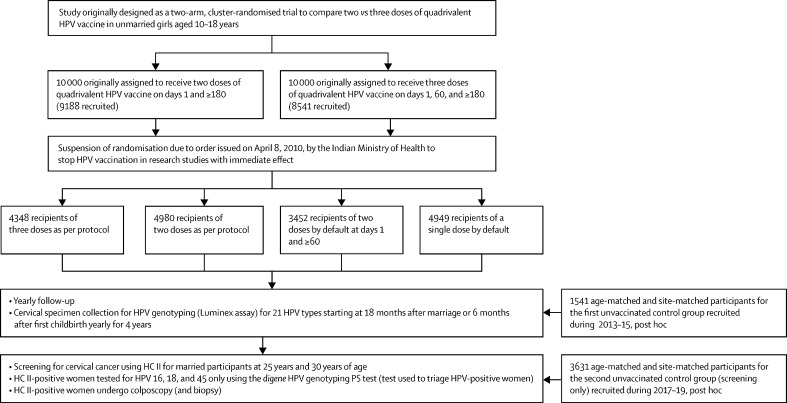
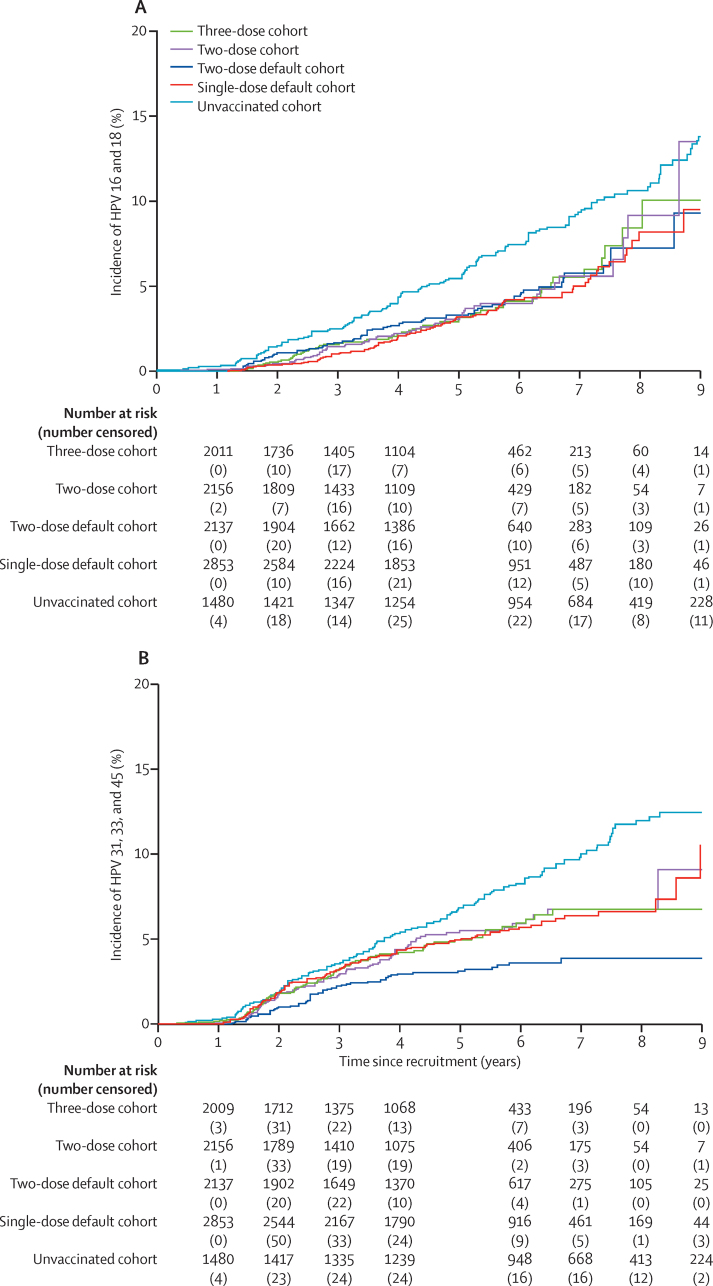
BACKGROUND: A randomised trial designed to compare three and two doses of quadrivalent human papillomavirus (HPV) vaccine in adolescent girls in India was converted to a cohort study after suspension of HPV vaccination in trials by the Indian Government. In this Article, the revised aim of the cohort study was to compare vaccine efficacy of single dose to that of three and two doses in protecting against persistent HPV 16 and 18 infection at 10 years post vaccination. METHODS: In the randomised trial, unmarried girls aged 10-18 years were recruited from nine centres across India and randomly assigned to either two doses or three doses of the quadrivalent HPV vaccine (Gardasil [Merck Sharp & Dohme, Whitehouse Station, NJ, USA]; 0·5 mL administered intramuscularly). After suspension of recruitment and vaccination, the study became a longitudinal, prospective cohort study by default, and participants were allocated to four cohorts on the basis of the number vaccine doses received per protocol: the two-dose cohort (received vaccine on days 1 and 180 or later), three-dose cohort (days 1, 60, and 180 or later), two-dose default cohort (days 1 and 60 or later), and the single-dose default cohort. Participants were followed up yearly. Cervical specimens were collected from participants 18 months after marriage or 6 months after first childbirth, whichever was earlier, to assess incident and persistent HPV infections. Married participants were screened for cervical cancer as they reached 25 years of age. Unvaccinated women age-matched to the married vaccinated participants were recruited to serve as controls. Vaccine efficacy against persistent HPV 16 and 18 infections (the primary endpoint) was analysed for single-dose recipients and compared with that in two-dose and three-dose recipients after adjusting for imbalance in the distribution of potential confounders between the unvaccinated and vaccinated cohorts. This trial is registered with ISRCTN, ISRCTN98283094, and ClinicalTrials.gov, NCT00923702. FINDINGS: Vaccinated participants were recruited between Sept 1, 2009, and April 8, 2010 (date of vaccination suspension), and followed up over a median duration of 9·0 years (IQR 8·2-9·6). 4348 participants had three doses, 4980 had two doses (0 and 6 months), and 4949 had a single dose. Vaccine efficacy against persistent HPV 16 and 18 infection among participants evaluable for the endpoint was 95·4% (95% CI 85·0-99·9) in the single-dose default cohort (2135 women assessed), 93·1% (77·3-99·8) in the two-dose cohort (1452 women assessed), and 93·3% (77·5-99·7) in three-dose recipients (1460 women assessed). INTERPRETATION: A single dose of HPV vaccine provides similar protection against persistent infection from HPV 16 and 18, the genotypes responsible for nearly 70% of cervical cancers, to that provided by two or three doses. FUNDING: Bill & Melinda Gates Foundation.
Overview
The claims and statistics of this paper haven’t been checked yet.
Run the check — free, no account needed. It reads the open-access text and checks the sources it cites.
Integrity signals
Registry
Cites
Statistics
Figures
Verification
Claims the paper makes
The claims and statistics of this paper haven’t been checked yet.
Run the check — free, no account needed. It reads the open-access text and checks the sources it cites.
Claims other papers make about this one
Each is checked against this paper’s own text: does it say what the citing paper says it does?
The source backs part of the claim, not all of it — or backs it for a different population, condition or comparison.
In the citing paper
“Notably, the IARC India trial with a quadrivalent vaccine, and the Costa Rica Trial with a bivalent vaccine, have shown comparable efficacy between single-dose and multi-dose schedules, with sustained antibody levels for at least 11 years after vaccination.”
From Evidence-based impact projections of single-dose human papillomavirus vaccination in India: a modelling study (2022) · cites this paper as [11]
Experimental — accuracy not yet measuredThe cited source says what the claim attributes to it.
In the citing paper
“which currently provides the best data on single-dose protection because of its long follow-up and near-random assignment of participants to different dose schedules.10, 11”
From Evidence-based impact projections of single-dose human papillomavirus vaccination in India: a modelling study (2022) · cites this paper as [11]
The check wasn’t confident either way, so it gives no verdict — never disputed.
In the citing paper
“The titles and abstracts of all retrieved records were independently screened by two reviewers (KJ and RRD) using pre-defined inclusion and exclusion criteria on the Rayyan web-based systematic review platform8.”
From Barriers to HPV vaccination among adolescent girls in India: A scoping review (2026) · cites this paper as [8]
Experimental — accuracy not yet measured
Self-check
Percentages, sums and reported differences re-computed from the paper’s own numbers.
The self-check needs the paper’s full text.
Citations
Cites
Vaccine delivery: a matter of size, geometry, kinetics and molecular patterns
Bachmann, M. F., & Jennings, G. T. (2010) · Nature reviews. Immunology · doi:10.1038/nri2868 · Cited by 2,120
Presentation of multivariate data for clinical use: The Framingham Study risk score functions
SULLIVAN, L. M., Massaro, J. M., & D’Agostino, R. B. (2004) · Statistics in Medicine · doi:10.1002/sim.1742 · Cited by 1,756
Epidemiologic Analysis with a Programmable Calculator
Rothman, K. J., Boice, H. D., & Austin, H. D. (1982) · American Journal of Epidemiology · Cited by 1,039
Brisson, M., Kim, J. J., Canfell, K., Drolet, M., Gingras, G., Burger, E. A., Martin, D., Simms, K. T., Bénard, É., Boily, M.-C., et al. (2020) · The Lancet · doi:10.1016/s0140-6736(20)30068-4 · Cited by 943
Bruni, L., Saura‐Lázaro, A., Montoliu, A., Brotons, M., Alemany, L., Diallo, M., Afsar, O. Z., LaMontagne, D. S., Mosina, L., Contreras, M., et al. (2020) · Preventive Medicine · doi:10.1016/j.ypmed.2020.106399 · Cited by 767
Kreimer, A. R., Struyf, F., Rosario‐Raymundo, M. R. D., Hildesheim, A., Skinner, S. R., Wacholder, S., Garland, S. M., Herrero, R., David, M., & Wheeler, C. M. (2015) · The Lancet Oncology · doi:10.1016/s1470-2045(15)00047-9 · Cited by 316
Sankaranarayanan, R., Prabhu, P. R., Pawlita, M., Gheit, T., Bhatla, N., Muwonge, R., Nene, B. M., Esmy, P. O., Joshi, S., Poli, U. R. R., et al. (2016) · The Lancet Oncology · doi:10.1016/s1470-2045(15)00414-3 · Cited by 242
Self-citationEvaluation of Durability of a Single Dose of the Bivalent HPV Vaccine: The CVT Trial
Kreimer, A. R., Sampson, J. N., Porras, C., Schiller, J. T., Kemp, T. J., Herrero, R., Wagner, S. A., Boland, J. F., Schussler, J. E., Lowy, D. R., et al. (2020) · JNCI Journal of the National Cancer Institute · doi:10.1093/jnci/djaa011 · Cited by 220
In Vivo Mechanisms of Vaccine-Induced Protection against HPV Infection
Day, P. M., Kines, R. C., Thompson, C. D., Jagu, S., Roden, R. B. S., Lowy, D. R., & Schiller, J. T. (2010) · Cell Host & Microbe · doi:10.1016/j.chom.2010.08.003 · Cited by 171
Sankaranarayanan, R., Joshi, S., Muwonge, R., Esmy, P. O., Basu, P., Prabhu, P., Bhatla, N., Nene, B. M., Shaw, J., Poli, U. R. R., et al. (2018) · Vaccine · doi:10.1016/j.vaccine.2018.02.087 · Cited by 164
Self-citationCurrent status of human papillomavirus vaccination in India's cervical cancer prevention efforts
Sankaranarayanan, R., Basu, P., Kaur, P., Bhaskar, R., Singh, G. B., Denzongpa, P., Grover, R. K., Sebastian, P., Saikia, T., Oswal, K., et al. (2019) · The Lancet Oncology · doi:10.1016/s1470-2045(19)30531-5 · Cited by 136
Self-citationWhitworth, H. S., Gallagher, K. E., Howard, N., Mounier-Jack, S., Mbwanji, G., Kreimer, A. R., Basu, P., Kelly, H., Drolet, M., Brisson, M., et al. (2020) · Vaccine · doi:10.1016/j.vaccine.2019.12.017 · Cited by 118
Self-citationIs one dose of human papillomavirus vaccine as effective as three?: A national cohort analysis
Brotherton, J. M. L., Budd, A. C., Rompotis, C., Bartlett, N., Malloy, M. J., Andersen, R. L., Coulter, K. A., Couvee, P. W., Steel, N., Ward, G. H., et al. (2019) · Papillomavirus Research · doi:10.1016/j.pvr.2019.100177 · Cited by 118
Bosch, F. X., Qiao, Y., & Castellsagué, X. (2006) · International Journal of Gynecology & Obstetrics · doi:10.1016/s0020-7292(07)60004-6 · Cited by 97
Durability of Cross-Protection by Different Schedules of the Bivalent HPV Vaccine: The CVT Trial
Tsang, S. H., Sampson, J. N., Schussler, J. E., Porras, C., Wagner, S. A., Boland, J. F., Cortés, B., Lowy, D. R., Schiller, J. T., SCHIFFMAN, M. H., et al. (2020) · JNCI Journal of the National Cancer Institute · doi:10.1093/jnci/djaa010 · Cited by 95
Prem, K., Choi, Y. H., Bénard, É., Burger, E. A., Hadley, L., Laprise, J., Regan, M. C., Drolet, M., Sy, S., Abbas, K., et al. (2023) · BMC Medicine · doi:10.1186/s12916-023-02988-3 · Cited by 78
Markowitz, L. E., Naleway, A. L., Klein, N. P., Lewis, R. M., Crane, B., Querec, T. D., Hsiao, A., Aukes, L. L., Timbol, J., Weinmann, S. A., et al. (2019) · The Journal of Infectious Diseases · doi:10.1093/infdis/jiz555 · Cited by 74
Verdoodt, F., Dehlendorff, C., & Kjær, S. K. (2019) · Clinical Infectious Diseases · doi:10.1093/cid/ciz239 · Cited by 64
Rodriguez, A. M., Zeybek, B., Vaughn, M. M., Westra, J. R., Kaul, S., Montealegre, J. R., Lin, Y., & Kuo, Y. (2020) · Cancer · doi:10.1002/cncr.32700 · Cited by 51
Eklund, C., Forslund, O., Wallin, K., & Dillner, J. (2018) · Journal of Clinical Virology · doi:10.1016/j.jcv.2018.01.016 · Cited by 46
Orumaa, M., Kjær, S. K., Dehlendorff, C., Munk, C., Olsen, A. O., Hansen, B. T., Campbell, S., & Nygård, M. (2020) · Vaccine · doi:10.1016/j.vaccine.2019.12.016 · Cited by 36
Basu, P. S., Muwonge, R., Bhatla, N., Nene, B. M., Joshi, S., Esmy, P. O., Poli, U. R., Joshi, G. M., Verma, Y., Zomawia, E., et al. (2019) · Papillomavirus Research · doi:10.1016/j.pvr.2019.01.004 · Cited by 29
Self-citationEliminating cervical cancer in the COVID-19 era
Ginsburg, O., Basu, P. S., Kapambwe, S. K., & Canfell, K. (2021) · Nature Cancer · doi:10.1038/s43018-021-00178-9 · Cited by 28
Self-citationGlobal Partnerships for HPV Vaccine Must Look Beyond National Income
Shinkafi-Bagudu, Z. (2020) · JCO Global Oncology · doi:10.1200/go.20.00504 · Cited by 22
Zeybek, B., Lin, Y., Kuo, Y., & Rodriguez, A. M. (2018) · Journal of Lower Genital Tract Disease · doi:10.1097/lgt.0000000000000401 · Cited by 20
Prem, K., Choi, Y. H., Bénard, É., Burger, E. A., Hadley, L., Laprise, J., Regan, M. C., Drolet, M., Sy, S., Abbas, K., et al. (2021) · medRxiv · doi:10.1101/2021.02.08.21251186 · Cited by 13
Prem, K., Choi, Y. H., Bénard, É., Burger, E. A., Hadley, L., Laprise, J., Regan, C., Drolet, M., Sy, S., Abbas, K., et al. (2021) · SSRN Electronic Journal · doi:10.2139/ssrn.3779876 · Cited by 9
Cited by
Sorted by citations
Falcaro, M., Castañon, A., Ndlela, B., Checchi, M., Soldan, K., Lopez-Bernal, J., Elliss-Brookes, L., & Sasieni, P. (2021) · The Lancet · doi:10.1016/s0140-6736(21)02178-4 · Cited by 785
Human Papillomavirus Vaccine Efficacy and Effectiveness against Cancer
Kamolratanakul, S., & Pitisuttithum, P. (2021) · Vaccines · doi:10.3390/vaccines9121413 · Cited by 303
Efficacy of Single-Dose Human Papillomavirus Vaccination among Young African Women
Barnabas, R. V., Brown, E. R., Onono, M. A., Bukusi, E. A., Njoroge, B., Winer, R. L., Galloway, D. A., Pinder, L. F., Donnell, D., Wakhungu, I., et al. (2022) · NEJM Evidence · doi:10.1056/evidoa2100056 · Cited by 223
Recent Developments in Human Papillomavirus (HPV) Vaccinology
Williamson, A. (2023) · Viruses · doi:10.3390/v15071440 · Cited by 227
Human Papillomavirus Vaccination
Markowitz, L. E., & Unger, E. R. (2023) · New England Journal of Medicine · doi:10.1056/nejmcp2108502 · Cited by 136
Metadata
- Authors
- Basu, P., Malvi, S. G., Joshi, S., Bhatla, N., Muwonge, R., Lucas, E., Verma, Y., Esmy, P. O., Poli, U. R. R., Shah, A., Zomawia, E., Pimple, S., Jayant, K., Hingmire, S., Chiwate, A., Divate, U., Vashist, S., Mishra, G., Jadhav, R., Siddiqi, M., Sankaran, S., Prabhu, P. R., Kannan, T. P. R. A., Varghese, R., Shastri, S. S., Anantharaman, D., Gheit, T., Tommasino, M., Sauvaget, C., Pillai, M. R., & Sankaranarayanan, R.
- Affiliations
- Centre international de recherche sur le cancer (FR)
- Nargis Dutt Memorial Cancer Hospital (IN)
- Jehangir Hospital (IN)
- All India Institute of Medical Sciences (IN)
- Sikkim Manipal University (IN)
- Public Health Foundation of India (IN)
- Gujarat Cancer & Research Institute (IN)
- Homi Bhabha National Institute (IN)
- Cancer Foundation of India (IN)
- Rajiv Gandhi Centre for Biotechnology (IN)
- Fred Hutch Cancer Center (US)
- The University of Texas MD Anderson Cancer Center (US)
- RTI International (US)
- Corresponding author
- Basu, Partha
- ORCID
- Basu, Partha
- Bhatla, Neerja
- Muwonge, Richard
- Lucas, Eric
- Verma, Yogesh
- Poli, Usha Rani Reddy
- Shah, Anand
- Zomawia, Eric
- Pimple, Sharmila
- Divate, Uma
- Vashist, Shachi
- Mishra, Gauravi
- Siddiqi, Maqsood
- Prabhu, Priya Ramesh
- Varghese, Rintu
- Shastri, Surendra S
- Anantharaman, Devasena
- Gheit, Tarik
- Tommasino, Massimo
- Sauvaget, Catherine
- Pillai, M Radhakrishna
- Sankaranarayanan, Rengaswamy
- Venue
- The Lancet Oncology
- Publisher
- Elsevier BV
- Published
- 2021-11
- Volume
- 22
- Issue
- 11
- Pages
- 1518-1529
- ISSN
- 1470-2045 (ISSN-L)
- PMC
- PMC8560643
- OpenAlex
- W3204615344
- Cited by
- 272
- References
- 29
- Citations by year
- 2026: 41 · 2025: 63 · 2024: 72 · 2023: 46 · 2022: 41 · 2021: 9
- FWCI
- 30.26
- Type
- journal article
- Language
- en
- Update notices
- erratum (2022-01-01)
- Open access
- hybrid
- doi.org
- Licence
- Locations
- The Lancet Oncology (publishedVersion, cc-by)
- Europe PMC (PubMed Central) (publishedVersion, other-oa)
- PubMed Central (publishedVersion, cc-by)
- PubMed (publishedVersion)
- Funders
- GlaxoSmithKline
- World Health Organization
- Centre International de Recherche sur le Cancer
- Seventh Framework Programme (FP7-HEALTH-2011-282562)
- Bill and Melinda Gates Foundation
- Topics
- Health Sciences › Medicine › Epidemiology › Cervical Cancer and HPV Research
- Health Sciences › Medicine › Surgery › Genital Health and Disease
- Life Sciences › Immunology and Microbiology › Microbiology › Reproductive tract infections research
- Keywords
- human papillomavirus, HPV16, HPV 18, quadrivalent HPV vaccine, Gardasil, vaccine efficacy, persistent HPV infection, single-dose vaccination, two-dose vaccination, adolescent girls, cervical cancer prevention, cervical cancer screening, India, cervical cancer incidence
- MeSH terms
- Human Papillomavirus Recombinant Vaccine Quadrivalent, Types 6, 11, 16, 18, Adolescent, Uterine Cervical Neoplasms, Cervix Uteri, Child, Female, Humans, India, Longitudinal Studies, Prospective Studies, Vaccination, Papillomavirus Infections, Human papillomavirus 18, Human papillomavirus 16
About these checks
Registry, retraction, Cites and statistics results are computed, not judged, with one exception: a printed reference that no index lists is read once by a model before it counts as a citation error. Claims are extracted by a model and kept only when their quote appears verbatim in the text; each cited source is then checked, with a model’s help, for whether it says what the claim relies on. Those verdicts can be wrong — read the claim’s quote and the cited source before relying on one.
Statistics and arithmetic are recomputed, not judged.
Confidence bands are shown only for fields calibrated on our annotated test set. None is calibrated yet, so no band is shown.
What counts as a claim ›How we measure confidence ›How we check this ›
Are you an author, or do you see a problem with this page? Request a review
