

Highly drug-resistant Salmonella enterica serotype Kentucky ST198-X1: a microbiological study
Open accessThe DOI matches its Crossref record; 31 of the 31 references it cites were found in a registry or an index.
Abstract
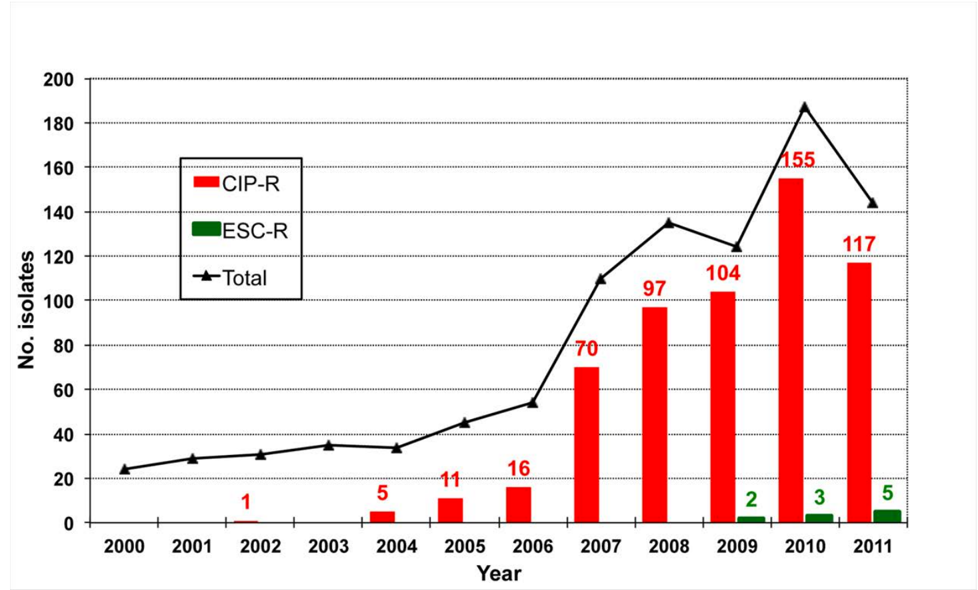
BACKGROUND Salmonella enterica is a major global food-borne pathogen, causing life-threatening infections. Ciprofloxacin and extended-spectrum cephalosporins (ESCs) are the drugs of choice for severe infections. We previously reported a ciprofloxacin-resistant S. enterica serotype Kentucky (S Kentucky) ST198-X1 strain that emerged in Egypt and spread throughout Africa and the Middle East from 2002 to 2008. We aimed to monitor recent trends in the location of transmission and antimicrobial resistance of this strain. METHODS We analysed isolates of S Kentucky collected by the French national surveillance system for salmonellosis in France from Jan 1, 2000, to Dec 31, 2011, and at two sites in Casablanca, Morocco, between Jan 1, 2003, and Dec 31, 2011. We analysed patterns of travel of patients infected with a ciprofloxacin-resistant strain of S Kentucky. We identified isolates showing resistance to ESCs or decreased susceptibility to carbapenems, characterised isolates by XbaI-pulsed field gel electrophoresis and multilocus sequence typing, and assessed mechanisms of bacterial resistance to antimicrobial drugs. FINDINGS 954 (1%) of 128,836 serotyped Salmonella spp isolates in France were identified as S Kentucky, as were 30 (13%) of 226 Salmonella spp isolates from Morocco. During 2000-08, 200 (40%) of 497 subculturable isolates of S Kentucky obtained in France were resistant to ciprofloxacin, compared with 376 (83%) of 455 isolates in 2009-11, suggesting a recent increase in ciprofloxacin resistance in France. Travel histories suggested S Kentucky infections originated predominantly in east Africa, north Africa, west Africa, and the Middle East, but also arose in India. We report several occurrences of acquisition of extended-spectrum β-lactamase (CTX-M-1, CTX-M-15), plasmid-encoded cephalosporinase (CMY-2), or carbapenemase (OXA-48, VIM-2) genes by ciprofloxacin-resistant isolates of S Kentucky ST198-X1 from the Mediterranean area since 2009. Many of these highly drug-resistant isolates were also resistant to most aminoglycosides, to co-trimoxazole (trimethoprim-sulfamethoxazole), and to azithromycin. INTERPRETATION The potential risk to public health posed by ciprofloxacin-resistant S Kentucky ST198-X1 warrants its inclusion in national programmes for the control of S. enterica in food-producing animals, in particular in poultry. FUNDING Institut Pasteur, Institut de Veille Sanitaire, Fondation pour la Recherche Médicale, French Government Investissement d'Avenir programme.
Overview
The claims and statistics of this paper haven’t been checked yet.
Free: it reads the open-access text and checks the first 5 claims that cite a source we can check. Create a free account to check every claim.
Integrity signals
Registry
Cites
Statistics
Figures
Verification
Claims the paper makes
The claims and statistics of this paper haven’t been checked yet.
Free: it reads the open-access text and checks the first 5 claims that cite a source we can check. Create a free account to check every claim.
Claims other papers make about this one
Each is checked against this paper’s own text: does it say what the citing paper says it does?
The source backs part of the claim, not all of it — or backs it for a different population, condition or comparison.
In the citing paper
“The three MDR serotype Kentucky isolates (see below) were ST198, clustered into the HC2000_528 superlineage”
From Contamination of street food with multidrug-resistant Salmonella, in Ouagadougou, Burkina Faso (2021) · cites this paper as [14]
Experimental — accuracy not yet measured
Self-check
Percentages, sums and reported differences re-computed from the paper’s own numbers.
The self-check needs the paper’s full text.
Citations
Cites
The Global Burden of Nontyphoidal Salmonella Gastroenteritis
Majowicz, S. E., Musto, J., Scallan, E., Angulo, F. J., Kirk, M., O’Brien, S. J., Jones, T. F., Fazil, A., & Hoekstra, R. M. (2010) · Clinical Infectious Diseases · doi:10.1086/650733 · Cited by 2,442
Global Spread of Carbapenemase-producing Enterobacteriaceae
Nordmann, P., Naas, T., & Poirel, L. (2011) · Emerging Infectious Diseases · doi:10.3201/eid1710.110655 · Cited by 2,378
Antibiotic-Resistant Bugs in the 21st Century — A Clinical Super-Challenge
Arias, C. A., & Murray, B. E. (2009) · New England Journal of Medicine · doi:10.1056/nejmp0804651 · Cited by 1,027
Detection of erythromycin-resistant determinants by PCR
Sutcliffe, J., Grebe, T., Tait-Kamradt, A., & Wondrack, L. (1996) · Antimicrobial Agents and Chemotherapy · doi:10.1128/aac.40.11.2562 · Cited by 989
OXA-48-like carbapenemases: the phantom menace
Poirel, L., Potron, A., & Nordmann, P. (2012) · Journal of Antimicrobial Chemotherapy · doi:10.1093/jac/dks121 · Cited by 924
Rapid Detection of Carbapenemase-producing Enterobacteriaceae
Nordmann, P., Poirel, L., & Dortet, L. (2012) · Emerging Infectious Diseases · doi:10.3201/eid1809.120355 · Cited by 761
The emerging NDM carbapenemases
Nordmann, P., Poirel, L., Walsh, T. R., & Livermore, D. M. (2011) · Trends in Microbiology · doi:10.1016/j.tim.2011.09.005 · Cited by 663
A National Outbreak of Salmonella enteritidis Infections from Ice Cream
Hennessy, T. W., Hedberg, C. W., Slutsker, L., White, K. E., Besser-Wiek, J. M., Moen, M. E., Feldman, J., Coleman, W. W., Edmonson, L. M., MacDonald, K. L., et al. (1996) · New England Journal of Medicine · doi:10.1056/nejm199605163342001 · Cited by 389
Le Hello, S., Hendriksen, R. S., Doublet, B., Fisher, I., Nielsen, E. M., Whichard, J. M., Bouchrif, B., Fashae, K., Granier, S. A., Jourdan-Da Silva, N., et al. (2011) · Journal of Infectious Diseases · doi:10.1093/infdis/jir409 · Cited by 277
Self-citationThe Emergence in Taiwan of Fluoroquinolone Resistance in Salmonella enterica Serotype Choleraesuis
Chiu, C.-H., Wu, T.-L., Su, L.-H., Chu, C., Chia, J.-H., Kuo, A.-J., Chien, M.-S., & Lin, T.-Y. (2002) · New England Journal of Medicine · doi:10.1056/nejmoa012261 · Cited by 272
Cited by
Items 101–186 of 186
A meta-analysis of the proportion of antimicrobial resistant human Salmonella isolates in Ethiopia
Tadesse, G. (2014) · BMC Pharmacology and Toxicology · doi:10.1186/2050-6511-15-51 · Cited by 15
“Antimicrobial resistant Salmonella is one of the global problems in present day clinical practices and recently, a strain on the verge of pan-resistance was reported [2].”
BackgroundChelaru, E.-C., Muntean, A.-A., Hogea, M.-O., Muntean, M.-M., Popa, M. I., & Popa, G. L. (2024) · Antibiotics · doi:10.3390/antibiotics13040295 · Cited by 20
“In some regions, OXA-48 and VIM-2 Salmonella enterica ser. Kentucky were reported, according to a study published in 2013 [160].”
Tourdjman, M., Hello, S. L., Gossner, C. M., Delmas, G., Tubiana, S., Fabre, L., Kerléguer, A., Tarantola, A., Fruth, A., Friesema, I. H. M., et al. (2013) · Eurosurveillance · doi:10.2807/1560-7917.es2013.18.39.20594 · Cited by 14
“We determined the minimum inhibitory concentration (MIC) of ciprofloxacin, nalidixic acid and azithromycin using Etests (bioMérieux, Marcy l’Etoile, France), as previously described [9].”
MethodSelf-citationSalmonella spp. in poultry: a constant challenge and new insights
Velhner, M., Milanov, D. S., & Kozoderović, G. (2018) · Journal of the Hellenic Veterinary Medical Society · doi:10.12681/jhvms.18012 · Cited by 18
“The international trade has facilitated the spread of those strains to the domestic poultry in the region of Mediterranean basin (Le Hello et al., 2013).”
BackgroundBesharati, S., Sadeghi, A. B., Ahmadi, F., Tajeddin, E., Salehi, R. M., Fani, F., Pouladfar, G., Nikmanesh, B., Majidpour, A., Moghadam, S. S., et al. (2020) · PubMed · Cited by 17
Al‐Gallas, N., Belghouthi, K., Barratt, N., Ghedira, K., Hotzel, H., Tomaso, H., El‐Adawy, H., Neubauer, H., Laouini, D., Zarrouk‐Mahjoub, S., et al. (2021) · Journal of Applied Microbiology · doi:10.1111/jam.15211 · Cited by 16
“T A B L E 2 (Continued) | 287AL- GALLAS et AL. observations agree with the studies of Le Hello et al. (2013) and Eguale et al. (2015).”
BackgroundResultInfluentialChin, T. L., MacGowan, A. P., Bowker, K. E., Elder, F. C. T., Beck, C., & McNulty, C. A. M. (2015) · Journal of Antimicrobial Chemotherapy · doi:10.1093/jac/dkv050 · Cited by 14
Karraouan, B., Ziyate, N., Ed‐Dra, A., Amajoud, N., Boutaib, R., Akil, A., Allaoui, A. E., Ossmani, H. E., Zerouali, K., Elmdaghri, N., et al. (2017) · The Journal of Infection in Developing Countries · doi:10.3855/jidc.8171 · Cited by 13
“In Egypt, during the period 2002-2005 Salmonella Kentucky resistance to ciprofloxacin was a major health problem and from there it spread throughout Africa and Middle East [2].”
BackgroundSelf-citationKhallaf, M., Ameur, N., Terta, M., Lakranbi, M., Senouci, S., & Ennaji, M. M. (2014) · Cited by 14
Antimicrobial resistance among GLASS pathogens in Morocco: an epidemiological scoping review
Nejjari, C., Achhab, Y. E., Benaouda, A., & Chakib, A. (2022) · BMC Infectious Diseases · doi:10.1186/s12879-022-07412-4 · Cited by 22
Badr, H., Roshdy, H., Sorour, H. K., AbdelRahman, M. A. A., Erfan, A. M., Salem, N. O. Y., Nasef, S. A., HASSAN, W. M. M., & Abdelaty, M. F. (2021) · Advances in Animal and Veterinary Sciences · doi:10.17582/journal.aavs/2021/9.6.823.834 · Cited by 14
Afroj, S., Aldahami, K., Reddy, G., Guard, J. Y., Adesiyun, A. A., Samuel, T., & Abdela, W. (2017) · Journal of Food Protection · doi:10.4315/0362-028x.jfp-17-133 · Cited by 13
Veeraraghavan, B., Jacob, J. J., Prakash, J. A. J., Pragasam, A. K., Neeravi, A., Narasimman, V., & Anandan, S. (2019) · Pathogens and Global Health · doi:10.1080/20477724.2019.1574112 · Cited by 16
Zhou, Y., Wu, K., Lin, H., Hu, Y.-L., Xu, W., Zhang, J., Zhou, S., Yu, K., Liu, C., Wang, H., et al. (2025) · Poultry Science · doi:10.1016/j.psj.2025.105647 · Cited by 12
Chen, K., Peng, J., Peng, Z., Xiao, R., Wang, N., Deng, Y., Wu, C., Zheng, Z., Guan, J., Tang, Y., et al. (2025) · Emerging Microbes & Infections · doi:10.1080/22221751.2025.2576588 · Cited by 13
“Notably, ST314 emerged as a prevalent novel type alongside ST198 on a global scale, exhibiting epidemiological trends that mirror those of ST198, a clone of public health significance [4,7].”
InfluentialRagheb, S. M., Govinden, U., & Sekyere, J. O. (2021) · Annals of the New York Academy of Sciences · doi:10.1111/nyas.14703 · Cited by 13
Al‐Gallas, N., Khadraoui, N., Hotzel, H., Tomaso, H., El‐Adawy, H., Neubauer, H., Belghouthi, K., Ghedira, K., Gautam, H. K., Kumar, B., et al. (2020) · Journal of Applied Microbiology · doi:10.1111/jam.14822 · Cited by 12
“Unfortunately, fluoroquinolone-resistant zoonotic and environmental Salmonella isolates have frequently been reported and have become increasingly common in Europe and the United States (Turki et al. 2012; Le Hello et al. 2013; Wasyl et al. 2015; Acheampong et al. 2019).”
BackgroundSlowey, R., Kim, S. W., Prendergast, D. M., Madigan, G., Kessel, J. A. S. V., & Haley, B. J. (2021) · Zoonoses and Public Health · doi:10.1111/zph.12884 · Cited by 12
Ju, Z., Cui, L., Lei, C., Song, M., Chen, X., Liao, Z., Zhang, T., & Wang, H. (2023) · Antibiotics · doi:10.3390/antibiotics12111642 · Cited by 12
“Kentucky have presented risks for public health in recent years [67–69].”
BackgroundZhai, W., Lu, M., Zhao, L., Du, P., Cui, S., Liu, Y., Tan, D., Zeng, X., Yang, B., Li, R., et al. (2025) · mSystems · doi:10.1128/msystems.01018-24 · Cited by 16
“Unlike other MDR serovars, such as Indiana/Kentucky, which harbor plasmid replicons like IncHI2/HI2A, IncX1, and IncI2 along with mutations in gyrA and parC (18, 59), the emergence of CIP R CTX R AZI R phenotypes in S .”
Sharma, N. C., Kumar, D., Sarkar, A., Chowdhury, G., Mukhopadhyay, A. K., & Ramamurthy, T. (2019) · Japanese Journal of Infectious Diseases · doi:10.7883/yoken.jjid.2019.063 · Cited by 11
Hage, R. E., Losasso, C., Longo, A., Petrin, S., Ricci, A., Mathieu, F., Khattar, Z. A., & Rayess, Y. E. (2020) · Journal of Global Antimicrobial Resistance · doi:10.1016/j.jgar.2020.11.002 · Cited by 12
“First recorded in Egypt in 2002, a new clone of ciprofloxacinresistant (CIP) Salmonella Kentucky sequence type 198 (ST198) has spread worldwide [2,3], causing human infections linked to travellers returning from the Middle East, Southeast Asia and Africa [4].”
BackgroundInfluentialQu, M., Huang, Y., Lyu, B., Zhang, X., Tian, Y., Feng, Z., Gao, Z., & Zhang, D. (2024) · China CDC Weekly · doi:10.46234/ccdcw2024.179 · Cited by 10
Vázquez, X., Fernández, J., Bances, M., Lumbreras-Iglesias, P., Alkorta, M., Hernáez, S., Prieto, E., de la Iglesia, P., de Toro, M., Rodicio, M. R., et al. (2021) · Frontiers in Microbiology · doi:10.3389/fmicb.2021.720449 · Cited by 11
Nassri, I., Tahri, L., Saïdi, A., Ameur, N., & Fekhaoui, M. (2021) · Biodiversitas Journal of Biological Diversity · doi:10.13057/biodiv/d220337 · Cited by 14
“Other studies have shown a fairly high prevalence of multidrug-resistant strains (Oubrim et al. 2012; Le Hello et al. 2013b; Chahboune et al. 2014; Ed-dra et al. 2017).”
BackgroundInfluentialTalukder, S., Hasan, M. M., Mandal, A. K., Tasmim, S. T., Parvin, M. S., Ali, M. Y., Nahar, A., Islam, M. Z., & Islam, M. T. (2021) · The Journal of Infection in Developing Countries · doi:10.3855/jidc.14100 · Cited by 13
“Moreover, cross-resistance in other antimicrobial classes due to the result of long term and intensive use of broad-spectrum antimicrobial agents alone or in combinations in the agricultural sector might be the reason behind the emergence and spread of carbapenem resistance [39].”
BackgroundLiu, X., Yang, X., Ye, L., Chan, E. W., & Chen, S. (2022) · Microbiology Spectrum · doi:10.1128/spectrum.00788-22 · Cited by 16
Enteropathogens and antibiotics
González-Torralba, A., García-Esteban, C., & Alós, J.-I. (2017) · Enfermedades infecciosas y microbiologia clinica (English ed ) · doi:10.1016/j.eimce.2015.06.002 · Cited by 11
Amare, A., Asnakew, F., Asressie, Y., Guadie, E., Tirusew, A., Muluneh, S., Awoke, A., Assefa, M., Ferede, W., Getaneh, A., et al. (2024) · PLoS ONE · doi:10.1371/journal.pone.0301697 · Cited by 11
“A pan-resistant Salmonella strain was recently reported [40].”
BackgroundOccurrence of Aztreonam-Avibactam-Resistant NDM-5-Producing Escherichia coli in the Food Chain
Sadek, M., Poirel, L., & Nordmann, P. (2021) · Antimicrobial Agents and Chemotherapy · doi:10.1128/aac.00882-21 · Cited by 10
“another study, Salmonella enterica clinical isolates producing VIM-2 and OXA-48 were reportedly isolated from a French patient with a travel history to Africa and the Middle East, suggesting foodborne transmission of carbapenemase producers (18).”
BackgroundEnteropatógenos y antibióticos
González-Torralba, A., García-Esteban, C., & Alós, J.-I. (2015) · Enfermedades Infecciosas y Microbiología Clínica · doi:10.1016/j.eimc.2015.06.015 · Cited by 9
Wang, W., Liu, F., Peng, Z., Li, F., & Ma, A. (2016) · Genome Announcements · doi:10.1128/genomea.00662-16 · Cited by 9
“Salmonella enterica is a major global foodborne pathogen, causing life-threatening infections (1).”
BackgroundMolecular epidemiology of Salmonella Enteritidis in humans and animals in Spain
Samper-Cativiela, C., Torre‐Fuentes, L., Diéguez-Roda, B., Maex, M., Ugarte‐Ruiz, M., Carrizo, P., Hernández, M., Höfle, Ú., Sáez, J. L., de Frutos, C., et al. (2025) · Antimicrobial Agents and Chemotherapy · doi:10.1128/aac.00738-24 · Cited by 12
“Nevertheless, considering the recent emergence of new Salmo nella clones linked with travelers in poultry production in Europe (such as Salmonella Kentucky ST198) (58), some of which may pose a potential public health threat, their distribution should be monitored in the future as suggested before (59).”
Mechanisms of Resistance to Quinolones and Epidemiological Significance of Salmonella spp.
Velhner, M. (2016) · Acta veterinaria · doi:10.1515/acve-2016-0013 · Cited by 8
Characterization and resistance mechanism of phage-resistant strains of Salmonella enteritidis
Zeng, Y., Shen, M., Liu, S., & Zhou, X. (2024) · Poultry Science · doi:10.1016/j.psj.2024.103756 · Cited by 9
OXA-48 carbapenemase-producing Salmonella enterica serovar Kentucky ST198 isolated from Saudi Arabia
Alghoribi, M. F., Desin, T. S., Alswaji, A. A., Alwan, B. H. A., Alzayer, M., Okdah, L., Johani, S. A., Balkhy, H. H., & Doumith, M. (2020) · Journal of Antimicrobial Chemotherapy · doi:10.1093/jac/dkaa077 · Cited by 7
Guard, J. Y., Abdo, Z., Byers, S. O., Kriebel, P., & Rothrock, M. J. (2016) · Foodborne Pathogens and Disease · doi:10.1089/fpd.2015.2088 · Cited by 7
“Serotype Kentucky is at most an infrequent cause of human disease, but there is concern that it carries a transmissible plasmid encoding antibiotic resistance (Le Hello et al., 2013).”
BackgroundAnti Microbial Resistance in Salmonella
Singh, Y., Saxena, A., Bohra, J. S., Kumar, R., Kumar, A., & Saxena, M. K. (2019) · Journal of Basic & Applied Sciences · doi:10.29169/1927-5129.2019.15.03 · Cited by 7
Hanafi, M. E., Bouchriti, N., Nassik, S., & Karib, H. (2023) · World s Veterinary Journal · doi:10.54203/scil.2023.wvj4 · Cited by 6
Intuy, R., Supa-amornkul, S., Jaemsai, B., Ruangchai, W., Wiriyarat, W., Chaturongakul, S., & Palittapongarnpim, P. (2024) · Microbiology Spectrum · doi:10.1128/spectrum.03994-23 · Cited by 6
“Previous studies using NGS short-read data have shown that the region in SGI1-K between resG ( S027 ) and S044∆ is the primary site in the Salmonella genome where most ARGs are located (9).”
BackgroundPlasmid-mediated azithromycin resistance in non-typhoidal Salmonella recovered from human infections
Zhang, X.-W., Song, J., Zeng, S., Huang, Y., Luo, J.-J., Guo, W.-L., & Li, X. (2024) · Journal of Antimicrobial Chemotherapy · doi:10.1093/jac/dkae281 · Cited by 9
Antimicrobial Resistance of Common Zoonotic Bacteria in the Food Chain: An Emerging Threat
Rozman, V., Matijašić, B. B., & Možina, S. S. (2019) · IntechOpen eBooks · doi:10.5772/intechopen.80782 · Cited by 7
Molecular detection of the index case of a subclinical Salmonella Kentucky epidemic on a dairy farm
Haley, B. J., Allard, M. W., Brown, E. W., Hovingh, E., Karns, J. S., & Kessel, J. S. V. (2014) · Epidemiology and Infection · doi:10.1017/s0950268814001289 · Cited by 6
“have spread globally suggesting it is a serotype with clear global health significance [4, 5].”
BackgroundEmergence of VIM-1-producing Salmonella enterica serovar Typhimurium in a paediatric patient
Sotillo, A., Muñoz-Vélez, M., Santamaria, M. L., Carrascoso, G. R., Bujalance, S. G., Gómez-Gil, R., & Mingorance, J. (2015) · Journal of Medical Microbiology · doi:10.1099/jmm.0.000170 · Cited by 6
“VIM-2producing Salmonella have been described in an epidemiological survey in humans (Le Hello et al., 2013), but this is, to the best of our knowledge, the first case of nosocomial infection by a VIM-1 carbapenemaseproducing Salmonella enterica.”
BackgroundHaley, B. J., Luo, Y., Wang, C., Brown, E. W., Allard, M. W., Karns, J. S., & Kessel, J. A. S. V. (2017) · Genome Announcements · doi:10.1128/genomea.01119-17 · Cited by 6
Gorski, L., & Aviles-Noriega, A. (2023) · Microorganisms · doi:10.3390/microorganisms11082109 · Cited by 7
Sutar, A., Dashpute, R. S., Shinde, Y. D., Mukherjee, S., & Chowdhury, C. (2023) · Indian Journal of Microbiology · doi:10.1007/s12088-023-01176-4 · Cited by 7
“Portable analytical tools such as Paper Based Analytical Devices have also been explored to develop a Macrolides class of antibiotics [199] detection strategy for Salmonella due to their unique properties such as less reagent requirement, portability and dis-posability (Table 3) [142].”
Microbiological Hazards of Wild Birds and Free-Range Chickens
Sánchez, S., França, M., & Nemeth, N. M. (2015) · Springer eBooks · doi:10.1007/978-3-319-24442-6_4 · Cited by 8
Salmonella : une bactérie multi-résistante aux antibiotiques dans nos assiettes
Hello, S. L. (2014) · Journal des Anti-infectieux · doi:10.1016/j.antinf.2014.10.004 · Cited by 9
Qiu, Y., Xu, H., Huang, M., Chen, J., Yang, J., & Weng, S. (2024) · Journal of Global Antimicrobial Resistance · doi:10.1016/j.jgar.2024.04.003 · Cited by 5
Ahmed, J., Soltys, R. C., Shringi, S., Guard, J. Y., Haley, B. J., & Shah, D. H. (2025) · Genes · doi:10.3390/genes16091051 · Cited by 3
“Notably, Flu R ST198 harbors two mutations in gyrA and three mutations in parC in the quinolone resistance-determining region (QRDR), which is concerning given that ciprofloxacin remains the first-line antibiotic for the treatment of NTS infections in humans worldwide [6,15].”
Salmonella - Perspectives for Low-Cost Prevention, Control and Treatment
Huang, H., & Naushad, S. (2022) · IntechOpen eBooks · doi:10.5772/intechopen.102150 · Cited by 9
Wang, J., Mei, C.-Y., Wu, H. J., Wang, Y., Wang, Z., Ma, Q.-C., Shen, P.-C., Zhou, Y., & Jiao, X. (2021) · Journal of Global Antimicrobial Resistance · doi:10.1016/j.jgar.2021.07.007 · Cited by 3
Fayrouz, D., Idam, F., Hanchi, A. L., & Soraa, N. (2023) · Cureus · doi:10.7759/cureus.35811 · Cited by 3
“No production of carbapenemase type OXA-48 was described [2].”
BackgroundInfluentialBenamrouche, N., Belkader, C., Deriet-Ammar, A., de la Gándara, M. P., Zemam, S. S., Njamkepo, E., Sadat, S., Msela, A., Fabre, L., Mechouet, F., et al. (2025) · Microbial Genomics · doi:10.1099/mgen.0.001581 · Cited by 5
“Kentucky ST198 in other North African countries [5, 6, 8, 10, 32], all S .”
InfluentialSelf-citationGrakh, K., Jadhav, V. J., Joshi, V. G., Khurana, R., & Jindal, N. (2026) · Journal of Consumer Protection and Food Safety · doi:10.1007/s00003-026-01599-3 · Cited by 2
Jovčić, B., Malešević, M., Kojić, M., Galić, N., Todorović, D., Vidanović, D., & Velhner, M. (2022) · Foodborne Pathogens and Disease · doi:10.1089/fpd.2022.0029 · Cited by 2
Kuleshov, K. V., Pavlova, A. S., Kremleva, A. A., Karpenko, A. E., Mikhailova, Y. V., Krutova, N. E., Lisitsyna, M. R., Popova, K. R., Veselova, О. А., Podkolzin, A. T., et al. (2024) · Journal of microbiology epidemiology immunobiology · doi:10.36233/0372-9311-488 · Cited by 2
Djemaioune, A., Todorović, D., Novović, K., Dramlić, S. M., Cherak, Z., Bendjama, E., Khalouta, O., Mamache, B., Jovčić, B., Velhner, M., et al. (2025) · Acta veterinaria · doi:10.2478/acve-2025-0024 · Cited by 3
Kim, S.-W., Haley, B. J., Roberson, D., Allard, M. W., Hammack, T. S., Brown, E. W., & Kessel, J. A. S. V. (2017) · Genome Announcements · doi:10.1128/genomea.01699-16 · Cited by 2
Non-Thypoid Salmonella Causes Food-borne Diseases Causing:Prevention and Control
Zelpina, E., & Noor, S. M. (2020) · Indonesian Bulletin of Animal and Veterinary Sciences · doi:10.14334/wartazoa.v30i4.2194 · Cited by 2
Sepsis caused by Salmonella Paratyphi B producing an OXA-48 carbapenemase in a traveller
Balandraud, A., Khedher, M. B., Hadjadj, L., Dubourg, G., Mailhe, M., Rolain, J., & Baron, S. A. (2021) · Journal of Global Antimicrobial Resistance · doi:10.1016/j.jgar.2021.05.020 · Cited by 2
DETECTION OF SOME OF VIRULENCE GENES IN SALMONELLA KENTUCKY ISOLATED FROM POULTRY
ABDEL RAHMAN, M., NASEF, S., & HAMED, E. (2017) · Assiut Veterinary Medical Journal/Maǧallaẗ Asyūṭ al-ṭibiyyaẗ al-baytariyyaẗ · doi:10.21608/avmj.2017.170785 · Cited by 2
Piccirilli, A., Marcantonio, S. D., Costantino, V., Simonetti, O., Busetti, M., Luzzati, R., Principe, L., Domenico, M. D., Rinaldi, A., Cammà, C., et al. (2023) · Antibiotics · doi:10.3390/antibiotics12121659 · Cited by 2
Berradi, T., Karraouan, B., Charafeddine, O., Bouchrif, B., & Abouchoaib, N. (2018) · Médecine et Maladies Infectieuses · doi:10.1016/j.medmal.2018.07.002 · Cited by 2
Self-citationAn outbreak of multidrug-resistant Salmonella Kentucky infection in long-nosed fur seals
Blyde, D. J., March, D., Howard, P., Sintchenko, V., Rousselet, E., & Atkin, C. (2020) · Diseases of Aquatic Organisms · doi:10.3354/dao03540 · Cited by 1
Zhao, H. (2024) · IntechOpen eBooks · doi:10.5772/intechopen.113376 · Cited by 1
Research Progress on Antimicrobial Resistance of Salmonella
杨, 君. (2025) · Advances in Clinical Medicine · doi:10.12677/acm.2025.151220 · Cited by 1
Qi, H., Li, M. H., Li, Y., Li, R., Cui, Y., Wu, L., Zhang, M., Zhang, G. L., & Li, Y. (2026) · Frontiers in Microbiology · doi:10.3389/fmicb.2026.1758643 · Cited by 1
Strategies for Circumventing Bacterial Resistance Mechanisms
Fisher, J. F., Johnson, J. W., & Mobashery, S. (2017) · Springer eBooks · doi:10.1007/978-1-4939-0694-9_12 · Cited by 1
Velhner, M., Milanov, D. S., & Aleksić, N. (2022) · Archives of Veterinary Medicine · doi:10.46784/eavm.v15i1.294 · Cited by 1
“…prominent examples of the successful clonal spread in Salmonella enteric serovars are Salmonella Typhimurium DT104 (Th relfall, 2000), Salmonella Kentucky ST198 (Le Hello et al., 2013), Salmonella Infantis (Aviv et al., 2014) and Salmonella Enteritidis (Pijnacker et al., 2019, Li et al., 2021).”
BackgroundBenlashehr, I., Elmasri, K., Kammon, A. M., & Asheg, A. (2024) · Journal of World s Poultry Research · doi:10.36380/jwpr.2024.22 · Cited by 2
“In addition, the recent emergence in Africa and Europe, mainly in turkey flocks of Salmonella Kentucky (CipR) resistant to ciprofloxacin (Le Hello et al., 2013) which is highly pathogenic and highly resistant to antibiotics reminds that the combat is never-ending.”
BackgroundAntimicrobial Resistance Among GLASS Pathogens In Morocco: An Epidemiological Scoping ReviewPreprint
Nejjari, C., Achhab, Y. E., Benaouda, A., & Chakib, A. (2022) · Research Square · doi:10.21203/rs.3.rs-1265452/v1 · Cited by 1
Guyomard-Rabenirina, S. (2016) · theses.fr (ABES) · doi:10.70675/6b658294zeb65z40b5z99dbzc48b8319ec4c · Cited by 2
Global Spreading of Antimicrobial Resistance through Contaminated Foods
Izumiya, H. (2014) · Japanese Journal of Food Microbiology · doi:10.5803/jsfm.31.57
Expression of pattern recognition receptors by oral epithelial cell lines
Schuschnig, M. (2011) · University of Vienna · doi:10.25365/thesis.16617
Microdiversity of Salmonella Kentucky During Long-Term Colonization of a Dairy Herd
Salaheen, S., Kim, S. W., Karns, J. S., Kessel, J. A. S. V., & Haley, B. J. (2024) · Foodborne Pathogens and Disease · doi:10.1089/fpd.2023.0090
“The global epidemiology of this serovar is quite different than that of North America and Salmonella Kentucky accounts for a much more significant portion of the salmonellosis burden in countries other than the United States (EFSA, 2016; Le Hello et al., 2013).”
Yosef, D. K. (2024) · Research Square · doi:10.21203/rs.3.rs-3948197/v1
Katsande, P., Davies, A. R., Owusu-Nyantakyi, C., Gufe, C., Musari, S., Majuru, C. S., & Machakwa, J. (2025) · Microbial Genomics · doi:10.1099/mgen.0.001550
Liu, B., Wu, S., Huang, J., Cui, L., Song, X., Tang, W., & Sun, S. (2026) · Frontiers in Veterinary Science · doi:10.3389/fvets.2026.1769606
Génomique épidémiologique de Salmonella
Dien, A. T. (2018) · theses.fr (ABES) · doi:10.70675/1cdd940bz824fz481ezac73z4880729f7dd7
Zhu, X., He, W., Hu, Y., Zhang, T., Cheng, Y., Cheng, P., Li, Z. Y., Qin, X., Dong, Q., & Xiao, L. (2026) · Food Research International · doi:10.1016/j.foodres.2026.120014
Strategies for Circumventing Bacterial Resistance Mechanisms
Fisher, J. F., Johnson, J. W., & Mobashery, S. (2014) · Springer eBooks · doi:10.1007/978-1-4939-0667-3_12-1
Metadata
- Authors
- Le Hello, S., Harrois, D., Bouchrif, B., Sontag, L., Elhani, D., Guibert, V., Zerouali, K., & Weill, F.-X.
- Affiliations
- Institut Pasteur (FR)
- Institut Pasteur du Maroc (MA)
- Centre Hospitalier Universitaire Ibn Rochd (MA)
- Corresponding author
- Weill, François-Xavier
- Venue
- The Lancet Infectious Diseases
- Publisher
- Elsevier BV
- Published
- 2013-08
- Volume
- 13
- Issue
- 8
- Pages
- 672-679
- ISSN
- 1473-3099 (ISSN-L)
- OpenAlex
- W2074192765
- Semantic Scholar
- 35623680c1b3a906362e60677dfb4c5e00034582
- Cited by
- 186
- References
- 31
- Citations by year
- 2026: 4 · 2025: 10 · 2024: 11 · 2023: 12 · 2022: 16 · 2021: 16 · 2020: 15 · 2019: 14 · 2018: 11 · 2017: 13 · 2016: 17 · 2015: 14 · 2014: 23 · 2013: 9
- FWCI
- 31.32
- Type
- journal article
- Language
- en
- Open access
- green
- pasteur.hal.science
- Licence
- cc-by
- www.elsevier.com/tdm/userlicense/1.0/ (tdm)
- www.elsevier.com/legal/tdmrep-license (tdm)
- Locations
- The Lancet Infectious Diseases (publishedVersion)
- PubMed (publishedVersion)
- HAL (submittedVersion, cc-by)
- Greater South Information System
- Funders
- French Government “Investissement d'Avenir” programme (ANR-10-LABX-62-IBEID)
- Topics
- Life Sciences › Agricultural and Biological Sciences › Food Science › Salmonella and Campylobacter epidemiology
- Health Sciences › Medicine › Microbiology (medical) › Antibiotic Resistance in Bacteria
- Health Sciences › Medicine › Infectious Diseases › Antibiotic Use and Resistance
- Keywords
- ciprofloxacin resistance, extended-spectrum cephalosporins, carbapenem resistance, antimicrobial resistance, extended-spectrum beta-lactamase, CTX-M-15, CMY-2, OXA-48, VIM-2, plasmid-mediated resistance genes, travel-associated transmission, molecular epidemiology, multilocus sequence typing
- MeSH terms
- Adolescent, Adult, Aged, Aged, 80 and over, Aminoglycosides, Anti-Bacterial Agents, Bacterial Proteins, beta-Lactamases, Child, Ciprofloxacin, Female, France, Humans, Male, Microbial Sensitivity Tests, Morocco, Salmonella Infections, Travel, Trimethoprim, Sulfamethoxazole Drug Combination, Azithromycin, Salmonella enterica, Drug Resistance, Multiple, Bacterial, Young Adult
About these checks
Registry, retraction, Cites and statistics results are computed, not judged, with one exception: a printed reference that no index lists is read once by a model before it counts as a citation error. Claims are extracted by a model and kept only when their quote appears verbatim in the text; each cited source is then checked, with a model’s help, for whether it says what the claim relies on. Those verdicts can be wrong — read the claim’s quote and the cited source before relying on one.
Statistics and arithmetic are recomputed, not judged.
Confidence bands are shown only for fields calibrated on our annotated test set. None is calibrated yet, so no band is shown.
What counts as a claim ›How we measure confidence ›How we check this ›
Are you an author, or do you see a problem with this page? Request a review
Data sources
Bibliographic data: Semantic Scholar, OpenAlex, Crossref.
Contains information from the Semantic Scholar Academic Graph Datasets, made available under the ODC Attribution License (ODC-BY 1.0).
Semantic Scholar’s data is described in: Kinney, R., et al. (2023). The Semantic Scholar Open Data Platform. arXiv:2301.10140.
