

Highly drug-resistant Salmonella enterica serotype Kentucky ST198-X1: a microbiological study
Open accessThe DOI matches its Crossref record; 31 of the 31 references it cites were found in a registry or an index.
Abstract
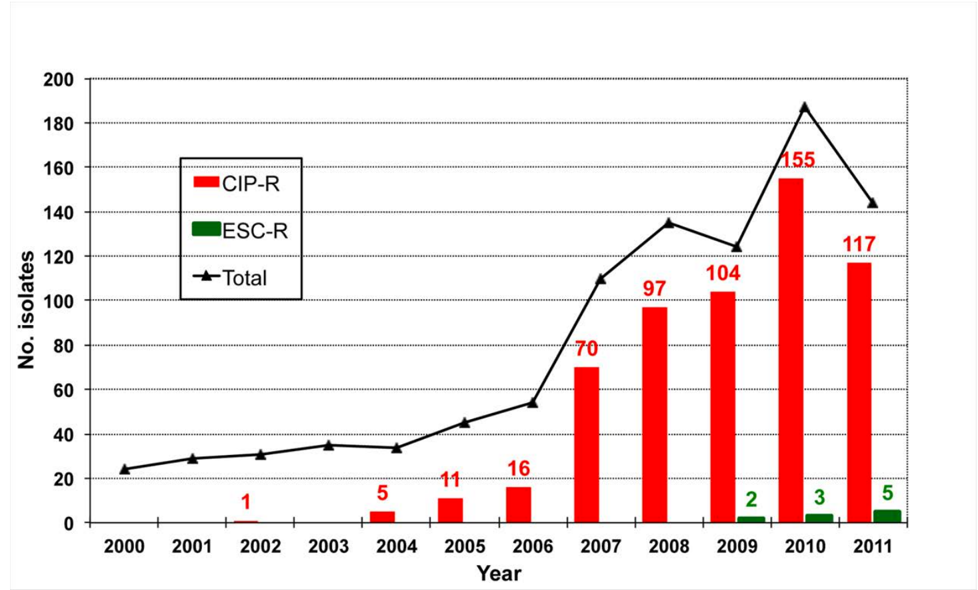
BACKGROUND Salmonella enterica is a major global food-borne pathogen, causing life-threatening infections. Ciprofloxacin and extended-spectrum cephalosporins (ESCs) are the drugs of choice for severe infections. We previously reported a ciprofloxacin-resistant S. enterica serotype Kentucky (S Kentucky) ST198-X1 strain that emerged in Egypt and spread throughout Africa and the Middle East from 2002 to 2008. We aimed to monitor recent trends in the location of transmission and antimicrobial resistance of this strain. METHODS We analysed isolates of S Kentucky collected by the French national surveillance system for salmonellosis in France from Jan 1, 2000, to Dec 31, 2011, and at two sites in Casablanca, Morocco, between Jan 1, 2003, and Dec 31, 2011. We analysed patterns of travel of patients infected with a ciprofloxacin-resistant strain of S Kentucky. We identified isolates showing resistance to ESCs or decreased susceptibility to carbapenems, characterised isolates by XbaI-pulsed field gel electrophoresis and multilocus sequence typing, and assessed mechanisms of bacterial resistance to antimicrobial drugs. FINDINGS 954 (1%) of 128,836 serotyped Salmonella spp isolates in France were identified as S Kentucky, as were 30 (13%) of 226 Salmonella spp isolates from Morocco. During 2000-08, 200 (40%) of 497 subculturable isolates of S Kentucky obtained in France were resistant to ciprofloxacin, compared with 376 (83%) of 455 isolates in 2009-11, suggesting a recent increase in ciprofloxacin resistance in France. Travel histories suggested S Kentucky infections originated predominantly in east Africa, north Africa, west Africa, and the Middle East, but also arose in India. We report several occurrences of acquisition of extended-spectrum β-lactamase (CTX-M-1, CTX-M-15), plasmid-encoded cephalosporinase (CMY-2), or carbapenemase (OXA-48, VIM-2) genes by ciprofloxacin-resistant isolates of S Kentucky ST198-X1 from the Mediterranean area since 2009. Many of these highly drug-resistant isolates were also resistant to most aminoglycosides, to co-trimoxazole (trimethoprim-sulfamethoxazole), and to azithromycin. INTERPRETATION The potential risk to public health posed by ciprofloxacin-resistant S Kentucky ST198-X1 warrants its inclusion in national programmes for the control of S. enterica in food-producing animals, in particular in poultry. FUNDING Institut Pasteur, Institut de Veille Sanitaire, Fondation pour la Recherche Médicale, French Government Investissement d'Avenir programme.
Overview
The claims and statistics of this paper haven’t been checked yet.
Free: it reads the open-access text and checks the first 5 claims that cite a source we can check. Create a free account to check every claim.
Integrity signals
Registry
Cites
Statistics
Figures
Verification
Claims the paper makes
The claims and statistics of this paper haven’t been checked yet.
Free: it reads the open-access text and checks the first 5 claims that cite a source we can check. Create a free account to check every claim.
Claims other papers make about this one
Each is checked against this paper’s own text: does it say what the citing paper says it does?
The source backs part of the claim, not all of it — or backs it for a different population, condition or comparison.
In the citing paper
“The three MDR serotype Kentucky isolates (see below) were ST198, clustered into the HC2000_528 superlineage”
From Contamination of street food with multidrug-resistant Salmonella, in Ouagadougou, Burkina Faso (2021) · cites this paper as [14]
Experimental — accuracy not yet measured
Self-check
Percentages, sums and reported differences re-computed from the paper’s own numbers.
The self-check needs the paper’s full text.
Citations
Cites
The Global Burden of Nontyphoidal Salmonella Gastroenteritis
Majowicz, S. E., Musto, J., Scallan, E., Angulo, F. J., Kirk, M., O’Brien, S. J., Jones, T. F., Fazil, A., & Hoekstra, R. M. (2010) · Clinical Infectious Diseases · doi:10.1086/650733 · Cited by 2,442
Global Spread of Carbapenemase-producing Enterobacteriaceae
Nordmann, P., Naas, T., & Poirel, L. (2011) · Emerging Infectious Diseases · doi:10.3201/eid1710.110655 · Cited by 2,378
Antibiotic-Resistant Bugs in the 21st Century — A Clinical Super-Challenge
Arias, C. A., & Murray, B. E. (2009) · New England Journal of Medicine · doi:10.1056/nejmp0804651 · Cited by 1,027
Detection of erythromycin-resistant determinants by PCR
Sutcliffe, J., Grebe, T., Tait-Kamradt, A., & Wondrack, L. (1996) · Antimicrobial Agents and Chemotherapy · doi:10.1128/aac.40.11.2562 · Cited by 989
OXA-48-like carbapenemases: the phantom menace
Poirel, L., Potron, A., & Nordmann, P. (2012) · Journal of Antimicrobial Chemotherapy · doi:10.1093/jac/dks121 · Cited by 924
Rapid Detection of Carbapenemase-producing Enterobacteriaceae
Nordmann, P., Poirel, L., & Dortet, L. (2012) · Emerging Infectious Diseases · doi:10.3201/eid1809.120355 · Cited by 761
The emerging NDM carbapenemases
Nordmann, P., Poirel, L., Walsh, T. R., & Livermore, D. M. (2011) · Trends in Microbiology · doi:10.1016/j.tim.2011.09.005 · Cited by 663
A National Outbreak of Salmonella enteritidis Infections from Ice Cream
Hennessy, T. W., Hedberg, C. W., Slutsker, L., White, K. E., Besser-Wiek, J. M., Moen, M. E., Feldman, J., Coleman, W. W., Edmonson, L. M., MacDonald, K. L., et al. (1996) · New England Journal of Medicine · doi:10.1056/nejm199605163342001 · Cited by 389
Le Hello, S., Hendriksen, R. S., Doublet, B., Fisher, I., Nielsen, E. M., Whichard, J. M., Bouchrif, B., Fashae, K., Granier, S. A., Jourdan-Da Silva, N., et al. (2011) · Journal of Infectious Diseases · doi:10.1093/infdis/jir409 · Cited by 277
Self-citationThe Emergence in Taiwan of Fluoroquinolone Resistance in Salmonella enterica Serotype Choleraesuis
Chiu, C.-H., Wu, T.-L., Su, L.-H., Chu, C., Chia, J.-H., Kuo, A.-J., Chien, M.-S., & Lin, T.-Y. (2002) · New England Journal of Medicine · doi:10.1056/nejmoa012261 · Cited by 272
Cited by
Crump, J. A., Sjölund-Karlsson, M., Gordon, M. A., & Parry, C. M. (2015) · Clinical Microbiology Reviews · doi:10.1128/cmr.00002-15 · Cited by 1,156
Genomic insights into the emergence and spread of antimicrobial-resistant bacterial pathogens
Baker, S., Thomson, N., Weill, F.-X., & Holt, K. E. (2018) · Science · doi:10.1126/science.aar3777 · Cited by 401
Self-citationMadec, J.-Y., Haenni, M., Nordmann, P., & Poirel, L. (2017) · Clinical Microbiology and Infection · doi:10.1016/j.cmi.2017.01.013 · Cited by 250
Woodford, N., Wareham, D. W., Guerra, B., & Teale, C. (2014) · Journal of Antimicrobial Chemotherapy · doi:10.1093/jac/dkt392 · Cited by 250
Guerra, B., Fischer, J., & Helmuth, R. (2014) · Veterinary Microbiology · doi:10.1016/j.vetmic.2014.02.001 · Cited by 178
Shah, D. H., Paul, N. C., Sischo, W. C., Crespo, R., & Guard, J. (2017) · Poultry Science · doi:10.3382/ps/pew342 · Cited by 176
Authority, E. F. S., & European Centre for Disease Prevention and Control (2016) · EFSA Journal · doi:10.2903/j.efsa.2016.4380 · Cited by 175
“%) of S. Kentucky was resistant to ciprofloxacin, which is consistent with the dissemination of the ciprofloxacin-resistant S. Kentucky ST198 strain in Europe and elsewhere since 2010 (Le Hello et al., 2013).”
Neuert, S., Nair, S., Day, M. R., Doumith, M., Ashton, P. M., Mellor, K. C., Jenkins, C., Hopkins, K. L., Woodford, N., de Pinna, E., et al. (2018) · Frontiers in Microbiology · doi:10.3389/fmicb.2018.00592 · Cited by 164
“More recently, the spread of an extensively drug-resistant strain of S. Kentucky, non-susceptible to ciprofloxacin, extendedspectrum cephalosporins, carbapenems, most aminoglycosides, trimethoprim-sulfamethoxazole, and azithromycin, has sparked concern (Le Hello et al., 2013).”
BackgroundLe Hello, S., Bekhit, A., Granier, S. A., Barua, H., Beutlich, J., Zając, M., Münch, S., Sintchenko, V., Bouchrif, B., Fashae, K., et al. (2013) · Frontiers in Microbiology · doi:10.3389/fmicb.2013.00395 · Cited by 154
Self-citationMacrolide resistance mechanisms in Enterobacteriaceae : Focus on azithromycin
Gomes, C., Martínez‐Puchol, S., Palma, N., Horna, G., Ruiz‐Roldán, L., Pons, M. J., & Ruiz, J. (2016) · Critical Reviews in Microbiology · doi:10.3109/1040841x.2015.1136261 · Cited by 185
“…emergence of azithromycin-resistance has been observed among different members of this family in different geographical areas (Baker et al., 2015; Boumghar-Bourtchai et al., 2008; Bowen et al., 2015; Le Hello et al., 2013; Ochoa et al., 2009; Sj€olund Karlsson et al., 2013; Vlieghe et al., 2012).”
Background(EFSA), E. F. S. A. (2015) · EFSA Journal · doi:10.2903/j.efsa.2015.4036 · Cited by 218
Antimicrobial resistance in zoonotic nontyphoidal Salmonella : an alarming trend?
Michael, G. B., & Schwarz, Š. (2016) · Clinical Microbiology and Infection · doi:10.1016/j.cmi.2016.07.033 · Cited by 166
“The mobile nature of antimicrobial resistance means that antimicrobial resistance genes can easily be acquired and multidrug-resistant clones may exist in serovars that otherwise showa low level of resistance [9].”
BackgroundGlobal phylogenomics of multidrug-resistant Salmonella enterica serotype Kentucky ST198
Hawkey, J., Hello, S. L., Doublet, B., Granier, S. A., Hendriksen, R. S., Fricke, W. F., Ceyssens, P., Gomart, C., Billman‐Jacobe, H., Holt, K. E., et al. (2019) · Microbial Genomics · doi:10.1099/mgen.0.000269 · Cited by 161
“One variant of the SGI, known as SGI2 or SGI1-J, differs not only in the composition of the integron, but also in the site at which the integron is inserted into the SGI backbone [8, 19].”
BackgroundInfluentialSelf-citationEpidemiology of common resistant bacterial pathogens in the countries of the Arab League
Moghnieh, R., Kanafani, Z. A., Tabaja, H., Sharara, S. L., Awad, L. S., & Kanj, S. S. (2018) · The Lancet Infectious Diseases · doi:10.1016/s1473-3099(18)30414-6 · Cited by 134
Fernández, J., Guerra, B., & Rodicio, M. R. (2018) · Veterinary Sciences · doi:10.3390/vetsci5020040 · Cited by 150
“Kentucky with decreased susceptibility to imipenem [32].”
BackgroundMultidrug-Resistant Pathogens in the Food Supply
Doyle, M. E. (2015) · Foodborne Pathogens and Disease · doi:10.1089/fpd.2014.1865 · Cited by 119
Travel and the Spread of Drug-Resistant Bacteria
Schwartz, K. L., & Morris, S. K. (2018) · Current Infectious Disease Reports · doi:10.1007/s11908-018-0634-9 · Cited by 115
Wong, M. H. Y., Yan, M., Chan, E. W., Biao, K., & Chen, S. (2014) · Antimicrobial Agents and Chemotherapy · doi:10.1128/aac.02770-13 · Cited by 109
“Kentucky ST198-X1, a much less prevalent serotype (16).”
BackgroundSalmonella serovars and their distribution in Nigerian commercial chicken layer farms
Fagbamila, I. O., Barco, L., Mancin, M., Kwaga, J. K. P., Ngulukun, S. S., Zavagnin, P., Lettini, A. A., Lorenzetto, M., Abdu, P. A., Kabir, J., et al. (2017) · PLoS ONE · doi:10.1371/journal.pone.0173097 · Cited by 120
Monte, D. F. M., Lincopán, N., Berman, H. L., Cerdeira, L., Keelara, S., Thakur, S., Fedorka–Cray, P. J., & Landgraf, M. (2019) · Scientific Reports · doi:10.1038/s41598-019-45838-0 · Cited by 103
Langendorf, C., Le Hello, S., Moumouni, A., Gouali, M., Mamaty, A.-A., Grais, R. F., Weill, F.-X., & Page, A.-L. (2015) · PLOS ONE · doi:10.1371/journal.pone.0120275 · Cited by 88
“enterica serotype Kentucky ST198-X1 strain which originated in Egypt during the 1990s, before disseminating across Africa, the Middle East, the Indian subcontinent and South East Asia beginning in the mid-2000s [37,68].”
BackgroundSelf-citationBai, L., Zhao, J., Gan, X., Wang, J., Zhang, X., Cui, S., Xia, S., Hu, Y., Yan, S., Wang, J., et al. (2016) · Antimicrobial Agents and Chemotherapy · doi:10.1128/aac.02849-15 · Cited by 88
“enterica serovar Kentucky ST198-X1 (blaCTX-M-1 and blaCTX-M-15) (28) and in S.”
BackgroundInfluentialScientific Opinion on Carbapenem resistance in food animal ecosystems
(BIOHAZ), E. P. O. B. H. (2013) · EFSA Journal · doi:10.2903/j.efsa.2013.3501 · Cited by 100
Prevalence and risk factors of Salmonella in commercial poultry farms in Nigeria
Jibril, A. H., Okeke, I. N., Dalsgaard, A., Kudirkienė, E., Akinlabi, O. C., Bello, M. B., & Olsen, J. E. (2020) · PLoS ONE · doi:10.1371/journal.pone.0238190 · Cited by 89
“Human illnesses caused by this pathogen in North America and Europe are typically associated with a history of travel to Africa, Southeast Asia, and the Middle East, where this pathogen is established in poultry [59].”
BackgroundLin, D., Chen, K., Chan, E. W., & Chen, S. (2015) · Scientific Reports · doi:10.1038/srep14754 · Cited by 82
Li, Y., Ed‐Dra, A., Tang, B., Kang, X., Müller, A., Kehrenberg, C., Jia, C., Pan, H., Yang, H., & Yue, M. (2022) · Journal of Hazardous Materials · doi:10.1016/j.jhazmat.2022.129476 · Cited by 76
Potential Sources and Transmission of Salmonella and Antimicrobial Resistance in Kampala, Uganda
Afema, J. A., Byarugaba, D. K., Shah, D. H., Atukwase, E., Nambi, M., & Sischo, W. M. (2016) · PLoS ONE · doi:10.1371/journal.pone.0152130 · Cited by 86
“Kentucky isolated from human illnesses [37,38].”
Nair, S., Ashton, P., Doumith, M., Connell, S., Painset, A., Mwaigwisya, S., Langridge, G. C., de Pinna, E., Godbole, G., & Day, M. (2016) · Journal of Antimicrobial Chemotherapy · doi:10.1093/jac/dkw318 · Cited by 79
Keisam, S., Tuikhar, N., Ahmed, G., & Jeyaram, K. (2019) · International Journal of Food Microbiology · doi:10.1016/j.ijfoodmicro.2019.02.012 · Cited by 72
Burke, L. P., Hopkins, K. L., Meunier, D., de Pinna, E., Fitzgerald‐Hughes, D., Humphreys, H., & Woodford, N. (2013) · Journal of Antimicrobial Chemotherapy · doi:10.1093/jac/dkt469 · Cited by 64
Djeffal, S., Mamache, B., Elgroud, R., Hireche, S., & Bouaziz, O. (2018) · Veterinary World · doi:10.14202/vetworld.2018.1102-1108 · Cited by 71
Prevalence and characterisation of quinolone resistance mechanisms in Salmonella spp.
Wasyl, D., Hoszowski, A., & Zając, M. (2014) · Veterinary Microbiology · doi:10.1016/j.vetmic.2014.01.040 · Cited by 65
Antimicrobial susceptibility of Salmonella isolates from healthy pigs and chickens (2008–2011)
de Jong, A., Smet, A., Ludwig, C., Stephan, B., Graef, E. D., Vanrobaeys, M., & Haesebrouck, F. (2014) · Veterinary Microbiology · doi:10.1016/j.vetmic.2014.01.030 · Cited by 62
Haley, B. J., Kim, S. W., Pettengill, J., Luo, Y., Karns, J. S., & Kessel, J. A. S. V. (2016) · PLoS ONE · doi:10.1371/journal.pone.0161225 · Cited by 68
Fang, T., Wang, H., Cui, Q., Rogers, M. J., & Dong, P. (2018) · Water Research · doi:10.1016/j.watres.2018.08.042 · Cited by 62
Harrois, D., Breurec, S., Seck, A., Delauné, A., Hello, S. L., de la Gándara, M. P., Sontag, L., Perrier-Gros-Claude, J.-D., Sire, J.-M., Garin, B., et al. (2013) · Clinical Microbiology and Infection · doi:10.1111/1469-0691.12339 · Cited by 59
“So far, 23 different Salmonella serotypes producing ESBLs have been described in studies of human isolates in West Africa [2,4–6], Maghreb [2,3,9,12,13,15], East Africa [2,8,10,11], South Africa [7,14] and Central Africa (S.”
BackgroundSelf-citationChen, Q., Bai, J., Zhang, X., Wang, S., Chen, K., Lin, Q., Xu, C., Qu, X., Zhang, H., Liao, M., et al. (2021) · International Journal of Food Microbiology · doi:10.1016/j.ijfoodmicro.2021.109055 · Cited by 64
Abraham, S., Groves, M. D., Trott, D. J., Chapman, T. A., Turner, B., Hornitzky, M. A. Z., & Jordan, D. (2013) · International Journal of Antimicrobial Agents · doi:10.1016/j.ijantimicag.2013.10.014 · Cited by 56
“Examples of MDR S. enterica serovars with levated virulence for humans that have recently emerged in anials include serovar Newport in the USA [4,5], serovar Heidelberg n Canada [6] and serovar Kentucky in Egypt and Africa [7,8].”
BackgroundSeiffert, S. N., Perreten, V., Johannes, S., Droz, S., Bodmer, T., & Endimiani, A. (2014) · Antimicrobial Agents and Chemotherapy · doi:10.1128/aac.02417-13 · Cited by 61
“These strains were detected during 2009 to 2011 in the stools of a unique nonhospitalized female who traveled in Egypt (7).”
Genomic epidemiology of emerging ESBL-producing Salmonella Kentucky bla CTX-M-14b in Europe
Coipan, C. E., Westrell, T., van Hoek, A. H. A. M., Alm, E., Kotila, S., Berbers, B., Keersmaecker, S. C. J. D., Ceyssens, P., Borg, M. L., Chattaway, M. A., et al. (2020) · Emerging Microbes & Infections · doi:10.1080/22221751.2020.1821582 · Cited by 58
“(from 55% in 2007 to 88% in 2017 [4,6]) and steady accumulation of genetic elements conferring resistance to other antibiotic classes in the early years of”
BackgroundInfluentialSapkota, A. R., Kinney, E. L., George, A., Hulet, R. M., Cruz‐Cano, R., Schwab, K. J., Zhang, G., & Joseph, S. W. (2014) · The Science of The Total Environment · doi:10.1016/j.scitotenv.2013.12.005 · Cited by 62
Wasyl, D., Kern-Zdanowicz, I., Domańska-Blicharz, K., Zając, M., & Hoszowski, A. (2014) · Veterinary Microbiology · doi:10.1016/j.vetmic.2014.10.014 · Cited by 59
Tran-Dien, A., le Hello, S., Bouchier, C., & Weill, F. (2017) · Lancet. Infectious Diseases (Print) · doi:10.1016/s1473-3099(17)30705-3 · Cited by 41
Self-citationChen, Q., Bai, J., Wang, S., Zhang, X., Zhan, Z., Shen, H., Zhang, H., Wen, J., Gao, Y., Liao, M., et al. (2020) · Microorganisms · doi:10.3390/microorganisms8030444 · Cited by 57
“Kentucky, which represents a serious threat to public health [40,41].”
BackgroundCeyssens, P., Mattheus, W., Vanhoof, R., & Bertrand, S. (2014) · Antimicrobial Agents and Chemotherapy · doi:10.1128/aac.04203-14 · Cited by 54
Monte, D. F. M., Lincopán, N., Fedorka–Cray, P. J., & Landgraf, M. (2019) · Current Opinion in Food Science · doi:10.1016/j.cofs.2019.03.004 · Cited by 62
Eibach, D., Al-Emran, H. M., Dekker, D. M., Krumkamp, R., Adu-Sarkodie, Y., Cruz Espinoza, L. M., Ehmen, C., Boahen, K., Heisig, P., Im, J., et al. (2016) · Clinical Infectious Diseases · doi:10.1093/cid/civ757 · Cited by 44
Tadesse, G., Tessema, T. S., Beyene, G., & Aseffa, A. (2018) · PLoS ONE · doi:10.1371/journal.pone.0192575 · Cited by 55
A Public Health Insight into Salmonella in Poultry in Africa: A Review of the Past Decade: 2010–2020
Ramtahal, M. A., Amoako, D. G., Abia, A. L. K., Somboro, A. M., Bester, L. A., & Essack, S. Y. (2022) · Microbial Drug Resistance · doi:10.1089/mdr.2021.0384 · Cited by 56
Haley, B. J., Kim, S. W., Haendiges, J., Keller, E. N., Torpey, D., Kim, A., Crocker, K., Myers, R. A., & Kessel, J. A. S. V. (2019) · Zoonoses and Public Health · doi:10.1111/zph.12571 · Cited by 47
Pérez, F., Hujer, A. M., Marshall, S. H., Ray, A. J., Rather, P. N., Suwantarat, N., Dumford, D., O'Shea, P., Domitrovic, T. N. J., Salata, R. A., et al. (2014) · Antimicrobial Agents and Chemotherapy · doi:10.1128/aac.02372-14 · Cited by 46
“enterica serovar Kentucky is prevalent (45).”
Matsumura, Y., Yamamoto, M., Gomi, R., Tsuchido, Y., Shinohara, K., Noguchi, T., & Nagao, M. (2025) · Clinical Microbiology Reviews · doi:10.1128/cmr.00140-22 · Cited by 57
Contamination of street food with multidrug-resistant Salmonella, in Ouagadougou, Burkina Faso
Nikiema, M. E. M., Pardos de la Gandara, M., Compaore, K. A. M., Ky Ba, A., Soro, K. D., Nikiema, P. A., Barro, N., Sangare, L., & Weill, F.-X. (2021) · PLoS ONE · doi:10.1371/journal.pone.0253312 · Cited by 41
“enterica serotype Kentucky isolates identified in our study belonged to the “ST198-X1” clone [14].”
BackgroundSelf-citationChen, H., Song, J., Zeng, X., Chen, D., Chen, R., Qiu, C., & Zhou, K. (2021) · mSystems · doi:10.1128/msystems.00935-20 · Cited by 42
“We identified that the IncHI2/2A-type plasmid carried by zj-f50 carried numerous AMR genes, including aac(3)-IV, aph(4)-I, sul2, sul3, aadA1, cmlA1, rmtB1, floR, aac (69)-Ib-cr, blaOXA-1, catB3, arr-3, and dfrA12.”
BackgroundResultCarbapenemase-producing Organism in Food, 2014
Rubin, J. E., Ekanayake, S., & Fernando, C. (2014) · Emerging infectious diseases · doi:10.3201/eid2007.140534 · Cited by 38
Fonteneau, L., Silva, N. J., Fabre, L., Ashton, P., Torpdahl, M., Müller, L., Bouchrif, B., Boulani, A. E., Valkanou, E., Mattheus, W., et al. (2017) · Eurosurveillance · doi:10.2807/1560-7917.es.2017.22.7.30463 · Cited by 39
“AST was carried out by the disk diffusion method, with a panel of 32 antimicrobial drugs (Bio-Rad) as previously described [18].”
MethodSelf-citationAmajoud, N., Bouchrif, B., Maadoudi, M. E., Senhaji, N. S., Karraouan, B., Harsal, A. E., & Abrini, J. (2017) · The Journal of Infection in Developing Countries · doi:10.3855/jidc.8026 · Cited by 36
“The emergence of resistant strains of Kentucky in Egypt and their expansion to African countries [28] can explain its predominance in Morocco.”
BackgroundSelf-citationKuijpers, L. M. F., Hello, S. L., Fawal, N., Fabre, L., Tourdjman, M., Dufour, M., Sar, D., Kham, C., Phe, T., Vlieghe, E., et al. (2016) · Microbial Genomics · doi:10.1099/mgen.0.000092 · Cited by 32
“From 2008 to 2015, 1162 Salmonella Typhi isolates were received at the FNRC-ESS.”
BackgroundInfluentialSelf-citationParvin, M. S., Hasan, M. M., Ali, M. Y., Chowdhury, E. H., Rahman, M. T., & Islam, M. T. (2020) · Journal of Food Protection · doi:10.4315/jfp-20-172 · Cited by 48
Salmonella spp. in Chicken: Prevalence, Antimicrobial Resistance, and Detection Methods
Tan, S. J., Nordin, S., Esah, E. M., & Mahror, N. (2022) · Microbiology Research · doi:10.3390/microbiolres13040050 · Cited by 49
Tate, H. P., Hsu, C.-H., Chen, J. C., Han, J., Foley, S. L., Folster, J. P., Watkins, L. F., Reynolds, J. L., Tillman, G. E., Nyirabahizi, E., et al. (2022) · Foodborne Pathogens and Disease · doi:10.1089/fpd.2022.0005 · Cited by 37
Alghoribi, M. F., Doumith, M., Alrodayyan, M., Alzayer, M., Köster, W. L., Muhanna, A., AlJohani, S. M., Balkhy, H. H., & Desin, T. S. (2019) · Frontiers in Cellular and Infection Microbiology · doi:10.3389/fcimb.2019.00187 · Cited by 36
Ebomah, K. E., & Okoh, A. I. (2020) · Heliyon · doi:10.1016/j.heliyon.2020.e03899 · Cited by 46
Drug-resistant Salmonella enterica serotype Kentucky in Europe
Westrell, T., Monnet, D. L., Gossner, C. M., Heuer, O. E., & Takkinen, J. (2014) · The Lancet Infectious Diseases · doi:10.1016/s1473-3099(14)70703-0 · Cited by 32
Endemic fluoroquinolone-resistant Salmonella enterica serovar Kentucky ST198 in northern India
Mahindroo, J., Thanh, D. P., Nguyen, T. N. T., Mohan, B., Thakur, S., Baker, S. G., & Taneja, N. (2019) · Microbial Genomics · doi:10.1099/mgen.0.000275 · Cited by 32
Genetic lineages of Salmonella enterica serovar Kentucky spreading in pet reptiles
Zając, M., Wasyl, D., Hoszowski, A., Hello, S. L., & Szulowski, K. (2013) · Veterinary Microbiology · doi:10.1016/j.vetmic.2013.07.023 · Cited by 36
Zeng, X., Lv, S., Qu, C., Lan, L., Tan, D., Li, X., & Bai, L. (2020) · Food Control · doi:10.1016/j.foodcont.2020.107478 · Cited by 33
Carbapenemase-producing Salmonella enterica isolates in the UK
Day, M. R., Meunier, D., Doumith, M., de Pinna, E., Woodford, N., & Hopkins, K. L. (2015) · Journal of Antimicrobial Chemotherapy · doi:10.1093/jac/dkv075 · Cited by 29
Zhang, Z., Yang, J., Xu, X., Zhou, X., Shi, C., Zhao, X., Liu, Y., & Shi, X. (2020) · Food Control · doi:10.1016/j.foodcont.2020.107269 · Cited by 31
Caffrey, N., Agunos, A., Gow, S., Liljebjelke, K. A., Mainali, C., & Checkley, S. (2021) · Zoonoses and Public Health · doi:10.1111/zph.12769 · Cited by 31
Ley, B., Hello, S. L., Lunguya, O., Lejon, V., Muyembe, J., Weill, F., & Jacobs, J. A. (2014) · Emerging infectious diseases · doi:10.3201/eid2004.131488 · Cited by 28
“The presence of macrolide resistance genes was assessed by PCR and sequencing as described elsewhere (7).”
MethodSelf-citationMultidrug-Resistant Salmonella enterica Serotype Typhi, Gulf of Guinea Region, Africa
Baltazar, M., Ngandjio, A., Holt, K. E., Lepillet, E., Pardos de la Gandara, M., Collard, J.-M., Bercion, R., Nzouankeu, A., Le Hello, S., Dougan, G., et al. (2015) · Emerging Infectious Diseases · doi:10.3201/eid2104.141355 · Cited by 26
“) and shows results of cluster analysis on the basis of Xba I– pulsed-field gel electrophoresis (PFGE) fingerprinting.”
BackgroundMethodInfluentialSelf-citationBall, T. A., Monte, D. F. M., Aïdara‐Kane, A., Matheu, J., Ru, H., Thakur, S., Ejobi, F., & Fedorka–Cray, P. J. (2020) · PLoS ONE · doi:10.1371/journal.pone.0220484 · Cited by 25
European Centre for Disease Prevention and Control, E. F. S. A. (2022) · EFSA Supporting Publications · doi:10.2903/sp.efsa.2022.en-7180 · Cited by 25
Samper-Cativiela, C., Diéguez-Roda, B., da Roza, F. T., Ugarte‐Ruiz, M., Elnekave, E., Lim, S., Hernández, M., Abad, D., Collado, S., Sáez, J. L., et al. (2022) · Microbial Genomics · doi:10.1099/mgen.0.000773 · Cited by 29
“Kentucky clinical isolates from African countries [72, 73].”
Du, P., Liu, X., Liu, Y., Li, R., Lü, X., Cui, S., Wu, Y., Fanning, S., & Bai, L. (2022) · mSystems · doi:10.1128/msystems.00253-22 · Cited by 23
Raut, R., Maharjan, P., & Fouladkhah, A. C. (2023) · International Journal of Environmental Research and Public Health · doi:10.3390/ijerph20176654 · Cited by 33
Mashe, T., Thilliez, G. J. A., Chaibva, B. V., Leekitcharoenphon, P., Bawn, M., Nyanzunda, M., Robertson, V. J., Tarupiwa, A., Al-Khanaq, H., Baker, D., et al. (2023) · npj Antimicrobials and Resistance · doi:10.1038/s44259-023-00003-6 · Cited by 24
Self-citationAgbaje, M., Ayo-Ajayi, P. O., Kehinde, O., Omoshaba, E., Dipeolu, M. A., & Fasina, F. O. (2021) · Antibiotics · doi:10.3390/antibiotics10070773 · Cited by 22
“Kentucky has a worldwide distribution and was previously thought to be endemic in Africa with public health significance (24,25).”
BackgroundGenomic and phenotypic characterization of Salmonella enterica serovar Kentucky
Richards, A. K., Kue, S., Norris, C. G., & Shariat, N. W. (2023) · Microbial Genomics · doi:10.1099/mgen.0.001089 · Cited by 28
“Conversely, serovar Kentucky-II has a higher association with human illness outside of the USA, particularly in Europe, South-East Asia, China and Africa [25, 32–34].”
Superbugs in food: a severe public health concern
Collignon, P. (2013) · The Lancet Infectious Diseases · doi:10.1016/s1473-3099(13)70141-5 · Cited by 20
Prevalence and antimicrobial resistance of Salmonella isolates in Moroccan laying hens farms
Ziyate, N., Karraouan, B., Kadiri, A., Darkaoui, S., Soulaymani, A., & Bouchrif, B. (2016) · The Journal of Applied Poultry Research · doi:10.3382/japr/pfw036 · Cited by 20
Self-citationWharf, C., & London, E. (2014) · Cited by 22
Carbapenemase-producingSalmonella entericaserotype Kentucky ST198, North Africa: Table 1.
Ktari, S., Hello, S. L., Ksibi, B., Courdavault, L., Mnif, B., Maalej, S., Fabre, L., Hammami, A., & Weill, F. (2015) · Journal of Antimicrobial Chemotherapy · doi:10.1093/jac/dkv276 · Cited by 25
Self-citationOsman, K. M., HASSAN, W. M. M., & Mohamed, R. A. H. (2014) · European Journal of Clinical Microbiology & Infectious Diseases · doi:10.1007/s10096-014-2072-4 · Cited by 20
“[11], who revealed that S.”
Ciprofloxacin-ResistantSalmonella entericaSerotype Kentucky Sequence Type 198
Rickert, R., & Folster, J. P. (2014) · Emerging infectious diseases · doi:10.3201/eid2005.131575 · Cited by 19
“Poultry has been implicated as the most likely vehicle for infection by this sequence type (2,3).”
BackgroundAnalyses of prevalence and molecular typing of Salmonella in the goose production chain
Wang, M., Zhang, M., Lu, Y., Kang, X., Meng, C., Zhou, L., Li, A., Li, Z., & Song, H. (2020) · Poultry Science · doi:10.1016/j.psj.2019.12.008 · Cited by 18
Albert, M. J., Obaid, K. A., Alfouzan, W. A., Sheikh, A. R., Udo, E. E., Izumiya, H., Bulach, D., & Seemann, T. (2014) · Journal of Clinical Microbiology · doi:10.1128/jcm.01775-14 · Cited by 18
Development and characterisation of highly antibiotic resistant Bartonella bacilliformis mutants
Gomes, C., Martínez‐Puchol, S., Ruiz‐Roldán, L., Pons, M. J., del Valle-Mendoza, J., & Ruiz, J. (2016) · Scientific Reports · doi:10.1038/srep33584 · Cited by 18
Antimicrobial Resistance in Foodborne Pathogens
O’Bryan, C. A., Crandall, P. G., & Ricke, S. C. (2017) · Elsevier eBooks · doi:10.1016/b978-0-12-811835-1.00006-3 · Cited by 25
Cordeiro, N. F., Chabalgoity, J. A., Yim, L., & Vignoli, R. (2014) · Antimicrobial Agents and Chemotherapy · doi:10.1128/aac.02847-14 · Cited by 22
“Furthermore, only a few reports concerning the occurrence of MBL in clinical isolates of this genus have been published; although epidemiologically unrelated, such isolates carried all blaNDM-1 (9, 10, 11), and recently, VIM-2.”
BackgroundResultFang, L., Lin, G., Li, Y., Lin, Q., Lou, H., Lin, M., Hu, Y., Xie, A., Zhang, Q., Zhou, J., et al. (2022) · Frontiers in Microbiology · doi:10.3389/fmicb.2022.961739 · Cited by 21
Park, A. K., Shin, E., Kim, S.-J., Park, J., Jeong, H. J., Chun, J., Hwang, K. J., & Kim, J. (2019) · Journal of Global Antimicrobial Resistance · doi:10.1016/j.jgar.2019.12.014 · Cited by 19
Isolation of multidrug-resistant Salmonella in Singapore
Phoon, Y., Chan, Y., & Th, K. (2015) · Singapore Medical Journal · doi:10.11622/smedj.2015129 · Cited by 17
Jiang, Y., Wang, Z., Li, Q., Lu, M.-J., Wu, H. J., Mei, C.-Y., Shen, P.-C., Jiao, X., & Wang, J. (2023) · Microbiology Spectrum · doi:10.1128/spectrum.03219-22 · Cited by 19
“Kentucky ST198 were likely carried by plasmids except for blaCTX-M-14b (8, 9, 20).”
BackgroundInfluentialZhao, L., Liu, G., Tang, W., Song, X.-B., Zhao, X., Wang, C., Li, Y., & Zou, M. (2023) · Frontiers in Veterinary Science · doi:10.3389/fvets.2023.1292401 · Cited by 18
“The dual resistance to CIP and third-generation cephalosporins poses an enormous threat to human health, as treatment failure may have serious consequences (40).”
BackgroundÁlvarez, J., López, G., Muellner, P., de Frutos, C., Ahlstrom, C. A., Serrano, T., Moreno, M. Á., Durán, M. E. M., Sáez, J. L., Domínguez, L., et al. (2019) · Transboundary and Emerging Diseases · doi:10.1111/tbed.13346 · Cited by 17
Abate, D., & Assefa, N. (2021) · PubMed Central · Cited by 27
Tadesse, G. (2015) · BMC Infectious Diseases · doi:10.1186/s12879-015-0835-x · Cited by 16
“Of particular concern is the occurrence of strains resistant to drugs of critical importance to human health such as the extended-spectrum cephalosporins and the fluoroquinolones [3-5].”
BackgroundInfluentialShittu, O. B., Uzairue, L. I., Ojo, O. E., Obuotor, T. M., Folorunso, J. B., Raheem-Ademola, R. R., Olanipekun, G. M., Ajose, T., Medugu, N., Ebruke, B. E., et al. (2022) · Journal of Applied Microbiology · doi:10.1111/jam.15477 · Cited by 22
“…antimicrobials, ciprofloxacin is now primarily used in the treatment of clinical salmonellosis in humans, while third generations cephalosporin and azithromycin have also been used in some cases (Le Hello et al. 2011; Le Hello et al. 2013; Raufu et al. 2013 Akinyemi et al. 2018; Ghazaei, 2018).”
Background
Metadata
- Authors
- Le Hello, S., Harrois, D., Bouchrif, B., Sontag, L., Elhani, D., Guibert, V., Zerouali, K., & Weill, F.-X.
- Affiliations
- Institut Pasteur (FR)
- Institut Pasteur du Maroc (MA)
- Centre Hospitalier Universitaire Ibn Rochd (MA)
- Corresponding author
- Weill, François-Xavier
- Venue
- The Lancet Infectious Diseases
- Publisher
- Elsevier BV
- Published
- 2013-08
- Volume
- 13
- Issue
- 8
- Pages
- 672-679
- ISSN
- 1473-3099 (ISSN-L)
- OpenAlex
- W2074192765
- Semantic Scholar
- 35623680c1b3a906362e60677dfb4c5e00034582
- Cited by
- 186
- References
- 31
- Citations by year
- 2026: 4 · 2025: 10 · 2024: 11 · 2023: 12 · 2022: 16 · 2021: 16 · 2020: 15 · 2019: 14 · 2018: 11 · 2017: 13 · 2016: 17 · 2015: 14 · 2014: 23 · 2013: 9
- FWCI
- 31.32
- Type
- journal article
- Language
- en
- Open access
- green
- pasteur.hal.science
- Licence
- cc-by
- www.elsevier.com/tdm/userlicense/1.0/ (tdm)
- www.elsevier.com/legal/tdmrep-license (tdm)
- Locations
- The Lancet Infectious Diseases (publishedVersion)
- PubMed (publishedVersion)
- HAL (submittedVersion, cc-by)
- Greater South Information System
- Funders
- French Government “Investissement d'Avenir” programme (ANR-10-LABX-62-IBEID)
- Topics
- Life Sciences › Agricultural and Biological Sciences › Food Science › Salmonella and Campylobacter epidemiology
- Health Sciences › Medicine › Microbiology (medical) › Antibiotic Resistance in Bacteria
- Health Sciences › Medicine › Infectious Diseases › Antibiotic Use and Resistance
- Keywords
- ciprofloxacin resistance, extended-spectrum cephalosporins, carbapenem resistance, antimicrobial resistance, extended-spectrum beta-lactamase, CTX-M-15, CMY-2, OXA-48, VIM-2, plasmid-mediated resistance genes, travel-associated transmission, molecular epidemiology, multilocus sequence typing
- MeSH terms
- Adolescent, Adult, Aged, Aged, 80 and over, Aminoglycosides, Anti-Bacterial Agents, Bacterial Proteins, beta-Lactamases, Child, Ciprofloxacin, Female, France, Humans, Male, Microbial Sensitivity Tests, Morocco, Salmonella Infections, Travel, Trimethoprim, Sulfamethoxazole Drug Combination, Azithromycin, Salmonella enterica, Drug Resistance, Multiple, Bacterial, Young Adult
About these checks
Registry, retraction, Cites and statistics results are computed, not judged, with one exception: a printed reference that no index lists is read once by a model before it counts as a citation error. Claims are extracted by a model and kept only when their quote appears verbatim in the text; each cited source is then checked, with a model’s help, for whether it says what the claim relies on. Those verdicts can be wrong — read the claim’s quote and the cited source before relying on one.
Statistics and arithmetic are recomputed, not judged.
Confidence bands are shown only for fields calibrated on our annotated test set. None is calibrated yet, so no band is shown.
What counts as a claim ›How we measure confidence ›How we check this ›
Are you an author, or do you see a problem with this page? Request a review
Data sources
Bibliographic data: Semantic Scholar, OpenAlex, Crossref.
Contains information from the Semantic Scholar Academic Graph Datasets, made available under the ODC Attribution License (ODC-BY 1.0).
Semantic Scholar’s data is described in: Kinney, R., et al. (2023). The Semantic Scholar Open Data Platform. arXiv:2301.10140.
