

Maternal immunisation with trivalent inactivated influenza vaccine for prevention of influenza in infants in Mali: a prospective, active-controlled, observer-blind, randomised phase 4 trial
Open accessThe DOI matches its Crossref record; 29 of the 29 references it cites were found in a registry or an index.
Abstract
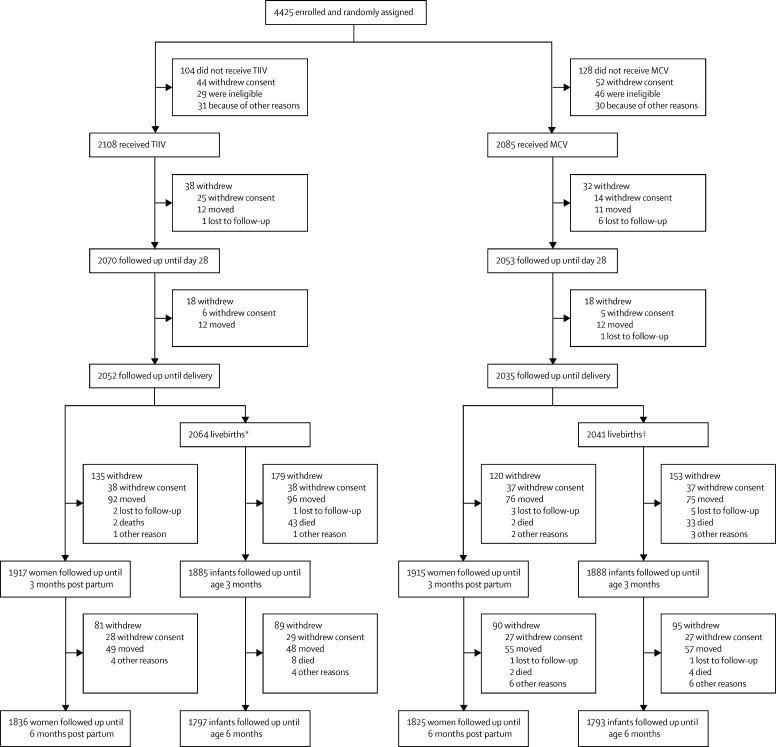
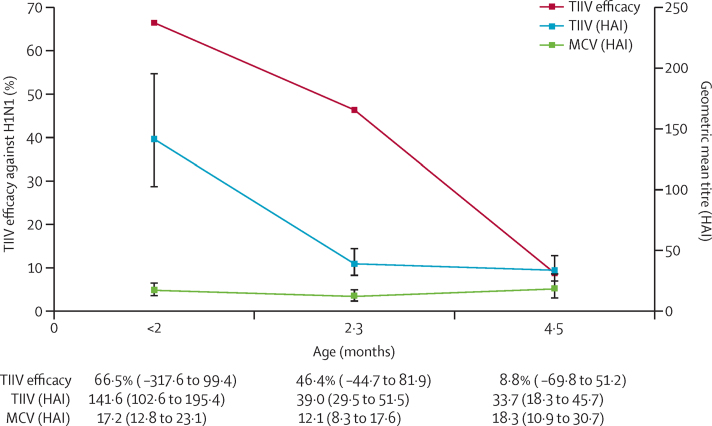
BACKGROUND: Despite the heightened risk of serious influenza during infancy, vaccination is not recommended in infants younger than 6 months. We aimed to assess the safety, immunogenicity, and efficacy of maternal immunisation with trivalent inactivated influenza vaccine for protection of infants against a first episode of laboratory-confirmed influenza. METHODS: We did this prospective, active-controlled, observer-blind, randomised phase 4 trial at six referral centres and community health centres in Bamako, Mali. Third-trimester pregnant women (≥28 weeks' gestation) were randomly assigned (1:1), via a computer-generated, centre-specific list with alternate block sizes of six or 12, to receive either trivalent inactivated influenza vaccine or quadrivalent meningococcal vaccine. Study personnel administering vaccines were not masked to treatment allocation, but allocation was concealed from clinicians, laboratory personnel, and participants. Infants were visited weekly until age 6 months to detect influenza-like illness; laboratory-confirmed influenza diagnosed with RT-PCR. We assessed two coprimary objectives: vaccine efficacy against laboratory-confirmed influenza in infants born to women immunised any time prepartum (intention-to-treat population), and vaccine efficacy in infants born to women immunised at least 14 days prepartum (per-protocol population). The primary outcome was the occurrence of a first case of laboratory-confirmed influenza by age 6 months. This trial is registered with ClinicalTrials.gov, number NCT01430689. FINDINGS: We did this trial from Sept 12, 2011, to Jan 28, 2014. Between Sept 12, 2011, and April 18, 2013, we randomly assigned 4193 women to receive trivalent inactivated influenza vaccine (n=2108) or quadrivalent meningococcal vaccine (n=2085). There were 4105 livebirths; 1797 (87%) of 2064 infants in the trivalent inactivated influenza vaccine group and 1793 (88%) of 2041 infants in the quadrivalent meningococcal vaccine group were followed up until age 6 months. We recorded 5279 influenza-like illness episodes in 2789 (68%) infants, of which 131 (2%) episodes were laboratory-confirmed influenza. 129 (98%) cases of laboratory-confirmed influenza were first episodes (n=77 in the quadrivalent meningococcal vaccine group vs n=52 in the trivalent inactivated influenza vaccine group). In the intention-to-treat population, overall infant vaccine efficacy was 33·1% (95% CI 3·7-53·9); in the per-protocol population, vaccine efficacy was 37·3% (7·6-57·8). Vaccine efficacy remained robust during the first 4 months of follow-up (67·9% [95% CI 35·1-85·3] by intention to treat and 70·2% [35·7-87·6] by per protocol), before diminishing during the fifth month (57·3% [30·6-74·4] and 60·7 [33·8-77·5], respectively). Adverse event rates in women and infants were similar among groups. Pain at the injection site was more common in women given quadrivalent meningococcal vaccine than in those given trivalent inactivated influenza vaccine (n=253 vs n=132; p<0·0001), although 354 [92%] reactions were mild. Obstetrical and non-obstetrical serious adverse events were reported in 60 (3%) women in the quadrivalent meningococcal vaccine group and 61 (3%) women in the trivalent inactivated influenza vaccine group. Presumed neonatal infection was more common in infants in the trivalent inactivated influenza vaccine group than in those in the quadrivalent meningococcal vaccine group (n=60 vs n=37; p=0·02). No serious adverse events were related to vaccination. INTERPRETATION: Vaccination of pregnant women with trivalent inactivated influenza vaccine in Mali-a poorly resourced country with high infant mortality-was technically and logistically feasible and protected infants from laboratory-confirmed influenza for 4 months. With adequate financing to procure the vaccine, implementation will parallel the access to antenatal care and immunisation coverage of pregnant women with tetanus toxoid. FUNDING: Bill & Melinda Gates Foundation.
Overview
The claims and statistics of this paper haven’t been checked yet.
Free: it reads the open-access text and checks the first 5 claims that cite a source we can check. Create a free account to check every claim.
Integrity signals
Registry
Cites
Statistics
Figures
Verification
Claims the paper makes
The claims and statistics of this paper haven’t been checked yet.
Free: it reads the open-access text and checks the first 5 claims that cite a source we can check. Create a free account to check every claim.
Claims other papers make about this one
Each is checked against this paper’s own text: does it say what the citing paper says it does?
The source backs part of the claim, not all of it — or backs it for a different population, condition or comparison.
In the citing paper
“Maternal vaccination is a highly effective approach to protect infants from infection.”
From Factors Affecting the FcRn-Mediated Transplacental Transfer of Antibodies and Implications for Vaccination in Pregnancy (2017) · cites this paper as [17]
Experimental — accuracy not yet measuredThe source backs part of the claim, not all of it — or backs it for a different population, condition or comparison.
In the citing paper
“infants of influenza vaccinated mothers were 45–63% less likely to have episodes of proven influenza illness in early infancy (4–6 months of age).”
From Factors Affecting the FcRn-Mediated Transplacental Transfer of Antibodies and Implications for Vaccination in Pregnancy (2017) · cites this paper as [17]
Experimental — accuracy not yet measured
Self-check
Percentages, sums and reported differences re-computed from the paper’s own numbers.
The self-check needs the paper’s full text.
Citations
Cites
Lozano, R., Naghavi, M., Foreman, K., Lim, S., Shibuya, K., Aboyans, V., Abraham, J., Adair, T., Aggarwal, R., Ahn, S. Y., et al. (2012) · The Lancet · doi:10.1016/s0140-6736(12)61728-0 · Cited by 14,070
New Ballard Score, expanded to include extremely premature infants
Ballard, J. L., Khoury, J. C., Wedig, K., Wang, L., Eilers-Walsman, B. L., & Lipp, R. (1991) · The Journal of Pediatrics · doi:10.1016/s0022-3476(05)82056-6 · Cited by 1,961
Effectiveness of maternal influenza immunization in mothers and infants
Zaman, K., Roy, E., Arifeen, S. E., Rahman, M., Raqib, R., Wilson, E., Omer, S. B., Shahid, N. S., Breiman, R. F., & Steinhoff, M. C. (2008) · New England Journal of Medicine · doi:10.1056/nejmoa0708630 · Cited by 1,227
Vaccines against influenza WHO position paper – November 2012.
(2012) · PubMed · Cited by 1,122
Nair, H., Brooks, W. A., Katz, M., Roca, A., Berkley, J. A., Madhi, S. A., Simmerman, J. M., Gordon, A., Sato, M., Howie, S., et al. (2011) · The Lancet · doi:10.1016/s0140-6736(11)61051-9 · Cited by 1,006
Severe 2009 H1N1 Influenza in Pregnant and Postpartum Women in California
Louie, J. K., Acosta, M., Jamieson, D. J., & Honein, M. A. (2010) · New England Journal of Medicine · doi:10.1056/nejmoa0910444 · Cited by 647
Influenza vaccination of pregnant women and protection of their infants
Madhi, S. A., Cutland, C. L., Kuwanda, L., Weinberg, A., Hugo, A., Jones, S., Adrian, P. V., van Niekerk, N., Treurnicht, F., Ortiz, J. R., et al. (2014) · New England Journal of Medicine · doi:10.1056/nejmoa1401480 · Cited by 556
Effects of influenza on pregnant women and infants
Rasmussen, S. A., Jamieson, D. J., & Uyeki, T. M. (2012) · American Journal of Obstetrics and Gynecology · doi:10.1016/j.ajog.2012.06.068 · Cited by 431
Roper, M. H., Vandelaer, J. H., & Gasse, F. L. (2007) · The Lancet · doi:10.1016/s0140-6736(07)61261-6 · Cited by 310
Perinatal outcomes after maternal 2009/H1N1 infection: national cohort study
Pierce, M., Kurinczuk, J. J., Spark, P., Brocklehurst, P., Knight, M., & UKOSS, O. B. O. (2011) · BMJ · doi:10.1136/bmj.d3214 · Cited by 280
Cited by
Items 201–252 of 252
Determining optimal community protection strategies for the influenza vaccine
Switzer, C., Babiuk, L. A., & Loeb, M. B. (2019) · Expert Review of Vaccines · doi:10.1080/14760584.2019.1642110 · Cited by 3
Rapport 21-03. Il faut vacciner les femmes enceintes contre la grippe et contre la coqueluche
Buisson, Y., Bègué, P., & Grimprel, E. (2021) · Bulletin de l Académie Nationale de Médecine · doi:10.1016/j.banm.2021.04.004 · Cited by 3
Kittikraisak, W., Tinoco, Y. O., Levine, M. Z., Mott, J. A., Kanjanapattanakul, W., Munayco, C. V., Rawangban, B., Hunt, D. R., Mohanty, S., Wesley, M. G., et al. (2024) · International Journal of Infectious Diseases · doi:10.1016/j.ijid.2024.107264 · Cited by 2
Self-citationMorris, S. E., O’Halloran, A. C., Sundaresan, D., Dawood, F. S., Ellington, S., Grohskopf, L. A., Olson, S. M., Borchering, R. K., Bozio, C. H., Reed, C., et al. (2025) · Vaccine · doi:10.1016/j.vaccine.2025.127887 · Cited by 2
Fell, D. B., Tapia, M. D., & Nunes, M. C. (2019) · Elsevier eBooks · doi:10.1016/b978-0-12-814582-1.00008-5 · Cited by 2
Self-citationInactivated and Recombinant Influenza Vaccines
Patel, M. M., Grohskopf, L. A., Sambhara, S. R., Belser, J. A., Katz, J. M., & Fry, A. M. (2023) · Elsevier eBooks · doi:10.1016/b978-0-323-79058-1.00033-5 · Cited by 5
Davies, H. G., Thorley, E., Al-Bahadili, R., Sutton, N., Burt, J., Hookham, L., Karampatsas, K., Lambach, P., Muñoz, F. M., Cutland, C., et al. (2024) · Vaccine X · doi:10.1016/j.jvacx.2024.100464 · Cited by 2
Loubet, P., & Launay, O. (2017) · The Lancet Infectious Diseases · doi:10.1016/s1473-3099(17)30250-5 · Cited by 2
Buchwald, A. G., Tegueté, I., Doumbia, M. F., Haidara, F. C., Coulibaly, F., Diallo, F., Sow, S. O., Blackwelder, W. C., & Tapia, M. D. (2019) · Global Pediatric Health · doi:10.1177/2333794x19857402 · Cited by 3
“As previously described, women believed to be in their third trimester of pregnancy were recruited from among women receiving prenatal care at health centers in Bamako, Mali.30 According to the Demographic Health Surveys, 95% of births in the population take place within community health centers.31 Women were enrolled…”
BackgroundSelf-citationInfluenza Vaccination During Pregnancy Can Protect Women Against Hospitalization Across Continents
Muñoz, F. M. (2018) · Clinical Infectious Diseases · doi:10.1093/cid/ciy740 · Cited by 2
Immunobiological aspects of vaccines in pregnancy: Infant perspective
Wilcox, C. R., & Jones, C. E. (2019) · Elsevier eBooks · doi:10.1016/b978-0-12-814582-1.00004-8 · Cited by 1
Recommendations for Prevention and Control of Influenza in Children, 2026–2027: Technical Report
Committee on Infectious Diseases, Campbell, J. D., Ardura, M. I., Bryant, K. A., DeBiasi, R. L., Espinosa, C., Frenck, R. W., Healy, C. M., Herold, B. C., John, C. C., et al. (2026) · PEDIATRICS · doi:10.1542/peds.2026-078779 · Cited by 1
Floret, D. (2021) · Journal de Pédiatrie et de Puériculture · doi:10.1016/j.jpp.2020.12.007 · Cited by 3
Omer, S. B., Yildirim, I. B., & Jamieson, D. J. (2023) · Elsevier eBooks · doi:10.1016/b978-0-323-79058-1.00073-6 · Cited by 2
Frivold, C. J., Katz, J., Lama, T. P., Tielsch, J. M., Khatry, S. K., LeClerq, S. C., Carone, M., John-Stewart, G. C., Khosropour, C. M., Englund, J. A., et al. (2025) · American Journal of Tropical Medicine and Hygiene · doi:10.4269/ajtmh.25-0065 · Cited by 1
Association between seasonal influenza vaccination and neonatal outcomes in Shanghai, China
Lei, L., Yang, L., Feng, D.-M., Yan, Y., Cai, Q.-Q., & Pang, H. (2025) · Human Vaccines & Immunotherapeutics · doi:10.1080/21645515.2025.2583804 · Cited by 1
Jamieson, D. J., Muñoz, F. M., & Rasmussen, S. A. (2026) · Obstetrics and Gynecology · doi:10.1097/aog.0000000000006243 · Cited by 1
Kansara, D. N., Košíková, M., Milletich, P. L., Zhou, J., Coughlan, L., Zens, M. S., Swamy, G. K., Hoen, A. G., Xie, H., Ackerman, M. E., et al. (2026) · mBio · doi:10.1128/mbio.03904-25 · Cited by 1
“Maternal vaccination is an effective intervention to prevent influenza and influenza-related complications in the mother-infant dyad and is recommended at any stage of pregnancy during the flu season (8, 9).”
Self-citationMaternal Immunization: Optimizing Passive Immunity in the Newborn
Michie, C. A. (2026) · Newborn · doi:10.5005/jp-journals-11002-0173 · Cited by 1
Immunobiological aspects of vaccines in pregnancy: Maternal perspective
Chu, H. Y., & Marchant, A. (2019) · Elsevier eBooks · doi:10.1016/b978-0-12-814582-1.00003-6 · Cited by 2
“Influenza vaccine is safe, immunogenic and efficacious in pregnancy, as has been demonstrated in several randomized clinical trials [14] [15] [16] [17] .”
BackgroundInfluenza immunisation in pregnancy is efficacious and safe, but questions remain
Loubet, P., Tsatsaris, V., & Launay, O. (2020) · The Lancet Respiratory Medicine · doi:10.1016/s2213-2600(20)30034-5 · Cited by 1
Universal influenza vaccination: a Mexican Expert Position Paper
Santos, G. M., Betancourt-Cravioto, M., Espinosa-Rosales, F. J., Rivas-Ruíz, R., Guerrero-Almeida, M. C., Guerrero-Almeida, M. D. L., Porras, M. H., Macías, A. E., Macías-Parra, M., Moreno‐Espinosa, S., et al. (2022) · Gaceta Médica de México · doi:10.24875/gmm.m21000628 · Cited by 1
Influenza Virus and Vaccination
DeDiego, M. L., & Nogales, A. (2020) · MDPI eBooks · doi:10.3390/books978-3-03928-818-2 · Cited by 2
Dawood, F. S., & Rao, S. (2022) · Elsevier eBooks · doi:10.1016/b978-0-323-75608-2.00229-9 · Cited by 1
Neuzil, K. M. (2018) · The Pediatric Infectious Disease Journal · doi:10.1097/inf.0000000000001967 · Cited by 1
Impfungen in der Schwangerschaft
Kommission für Infektionskrankheiten und Impffragen, D. A. F. K. U. J. E. V. (2019) · Monatsschrift Kinderheilkunde · doi:10.1007/s00112-019-0657-9 · Cited by 1
Hutcheon et al. Respond to “Maternal Influenza Immunization and Birth Outcomes”
Hutcheon, J. A., Fell, D. B., Jackson, M. L., Kramer, M. S., Ortiz, J. R., Savitz, D. A., & Platt, R. W. (2016) · American Journal of Epidemiology · doi:10.1093/aje/kww111
“(6) found no significant differences in neonatal outcomes between study groups.”
BackgroundWriters, A. M. (2017) · Drugs & Therapy Perspectives · doi:10.1007/s40267-017-0471-1
Walsh, L. K. (2019) · uO Research (University of Ottawa) · doi:10.20381/ruor-22911
de Almeida, A. F. (2019) · Digital Library of Theses and Dissertations (Universidade de São Paulo) · doi:10.11606/d.87.2019.tde-27062018-115714
Seasonal influenza vaccine effectiveness in asthma
Vasileiou, E. (2019) · ERA
Vaccinating Mothers to Protect Their Babies Against Influenza
Cohen, C., & Nunes, M. C. (2019) · The Journal of Infectious Diseases · doi:10.1093/infdis/jiz387
Vaccination of women in the pre-conception and post-partum periods
Wood, N. (2019) · Elsevier eBooks · doi:10.1016/b978-0-12-814582-1.00002-4
Jinks, H., Pagan, M., Black, L., Adams, A., Plowden, T. C., Magann, E. F., & Wilson, K. L. (2020) · Clinical Obstetrics Gynecology and Reproductive Medicine · doi:10.15761/cogrm.1000322
“It is estimated the seasonal influenza vaccine has a 63% efficacy in newborns up to 6 months of age when mothers are vaccinated in pregnancy and the number of febrile, respiratory illness is reduced by 36% [5-7].”
Backgroundda Silva, A. S. (2019) · Digital Library of Theses and Dissertations (Universidade de São Paulo) · doi:10.11606/d.87.2019.tde-13012021-163404
Leuridan, E. E., Nunes, M. C., & Jones, C. E. (2019) · Elsevier eBooks · doi:10.1016/b978-0-12-814582-1.00016-4
Wallace, E. M., & Giles, M. (2018) · Faculty Opinions – Post-Publication Peer Review of the Biomedical Literature · doi:10.3410/f.727626291.793552181
A Poorest-First Approach to RSV Vaccine Development
Mazur, N. I. (2022) · Utrecht University Repository (Utrecht University) · doi:10.33540/1504
(CCNI), C. C. N. D. L., Siu, W., Sinilaité, A., & Papenburg, J. (2024) · Relevé des maladies transmissibles au Canada · doi:10.14745/ccdr.v50i34a01f
Optimization of timing for maternal immunization to protect newborns from influenza infection
Wahab, E. R. A., Khalifa, A., Alessi, A. W., Saeed, M., Tahhan, O., Khan, S. B., & Khalifa, H. (2024) · F1000Research · doi:10.12688/f1000research.148519.2
Prevention of fetal and early life infections through maternal-neonatal immunization
Abu-Raya, B., & Edwards, K. M. (2024) · Elsevier eBooks · doi:10.1016/b978-0-323-79525-8.00050-0 · Cited by 1
Vaccinations for Expecting Mothers to Improve Pregnancy Care in Middle Tennessee
Harvey, A., Tabatabai, M., Wilus, D. M., Thomas, S., Hildreth, J. E. K., & Alcendor, D. J. (2025) · Pathogens · doi:10.3390/pathogens14121255
Song, J. Y., Park, K. V., Han, S. W., Choi, M. J., Noh, J. Y., Cheong, H. J., Kim, W. J., Oh, M.-J., & Cho, G. J. (2020) · Figshare · doi:10.6084/m9.figshare.12644475
Antenatal influenza vaccination: engaging clinicians for increasing coverage
Giduthuri, J. G. (2021) · edoc (University of Basel) · doi:10.5451/unibas-ep83216
Influenza Vaccination Rates in Primary Care
Kreft, K. (2022) · NDSU Repository (North Dakota State University)
Tiley, K. S., Overbeek, H. T. H.-V., Armitage, A. E., van Binnendijk, R. S., Holder, B. S., Clarke, E., Cose, S., Dang, D. A., Hoang, H. T. T., Kampmann, B., et al. (2025) · Vaccine · doi:10.1016/j.vaccine.2025.128132
Self-citationOstad-Ahmadi, Z., Boccalini, S., Modabberi, M.-R., & Behzadi, A. (2026) · Iranian Journal of Public Health · doi:10.18502/ijph.v54i12.20816
Effectiveness of maternal influenza vaccine to infants: A population-based cohort study
Yi-Ning-Li, Lin, Y.-H., Lin, C.-H., & Lin, M. (2026) · Pediatrics & Neonatology · doi:10.1016/j.pedneo.2026.01.006
Philippine Clinical Practice Guidelines for Periodic Health Examination: Immunization for Adults
Armin N. Masbang, R., Zamora, R. P., Jane Eflyn L. Lardizabal-Bunyi, R., Razo, M. R. A., II, Punongbayan, R., Bayona, H. H. G., & Domingo, A. L. B. (2026) · Acta Medica Philippina · doi:10.47895/amp.v60i10.12775
Martinón‐Torres, F., Razzini, J. L., Giné-Vázquez, I., & Finn, A. H. R. (2026) · The Lancet Infectious Diseases · doi:10.1016/s1473-3099(26)00419-6
Metadata
- Authors
- Tapia, M. D., Sow, S. O., Tamboura, B., Tégueté, I., Pasetti, M. F., Kodio, M., Onwuchekwa, U., Tennant, S. M., Blackwelder, W. C., Coulibaly, F., Traoré, A., Keita, A. M., Haidara, F. C., Diallo, F., Doumbia, M., Sanogo, D., DeMatt, E., Schluterman, N. H., Buchwald, A., Kotloff, K. L., Chen, W. H., Orenstein, E. W., Orenstein, L. A. V., Villanueva, J., Bresee, J., Treanor, J., & Levine, M. M.
- Affiliations
- University of Maryland, Baltimore (US)
- Centre Pour le Développement des Vaccins-Mali (ML)
- United States Department of Veterans Affairs (US)
- Children's Hospital of Philadelphia (US)
- Emory University (US)
- Centers for Disease Control and Prevention (US)
- University of Rochester Medicine (US)
- Corresponding author
- Levine, Myron M
- ORCID
- Tapia, Milagritos D
- Sow, Samba O
- Tamboura, Boubou
- Pasetti, Marcela F
- Tennant, Sharon M
- Blackwelder, William C
- Traoré, Awa
- Keita, Adama Mamby
- Haidara, Fadima Cheick
- Diallo, Fatoumata
- Doumbia, Moussa
- Buchwald, Andrea
- Kotloff, Karen L
- Chen, Wilbur H
- Orenstein, Evan W
- Orenstein, Lauren A V
- Villanueva, Julie
- Bresee, Joseph
- Levine, Myron M
- Venue
- The Lancet Infectious Diseases
- Publisher
- Elsevier BV
- Published
- 2016-09
- Volume
- 16
- Issue
- 9
- Pages
- 1026-1035
- ISSN
- 1473-3099 (ISSN-L)
- PMC
- PMC4985566
- OpenAlex
- W2414404462
- Semantic Scholar
- 7ababccacb737665d65b279f42f7f051a9f065b1
- Cited by
- 245
- References
- 29
- Citations by year
- 2026: 7 · 2025: 13 · 2024: 15 · 2023: 13 · 2022: 13 · 2021: 27 · 2020: 31 · 2019: 56 · 2018: 30 · 2017: 34 · 2016: 5
- FWCI
- 39.08
- Type
- journal article
- Language
- en
- Open access
- hybrid
- doi.org
- Licence
- cc-by
- www.elsevier.com/tdm/userlicense/1.0/ (tdm)
- www.elsevier.com/legal/tdmrep-license (tdm)
- creativecommons.org/licenses/by/4.0/ (vor)
- Locations
- The Lancet Infectious Diseases (publishedVersion, cc-by)
- PubMed Central (publishedVersion, cc-by)
- PubMed (publishedVersion)
- Funders
- Bill & Melinda Gates Foundation (OPP1002744)
- Topics
- Health Sciences › Medicine › Epidemiology › Influenza Virus Research Studies
- Health Sciences › Medicine › Epidemiology › Respiratory viral infections research
- Life Sciences › Immunology and Microbiology › Microbiology › Bacterial Infections and Vaccines
- Keywords
- maternal immunization, trivalent inactivated influenza vaccine, quadrivalent meningococcal vaccine, vaccine efficacy, vaccine safety, immunogenicity, influenza-like illness, infants under 6 months, Mali, pregnant women, cross-protective immunity, seroconversion, seroconversion rate
- MeSH terms
- Adjuvants, Immunologic, Adult, Female, Humans, Immunization, Immunization Schedule, Infant, Infant, Newborn, Influenza, Human, Influenza Vaccines, Mali, Prospective Studies, Vaccination, Meningococcal Vaccines
About these checks
Registry, retraction, Cites and statistics results are computed, not judged, with one exception: a printed reference that no index lists is read once by a model before it counts as a citation error. Claims are extracted by a model and kept only when their quote appears verbatim in the text; each cited source is then checked, with a model’s help, for whether it says what the claim relies on. Those verdicts can be wrong — read the claim’s quote and the cited source before relying on one.
Statistics and arithmetic are recomputed, not judged.
Confidence bands are shown only for fields calibrated on our annotated test set. None is calibrated yet, so no band is shown.
What counts as a claim ›How we measure confidence ›How we check this ›
Are you an author, or do you see a problem with this page? Request a review
Data sources
Bibliographic data: Semantic Scholar, OpenAlex, Crossref.
Contains information from the Semantic Scholar Academic Graph Datasets, made available under the ODC Attribution License (ODC-BY 1.0).
Semantic Scholar’s data is described in: Kinney, R., et al. (2023). The Semantic Scholar Open Data Platform. arXiv:2301.10140.
