

Moderate hypothermia within 6 h of birth plus inhaled xenon versus moderate hypothermia alone after birth asphyxia (TOBY-Xe): a proof-of-concept, open-label, randomised controlled trial
Open accessThe DOI matches its Crossref record; 30 of the 30 references it cites were found in a registry or an index.
Abstract
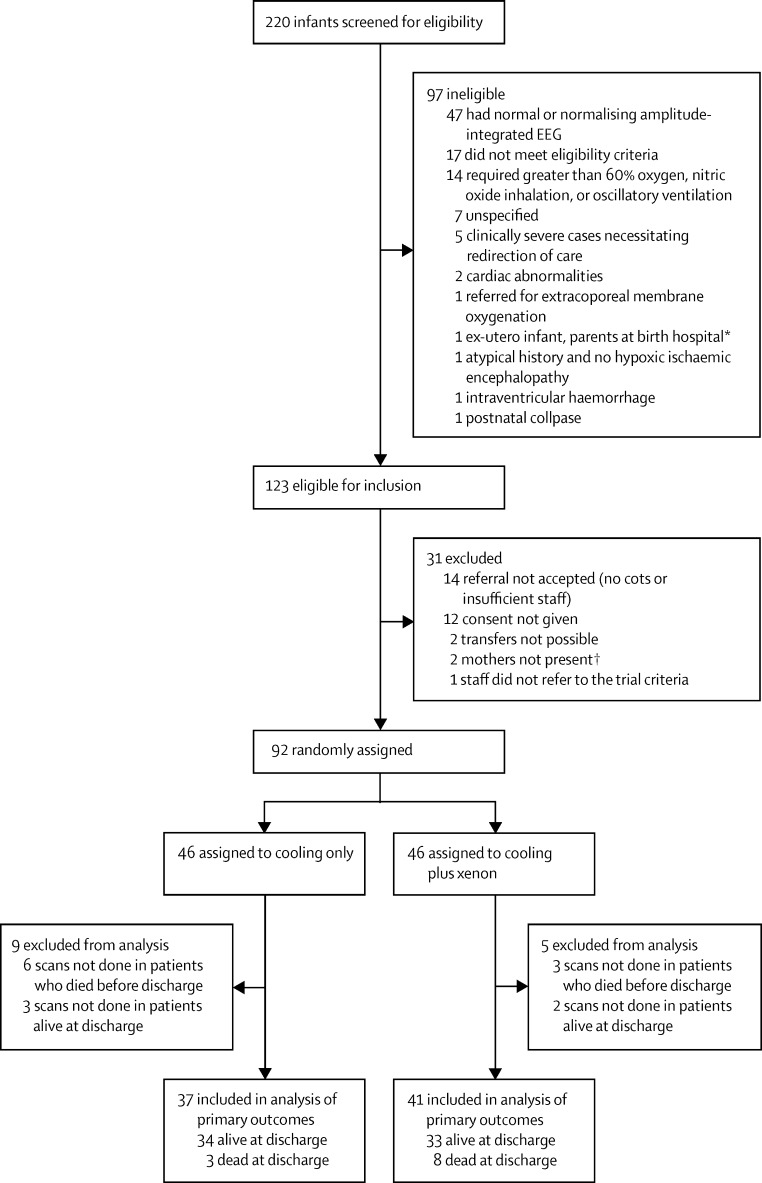
BACKGROUND: Moderate cooling after birth asphyxia is associated with substantial reductions in death and disability, but additional therapies might provide further benefit. We assessed whether the addition of xenon gas, a promising novel therapy, after the initiation of hypothermia for birth asphyxia would result in further improvement. METHODS: Total Body hypothermia plus Xenon (TOBY-Xe) was a proof-of-concept, randomised, open-label, parallel-group trial done at four intensive-care neonatal units in the UK. Eligible infants were 36-43 weeks of gestational age, had signs of moderate to severe encephalopathy and moderately or severely abnormal background activity for at least 30 min or seizures as shown by amplitude-integrated EEG (aEEG), and had one of the following: Apgar score of 5 or less 10 min after birth, continued need for resuscitation 10 min after birth, or acidosis within 1 h of birth. Participants were allocated in a 1:1 ratio by use of a secure web-based computer-generated randomisation sequence within 12 h of birth to cooling to a rectal temperature of 33·5°C for 72 h (standard treatment) or to cooling in combination with 30% inhaled xenon for 24 h started immediately after randomisation. The primary outcomes were reduction in lactate to N-acetyl aspartate ratio in the thalamus and in preserved fractional anisotropy in the posterior limb of the internal capsule, measured with magnetic resonance spectroscopy and MRI, respectively, within 15 days of birth. The investigator assessing these outcomes was masked to allocation. Analysis was by intention to treat. This trial is registered with ClinicalTrials.gov, number NCT00934700, and with ISRCTN, as ISRCTN08886155. FINDINGS: The study was done from Jan 31, 2012, to Sept 30, 2014. We enrolled 92 infants, 46 of whom were randomly assigned to cooling only and 46 to xenon plus cooling. 37 infants in the cooling only group and 41 in the cooling plus xenon group underwent magnetic resonance assessments and were included in the analysis of the primary outcomes. We noted no significant differences in lactate to N-acetyl aspartate ratio in the thalamus (geometric mean ratio 1·09, 95% CI 0·90 to 1·32) or fractional anisotropy (mean difference -0·01, 95% CI -0·03 to 0·02) in the posterior limb of the internal capsule between the two groups. Nine infants died in the cooling group and 11 in the xenon group. Two adverse events were reported in the xenon group: subcutaneous fat necrosis and transient desaturation during the MRI. No serious adverse events were recorded. INTERPRETATION: Administration of xenon within the delayed timeframe used in this trial is feasible and apparently safe, but is unlikely to enhance the neuroprotective effect of cooling after birth asphyxia. FUNDING: UK Medical Research Council.
Overview
The claims and statistics of this paper haven’t been checked yet.
Free: it reads the open-access text and checks the first 5 claims that cite a source we can check. Create a free account to check every claim.
Integrity signals
Registry
Cites
Statistics
Figures
Verification
Claims the paper makes
The claims and statistics of this paper haven’t been checked yet.
Free: it reads the open-access text and checks the first 5 claims that cite a source we can check. Create a free account to check every claim.
Claims other papers make about this one
Each is checked against this paper’s own text: does it say what the citing paper says it does?
The cited source says what the claim attributes to it.
In the citing paper
“Despite TH, some infants with HIE will exhibit poor long-term neurologic outcomes across a spectrum of severity including neurodevelopmental impairment (NDI) (3–6).”
Self-check
Percentages, sums and reported differences re-computed from the paper’s own numbers.
The self-check needs the paper’s full text.
Citations
Cites
Tract-based spatial statistics: Voxelwise analysis of multi-subject diffusion data
Smith, S. M., Jenkinson, M., Johansen-Berg, H., Rueckert, D., Nichols, T. E., Mackay, C. E., Watkins, K. E., Ciccarelli, O., Cader, M. Z., Matthews, P. M., et al. (2006) · NeuroImage · doi:10.1016/j.neuroimage.2006.02.024 · Cited by 6,478
Permutation inference for the general linear model
Winkler, A. M., Ridgway, G. R., Webster, M. A., Smith, S. M., & Nichols, T. E. (2014) · NeuroImage · doi:10.1016/j.neuroimage.2014.01.060 · Cited by 3,563
1,026 Experimental treatments in acute stroke
O'Collins, V. E., Macleod, M. R., Donnan, G. A., Horky, L. L., van der Worp, B. H., & Howells, D. W. (2006) · Annals of Neurology · doi:10.1002/ana.20741 · Cited by 1,460
Rutherford, M., Ramenghi, L. A., Edwards, A. D., Brocklehurst, P., Halliday, H., Levene, M., Strohm, B., Thoresen, M., Whitelaw, A., & Azzopardi, D. (2010) · The Lancet Neurology · doi:10.1016/s1474-4422(09)70295-9 · Cited by 600
Self-citationHow does xenon produce anaesthesia?
Franks, N. P., Dickinson, R., de Sousa, S. L. M., Hall, A. C., & Lieb, W. R. (1998) · Nature · doi:10.1038/24525 · Cited by 514
Self-citationThompson, C., Puterman, A., Linley, L., Hann, F., van der Elst, C., Molteno, C., & Malan, A. (1997) · Acta Paediatrica · doi:10.1111/j.1651-2227.1997.tb08581.x · Cited by 466
Assessment of Neonatal Encephalopathy by Amplitude-integrated Electroencephalography
al Naqeeb, N., Edwards, A. D., Cowan, F. M., & Azzopardi, D. (1999) · Pediatrics · doi:10.1542/peds.103.6.1263 · Cited by 458
Self-citationAzzopardi, D., Wyatt, J. S., Cady, E. B., Delpy, D. T., Baudin, J., Stewart, A. L., Hope, P. L., Hamilton, P. A., & Reynolds, E. O. R. (1989) · Pediatric Research · doi:10.1203/00006450-198905000-00004 · Cited by 366
Self-citationCerebral Magnetic Resonance Biomarkers in Neonatal Encephalopathy: A Meta-analysis
Thayyil, S., Chandrasekaran, M., Taylor, A., Bainbridge, A., Cady, E. B., Chong, W. K. K., Murad, S., Omar, R. Z., & Robertson, N. J. (2010) · Pediatrics · doi:10.1542/peds.2009-1046 · Cited by 359
Self-citationNeuroprotection With Prolonged Head Cooling Started Before Postischemic Seizures in Fetal Sheep
Gunn, A. J., Gunn, T. R., Gunning, M. I., Williams, C. E., & Gluckman, P. D. (1998) · Pediatrics · doi:10.1542/peds.102.5.1098 · Cited by 324
Cited by
Items 201–267 of 267
Management of the Depressed Newborn; to Cool or Not to Cool
Shah, D. K. (2020) · Springer eBooks · doi:10.1007/978-3-030-28829-7_4 · Cited by 1
Magnetic resonance spectroscopy in hypoxic ischaemic encephalopathy
Lally, P. (2018) · Spiral (Imperial College London) · doi:10.25560/82008 · Cited by 1
Chalia, M. (2018) · Apollo (University of Cambridge) · doi:10.17863/cam.31784 · Cited by 1
Arola, O. (2019) · UTUPub (University of Turku) · Cited by 1
Lagnese, K., Sheth, S., Vice, S., Rajderkar, D., Roig, J. C., Weiss, M., & Wynn, J. L. (2026) · Frontiers in Pediatrics · doi:10.3389/fped.2026.1844058
Chevin, M. (2016) · Knowledge UdeS (Institutional Deposit of the University of Sherbrooke)
Timing Perinatal Hypoxic-Ischemic Brain Injury
Bennet, L., Dhillon, S. K., Davidson, J. O., & Gunn, A. J. (2017) · Cambridge University Press eBooks · doi:10.1017/9781316275498.022
Future Roles for Xenon in Emergency Medicine and Critical Care
Laitio, T. T., & Maze, M. (2018) · Annual update in intensive care and emergency medicine · doi:10.1007/978-3-319-73670-9_49
Self-citationHypothermia and the Evaluation of Combination Therapies for Neonatal Hypoxic-Ischemic Brain Damage
Przyslupski, A. (2016) · ERA: Education and Research Archive (University of Alberta) · doi:10.7939/r3bz61k3c
Perinatal and Neonatal Hypoxia Ischaemia: The Unique Challenges of Treating the Infant Brain
Millar, L. J. (2018) · IntechOpen eBooks · doi:10.5772/intechopen.79674
Weiss, M. D., Bliznyuk, N., Rossignol, C., Sura, L., Huene, M., Copenhaver, N., Glushakova, O. Y., & Hayes, R. L. (2019) · The Open Biomarkers Journal · doi:10.2174/1875318301909010021
Prenatal methadone exposure and the developing brain
Monnelly, V. J. (2019) · ERA
Rüdiger, M., & Roehr, C. C. (2019) · Intensivmedizin up2date · doi:10.1055/a-0653-6214
Zou, R., Tang, J., Bao, S., Wu, T., Huang, J., Qu, Y., & Mu, D. (2018) · PubMed · doi:10.7499/j.issn.1008-8830.2018.06.004
Neuroprotection by noble gases in models of brain injury
Koziakova, M. (2017) · Spiral (Imperial College London) · doi:10.25560/78221
PERINATAL ASPHYXIA: PREDICTING AND IMPROVING OUTCOME
Annink, K. V. (2020) · Utrecht University Repository (Utrecht University) · doi:10.33540/67
Antioxidant-loaded nanoparticles for the treatment of excitotoxicity in neurological disease
Liao, R. (2020) · ResearchWorks at the University of Washington (University of Washington)
Investigating Treatments for Hemorrhagic Stroke Using Rodent Models
Wowk, S. (2020) · ERA: Education and Research Archive (University of Alberta) · doi:10.7939/r3-c8jx-y113
Intrapartum Asphyxia and Its Sequelae
Montalto, S. A. (2021) · Cambridge University Press eBooks · doi:10.1017/9781108863049.061
Endogenous and Exogenous Neuroprotective Mechanisms after Hypoxic-Ischemic Injury
Davidson, J. O., Dhillon, S. K., Bennet, L., & Gunn, A. J. (2017) · Cambridge University Press eBooks · doi:10.1017/9781009418034.007
GENE POLYMORPHISM AS A PREDICTOR DEVELOPMENT OF THE CHILDREN DISEASE
Davydenko, A. (2022) · Актуальні проблеми сучасної медицини Вісник Української медичної стоматологічної академії · doi:10.31718/2077-1096.22.3.4.225
Tsuda, K., Shibasaki, J., Takeuchi, A., Mukai, T., Sugiyama, Y., Isayama, T., Ioroi, T., Takahashi, A., Yutaka, N., Iwata, O., et al. (2023) · Acta Paediatrica · doi:10.1111/apa.16687
New therapies in the treatment of Perinatal Asphyxia: A systematic review
Inácio, E. L., & Capani, F. (2023) · SCT Proceedings in Interdisciplinary Insights and Innovations. · doi:10.56294/piii2023169
Therapeutic Hypothermia and Neuroprotection Strategies in Neonatology
Устинович, Ю. А., Жевнеронок, И. В., & Кизатова, С. Т. (2024) · Репродуктивное здоровье Восточная Европа · doi:10.34883/pi.2024.14.2.011
Therapeutic Applications of Xenon (Literature Review).
Евгеньевич, П. М., Николаевна, З. Е., Podprugina, S. V., Владимирович, Н. П., Agakina, Y. S., & Yavorovskiy, A. G. (2024) · Regional Anesthesia and Acute Pain Management · doi:10.17816/ra637113
Magnesium and Traumatic Brain Injury
Khiat, A. E., Foutat, S. E., El‐Mansoury, B., Ali, D. A., Hamdan, Y. A., Dadda, S., Kaoutar, K., Korchyou, Y., Tamegart, L., Koutbi, M. E., et al. (2024) · Nutritional neurosciences · doi:10.1007/978-981-97-6341-2_10
Güncel Çocuk Sağlığı ve Hastalıkları VIII (Bahar)
Özdoğar, M. B., Ateş, B., Güzeloğlu, E., Pehlivanoğlu, B. N., Yanaşoğlu, E., Uçar, S., Sağlam, M. K., İşcan, T., Kurt, C., & Koraman, A. A. (2025) · Akademisyen Kitabevi eBooks · doi:10.37609/akya.3637
ABORDAGEM E MANEJO CLÍNICO DO PACIENTE IDOSO COM EAP NA EMERGÊNCIA
́Anna, C. O. M. D. S., & Perez, M. C. A. (2025) · Jornada Científica do Internato Médico · doi:10.29327/1718890.46-24
TRANSTORNO DO ESPECTRO AUTISTA: O DIAGNÓSTICO TARDIO E O SUBDIAGNÓSTICO
Bernardino, L. F. M., & Desiderati, M. (2025) · Jornada Científica do Internato Médico · doi:10.29327/1718890.46-20
QUEIMADURA: MANEJO NA EMERGÊNCIA
Gaspar, L. M. A., & Rodriguez, L. M. (2025) · Jornada Científica do Internato Médico · doi:10.29327/1718890.46-12
MENINGITE ASSÉPTICA INDUZIDA POR AMOXICILINA
Ribeiro, A. R., Dóczy, A. D. P., & Campos, A. R. R. (2025) · Jornada Científica do Internato Médico · doi:10.29327/1718890.46-9
ESTUDO DAS DIFERENTES TECNICAS CIRÚRGICAS NA REVASCULARIZACAO DO MIOCÁRDIO
de Moraes, B. L. L., & Nunes, C. P. (2025) · Jornada Científica do Internato Médico · doi:10.29327/1718890.46-11
EFEITOS DA SUPLEMENTAÇÃO DE VITAMINA D NA PREVENÇÃO DE DOENÇAS OCULARES
Domingos, E. D., & de Melo, L. R. B. (2025) · Jornada Científica do Internato Médico · doi:10.29327/1718890.46-16
TRATAMENTOS PARA A PERSISTÊNCIA DO CANAL ARTERIAL EM PREMATUROS
Sohn, E. R. T., & Correa, C. (2025) · Jornada Científica do Internato Médico · doi:10.29327/1718890.46-17
AVALIAÇÃO DAS DIFERENTES ETIOLOGIAS DE HIPERBILIRRUBINEMIA NEONATAL
Itajahy, M. C. C. M., Rodrigues, S., & Vasconcellos, M. (2025) · Jornada Científica do Internato Médico · doi:10.29327/1718890.46-7
A IMPORTÂNCIA DA GOLDEN HOUR PARA O FORTALECIMENTO DO VÍNCULO MAMÃE E BEBÊ
Viana, V. D. S., & Gama, C. E. D. S. (2025) · Jornada Científica do Internato Médico · doi:10.29327/1718890.46-4
SINTOMAS INESPECÍFICOS NO CÂNCER PEDIÁTRICO: O PAPEL DO DIAGNÓSTICO PRECOCE
de Pinho, L. L., & Vasconcellos, M. (2025) · Jornada Científica do Internato Médico · doi:10.29327/1718890.46-3
DERMATOLOGIA E SAÚDE MENTAL: O VÍNCULO ENTRE ACNE E DEPRESSÃO EM INDIVÍDUOS JOVENS
Motta, L. D. L., & Granja, P. D. D. (2025) · Jornada Científica do Internato Médico · doi:10.29327/1718890.46-63
INOVAÇÕES E DESAFIOS NO TRATAMENTO DA TETRALOGIA DE FALLOT
Silveira, I. M. S., & Escrivães, A. C. N. D. C. (2025) · Jornada Científica do Internato Médico · doi:10.29327/1718890.46-60
Chiconelli, H. M. A., & Desiderati, M. (2025) · Jornada Científica do Internato Médico · doi:10.29327/1718890.46-56
NEUROPROTEÇÃO COM SULFATO DE MANGÉSIO: APLICAÇÃO NA OBSTETRÍCIA
Gouvêa, E. H., & B.Gama, C. R. (2025) · Jornada Científica do Internato Médico · doi:10.29327/1718890.46-53
ATUALIZAÇÕES NOS CRITÉRIOS DIAGNÓSTICOS E TRATAMENTO DA SEPSE.
Cavalcanti, R. D. G., & Perez, M. C. A. (2025) · Jornada Científica do Internato Médico · doi:10.29327/1718890.46-50
HEMORRAGIA DIGESTIVA ALTA POR VARIZES GASTROESOFÁGICAS EM PACIENTES CIRRÓTICOS
Neves, G. V., & Figueiredo, L. F. (2025) · Jornada Científica do Internato Médico · doi:10.29327/1718890.46-54
ANÁLISE DA IMUNIZAÇÃO INFANTIL DE 0 A 5 ANOS EM UM AMBULATÓRIO DE ENSINO
Erthal, S. S., & Rodrigues, S. (2025) · Jornada Científica do Internato Médico · doi:10.29327/1718890.46-32
USO DO OMALIZUMABE PARA O TRATAMENTO DA ASMA ALÉRGICA GRAVE
Fernandes, G. N., & Nunes, C. P. (2025) · Jornada Científica do Internato Médico · doi:10.29327/1718890.46-34
TRANSTORNOS DA PERSONALIDADE DO GRUPO B NA ATENÇÃO PRIMÁRIA
Peclat, B. E., & Dóczy, A. D. P. (2025) · Jornada Científica do Internato Médico · doi:10.29327/1718890.46-35
Steuerung der Intensivtherapie bei Neugeborenen mit schwerer Asphyxie
Hübler, A. (2025) · Neonatologie Scan · doi:10.1055/a-2209-2834
Seitz, M. (2023) · DuEPublico (University of Duisburg-Essen) · doi:10.17185/duepublico/78301
Reinboth, B. S. (2020) · DuEPublico (University of Duisburg-Essen) · doi:10.17185/duepublico/71543
Wang, Z., Zhang, P., Zhou, W., Xia, S., Zhou, W., Zhou, X., 程秀永, Shi, Y., Lin, Z., Song, D., et al. (2021) · Figshare · doi:10.6084/m9.figshare.14738532
Wang, Z., Zhang, P., Zhou, W., Xia, S., Zhou, W., Zhou, X., 程秀永, Shi, Y., Lin, Z., Song, D., et al. (2021) · Figshare · doi:10.6084/m9.figshare.14738535
Tetorou, K. (2023) · UCL Discovery (University College London)
Neuroproteção Perinatal: Quo vadis?
Brandão, P. D. D. S. (2018) · Portuguese National Funding Agency for Science, Research and Technology (RCAAP Project by FCT)
Terapêuticas coadjuvantes da hipotermia na encefalopatia hipóxico-isquémica neonatal
Costeira, R. A. (2016) · Portuguese National Funding Agency for Science, Research and Technology (RCAAP Project by FCT)
Rodríguez‐Fanjul, J. (2018) · Dipòsit Digital de la Universitat de Barcelona (Universitat de Barcelona)
Núñez‐Ramiro, A. (2021) · Repository of Digital Objects for Teaching Research and Culture (University of Valencia)
Estrategias neuroprotectoras frente a la encefalopatía hipóxico-isquémica neonatal
Zorrilla Fernández, B. (2023) · Communities in ADDI (University of the Basque Country)
Perinatal Neuroprotection: Quo vadis?
Brandão, P. D. D. S. (2018) · Portuguese National Funding Agency for Science, Research and Technology (RCAAP Project by FCT)
Matheron, I. (2017) · theses.fr (ABES) · doi:10.70675/f0be3f3az2acdz407aza7f1z575e63553cd6
Drug development for newborn brain injury
Maltepe, E. (2026) · Pediatric Research · doi:10.1038/s41390-026-05142-w
Drugs and Cell-Based Therapies for the Prevention and Treatment of Neonatal Brain Injury
McNally, M. A., & Soul, J. S. (2026) · Clinics in Perinatology · doi:10.1016/j.clp.2026.05.003
Juszczak, E., Hardy, P., Bradburn, M., Cole, C., DANIELS, J. P., Dimairo, M., Fiaschi, L., Gale, C. P., James, H., Johnson, S. J., et al. (2026) · NIHR Open Research · doi:10.3310/nihropenres.14207.1
Self-citationVicente, L. H. P., Rondagh, M., van Steenis, A., van Oldenmark, B. O., Toirkens, J., Groenendaal, F., de Vries, L. S., & Steggerda, S. J. (2026) · Archives of Disease in Childhood Fetal & Neonatal · doi:10.1136/archdischild-2026-330796
Zhu, J., Ruan, Y., Weng, J., Xu, X., Wu, Z., Yu, Y., Haifeng, L., Li, X., Tong, J., Ou, Y., et al. (2026) · bioRxiv (Cold Spring Harbor Laboratory) · doi:10.64898/2026.09.23.753714
Hollmén, C. C. (2026) · UTUPub (University of Turku)
Herrera, M. I., Udovin, L. D., Kobiec, T., Toro-Urrego, N., Kusnier, C. F., Kölliker-Frers, R. A., Luaces, J. P., Otero-Losada, M., & Capani, F. (2022) · doi:10.3389/fnbeh.2022.953157.s002
Metadata
- Authors
- Azzopardi, D., Robertson, N. J., Bainbridge, A., Cady, E., Charles-Edwards, G., Deierl, A., Fagiolo, G., Franks, N. P., Griffiths, J., Hajnal, J., Juszczak, E., Kapetanakis, B., Linsell, L., Maze, M., Omar, O., Strohm, B., Tusor, N., & Edwards, A. D.
- Affiliations
- King's College London (GB)
- University College London (GB)
- University College London Hospitals NHS Foundation Trust (GB)
- Imperial College Healthcare NHS Trust (GB)
- Imperial College London (GB)
- University of Oxford (GB)
- University of California, San Francisco (US)
- Corresponding author
- Azzopardi, Denis
- ORCID
- Venue
- The Lancet Neurology
- Publisher
- Elsevier BV
- Published
- 2016-02
- Volume
- 15
- Issue
- 2
- Pages
- 145-153
- ISSN
- 1474-4422 (ISSN-L)
- PMC
- PMC4710577
- OpenAlex
- W2206541338
- Semantic Scholar
- 3b644d2a3ff3a2a3854b9de5f6ff39914116b859
- Cited by
- 220
- References
- 30
- Citations by year
- 2026: 9 · 2025: 11 · 2024: 16 · 2023: 15 · 2022: 13 · 2021: 27 · 2020: 29 · 2019: 28 · 2018: 28 · 2017: 28 · 2016: 14
- FWCI
- 23.58
- Type
- journal article
- Language
- en
- Open access
- hybrid
- doi.org
- Licence
- cc-by
- www.elsevier.com/tdm/userlicense/1.0/ (tdm)
- creativecommons.org/licenses/by/4.0/ (vor)
- Locations
- The Lancet Neurology (publishedVersion, cc-by)
- Europe PMC (PubMed Central) (publishedVersion, cc-by)
- PubMed Central (publishedVersion, cc-by)
- PubMed (publishedVersion)
- UCL Discovery (University College London) (submittedVersion)
- eScholarship (California Digital Library) (submittedVersion)
- Research Portal (King's College London) (submittedVersion, cc-by)
- University of Birmingham Research Portal (University of Birmingham) (submittedVersion, cc-by)
- Spiral (Imperial College London) (submittedVersion, other-oa)
- Funders
- UK Medical Research Council (G0701714/1)
- Topics
- Health Sciences › Medicine › Pediatrics, Perinatology and Child Health › Neonatal and fetal brain pathology
- Health Sciences › Medicine › Critical Care and Intensive Care Medicine › Thermal Regulation in Medicine
- Health Sciences › Medicine › Pulmonary and Respiratory Medicine › Neonatal Respiratory Health Research
- Keywords
- neonatal asphyxia, neonatal hypothermia, xenon, total body cooling, neonatal encephalopathy, fractional anisotropy, thalamus, internal capsule, neuroprotection, neonatal seizures, amplitude-integrated electroencephalography, gestational age, Apgar score, acidosis, magnetic resonance spectroscopy
- MeSH terms
- Acidosis, Apgar Score, Aspartic Acid, Asphyxia Neonatorum, Combined Modality Therapy, Feasibility Studies, Female, Humans, Hypothermia, Induced, Infant, Newborn, Magnetic Resonance Imaging, Male, Resuscitation, Thalamus, Xenon, Single-Blind Method, Outcome Assessment, Health Care, Anesthetics, Inhalation, Lactic Acid, Internal Capsule
About these checks
Registry, retraction, Cites and statistics results are computed, not judged, with one exception: a printed reference that no index lists is read once by a model before it counts as a citation error. Claims are extracted by a model and kept only when their quote appears verbatim in the text; each cited source is then checked, with a model’s help, for whether it says what the claim relies on. Those verdicts can be wrong — read the claim’s quote and the cited source before relying on one.
Statistics and arithmetic are recomputed, not judged.
Confidence bands are shown only for fields calibrated on our annotated test set. None is calibrated yet, so no band is shown.
What counts as a claim ›How we measure confidence ›How we check this ›
Are you an author, or do you see a problem with this page? Request a review
Data sources
Bibliographic data: Semantic Scholar, OpenAlex, Crossref.
Contains information from the Semantic Scholar Academic Graph Datasets, made available under the ODC Attribution License (ODC-BY 1.0).
Semantic Scholar’s data is described in: Kinney, R., et al. (2023). The Semantic Scholar Open Data Platform. arXiv:2301.10140.
