

Spatial patterns of neuroimaging biomarker change in individuals from families with autosomal dominant Alzheimer's disease: a longitudinal study
Open accessThe DOI matches its Crossref record; 57 of the 60 references it cites were found in a registry or an index; 9 of the 24 sources its claims cite were checked for support.
Abstract
Background Models of Alzheimer's disease propose a sequence of amyloid β (Aβ) accumulation, hypometabolism, and structural decline that precedes the onset of clinical dementia. These pathological features evolve both temporally and spatially in the brain. In this study, we aimed to characterise where in the brain and when in the course of the disease neuroimaging biomarkers become abnormal.Methods Between Jan 1, 2009, and Dec 31, 2015, we analysed data from mutation non-carriers, asymptomatic carriers, and symptomatic carriers from families carrying gene mutations in presenilin 1 (PSEN1), presenilin 2 (PSEN2), or amyloid precursor protein (APP) enrolled in the Dominantly Inherited Alzheimer's Network. We analysed 11 C-Pittsburgh Compound B (11 C-PiB) PET, 18 F-Fluorodeoxyglucose (18 F-FDG) PET, and structural MRI data using regions of interest to assess change throughout the brain. We estimated rates of biomarker change as a function of estimated years to symptom onset at baseline using linear mixed-effects models and determined the earliest point at which biomarker trajectories differed between mutation carriers and non-carriers. This study is registered at ClinicalTrials.gov (number NCT00869817) FINDINGS: 11 C-PiB PET was available for 346 individuals (162 with longitudinal imaging), 18 F-FDG PET was available for 352 individuals (175 with longitudinal imaging), and MRI data were available for 377 individuals (201 with longitudinal imaging). We found a sequence to pathological changes, with rates of Aβ deposition in mutation carriers being significantly different from those in non-carriers first (across regions that showed a significant difference, at a mean of 18·9 years [SD 3·3] before expected onset), followed by hypometabolism (14·1 years [5·1] before expected onset), and lastly structural decline (4·7 years [4·2] before expected onset). This biomarker ordering was preserved in most, but not all, regions. The temporal emergence within a biomarker varied across the brain, with the precuneus being the first cortical region for each method to show divergence between groups (22·2 years before expected onset for Aβ accumulation, 18·8 years before expected onset for hypometabolism, and 13·0 years before expected onset for cortical thinning).Interpretation Mutation carriers had elevations in Aβ deposition, reduced glucose metabolism, and cortical thinning compared with non-carriers which preceded the expected onset of dementia. Accrual of these pathologies varied throughout the brain, suggesting differential regional and temporal vulnerabilities to Aβ, metabolic decline, and structural atrophy, which should be taken into account when using biomarkers in a clinical setting as well as designing and evaluating clinical trials.Funding US National Institutes of Health, the German Center for Neurodegenerative Diseases, and the Medical Research Council Dementias Platform UK.
Overview
CoChat Summary
TL;DR
In the DIAN longitudinal cohort, mutation carriers showed earlier and regionally variable neuroimaging biomarker changes than non-carriers, with Aβ deposition diverging first, followed by hypometabolism and then structural decline. The precuneus was the earliest cortical region to show divergence across all three modalities.
Key findings
- Among regions with significant group differences, rates of Aβ deposition in mutation carriers diverged first at an average estimated years from symptom onset (EYO) of −18·9 (SD 3·3), followed by hypometabolism at −14·1 (SD 5·1) and structural decline at −4·7 (SD 4·2).
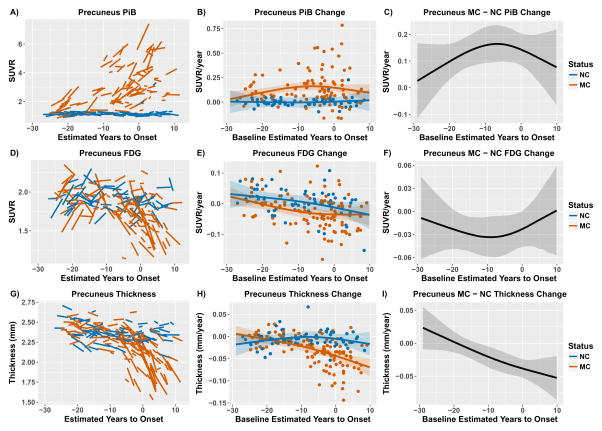
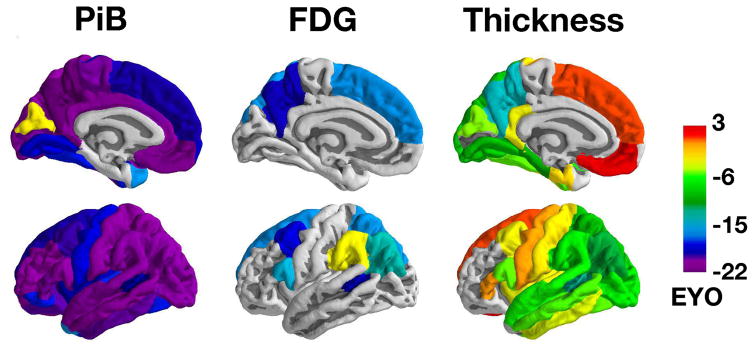
- The precuneus was the first cortical region in each modality: Aβ accumulation diverged at EYO −22·2, hypometabolism at −18·8, and cortical thinning at −13·0.
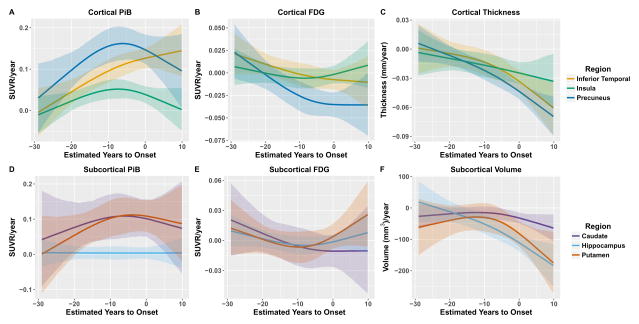
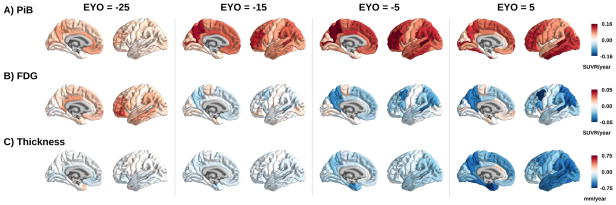
- PiB PET showed significantly greater longitudinal Aβ accumulation in 32/34 cortical regions in mutation carriers versus non-carriers, with divergence from EYO −22·2 to −2·5; all but the cuneus (−2·5) occurred before EYO −15. FDG PET showed significant hypometabolism in 8/34 cortical regions (EYO −18·8 to −2·8) and no subcortical regions. MRI showed increased atrophy in 24/34 cortical and 4/7 subcortical regions (EYO −13·0 to 2·3).
- Regional relationships were heterogeneous: all regions with metabolic decreases had abnormal Aβ accumulation, but many regions with abnormal Aβ accumulation did not show elevated metabolic decline; some regions, such as the hippocampus, had structural declines without Aβ or FDG changes.
Methods
- Participants were from families with PSEN1, PSEN2, or APP mutations in the Dominantly Inherited Alzheimer Network observational study, recruited from 14 sites in the United States, Great Britain, Germany, and Australia between January 1, 2009, and December 31, 2015; Dutch and Flemish APP mutation families were excluded. Analyses included 346 individuals with PiB PET (162 longitudinal), 352 with FDG PET (175 longitudinal), and 377 with MRI (201 longitudinal); longitudinal subjects averaged 2·4 visits (SD 0·8) and 2·7 years (SD 1·1) of data.
- Imaging used [11C]Pittsburgh Compound B PET, [18F]fluorodeoxyglucose PET, and structural MRI with ADNI protocol; PET data were converted to SUVRs relative to cerebellar grey matter and partial volume corrected, and MRI was processed with FreeSurfer to define 34 cortical and 7 subcortical regions of interest.
- Bayesian multivariate linear mixed-effects models were fit in Stan, separately for cortical and subcortical regions for each modality (six models total), with fixed effects for mutation status, time from baseline, baseline EYO, and interactions; significance was based on 99% equal-tailed credible intervals not overlapping zero.
Limitations
- Stated in the paper: most longitudinal subjects had limited follow-up (average 2·4 visits), results at the edges of the EYO range may be disproportionately influenced by outliers, and there were only modest numbers of subjects with PSEN2 and APP mutations.
- Stated in the paper: no individual has data across the entire disease window, results represent population rather than individual subject effects, some individuals differ from population trajectories, and imaging data alone may not be sufficient for individual-level disease staging.
- Stated in the paper: the temporal ordering is relative rather than absolute and depends on the EYO definition; PET/MRI findings are constrained by technique sensitivity and signal-to-noise; partial volume correction and cerebellum reference region choices may affect trajectories; and ADAD as a model for sporadic AD requires direct comparisons. Evident from the text: the study did not include tau or inflammation biomarkers, which the authors note may help explain heterogeneous regional relationships.
Model-written summary. Check it against the paper before relying on it.
Integrity signals
Registry
Cites
Statistics
Figures
Verification
Claims the paper makes
5 Valid · 0 Not valid · 4 Not checked · 74 Own results and interpretations
The cited sources support only part of this claim — read each source’s verdict below.
In the paper
“Autosomal dominant AD (ADAD) is well suited to study biomarker trajectories due to the virtually complete penetrance of the mutations and consistency of symptom onset within families4,5.”
§ Spatial patterns of neuroimaging biomarker change in individuals from families with autosomal dominant Alzheimer disease: a longitudinal study > Introduction
What the sources say
- Supportedcites [4] Moulder KL Snider BJ Mills SL Dominantly Inherited Alzheimer Network: facilitating research and clinical trials Alzheimers Res Ther 2013 5 48 24131566 PMC3978584 source
The Introduction passage states that ADAD mutations are almost 100% penetrant, that carriers are virtually certain to develop symptomatic AD at an age at onset very similar to their affected parent, and that this more predictable disease course will facilitate understanding of biomarkers in asymptomatic carriers. The Conclusions passage reinforces this, noting that biomarker measurements in the preclinical stage can be ordered relative to parental AAO. Together these support both the penetrance and within-family onset-consistency rationales for studying biomarker trajectories. (LLM, conf=0.93)
- Partly supportedcites [5] Ryman DC Acosta-Baena N Aisen PS Symptom onset in autosomal dominant Alzheimer disease: a systematic review and meta-analysis Neurology 2014 83 253 60 24928124 PMC4117367 sourceExperimental — accuracy not yet measured
Our copy supports the onset-predictability half of the claim: the Abstract Conclusions state that significant proportions of the variance in age at symptom onset in ADAD can be explained by family history and mutation type, and the Discussion (final paragraph) says these findings let researchers estimate onset before symptoms, with biomarker relationships named only as a future direction alongside ongoing DIAN trials. But the 'virtually complete penetrance' rationale is not stated anywhere in our copy; the Discussion explicitly hedges it, noting that for later-onset mutations many carriers may die of unrelated causes before onset, 'making penetrance difficult to determine conclusively.' The Discussion and Introduction also qualify within-family consistency ('substantial variation remains within many ADAD families and mutation types'; 'Some families carrying an identical ADAD mutation can have significantly different ages at onset'), and the paper never asserts that ADAD is well suited to studying biomarker trajectories. (LLM, conf=0.75)
boostedstates a cause- Asserted: passes — The authors put it forward as true.
- Checkable: passes — It can be checked against evidence.
- Load-bearing: passes — The paper’s conclusions depend on it.
- Based: passes — The paper gives a reason why it holds.
- Supported
The cited sources support only part of this claim — read each source’s verdict below.
In the paper
“Multivariate LME models can increased statistical power and reliability compared to univariate methods30,31.”
§ Spatial patterns of neuroimaging biomarker change in individuals from families with autosomal dominant Alzheimer disease: a longitudinal study > Methods > Statistical Analyses
What the sources say
- Partly supportedcites [30] Bernal-Rusiel JL Reuter M Greve DN Fischl B Sabuncu MR Spatiotemporal linear mixed effects modeling for the mass-univariate analysis of longitudinal neuroimage data Neuroimage 2013 81 358 70 23702413 PMC3816382 sourceExperimental — accuracy not yet measured
Results §3.1 reports that spatiotemporal LME had greater statistical power and repeatability than the benchmark methods, including vertex-wise LME. But Methods §2.4 and the Discussion describe the proposed approach as mass-univariate, not multivariate; the cited paper therefore does not establish the claim for multivariate LME models. (LLM, conf=0.88)
- Partly supportedcites [31] Bernal-Rusiel JL Greve DN Reuter M Fischl B Sabuncu MR Statistical analysis of longitudinal neuroimage data with Linear Mixed Effects models Neuroimage 2013 66 249 60 23123680 PMC3586747 sourceExperimental — accuracy not yet measured
The Results (§3.3) report higher sensitivity and more repeatable findings for LME than for repeated-measures ANOVA and slope-based analysis. But the Discussion (§4) explicitly says this study focused on univariate analysis; it does not compare multivariate LME models with univariate methods. (LLM, conf=0.89)
plainstates a cause- Asserted: passes — The authors put it forward as true.
- Checkable: passes — It can be checked against evidence.
- Load-bearing: passes — The paper’s conclusions depend on it.
- Based: passes — The paper gives a reason why it holds.
- Partly supported
The cited sources support only part of this claim — read each source’s verdict below.
In the paper
“Longitudinal analyses can provide a better estimate of the true pathological trajectories.17,18”
§ Spatial patterns of neuroimaging biomarker change in individuals from families with autosomal dominant Alzheimer disease: a longitudinal study > Introduction
What the sources say
- Supportedcites [17] Thompson WK Hallmayer J O’Hara R Initiative the ADN Design Considerations for Characterizing Psychiatric Trajectories Across the Lifespan: Application to Effects of APOE-ε4 on Cerebral Cortical Thickness in Alzheimer’s Disease Am J Psychiatry 2011 168 894 903 21724665 PMC5493321 source
The Conclusions state that multicohort longitudinal designs, combined with attention to cohort effects, can provide the best possible estimates of psychiatric illness trajectories. The paper qualifies that longitudinal designs alone are not a panacea, but the claim’s use of “can” is consistent with that conclusion. (LLM, conf=0.91)
- Partly supportedcites [18] Xu Z Shen X Pan W Longitudinal analysis is more powerful than cross-sectional analysis in detecting genetic association with neuroimaging phenotypes PLoS One 2014 9 e102312 25098835 PMC4123854 sourceExperimental — accuracy not yet measured
The Introduction (page unavailable) says longitudinal analysis can estimate rates of change in neuroimaging phenotypes, whereas baseline cross-sectional analysis captures only mean differences. The Results > Data summary discusses individual hippocampal-volume trajectories. The paper does not establish that these estimates better represent the true underlying pathological trajectories. (LLM, conf=0.80)
plainstates a cause- Asserted: passes — The authors put it forward as true.
- Checkable: passes — It can be checked against evidence.
- Load-bearing: passes — The paper’s conclusions depend on it.
- Based: passes — The paper gives a reason why it holds.
- Supported
A result the paper reports from its own data — it cites no other source for it, so there is none to check. The quote shows it is in the paper.
In the paper
“with the precuneus, posterior cingulate gyrus, and medial orbital frontal cortex regions showing the earliest changes (~EYO −21).”
§ Spatial patterns of neuroimaging biomarker change in individuals from families with autosomal dominant Alzheimer disease: a longitudinal study > Results
plainstates an association- Asserted: passes — The authors put it forward as true.
- Checkable: passes — It can be checked against evidence.
- Load-bearing: passes — The paper’s conclusions depend on it.
- Based: passes — The paper gives a reason why it holds.
- Rests on an assumption not shown here.
A result the paper reports from its own data — it cites no other source for it, so there is none to check. The quote shows it is in the paper.
In the paper
“and lastly structural declines (−4·7 years, sd 4·2)”
§ Spatial patterns of neuroimaging biomarker change in individuals from families with autosomal dominant Alzheimer disease: a longitudinal study > Abstract > Findings
plainstates an association- Asserted: passes — The authors put it forward as true.
- Checkable: passes — It can be checked against evidence.
- Load-bearing: passes — The paper’s conclusions depend on it.
- Based: passes — The paper gives a reason why it holds.
- Rests on an assumption not shown here.
44 more claims
Create a free account to see all 83 claims and to verify the 15 references still open.
- Probably not a substantial claim. 16
- It may state two separate claims as one. 23
Claims other papers make about this one
Each is checked against this paper’s own text: does it say what the citing paper says it does?
The source backs part of the claim, not all of it — or backs it for a different population, condition or comparison.
In the citing paper
“These pathological changes can be assessed by magnetic resonance imaging (MRI), positron-emission tomography (PET), and measurement of amyloid-β and tau protein levels in the cerebrospinal fluid (CSF)1–4.”
From Serum neurofilament dynamics predicts neurodegeneration and clinical progression in presymptomatic Alzheimer’s disease (2019) · cites this paper as [2]
Experimental — accuracy not yet measuredThe source backs part of the claim, not all of it — or backs it for a different population, condition or comparison.
In the citing paper
“Cross-sectional and longitudinal data analyses of DIAN and other large Alzheimer’s disease cohorts have demonstrated that the pathological processes in Alzheimer’s disease begin more than two decades before the onset of clinical symptoms.”
From Serum neurofilament dynamics predicts neurodegeneration and clinical progression in presymptomatic Alzheimer’s disease (2019) · cites this paper as [2]
Experimental — accuracy not yet measuredThe source backs part of the claim, not all of it — or backs it for a different population, condition or comparison.
In the citing paper
“In fact, precuneus thinning was also detected around 16 years before symptom onset2”
From Serum neurofilament dynamics predicts neurodegeneration and clinical progression in presymptomatic Alzheimer’s disease (2019) · cites this paper as [2]
Experimental — accuracy not yet measuredThe source backs part of the claim, not all of it — or backs it for a different population, condition or comparison.
In the citing paper
“A recent longitudinal study of asymptomatic autosomal dominant carriers of AD provided further insight into the progression of brain chemistry changes with Aβ deposition occurring first, followed by hypometabolism, and finally structural atrophy [141].”
From Mitochondrial Oxidative and Nitrosative Stress and Alzheimer Disease (2020) · cites this paper as [141]
Experimental — accuracy not yet measuredThe source backs part of the claim, not all of it — or backs it for a different population, condition or comparison.
In the citing paper
“Researchers also found that glucose metabolism starts decreasing 18 years before expected symptom onset, and brain atrophy begins 13 years before expected symptom onset.”
From 2024 Alzheimer's disease facts and figures (2024) · cites this paper as [5]
Experimental — accuracy not yet measured
12 more claims about this paper
Create a free account to see every claim other papers make about this one.
Citations
Cites
Fitting Linear Mixed-Effects Models Using lme4
Bates, D., Mächler, M., Bolker, B., & Walker, S. (2015) · Journal of Statistical Software · doi:10.18637/jss.v067.i01 · Cited by 86,835
Inference from iterative simulation using multiple sequences
Gelman, A., & Rubin, D. B. (1992) · Statistical Science · doi:10.1214/ss/1177011136 · Cited by 16,627
The Clinical Dementia Rating (CDR): Current version and scoring rules
Morris, J. C. (1993) · Neurology · doi:10.1212/wnl.43.11.2412-a · Cited by 9,882
Self-citationFischl, B. (2012) · NeuroImage · doi:10.1016/j.neuroimage.2012.01.021 · Cited by 9,526
Stan : A Probabilistic Programming Language
Carpenter, B., Gelman, A., Hoffman, M. D., Lee, D., Goodrich, B., Betancourt, M., Brubaker, M., Guo, J., Li, P., & Riddell, A. (2017) · Journal of Statistical Software · doi:10.18637/jss.v076.i01 · Cited by 7,754
Alzheimer's disease: the amyloid cascade hypothesis
Hardy, J. A., & Higgins, G. A. (1992) · Science · doi:10.1126/science.1566067 · Cited by 7,484
General methods for monitoring convergence of iterative simulations
Brooks, S. P., & Gelman, A. (1998) · Journal of Computational and Graphical Statistics · doi:10.1080/10618600.1998.10474787 · Cited by 6,045
Measuring the thickness of the human cerebral cortex from magnetic resonance images
Fischl, B., & Dale, A. M. (2000) · Proceedings of the National Academy of Sciences · doi:10.1073/pnas.200033797 · Cited by 5,818
Fitzmaurice, G. M., Laird, N. M., & Ware, J. H. (2011) · Wiley Series in Probability and Statistics · doi:10.1002/9781119513469 · Cited by 4,639
Jack, C. R., Knopman, D. S., Jagust, W. J., Petersen, R. C., Weiner, M. W., Aisen, P. S., Shaw, L. M., Vemuri, P., Wiste, H. J., Weigand, S. D., et al. (2013) · The Lancet Neurology · doi:10.1016/s1474-4422(12)70291-0 · Cited by 4,396
Self-citation
Cited by
Items 501–600 of 616
Espinosa, N., Dalton, M. A., Almgren, H., McKinnon, A. C., Mitchell, H. F., Schrire, Z. M., & Naismith, S. L. (2025) · GeroScience · doi:10.1007/s11357-025-01844-x · Cited by 1
“Notably, the precuneus has been linked to early metabolic and structural changes in Alzheimer’s disease [62], suggesting that engaging in musical practice may support brain resilience in vulnerable areas.”
Identification de biomarqueurs sanguins chez des sujets à risque pour la maladie d’Alzheimer
Potier, M. (2021) · Bulletin de l Académie Nationale de Médecine · doi:10.1016/j.banm.2021.02.003 · Cited by 2
A human embryonic stem cell model of Aβ-dependent chronic progressive neurodegenerationPreprint
Ubina, T., Magallanes, M., Srivastava, S., Warden, C., Yee, J., & Salvaterra, P. M. (2018) · bioRxiv (Cold Spring Harbor Laboratory) · doi:10.1101/419978 · Cited by 1
Mistlberger, R. E., & Kent, B. A. (2018) · Faculty Opinions – Post-Publication Peer Review of the Biomedical Literature · doi:10.3410/f.734019088.793552993 · Cited by 1
Diagnostic Fluid Biomarkers in Alzheimer’s Disease: Blood and Cerebrospinal FluidPreprint
Park, J. E., Gunasekaran, T. I., Cho, Y. H., Choi, S., Song, M., Cho, S. H., Kim, J., Song, H., Choi, K. Y., Lee, J. J., et al. (2021) · Research Square · doi:10.21203/rs.3.rs-763031/v2 · Cited by 1
Liu, Z., Cai, Y. Q., Li, A., Lan, G., Sun, P., Liu, L., Zhu, Y., Yang, J., Zhou, Y., Guo, L., et al. (2023) · Research Square · doi:10.21203/rs.3.rs-3172107/v1 · Cited by 1
Leasure, J. W., Mai, T., Fogel, A. V., Danos-Diaz, P., Wang, L., Sanborn, M. A., Ye, Z., Kim, Y.-M., Wang, X., Flores, J., et al. (2024) · bioRxiv (Cold Spring Harbor Laboratory) · doi:10.1101/2024.11.05.622172 · Cited by 2
Boruch, A. E., Madrid, A., Papale, L. A., Bergmann, P. E., Renteria, I., Faasen, S. G., Cook, D. B., Alisch, R. S., & Hogan, K. J. (2025) · bioRxiv (Cold Spring Harbor Laboratory) · doi:10.1101/2025.06.16.659556 · Cited by 1
Role of Astrocytic Serine in Learning and Memory and its Implications in Alzheimer's Disease.
Maugard, M. (2018) · theses.fr (ABES) · doi:10.70675/2a0528d8zc687z43e6za9b4zfa45cdb5b6d9 · Cited by 4
La malaltia d’Alzheimer: dels orígens històrics a la prevenció. Actualitat de la recerca
Gramunt, N., & Grau‐Rivera, O. (2019) · Studia lulliana
Automated detection of early-stage Alzheimer’s Disease
Ren, J. (2020) · Electronic Theses of LMU Munich (Ludwig-Maximilians-Universität München) · doi:10.5282/edoc.26006
Modelling prognostic trajectories in Alzheimer’s disease
Giorgio, J. (2020) · Apollo (University of Cambridge) · doi:10.17863/cam.58841
McKeever, P. M. (2018) · TSpace (University of Toronto)
Pae, J. Y. (2021) · DR-NTU (Nanyang Technological University) · doi:10.32657/10356/147664
Li, B., Huang, H., Li, M., Zhang, M., Qiu, J., Chen, H., Mou, X., Chen, Q., Li, T. C., & Peng, J. (2021) · Research Square · doi:10.21203/rs.3.rs-138356/v1
“DISCUSSION In this study, our main findings are listed below: (1) sleep quality (PSQI score) correlates with depression (HRSD-24 score), anxiety (HAMA score), blood A42 and TaupT181 levels; (2) A42 and Tau-pT181 levels also correlate with HRSD-24 and HAMA individually; (3) sleep treatment improves cognition (MoCA an…”
BackgroundResultADAM10 as a biomarker for Alzheimer’s disease
de Almeida, M. L., Vatanabe, I. P., Manzine, P. R., Peron, R., Júnior, C. R. B., & Cominetti, M. R. (2021) · Elsevier eBooks · doi:10.1016/b978-0-12-818000-6.00023-8 · Cited by 1
Cellular bioenergetics in human iPSC–derived glutamatergic neurons in health and disease
Aldana, B. I., Salcedo, C., Freude, K., & Waagepetersen, H. S. (2021) · Elsevier eBooks · doi:10.1016/b978-0-12-823884-4.00008-0
da Silva, A. P. (2021) · Digital Library of Theses and Dissertations (Universidade de São Paulo) · doi:10.11606/t.75.2021.tde-26072021-103302
Disruption of White Matter Connectivity Precedes Development of Dementia in Alzheimer Disease
McEvoy, L. K. (2021) · Radiology · doi:10.1148/radiol.2021212097
Wyss, P., Ginsbourger, D., Shou, H., Davatzikos, C. A., Klöppel, S., Abdulkadir, A., Study, T. I., Initiative, T. A. D. N., & ageing, T. A. I. B. A. L. F. S. O. (2021) · medRxiv · doi:10.1101/2021.10.26.21265515 · Cited by 1
“Also, in recent years there have been studies that applied mixed-effects models to infer underlying structures of multivariate change or to derive flexible or even dynamic classification approaches (11, 16, 22, 24, 27) also in diagnosis of neurodegeneration (22, 32, 35).”
BackgroundCBIAAT: Context Based Image Analyzer for Alzheimer’s Therapy
Kanthasamy, G., & Aponso, A. C. (2021) · Lecture notes in networks and systems · doi:10.1007/978-3-030-89880-9_14
Leer para aprender y descubrir otras culturas
Gutiérrez, B. M., & Santibáñez, D. P. (2007) · Americanae (AECID Library)
The Relationship Between Funcation Connectivity and Amyloid Accumulation in AD Continuum
Ling, R., Yang, Y., Wei, L., & Fan, C. (2021) · International Congress on Image and Signal Processing (CISP) · doi:10.1109/cisp-bmei53629.2021.9624445
Young, R. (2021) · Wiley eBooks · doi:10.1002/0471266949.bmc242.pub2
Kobayashi, R., Kawakatsu, S., Hayashi, H., Morioka, D., Hara, N., Ikeuchi, T., & Otani, K. (2022) · Geriatrics and gerontology international/Geriatrics & gerontology international · doi:10.1111/ggi.14361 · Cited by 1
Ashford, J. W. (2018) · Faculty Opinions – Post-Publication Peer Review of the Biomedical Literature · doi:10.3410/f.734280398.793553881
Pandohee, J., & Mahomoodally, M. F. (2020) · Elsevier eBooks · doi:10.1016/b978-0-12-819212-2.00015-3
Plasma miRNAs as Biomarkers for Amnestic Mild Cognitive Impairment and Modulation on BACE1Preprint
He, H., Yang, H., Zhang, W., Xie, Z., Zhang, M., Xu, H., Liu, Y., An, N., Hong, B., Yan, F., et al. (2020) · Research Square · doi:10.21203/rs.3.rs-35767/v1
Atrophy and hypometabolism patterns in Niemann-Pick type C: A cross-sectional and longitudinal studyPreprint
Silva‐Rodríguez, J., Castro, C., Cortés, J., Arias, M., Núñez, V. P., Moscoso, A., Rouco, I., Gascón, J., Sobrido, M. J., & Aguiar, P. (2022) · Research Square · doi:10.21203/rs.3.rs-1847128/v1
Tuzzi, E., Loktyushin, A., Zeller, A., Pohmann, R., Laske, C., Scheffler, K., & Hagberg, G. E. (2022) · medRxiv · doi:10.1101/2022.09.23.22280290 · Cited by 1
“before the clinical onset [1-6], with diffuse and fibrillar types prevailing in the preclinical and end-”
BackgroundTargeting pathological changes in the gut protects the CNS from neuropathology.
Charpentier, B. (2022) · ThinkIR: The University of Louisville's Institutional Repository (University of Louisville) · doi:10.18297/etd/3966
التأثیر الوقائی لبعض الأغذیة الغنیة بالكولین والسیلینیوم والفلافونوید من الزهایمر فی الفئران
شاهین, ر. (2022) · المجلة المصرية للدراسات المتخصصة · doi:10.21608/ejos.2022.275735
Stocks, J. K., Initiative, A. D. N., Heywood, A. A., Popuri, K., Beg, M. F., Rosen, H. J., & Wang, L. (2023) · Journal of Alzheimer s Disease · doi:10.3233/jad-220975
“Indeed, different pathophysiological aspects of neurodegenerative disorders can be captured by different neuroimaging modalities [31].”
The Mediterranean diet: Unsaturated fatty acids and prevention of Alzheimer's disease
Estrada, J. A., & Contreras, I. (2023) · Elsevier eBooks · doi:10.1016/b978-0-323-89834-8.00041-6 · Cited by 1
Metabolic medicine: The mechanism of metabolic influence on diseases of various systems
Ding, S., Wu, Q., Lu, C., Wang, Z., Lan, Y., Fang, L., & Zheng, L. (2023) · Metabolism and Translational Medicine · doi:10.54844/mtm.2023.0345
Alzheimer’s disease beyond the amyloid accumulation
Urkon, M., & Nagy, E. E. (2022) · Orvostudományi Értesítö · doi:10.2478/orvtudert-2022-0002
Xu, G. M., Sacilotto, P., Gorski, C., Bali, P., Fromholt, S., Vo, Q., McFarland, K. N., Lu, Q., Borchelt, D., & Chakrabarty, P. (2024) · bioRxiv (Cold Spring Harbor Laboratory) · doi:10.1101/2024.04.30.591932
Spray freezing drying microencapsulation of krill oil enhances digestion and storage stability
Ortiz-Sánchez, C. A., Veracruzana, U., Bonilla-Zavaleta, E., Cantú‐Lozano, D., Jiménez‐Fernández, M., Luna‐Solano, G., & Rascón-Díaz, M. P. (2024) · Revista Mexicana de Ingeniería Química · doi:10.24275/rmiq/alim24240
Paradigm Shift in AD Diagnostic Criteria: Applications and Challenges
张, 春. (2024) · Advances in Clinical Medicine · doi:10.12677/acm.2024.1482186
Badesso, S. (2024) · Depósito Académico Digital Universidad de Navarra (University of Navarra) · doi:10.15581/10171/70194
Farnum, Z., Mani, R., Bindoff, A. D., Wilson, R., Fiotakis, A., Stephens, J., Cho, H., Mackay‐Sim, A., & Sinclair, D. (2024) · Journal of Neurochemistry · doi:10.1111/jnc.16263
Komori, Y., Kurihara, M., Goto, R., Obata, M., Ishibashi, K., Ishii, K., Tokumaru, A. M., Kanemaru, K., Takeda, K., & Iwata, A. (2024) · The Clinical Neuropsychologist · doi:10.1080/13854046.2024.2428917
“18 F-FDG PET has been reported to be more sensitive to disease progression than structural changes observed in MRI in various disease pathologies (Albrecht et al., 2019; Gordon et al., 2018; Mosconi et al., 2006; Tang et al., 2013).”
Hypometabolism and atrophy patterns associated with Niemann-Pick type C
Silva‐Rodríguez, J., Castro, C., Cortés, J., Arias, M., Núñez, V. P., Moscoso, A., Grothe, M. J., Reynés‐Llompart, G., Rodríguez-Bel, L., Gascón‐Bayarri, J., et al. (2025) · EJNMMI Research · doi:10.1186/s13550-025-01208-8
Hawsawi, M. B., Khan, S. A., Iqbal, T., Hussain, R., & Fiaz, Z. (2025) · ChemistrySelect · doi:10.1002/slct.202500957
P-TAU205 IS A BIOMARKER LINKED TO TAU-PET ABNORMALITY: A CROSS-SECTIONAL AND LONGITUDINAL STUDYPreprint
Lantero‐Rodriguez, J., Janelidze, S., Palmqvist, S., Braun-Wohlfahrt, L. S., Vávra, J., Bali, D., Dolado, A. O., Mattsson, N., Stomrud, E., Zetterberg, H., et al. (2025) · medRxiv · doi:10.1101/2025.10.21.25338437
Wang, W., Hou, S., Wang, B., Sun, D., Liu, H., Zhao, T., Wang, Q., Xu, S., Li, T., & Quan, M. (2025) · iScience · doi:10.1016/j.isci.2025.113895
Liu, X., Valencak, T. G., Guo, B., & Ren, D. (2025) · Neurochemical Research · doi:10.1007/s11064-025-04612-7
Proof-of-concept of a novel methylated PET tracer designed to enhance the Photostability of PM-PBB3
Imai, T., Tanaka, Y., Kannaka, K., Suzuki, H., Fujinaga, M., Mizuma, H., Zhang, M.-R., Higuchi, M., Narumi, T., & Uehara, T. (2025) · Results in Chemistry · doi:10.1016/j.rechem.2025.102979
Wang, M., Wang, Z., Yu, Y., Zhao, D., Shen, Z., & Wei, F. (2024) · Figshare · doi:10.6084/m9.figshare.26671803
Tomassen, J., den Braber, A., van der Lee, S. J., Reus, L. M., Konijnenberg, E., Carter, S. F., Yaqub, M. M., van Berckel, B. N. M., Collij, L. E., Boomsma, D. I., et al. (2024) · Figshare · doi:10.6084/m9.figshare.26554649
Weston, P. S. J., Poole, T., Nicholas, J. M., Toussaint, N., Simpson, I., Modat, M., Ryan, N. S., Liang, Y., Rossor, M. N., Schott, J. M., et al. (2020) · Figshare · doi:10.6084/m9.figshare.12972024
Self-citationSanchez, J. S., Hanseeuw, B. J., Lopera, F., Sperling, R. A., Baena, A. Y., Bocanegra, Y., Aguillon, D., Guzmán‐Vélez, E., Pardilla‐Delgado, E., Ramirez-Gomez, L., et al. (2021) · Figshare · doi:10.6084/m9.figshare.13585302
Newton, C. (2023) · Apollo (University of Cambridge) · doi:10.17863/cam.93912 · Cited by 1
Sanchez, J. S., Hanseeuw, B. J., Lopera, F., Sperling, R. A., Baena, A. Y., Bocanegra, Y., Aguillon, D., Guzmán‐Vélez, E., Pardilla‐Delgado, E., Ramirez-Gomez, L., et al. (2021) · Figshare · doi:10.6084/m9.figshare.13585296
Liu, Z., Shi, D., Cai, Y., Li, A., Lan, G., Sun, P., Liu, L., Zhu, Y., Yang, J., Zhou, Y., et al. (2024) · Figshare · doi:10.6084/m9.figshare.26707541
Tomassen, J., den Braber, A., van der Lee, S. J., Reus, L. M., Konijnenberg, E., Carter, S. F., Yaqub, M. M., van Berckel, B. N. M., Collij, L. E., Boomsma, D. I., et al. (2024) · Figshare · doi:10.6084/m9.figshare.26554646
Wang, M., Wang, Z., Yu, Y., Zhao, D., Shen, Z., & Wei, F. (2024) · Figshare · doi:10.6084/m9.figshare.26671806
Sanchez, J. S., Hanseeuw, B. J., Lopera, F., Sperling, R. A., Baena, A. Y., Bocanegra, Y., Aguillon, D., Guzmán‐Vélez, E., Pardilla‐Delgado, E., Ramirez-Gomez, L., et al. (2021) · Figshare · doi:10.6084/m9.figshare.13585305
Tomassen, J., den Braber, A., van der Lee, S. J., Reus, L. M., Konijnenberg, E., Carter, S. F., Yaqub, M. M., van Berckel, B. N. M., Collij, L. E., Boomsma, D. I., et al. (2024) · Figshare · doi:10.6084/m9.figshare.26554652
Millar, P. R., Gordon, B. A., Wisch, J. K., Schultz, S. A., Benzinger, T. L. S., Cruchaga, C., Hassenstab, J. J., Ibanez, L., Karch, C. M. M., Llibre‐Guerra, J. J., et al. (2024) · Figshare · doi:10.6084/m9.figshare.26655946
Self-citationSanchez, J. S., Hanseeuw, B. J., Lopera, F., Sperling, R. A., Baena, A. Y., Bocanegra, Y., Aguillon, D., Guzmán‐Vélez, E., Pardilla‐Delgado, E., Ramirez-Gomez, L., et al. (2021) · Figshare · doi:10.6084/m9.figshare.13585308
Yeapuri, P., Machhi, J., Lu, Y., Abdelmoaty, M. M., Kadry, R., Patel, M., Bhattarai, S., Lu, E., Namminga, K. L., Olson, K. E., et al. (2023) · Figshare · doi:10.6084/m9.figshare.24864141
Sanchez, J. S., Hanseeuw, B. J., Lopera, F., Sperling, R. A., Baena, A. Y., Bocanegra, Y., Aguillon, D., Guzmán‐Vélez, E., Pardilla‐Delgado, E., Ramirez-Gomez, L., et al. (2021) · Figshare · doi:10.6084/m9.figshare.13585299
Gerb, J., Brandt, T. H., & Dieterich, M. (2024) · Figshare · doi:10.6084/m9.figshare.26684685
Gerards, M. (2024) · Kölner Universitäts PublikationsServer (Universität zu Köln)
Mulder, L. (2021) · Research Repository (Delft University of Technology)
Wiedemann, E. (2019) · mediaTUM (Technical University of Munich)
Arch, A. (2020) · UND Scholarly Commons (University of North Dakota)
Petit, D. (2020) · Lirias (KU Leuven)
Perception and Action: Behavioural, neuroimaging and neuropsychological studies.
Warman, A. (2024) · UEA Digital Repository (University of East Anglia)
Characterising the role of ADAM17 in neuronal development in the context of Alzheimers disease
SENGUPTA, M. (2023) · Open Repository and Bibliography (University of Luxembourg)
Therapeutics immunotargets for Tauopathy
Chinnathambi, S., & Rangappa, N. (2025) · Advances in protein chemistry and structural biology · doi:10.1016/bs.apcsb.2025.10.015
Brain volume trajectories in Down syndrome and autosomal dominant Alzheimer's disease
Kennedy, J. T., Wisch, J. K., Boerwinkle, A. H., Millar, P. R., McKay, N. S., Brickman, A. M., Chhatwal, J. P., Méndez, P. C., Christian, B. T., Cohen, A., et al. (2026) · Alzheimer s & Dementia · doi:10.1002/alz.71103
“42 Other work has identified precuneus atrophy as an early marker of neurodegeneration in both ADAD 39 and APOE ε 44 carriers.”
Self-citationEditorial: Highlights in cognition: visual-spatial processing
Mavritsaki, E., Diaz, J. A., & Qiang, J. (2026) · Frontiers in Psychology · doi:10.3389/fpsyg.2026.1780957
A National Big Data Analysis on Alzheimer’s and Other Dementias in Türkiye
YİĞİT, T., DİNÇER, M., Ata, N., Ülgü, M. M., Birinci, Ş., & Ayvalı, M. O. (2026) · Journal of Aging Research · doi:10.1155/jare/1010110
“…rate of cerebral metabolism 10–15 years before the onset of symptoms and cognitive impairment up to 5 years before the onset of symptoms, while patients can fulfll the diagnostic criteria only 3 years after the onset of symptoms, reveal the importance of these biomarker-oriented studies [40–42].”
Employing Capsule Neural Networks for the Detection of Alzheimer’s Disease
Masthan, S. K., Ajay, S., Reddy, S. V., & Kumar, N. S. S. S. G. (2026) · Communications in computer and information science · doi:10.1007/978-3-032-18293-7_4
Choo, I. H., Park, H., Gordon, B. A., Bateman, R. J., Bateman, R. J., Daniels, A. J., Courtney, L., Ziegemeier, A., Skrbec, K., Hellm, C., et al. (2026) · The Journal of Prevention of Alzheimer s Disease · doi:10.1016/j.tjpad.2026.100513
“The current work had a priori laterality predictions in subcortical regions, although not in the previous DIAN study [8] The observed asymmetry in longitudinal subcortical atrophy, particularly the right-dominant involvement of the thalamus and nucleus accumbens, warrants further consideration.”
InfluentialSelf-citationZhang, T., Nie, B., Liu, H., Mao, G., OuYang, C., Jiang, X., & Shan, B. (2026) · European Journal of Nuclear Medicine and Molecular Imaging · doi:10.1007/s00259-026-07797-3 · Cited by 1
“…via different strategies, including leveraging predictable onset ages in autosomal dominant Alzheimer’s disease (ADAD) patient populations [6–9], utilizing longitudinal data to track individual developmental trajectories [3, 10, 11], estimating disease progression timelines based on…”
Zhang, Y., Li, Y., Wang, Q., Pang, J., Wang, D., Yuan, T., & Liu, Z. (2026) · Alzheimer s & Dementia · doi:10.1002/alz.71287 · Cited by 1
“…pathologies, such as progressive A β deposition and age-associated declines in glucose metabolism, intensify with advancing age, 6–8 and to date there are no approved disease-modifying treatments capable of stopping or reversing age-associated amyloid deposition,…”
Alzheimer’s Disease Accelerates Cerebral Atrophy by Over a Decade Compared to Healthy Aging
Jalalian, S., & Weickenmeier, J. (2026) · Annals of Biomedical Engineering · doi:10.1007/s10439-026-04059-z · Cited by 1
“This pattern is consistent with spatiotemporal analyses of biomarker progression, demonstrating that pathological changes follow a sequential spread throughout the brain [51, 65].”
Gouilly, D. (2022) · theses.fr (ABES) · doi:10.70675/a0fe7c9bzf66ez4bdbzbc10zb5444b49c42e · Cited by 1
Deep learning for the detection of neurological diseases
Nguyen, H. (2023) · theses.fr (ABES) · doi:10.70675/25593183zc229z4451za715z96aa9ae8e073 · Cited by 4
Virtual histopathology of Alzheimer's disease
Chourrout, M. (2023) · theses.fr (ABES) · doi:10.70675/10f76dd7za946z404bzb78az3782a7ef9c69
Koch, M. R. (2022) · Montana State University ScholarWorks (Montana State University)
Outcome associations of CSF total tau in suspected non-Alzheimer pathophysiology
Briel, N., Borsi, M., Schreiner, S. J., Schneider, T., Loosli, S. V., Togni, C., Carta, M. C., Loosli, J., Köpp, A., Ziegler, M., et al. (2026) · Journal of Neurology · doi:10.1007/s00415-026-13841-x
Yang, Y., Wu, T., Fan, X., Yao, Y., Chen, C., Kang, K., Tang, X., Huang, T., Xu, Y., He, Y., et al. (2026) · Advanced Materials · doi:10.1002/adma.202516343 · Cited by 3
Irisin as an Exerkine of Neuroprotection in Aging and Alzheimer’s Disease
White, Z. J., & Hall, S. E. (2026) · Biomolecules · doi:10.3390/biom16050687
Alzheimer's Disease Classification Using Graphical User Interface
Chandralekha, R., & Kayalvizhi, S. (2026) · International Conference on Recent Advances in Electrical, Electronics, Ubiquitous Communication, and Computational Intelligence (RAEEUCCI) · doi:10.1109/raeeucci67649.2026.11504487
“The clinical sign may emerge suddenly, but the biological changes responsible for them often develop decades earlier [1–5].”
Zhou, Z., Gao, J., Wang, Q., Wang, Q., Liu, L., Zhang, X., Li, C., Liu, J., Wei, Y., Zhang, S., et al. (2026) · Alzheimer s Research & Therapy · doi:10.1186/s13195-026-02069-6
“The distinct pattern of Aβ deposition in ADAD Previous autopsy and PET studies have suggested that ADAD often exhibits more prominent Aβ deposition in the striatum than in the neocortex, which is different from that typically observed in sporadic AD [1, 8–12 , 24– 26].”
Brain tau network derived biomarker improves the diagnostic accuracy of Alzheimer’s disease
Pan, T., Zhou, Q., Li, P., Nie, B., Li, N., Yang, H., Shan, B., & Li, W. (2026) · Brain Research Bulletin · doi:10.1016/j.brainresbull.2026.111962
Fulghum, K., Hayir, A., ANKERIASNIEMI, R., Shaddy‐Gouvion, C., Vang, C. M., Salathe, S. F., Queathem, E. D., Hughey, C. C., Haeri, M., Thyfault, J. P., et al. (2026) · bioRxiv (Cold Spring Harbor Laboratory) · doi:10.64898/2026.06.03.729999
Pereira, H. R., Diogo, V. S., Fonseca, J., Ferreira, H. A., & Prata, D. P. (2026) · Clinical Neuroradiology · doi:10.1007/s00062-026-01688-8 · Cited by 2
Liang, J., Gao, Y., Li, Y., Yuan, M., Yan, F.-X., Qu, S., Liu, L., & Ma, X. Y. (2026) · Research Square · doi:10.21203/rs.3.rs-9862612/v1
The Tau-mitochondria connection and its impact on cellular energy metabolism in Alzheimer’s disease
Singh, A. K., Supraja, M. R., Amal, P. S., Krishnamoorthi, S., Iyaswamy, A., & Durairajan, S. S. K. (2026) · International review of neurobiology · doi:10.1016/bs.irn.2026.06.002
Distinct brain regions are affected by neurodevelopmental or pre-dementia changes in Down syndrome
Jorge, L., Oliveira, J., Martins, R., Lopes, T., Quental, H., & Castelo-Branco, M. S. (2026) · Brain Communications · doi:10.1093/braincomms/fcag269
Lawal, A. O., Jacob, I. B., Karnik, V., Fan, H., Thangamani, S., Massa, P. T., & Wang, G. (2026) · Viruses · doi:10.3390/v18070783
Self-citationWang, K., Ma, Z., Lee, M., Park, J., Johnson, C., & Gu, D. (2026) · The Gerontologist · doi:10.1093/geront/gnag165
Metadata
- Authors
- Gordon, B. A., Blazey, T. M., Su, Y., Hari-Raj, A., Dincer, A., Flores, S., Christensen, J., McDade, E., Wang, G., Xiong, C., Cairns, N. J., Hassenstab, J., Marcus, D. S., Fagan, A. M., Jack, C. R., Hornbeck, R. C., Paumier, K. L., Ances, B. M., Berman, S. B., Brickman, A. M., Cash, D. M., Chhatwal, J. P., Correia, S., Förster, S., Fox, N. C., Graff-Radford, N. R., la Fougère, C., Levin, J., Masters, C. L., Rossor, M. N., Salloway, S., Saykin, A. J., Schofield, P. R., Thompson, P. M., Weiner, M. M., Holtzman, D. M., Raichle, M. E., Morris, J. C., Bateman, R. J., & Benzinger, T. L. S.
- Affiliations
- Washington University in St. Louis (US)
- Mayo Clinic (US)
- University of Pittsburgh (US)
- Columbia University (US)
- UCL Queen Square Institute of Neurology (GB)
- Harvard University (US)
- Brown University (US)
- German Center for Neurodegenerative Diseases (DE)
- The University of Melbourne (AU)
- UNSW Sydney (AU)
- University of Southern California (US)
- Corresponding author
- Gordon, Brian A
- ORCID
- Gordon, Brian A
- Blazey, Tyler M
- Su, Yi
- Dincer, Aylin
- Flores, Shaney
- McDade, Eric
- Wang, Guoqiao
- Xiong, Chengjie
- Cairns, Nigel J
- Hassenstab, Jason
- Marcus, Daniel S
- Fagan, Anne M
- Jack, Clifford R
- Hornbeck, Russ C
- Paumier, Katrina L
- Ances, Beau M
- Berman, Sarah B
- Brickman, Adam M
- Cash, David M
- Chhatwal, Jasmeer P
- Correia, Stephen
- Förster, Stefan
- Fox, Nick C
- Levin, Johannes
- Masters, Colin L
- Rossor, Martin N
- Salloway, Stephen
- Saykin, Andrew J
- Schofield, Peter R
- Thompson, Paul M
- Holtzman, David M
- Raichle, Marcus E
- Morris, John C
- Bateman, Randall J
- Benzinger, Tammie L S
- Venue
- The Lancet Neurology
- Publisher
- Elsevier BV
- Published
- 2018-03
- Volume
- 17
- Issue
- 3
- Pages
- 241-250
- ISSN
- 1474-4422 (ISSN-L)
- PMC
- PMC5816717
- OpenAlex
- W2787666045
- Semantic Scholar
- ce664e89d3de30e9b12ab69948701e913ce1e3f0
- Cited by
- 602
- References
- 60
- Citations by year
- 2026: 46 · 2025: 68 · 2024: 89 · 2023: 82 · 2022: 80 · 2021: 109 · 2020: 59 · 2019: 42 · 2018: 25
- FWCI
- 45.91
- Type
- journal article
- Language
- en
- Open access
- green
- www.ncbi.nlm.nih.gov
- Licence
- cc-by-nc-nd
- www.elsevier.com/tdm/userlicense/1.0/ (tdm)
- Locations
- The Lancet Neurology (publishedVersion)
- PubMed (publishedVersion)
- Europe PMC (PubMed Central) (acceptedVersion, cc-by-nc-nd)
- PubMed Central (acceptedVersion, cc-by-nc-nd)
- UNSWorks (University of New South Wales, Sydney, Australia) (submittedVersion, cc-by-nc-nd)
- Minerva Access (University of Melbourne) (submittedVersion, cc-by-nc-nd)
- UCL Discovery (University College London) (submittedVersion)
- eScholarship (California Digital Library) (submittedVersion, cc-by-nc-nd)
- DZNE Pub (submittedVersion)
- Funders
- U.S. Department of Defense
- Alzheimer's Association
- Larry L. Hillblom Foundation
- Alzheimer's Drug Discovery Foundation
- Eli Lilly and Company
- Pfizer
- AstraZeneca
- GlaxoSmithKline (P01AG026276)
- Sanofi
- Biogen
- Patient-Centered Outcomes Research Institute
- Synarc
- Foundation for Barnes-Jewish Hospital
- BioClinica
- Judith Jane Mason and Harold Stannett Williams Memorial Foundation
- Hope Center for Neurological Disorders
- Alzheimer's Society
- National Institute for Health and Care Research
- Rosetrees Trust (M668-CD1)
- Eisai
- Deutsches Zentrum für Neurodegenerative Erkrankungen
- Servier
- H. Lundbeck A/S
- Grifols
- Dementias Platform UK
- National Institutes of Health (1s10rr022984-01a1, UL1TR000448, 1s10od018091-01, UF01AG032438, UL1TR002345)
- Genentech
- Novartis Pharma
- Avid Radiopharmaceuticals
- Medical Research Council (MR/L023784/2, MR/L023784/1)
- National Health and Medical Research Council
- National Institute on Aging (K23AG049087, UF1AG032438, P50AG005681, P01AG003991, U19AG032438, U01AG032438, P01AG026276, K01AG053474)
- National Institute of Mental Health
- National Institute of Neurological Disorders and Stroke (P01NS080675, P30NS048056, P30NS098577)
- National Institute of Biomedical Imaging and Bioengineering (P41EB015922, R01EB009352)
- National Center for Research Resources (S10 RR022984)
- National Center for Advancing Translational Sciences
- Topics
- Health Sciences › Medicine › Psychiatry and Mental health › Dementia and Cognitive Impairment Research
- Life Sciences › Neuroscience › Cellular and Molecular Neuroscience › Alzheimer's disease research and treatments
- Health Sciences › Medicine › Clinical Neurology › Amyotrophic Lateral Sclerosis Research
- Keywords
- autosomal dominant Alzheimer's disease, neuroimaging biomarkers, amyloid-beta deposition, hypometabolism, presenilin 1, presenilin 2, amyloid precursor protein, 11C-PiB PET, 18F-FDG PET, structural MRI, mutation carriers, asymptomatic carriers, precuneus, brain atrophy, disease progression
- MeSH terms
- Adult, Alzheimer Disease, Aniline Compounds, Brain, Brain Mapping, Family Health, Female, Humans, Longitudinal Studies, Magnetic Resonance Imaging, Male, Middle Aged, Thiazoles, Amyloid beta-Protein Precursor, Statistics, Nonparametric, Fluorodeoxyglucose F18, Positron-Emission Tomography, Presenilin-1, Presenilin-2
About these checks
Registry, retraction, Cites and statistics results are computed, not judged, with one exception: a printed reference that no index lists is read once by a model before it counts as a citation error. Claims are extracted by a model and kept only when their quote appears verbatim in the text; each cited source is then checked, with a model’s help, for whether it says what the claim relies on. Those verdicts can be wrong — read the claim’s quote and the cited source before relying on one.
The claim verdicts this report counts are experimental: their accuracy is not yet measured.
A language model drew the claims from the paper on 2026-10-05, under version 3 of the claim definition (model deepseek-v4.1-flash, prompt extract-v3).
A second model labelled each claim on 2026-10-05 (model jev-1.13-20260917, definition revision gold-guideline-v0.2).
Cited sources are checked with a language model’s help (qwen3.8-omni-flash and gpt-6-sol).
Statistics and arithmetic are recomputed, not judged.
Confidence bands are shown only for fields calibrated on our annotated test set. None is calibrated yet, so no band is shown.
What counts as a claim ›How we measure confidence ›How we check this ›
Are you an author, or do you see a problem with this page? Request a review
Data sources
Bibliographic data: Semantic Scholar, OpenAlex, Crossref.
Contains information from the Semantic Scholar Academic Graph Datasets, made available under the ODC Attribution License (ODC-BY 1.0).
Semantic Scholar’s data is described in: Kinney, R., et al. (2023). The Semantic Scholar Open Data Platform. arXiv:2301.10140.
