

Continuous positive airway pressure in older people with obstructive sleep apnoea syndrome (PREDICT): a 12-month, multicentre, randomised trial
Open accessThe DOI matches its Crossref record; 35 of the 35 references it cites were found in a registry or an index.
Abstract
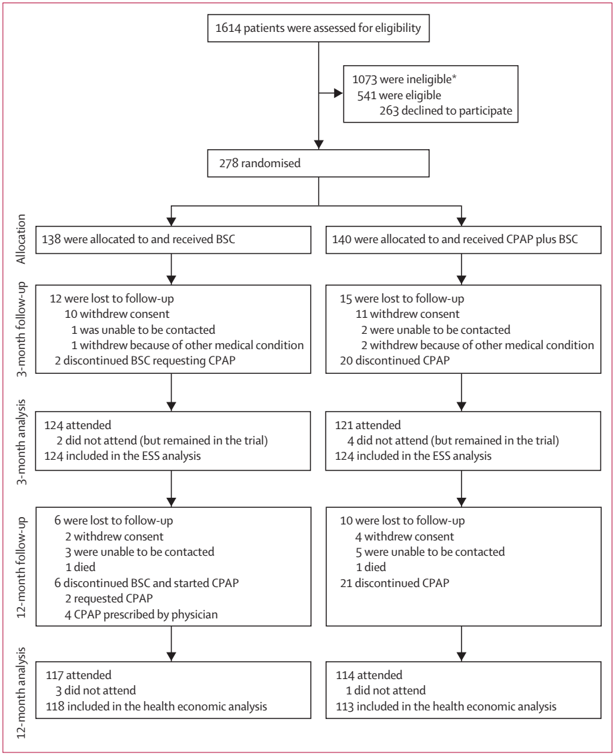
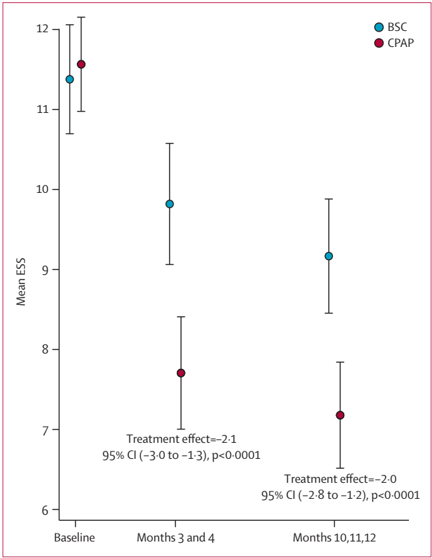
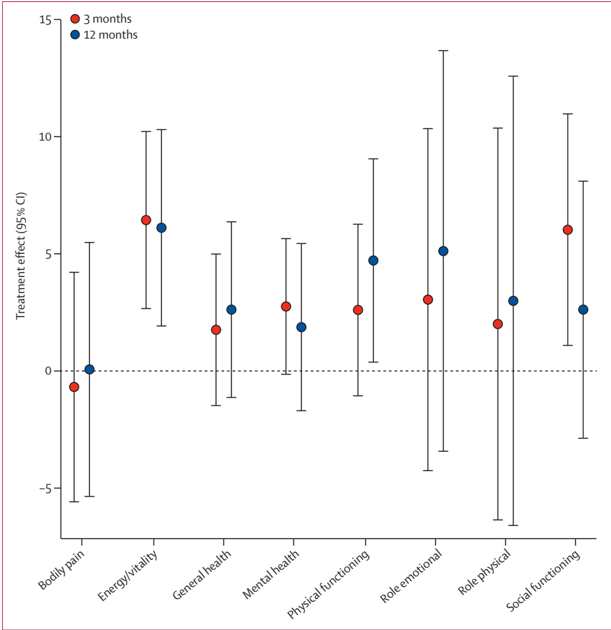
BACKGROUND: The therapeutic and economic benefits of continuous positive airway pressure (CPAP) for moderate to severe obstructive sleep apnoea (OSA) syndrome have been established in middle-aged people; however, the benefits in older people are unknown. This trial was designed to address this evidence gap. METHODS: This 12-month, multicentre, randomised trial enrolled patients across 14 National Health Service sleep centres in the UK. Consecutive patients aged 65 years or older with newly diagnosed OSA syndrome were eligible to join the trial. Patients were randomly assigned (1:1) into parallel groups to receive either CPAP with best supportive care (BSC) or BSC alone for 12 months. Randomisation was done by the Medical Research Council Clinical Trials Unit with computer-generated randomisation. The main investigator at each centre was masked to the trial randomisation. Coprimary endpoints were Epworth sleepiness score (ESS) at 3 months and cost-effectiveness over the 12-month trial period. Secondary outcomes were subjective sleepiness at 12 months, plus objective sleepiness, quality of life, mood, functionality, nocturia, mobility, accidents, cognitive function, and cardiovascular risk factors and events at 3 months and 12 months. The analysis was by intention to treat. This study is registered as an International Standard Randomised Controlled Trial, number ISRCTN90464927. FINDINGS: Between Feb 24, 2010, and May 30, 2012, 278 patients were randomly assigned to the trial, of whom 231 (83%) completed the trial. 140 patients were allocated to and received CPAP plus BSC and 138 were allocated to and received BSC only. CPAP reduced ESS by 2·1 points (95% CI -3·0 to -1·3; p<0·0001) at 3 months for 124 (89%) of 140 patients compared with 124 (90%) of 138 patients given BSC, and by 2·0 points (-2·8 to -1·2; p<0·0001) at 12 months for 116 patients compared with 122 patients given BSC. The effect was greater in patients with higher CPAP usage or higher baseline ESS. Quality-adjusted life-years were similar between the groups (treatment effect 0·01 (95% CI -0·03 to 0·04; p=0·787) and health-care costs were marginally reduced with CPAP (-£35, -390 to 321; p=0·847). CPAP improved objective sleepiness (p=0·024), mobility (p=0·029), total cholesterol (p=0·048), and LDL cholesterol (p=0·042) at 3 months, but these were not sustained at 12 months. Measures of mood, functionality, nocturia, accidents, cognitive function, and cardiovascular events remained unchanged. Systolic blood pressure fell in the BSC group. 37 serious adverse events occurred in the CPAP group, and 22 in BSC group; all were independently classified as being unrelated to the trial and no significant harm was attributed to CPAP use. INTERPRETATION: In older people with OSA syndrome, CPAP reduces sleepiness and is marginally more cost effective over 12 months than is BSC alone. On the basis of these results, we recommend that CPAP treatment should be offered routinely to older patients with OSA syndrome. FUNDING: National Institute of Health Research (NIHR) Health Technology Assessment, NIHR Respiratory Biomedical Research Unit at the Royal Brompton and Harefield NHS Foundation Trust and Imperial College London.
Overview
The claims and statistics of this paper haven’t been checked yet.
Free: it reads the open-access text and checks the first 5 claims that cite a source we can check. Create a free account to check every claim.
Integrity signals
Registry
Cites
Statistics
Figures
Verification
Claims the paper makes
The claims and statistics of this paper haven’t been checked yet.
Free: it reads the open-access text and checks the first 5 claims that cite a source we can check. Create a free account to check every claim.
Claims other papers make about this one
Each is checked against this paper’s own text: does it say what the citing paper says it does?
The source backs part of the claim, not all of it — or backs it for a different population, condition or comparison.
In the citing paper
“Incident AF was not separately analyzed but was reported in a supplementary table and occurred in 16.5% of supportive care patients over 12 months of follow-up versus 7.6% in the CPAP group, a difference that is not statistically significant.1219”
From International Consensus Statement on Obstructive Sleep Apnea (2023) · cites this paper as [1219]
Experimental — accuracy not yet measured
Self-check
Percentages, sums and reported differences re-computed from the paper’s own numbers.
The self-check needs the paper’s full text.
Citations
Cites
The Hospital Anxiety and Depression Scale
Zigmond, A. S., & Snaith, R. P. (1983) · Acta Psychiatrica Scandinavica · doi:10.1111/j.1600-0447.1983.tb09716.x · Cited by 47,139
A New Method for Measuring Daytime Sleepiness: The Epworth Sleepiness Scale
Johns, M. W. (1991) · Sleep · doi:10.1093/sleep/14.6.540 · Cited by 17,364
The Timed “Up & Go”: A Test of Basic Functional Mobility for Frail Elderly Persons
Podsiadlo, D., & Richardson, S. (1991) · Journal of the American Geriatrics Society · doi:10.1111/j.1532-5415.1991.tb01616.x · Cited by 14,418
The Occurrence of Sleep-Disordered Breathing among Middle-Aged Adults
Young, T., Palta, M., Dempsey, J., Skatrud, J., Weber, S., & Badr, S. (1993) · New England Journal of Medicine · doi:10.1056/nejm199304293281704 · Cited by 10,183
Multiple imputation using chained equations: Issues and guidance for practice
White, I. R., Royston, P., & Wood, A. M. (2011) · Statistics in Medicine · doi:10.1002/sim.4067 · Cited by 9,792
EuroQol: the current state of play
Brooks, R. (1996) · Health Policy · doi:10.1016/0168-8510(96)00822-6 · Cited by 5,815
Increased Prevalence of Sleep-Disordered Breathing in Adults
Peppard, P. E., Young, T., Barnet, J. H., Palta, M., Hagen, E. W., & Hla, K. M. (2013) · American Journal of Epidemiology · doi:10.1093/aje/kws342 · Cited by 4,618
The estimation of a preference-based measure of health from the SF-36
Brazier, J., Roberts, J., & Deverill, M. (2002) · Journal of Health Economics · doi:10.1016/s0167-6296(01)00130-8 · Cited by 3,026
The Mini-Mental State Examination
Folstein, M. F. (1983) · Archives of General Psychiatry · doi:10.1001/archpsyc.1983.01790060110016 · Cited by 1,936
Adult obstructive sleep apnoea
Jordan, A. S., McSharry, D. G., & Malhotra, A. (2014) · The Lancet · doi:10.1016/s0140-6736(13)60734-5 · Cited by 1,735
Cited by
Items 201–234 of 234
Sleep apnoea in the elderly – Authors' reply
McMillan, A., Bratton, D. J., Faria, R., Laskawiec-Szkonter, M., Griffin, S. C., Nunn, A., Stradling, J. R., Riha, R. L., & Morrell, M. J. (2014) · The Lancet Respiratory Medicine · doi:10.1016/s2213-2600(14)70240-1 · Cited by 1
Self-citationUpdate in respiratory sleep disorders: Prologue to a modern review series
Eastwood, P. R., Morrell, M. J., & Malhotra, A. (2016) · Respirology · doi:10.1111/resp.12959 · Cited by 1
Self-citationCruz, F. C. S. G. (2023) · Digital Library of Theses and Dissertations (Universidade de São Paulo) · doi:10.11606/t.5.2023.tde-05052023-155128 · Cited by 2
Baran, B., & Lee, E. E. (2024) · doi:10.31234/osf.io/anb29 · Cited by 1
LIvES: Lifestyle, Energy Expenditure, and Sleep in Obstructive Sleep Apnoea (A pilot study)
Edwards, S. B. (2016) · Otago University Research Archive (University of Otago)
Update in Pulmonary Medicine: Evidence Published in 2015
Howard, C., & Guntupalli, K. K. (2016) · Annals of Internal Medicine · doi:10.7326/m16-0225
“Implications: Previous similar studies have had mixed results; one trial showed no cognitive benefit with use of CPAP, although adherence was relatively low (10).”
ResultVolkskrankheit obstruktive Schlafapnoe – wen abklären und wie?
Brill, A., & Geiser, T. (2016) · Praxis · doi:10.1024/1661-8157/a002235 · Cited by 1
“Da auch Senioren hinsichtlich kognitiver Funktion, Schläfrigkeit und Mortalität von einer Therapie profi tieren [15–17], gibt es prinzipiell kein striktes Alterslimit für Diagnostik und Therapieeinleitung.”
PULMONARY, SLEEP, AND CRITICAL CARE UPDATE Update in Sleep Medicine 2014
Ayas, N., Owens, R. L., & Gozal, D. (2015)
Bliwise, D. L. (2019) · Prostate Cancer and Prostatic Diseases · doi:10.1038/s41391-018-0122-1
Selecting Different Surgical Approaches for Hypopharyngeal Obstruction
Qin, P. C., Han, L. S. R., & Tar, T. S. (2019) · International Journal of Head and Neck Surgery · doi:10.5005/jp-journals-10001-1375
Cardiovascular consequences of sleep disordered breathing: the role of CPAP treatment
Bonsignore, M. R., Gallina, S., & Drager, L. F. (2020) · European Respiratory Society eBooks · doi:10.1183/2312508x.10027819
Vascular Consequences of Obstructive Sleep Apnea
Schwarz, E. I., & Kohler, M. (2021) · Elsevier eBooks · doi:10.1016/b978-0-08-102723-3.00125-6
Executive and frontal lobe function
Lau, E. Y. Y. (2022) · Elsevier eBooks · doi:10.1016/b978-0-12-822963-7.00204-8 · Cited by 1
Lau, E. Y. Y. (2022) · Elsevier eBooks · doi:10.1016/b978-0-12-822963-7.00277-2
Basic medical management of sleep disordered breathing in elderly
櫻井, 滋., 敬輔, 細., & 櫻井, 伴. (2017) · Nippon Ronen Igakkai Zasshi Japanese Journal of Geriatrics · doi:10.3143/geriatrics.54.335
Endeshaw, Y. W., & Bliwise, D. L. (2017) · Oxford University Press eBooks · doi:10.1093/med/9780198701590.003.0135
Clinical Assessment of the Patient With Respiratory Sleep Disorder
Schiza, S. E., & Bouloukaki, I. (2021) · Elsevier eBooks · doi:10.1016/b978-0-08-102723-3.00128-1
Sleep-related breathing disorders
Morrell, M. J., Kelly, J. L., McMillan, A., & Hind, M. D. (2020) · doi:10.1093/med/9780198746690.003.0408
Self-citationXu, H., Liu, Y., Li, C., Li, X., Shen, L., Wang, H., Liu, F., Zou, J., Xia, Y., Huang, W., et al. (2023) · SSRN Electronic Journal · doi:10.2139/ssrn.4652529
Srisawart, P. (2024) · Chulalongkorn Medical Journal · doi:10.56808/2673-060x.5453
van Veldhuisen, S. L., Keusters, W. R., Kuppens, K., de Raaff, C. A. L., van Veen, R. N., Wiezer, M. J., Swank, D. J., Demirkiran, A., Boerma, E.-J. G., Greve, J.-W. M., et al. (2024) · Surgery for Obesity and Related Diseases · doi:10.1016/j.soard.2024.06.009 · Cited by 2
OSA in the very elderly. an unresolved problem
Oscullo, G., Gómez-Olivas, J. D., Padilla, D. E. L., & Martínez‐García, M. Á. (2025) · Sleep Medicine · doi:10.1016/j.sleep.2025.106673
Nicholl, C. G., Wilson, K. J., & D'Souza, S. (2025) · Wiley eBooks · doi:10.1002/9781394397976.ch8
Hasala, H., Mattila, T., Kreivi, H., Avellan-Hietanen, H., Vasankari, T., Herse, F., Leskelä, R., Toppila-Salmi, S. K., Erhola, M., Jääskeläinen, T., et al. (2025) · Respiratory Medicine and Research · doi:10.1016/j.resmer.2025.101201
Sawunyavisuth, B., Suntrawanichakul, S., Heingraj, S., Amornpan, S., & Sawanyawisuth, K. (2025) · Future Science OA · doi:10.1080/20565623.2025.2569280
“…sleepiness score by 2.1 points ( p < 0.0001) at 3 months and significantly improved survival (91 months vs 52 months; p < 0.0001) than nonusers [11,12]. even though cPaP is effective in the treatment of Osa in older adults with Osa, cPaP purchasing rate in this segment is limited. a previous…”
InfluentialChe, L., Wang, J., Wu, R., & Su, R. (2025) · CRANIO® · doi:10.1080/08869634.2025.2568806
“The four included studies originated from the United States [15–18], three studies were from Canada [19–21], three from Spain [22–24], two from the United Kingdom [25,26], and five from other countries [27–31], with publication years ranging from 2001 to 2025.”
Antza, C., Ottridge, R. S., Patel, S., Slinn, G., Tearne, S., Nicholls, M., Cooper, B. G., Ali, A., & Tahrani, A. A. (2021) · Figshare · doi:10.6084/m9.figshare.14266738
Serotonergic antidepressant use following positive airway pressure initiation
Vozoris, N. T., Luo, J., Austin, P. C., & Ryan, C. M. (2026) · Sleep Medicine · doi:10.1016/j.sleep.2026.108942
André, C. (2019) · theses.fr (ABES) · doi:10.70675/a6a04137zbf97z47aazaa36z0de2f4b90657 · Cited by 1
Myofunctional Therapy for Geriatric Sleep Apnea: A Narrative Review
Suhana Banu, S., & Simon, S. (2026) · JOURNAL FOR STEM CELL AND CLINICAL RESEARCH · doi:10.66715/jsccr/2026.v3.i3.99108
Reporting of harms associated with CPAP use in randomised controlled trials: a systematic review
Lalonde, K. M., Saymeh, M., Kendzerska, T., & Povitz, M. (2026) · Sleep Medicine · doi:10.1016/j.sleep.2026.109240
Glymphatic dysfunction across sleep disorders and its cognitive implicationsPreprint
Whitehouse, R. M., Farr, T. D., Li, S., Huckstepp, R. T. R., & Boltze, J. (2026) · medRxiv · doi:10.64898/2026.10.20.26366043
Metadata
- Authors
- McMillan, A., Bratton, D. J., Faria, R., Laskawiec-Szkonter, M., Griffin, S., Davies, R. J., Nunn, A. J., Stradling, J. R., Riha, R. L., & Morrell, M. J.
- Affiliations
- Royal Brompton & Harefield NHS Foundation Trust (GB)
- MRC Clinical Trials Unit at UCL (GB)
- University of York (GB)
- Churchill Hospital (GB)
- Edinburgh Royal Infirmary (GB)
- Corresponding author
- Morrell, Mary J
- ORCID
- Venue
- The Lancet Respiratory Medicine
- Publisher
- Elsevier BV
- Published
- 2014-10
- Volume
- 2
- Issue
- 10
- Pages
- 804-812
- ISSN
- 2213-2600 (ISSN-L)
- OpenAlex
- W2105653766
- Semantic Scholar
- ca43fb267f358d430a82d3d94942614c37a7e294
- Cited by
- 234
- References
- 35
- Citations by year
- 2026: 9 · 2025: 18 · 2024: 20 · 2023: 19 · 2022: 18 · 2021: 28 · 2020: 27 · 2019: 20 · 2018: 10 · 2017: 23 · 2016: 25 · 2015: 14 · 2014: 3
- FWCI
- 14.39
- Type
- journal article
- Language
- en
- Open access
- hybrid
- doi.org
- Licence
- cc-by
- www.elsevier.com/tdm/userlicense/1.0/ (tdm)
- creativecommons.org/licenses/by/3.0/ (vor)
- Locations
- The Lancet Respiratory Medicine (publishedVersion, cc-by)
- PubMed (publishedVersion)
- UCL Discovery (University College London) (submittedVersion)
- Edinburgh Research Explorer (University of Edinburgh) (submittedVersion, cc-by)
- Funders
- ResMed
- National Institute for Health and Care Research (08/56/02)
- Imperial College London
- Topics
- Health Sciences › Medicine › Physiology (medical) › Obstructive Sleep Apnea Research
- Social Sciences › Psychology › Experimental and Cognitive Psychology › Sleep and related disorders
- Health Sciences › Medicine › Pulmonary and Respiratory Medicine › Respiratory Support and Mechanisms
- Keywords
- continuous positive airway pressure, obstructive sleep apnea, older adults, sleepiness, Epworth sleepiness score, cost-effectiveness, quality-adjusted life years, supportive care, cardiovascular risk factors, cognitive function, nocturia, quality of life, CPAP adherence, sleep-disordered breathing, PREDICT trial, health economic evaluation
- MeSH terms
- Aged, Aged, 80 and over, Cost-Benefit Analysis, Female, United Kingdom, Humans, Male, Quality of Life, Sleep, Comorbidity, Treatment Outcome, Sleep Apnea, Obstructive, Continuous Positive Airway Pressure
About these checks
Registry, retraction, Cites and statistics results are computed, not judged, with one exception: a printed reference that no index lists is read once by a model before it counts as a citation error. Claims are extracted by a model and kept only when their quote appears verbatim in the text; each cited source is then checked, with a model’s help, for whether it says what the claim relies on. Those verdicts can be wrong — read the claim’s quote and the cited source before relying on one.
Statistics and arithmetic are recomputed, not judged.
Confidence bands are shown only for fields calibrated on our annotated test set. None is calibrated yet, so no band is shown.
What counts as a claim ›How we measure confidence ›How we check this ›
Are you an author, or do you see a problem with this page? Request a review
Data sources
Bibliographic data: Semantic Scholar, OpenAlex, Crossref.
Contains information from the Semantic Scholar Academic Graph Datasets, made available under the ODC Attribution License (ODC-BY 1.0).
Semantic Scholar’s data is described in: Kinney, R., et al. (2023). The Semantic Scholar Open Data Platform. arXiv:2301.10140.
