

Continuous positive airway pressure in older people with obstructive sleep apnoea syndrome (PREDICT): a 12-month, multicentre, randomised trial
Open accessThe DOI matches its Crossref record; 35 of the 35 references it cites were found in a registry or an index.
Abstract
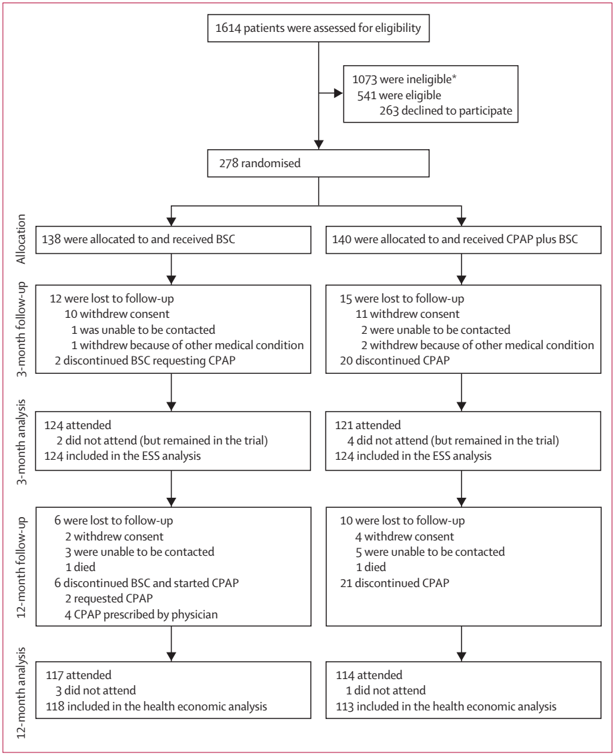
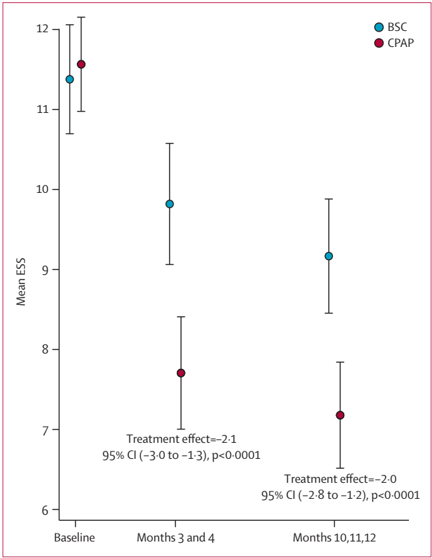
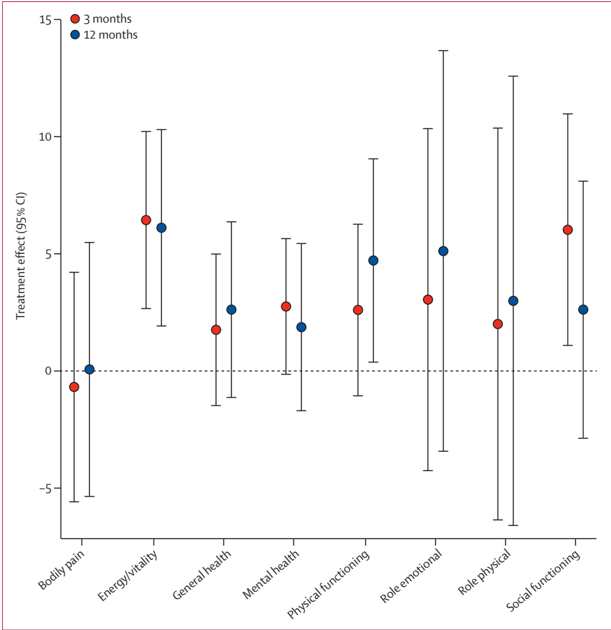
BACKGROUND: The therapeutic and economic benefits of continuous positive airway pressure (CPAP) for moderate to severe obstructive sleep apnoea (OSA) syndrome have been established in middle-aged people; however, the benefits in older people are unknown. This trial was designed to address this evidence gap. METHODS: This 12-month, multicentre, randomised trial enrolled patients across 14 National Health Service sleep centres in the UK. Consecutive patients aged 65 years or older with newly diagnosed OSA syndrome were eligible to join the trial. Patients were randomly assigned (1:1) into parallel groups to receive either CPAP with best supportive care (BSC) or BSC alone for 12 months. Randomisation was done by the Medical Research Council Clinical Trials Unit with computer-generated randomisation. The main investigator at each centre was masked to the trial randomisation. Coprimary endpoints were Epworth sleepiness score (ESS) at 3 months and cost-effectiveness over the 12-month trial period. Secondary outcomes were subjective sleepiness at 12 months, plus objective sleepiness, quality of life, mood, functionality, nocturia, mobility, accidents, cognitive function, and cardiovascular risk factors and events at 3 months and 12 months. The analysis was by intention to treat. This study is registered as an International Standard Randomised Controlled Trial, number ISRCTN90464927. FINDINGS: Between Feb 24, 2010, and May 30, 2012, 278 patients were randomly assigned to the trial, of whom 231 (83%) completed the trial. 140 patients were allocated to and received CPAP plus BSC and 138 were allocated to and received BSC only. CPAP reduced ESS by 2·1 points (95% CI -3·0 to -1·3; p<0·0001) at 3 months for 124 (89%) of 140 patients compared with 124 (90%) of 138 patients given BSC, and by 2·0 points (-2·8 to -1·2; p<0·0001) at 12 months for 116 patients compared with 122 patients given BSC. The effect was greater in patients with higher CPAP usage or higher baseline ESS. Quality-adjusted life-years were similar between the groups (treatment effect 0·01 (95% CI -0·03 to 0·04; p=0·787) and health-care costs were marginally reduced with CPAP (-£35, -390 to 321; p=0·847). CPAP improved objective sleepiness (p=0·024), mobility (p=0·029), total cholesterol (p=0·048), and LDL cholesterol (p=0·042) at 3 months, but these were not sustained at 12 months. Measures of mood, functionality, nocturia, accidents, cognitive function, and cardiovascular events remained unchanged. Systolic blood pressure fell in the BSC group. 37 serious adverse events occurred in the CPAP group, and 22 in BSC group; all were independently classified as being unrelated to the trial and no significant harm was attributed to CPAP use. INTERPRETATION: In older people with OSA syndrome, CPAP reduces sleepiness and is marginally more cost effective over 12 months than is BSC alone. On the basis of these results, we recommend that CPAP treatment should be offered routinely to older patients with OSA syndrome. FUNDING: National Institute of Health Research (NIHR) Health Technology Assessment, NIHR Respiratory Biomedical Research Unit at the Royal Brompton and Harefield NHS Foundation Trust and Imperial College London.
Overview
The claims and statistics of this paper haven’t been checked yet.
Free: it reads the open-access text and checks the first 5 claims that cite a source we can check. Create a free account to check every claim.
Integrity signals
Registry
Cites
Statistics
Figures
Verification
Claims the paper makes
The claims and statistics of this paper haven’t been checked yet.
Free: it reads the open-access text and checks the first 5 claims that cite a source we can check. Create a free account to check every claim.
Claims other papers make about this one
Each is checked against this paper’s own text: does it say what the citing paper says it does?
The source backs part of the claim, not all of it — or backs it for a different population, condition or comparison.
In the citing paper
“Incident AF was not separately analyzed but was reported in a supplementary table and occurred in 16.5% of supportive care patients over 12 months of follow-up versus 7.6% in the CPAP group, a difference that is not statistically significant.1219”
From International Consensus Statement on Obstructive Sleep Apnea (2023) · cites this paper as [1219]
Experimental — accuracy not yet measured
Self-check
Percentages, sums and reported differences re-computed from the paper’s own numbers.
The self-check needs the paper’s full text.
Citations
Cites
The Hospital Anxiety and Depression Scale
Zigmond, A. S., & Snaith, R. P. (1983) · Acta Psychiatrica Scandinavica · doi:10.1111/j.1600-0447.1983.tb09716.x · Cited by 47,139
A New Method for Measuring Daytime Sleepiness: The Epworth Sleepiness Scale
Johns, M. W. (1991) · Sleep · doi:10.1093/sleep/14.6.540 · Cited by 17,364
The Timed “Up & Go”: A Test of Basic Functional Mobility for Frail Elderly Persons
Podsiadlo, D., & Richardson, S. (1991) · Journal of the American Geriatrics Society · doi:10.1111/j.1532-5415.1991.tb01616.x · Cited by 14,418
The Occurrence of Sleep-Disordered Breathing among Middle-Aged Adults
Young, T., Palta, M., Dempsey, J., Skatrud, J., Weber, S., & Badr, S. (1993) · New England Journal of Medicine · doi:10.1056/nejm199304293281704 · Cited by 10,183
Multiple imputation using chained equations: Issues and guidance for practice
White, I. R., Royston, P., & Wood, A. M. (2011) · Statistics in Medicine · doi:10.1002/sim.4067 · Cited by 9,792
EuroQol: the current state of play
Brooks, R. (1996) · Health Policy · doi:10.1016/0168-8510(96)00822-6 · Cited by 5,815
Increased Prevalence of Sleep-Disordered Breathing in Adults
Peppard, P. E., Young, T., Barnet, J. H., Palta, M., Hagen, E. W., & Hla, K. M. (2013) · American Journal of Epidemiology · doi:10.1093/aje/kws342 · Cited by 4,618
The estimation of a preference-based measure of health from the SF-36
Brazier, J., Roberts, J., & Deverill, M. (2002) · Journal of Health Economics · doi:10.1016/s0167-6296(01)00130-8 · Cited by 3,026
The Mini-Mental State Examination
Folstein, M. F. (1983) · Archives of General Psychiatry · doi:10.1001/archpsyc.1983.01790060110016 · Cited by 1,936
Adult obstructive sleep apnoea
Jordan, A. S., McSharry, D. G., & Malhotra, A. (2014) · The Lancet · doi:10.1016/s0140-6736(13)60734-5 · Cited by 1,735
Cited by
St-Onge, M.-P., Grandner, M. A., Brown, D., Conroy, M. B., Jean-Louis, G., Coons, M., & Bhatt, D. L. (2016) · Circulation · doi:10.1161/cir.0000000000000444 · Cited by 1,044
Patil, S. P., Ayappa, I. A., Caples, S. M., Kimoff, R. J., Patel, S. R., & Harrod, C. G. (2019) · Journal of Clinical Sleep Medicine · doi:10.5664/jcsm.7638 · Cited by 721
“81,114 One study 71 recruited sleepy participants with mild OSA and one study 63 recruited non-sleepy participants with mild to moderate OSA.”
InfluentialSleep Apnea and Cardiovascular Disease: Lessons From Recent Trials and Need for Team Science
Drager, L. F., McEvoy, R. D., Barbe, F., Lorenzi-Filho, G., & Redline, S. (2017) · Circulation · doi:10.1161/circulationaha.117.029400 · Cited by 465
Bubu, O. M., Andrade, A. G., Umasabor-Bubu, O. Q., Hogan, M. M., Turner, A. D., de Leon, M. J., Ogedegbe, G., Ayappa, I., Jean-Louis G, G., Jackson, M. L., et al. (2020) · Sleep Medicine Reviews · doi:10.1016/j.smrv.2019.101250 · Cited by 389
Yu, J., Zhou, Z., McEvoy, R. D., Anderson, C. S., Rodgers, A., Perkovic, V., & Neal, B. (2017) · JAMA · doi:10.1001/jama.2017.7967 · Cited by 371
Bratton, D. J., Gaisl, T., Wons, A. M., & Kohler, M. (2015) · JAMA · doi:10.1001/jama.2015.16303 · Cited by 362
Self-citationInternational Consensus Statement on Obstructive Sleep Apnea
Chang, J. L., Goldberg, A. N., Alt, J. A., Mohammed, A., Ashbrook, L., Auckley, D., Ayappa, I., Bakhtiar, H., Barrera, J. E., Bartley, B. L., et al. (2023) · International Forum of Allergy & Rhinology · doi:10.1002/alr.23079 · Cited by 350
Obstructive sleep apnoea heterogeneity and cardiovascular disease
Redline, S., Azarbarzin, A., & Peker, Y. (2023) · Nature Reviews Cardiology · doi:10.1038/s41569-023-00846-6 · Cited by 325
Sleep apnoea and the brain: a complex relationship
Rosenzweig, I., Glasser, M., Polsek, D., Leschziner, G. D., Williams, S. C. R., & Morrell, M. J. (2015) · The Lancet Respiratory Medicine · doi:10.1016/s2213-2600(15)00090-9 · Cited by 277
Self-citationJonas, D. E., Amick, H. R., Feltner, C., Weber, R. P., Arvanitis, M., Stine, A., Lux, L., & Harris, R. P. (2017) · JAMA · doi:10.1001/jama.2016.19635 · Cited by 267
The Association Between Obstructive Sleep Apnea and Alzheimer’s Disease: A Meta-Analysis Perspective
Emamian, F., Khazaie, H., Tahmasian, M., Leschziner, G. D., Morrell, M. J., Hsiung, G.-Y. R., Rosenzweig, I., & Sepehry, A. A. (2016) · Frontiers in Aging Neuroscience · doi:10.3389/fnagi.2016.00078 · Cited by 258
“These data have recently been extended to show the beneficial effects of the CPAP therapy on excessive daytime sleepiness in older OSA patients (McMillan et al., 2014).”
BackgroundSelf-citationPengo, M. F., Soranna, D., Giontella, A., Perger, E., Mattaliano, P., Schwarz, E. I., Lombardi, C., Bilo, G., Zambon, A., Steier, J., et al. (2020) · European Respiratory Journal · doi:10.1183/13993003.01945-2019 · Cited by 178
Obstructive Sleep Apnea and the Risk of Cognitive Decline in Older Adults
Gosselin, N., Baril, A.-A., Osorio, R. S., Kaminska, M., & Carrier, J. (2019) · American Journal of Respiratory and Critical Care Medicine · doi:10.1164/rccm.201801-0204pp · Cited by 162
“However, a 12-month randomized trial showed no effect of CPAP on cognitive function in adults aged 65 and older, despite improvement in sleepiness (50).”
BackgroundSubramani, Y., Singh, M., Wong, J., Kushida, C. A., Malhotra, A., & Chung, F. (2017) · Anesthesia & Analgesia · doi:10.1213/ane.0000000000001546 · Cited by 165
Effect of CPAP on Cognition, Brain Function, and Structure Among Elderly Patients With OSA
Dalmases, M., Solé‐Padullés, C., Torres, M., Embid, C., Núñez, M. D. S., Martínez‐García, M. Á., Farré, R., Bargalló, N., Bartrés‐Faz, D., & Montserrat, J. M. (2015) · CHEST Journal · doi:10.1378/chest.15-0171 · Cited by 176
Iftikhar, I. H., Bittencourt, L., Youngstedt, S. D., Ayas, N., Cistulli, P. A., Schwab, R. J., Durkin, M. W., & Magalang, U. J. (2016) · Sleep Medicine · doi:10.1016/j.sleep.2016.06.001 · Cited by 176
Khan, S. U., Duran, C. A., Rahman, H., Lekkala, M., Saleem, M. A., & Kaluski, E. (2018) · European Heart Journal · doi:10.1093/eurheartj/ehx597 · Cited by 138
Obstructive sleep apnea treatment and dementia risk in older adults
Dunietz, G. L., Chervin, R. D., Burke, J. F., Conceicao, A. S., & Braley, T. J. (2021) · Sleep · doi:10.1093/sleep/zsab076 · Cited by 133
“was not shown to have an effect on cognitive performance [30].”
BackgroundLabarca, G., Dreyse, J., Drake, L., Jorquera, J., & Barbe, F. (2020) · Sleep Medicine Reviews · doi:10.1016/j.smrv.2020.101312 · Cited by 121
Effects of CPAP and Mandibular Advancement Devices on Health-Related Quality of Life in OSA
Kuhn, E., Schwarz, E. I., Bratton, D. J., Rossi, V. A., & Kohler, M. (2017) · CHEST Journal · doi:10.1016/j.chest.2017.01.020 · Cited by 138
“The search strategy identified 1,491 studies, 23 of which were eligible for the network meta-analysis (2,342 patients) (Fig 1).(25-47) Fifteen RCTs (1,754 patients) compared CPAP with an inactive control treatment, three RCTs (177 patients) compared MADs with an inactive control treatment, and four RCTs (310 patients)…”
MethodSelf-citationGonzalo Labarca, T., Saavedra, D., Dreyse, J., Jorge Jorquera, A., & Barbé, F. (2020) · CHEST Journal · doi:10.1016/j.chest.2020.03.049 · Cited by 128
Bratton, D. J., Gaisl, T., Schlatzer, C., & Kohler, M. (2015) · The Lancet Respiratory Medicine · doi:10.1016/s2213-2600(15)00416-6 · Cited by 125
Self-citationBenjafield, A., Pépin, J., Cistulli, P. A., Wimms, A. J., Lavergne, F., Kuniyoshi, F. H. S., Munson, S. H., Schuler, B., Badikol, S. R., Wolfe, K. C., et al. (2025) · The Lancet Respiratory Medicine · doi:10.1016/s2213-2600(25)00002-5 · Cited by 138
Mullins, A. E., Kam, K., Parekh, A., Bubu, O. M., Osorio, R. S., & Varga, A. W. (2020) · Neurobiology of Disease · doi:10.1016/j.nbd.2020.105054 · Cited by 116
Campos-Rodriguez, F., Queipo-Corona, C., Carmona-Bernal, C., Jurado-Gamez, B., Cordero-Guevara, J., Reyes-Nuñez, N., Troncoso-Acevedo, F., Abad-Fernandez, A., Teran-Santos, J., Caballero-Rodriguez, J., et al. (2016) · American Journal of Respiratory and Critical Care Medicine · doi:10.1164/rccm.201602-0265oc · Cited by 99
On the cutting edge of obstructive sleep apnoea: where next?
Malhotra, A., Orr, J. E., & Owens, R. L. (2015) · The Lancet Respiratory Medicine · doi:10.1016/s2213-2600(15)00051-x · Cited by 97
Rosenzweig, I., Glasser, M., Crum, W. R., Kempton, M. J., Milošević, M., McMillan, A., Leschziner, G. D., Kumari, V., Goadsby, P. J., Simonds, A. K., et al. (2016) · EBioMedicine · doi:10.1016/j.ebiom.2016.03.020 · Cited by 106
“Inclusion criterion was an apnea/hypopnea index (AHI) N10 events/h (McMillan et al., 2014).”
BackgroundSelf-citationSleep apnoea in the elderly: a great challenge for the future
Osorio, R. S., Martínez‐García, M. Á., & Rapoport, D. M. (2021) · European Respiratory Journal · doi:10.1183/13993003.01649-2021 · Cited by 118
Wimms, A. J., Kelly, J. L., Turnbull, C. D., McMillan, A., Craig, S. E., O'Reilly, J. F., Nickol, A. H., Hedley, E. L., Decker, M. D., Willes, L. A., et al. (2020) · The Lancet Respiratory Medicine · doi:10.1016/s2213-2600(19)30402-3 · Cited by 95
Self-citationSleep disordered breathing at the extremes of age: the elderly
McMillan, A., & Morrell, M. J. (2016) · Breathe · doi:10.1183/20734735.003216 · Cited by 105
Self-citationLajoie, A. C., Lafontaine, A., Kimoff, R. J., & Kamińska, M. (2020) · Journal of Clinical Medicine · doi:10.3390/jcm9020297 · Cited by 99
Obstructive sleep apnoea and 5-year cognitive decline in the elderly
Marchi, N. A., Solelhac, G., Berger, M., Haba‐Rubio, J., Gosselin, N., Vollenweider, P., Marques-Vidal, P. M., Popp, J., von Gunten, A., Preisig, M., et al. (2023) · European Respiratory Journal · doi:10.1183/13993003.01621-2022 · Cited by 101
“In contrast, larger multicentre trials have shown no effect [49, 50] or only slight improvement in cognition [51, 52].”
The Impact of Treatments for OSA on Monetized Health Economic Outcomes
Wickwire, E. M., Albrecht, J. S., Towe, M. M., Abariga, S. A., Diaz-Abad, M., Shipper, A. G., Cooper, L. M., Assefa, S. Z., Tom, S. E., & Scharf, S. M. (2019) · Chest · doi:10.1016/j.chest.2019.01.009 · Cited by 88
Guo, J. X., Sun, Y., Xue, L.-J., Huang, Z., Wang, Y.-S., Zhang, L., Zhou, G., & Yuan, L.-X. (2016) · Sleep And Breathing · doi:10.1007/s11325-016-1319-y · Cited by 93
Feltner, C., Wallace, I. F., Aymes, S., Cook Middleton, J., Hicks, K. L., Schwimmer, M., Baker, C., Balio, C. P., Moore, D., Voisin, C. E., et al. (2022) · JAMA · doi:10.1001/jama.2022.18357 · Cited by 80
Catalan-Serra, P., Campos-Rodriguez, F., Reyes-Nuñez, N., Selma-Ferrer, M. J., Navarro-Soriano, C., Ballester-Canelles, M., Soler-Cataluña, J.-J., Roman-Sanchez, P., Almeida-Gonzalez, C. V., & Martinez-Garcia, M. A. (2019) · Stroke · doi:10.1161/strokeaha.118.023353 · Cited by 78
Wickwire, E. M., Tom, S. E., Vadlamani, A., Diaz‐Abad, M., Cooper, L. M., Johnson, A. M., Scharf, S. M., & Albrecht, J. S. (2020) · Journal of Clinical Sleep Medicine · doi:10.5664/jcsm.8128 · Cited by 76
“Wickwire and colleagues 41 recently performed a systematic review of peer-reviewed literature regarding economic effect of OSA treatments, yet only 2 of 17 included studies 42,43 were conducted among older adults.”
(2016) · Somnologie - Schlafforschung und Schlafmedizin · doi:10.1007/s11818-016-0093-1 · Cited by 90
Davies, C. R., & Harrington, J. J. (2016) · Sleep Medicine Clinics · doi:10.1016/j.jsmc.2016.04.006 · Cited by 75
Ponce, S., Pastor, E., Orosa, B., Oscullo, G., Catalán, P., Martinez, A., Hernández, L., Muriel, A., Chiner, E., & Martínez-García, M. Á. (2019) · European Respiratory Journal · doi:10.1183/13993003.00518-2019 · Cited by 66
Netzer, N. C., Ancoli-Israel, S., Bliwise, D. L., Fulda, S., Roffe, C., Almeida, F., Onen, H., Onen, F., Raschke, F., Martinez Garcia, M. A., et al. (2016) · European Respiratory Journal · doi:10.1183/13993003.01975-2015 · Cited by 64
Wang, T., Huang, W., Zong, H., & Zhang, Y. (2015) · International Neurourology Journal · doi:10.5213/inj.2015.19.3.178 · Cited by 63
“(2014) [18] CPAP UK 113 113 12 C onsecutive patients aged 65 years or older with newly diagnosed OSAS.”
BackgroundMethodWang, M., Wang, C., Tuo, M., Yu, Y., Wang, L., Yu, J., Tan, L., & Chi, S. (2020) · Journal of Alzheimer s Disease · doi:10.3233/jad-200088 · Cited by 66
Obstructive sleep apnea and stroke: The mechanisms, the randomized trials, and the road ahead
Javaheri, S., Peker, Y., Yaggi, H. K., & Bassetti, C. L. (2021) · Sleep Medicine Reviews · doi:10.1016/j.smrv.2021.101568 · Cited by 68
Pearse, R. M., Ranieri, V. M., Abbott, T. E. F., Pakats, M.-L., Piervincenzi, E., Patel, A., Kahan, B. C., Rhodes, A., Dias, P., Hewson, R., et al. (2021) · The Lancet Respiratory Medicine · doi:10.1016/s2213-2600(21)00089-8 · Cited by 66
Lin, H.-J., Yeh, J., Hsieh, M., & Hsu, C. (2020) · Sleep Medicine Reviews · doi:10.1016/j.smrv.2020.101354 · Cited by 57
Emerging co-morbidities of obstructive sleep apnea: cognition, kidney disease, and cancer
Gildeh, N., Drakatos, P., Higgins, S. E., Rosenzweig, I., & Kent, B. D. (2016) · Journal of Thoracic Disease · doi:10.21037/jtd.2016.09.23 · Cited by 55
Stevens, D. J., Jackson, B., Carberry, J. C., McLoughlin, J., Barr, C., Mukherjee, S., Oh, A., McEvoy, R. D., Crotty, M., & Vakulin, A. (2020) · The Journals of Gerontology Series A · doi:10.1093/gerona/glaa014 · Cited by 56
Wickwire, E. M., Jobe, S. L., Oldstone, L., Scharf, S. M., Johnson, A. M., & Albrecht, J. S. (2020) · SLEEP · doi:10.1093/sleep/zsaa122 · Cited by 52
Sleep physiology and disorders in aging and dementia
(2019) · Handbook of Clinical Neurology · doi:10.1016/b978-0-12-804766-8.00026-1 · Cited by 46
Feinsilver, S. H., & Hernandez, A. B. (2017) · Clinics in Geriatric Medicine · doi:10.1016/j.cger.2017.06.009 · Cited by 44
Tan, B., Tan, A. K. L., Chan, Y. H., Mok, Y., Wong, H. S., & Hsu, P. P. (2018) · American Journal of Otolaryngology · doi:10.1016/j.amjoto.2018.05.012 · Cited by 52
Upper Airway Stimulation Response in Older Adults with Moderate to Severe Obstructive Sleep Apnea
Withrow, K., Evans, S., Harwick, J., Kezirian, E., Strollo, P., & ADHERE Registry Investigators (2019) · Otolaryngology–Head and Neck Surgery · doi:10.1177/0194599819848709 · Cited by 43
“In addition, our study demonstrated that therapy usage was higher in the older population than in younger population, with both groups being higher than previously reported average nightly CPAP usage.(16) Although the exact reason for the increased usage among older patients is unclear, it is possible that this reflec…”
ResultDiagnostic approaches to respiratory sleep disorders.
Riha, R. L. (2015) · Journal of Thoracic Disease · doi:10.3978/j.issn.2072-1439.2015.08.28 · Cited by 52
“, diurnal napping) may cloud symptomatology (14).”
Self-citationLisan, Q., Van Sloten, T., Marques Vidal, P., Haba Rubio, J., Heinzer, R., & Empana, J. P. (2019) · JAMA Otolaryngology–Head & Neck Surgery · doi:10.1001/jamaoto.2019.0281 · Cited by 40
Unattended Hospital and Home Sleep Apnea Testing Following Cerebrovascular Events
Boulos, M. I., Elias, S., Wan, A., Im, J. H. B., Frankul, F., Atalla, M., Black, S. E., Basile, V. S., Sundaram, A. N. E., Hopyan, J. J., et al. (2016) · Journal of Stroke and Cerebrovascular Diseases · doi:10.1016/j.jstrokecerebrovasdis.2016.09.001 · Cited by 44
Ayas, N., Owens, R. L., & Gozal, D. (2015) · American Journal of Respiratory and Critical Care Medicine · doi:10.1164/rccm.201503-0647up · Cited by 43
Martínez‐García, M. Á., Valero-Sánchez, I., Reyes-Núñez, N., Oscullo, G., García‐Ortega, A., Gómez-Olivas, J. D., & Campos‐Rodríguez, F. (2019) · ERJ Open Research · doi:10.1183/23120541.00178-2018 · Cited by 40
Optimal NIV Medicare Access Promotion: Patients With COPD
Hill, N. S., Criner, G. J., Branson, R. D., Celli, B. R., MacIntyre, N. R., Sergew, A., Gay, P. C., Owens, R. L., Wolfe, L. F., Benditt, J. O., et al. (2021) · CHEST Journal · doi:10.1016/j.chest.2021.06.082 · Cited by 39
Jiang, X. G., Wang, Z., Hu, N., Yang, Y., Xiong, R., & Fu, Z. (2021) · Experimental Brain Research · doi:10.1007/s00221-021-06225-2 · Cited by 80
Patil, S. P., Billings, M. E., Bourjeily, G. R., Collop, N. A., Gottlieb, D. J., Johnson, K. G., Kimoff, R. J., & Pack, A. I. (2023) · Journal of Clinical Sleep Medicine · doi:10.5664/jcsm.10832 · Cited by 46
Kitamura, T., Miyazaki, S., Sulaiman, H. B., Akaike, R., Ito, Y., & Suzuki, H. (2020) · The EPMA Journal · doi:10.1007/s13167-020-00219-w · Cited by 41
Exploring the role and function of trial steering committees: results of an expert panel meeting
Harman, N. L., Conroy, E. J., Lewis, S. C., Murray, G., Norrie, J., Sydes, M. R., Lane, J. A., Altman, D. G., Baigent, C., Bliss, J. M., et al. (2015) · Trials · doi:10.1186/s13063-015-1125-z · Cited by 33
“Interestingly some academic journals require the role of the Funder to be clearly specified in the trial manuscript, yet for many trials funded by the NIHR HTA programme, this is overlooked in funding statements [14–20].”
Obstructive sleep apnea and its controversial effects on cognition
Devita, M., Montemurro, S., Ramponi, S., Marvisi, M., Villani, D., Raimondi, M. C., Rusconi, M. L., & Mondini, S. (2016) · Journal of Clinical and Experimental Neuropsychology · doi:10.1080/13803395.2016.1253668 · Cited by 47
“We believe that the cognitive and behavioral features of OSAS represent an interesting matter for investigation, given the direct connection with quality of life (McMillan et al., 2014).”
BackgroundLi, Z., Cai, S., Wang, J., & Chen, R. (2022) · Frontiers in Neurology · doi:10.3389/fneur.2022.911996 · Cited by 40
Monneret, D., Barthélemy, J., Hupin, D., Maudoux, D., Celle, S., Sforza, E. A., & Roche, F. (2017) · Sleep Medicine · doi:10.1016/j.sleep.2017.07.028 · Cited by 30
Adaptive servo ventilation for central sleep apnoea in heart failure: SERVE-HF on-treatment analysis
Woehrle, H., Cowie, M., zu Eulenburg, C., Suling, A. I., Angermann, C. E., d’Ortho, M., Erdmann, E., Levy, P. A., Simonds, A. K., Somers, V. K., et al. (2017) · European Respiratory Journal · doi:10.1183/13993003.01692-2016 · Cited by 31
“…which included patients with cardiovascular disease, were 3.8 and 3.3 hours/night at 6 and 12 months [32], and in the PREDICT trial, elderly patients with obstructive sleep apnoea (mean age 71 years) were using continuous positive airway pressure for 1.5 hours/night at both 3 and 12 months [33].”
InfluentialHypopnea definitions, determinants and dilemmas: a focused review
Shamim-Uzzaman, Q. A., Singh, S., & Chowdhuri, S. (2018) · Sleep Science and Practice · doi:10.1186/s41606-018-0023-1 · Cited by 34
Chhatre, S., Chang, Y. H. A., Gooneratne, N. S., Kuna, S., Strollo, P., & Jayadevappa, R. (2020) · Sleep · doi:10.1093/sleep/zsz188 · Cited by 29
Yunus, F. M., Khan, S., Mitra, D. K., Mistry, S. K., Afsana, K., & Rahman, M. (2017) · Sleep Health · doi:10.1016/j.sleh.2017.10.003 · Cited by 30
Oliver, C., Li, H., Biswas, B., Woodstoke, D., Blackman, J., Butters, A. F., Drew, C. J. G., Gabb, V. G., Harding, S. A., Hoyos, C. M., et al. (2023) · Sleep Medicine Reviews · doi:10.1016/j.smrv.2023.101869 · Cited by 37
Cohen, O. S., Sánchez‐de‐la‐Torre, M., Al-Taie, Z., Khan, S., Kundel, V., Kovacic, J. C., Gràcia‐Lavedan, E., de Batlle, J., Nadkarni, G. N., Barbé, F., et al. (2024) · Annals of the American Thoracic Society · doi:10.1513/annalsats.202309-799oc · Cited by 29
Berlowitz, D. J., Schembri, R., Graco, M., Ross, J. M., Ayas, N., Gordon, I., Lee, B. B., Graham, A., Cross, S., McClelland, M., et al. (2018) · Thorax · doi:10.1136/thoraxjnl-2018-212319 · Cited by 30
“39 42 43 The minimally clinical important difference in the KSS has not been defined; however, the 1.26 unit relative reduction in sleepiness with CPAP observed on the intention-to-treat analysis compares favourably with the reported difference of 1.35 between people with and without moderate SDB…”
InfluentialSelf-citationMohamed, B. A., Yarlagadda, K., Self, Z., Simon, A., Rigueiro, F., Sohooli, M., Eisenschenk, S. J., & Doré, S. (2023) · Translational Stroke Research · doi:10.1007/s12975-023-01123-x · Cited by 34
Donovan, L. M., Hoyos, C. M., Kimoff, R. J., Morrell, M. J., Bosch, N. A., Chooljian, D. M., McEvoy, R. D., Sawyer, A. M., Wagner, T. H., Al-Lamee, R. K., et al. (2023) · Annals of the American Thoracic Society · doi:10.1513/annalsats.202303-258st · Cited by 30
Self-citationTreatment with CPAP in Elderly Patients with Obstructive Sleep Apnoea
Posadas, T., Oscullo, G., Zaldívar, E., García‐Ortega, A., Gómez-Olivas, J. D., Monteagudo, M. J., & Martínez‐García, M. Á. (2020) · Journal of Clinical Medicine · doi:10.3390/jcm9020546 · Cited by 30
Alqurashi, Y. D., Dawidziuk, A., Alqarni, A. M. M., Kelly, J. L., Moss, J., Polkey, M. I., & Morrell, M. J. (2021) · Annals of Thoracic Medicine · doi:10.4103/atm.atm_437_20 · Cited by 28
“, 2014.[18] These researchers investigated the impact of CPAP on daytime sleepiness in older patients with OSA, recording the ESS before and after CPAP treatment.”
BackgroundMethodSelf-citationSleep apnoea, gut dysbiosis and cognitive dysfunction
Deyang, T., Baig, M., Dolkar, P., Hediyal, T. A., Rathipriya, A. G., Bhaskaran, M., Pandi-Perumal, S. R., Monaghan, T. M., Mahalakshmi, A. M., & Chidambaram, S. B. (2023) · FEBS Journal · doi:10.1111/febs.16960 · Cited by 27
“The most popular therapeutic strategy for preventing upper airway collapse in SA currently is CPAP therapy [206,207].”
BackgroundNocturia in CPAP-Treated Obstructive Sleep Apnea Patients: a Systematic Review and Meta-Analysis
Papadopoulos, V. P., Apergis, N., & Filippou, D. K. (2020) · SN Comprehensive Clinical Medicine · doi:10.1007/s42399-020-00584-7 · Cited by 25
Wickwire, E. M., Bailey, M. D., Somers, V. K., Oldstone, L., Srivastava, M. C., Johnson, A. M., Scharf, S. M., & Albrecht, J. S. (2021) · Journal of Clinical Sleep Medicine · doi:10.5664/jcsm.9478 · Cited by 25
Hill, E. A., Fairley, D. M., Williams, L. J., Spanò, G., Cooper, S., & Riha, R. L. (2020) · Brain Sciences · doi:10.3390/brainsci10110844 · Cited by 24
“9 events per hour) demonstrating improvements in sleepiness, mood and daytime function, even with low CPAP compliance [28,33].”
BackgroundResultInfluentialSelf-citationMartínez‐García, M. Á., Oscullo, G., Ponce, S., Pastor, E., Orosa-Bertol, B., Catalán, P., Martinez, A., Hernández, L. M., Muriel, A., Chiner, E., et al. (2021) · Sleep Medicine · doi:10.1016/j.sleep.2021.11.009 · Cited by 24
Graco, M., Green, S., Tolson, J., Stevens, B., Barnes, M., Rigoni, A., Henderson, S., Nicholls, C., & Berlowitz, D. J. (2018) · Spinal Cord · doi:10.1038/s41393-018-0210-z · Cited by 25
“CPAP has also been found to improve daytime sleepiness in specialised populations such as stroke survivors and the elderly [10, 11].”
BackgroundBradicich, M., Pengo, M. F., Steier, J. S., & Schwarz, E. I. (2024) · ERJ Open Research · doi:10.1183/23120541.00718-2024 · Cited by 24
Obstructive sleep apnea treatment disparities among older adults with neurological disorders
Dunietz, G. L., Chervin, R. D., Burke, J. F., & Braley, T. J. (2020) · Sleep Health · doi:10.1016/j.sleh.2020.01.009 · Cited by 22
“Contributing to the uncertainty, available estimates regarding the proportion of older adults in general who are adherent to CPAP therapy vary widely.(1, 24, 25) Collectively, these gaps in knowledge indicate an unmet need to determine which patients are most vulnerable to gaps and barriers in OSA treatment, in order…”
BackgroundAffas, Z., Affas, S., & Tabbaa, K. (2022) · Spartan Medical Research Journal · doi:10.51894/001c.34521 · Cited by 24
Marchi, N. A., Allali, G., & Heinzer, R. C. (2024) · SLEEP · doi:10.1093/sleep/zsae161 · Cited by 25
Ward, S. A., Storey, E., Gašević, D., Naughton, M. T., Hamilton, G. S., Trevaks, R. E., Wolfe, R. S., O’Donoghue, F. J., Stocks, N. P., Abhayaratna, W. P., et al. (2022) · Respirology · doi:10.1111/resp.14279 · Cited by 22
“Indeed, a randomized controlled trial of CPAP in older adults with SDB, as defined by the ODI, demonstrated improvements in QOL in those treated with CPAP.40 Given this, assessing QOL in older adults with SDB may be particularly useful in delineating subgroups for treatment.”
MethodObstructive sleep apnea and cardiovascular events in elderly patients
Catalán, P., & Soler, X. (2022) · Expert Review of Respiratory Medicine · doi:10.1080/17476348.2022.2030225 · Cited by 20
“study was the poor adherence to CPAP treatment [87].”
BackgroundChowdhuri, S., Patel, P. J., & Badr, M. S. (2017) · Sleep Medicine Clinics · doi:10.1016/j.jsmc.2017.09.003 · Cited by 22
Clinical Predictors of Mixed Apneas in Patients with Obstructive Sleep Apnea (OSA)
Liu, P., Chen, Q., Yuan, F., Zhang, Q., Zhang, X., Xue, C., Wei, Y., Wang, Y., & Wang, H. (2022) · Nature and Science of Sleep · doi:10.2147/nss.s351946 · Cited by 18
Comparison of Dexmedetomidine versus Propofol for Sedation after Uvulopalatopharyngoplasty
Xu, J., Jin, C.-J., Cui, X., & Jin, Z. (2015) · Medical Science Monitor · doi:10.12659/msm.893884 · Cited by 18
Cognitive Complaints and Comorbidities in Obstructive Sleep Apnea
Vardanian, M., & Ravdin, L. (2022) · Sleep Medicine Clinics · doi:10.1016/j.jsmc.2022.07.009 · Cited by 20
A 7‐year follow‐up study of obstructive sleep apnoea in healthy elderly: T he PROOF cohort study
Sforza, E. A., Hupin, D., Pichot, V., Barthélemy, J., & Roche, F. (2017) · Respirology · doi:10.1111/resp.13013 · Cited by 20
Balk, E. M., Adam, G. P., Cao, W., Bhuma, M. R., D’Ambrosio, C., & Trikalinos, T. A. (2024) · Journal of Clinical Sleep Medicine · doi:10.5664/jcsm.11030 · Cited by 16
Xu, H., Liu, Y., Li, C., Li, X., Shen, L., Wang, H., Liu, F., Zou, J., Xia, Y., Huang, W., et al. (2025) · American Journal of Respiratory and Critical Care Medicine · doi:10.1164/rccm.202406-1170oc · Cited by 20
Nocturia in Women With Obstructive Sleep Apnea
Doyle-McClam, M., Shahid, M. H., Sethi, J. M., & Koo, P. (2018) · American Journal of Lifestyle Medicine · doi:10.1177/1559827618782657 · Cited by 20
Ward, S. A., Storey, E., Woods, R. L., Hamilton, G. S., Kawasaki, R., Janke, A. L., Naughton, M. T., O’Donoghue, F. J., Wolfe, R. S., Wong, T. Y., et al. (2017) · Contemporary Clinical Trials · doi:10.1016/j.cct.2017.10.016 · Cited by 16
Kitakata, H., Kohno, T., & Fukuda, K. (2018) · Journal of Thoracic Disease · doi:10.21037/jtd.2018.03.179 · Cited by 16
Liu, X., Wei, Z., Ting, L., Liu, X., Shu, Y., Huang, L., Li, L., Liu, Y., Xia, G.-J., Peng, D., et al. (2024) · Nature and Science of Sleep · doi:10.2147/nss.s460919 · Cited by 17
“13,14 Additionally, variability in the degree of neuronal degeneration in patients with OSA of different severities may explain the heterogeneity in recovery from cognitive impairment with CPAP treatment.”
Metadata
- Authors
- McMillan, A., Bratton, D. J., Faria, R., Laskawiec-Szkonter, M., Griffin, S., Davies, R. J., Nunn, A. J., Stradling, J. R., Riha, R. L., & Morrell, M. J.
- Affiliations
- Royal Brompton & Harefield NHS Foundation Trust (GB)
- MRC Clinical Trials Unit at UCL (GB)
- University of York (GB)
- Churchill Hospital (GB)
- Edinburgh Royal Infirmary (GB)
- Corresponding author
- Morrell, Mary J
- ORCID
- Venue
- The Lancet Respiratory Medicine
- Publisher
- Elsevier BV
- Published
- 2014-10
- Volume
- 2
- Issue
- 10
- Pages
- 804-812
- ISSN
- 2213-2600 (ISSN-L)
- OpenAlex
- W2105653766
- Semantic Scholar
- ca43fb267f358d430a82d3d94942614c37a7e294
- Cited by
- 234
- References
- 35
- Citations by year
- 2026: 9 · 2025: 18 · 2024: 20 · 2023: 19 · 2022: 18 · 2021: 28 · 2020: 27 · 2019: 20 · 2018: 10 · 2017: 23 · 2016: 25 · 2015: 14 · 2014: 3
- FWCI
- 14.39
- Type
- journal article
- Language
- en
- Open access
- hybrid
- doi.org
- Licence
- cc-by
- www.elsevier.com/tdm/userlicense/1.0/ (tdm)
- creativecommons.org/licenses/by/3.0/ (vor)
- Locations
- The Lancet Respiratory Medicine (publishedVersion, cc-by)
- PubMed (publishedVersion)
- UCL Discovery (University College London) (submittedVersion)
- Edinburgh Research Explorer (University of Edinburgh) (submittedVersion, cc-by)
- Funders
- ResMed
- National Institute for Health and Care Research (08/56/02)
- Imperial College London
- Topics
- Health Sciences › Medicine › Physiology (medical) › Obstructive Sleep Apnea Research
- Social Sciences › Psychology › Experimental and Cognitive Psychology › Sleep and related disorders
- Health Sciences › Medicine › Pulmonary and Respiratory Medicine › Respiratory Support and Mechanisms
- Keywords
- continuous positive airway pressure, obstructive sleep apnea, older adults, sleepiness, Epworth sleepiness score, cost-effectiveness, quality-adjusted life years, supportive care, cardiovascular risk factors, cognitive function, nocturia, quality of life, CPAP adherence, sleep-disordered breathing, PREDICT trial, health economic evaluation
- MeSH terms
- Aged, Aged, 80 and over, Cost-Benefit Analysis, Female, United Kingdom, Humans, Male, Quality of Life, Sleep, Comorbidity, Treatment Outcome, Sleep Apnea, Obstructive, Continuous Positive Airway Pressure
About these checks
Registry, retraction, Cites and statistics results are computed, not judged, with one exception: a printed reference that no index lists is read once by a model before it counts as a citation error. Claims are extracted by a model and kept only when their quote appears verbatim in the text; each cited source is then checked, with a model’s help, for whether it says what the claim relies on. Those verdicts can be wrong — read the claim’s quote and the cited source before relying on one.
Statistics and arithmetic are recomputed, not judged.
Confidence bands are shown only for fields calibrated on our annotated test set. None is calibrated yet, so no band is shown.
What counts as a claim ›How we measure confidence ›How we check this ›
Are you an author, or do you see a problem with this page? Request a review
Data sources
Bibliographic data: Semantic Scholar, OpenAlex, Crossref.
Contains information from the Semantic Scholar Academic Graph Datasets, made available under the ODC Attribution License (ODC-BY 1.0).
Semantic Scholar’s data is described in: Kinney, R., et al. (2023). The Semantic Scholar Open Data Platform. arXiv:2301.10140.
