

The DOI matches its Crossref record; 40 of the 42 references it cites were found in a registry or an index.
Long working hours, socioeconomic status, and the risk of incident type 2 diabetes: a meta-analysis of published and unpublished data from 222 120 individuals
Open accessAbstract
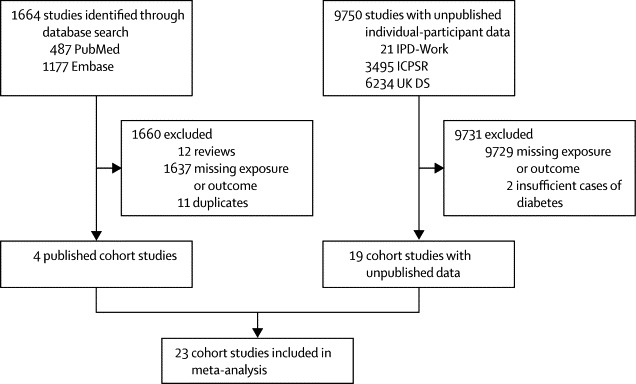
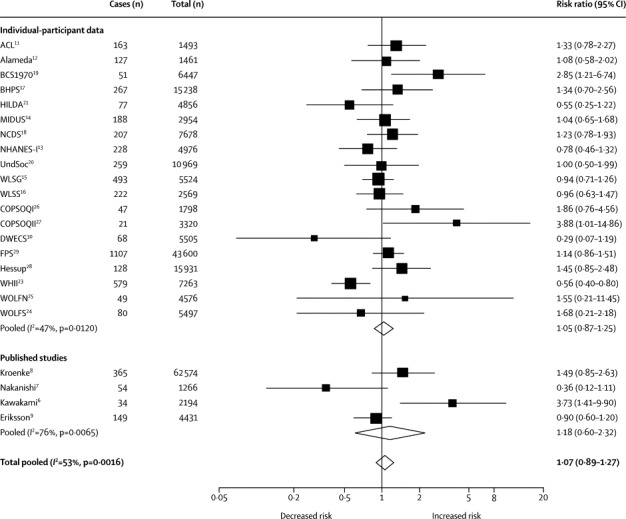
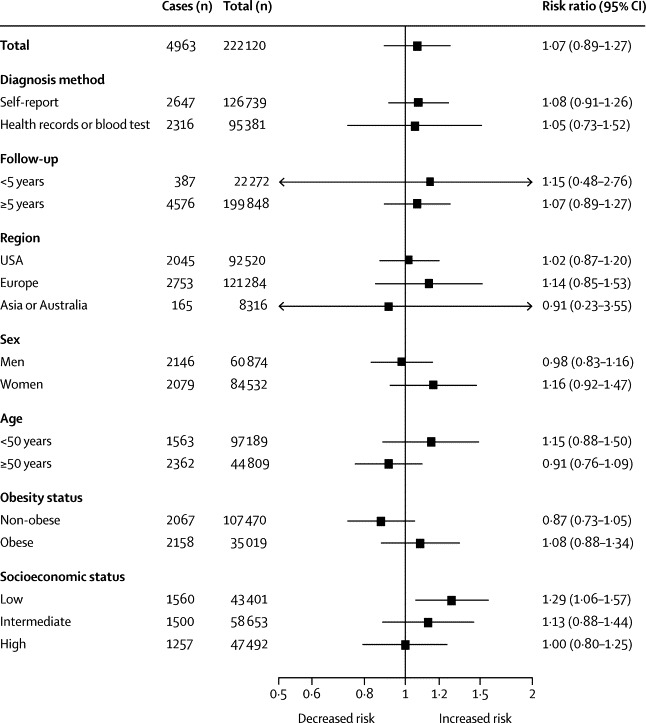
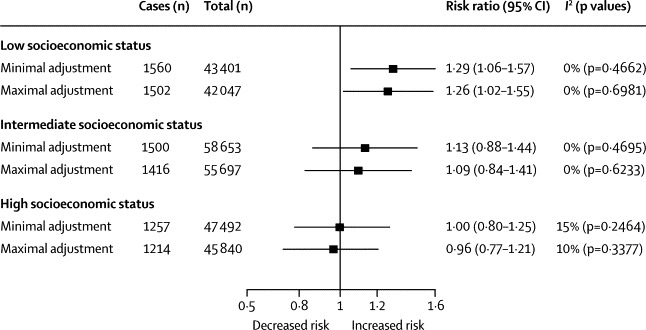
BACKGROUND: Working long hours might have adverse health effects, but whether this is true for all socioeconomic status groups is unclear. In this meta-analysis stratified by socioeconomic status, we investigated the role of long working hours as a risk factor for type 2 diabetes. METHODS: We identified four published studies through a systematic literature search of PubMed and Embase up to April 30, 2014. Study inclusion criteria were English-language publication; prospective design (cohort study); investigation of the effect of working hours or overtime work; incident diabetes as an outcome; and relative risks, odds ratios, or hazard ratios (HRs) with 95% CIs, or sufficient information to calculate these estimates. Additionally, we used unpublished individual-level data from 19 cohort studies from the Individual-Participant-Data Meta-analysis in Working-Populations Consortium and international open-access data archives. Effect estimates from published and unpublished data from 222 120 men and women from the USA, Europe, Japan, and Australia were pooled with random-effects meta-analysis. FINDINGS: During 1·7 million person-years at risk, 4963 individuals developed diabetes (incidence 29 per 10 000 person-years). The minimally adjusted summary risk ratio for long (≥55 h per week) compared with standard working hours (35-40 h) was 1·07 (95% CI 0·89-1·27, difference in incidence three cases per 10 000 person-years) with significant heterogeneity in study-specific estimates (I(2)=53%, p=0·0016). In an analysis stratified by socioeconomic status, the association between long working hours and diabetes was evident in the low socioeconomic status group (risk ratio 1·29, 95% CI 1·06-1·57, difference in incidence 13 per 10 000 person-years, I(2)=0%, p=0·4662), but was null in the high socioeconomic status group (1·00, 95% CI 0·80-1·25, incidence difference zero per 10 000 person-years, I(2)=15%, p=0·2464). The association in the low socioeconomic status group was robust to adjustment for age, sex, obesity, and physical activity, and remained after exclusion of shift workers. INTERPRETATION: In this meta-analysis, the link between longer working hours and type 2 diabetes was apparent only in individuals in the low socioeconomic status groups. FUNDING: Medical Research Council, European Union New and Emerging Risks in Occupational Safety and Health research programme, Finnish Work Environment Fund, Swedish Research Council for Working Life and Social Research, German Social Accident Insurance, Danish National Research Centre for the Working Environment, Academy of Finland, Ministry of Social Affairs and Employment (Netherlands), Economic and Social Research Council, US National Institutes of Health, and British Heart Foundation.
Overview
The claims and statistics of this paper haven’t been checked yet.
Run the check — free, no account needed. It reads the open-access text and checks the sources it cites.
Integrity signals
Registry
Cites
Statistics
Figures
Verification
Claims the paper makes
The claims and statistics of this paper haven’t been checked yet.
Run the check — free, no account needed. It reads the open-access text and checks the sources it cites.
Claims other papers make about this one
Each is checked against this paper’s own text: does it say what the citing paper says it does?
The cited source says what the claim attributes to it.
In the citing paper
“Long work hours (≥55 h per week) have also been related to increased risk of diabetes mellitus but only in low socioeconomic groups 79”
From Type 2 diabetes mellitus and psychological stress — a modifiable risk factor (2017) · cites this paper as [79]
Self-check
Percentages, sums and reported differences re-computed from the paper’s own numbers.
The self-check needs the paper’s full text.
Citations
Cites
Preferred Reporting Items for Systematic Reviews and Meta-Analyses: the PRISMA statement
Moher, D., Liberati, A., Tetzlaff, J., Altman, D. G., & for the PRISMA Group (2009) · BMJ · doi:10.1136/bmj.b2535 · Cited by 83,823
Measuring inconsistency in meta-analyses
Higgins, J. P. T., Thompson, S. G., Deeks, J. J., & Altman, D. G. (2003) · BMJ · doi:10.1136/bmj.327.7414.557 · Cited by 63,139
Preferred reporting items for systematic reviews and meta-analyses: the PRISMA Statement.
(2009) · PubMed Central · Cited by 44,859
Preferred Reporting Items for Systematic Reviews and Meta-Analyses: The PRISMA Statement
Moher, D., Liberati, A., Tetzlaff, J., & Altman, D. G. (2009) · Journal of Clinical Epidemiology · doi:10.1016/j.jclinepi.2009.06.005 · Cited by 19,575
Murray, C. J. L., Vos, T., Lozano, R., Naghavi, M., Flaxman, A. D., Michaud, C., Ezzati, M., Shibuya, K., Salomon, J. A., Abdalla, S., et al. (2012) · The Lancet · doi:10.1016/s0140-6736(12)61689-4 · Cited by 8,888
Global estimates of the prevalence of diabetes for 2010 and 2030
Shaw, J. E., Sicree, R. A., & Zimmet, P. Z. (2010) · Diabetes Research and Clinical Practice · doi:10.1016/j.diabres.2009.10.007 · Cited by 7,216
Health inequalities among British civil servants: the Whitehall II study
Marmot, M. G., Stansfeld, S. A., Patel, C., North, F. M., Head, J. A., White, I. R., Brunner, E. J., Feeney, A., Marmot, M. G., & Smith, G. D. (1991) · The Lancet · doi:10.1016/0140-6736(91)93068-k · Cited by 3,571
Self-citationQuantity and Quality of Sleep and Incidence of Type 2 Diabetes
Cappuccio, F. P., D'Elia, L., Strazzullo, P., & Miller, M. A. (2010) · Diabetes Care · doi:10.2337/dc09-1124 · Cited by 1,670
Kristensen, T. S., Hannerz, H., Høgh, A., & Borg, V (2005) · Scandinavian Journal of Work, Environment & Health · doi:10.5271/sjweh.948 · Cited by 1,430
The second version of the Copenhagen Psychosocial Questionnaire
Pejtersen, J. H., Kristensen, T. S., Borg, V., & Bjorner, J. B. (2010) · Scandinavian Journal of Public Health · doi:10.1177/1403494809349858 · Cited by 1,187
Self-citation
Research works printed but not linked: 1
- Feveile, 2007, Danish Work Environment Cohort Study 2005: from idea to sampling design, Stat Transit, 8, 441
Cited by
Sorted by citations
Social determinants of health and diabetes: A scientific review
Hill-Briggs, F., Adler, N. E., Berkowitz, S. A., Chin, M. H., Gary-Webb, T. L., Navas-Acien, A., Thornton, P. L., & Haire-Joshu, D. (2021) · Diabetes Care · doi:10.2337/dci20-0053 · Cited by 1,732
(2015) · doi:10.1016/s0140-6736(15)60295-1 · Cited by 732
Self-citationRisk factors for type 2 diabetes mellitus: An exposure-wide umbrella review of meta-analyses
Bellou, V., Belbasis, L., Tzoulaki, I., & Evangelou, E. (2018) · PLOS ONE · doi:10.1371/journal.pone.0194127 · Cited by 713
Japanese clinical practice guideline for diabetes 2019
Araki, E., Goto, A., Kondo, T., Noda, M., Noto, H., Origasa, H., Osawa, H., Taguchi, A., Tanizawa, Y., Tobe, K., et al. (2020) · Diabetology International · doi:10.1007/s13340-020-00439-5 · Cited by 545
Work Stress as a Risk Factor for Cardiovascular Disease
Mika Kivimaki, B., & Kawachi, I. I. (2015) · Current Cardiology Reports · doi:10.1007/s11886-015-0630-8 · Cited by 618
Self-citation
Metadata
- Authors
- Kivimäki, M., Virtanen, M., Kawachi, I., Nyberg, S. T., Alfredsson, L., Batty, G. D., Bjorner, J. B., Borritz, M., Brunner, E. J., Burr, H., Dragano, N., Ferrie, J. E., Fransson, E. I., Hamer, M., Heikkilä, K., Knutsson, A., Koskenvuo, M., Madsen, I. E. H., Nielsen, M. L., Nordin, M., Oksanen, T., Pejtersen, J. H., Pentti, J., Rugulies, R., Salo, P., Siegrist, J., Steptoe, A., Suominen, S., Theorell, T., Vahtera, J., Westerholm, P. J. M., Westerlund, H., Singh-Manoux, A., & Jokela, M.
- Affiliations
- Finnish Institute of Occupational Health (FI)
- Harvard University (US)
- Region Stockholm (SE)
- Alzheimer Scotland (GB)
- Bispebjerg Hospital (DK)
- University College London (GB)
- Federal Institute for Occupational Safety and Health (DE)
- Heinrich Heine University Düsseldorf (DE)
- University of Bristol (GB)
- Stockholm University (SE)
- Mid Sweden University (SE)
- University of Helsinki (FI)
- National Research Centre for the Working Environment (DK)
- Umeå University (SE)
- Danish National Centre for Social Research (DK)
- University of Copenhagen (DK)
- University of Turku (FI)
- Uppsala University (SE)
- ORCID
- Virtanen, Marianna
- Kawachi, Ichiro
- Nyberg, Solja T
- Alfredsson, Lars
- Batty, G David
- Borritz, Marianne
- Brunner, Eric J
- Burr, Hermann
- Fransson, Eleonor I
- Hamer, Mark
- Heikkilä, Katriina
- Madsen, Ida E H
- Nielsen, Martin L
- Oksanen, Tuula
- Pejtersen, Jan H
- Rugulies, Reiner
- Salo, Paula
- Steptoe, Andrew
- Suominen, Sakari
- Theorell, Töres
- Vahtera, Jussi
- Westerholm, Peter J M
- Westerlund, Hugo
- Jokela, Markus
- Venue
- The Lancet Diabetes & Endocrinology
- Publisher
- Elsevier BV
- Published
- 2015-01
- Volume
- 3
- Issue
- 1
- Pages
- 27-34
- ISSN
- 2213-8587 (ISSN-L)
- PMC
- PMC4286814
- OpenAlex
- W2148375661
- Cited by
- 279
- References
- 42
- Citations by year
- 2026: 13 · 2025: 24 · 2024: 16 · 2023: 33 · 2022: 30 · 2021: 27 · 2020: 26 · 2019: 25 · 2018: 32 · 2017: 17 · 2016: 22 · 2015: 12
- FWCI
- 3.01
- Type
- journal article
- Language
- en
- Open access
- hybrid
- doi.org
- Licence
- Locations
- The Lancet Diabetes & Endocrinology (publishedVersion, cc-by)
- Europe PMC (PubMed Central) (publishedVersion, cc-by)
- PubMed Central (publishedVersion, cc-by)
- PubMed (publishedVersion)
- Research at the University of Copenhagen (University of Copenhagen) (publishedVersion, other-oa)
- Research at the University of Copenhagen (University of Copenhagen) (publishedVersion, cc-by)
- Tampere University Institutional Repository (Tampere University) (publishedVersion, cc-by)
- LSHTM Research Online (London School of Hygiene and Tropical Medicine) (acceptedVersion)
- Digital Access to Scholarship at Harvard (DASH) (Harvard University) (submittedVersion, cc-by)
- Diva portal (Dalarna University Library) (submittedVersion, other-oa)
- DiVA at Umeå University (Umeå University) (submittedVersion, other-oa)
- KTH Publication Database DiVA (KTH Royal Institute of Technology) (submittedVersion, other-oa)
- Loughborough University Institutional Repository (Loughborough University) (submittedVersion, cc-by)
- Loughborough University Research Repository (Loughborough University) (submittedVersion, cc-by)
- Työväentutkimus Vuosikirja (submittedVersion)
- Explore Bristol Research (submittedVersion, cc-by)
- Tampere University Institutional Repository (Tampere University) (submittedVersion, cc-by)
- STM:n Hallinnonalan avoin julkaisuarkisto (Julkari) (submittedVersion)
- Funders
- Työsuojelurahasto
- National Institutes of Health (R01AG034454, R01HL036310)
- Deutsche Gesetzliche Unfallversicherung
- Ministerie van Sociale Zaken en Werkgelegenheid
- Medical Research Council (K013351)
- British Heart Foundation
- Economic and Social Research Council
- Topics
- Health Sciences › Medicine › Public Health, Environmental and Occupational Health › Workplace Health and Well-being
- Social Sciences › Psychology › Experimental and Cognitive Psychology › Sleep and Work-Related Fatigue
- Life Sciences › Neuroscience › Endocrine and Autonomic Systems › Circadian rhythm and melatonin
- Keywords
- long working hours, overtime, type 2 diabetes, socioeconomic status, low socioeconomic status, diabetes incidence, occupational health
- MeSH terms
- Adult, Diabetes Mellitus, Type 2, Female, Humans, Male, Middle Aged, Risk Factors, Social Class, Work Schedule Tolerance, Incidence
About these checks
Registry, retraction, Cites and statistics results are computed, not judged, with one exception: a printed reference that no index lists is read once by a model before it counts as a citation error. Claims are extracted by a model and kept only when their quote appears verbatim in the text; each cited source is then checked, with a model’s help, for whether it says what the claim relies on. Those verdicts can be wrong — read the claim’s quote and the cited source before relying on one.
Statistics and arithmetic are recomputed, not judged.
Confidence bands are shown only for fields calibrated on our annotated test set. None is calibrated yet, so no band is shown.
What counts as a claim ›How we measure confidence ›How we check this ›
Are you an author, or do you see a problem with this page? Request a review
