

The DOI matches its Crossref record; 35 of the 36 references it cites were found in a registry or an index.
Effect of metformin on maternal and fetal outcomes in obese pregnant women (EMPOWaR): a randomised, double-blind, placebo-controlled trial
Open accessAbstract
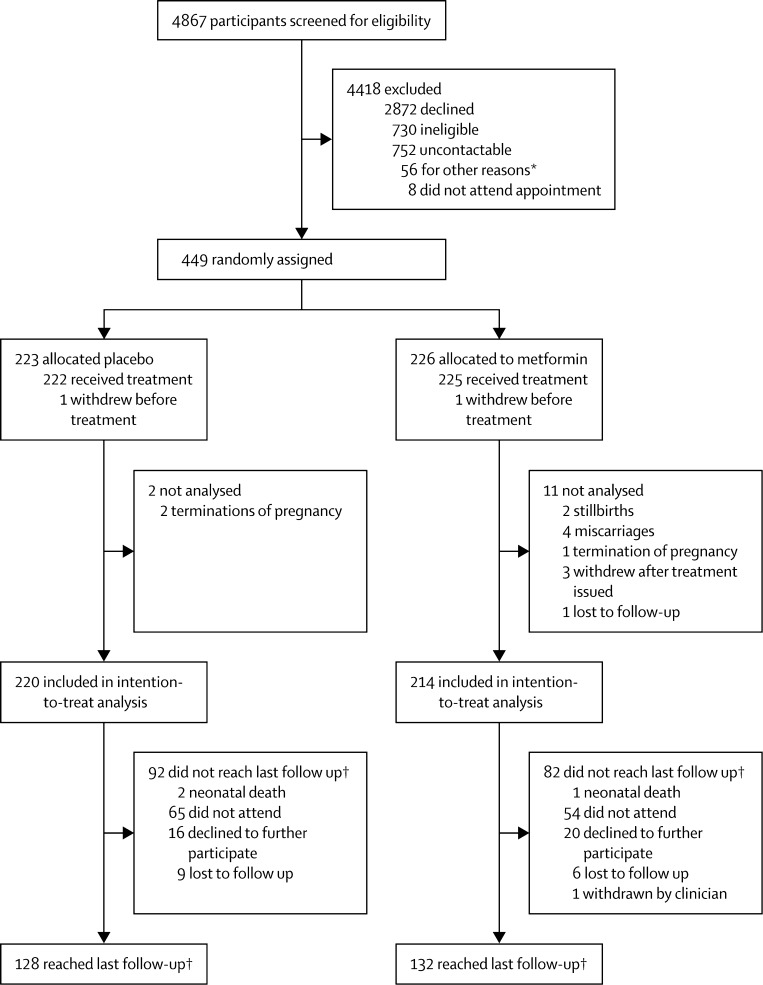
BACKGROUND: Maternal obesity is associated with increased birthweight, and obesity and premature mortality in adult offspring. The mechanism by which maternal obesity leads to these outcomes is not well understood, but maternal hyperglycaemia and insulin resistance are both implicated. We aimed to establish whether the insulin sensitising drug metformin improves maternal and fetal outcomes in obese pregnant women without diabetes. METHODS: We did this randomised, double-blind, placebo-controlled trial in antenatal clinics at 15 National Health Service hospitals in the UK. Pregnant women (aged ≥16 years) between 12 and 16 weeks' gestation who had a BMI of 30 kg/m(2) or more and normal glucose tolerance were randomly assigned (1:1), via a web-based computer-generated block randomisation procedure (block size of two to four), to receive oral metformin 500 mg (increasing to a maximum of 2500 mg) or matched placebo daily from between 12 and 16 weeks' gestation until delivery of the baby. Randomisation was stratified by study site and BMI band (30-39 vs ≥40 kg/m(2)). Participants, caregivers, and study personnel were masked to treatment assignment. The primary outcome was Z score corresponding to the gestational age, parity, and sex-standardised birthweight percentile of liveborn babies delivered at 24 weeks or more of gestation. We did analysis by modified intention to treat. This trial is registered, ISRCTN number 51279843. FINDINGS: Between Feb 3, 2011, and Jan 16, 2014, inclusive, we randomly assigned 449 women to either placebo (n=223) or metformin (n=226), of whom 434 (97%) were included in the final modified intention-to-treat analysis. Mean birthweight at delivery was 3463 g (SD 660) in the placebo group and 3462 g (548) in the metformin group. The estimated effect size of metformin on the primary outcome was non-significant (adjusted mean difference -0·029, 95% CI -0·217 to 0·158; p=0·7597). The difference in the number of women reporting the combined adverse outcome of miscarriage, termination of pregnancy, stillbirth, or neonatal death in the metformin group (n=7) versus the placebo group (n=2) was not significant (odds ratio 3·60, 95% CI 0·74-17·50; p=0·11). INTERPRETATION: Metformin has no significant effect on birthweight percentile in obese pregnant women. Further follow-up of babies born to mothers in the EMPOWaR study will identify longer-term outcomes of metformin in this population; in the meantime, metformin should not be used to improve pregnancy outcomes in obese women without diabetes. FUNDING: The Efficacy and Mechanism Evaluation (EME) Programme, a Medical Research Council and National Institute for Health Research partnership.
Overview
The claims and statistics of this paper haven’t been checked yet.
Run the check — free, no account needed. It reads the open-access text and checks the sources it cites.
Integrity signals
Registry
Cites
Statistics
Figures
Verification
Claims the paper makes
The claims and statistics of this paper haven’t been checked yet.
Run the check — free, no account needed. It reads the open-access text and checks the sources it cites.
Claims other papers make about this one
Each is checked against this paper’s own text: does it say what the citing paper says it does?
In the citing paper
“In the Fetal Medicine Foundation trial, women had a higher BMI (>35 kg/m2 vs. >30 kg/m2), were treated with a higher starting and maximum dose of metformin, and were more compliant than women in the EMPOWaR trial(95, 96).”
From Metformin, the Aspirin of the 21st Century: Its Role in Gestational Diabetes Mellitus, Prevention of Preeclampsia and Cancer, and the Promotion of Longevity (2017) · cites this paper as [95]
In the citing paper
“By contrast, in the EMPOWaR trial, compliance was defined as ingestion of at least one tablet for at least 29% of the days between randomization and delivery, and only 67% of women fulfilled this criterion(95).”
From Metformin, the Aspirin of the 21st Century: Its Role in Gestational Diabetes Mellitus, Prevention of Preeclampsia and Cancer, and the Promotion of Longevity (2017) · cites this paper as [95]
In the citing paper
“In this trial, metformin had no significant effect on birth weight, maternal weight gain during gestation, preeclampsia, or combined adverse pregnancy outcomes, including miscarriage, termination of pregnancy, or fetal or neonatal death(95).”
From Metformin, the Aspirin of the 21st Century: Its Role in Gestational Diabetes Mellitus, Prevention of Preeclampsia and Cancer, and the Promotion of Longevity (2017) · cites this paper as [95]
In the citing paper
“In the Fetal Medicine Foundation trial, women had a higher BMI (>35 kg/m2 vs. >30 kg/m2), were treated with a higher starting and maximum dose of metformin, and were more compliant than women in the EMPOWaR trial(95, 96).”
From Metformin, the Aspirin of the 21st Century: Its Role in Gestational Diabetes Mellitus, Prevention of Preeclampsia and Cancer, and the Promotion of Longevity (2017) · cites this paper as [95]
In the citing paper
“In this trial, metformin had no significant effect on birth weight, maternal weight gain during gestation, preeclampsia, or combined adverse pregnancy outcomes, including miscarriage, termination of pregnancy, or fetal or neonatal death(95).”
From Metformin, the Aspirin of the 21st Century: Its Role in Gestational Diabetes Mellitus, Prevention of Preeclampsia and Cancer, and the Promotion of Longevity (2017) · cites this paper as [95]
In the citing paper
“It is also noteworthy that only 13% (443/3329) of eligible patients consented to participate in the EMPOWaR study, whereas 47% (400/844) of eligible women were recruited to the Fetal Medicine Foundation study, making the latter group more representative of women who meet the study’s eligibility criteria and to whom the study’s results apply.”
From Metformin, the Aspirin of the 21st Century: Its Role in Gestational Diabetes Mellitus, Prevention of Preeclampsia and Cancer, and the Promotion of Longevity (2017) · cites this paper as [95]
In the citing paper
“In the Fetal Medicine Foundation trial, women had a higher BMI (>35 kg/m2 vs. >30 kg/m2), were treated with a higher starting and maximum dose of metformin, and were more compliant than women in the EMPOWaR trial(95, 96).”
From Metformin, the Aspirin of the 21st Century: Its Role in Gestational Diabetes Mellitus, Prevention of Preeclampsia and Cancer, and the Promotion of Longevity (2017) · cites this paper as [95]
In the citing paper
“By contrast, in the EMPOWaR trial, compliance was defined as ingestion of at least one tablet for at least 29% of the days between randomization and delivery, and only 67% of women fulfilled this criterion(95).”
From Metformin, the Aspirin of the 21st Century: Its Role in Gestational Diabetes Mellitus, Prevention of Preeclampsia and Cancer, and the Promotion of Longevity (2017) · cites this paper as [95]
In the citing paper
“In this trial, metformin had no significant effect on birth weight, maternal weight gain during gestation, preeclampsia, or combined adverse pregnancy outcomes, including miscarriage, termination of pregnancy, or fetal or neonatal death(95).”
From Metformin, the Aspirin of the 21st Century: Its Role in Gestational Diabetes Mellitus, Prevention of Preeclampsia and Cancer, and the Promotion of Longevity (2017) · cites this paper as [95]
Self-check
Percentages, sums and reported differences re-computed from the paper’s own numbers.
The self-check needs the paper’s full text.
Citations
Cites
Hyperglycemia and adverse pregnancy outcomes
(2008) · New England Journal of Medicine · doi:10.1056/nejmoa0707943 · Cited by 5,563
International Association of Diabetes and Pregnancy Study Groups Consensus Panel (2010) · Diabetes Care · doi:10.2337/dc09-1848 · Cited by 5,390
Boney, C. M., Verma, A., Tucker, R., & Vohr, B. R. (2005) · Pediatrics · doi:10.1542/peds.2004-1808 · Cited by 2,303
Metzger, B. E., Gabbe, S. G., Persson, B., Lowe, L. P., Dyer, A. R., Oats, J. J. N., & Buchanan, T. A. (2010) · Diabetes Care · doi:10.2337/dc10-0719 · Cited by 1,888
Metformin versus insulin for the treatment of gestational diabetes
Rowan, J. A., Hague, W. M., Gao, W., Battin, M. R., & Moore, M. P. (2008) · New England Journal of Medicine · doi:10.1056/nejmoa0707193 · Cited by 1,291
Childhood predictors of adult obesity: a systematic review.
Parsons, T. J., Power, C., Logan, S., & Summerbell, C. (1999) · PubMed · Cited by 1,001
Birth Weight and Adult Hypertension, Diabetes Mellitus, and Obesity in US Men
Curhan, G. C., Willett, W. C., Rimm, E. B., Spiegelman, D. L., Ascherio, A., & Stampfer, M. J. (1996) · Circulation · doi:10.1161/01.cir.94.12.3246 · Cited by 917
Maternal Body Mass Index and the Risk of Preeclampsia: A Systematic Overview
O'Brien, T., Ray, J. G., & Chan, W. (2003) · Epidemiology · doi:10.1097/00001648-200305000-00020 · Cited by 908
Catalano, P., & Ehrenberg, H. M. (2006) · BJOG An International Journal of Obstetrics & Gynaecology · doi:10.1111/j.1471-0528.2006.00989.x · Cited by 828
Thangaratinam, S., Rogozinska, E., Jolly, K., Glinkowski, S., Roseboom, T., Tomlinson, J. W., Kunz, R., Mol, B. W., Coomarasamy, A., & Khan, K. S. (2012) · BMJ · doi:10.1136/bmj.e2088 · Cited by 802
Birth Weight and Adult Hypertension and Obesity in Women
Curhan, G. C., Chertow, G. M., Willett, W. C., Spiegelman, D. L., Colditz, G. A., Manson, J. E., Speizer, F. E., & Stampfer, M. J. (1996) · Circulation · doi:10.1161/01.cir.94.6.1310 · Cited by 671
Maternal Body Mass Index and the Risk of Preeclampsia: A Systematic Overview
O’Brien, T. E., Ray, J. G., & Chan, W. (2003) · Epidemiology · doi:10.1097/01.ede.0000059921.71494.d1 · Cited by 644
Poston, L., Bell, R., Croker, H., Flynn, A. C., Godfrey, K. M., Goff, L., Hayes, L., Khazaezadeh, N., Nelson, S. M., Oteng-Ntim, E., et al. (2015) · The Lancet Diabetes & Endocrinology · doi:10.1016/s2213-8587(15)00227-2 · Cited by 642
Reynolds, R. M., Allan, K. M., Raja, E. A., Bhattacharya, S., McNeill, G., Hannaford, P. C., Sarwar, N., Lee, A. J., Bhattacharya, S., & Norman, J. E. (2013) · BMJ · doi:10.1136/bmj.f4539 · Cited by 571
Self-citationHeslehurst, N., Simpson, H., Ells, L. J., Rankin, J. M., Wilkinson, J. R., Lang, R., Brown, T. J., & Summerbell, C. (2008) · Obesity Reviews · doi:10.1111/j.1467-789x.2008.00511.x · Cited by 542
Reasons for Increasing Trends in Large for Gestational Age Births
Surkan, P. J., Hsieh, C.-C., Johansson, A. L. V., Dickman, P. W., & Cnattingius, S. (2004) · Obstetrics and Gynecology · doi:10.1097/01.aog.0000141442.59573.cd · Cited by 347
Is it time to revisit the Pedersen hypothesis in the face of the obesity epidemic?
Catalano, P. M., & Mouzon, S. H. (2011) · American Journal of Obstetrics and Gynecology · doi:10.1016/j.ajog.2010.11.039 · Cited by 341
Vanky, E., Stridsklev, S., Heimstad, R., Romundstad, P., Skogøy, K., Kleggetveit, O., Hjelle, S., von Brandis, P., Eikeland, T., Flo, K., et al. (2010) · The Journal of Clinical Endocrinology & Metabolism · doi:10.1210/jc.2010-0853 · Cited by 315
Starling, A. P., Brinton, J. T., Glueck, D. H., Shapiro, A. L. B., Harrod, C. S., Lynch, A. M., Siega‐Riz, A. M., & Dabelea, D. (2014) · American Journal of Clinical Nutrition · doi:10.3945/ajcn.114.094946 · Cited by 282
Stewart, F. M., Freeman, D. J., Ramsay, J. E., Greer, I. A., CASLAKE, M. J., & Ferrell, W. R. (2006) · The Journal of Clinical Endocrinology & Metabolism · doi:10.1210/jc.2006-2083 · Cited by 274
Maternal Glucose Concentration Influences Fetal Growth, Gestation, and Pregnancy Complications
Scholl, T. O., Sowers, M., Chen, X., & Lenders, C. M. (2001) · American Journal of Epidemiology · doi:10.1093/aje/154.6.514 · Cited by 198
Johansson, S., Villamor, E., Altman, M., Bonamy, A. E., Granath, F. N., & Cnattingius, S. (2014) · BMJ · doi:10.1136/bmj.g6572 · Cited by 186
For the LIMIT Randomised Trial Group, Dodd, J. M., Cramp, C., Sui, Z., Yelland, L. N., Deussen, A. R., Grivell, R. M., Moran, L., Crowther, C. A., Turnbull, D. A., et al. (2014) · BMC Medicine · doi:10.1186/s12916-014-0161-y · Cited by 182
Inflammation and Dyslipidemia Related to Risk of Spontaneous Preterm Birth
Catov, J. M., Bodnar, L. M., Ness, R. B., Barron, S. J., & Roberts, J. M. (2007) · American Journal of Epidemiology · doi:10.1093/aje/kwm273 · Cited by 144
Centile charts for birthweight for gestational age for Scottish singleton births
Bonellie, S., Chalmers, J. W. T., Gray, R., Greer, I. A., Jarvis, S. N., & Williams, C. A. L. (2008) · BMC Pregnancy and Childbirth · doi:10.1186/1471-2393-8-5 · Cited by 138
Diabetes and pregnancy: Blood sugar of newborn infants
Miller, H. C. (1953) · The Journal of Pediatrics · doi:10.1016/s0022-3476(53)80122-8 · Cited by 105
The relationship of hypovitaminosis D and IL-6 in preeclampsia
Xu, L., Lee, M., Jeyabalan, A., & Roberts, J. M. (2013) · American Journal of Obstetrics and Gynecology · doi:10.1016/j.ajog.2013.09.037 · Cited by 81
Dodd, J. M., Grivell, R. M., Deussen, A. R., & Hague, W. M. (2018) · Cochrane Database of Systematic Reviews · doi:10.1002/14651858.cd010564.pub2 · Cited by 74
Effect of metformin on serum interleukin-6 levels in polycystic ovary syndrome: a systematic review
Xu, X., Du, C., Zheng, Q., Peng, L., & Sun, Y. (2014) · BMC Women s Health · doi:10.1186/1472-6874-14-93 · Cited by 67
Salomäki, H., Heinäniemi, M., Vähätalo, L. H., Ailanen, L., Eerola, K., Ruohonen, S. T., Pesonen, U., & Koulu, M. (2014) · PLoS ONE · doi:10.1371/journal.pone.0115778 · Cited by 63
Goldberg, R. B., Temprosa, M. G., Mather, K. J., Orchard, T. J., Kitabchi, A. E., & Watson, K. E. (2014) · Diabetes Care · doi:10.2337/dc13-2471 · Cited by 55
Is It Time to Revisit the Pedersen Hypothesis in the Face of the Obesity Epidemic?
Catalano, P., & Mouzon, S. H. (2012) · Obstetric Anesthesia Digest · doi:10.1097/01.aoa.0000414058.25051.7f · Cited by 47
Prediction of adolescent and adult adiposity outcomes from early life anthropometrics
Graversen, L., Sørensen, T. I. A., Gerds, T. A., Petersen, L. V., Sovio, U., Kaakinen, M., Sandbæk, A., Laitinen, J. H., Taanila, A. M., Pouta, A. M., et al. (2014) · Obesity · doi:10.1002/oby.20921 · Cited by 21
Efficacy of metformin in pregnant obese women: a randomised controlled trial
Chiswick, C. A., Reynolds, R. M., Denison, F. C., Whyte, S., Drake, A. J., Newby, D. E., Walker, B. R., Forbes, S., Murray, G. D., Quenby, S. M., et al. (2015) · BMJ Open · doi:10.1136/bmjopen-2014-006854 · Cited by 21
Self-citationMetformin for women who are obese during pregnancy for improving maternal and infant outcomes
Eames, A. J., Grivell, R. M., Deussen, A. R., Hague, W. M., & Dodd, J. M. (2013) · Cochrane Database of Systematic Reviews · doi:10.1002/14651858.cd010564 · Cited by 3
Cited by
Sorted by citations
McIntyre, H. D., Catalano, P., Zhang, C., Desoye, G., Mathiesen, E. R., & Damm, P. (2019) · Nature Reviews Disease Primers · doi:10.1038/s41572-019-0098-8 · Cited by 1,850
Poon, L. C., Shennan, A. H., Hyett, J. A., Kapur, A., Hadar, E., Divakar, H., McAuliffe, F. M., Costa, F. D. S., von Dadelszen, P., McIntyre, D. H., et al. (2019) · International Journal of Gynecology & Obstetrics · doi:10.1002/ijgo.12802 · Cited by 1,430
Stephenson, J., Heslehurst, N., Hall, J., Schoenaker, D. A. J. M., Hutchinson, J., Cade, J. E., Poston, L., Barrett, G., Crozier, S. R., Barker, M., et al. (2018) · The Lancet · doi:10.1016/s0140-6736(18)30311-8 · Cited by 1,222
Triangulation in aetiological epidemiology
Lawlor, D. A., Tilling, K., & Davey Smith, G. (2017) · International Journal of Epidemiology · doi:10.1093/ije/dyw314 · Cited by 1,129
Influence of Maternal Obesity on the Long-Term Health of Offspring
Godfrey, K. M., Reynolds, R. M., Prescott, S. L., Nyirenda, M., Jaddoe, V. W. V., Eriksson, J. G., & Broekman, B. F. P. (2017) · The Lancet Diabetes & Endocrinology · doi:10.1016/s2213-8587(16)30107-3 · Cited by 1,059
Self-citation
Metadata
- Authors
- Chiswick, C., Reynolds, R. M., Denison, F., Drake, A. J., Forbes, S., Newby, D. E., Walker, B. R., Quenby, S., Wray, S., Weeks, A., Lashen, H., Rodriguez, A., Murray, G., Whyte, S., & Norman, J. E.
- Affiliations
- MRC Centre for Reproductive Health (GB)
- British Heart Foundation Centre for Cardiovascular Science (GB)
- Edinburgh Royal Infirmary (GB)
- University of Warwick (GB)
- Liverpool Women's Hospital (GB)
- Jessop Hospital (GB)
- University of Edinburgh (GB)
- Corresponding author
- Norman, Jane E
- ORCID
- Venue
- The Lancet Diabetes & Endocrinology
- Publisher
- Elsevier BV
- Published
- 2015-10
- Volume
- 3
- Issue
- 10
- Pages
- 778-786
- ISSN
- 2213-8587 (ISSN-L)
- PMC
- PMC4673088
- OpenAlex
- W2144199745
- Cited by
- 260
- References
- 36
- Citations by year
- 2026: 12 · 2025: 20 · 2024: 15 · 2023: 21 · 2022: 21 · 2021: 27 · 2020: 28 · 2019: 28 · 2018: 33 · 2017: 22 · 2016: 27 · 2015: 6
- FWCI
- 33.38
- Type
- journal article
- Language
- en
- Open access
- hybrid
- doi.org
- Locations
- The Lancet Diabetes & Endocrinology (publishedVersion, cc-by)
- Europe PMC (PubMed Central) (publishedVersion, cc-by)
- PubMed Central (publishedVersion, cc-by)
- PubMed (publishedVersion)
- Explore Bristol Research (publishedVersion)
- Warwick Research Archive Portal (University of Warwick) (acceptedVersion)
- Edinburgh Research Explorer (University of Edinburgh) (submittedVersion, cc-by)
- Bristol Research (University of Bristol) (submittedVersion, cc-by)
- Newcastle University ePrints (Newcastle Univesity)
- Funders
- Wellcome Trust (103782)
- National Institute for Health and Care Research (08/246/09)
- Medical Research Council (MC_G1002463)
- Topics
- Health Sciences › Medicine › Obstetrics and Gynecology › Gestational Diabetes Research and Management
- Health Sciences › Medicine › Public Health, Environmental and Occupational Health › Pregnancy and Medication Impact
- Health Sciences › Medicine › Pediatrics, Perinatology and Child Health › Birth, Development, and Health
- Keywords
- metformin, maternal obesity, pregnancy, birth weight, insulin resistance, miscarriage, stillbirth, preterm birth, gestational diabetes mellitus, maternal hyperglycemia, placental growth factor, placental insufficiency, fetal growth restriction, placental DNA methylation, epigenetics
- MeSH terms
- Abortion, Spontaneous, Adult, Double-Blind Method, Female, Fetal Macrosomia, Humans, Hypoglycemic Agents, Metformin, Pregnancy, Pregnancy Complications, Pregnancy Outcome, Diabetes, Gestational, Stillbirth, Young Adult, Obesity, Abdominal
About these checks
Registry, retraction, Cites and statistics results are computed, not judged, with one exception: a printed reference that no index lists is read once by a model before it counts as a citation error. Claims are extracted by a model and kept only when their quote appears verbatim in the text; each cited source is then checked, with a model’s help, for whether it says what the claim relies on. Those verdicts can be wrong — read the claim’s quote and the cited source before relying on one.
Statistics and arithmetic are recomputed, not judged.
Confidence bands are shown only for fields calibrated on our annotated test set. None is calibrated yet, so no band is shown.
What counts as a claim ›How we measure confidence ›How we check this ›
Are you an author, or do you see a problem with this page? Request a review
