

The consequences of tobacco tax on household health and finances in rich and poor smokers in China: an extended cost effectiveness analysis
Open accessThe DOI matches its Crossref record; 70 of the 72 references it cites were found in a registry or an index.
Abstract
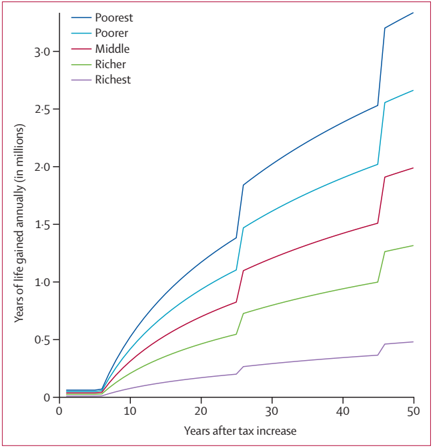
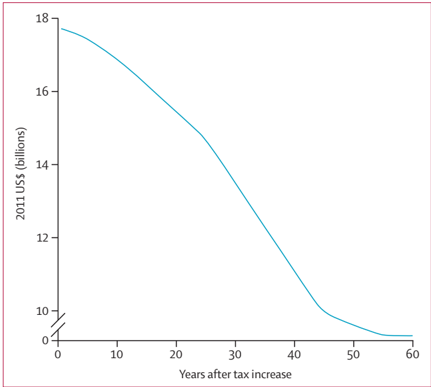
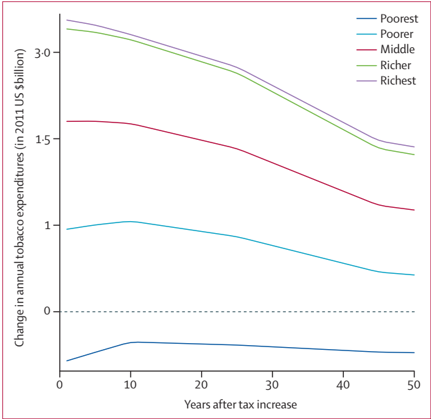
BACKGROUND: In China, there are more than 300 million male smokers. Tobacco taxation reduces smoking-related premature deaths and increases government revenues, but has been criticised for disproportionately affecting poorer people. We assess the distributional consequences (across different wealth quintiles) of a specific excise tax on cigarettes in China in terms of both financial and health outcomes. METHODS: We use extended cost-effectiveness analysis methods to estimate, across income quintiles, the health benefits (years of life gained), the additional tax revenues raised, the net financial consequences for households, and the financial risk protection provided to households, that would be caused by a 50% increase in tobacco price through excise tax fully passed onto tobacco consumers. For our modelling analysis, we used plausible values for key parameters, including an average price elasticity of demand for tobacco of -0·38, which is assumed to vary from -0·64 in the poorest quintile to -0·12 in the richest, and we considered only the male population, which constitutes the overwhelming majority of smokers in China. FINDINGS: Our modelling analysis showed that a 50% increase in tobacco price through excise tax would lead to 231 million years of life gained (95% uncertainty range 194-268 million) over 50 years (a third of which would be gained in the lowest income quintile), a gain of US$703 billion ($616-781 billion) of additional tax revenues from the excise tax (14% of which would come from the lowest income quintile, compared with 24% from the highest income quintile). The excise tax would increase overall household expenditures on tobacco by $376 billion ($232-505 billion), but decrease these expenditures by $21 billion (-$83 to $5 billion) in the lowest income quintile, and would reduce expenditures on tobacco-related disease by $24·0 billion ($17·3-26·3 billion, 28% of which would benefit the lowest income quintile). Finally, it would provide financial risk protection worth $1·8 billion ($1·2-2·3 billion), mainly concentrated (74%) in the lowest income quintile. INTERPRETATION: Increased tobacco taxation can be a pro-poor policy instrument that brings substantial health and financial benefits to households in China. FUNDING: Bill & Melinda Gates Foundation and Dalla Lana School of Public Health.
Overview
The claims and statistics of this paper haven’t been checked yet.
Free: it reads the open-access text and checks the first 5 claims that cite a source we can check. Create a free account to check every claim.
Integrity signals
Registry
Cites
Statistics
Figures
Verification
Claims the paper makes
The claims and statistics of this paper haven’t been checked yet.
Free: it reads the open-access text and checks the first 5 claims that cite a source we can check. Create a free account to check every claim.
Claims other papers make about this one
Each is checked against this paper’s own text: does it say what the citing paper says it does?
The cited source says what the claim attributes to it.
In the citing paper
“With large price increases, the distribution in net cigarette expenditures relative to income could well be progressive.220,223”
From Global health 2050: the path to halving premature death by mid-century (2024) · cites this paper as [223]
In the citing paper
“Several extended cost-effectiveness analyses have established this: the overall impact of increased tobacco taxes is progressive when accounting for outcomes of health benefits and financial risk protection.223–229”
From Global health 2050: the path to halving premature death by mid-century (2024) · cites this paper as [223]
Self-check
Percentages, sums and reported differences re-computed from the paper’s own numbers.
The self-check needs the paper’s full text.
Citations
Cites
Lim, S. S., Vos, T., Flaxman, A. D., Danaei, G., Shibuya, K., Adair-Rohani, H., AlMazroa, M. A., Amann, M., Anderson, H. R., Andrews, K. G., et al. (2012) · The Lancet · doi:10.1016/s0140-6736(12)61766-8 · Cited by 11,805
Awais, A. (2015) · Data Archiving and Networked Services (DANS) · doi:10.17632/zcvgc6m58h.1 · Cited by 6,707
Mortality in relation to smoking: 40 years' observations on male British doctors
Doll, R., Peto, R., Wheatley, K., Gray, R., & Sutherland, I. (1994) · BMJ · doi:10.1136/bmj.309.6959.901 · Cited by 5,932
Disease control priorities in developing countries
(2006) · Choice Reviews Online · doi:10.5860/choice.44-0343 · Cited by 3,628
Mortality in relation to smoking: 50 years' observations on male British doctors
Doll, R., Peto, R., Boreham, J., & Sutherland, I. (2004) · BMJ · doi:10.1136/bmj.38142.554479.ae · Cited by 2,920
Rapid health transition in China, 1990–2010: findings from the Global Burden of Disease Study 2010
Yang, G., Wang, Y., Zeng, Y., Gao, G. F., Liang, X., Zhou, M., Wan, X., Yu, S., Jiang, Y., Naghavi, M., et al. (2013) · The Lancet · doi:10.1016/s0140-6736(13)61097-1 · Cited by 1,982
Economics of the Public Sector
Stiglitz, J. E. (1986) · Cited by 1,410
Global health 2035: a world converging within a generation
Jamison, D. T., Summers, L. H., Alleyne, G., Arrow, K. J., Berkley, S., Binagwaho, A., Bustreo, F., Evans, D., Feachem, R. G. A., Frenk, J., et al. (2013) · The Lancet · doi:10.1016/s0140-6736(13)62105-4 · Cited by 1,220
Self-citationEarly appraisal of China's huge and complex health-care reforms
Yip, W. C.-M., Hsiao, W. C., Chen, W., Hu, S., Ma, J., & Maynard, A. (2012) · The Lancet · doi:10.1016/s0140-6736(11)61880-1 · Cited by 1,155
Is Addiction "Rational"? Theory and Evidence
Gruber, J., & Koszegi, B. (2001) · The Quarterly Journal of Economics · doi:10.1162/003355301753265570 · Cited by 1,034
Research works printed but not linked: 8
- 36 Verguet S, Olson ZD, Babigumira JB, et al. Assessing pathways to universal health coverage in Ethiopia: health gains and fi nancial risk protection aff orded from selected interventions. Lancet Global Health (in press).
- 54 Shanghai Municipal Center for Disease Control & Prevention (SCDC). Study on global AGEing and adult health (SAGE), Wave 1. China National Report. Study Report October, 2012. http://apps. who.int/healthinfo/systems/surveydata/index.php/catalog/13/ download/1874 (accessed April 23, 2014).
- 66 Kostova D, Ross H, Blecher E, Markowitz S. Prices and cigarette demand: evidence from youth tobacco use in developing countries. National Bureau of Economic Research Working Paper no.15781. Cambridge, MA: National Bureau of Economic Research, 2010.
- 69 Mao ZZ, Jiang JL. Demand for cigarette and pricing policy [in Chinese] . Chinese Health Economics 1997; 16: 50-52.
- 71 Mao ZZ, Hu T-w, Yang GH. New estimate of the demand for cigarettes in China. Chin J Health Econ 2005; 24: 45-47 [in Chinese].
- 73 Mao ZZ, Jiang JL. Determinants of the demand for cigarettes: a cross-sectional study. Chin Health Service Management 1997; 13: 227-29 [in Chinese].
- 74 Mao ZX, Yang GH, Ma H. Adults' demand for cigarettes and its determinants in China. Soft Sci Health 2003; 17: 19-23 [in Chinese].
- 75 Mao ZZ, Hu T-w, Yang GH. Price elasticities and impact of tobacco tax among various income groups [in Chinese]. Chin J Evidence-Based Med 2005; 5 : 291-95.
Cited by
Items 101–142 of 142
Evaluating China’s Record of Tobacco Control
Barnett, R., Jiang, S., & Peng, S. (2021) · Global perspectives on health geography · doi:10.1007/978-3-030-76143-1_8 · Cited by 4
Tackling tobacco smoking in Saudi Arabia
Menezes, R. G., Hussain, S. A., & Madadin, M. S. (2015) · The Lancet Global Health · doi:10.1016/s2214-109x(15)00010-8 · Cited by 3
Dehal, N., Krishan, K., Kanchan, T., & Singh, J. (2015) · Perspectives in Public Health · doi:10.1177/1757913915616735 · Cited by 4
Factores socioeconómicos asociados con la compra ilegal de productos de tabaco en Panamá
Ballesteros, V. H. H., Cisneros, J. Z., Velásquez, I. M., Gómez, B., & Roa, R. (2017) · Salud Pública de México · doi:10.21149/7728 · Cited by 3
Averting adverse selection: The Government of India's scheme to distribute affordable medicines
Srinivas, S. S., & Marathe, R. R. (2021) · Socio-Economic Planning Sciences · doi:10.1016/j.seps.2021.101035 · Cited by 3
Club Convergence in Cigarette Consumption and Health Policies in Pre-Pandemic Period
Tirgil, A., Görüş, M. Ş., & Özgür, Ö. (2021) · Düzce Tıp Fakültesi Dergisi · doi:10.18678/dtfd.859119 · Cited by 4
“(27) argued that the rise in the price of cigarettes through an increase in taxes would increase life gains and a tax gain for a government in China.”
BackgroundTuvdendorj, A., Konings, S. R. A., Purevdorj, B., Buskens, E., & Feenstra, T. (2021) · Nicotine & Tobacco Research · doi:10.1093/ntr/ntab182 · Cited by 4
James, E. K., Saxena, A., Restrepo, C. F., Llorente, B. A., Ortiz, A. V., Uribe, M. V., Iunes, R. F., & Verguet, S. (2017) · World Bank, Washington, DC eBooks · doi:10.1596/28598 · Cited by 2
Self-citationTobacco taxes for improving welfare and distributional outcomes: the case of Georgia
Tarlovsky, A. F., & Icaza, M. F. G. (2021) · European Journal of Public Health · doi:10.1093/eurpub/ckab029 · Cited by 3
Chinese immigrant men smokers’ sources of cigarettes in Canada: A qualitative study
Mao, A., Bottorff, J. L., Oliffe, J. L., Sarbit, G., & Kelly, M. T. (2017) · Tobacco Induced Diseases · doi:10.1186/s12971-017-0123-1 · Cited by 2
The Economic Case for Surgical Care in Low-Resource Settings
Raykar, N. P., Mukhopadhyay, S., Halbach, J. L., Cossa, M., Saluja, S., Lin, Y., Shrime, M. G., Meara, J. G., & Bickler, S. W. (2017) · Springer eBooks · doi:10.1007/978-3-319-49482-1_3 · Cited by 2
Verguet, S., Nandi, A., Filippi, V., & Bundy, D. A. P. (2017) · Europe PMC (PubMed Central) · doi:10.1596/978-1-4648-0423-6/pt5.ch28 · Cited by 5
Self-citationKooshkebaghi, M., Dargahi, H., & Emamgholipour, S. (2022) · BMC Public Health · doi:10.1186/s12889-022-14673-w · Cited by 1
Extended Cost-Effectiveness Analysis
Verguet, S., Tolla, M. T., Memirie, S. T., & Jamison, D. T. T. (2019) · Oxford University Press eBooks · doi:10.1093/oso/9780190912765.003.0006 · Cited by 1
Self-citationUsing Compensating Variation to Measure the Costs of Taxing Cigarette in Iran
Raei, B., Takian, A., Yaseri, M., Abdoli, G., & Emamgholipour, S. (2020) · Health Scope · doi:10.5812/jhealthscope.108121 · Cited by 1
Universal Health Coverage and Intersectoral Action for Health
Jamison, D. T. T., Alwan, A., Mock, C., Nugent, R. A., Watkins, D., Adeyi, O., Anand, S., Atun, R. A., Bertozzi, S., Bhutta, Z. A., et al. (2017) · World Bank, Washington, DC eBooks · doi:10.1596/978-1-4648-0527-1_ch1 · Cited by 3
Self-citationTobacco Tax Policy and Its Impact on Health Finance in Different Countries: A Systematic Review
Gunnara, H., Daswito, R., Martias, I., & Harianja, R. R. (2023) · Journal of Health Sciences and Epidemiology · doi:10.62404/jhse.v2i2.44 · Cited by 1
“As in the other Articles, Article 8 underlines the increase in tobacco excise tax that has provided financial benefits through the excise policy objectives and improved public finances/welfare (Verguet et al., 2015).”
BackgroundESTIMATIVA DE VALORES ECONOMIZADOS COM A CESSAÇÃO DO TABAGISMO
Dornelles, C. F., Stumpf, M. A. M., Nakamura, M. C., Kluthcovsky, S. C., Vernizi, B. T., Müller, E. V., & Kluthcovsky, A. C. G. C. (2018) · Revista Interdisciplinar de Estudos em Saúde · doi:10.33362/ries.v7i2.1422 · Cited by 1
Welfare analysis of a zero-smoking policy – A case study in Japan
Nakamura, Y., Takahashi, K., Nomura, M., & Kamei, M. (2018) · Drug Discoveries & Therapeutics · doi:10.5582/ddt.2017.01062
“Studies in countries other than Japan such as India (10,11), China (12), the U.S. (13), and Jordan (14) have examined the price elasticity of tobacco, yielding figures ranging from 0.212 in India to 1.15 in Jordan.”
BackgroundInfluentialTütün Yasağının Genişletilmesinin Sigara Kullanma Olasılığı Üzerine Etkileri
Tirgil, A. (2020) · Yönetim ve Ekonomi Dergisi · doi:10.18657/yonveek.603273
Fiscal and Public Health Impact of a Change in Tobacco Excise Taxes in Ghana
Pokuaa, F. A., Crentsil, A. O., Osei, C. K., & Asante, F. (2020) · OpenDocs (Institute of Development Studies) · doi:10.19088/ictd.2020.003 · Cited by 1
“Increased tobacco taxation has been shown to be a pro-poor instrument that brings substantial health and financial benefits (Verguet et al. 2015).”
BackgroundTuvdendorj, A. (2021) · University of Groningen research database (University of Groningen / Centre for Information Technology) · doi:10.33612/diss.155457815
Equity and Noncummincable Disease Reduction Under the Sustainable Development GoalsPreprint
Schmidt, H., & Barnhill, A. (2016) · SSRN Electronic Journal · doi:10.2139/ssrn.2664744
Thom, M. (2020) · Springer eBooks · doi:10.1007/978-3-030-49176-5_4
Reducing Tobacco Use Through Taxation in the Russian Federation
World Bank Group (2018) · World Bank, Washington, DC eBooks · doi:10.1596/30612
“A tripling of the excise tax would roughly double the retail price of cigarettes, reduce tobacco consumption by about 40 percent (Jha, Marquez, and Dutta 2017), and lower the risk of tobacco-related diseases and premature death, as shown by recent assessments in China, Republic of Korea, Ukraine, and the United States…”
BackgroundThe Equity Impact of the Soft Drinks Industry Levy (SDIL) in the UKPreprint
Saksena, R., & Dahiya, A. (2023) · Research Square · doi:10.21203/rs.3.rs-3684183/v1
Hung, J. (2024) · Springer eBooks · doi:10.1007/978-981-97-2162-7_3
[Application of the cigarette purchase tasks in achieving China' s tobacco control goals].
Yang, X., Cao, W., Lin, H., Zhang, L., Lin, Y., Chen, Z., & Chang, C. (2024) · PubMed Central · doi:10.19723/j.issn.1671-167x.2024.03.015
Tapsoba, Y. (2017) · theses.fr (ABES) · doi:10.70675/d6dd7f0az26f6z445dza2ddzf49625ddeaac · Cited by 3
Projected impact of bidi tax reform on health and economic outcomes in India: a modelling study
Summan, A., Samria, D., John, R. M., Lall, A., Dutta, S., & Laxminarayan, R. (2026) · Tobacco Control · doi:10.1136/tc-2025-059667
Najafi, S., Moghadam, M. N., Amiresmaili, M. R., Barouni, M., Haqhdoost, A. A., Sirizi, M. J., & Goudarzi, R. (2026) · Cost Effectiveness and Resource Allocation · doi:10.1186/s12962-026-00791-4
“The search strategy combined relevant keywords and Medical Subject Headings (MeSH) terms to ensure comprehensive coverage of the literature [6].”
Santana, H. L. D. S. (2026) · Beijing Law Review · doi:10.4236/blr.2026.173045
Park, J., Oh, J., Cho, J., Yim, Y., Shin, Y. H., Aborode, A. T., Abu-Zaid, A., Adegbile, O. E., Advani, S. M., Agrawal, A., et al. (2026) · The Lancet Respiratory Medicine · doi:10.1016/s2213-2600(26)00218-3 · Cited by 1
Hong-jie, G., & Mayburov, I. A. (2026) · Journal of Tax Reform · doi:10.15826/jtr.2026.12.3.268
Kurniawan, D. W., Dwirahmadi, F., Byrnes, J., Erku, D., & Kusuma, D. (2026) · BMJ Open · doi:10.1136/bmjopen-2026-121512
Metadata
- Authors
- Verguet, S., Gauvreau, C. L., Mishra, S., MacLennan, M., Murphy, S. M., Brouwer, E. D., Nugent, R. A., Zhao, K., Jha, P., & Jamison, D. T.
- Affiliations
- Harvard University (US)
- St. Michael's Hospital (CA)
- University of Washington (US)
- China National Health Development Research Center (CN)
- University of California, San Francisco (US)
- Corresponding author
- Verguet, Stéphane
- ORCID
- Venue
- The Lancet Global Health
- Publisher
- Elsevier BV
- Published
- 2015-04
- Volume
- 3
- Issue
- 4
- Pages
- e206-e216
- ISSN
- 2214-109X (ISSN-L)
- OpenAlex
- W2128013496
- Semantic Scholar
- 7e89bf209695ce9ee2460d02b76d95afe0017daf
- Cited by
- 142
- References
- 72
- Citations by year
- 2026: 6 · 2025: 5 · 2024: 6 · 2023: 8 · 2022: 9 · 2021: 10 · 2020: 24 · 2019: 14 · 2018: 14 · 2017: 21 · 2016: 9 · 2015: 16
- FWCI
- 14.73
- Type
- journal article
- Language
- en
- Open access
- gold
- doi.org
- Licence
- cc-by-nc-sa
- www.elsevier.com/tdm/userlicense/1.0/ (tdm)
- www.elsevier.com/legal/tdmrep-license (tdm)
- creativecommons.org/licenses/by-nc-sa/4.0/ (vor)
- Locations
- The Lancet Global Health (publishedVersion, cc-by-nc-sa)
- PubMed (publishedVersion)
- Bushehr University of Medical Sciences Repository (Bushehr University of Medical Sciences) (acceptedVersion)
- Lancaster EPrints (Lancaster University) (acceptedVersion)
- DOAJ (DOAJ: Directory of Open Access Journals) (submittedVersion)
- Funders
- Bill and Melinda Gates Foundation
- University of Washington
- Topics
- Health Sciences › Medicine › Public Health, Environmental and Occupational Health › Smoking Behavior and Cessation
- Health Sciences › Medicine › Public Health, Environmental and Occupational Health › Global Public Health Policies and Epidemiology
- Social Sciences › Economics, Econometrics and Finance › Economics and Econometrics › Economic and Fiscal Studies
- Keywords
- tobacco excise tax, tobacco prices, tobacco taxation, smoking-related mortality, life-years gained, family financial burden, tobacco expenditure, tax revenue, financial protection, income distribution, pro-poor policy, China
- MeSH terms
- Smoking Prevention, Adolescent, Adult, Aged, China, Cost-Benefit Analysis, Health Status, Humans, Income, Male, Middle Aged, Public Health, Smoking, Taxes, Smoking Cessation, Models, Economic, Young Adult, Tobacco Products
About these checks
Registry, retraction, Cites and statistics results are computed, not judged, with one exception: a printed reference that no index lists is read once by a model before it counts as a citation error. Claims are extracted by a model and kept only when their quote appears verbatim in the text; each cited source is then checked, with a model’s help, for whether it says what the claim relies on. Those verdicts can be wrong — read the claim’s quote and the cited source before relying on one.
Statistics and arithmetic are recomputed, not judged.
Confidence bands are shown only for fields calibrated on our annotated test set. None is calibrated yet, so no band is shown.
What counts as a claim ›How we measure confidence ›How we check this ›
Are you an author, or do you see a problem with this page? Request a review
Data sources
Bibliographic data: Semantic Scholar, OpenAlex, Crossref.
Contains information from the Semantic Scholar Academic Graph Datasets, made available under the ODC Attribution License (ODC-BY 1.0).
Semantic Scholar’s data is described in: Kinney, R., et al. (2023). The Semantic Scholar Open Data Platform. arXiv:2301.10140.
