

Integration of pre-exposure prophylaxis services into public HIV care clinics in Kenya: a pragmatic stepped-wedge randomised trial
Open accessThe DOI matches its Crossref record; 24 of the 24 references it cites were found in a registry or an index.
Abstract
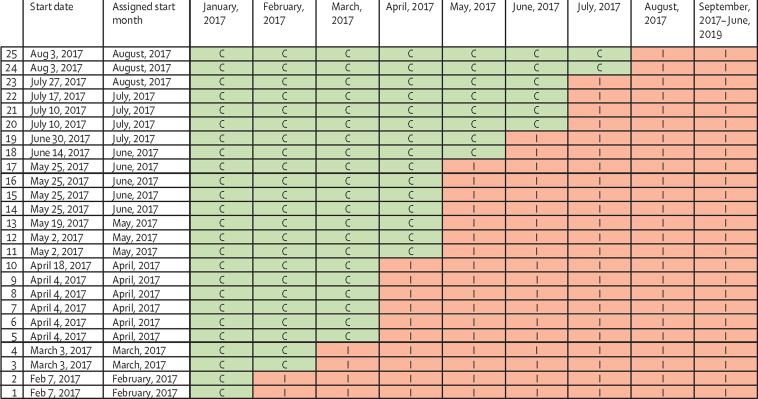
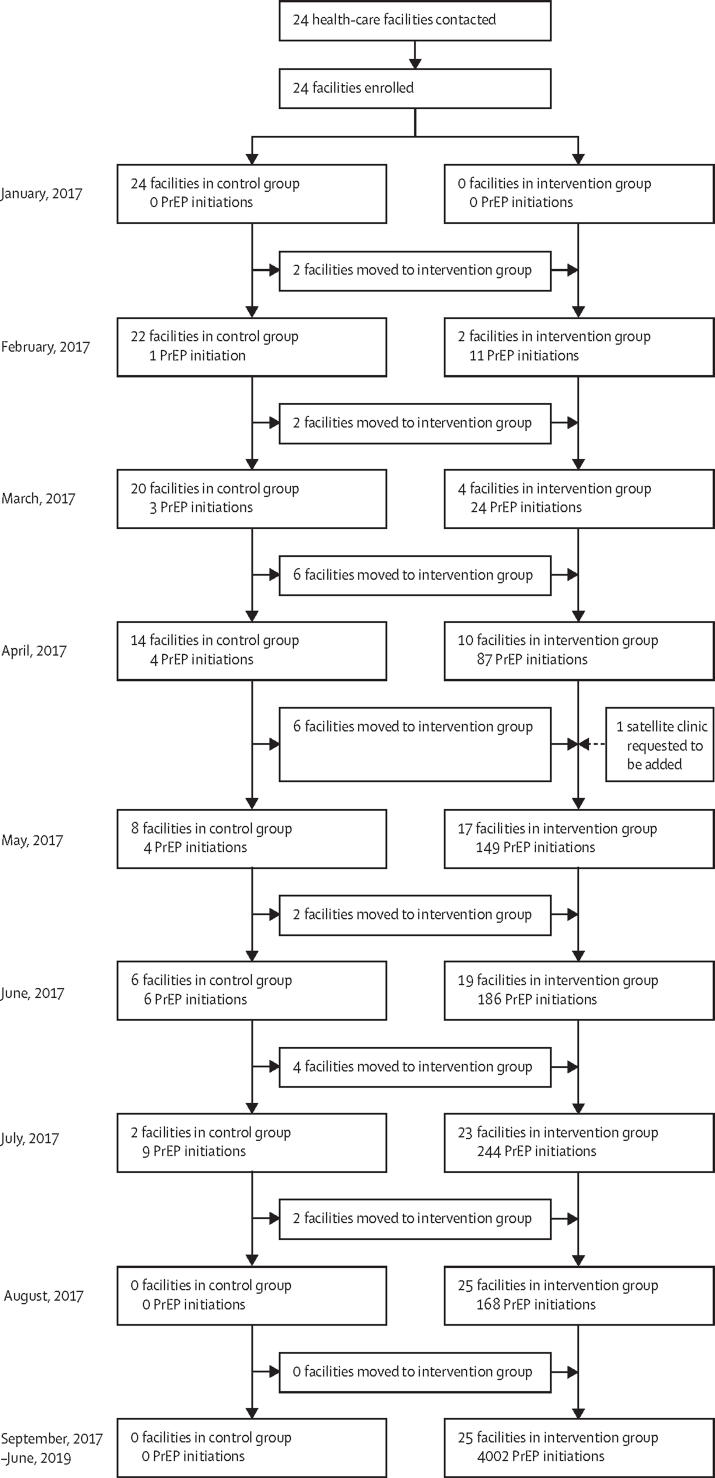
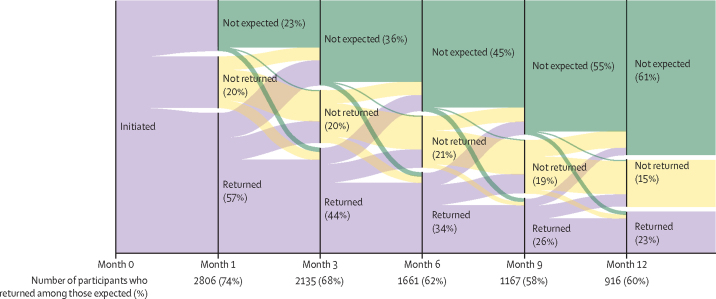
BACKGROUND: Successful and sustainable models for HIV pre-exposure prophylaxis (PrEP) delivery in public health systems in Africa are needed. We aimed to evaluate the implementation of PrEP delivery integrated in public HIV care clinics in Kenya. METHODS: As part of Kenya's national PrEP roll-out, we conducted a stepped-wedge cluster-randomised pragmatic trial to catalyse scale-up of PrEP delivery integrated in 25 public HIV care clinics. We selected high-volume clinics in these regions (ie, those with a high number of people living with HIV enrolled in HIV care and treatment). Clinics (each representing a cluster) were stratified by region and randomly assigned to the order in which clinic staff would receive PrEP training and ongoing technical support using numbered opaque balls picked from a bag. There was no masking. PrEP provision was done by clinic staff without additional financial support. Data were abstracted from records of individuals initiating PrEP. The primary outcome was the number of people initiating PrEP per clinic per month comparing intervention to control periods. Other outcomes included PrEP continuation, adherence, and incident HIV infections. This trial is registered with ClinicalTrials.gov, NCT03052010. FINDINGS: After the baseline period, which started in January, 2017, every month two to six HIV care clinics crossed over from control to intervention, until August, 2017, when all clinics were implementing the intervention. Of 4898 individuals initiating PrEP (27 during the control period and 4871 during the intervention period), 2640 (54%) were women, the median age was 31 years (IQR 25-39), and 4092 (84%) reported having a partner living with HIV. The mean monthly number of PrEP initiations per clinic was 0·1 (SD 0·5) before the intervention and 7·5 (2·7) after intervention introduction (rate ratio 23·7, 95% CI 14·2-39·5, p<0·0001). PrEP continuation was 57% at 1 month, 44% at 3 months, and 34% at 6 months, and 12% of those who missed a refill returned later for PrEP re-initiation. Tenofovir diphosphate was detected in 68 (96%) of 71 blood samples collected from a randomly selected subset of participants. Six HIV infections were observed over 2531 person-years of observation (incidence 0·24 cases per 100 person-years), three of which occurred at the first visit after PrEP initiation. INTERPRETATION: We observed high uptake, reasonable continuation with high adherence, frequent PrEP restarts, and low HIV incidence. Integration of PrEP services within public HIV care clinics in Africa is feasible. FUNDING: National Institute of Mental Health and Bill & Melinda Gates Foundation.
Overview
The claims and statistics of this paper haven’t been checked yet.
Free: it reads the open-access text and checks the first 5 claims that cite a source we can check. Create a free account to check every claim.
Integrity signals
Registry
Cites
Statistics
Figures
Verification
Claims the paper makes
The claims and statistics of this paper haven’t been checked yet.
Free: it reads the open-access text and checks the first 5 claims that cite a source we can check. Create a free account to check every claim.
Claims other papers make about this one
Each is checked against this paper’s own text: does it say what the citing paper says it does?
The cited source doesn’t support the claim as written.
In the citing paper
“In several studies, randomization was combined with masking to reduce bias during the intervention phase (43, 56).”
From Applications and implementation considerations for stepped-wedge designs in sub-Saharan Africa: a systematic review (2026) · cites this paper as [43]
Checked by a reasoning model — may be wrong.
Experimental — accuracy not yet measuredThe cited source says what the claim attributes to it.
In the citing paper
“In some studies, randomization was performed using a lottery or public draw method, which added an element of transparency and community involvement in the randomization process (29, 43, 78, 106).”
From Applications and implementation considerations for stepped-wedge designs in sub-Saharan Africa: a systematic review (2026) · cites this paper as [43]
The cited source says what the claim attributes to it.
In the citing paper
“Stratified randomization was used in several studies to ensure balance across key variables such as geographic location, facility size, or patient volume before random assignment (40, 43, 60, 64–66, 70, 71, 88, 99, 105).”
From Applications and implementation considerations for stepped-wedge designs in sub-Saharan Africa: a systematic review (2026) · cites this paper as [43]
Self-check
Percentages, sums and reported differences re-computed from the paper’s own numbers.
The self-check needs the paper’s full text.
Citations
Cites
Antiretroviral prophylaxis for HIV prevention in heterosexual men and women.
Baeten, J. M., Donnell, D., Ndase, P., Mugo, N. R., Campbell, J. D., Wangisi, J., Tappero, J. W., Bukusi, E. A., Cohen, C. R., Katabira, E., et al. (2012) · New England Journal of Medicine · doi:10.1056/nejmoa1108524 · Cited by 3,256
Self-citationEffectiveness and safety of oral HIV preexposure prophylaxis for all populations
Fonner, V. A., Dalglish, S. L., Kennedy, C. E., Baggaley, R., O’Reilly, K. R., Koechlin, F. M., Rodolph, M., Hodges-Mameletzis, I., & Grant, R. M. (2016) · AIDS · doi:10.1097/qad.0000000000001145 · Cited by 993
The Joint United Nations Programme on HIV / AIDS (UNAIDS). Project update.
(1999) · PubMed · Cited by 909
Defining success with HIV pre-exposure prophylaxis: a prevention-effective adherence paradigm
Haberer, J. E., Bangsberg, D. R., Baeten, J. M., Curran, K., Koechlin, F., Amico, K. R., Anderson, P., Mugo, N., Venter, F., Goicochea, P., et al. (2015) · AIDS · doi:10.1097/qad.0000000000000647 · Cited by 319
Self-citationKrakower, D., Ware, N., Mitty, J. A., Maloney, K., & Mayer, K. H. (2014) · AIDS and Behavior · doi:10.1007/s10461-014-0839-3 · Cited by 305
Anderson, P. L., Liu, A. Y., Castillo-Mancilla, J. R., Gardner, E. M., Seifert, S. M., McHugh, C., Wagner, T., Campbell, K., Morrow, M., Ibrahim, M., et al. (2018) · Antimicrobial Agents and Chemotherapy · doi:10.1128/aac.01710-17 · Cited by 272
Baeten, J. M., Heffron, R., Kidoguchi, L., Mugo, N. R., Katabira, E., Bukusi, E. A., Asiimwe, S., Haberer, J. E., Morton, J., Ngure, K., et al. (2016) · PLOS Medicine · doi:10.1371/journal.pmed.1002099 · Cited by 213
Self-citationWagenaar, B. H., Sherr, K., Fernandes, Q., & Wagenaar, A. C. (2016) · Health Policy and Planning · doi:10.1093/heapol/czv029 · Cited by 167
PrEP rollout in Africa: status and opportunity
Irungu, E., & Baeten, J. M. (2020) · Nature Medicine · doi:10.1038/s41591-020-0872-x · Cited by 158
Self-citationKoss, C. A., Charlebois, E. D., Ayieko, J., Kwarisiima, D., Kabami, J., Balzer, L. B., Atukunda, M., Mwangwa, F., Peng, J., Mwinike, Y., et al. (2020) · The Lancet HIV · doi:10.1016/s2352-3018(19)30433-3 · Cited by 154
Self-citation
Research works printed but not linked: 2
- Joint United Nations Programme on HIV/AIDS UNAIDS data 2020 2020 Joint United Nations Programme on HIV/AIDS Geneva, Switzerland 12349391
- WHO Guidelines on when to start antiretroviral therapy and on pre-exposure prophylaxis for HIV 2015 World Health Organization Geneva 26598776
Cited by
Kamya, M. R., Balzer, L. B., Ayieko, J., Kabami, J., Kakande, E. R., Chamie, G., Sutter, N. A., Sunday, H., Litunya, J., Schwab, J., et al. (2024) · The Lancet HIV · doi:10.1016/s2352-3018(24)00235-2 · Cited by 52
Preparing for long‐acting PrEP delivery: building on lessons from oral PrEP
Celum, C., Grinsztejn, B. G. J., & Ngure, K. (2023) · Journal of the International AIDS Society · doi:10.1002/jia2.26103 · Cited by 56
“PrEP was initially delivered in HIV clinics, which worked well to increase PrEP uptake among HIV-uninfected partners in HIV serodifferent couples through integrated care programmes delivering both ART and PrEP [30, 31].”
MethodSelf-citationOrtblad, K. F., Mogere, P., Omollo, V., Kuo, A. P., Asewe, M., Gakuo, S., Roche, S., Mugambi, M., Mugambi, M. L., Stergachis, A., et al. (2023) · Journal of the International AIDS Society · doi:10.1002/jia2.26131 · Cited by 38
“In the Partners Scale-up Project, an implementation study of PrEP delivery at 25 public HIV clinics in Kenya over 30 months (January 2017–June 2019), PrEP continuation was 57% (2806/4898), 44% (2135/4898) and 34% (1661/4898) at 1, 3 and 6 months [40]—similar to what was observed in this pilot [40].”
BackgroundResultInfluentialSelf-citationHeffron, R., Muwonge, T. R., Thomas, K. K., Nambi, F., Nakabugo, L., Kibuuka, J., Thomas, D., Feutz, E., Meisner, A., Ware, N. C., et al. (2022) · EClinicalMedicine · doi:10.1016/j.eclinm.2022.101611 · Cited by 20
Self-citationMugwanya, K. K., Palayew, A., Schaafsma, T., Irungu, E. M., Bukusi, E., Mugo, N., Morton, J., Odoyo, J., Ngure, K., Baeten, J. M., et al. (2023) · Journal of the International AIDS Society · doi:10.1002/jia2.26137 · Cited by 16
“The study was conducted between February 2017 and December 2021, as part of the Kenya National PrEP rollout programme [11].”
BackgroundMethodInfluentialSelf-citationHIV pre-exposure prophylaxis implementation in Africa: some early lessons
Karim, S. S. A., & Baxter, C. (2021) · The Lancet Global Health · doi:10.1016/s2214-109x(21)00460-5 · Cited by 15
“In The Lancet Global Health , Elizabeth Irungu and colleagues 5 conducted a pragmatic stepped-wedge randomised trial in 25 public clinics to evaluate Kenya’s PrEP scale-up programme.”
Zhang, L., Song, Y., Zheng, X., Liu, Y., & Chen, H. (2023) · Frontiers in Public Health · doi:10.3389/fpubh.2023.1224461 · Cited by 15
“From the clients’ side, they could obtain PrEP in general clinics, pharmacies, communities and via mobile phone, instead of sexual health clinics, which may address their concerns about stigma and costs, and protect their privacy (58, 59).”
BackgroundRestarting pre-exposure prophylaxis (PrEP) for HIV: a systematic review and meta-analysis
Kiggundu, R., Soh, Q. R., Tieosapjaroen, W., Fairley, C. K., Tucker, J. D., Tang, W., Zhang, L., & Ong, J. J. (2024) · EClinicalMedicine · doi:10.1016/j.eclinm.2024.102647 · Cited by 19
Rugira, E., Biracyaza, E., & Umubyeyi, A. (2023) · Patient Preference and Adherence · doi:10.2147/ppa.s427021 · Cited by 12
Lenacapavir for HIV Prevention: A Commitment to Equitable Access and Partnership by Gilead Sciences
Baeten, J. M. (2025) · Clinical Infectious Diseases · doi:10.1093/cid/ciaf116 · Cited by 15
Self-citationNagai, H., Adiibokah, E., Tagoe, H., Tun, W., Pilgrim, N. A., Ankomah, A., Rahman, Y. A. A., Addo, S. A., Atuahene, K., Essandoh, E., et al. (2023) · BMC Public Health · doi:10.1186/s12889-023-15871-w · Cited by 13
“A recent large scale cluster randomized trial of PrEP integration into 25 HIV care clinics in Kenya found high PrEP uptake with reasonable level of continuation with high adherence, and low HIV incidence [25].”
BackgroundThe potential of broadly neutralizing antibodies for HIV prevention
Gelderblom, H. C., Corey, L., & Barouch, D. H. (2024) · Journal of the International AIDS Society · doi:10.1002/jia2.26257 · Cited by 11
Mugambi, M. L., Odhiambo, B. O., Dollah, A., Marwa, M. M., Nyakina, J. N., Kinuthia, J., Baeten, J. M., Weiner, B. J., John-Stewart, G. C., Barnabas, R. V., et al. (2024) · Journal of the International AIDS Society · doi:10.1002/jia2.26301 · Cited by 13
Self-citationNakiganda, L. J., Grulich, A. E., Poynten, I. M., Serwadda, D., Bazaale, J. M., Jin, F., & Bavinton, B. R. (2022) · PLoS ONE · doi:10.1371/journal.pone.0277226 · Cited by 9
Velloza, J., Roche, S. D., Owidi, E., Irungu, E., Dollah, A., Kwach, B., Thuo, N. B., Morton, J. F., Mugo, N., Bukusi, E. A., et al. (2023) · Journal of the International AIDS Society · doi:10.1002/jia2.26055 · Cited by 10
“A number of implementation projects have also been conducted throughout Kenya to catalyse PrEP service delivery for key populations, including the Partners Scale-Up Project (PSUP), which was launched in 25 high-volume PrEP clinics in Central and Western Kenya in 2017 and initiated 4898 people in HIV serodiscordant cou…”
BackgroundSelf-citationChebet, J. J., McMahon, S. A., Chase, R. P., Tarumbiswa, T., Maponga, C., Mandara, E., Bärnighausen, T., & Geldsetzer, P. (2023) · PLOS Global Public Health · doi:10.1371/journal.pgph.0001423 · Cited by 10
“…evidence on specific interventions to improve PrEP uptake more broadly–such as counseling [25] and integration of PrEP services into HIV clinics [26]–more data on other promising interventions to achieve high PrEP coverage in the general adult population are needed, particularly in the…”
Sila, J., Wagner, A. D., Abuna, F., Dettinger, J. C., Odhiambo, B. O., Ngumbau, N. M., Oketch, G., Sifuna, E., Gómez, L., Hicks, S., et al. (2023) · Frontiers in Reproductive Health · doi:10.3389/frph.2023.1205503 · Cited by 8
Zewdie, K., Muwonge, T. R., Ssebuliba, T., Bambia, F., Nampewo, O., Stein, G., Mugwanya, K. K., Thomas, K. K., Wyatt, C. M., Yin, M. T., et al. (2024) · AIDS · doi:10.1097/qad.0000000000003988 · Cited by 8
Self-citationOnline delivery of oral HIV pre‐ and post‐exposure prophylaxis: findings from the ePrEP Kenya pilot
Kiptinness, C., Naik, P., Kareithi, T., Thuo, N., Okello, P., Culquichicon, C., Rafferty, M., Abdulrashid, S., Jomo, E., Nyamasyo, N., et al. (2025) · Journal of the International AIDS Society · doi:10.1002/jia2.26468 · Cited by 10
Self-citationNgwoke, I., Adedire, A. M., Danladi, N. P., Eze, C., Dada, O. K., & Okesanya, O. J. (2026) · Current HIV/AIDS Reports · doi:10.1007/s11904-026-00783-2 · Cited by 9
“The study concluded that integrating PrEP into public health facilities is feasible and can be achieved with high fidelity when healthcare providers receive appropriate training and technical support [131].”
Wairimu, N., Malen, R. C., Reedy, A. M., Mogere, P., Njeru, I., Culquichicón, C., McGowan, M., Gao, F., Baeten, J. M., Ngure, K., et al. (2023) · Trials · doi:10.1186/s13063-023-07734-x · Cited by 7
Self-citationRoche, S. D., Omollo, V. O., Mogere, P., Asewe, M., Gakuo, S., Banerjee, P., Harkey, K., Sharma, M., Pintye, J. C., Mugambi, M. L., et al. (2025) · Journal of the International AIDS Society · doi:10.1002/jia2.26467 · Cited by 9
Self-citationOwusu, A. Y., Moore, A. R., Ta, A., & Alexis, C. (2024) · Medical Research Archives · doi:10.18103/mra.v12i10.5676 · Cited by 5
Wairimu, N., Ngure, K., Ogello, V., Owidi, E., Mwangi, P. M., Etyang, L., Waituika, W., Mwangi, M., Githuku, D. M., Maina, S., et al. (2025) · PLOS Global Public Health · doi:10.1371/journal.pgph.0004493 · Cited by 5
Self-citationMoschese, D., Lazzarin, S., Colombo, M. L., Caruso, F., Giacomelli, A., Antinori, S., & Gori, A. (2024) · Viruses · doi:10.3390/v16060951 · Cited by 7
Ortblad, K. F., Kuo, A. P., Mogere, P., Roche, S. D., Kiptinness, C., Wairimu, N., Gakuo, S., Baeten, J. M., & Ngure, K. (2024) · BMC Health Services Research · doi:10.1186/s12913-024-10995-0 · Cited by 5
Self-citationZotova, N., Shongo, A., Lelo, P. V. M., Mbonze, N., Kaba, D. K., Ntangu, P., Shi, Q., Adedimeji, A., Anastos, K., Yotebieng, M., et al. (2025) · AIDS and Behavior · doi:10.1007/s10461-025-04809-5 · Cited by 4
Hamilton, D. T., Agutu, C., Sirengo, M., Chege, W., Goodreau, S. M., Elder, A. S., Sanders, E. J., & Graham, S. M. (2023) · Epidemics · doi:10.1016/j.epidem.2023.100696 · Cited by 5
Thuo, N. B., Bardon, A., Mogere, P., Kiptinness, C., Casmir, E., Wairimu, N., Owidi, E., Okello, P., Mugo, N., Baeten, J. M., et al. (2024) · BMC Health Services Research · doi:10.1186/s12913-024-11521-y · Cited by 4
“Levels of PrEP continuation remain suboptimal in many high HIV prevalence settings [3], thus we need to continue to innovate and test DSD PrEP models that can help us reach and engage clients who could benefit and bring us closer to ending the AIDS epidemic [26].”
BackgroundSelf-citationZewdie, K. B., Ngure, K., Mwangi, M., Mwangi, D., Maina, S., Etyang, L., Maina, G., Ogello, V., Owidi, E., Mugo, N. R., et al. (2024) · Journal of the International AIDS Society · doi:10.1002/jia2.26222 · Cited by 7
“The four clinics previously participated in the Partners Scale-Up Project [23].”
MethodSelf-citationHeilmann, E., Okuku, J., Itoh, M., Hines, J. Z., Prieto, J. T., Phiri, M., Watala, K., Nsofu, C., Luhana-Phiri, M., Vlahakis, N., et al. (2022) · AIDS and Behavior · doi:10.1007/s10461-022-03966-1 · Cited by 4
Anderson, K. M., Sheth, A. N., Diallo, D. D., Ellison, C. K., Er, D. L., Ntukogu, A., Komro, K. A., & Sales, J. M. (2025) · Archives of Sexual Behavior · doi:10.1007/s10508-025-03108-3 · Cited by 3
“…countries (Abdala et al., 2013; Baipluthong et al., 2017; Chidumwa et al., 2022; Corn-man et al., 2008; Fatti et al., 2017; Hartmann et al., 2019; Irungu et al., 2021; Jaiantilal et al., 2015; Kalichman et al., 2007; Montgomery et al., 2022; Namale et al., 2022; Pettifor et al., 2014; Rousseau…”
Mishriky, F., & Chan, P. (2026) · Infection and Drug Resistance · doi:10.2147/idr.s547635 · Cited by 3
“People at substantial risk of HIV [36] Infection and Drug Resistance 2026:19”
Nurse-led HIV Preexposure Prophylaxis in the United States: Landscape, Opportunities and Challenges
Abbas, U. L., Dickson, A., Gilmore, D., Bamberger, D. M., & Scott, H. M. (2022) · Medical Research Archives · doi:10.18103/mra.v10i11.3188 · Cited by 3
Rosen, J. G., Arnold, T. L., & Crane, M. E. (2025) · Current Opinion in HIV and AIDS · doi:10.1097/coh.0000000000000976 · Cited by 3
Wyatt, M. A., Pisarski, E. E., Nalumansi, A., Kasiita, V., Kamusiime, B., Nalukwago, G. K., Thomas, D., Muwonge, T. R., Mujugira, A., Heffron, R., et al. (2024) · PLOS Global Public Health · doi:10.1371/journal.pgph.0002916 · Cited by 1
“Those who experienced side effects noted they were manageable, and temporary.”
BackgroundRoberts, S. T., Otticha, S., Browne, E. N., Bann, C., Nyblade, L. C., Hartmann, M., Ochillo, M., & Agot, K. E. (2025) · AIDS Patient Care and STDs · doi:10.1177/10872914251361105 · Cited by 1
Kwach, B., Odoyo, J. B., Lauff, A., Omollo, V. O., Rono, B., Ogello, V., Mann, V. E., Kwena, Z., Thomas, K. K., Sharma, M., et al. (2025) · BMJ Open · doi:10.1136/bmjopen-2024-097792 · Cited by 1
Self-citationMukui, I., Urusaro, S., Kinuthia, J., Matemo, D. N., Morton, J. F., Mugwanya, K. K., & for the FP Plus Project Team (2026) · Journal of the International AIDS Society · doi:10.1002/jia2.70189 · Cited by 1
“…countries have utilized different service-delivery models and settings, initially integrating PrEP delivery within HIV care and treatment clinics [ 3, 4 ], and later expanding to sexual and reproductive health (SRH) services [ 5, 6 ], adolescent and youth health services [ 7 ], and services for…”
Self-citationImproving the Delivery of Pre-exposure Prophylaxis (PrEP) to Eliminate Vertical HIV Transmission
(2024) · Frontiers research topics · doi:10.3389/978-2-8325-5627-6 · Cited by 1
Pam, M. Z., Odoom, A., & Serbeh, M. (2025) · medRxiv · doi:10.1101/2025.09.20.25336235 · Cited by 1
Musa, Z. A., Akinsolu, F. T., Salako, A. O., Abodunrin, O. R., Ola, O. M., & Ezechi, O. C. (2026) · Frontiers in Epidemiology · doi:10.3389/fepid.2026.1529289
Orinda, J., Mudhune, V., Opollo, V. S., Mbeda, C., Panchia, R., Hamilton, E. L., Dadabhai, S. S., Reynolds, D., Sandfort, T. G. M., & the HPTN 075 study team (2024) · AIDS and Behavior · doi:10.1007/s10461-024-04514-9 · Cited by 1
“In Kenya, PrEP was not officially available but there was an ongoing PrEP implementation trial from 2016 which was investigating feasibility of scaling up oral PrEP among populations at risk of getting HIV [33], and another study on integration of PrEP programs into the public health system [37].”
Validation of a model for predicting HIV pre-exposure prophylaxis uptake: a study protocol
Kileku, E. N., Sitienei, J., Shisanya, M. S., & Gitahi, N. (2025) · Frontiers in Tropical Diseases · doi:10.3389/fitd.2025.1571116
Chauma-Ludaka, S. S., Li, R., Li, Y., Zou, Q., Zhang, X., Jing, F., Fan, J., He, X., & Tang, W. (2025) · Preprints.org · doi:10.20944/preprints202512.0192.v1
Kiptinness, C., Mureithi, M., Osoti, A. O., Wairimu, N., Githuku, D. M., Okello, P., Ongolly, F. K., Irungu, E., Ngure, K., Mugwanya, K. K., et al. (2025) · AIDS Care · doi:10.1080/09540121.2025.2605486
“These two counties were selected due to their involvement in the nationwide rollout of PrEP among sero-different couples (Irungu et al., 2021).”
Self-citationWairimu, N., Malen, R. C., Reedy, A. M., Mogere, P., Njeru, I., Culquichicón, C., McGowan, M., Gao, F., Baeten, J. M., Ngure, K., et al. (2024) · Figshare · doi:10.6084/m9.figshare.26635842
Self-citationOrtblad, K. F., Kuo, A. P., Mogere, P., Roche, S. D., Kiptinness, C., Wairimu, N., Gakuo, S., Baeten, J. M., & Ngure, K. (2024) · Figshare · doi:10.6084/m9.figshare.25801030
Self-citationOrtblad, K. F., Kuo, A. P., Mogere, P., Roche, S. D., Kiptinness, C., Wairimu, N., Gakuo, S., Baeten, J. M., & Ngure, K. (2024) · Figshare · doi:10.6084/m9.figshare.26719140
Self-citationOrtblad, K. F., Kuo, A. P., Mogere, P., Roche, S. D., Kiptinness, C., Wairimu, N., Gakuo, S., Baeten, J. M., & Ngure, K. (2024) · Figshare · doi:10.6084/m9.figshare.25801150
Self-citationKareithi, T., Roche, S. D., Meisner, A., Omollo, V. O., Ong’wen, P. A., Harkey, K., Kiptinness, C., Otieno, P., Juma, L., Malen, R. C., et al. (2025) · Trials · doi:10.1186/s13063-025-09384-7 · Cited by 1
“These teams—which include site principal investigators (PIs), study coordinators, technical officers (TOs), research assistants (RAs), data coordinators, and laboratory technicians—have extensive experience conducting PrEP clinical and implementation research [2, 16, 24–26].”
Self-citationBangun, J., Manami, W., & Sulih, Z. A. (2026) · The International Journal of Medical Science and Health Research · doi:10.70070/k3jga391
Ntimani, J. M., Phetlhu, D. R., & Beer, A. G. M.-D. (2026) · The Open Public Health Journal · doi:10.2174/01187494453175260723070512
Metadata
- Authors
- Irungu, E. M., Mugwanya, K. K., Mugo, N. R., Bukusi, E. A., Donnell, D., Odoyo, J., Wamoni, E., Peacock, S., Morton, J. F., Ngure, K., Mugambi, M., Mukui, I., O'Malley, G., & Baeten, J. M.
- Affiliations
- University of Washington (US)
- Kenya Medical Research Institute (KE)
- Corresponding author
- Irungu, Elizabeth M
- ORCID
- Venue
- The Lancet Global Health
- Publisher
- Elsevier BV
- Published
- 2021-12
- Volume
- 9
- Issue
- 12
- Pages
- e1730-e1739
- ISSN
- 2214-109X (ISSN-L)
- PMC
- PMC8609282
- OpenAlex
- W3212270151
- Semantic Scholar
- 50ea43e8f760e92164f40a57c8285aee72857e8a
- Cited by
- 49
- References
- 24
- Citations by year
- 2026: 4 · 2025: 13 · 2024: 16 · 2023: 11 · 2022: 4 · 2021: 1
- FWCI
- 2.53
- Type
- journal article
- Language
- en
- Open access
- gold
- doi.org
- Licence
- cc-by
- www.elsevier.com/tdm/userlicense/1.0/ (tdm)
- www.elsevier.com/legal/tdmrep-license (tdm)
- creativecommons.org/licenses/by/4.0/ (vor)
- Locations
- The Lancet Global Health (publishedVersion, cc-by)
- PubMed Central (publishedVersion, cc-by-nc-nd)
- PubMed (publishedVersion)
- DOAJ (DOAJ: Directory of Open Access Journals) (submittedVersion, cc-by-sa)
- Funders
- National Institutes of Health
- National Institute of Mental Health (R01MH095507)
- Bill and Melinda Gates Foundation (OPP10556051)
- Topics
- Health Sciences › Medicine › Infectious Diseases › HIV/AIDS Research and Interventions
- Health Sciences › Medicine › Epidemiology › HIV, Drug Use, Sexual Risk
- Health Sciences › Health Professions › General Health Professions › Health Policy Implementation Science
- Keywords
- HIV pre-exposure prophylaxis, PrEP scale-up, PrEP continuation, PrEP adherence, tenofovir diphosphate, HIV prevention, Kenya, people living with HIV, PrEP side effects, PrEP discontinuation
- MeSH terms
- Tenofovir, Assessment of Medication Adherence, Adult, Ambulatory Care Facilities, Female, Humans, Kenya, Male, HIV Infections, Drug Monitoring, Anti-HIV Agents, Medication Adherence, Pre-Exposure Prophylaxis
About these checks
Registry, retraction, Cites and statistics results are computed, not judged, with one exception: a printed reference that no index lists is read once by a model before it counts as a citation error. Claims are extracted by a model and kept only when their quote appears verbatim in the text; each cited source is then checked, with a model’s help, for whether it says what the claim relies on. Those verdicts can be wrong — read the claim’s quote and the cited source before relying on one.
Statistics and arithmetic are recomputed, not judged.
Confidence bands are shown only for fields calibrated on our annotated test set. None is calibrated yet, so no band is shown.
What counts as a claim ›How we measure confidence ›How we check this ›
Are you an author, or do you see a problem with this page? Request a review
Data sources
Bibliographic data: Semantic Scholar, OpenAlex, Crossref.
Contains information from the Semantic Scholar Academic Graph Datasets, made available under the ODC Attribution License (ODC-BY 1.0).
Semantic Scholar’s data is described in: Kinney, R., et al. (2023). The Semantic Scholar Open Data Platform. arXiv:2301.10140.
