

Trajectories of relapse in randomised, placebo-controlled trials of treatment discontinuation in major depressive disorder: an individual patient-level data meta-analysis
Open accessThe DOI matches its Crossref record; 36 of the 36 references it cites were found in a registry or an index.
Abstract
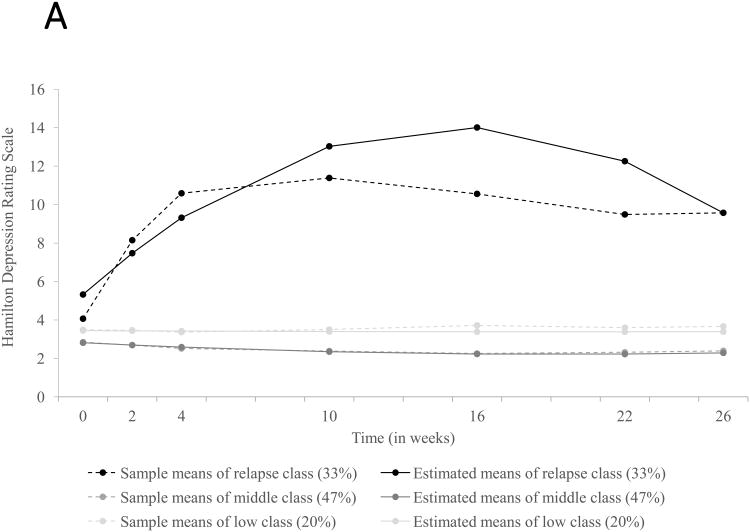
Background Understanding patterns of relapse in patients who respond to antidepressant treatment can inform strategies for prevention of relapse. We aimed to identify distinct trajectories of depression severity, assess whether similar or different trajectory classes exist for patients who continued or discontinued active treatment, and test whether clinical predictors of trajectory class membership exist using pooled data from clinical trials.Methods We analysed individual patient data from four double-blind discontinuation clinical trials of duloxetine or fluoxetine versus placebo in major depression from before 2012 (n=1462). We modelled trajectories of relapse up to 26 weeks during double-blind treatment. Trajectories of depression severity, as measured by the Hamilton Depression Rating Scale score, were identified in the entire sample, and separately in groups in which antidepressants had been continued or discontinued, using growth mixture models. Predictors of trajectory class membership were assessed with weighted logistic regression.Findings We identified similar relapse trajectories and two trajectories of stable depression scores in the normal range on active medication and on placebo. Active treatment significantly lowered the odds of membership in the relapse trajectory (odds ratio 0·47, 95% CI 0·37-0·61), whereas female sex (1·56, 1·23-2·06), shorter length of time with clinical response by 1 week (1·10, 1·06-1·15), and higher Clinical Global Impression score at baseline (1·28, 1·01-1·62) increased the odds. Overall, the protective effect of antidepressant medication relative to placebo on the risk of being classified as a relapser was about 13% (33% vs 46%).Interpretation The existence of similar relapse trajectories on active medication and on placebo suggests that there is no specific relapse signature associated with antidepressant discontinuation. Furthermore, continued treatment offers only modest protection against relapse. These data highlight the need to incorporate treatment strategies that prevent relapse as part of the treatment of depression.Funding National Institutes of Health, the US Department of Veterans Affairs Alcohol Research Center, and National Center for Post-Traumatic Stress Disorder.
Overview
The claims and statistics of this paper haven’t been checked yet.
Free: it reads the open-access text and checks the first 5 claims that cite a source we can check. Create a free account to check every claim.
Integrity signals
Registry
Cites
Statistics
Figures
Verification
Claims the paper makes
The claims and statistics of this paper haven’t been checked yet.
Free: it reads the open-access text and checks the first 5 claims that cite a source we can check. Create a free account to check every claim.
Claims other papers make about this one
Each is checked against this paper’s own text: does it say what the citing paper says it does?
The source backs part of the claim, not all of it — or backs it for a different population, condition or comparison.
In the citing paper
“Female sex was associated with a higher probability of recurrence (within patients discontinuing ADM) in one review (Gueorguieva et al., 2017) but not in four other reviews (Beshai et al., 2011; Bourgon & Kellner, 2000; Hardeveld et al., 2010; Hughes & Cohen, 2009).”
From Risk factors for relapse and recurrence of depression in adults and how they operate: A four-phase systematic review and meta-synthesis (2018) · cites this paper as Gueorguieva et al., 2017
Experimental — accuracy not yet measuredThe source backs part of the claim, not all of it — or backs it for a different population, condition or comparison.
In the citing paper
“There was good evidence for an association between shorter periods of time between starting ADM and reaching “clinical response”, and higher odds of subsequent relapse (for details see Supplementary Table 1) (Gueorguieva et al., 2017).”
From Risk factors for relapse and recurrence of depression in adults and how they operate: A four-phase systematic review and meta-synthesis (2018) · cites this paper as Gueorguieva et al., 2017
Experimental — accuracy not yet measuredThe source backs part of the claim, not all of it — or backs it for a different population, condition or comparison.
In the citing paper
“Finally, neurobehavioural disorders tend to be chronic and relapse even after a positive response to treatment in the short term.20,21”
From Precision clinical trials: a framework for getting to precision medicine for neurobehavioural disorders (2021) · cites this paper as [21]
Experimental — accuracy not yet measuredThe source backs part of the claim, not all of it — or backs it for a different population, condition or comparison.
In the citing paper
“Studies indicate that between one-fifth to one-half of patients in remission from a depressive episode will suffer a recurrence within 2 years.4–10”
Experimental — accuracy not yet measuredThe check wasn’t confident either way, so it gives no verdict — never disputed.
In the citing paper
“Many studies showed that sociodemographic factors such as younger age, women, and those who have never been married were at higher risk of recurrence [7, 11–15]; however, results of other studies on these risk factors have been inconsistent.”
From Predictors of recurrence of major depressive disorder (2020) · cites this paper as [14]
Experimental — accuracy not yet measured
2 more claims about this paper
Create a free account to see every claim other papers make about this one.
Self-check
Percentages, sums and reported differences re-computed from the paper’s own numbers.
The self-check needs the paper’s full text.
Citations
Cites
Testing the number of components in a normal mixture
Lo, Y. (2001) · Biometrika · doi:10.1093/biomet/88.3.767 · Cited by 4,640
The Epidemiology of Depression Across Cultures
Kessler, R. C., & Bromet, E. J. (2013) · Annual Review of Public Health · doi:10.1146/annurev-publhealth-031912-114409 · Cited by 2,657
Analyzing developmental trajectories: A semiparametric, group-based approach.
Nagin, D. S. (1999) · Psychological Methods · doi:10.1037/1082-989x.4.2.139 · Cited by 2,346
Finite Mixture Modeling with Mixture Outcomes Using the EM Algorithm
Muthén, B., & Shedden, K. (1999) · Biometrics · doi:10.1111/j.0006-341x.1999.00463.x · Cited by 1,486
Analyzing developmental trajectories of distinct but related behaviors: A group-based method.
Nagin, D. S., & Tremblay, R. E. (2001) · Psychological Methods · doi:10.1037//1082-989x.6.1.18 · Cited by 1,280
Ram, N., & Grimm, K. J. (2009) · International Journal of Behavioral Development · doi:10.1177/0165025409343765 · Cited by 1,143
Risk for recurrence in depression
Burcusa, S. L., & Iacono, W. G. (2007) · Clinical Psychology Review · doi:10.1016/j.cpr.2007.02.005 · Cited by 1,023 · cited 1×
“Gerard Sanacora on a filed patent application by Yale University related to targeting the glutamatergic system for the treatment of neuropsychiatric disorders (PCTWO06108055A1) (3) Charney D, Krystal JH, Manji H, Matthew S, Zarate C.”
BackgroundRelapse prevention with antidepressant drug treatment in depressive disorders: a systematic review
Geddes, J. R., Carney, S. M., Davies, C., Furukawa, T. A., Kupfer, D. J., Frank, E., & Goodwin, G. M. (2003) · The Lancet · doi:10.1016/s0140-6736(03)12599-8 · Cited by 945
Cleare, A., Pariante, C., Young, A., Anderson, I., Christmas, D., Cowen, P., Dickens, C., Ferrier, I., Geddes, J., Gilbody, S., et al. (2015) · Journal of Psychopharmacology · doi:10.1177/0269881115581093 · Cited by 759 · cited 1×
“14/306,382 filed on June 17, 2014 (4) Arias A, Petrakis I, Krystal JH.”
BackgroundCross-trial prediction of treatment outcome in depression: a machine learning approach
Chekroud, A. M., Zotti, R. J., Shehzad, Z., Gueorguieva, R., Johnson, M. K., Trivedi, M. H., Cannon, T. D., Krystal, J. H., & Corlett, P. R. (2016) · The Lancet Psychiatry · doi:10.1016/s2215-0366(15)00471-x · Cited by 676
Self-citation
Cited by
Psilocybin with psychological support for treatment-resistant depression: six-month follow-up
Carhart-Harris, R. L., Bolstridge, M., Day, C. M. J., Rucker, J., Watts, R., Erritzoe, D. E., Kaelen, M., Giribaldi, B., Bloomfield, M., Pilling, S., et al. (2018) · Psychopharmacology · doi:10.1007/s00213-017-4771-x · Cited by 970
“…imply that psilocybin may protect against relapse to an equivalent extent to daily use of an established antidepressant—as seen in discontinuation trials where responders either continue on medication (33% relapse) or transfer to placebo (46% relapse) for 6 months (Gueorguieva et al. 2017).”
BackgroundThe promise of machine learning in predicting treatment outcomes in psychiatry
Chekroud, A. M., Bondar, J., Delgadillo, J., Doherty, G., Wasil, A., Fokkema, M., Cohen, Z., Belgrave, D., DeRubeis, R., Iniesta, R., et al. (2021) · World Psychiatry · doi:10.1002/wps.20882 · Cited by 531
Self-citationBuckman, J. E. J., Underwood, A., Clarke, K., Saunders, R., Hollon, S. D., Fearon, P., & Pilling, S. (2018) · Clinical Psychology Review · doi:10.1016/j.cpr.2018.07.005 · Cited by 398
“Interestingly, a review of four ADM discontinuation RCTs using the individual patient data from those studies (n=1462) found no prognostic effect of a history of prior episodes across the dataset, irrespective of the number of prior episodes (Gueorguieva et al., 2017).”
BackgroundInfluentialKetamine and rapid antidepressant action: New treatments and novel synaptic signaling mechanisms
Krystal, J. H., Kavalali, E. T., & Monteggia, L. M. (2024) · Neuropsychopharmacology · doi:10.1038/s41386-023-01629-w · Cited by 262
Self-citationModern views of machine learning for precision psychiatry
Chen, Z. S., Kulkarni, P. (., Galatzer-Levy, I. R., Bigio, B., Nasca, C., & Zhang, Y. (2022) · Patterns · doi:10.1016/j.patter.2022.100602 · Cited by 210
Solmi, M., Cortese, S., Vita, G., Prisco, M. D., Raduà, J., Dragioti, E., Köhler‐Forsberg, O., Madsen, N. M., Rohde, C., Eudave, L., et al. (2023) · Molecular Psychiatry · doi:10.1038/s41380-023-02298-3 · Cited by 108
Krystal, J. H., Kaye, A. P., Jefferson, S., Girgenti, M. J., Wilkinson, S. T., Sanacora, G., & Esterlis, I. (2023) · Proceedings of the National Academy of Sciences · doi:10.1073/pnas.2305772120 · Cited by 91
Self-citationImproving Depression Outcome by Patient-Centered Medical Management
Rush, A. J., & Thase, M. E. (2018) · American Journal of Psychiatry · doi:10.1176/appi.ajp.2018.18040398 · Cited by 76
Predictors of recurrence in remitted late-life depression
Deng, Y., McQuoid, D. R., Potter, G. G., Steffens, D. C., Albert, K., Riddle, M., Beyer, J. L., & Taylor, W. D. (2018) · Depression and Anxiety · doi:10.1002/da.22772 · Cited by 65
Ross, E. L., Vijan, S., Miller, E. M., Valenstein, M., & Zivin, K. (2019) · Annals of Internal Medicine · doi:10.7326/m18-1480 · Cited by 50
Predicting individual clinical trajectories of depression with generative embedding
Frässle, S., Marquand, A. F., Schmaal, L., Dinga, R., Veltman, D. J., van der Wee, N. J. A., van Tol, M.-J., Schöbi, D., Penninx, B. W. J. H., & Stephan, K. E. (2020) · NeuroImage: Clinical · doi:10.1016/j.nicl.2020.102213 · Cited by 55
Rapid-Acting Antidepressants: Mechanistic Insights and Future Directions
Gerhard, D. M., & Duman, R. S. (2018) · Current Behavioral Neuroscience Reports · doi:10.1007/s40473-018-0139-8 · Cited by 52
Discontinuation of psychotropic medication: a synthesis of evidence across medication classes.
Vinkers, C. H., Kupka, R. W., Penninx, B. W., Ruhé, H. G., van Gaalen, J. M., van Haaren, P. C. F., Schellekens, A. F. A., Jauhar, S., Ramos-Quiroga, J. A., Vieta, E., et al. (2024) · Molecular Psychiatry · doi:10.1038/s41380-024-02445-4 · Cited by 51
Langenecker, S. A., Jenkins, L. M., Stange, J. P., Chang, Y.-S., DelDonno, S. R., Bessette, K. L., Passarotti, A. M., Bhaumik, R., Ajilore, O., & Jacobs, R. H. (2018) · NeuroImage: Clinical · doi:10.1016/j.nicl.2018.10.004 · Cited by 47
Gao, M., Tu, H., Liu, P., Zhang, Y., Zhang, R., Jing, L., & Zhang, K. (2023) · Journal of Affective Disorders · doi:10.1016/j.jad.2023.02.143 · Cited by 47
Predictors of recurrence of major depressive disorder
Lye, M.-S., Tey, Y.-Y., Tor, Y.-S., Shahabudin, A. F., Ibrahim, N., Ling, K.-H., Stanslas, J., Loh, S.-P., Rosli, R., Lokman, K. A., et al. (2020) · PLOS ONE · doi:10.1371/journal.pone.0230363 · Cited by 43
Lenze, E. J., Nicol, G. E., Barbour, D. L., Kannampallil, T., Wong, A. W. K., Piccirillo, J., Drysdale, A. T., Sylvester, C. M., Haddad, R., Miller, J. P., et al. (2021) · Journal of Psychiatry and Neuroscience · doi:10.1503/jpn.200042 · Cited by 43
Curtiss, J. E., Mischoulon, D., Fisher, L. B., Cusin, C., Fedor, S., Picard, R. W., & Pedrelli, P. (2021) · Psychological Medicine · doi:10.1017/s0033291721005183 · Cited by 43
Skelton, M., Carr, E., Buckman, J. E. J., Davies, M. R., Goldsmith, K., Hirsch, C. R., Peel, A. J., Rayner, C., Rimes, K. A., Saunders, R., et al. (2022) · Psychological Medicine · doi:10.1017/s0033291722003403 · Cited by 39
Approach to Evaluating and Managing Adult Attention-Deficit/Hyperactivity Disorder in Primary Care
Huang, H. Y., Huang, H., Spottswood, M., & Ghaemi, S. N. (2020) · Harvard Review of Psychiatry · doi:10.1097/hrp.0000000000000248 · Cited by 28
Bolinski, F., Etzelmüller, A., De Witte, N. A. J., van Beurden, C., Debard, G., Bonroy, B., Cuijpers, P., Riper, H., & Kleiboer, A. (2021) · Behaviour Research and Therapy · doi:10.1016/j.brat.2021.103877 · Cited by 23
Kumagai, N., Tajika, A., Hasegawa, A., Kawanishi, N., Horikoshi, M., Shimodera, S., Kurata, K., Chino, B., & Furukawa, T. A. (2019) · BMC Psychiatry · doi:10.1186/s12888-019-2382-2 · Cited by 20
Cancer-related fatigue trajectories up to 5 years after curative treatment for oesophageal cancer
Cheng, Z., Johar, A. M., Nilsson, M., Schandl, A. R., & Lagergren, P. (2023) · British Journal of Cancer · doi:10.1038/s41416-023-02551-0 · Cited by 20
Huijbers, M. J., Wentink, C., Simons, E. M. F., Spijker, J., & Speckens, A. E. M. (2020) · BMJ Open · doi:10.1136/bmjopen-2020-039053 · Cited by 17
Alcantarilla, L., López-Castro, M., Betriu, M., Torres, A., Garcia, C., Solé, E., Gelabert, E., & Roca, A. (2023) · Archives of Women s Mental Health · doi:10.1007/s00737-023-01370-9 · Cited by 16
McPherson, S., & Hengartner, M. P. (2019) · BJPsych Open · doi:10.1192/bjo.2019.65 · Cited by 15
Berwian, I. M., Wenzel, J. G., Kuehn, L., Schnuerer, I., Seifritz, E., Stephan, K. E., Walter, H., & Huys, Q. J. M. (2022) · Scientific Reports · doi:10.1038/s41598-022-13893-9 · Cited by 13
Boer, S., Dekkers, O. M., le Cessie, S., Carlier, I. V. E., & van Hemert, A. M. (2018) · Journal of Affective Disorders · doi:10.1016/j.jad.2018.12.035 · Cited by 14
Kubo, K., Sakurai, H., Tani, H., Watanabe, K., Mimura, M., & Uchida, H. (2022) · Journal of Affective Disorders · doi:10.1016/j.jad.2022.09.162 · Cited by 12
Cheng, Z., Johar, A. M., Lagergren, J., Schandl, A. R., & Lagergren, P. (2023) · International Journal of Surgery · doi:10.1097/js9.0000000000001026 · Cited by 12
Banerjee, S., Wu, Y., Bingham, K. S., Marino, P., Meyers, B. S., Mulsant, B. H., Neufeld, N. H., Oliver, L. D., Power, J. D., Rothschild, A. J., et al. (2023) · Psychological Medicine · doi:10.1017/s0033291723002945 · Cited by 11
Yamazaki, R., Matsuda, Y., Oba, M. S., Oi, H., & Kito, S. (2023) · BMC Psychiatry · doi:10.1186/s12888-023-04944-0 · Cited by 11
Improving Depression Outcome by Patient-Centered Medical Management
Rush, A. J., & Thase, M. E. (2020) · FOCUS The Journal of Lifelong Learning in Psychiatry · doi:10.1176/appi.focus.18207 · Cited by 9
Optimizing the Prediction of Depression Remission: A Longitudinal Machine Learning Approach
Carr, E., Rietschel, M., Mors, O. N., Henigsberg, N., Aitchison, K. J., Maier, W., Uher, R., FARMER, A. E., McGuffin, P., & Iniesta, R. (2024) · American Journal of Medical Genetics Part B Neuropsychiatric Genetics · doi:10.1002/ajmg.b.33014 · Cited by 7
Jia, H., Yiyun, C., Zhiguo, W., Su, Y., Zhang, M., Yifan, S., Zhu, N., Feng, J., Fang, Y., & Daihui, P. (2022) · Journal of Affective Disorders · doi:10.1016/j.jad.2022.08.116 · Cited by 7
Peng, C., Wang, L., Zhao, G., & Li, W. (2024) · Psychiatry Research · doi:10.1016/j.psychres.2024.115750 · Cited by 7
Patient Response Trajectories in Major Depressive Disorder
Larsen, K. G., Kennedy, S. H., Reines, E. H., & Thase, M. E. (2025) · Psychopharmacology Bulletin · doi:10.64719/pb.4370 · Cited by 7
An update on pharmacotherapy for recurrent depression in 2022
Belge, J.-B., Sabbe, A. C. F., & Sabbe, B. (2023) · Expert Opinion on Pharmacotherapy · doi:10.1080/14656566.2023.2223962 · Cited by 7
Lam, R. W., Rnic, K., Nunez, J.-J., Ho, K., LeMoult, J., Nunes, A., Chakrabarty, T., Foster, J. A., Frey, B. N., Harkness, K. L., et al. (2025) · The Canadian Journal of Psychiatry · doi:10.1177/07067437251337603 · Cited by 6
Predictors of recurrence in a sample of 508 outpatients with major depressive disorder
Serafini, G., Santi, F., Gonda, X., Aguglia, A., Fiorillo, A., Pompili, M., Carvalho, A. F., & Amore, M. (2019) · Journal of Psychiatric Research · doi:10.1016/j.jpsychires.2019.04.015 · Cited by 6
Cheng, Z., Johar, A. M., Lagergren, J., Schandl, A. R., & Lagergren, P. (2024) · Cancer Medicine · doi:10.1002/cam4.7466 · Cited by 6
Barton, B. B., Schramm, E., & Voderholzer, U. (2017) · Zeitschrift für Psychiatrie Psychologie und Psychotherapie · doi:10.1024/1661-4747/a000336 · Cited by 5
Artificial Intelligence and Pharmacogenomics
Iyer, R. K., Athreya, A. P., Wang, L., & Weinshilboum, R. M. (2019) · Advances in Molecular Pathology · doi:10.1016/j.yamp.2019.08.003 · Cited by 5
Explainable machine learning-based prediction of depression severity in medical studentsPreprint
Liu, D., Chen, Z., Marrero, W. J., Jacobson, N. C., & Thesen, T. (2023) · medRxiv · doi:10.1101/2023.12.14.23299975 · Cited by 5
Remission is insufficient: predictors and mechanistic models of recurrence in late-life depression
Taylor, W. D., Gerlach, A., Szymkowicz, S. M., Gujral, S., & Andreescu, C. (2026) · Neuropsychopharmacology · doi:10.1038/s41386-026-02324-2 · Cited by 4
Cheng, Z., Anandavadivelan, P., Nilsson, M., Johar, A. M., & Lagergren, P. (2022) · Annals of Surgical Oncology · doi:10.1245/s10434-022-11633-x · Cited by 4
Challenges in maintaining remission after ECT – insights from a six-month follow up study
van Diermen, L., Lambrichts, S., Berwouts, J., Hebbrecht, K., van den Ameele, S., Coppens, V., Belge, J.-B., Schrijvers, D., & Birkenhäger, T. (2025) · Journal of Psychiatric Research · doi:10.1016/j.jpsychires.2025.01.009 · Cited by 3
Training emotion recognition in depression—An experimental study
Preis, M. A., Schlegel, K., Rehbein, S., Lorenz, K., & Brockmeyer, T. (2025) · British Journal of Clinical Psychology · doi:10.1111/bjc.12540 · Cited by 3
Berwian, I. M., Wenzel, J. G., Kuehn, L., Schnuerer, I., Seifritz, E., Stephan, K. E., Walter, H., & Huys, Q. J. M. (2020) · Biological Psychiatry · doi:10.1101/2020.01.28.922500 · Cited by 3
Riiser, S., Smith‐Sivertsen, T., Baste, V., Haukenes, I., Hetlevik, Ø., & Ruths, S. (2025) · BMC Family Practice · doi:10.1186/s12875-025-02825-x · Cited by 2
Wang, W., Xing, S., Zhou, T., Wu, C., Peng, Y., Zhu, J., Zhou, X., Wu, H., Gu, Q., Jia, Y., et al. (2026) · Brain Behavior and Immunity Integrative · doi:10.1016/j.bbii.2026.100178 · Cited by 2
Immanuel, S. A., Schrader, G., & Bidargaddi, N. P. (2021) · Frontiers in Psychiatry · doi:10.3389/fpsyt.2021.558056 · Cited by 2
Prognosis of unipolar depression
Boberg, M., & Videbech, P. (2024) · Ugeskrift for Læger · doi:10.61409/v02240120 · Cited by 1
Können Antidepressiva den langfristigen Verlauf depressiver Erkrankungen negativ verändern?
Gründer, G., Mertens, L. J., Spangemacher, M., & Schmitz, C. N. (2025) · Der Nervenarzt · doi:10.1007/s00115-025-01801-1 · Cited by 1
Multiple Roads to Pathology: A Complex Systems Perspective on Personality Disorders
Cramer, A. O. J., & Borsboom, D. (2025) · Cambridge University Press eBooks · doi:10.1017/9781009445955.006 · Cited by 1
Modeling effect: How treatment intensity and duration impact depression recurrence
Li, F., Shi, Q., Visser, E., Schoevers, R. A., Feenstra, T., & Jörg, F. (2025) · European Psychiatry · doi:10.1192/j.eurpsy.2025.10145 · Cited by 1
Athreya, A. P. (2019) · Illinois Digital Environment for Access to Learning and Scholarship (University of Illinois at Urbana-Champaign) · Cited by 1
Yasinski, C. W., Ma, T., Thase, M. E., Kocsis, J. H., Arnow, B. A., Keller, M. B., Klein, D. N., Manber, R., Markowitz, J. C., Rothbaum, B. O., et al. (2026) · Journal of Affective Disorders · doi:10.1016/j.jad.2026.122506 · Cited by 1
Saulnier, K. G., Panaite, V., Ganoczy, D. A., Kim, H. M., Zivin, K., Hofer, T. P., Piette, J. D., & Pfeiffer, P. N. (2023) · General Hospital Psychiatry · doi:10.1016/j.genhosppsych.2023.10.008 · Cited by 1
Symptom trajectories in discontinuation trials
Browning, M. D. (2017) · The Lancet Psychiatry · doi:10.1016/s2215-0366(17)30054-8
Fatty acids in context : Neurometabolic perspectives on depression vulnerability
Mocking, R. J. T. (2017) · UvA-DARE (University of Amsterdam)
Pedraza, L. K. (2019) · LA Referencia (Red Federada de Repositorios Institucionales de Publicaciones Científicas)
Berwian, I. M. (2019) · Zurich Open Repository and Archive (University of Zurich) · doi:10.5167/uzh-186949
Die Antwort der modernen Biomedizin
Gründer, G. (2020) · Springer eBooks · doi:10.1007/978-3-662-61713-7_3
Things change: The early identification of patients with an unfavourable prognosis
de Boer, S. B. B. (2020) · Leiden Repository (Leiden University)
Coping Strategies in Patients Diagnosed with Major Depressive Disorder
Hingoro, M. R., Memon, M. N., Siddiqui, M. I., Junejo, J., Sadiq, M., & Adil, M. (2021) · Pakistan Journal of Medical and Health Sciences · doi:10.53350/pjmhs211593043
The Response of Modern Biomedicine
Gründer, G. (2022) · Springer eBooks · doi:10.1007/978-3-662-64225-2_3
Koshikawa, Y., Onohara, A., Wakeno, M., Takekita, Y., Kinoshita, T., & Kato, M. (2023) · Heliyon · doi:10.1016/j.heliyon.2023.e20917
Gründer, G. (2024) · Elsevier eBooks · doi:10.1016/b978-3-437-21199-7.00002-7
Symptom trajectories and their predictive factors in psychiatric inpatients with depression
Herpertz, J., Leenings, R., Claaß, L. V., Fasshauer, J. M., Ratzsch, J., Emden, D., Blitz, R., Rau, M., Gutfleisch, L., Steinmann, L. A., et al. (2025) · Journal of Affective Disorders · doi:10.1016/j.jad.2025.120661
Yamazaki, R., Matsuda, Y., Oba, M., Oi, H., & Kito, S. (2024) · Figshare · doi:10.6084/m9.figshare.26597579
Multimodal machine learning for precision psychiatry
Cearns, M. L. D. (2021) · Adelaide Research & Scholarship (AR&S) (University of Adelaide)
Prevención en los trabajos psicóticos: Un abordaje transversal
Aymerich, C. (2024) · Communities in ADDI (University of the Basque Country)
Major depressive disorder relapse in primary care
Abu-Ashour, W. (2026) · doi:10.48336/143
Abu-Ashour, W., Gamble, J., Hawboldt, J., & Sale, J. E. M. (2026) · PLOS mental health. · doi:10.1371/journal.pmen.0000427
Strawn, J. R., & Stahl, S. M. (2026) · Cambridge University Press eBooks · doi:10.1017/9781009642187.001
Metadata
- Authors
- Gueorguieva, R., Chekroud, A. M., & Krystal, J. H.
- Affiliations
- Yale University (US)
- Yale New Haven Hospital (US)
- Corresponding author
- Gueorguieva, Ralitza
- Venue
- The Lancet Psychiatry
- Publisher
- Elsevier BV
- Published
- 2017-03
- Volume
- 4
- Issue
- 3
- Pages
- 230-237
- ISSN
- 2215-0366 (ISSN-L)
- PMC
- PMC5340978
- OpenAlex
- W2586756570
- Cited by
- 67
- References
- 36
- Citations by year
- 2026: 5 · 2025: 8 · 2024: 7 · 2023: 13 · 2022: 6 · 2021: 7 · 2020: 7 · 2019: 5 · 2018: 6 · 2017: 3
- FWCI
- 0.73
- Type
- journal article
- Language
- en
- Open access
- green
- www.ncbi.nlm.nih.gov
- Licence
- cc-by
- www.elsevier.com/tdm/userlicense/1.0/ (tdm)
- Locations
- The Lancet Psychiatry (publishedVersion)
- PubMed (publishedVersion)
- Europe PMC (PubMed Central) (acceptedVersion, cc-by)
- PubMed Central (acceptedVersion, cc-by)
- Funders
- National Institutes of Health (grants K05AA14906 and 2P50AA012870)
- National Center for Research Resources [NCRR] (grant UL1RR024139)
- National Center for Advancing Translational Science [NCATS] (grant 5UL1TR000142)
- Topics
- Health Sciences › Medicine › Pharmacology (medical) › Treatment of Major Depression
- Social Sciences › Psychology › Experimental and Cognitive Psychology › Anxiety, Depression, Psychometrics, Treatment, Cognitive Processes
- Health Sciences › Medicine › Psychiatry and Mental health › Mental Health Treatment and Access
- Keywords
- major depressive disorder, relapse, antidepressant discontinuation, duloxetine, fluoxetine, treatment continuation, depression severity, relapse prevention, predictors of relapse, individual patient data meta-analysis
- MeSH terms
- Duloxetine Hydrochloride, Adult, Antidepressive Agents, Major Depressive Disorder, Female, Fluoxetine, Humans, Male, Middle Aged, Patient Dropouts, Recurrence, Severity of Illness Index, Time Factors, Meta-Analysis as Topic, Placebo Effect, Treatment Outcome, Withholding Treatment, Protective Factors
About these checks
Registry, retraction, Cites and statistics results are computed, not judged, with one exception: a printed reference that no index lists is read once by a model before it counts as a citation error. Claims are extracted by a model and kept only when their quote appears verbatim in the text; each cited source is then checked, with a model’s help, for whether it says what the claim relies on. Those verdicts can be wrong — read the claim’s quote and the cited source before relying on one.
Statistics and arithmetic are recomputed, not judged.
Confidence bands are shown only for fields calibrated on our annotated test set. None is calibrated yet, so no band is shown.
What counts as a claim ›How we measure confidence ›How we check this ›
Are you an author, or do you see a problem with this page? Request a review
Data sources
Bibliographic data: Semantic Scholar, OpenAlex, Crossref.
Contains information from the Semantic Scholar Academic Graph Datasets, made available under the ODC Attribution License (ODC-BY 1.0).
Semantic Scholar’s data is described in: Kinney, R., et al. (2023). The Semantic Scholar Open Data Platform. arXiv:2301.10140.
