

The DOI matches its Crossref record; 33 of the 35 references it cites were found in a registry or an index.
The relationship between cortical glutamate and striatal dopamine in first-episode psychosis: a cross-sectional multimodal PET and magnetic resonance spectroscopy imaging study
Open accessAbstract
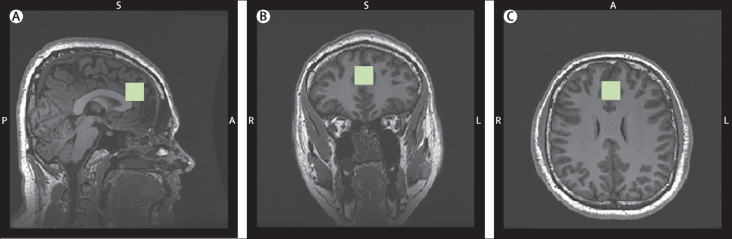
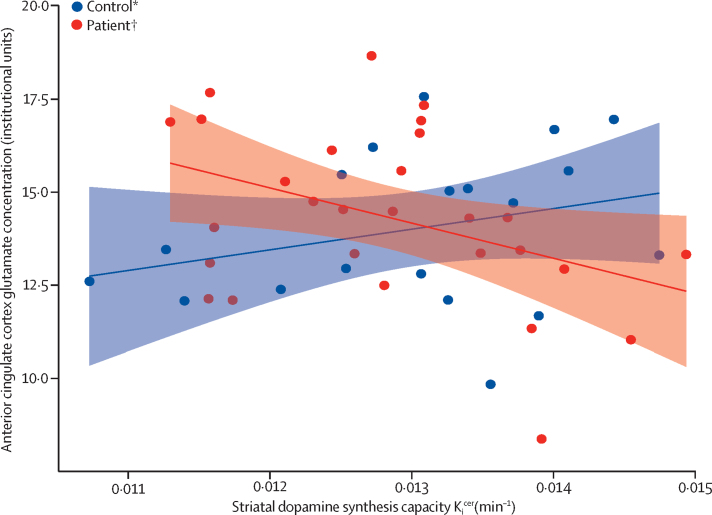
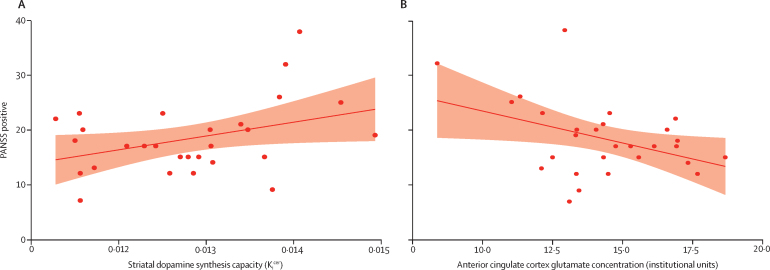
Background The pathophysiology of psychosis is incompletely understood. Disruption in cortical glutamatergic signalling causing aberrant striatal dopamine synthesis capacity is a proposed model for psychosis, but has not been tested in vivo. We therefore aimed to test the relationship between cortical glutamate concentrations and striatal dopamine synthesis capacity, and psychotic symptoms. Methods In this cross-sectional multimodal imaging study, 28 individuals with first-episode psychosis and 20 healthy controls underwent 18 F-DOPA PET (measuring striatal dopamine synthesis capacity), and proton magnetic resonance spectroscopy (measuring anterior cingulate cortex glutamate concentrations). Participants were recruited from first-episode psychosis services in London, UK and were required to be in the first episode of a psychotic illness, with no previous illness or treatment episodes. Exclusion criteria for all participants were: history of substantial head trauma, dependence on illicit substances, medical comorbidity (other than minor illnesses), and contraindications to scanning (such as pregnancy). Symptoms were measured using the Positive and Negative Syndrome Scale. The primary endpoint was the relationship between anterior cingulate cortex glutamate concentrations and striatal dopamine synthesis capacity in individuals with their first episode of psychosis as shown by imaging, examined by linear regression. Linear regression was used to examine relationships between measures. Findings Glutamate concentrations showed a significant inverse relationship with striatal dopamine synthesis capacity in patients with psychosis ( R 2 =0·16, p=0·03, β −1·71 × 10 −4 , SE 0·76 × 10 −4 ). This relationship remained significant after the addition of age, gender, ethnicity, and medication status to the model (p=0·015). In healthy controls, there was no significant relationship between dopamine and glutamate measures ( R 2 =0·04, p=0·39). Positive and Negative Syndrome Scale positive psychotic symptoms were positively associated with striatal dopamine synthesis capacity ( R 2 =0·14, p=0·046, β 2546, SE 1217) and showed an inverse relationship with anterior cingulate glutamate concentrations ( R 2 =0·16, p=0·03, β −1·71 × 10 −4 , SE 7·63 × 10 −5 ). No relationships were seen with negative symptoms (positive symptoms, mean [SD] −18·4 (6·6) negative symptoms, mean [SD] −15·4 [6·1]). Interpretation These observations are consistent with the hypothesis that cortical glutamate dysfunction is related to subcortical dopamine synthesis capacity and psychosis. Although the precise mechanistic relationship between cortical glutamate and dopamine in vivo remains unclear, our findings support further studies to test the effect of modulating cortical glutamate in the treatment of psychosis. Funding Medical Research Council, Wellcome Trust, Biomedical Research Council, South London and Maudsley NHS Foundation Trust, JMAS Sim Fellowship, Royal College of Physicians (Edinburgh) (SJ).
Overview
The claims and statistics of this paper haven’t been checked yet.
Run the check — free, no account needed. It reads the open-access text and checks the sources it cites.
Integrity signals
Registry
Cites
Statistics
Figures
Verification
Claims the paper makes
The claims and statistics of this paper haven’t been checked yet.
Run the check — free, no account needed. It reads the open-access text and checks the sources it cites.
Claims other papers make about this one
Each is checked against this paper’s own text: does it say what the citing paper says it does?
The cited source says what the claim attributes to it.
In the citing paper
“It is widely accepted that dopaminergic dysregulation stands as one of the most supported hypotheses for the pathogenesis of SCZ and psychosis as a whole (Jauhar et al., 2018; McCutcheon et al., 2020).”
From Can epigenetics shine a light on the biological pathways underlying major mental disorders? (2022) · cites this paper as Jauhar et al., 2018
Self-check
Percentages, sums and reported differences re-computed from the paper’s own numbers.
The self-check needs the paper’s full text.
Citations
Cites
The Positive and Negative Syndrome Scale (PANSS) for schizophrenia.
Kay, S. R., Fiszbein, A., & Opler, L. A. (1987) · Schizophrenia Bulletin · doi:10.1093/schbul/13.2.261 · Cited by 21,378
(1998) · The Journal of Clinical Psychiatry · Cited by 19,139
(1998) · PubMed · Cited by 10,216
The Dopamine Hypothesis of Schizophrenia: Version III--The Final Common Pathway
Howes, O. D., & Kapur, S. (2009) · Schizophrenia Bulletin · doi:10.1093/schbul/sbp006 · Cited by 2,693
Self-citationGlutamate receptor dysfunction and schizophrenia
Olney, J. W. (1995) · Archives of General Psychiatry · doi:10.1001/archpsyc.1995.03950240016004 · Cited by 1,685
NIRS-SPM: Statistical parametric mapping for near-infrared spectroscopy
Ye, J., Tak, S., JANG, K., JUNG, J., & JANG, J. (2008) · NeuroImage · doi:10.1016/j.neuroimage.2008.08.036 · Cited by 1,201
Carr, D. B., & Sesack, S. R. (2000) · Journal of Neuroscience · doi:10.1523/jneurosci.20-10-03864.2000 · Cited by 880
Elevated Striatal Dopamine Function Linked to Prodromal Signs of Schizophrenia
Howes, O. D., Montgomery, A. J., Asselin, M.-C., Murray, R. M., Valli, I., Tabraham, P., Bramon-Bosch, E., Valmaggia, L., Johns, L., Broome, M., et al. (2009) · Archives of General Psychiatry · doi:10.1001/archgenpsychiatry.2008.514 · Cited by 744
Self-citationGlutamate and dopamine in schizophrenia: An update for the 21 st century
Howes, O., McCutcheon, R., & Stone, J. (2015) · Journal of Psychopharmacology · doi:10.1177/0269881114563634 · Cited by 702
Self-citationKegeles, L., Abi-Dargham, A., Zea-Ponce, Y., Rodenhiser-Hill, J., Mann, J., Heertum, R. V. V., Cooper, T. B., Carlsson, A., & Laruelle, M. (2000) · Biological Psychiatry · doi:10.1016/s0006-3223(00)00976-8 · Cited by 425
Cited by
Sorted by citations
Items 101–114 of 114
Demler, V. F., Sterner, E., Wilson, M., Zimmer, C., & Knolle, F. (2023) · medRxiv · doi:10.1101/2023.02.01.23285183 · Cited by 1
“Reductions in glutamate concentrations have been found more consistently in the ACC in medicated early psychosis patients (29) and a mix of early psychosis and chronic schizophrenia patients (30).”
BackgroundResultSportelli, L., Eisenberg, D. P., Passiatore, R., D’Ambrosio, E., Antonucci, L. A., Chen, Q., Czarapata, J., Goldman, A. L., Gregory, M. A., Griffiths, K., et al. (2023) · bioRxiv (Cold Spring Harbor Laboratory) · doi:10.1101/2023.09.20.558594 · Cited by 1
Self-citationCompensatory Plasticity Defines a Vulnerable Neuronal State in Alzheimer’s Disease with PsychosisPreprint
Victor, M. B., Sun, N., Galani, K., Leary, N., Tanigawa, Y., Scannail, A. N., Ho, L., Prosper, S., Liu, L., Kofler, J., et al. (2025) · bioRxiv (Cold Spring Harbor Laboratory) · doi:10.1101/2025.04.30.651435 · Cited by 1
“Moreover, emerging evidence implicates the glutamatergic system in the development of a number of psychotic disorders, particularly through neuronal hyperactivity and resultant disruptions in functional connectivity 17,18 .”
Park, M. T. M., Jeon, P., KHAN, A. R., Dempster, K., Chakravarty, M. M., Lerch, J. P., Mackinley, M., Théberge, J., & Palaniyappan, L. K. (2019) · bioRxiv (Cold Spring Harbor Laboratory) · doi:10.1101/829630
A Preliminary Study of the Nociceptin Receptor System in Individuals with Psychosis
Khan, M. S. (2019) · TSpace (University of Toronto)
Tratamiento farmacológico de la esquizofrenia y la esquizofrenia refractaria
Uriarte, J. J. U. (2022) · Kranion · doi:10.24875/kranion.m22000028
On the bumpy road of psychotic disorders
van Hooijdonk, C. F. M. (2023) · Research Publications (Maastricht University) · doi:10.26481/dis.20231201ch
López‐Silva, P., & Abarca, M. (2023) · Revista Latinoamericana de Psicopatologia Fundamental · doi:10.1590/1415-4714.e220421
The aberrant language network dynamics in autism ages 5–60 yearsPreprint
Hu, Z., Guo, X., Yang, J., Qu, Z., Li, Z., Li, J., Gao, X., Liu, J., Wang, Y., Li, W., et al. (2024) · bioRxiv (Cold Spring Harbor Laboratory) · doi:10.1101/2024.10.28.620600
Pourdeh, E. F., Çil, M. A., & Jahrami, H. (2025) · Springer eBooks · doi:10.1007/978-3-031-93459-9_1
Reyes-Madrigal, F., León-Ortíz, P., Wengler, K., Bachmann, H. P., Singletary, N. M., Ortuño, M., Mao, X., Rivera-Chávez, L. F., Malacara, M., Shungu, D. C., et al. (2025) · Biological Psychiatry Cognitive Neuroscience and Neuroimaging · doi:10.1016/j.bpsc.2025.10.019
Laurikainen, H., Armio, R.-L., Tuominen, L. J., Nyman, M. J., Kirjavainen, A. K., Rajander, J., Haaparanta‐Solin, M., Solin, O. H., & Hietala, J. A. (2026) · Schizophrenia Bulletin · doi:10.1093/schbul/sbag038
“41-43 However, the result of no differences in regional CB1R availabilities between female FEP and HC suggests that midbrain dopamine dysregulation driven primarily by cortical ECS dysregulation is not by itself a sufficient etiological model for the emergence of positive symptoms.”
Hewitt, P., Kim, H., & Vida, T. A. (2026) · Frontiers in Aging Neuroscience · doi:10.3389/fnagi.2026.1748671
“However, the effect varied between subgroups, and a limitation of MRS in this context is that MRS-derived glutamate reflects both intra-and extra-synaptic pools, thereby limiting specificity (Jauhar et al., 2018).”
Metadata
- Authors
- Jauhar, S., McCutcheon, R., Borgan, F., Veronese, M., Nour, M., Pepper, F., Rogdaki, M., Stone, J., Egerton, A., Turkheimer, F., McGuire, P., & Howes, O. D.
- Affiliations
- King's College London (GB)
- Corresponding author
- Howes, Oliver D
- ORCID
- Venue
- The Lancet Psychiatry
- Publisher
- Elsevier BV
- Published
- 2018-10
- Volume
- 5
- Issue
- 10
- Pages
- 816-823
- ISSN
- 2215-0366 (ISSN-L)
- PMC
- PMC6162342
- OpenAlex
- W2889742508
- Cited by
- 114
- References
- 35
- Citations by year
- 2026: 4 · 2025: 9 · 2024: 14 · 2023: 15 · 2022: 21 · 2021: 14 · 2020: 21 · 2019: 15 · 2018: 1
- FWCI
- 10.03
- Type
- journal article
- Language
- en
- Open access
- hybrid
- doi.org
- Locations
- The Lancet Psychiatry (publishedVersion, cc-by)
- Europe PMC (PubMed Central) (publishedVersion, other-oa)
- PubMed Central (publishedVersion, cc-by)
- PubMed (publishedVersion)
- UCL Discovery (University College London) (submittedVersion)
- Research Portal (King's College London) (submittedVersion, cc-by)
- Padua Research Archive (University of Padova) (submittedVersion)
- Funders
- Wellcome Trust (200102/Z/15/Z)
- National Institute for Health and Care Research (ACF-2016-17-005)
- Topics
- Health Sciences › Medicine › Psychiatry and Mental health › Schizophrenia research and treatment
- Life Sciences › Neuroscience › Cellular and Molecular Neuroscience › Neurotransmitter Receptor Influence on Behavior
- Health Sciences › Medicine › Radiology, Nuclear Medicine and Imaging › Advanced MRI Techniques and Applications
- Keywords
- first-episode psychosis, anterior cingulate cortex, glutamatergic signalling, dopamine-glutamate interaction, 18F-DOPA PET, 1H NMR, positive psychotic symptoms, negative symptoms, psychosis pathophysiology, multimodal neuroimaging
- MeSH terms
- Adult, Corpus Striatum, Cross-Sectional Studies, Dihydroxyphenylalanine, Dopamine, Female, Humans, London, Magnetic Resonance Imaging, Male, Magnetic Resonance Spectroscopy, Psychiatric Status Rating Scales, Psychotic Disorders, Glutamic Acid
About these checks
Registry, retraction, Cites and statistics results are computed, not judged, with one exception: a printed reference that no index lists is read once by a model before it counts as a citation error. Claims are extracted by a model and kept only when their quote appears verbatim in the text; each cited source is then checked, with a model’s help, for whether it says what the claim relies on. Those verdicts can be wrong — read the claim’s quote and the cited source before relying on one.
Statistics and arithmetic are recomputed, not judged.
Confidence bands are shown only for fields calibrated on our annotated test set. None is calibrated yet, so no band is shown.
What counts as a claim ›How we measure confidence ›How we check this ›
Are you an author, or do you see a problem with this page? Request a review
