

The clinical effectiveness of sertraline in primary care and the role of depression severity and duration (PANDA): a pragmatic, double-blind, placebo-controlled randomised trial
Open accessThe DOI matches its Crossref record; 51 of the 51 references it cites were found in a registry or an index.
Abstract
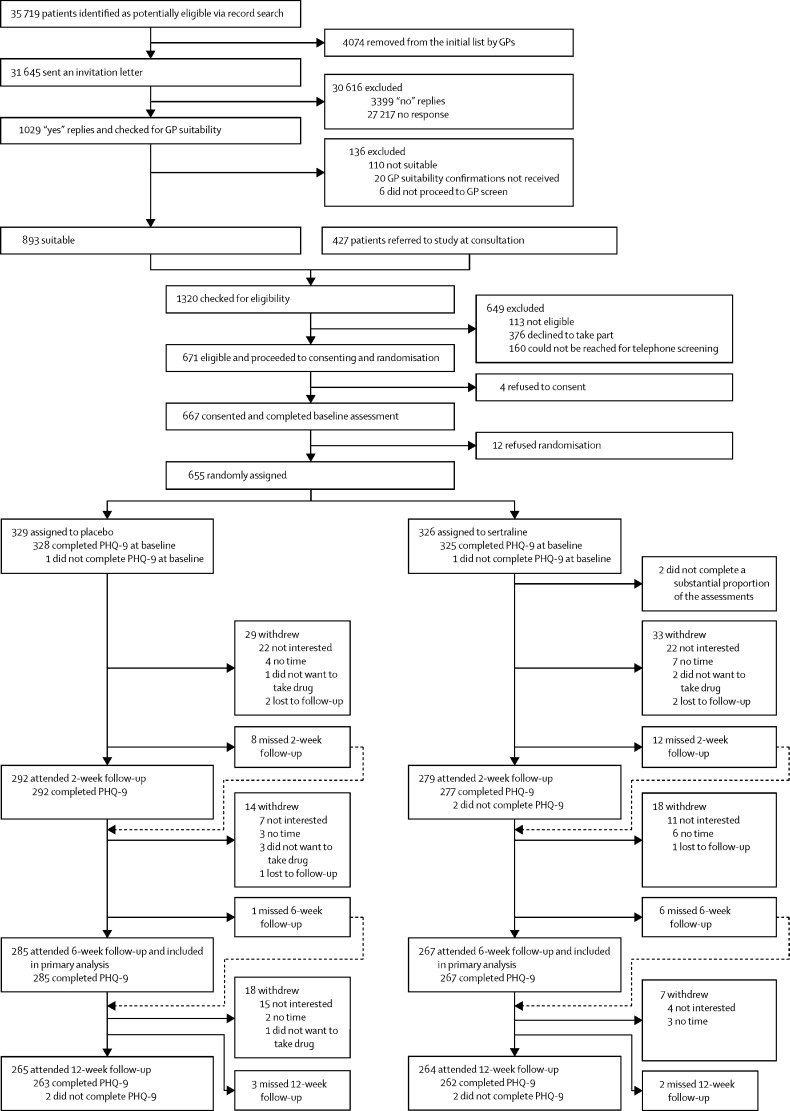
BACKGROUND: Depression is usually managed in primary care, but most antidepressant trials are of patients from secondary care mental health services, with eligibility criteria based on diagnosis and severity of depressive symptoms. Antidepressants are now used in a much wider group of people than in previous regulatory trials. We investigated the clinical effectiveness of sertraline in patients in primary care with depressive symptoms ranging from mild to severe and tested the role of severity and duration in treatment response. METHODS: The PANDA study was a pragmatic, multicentre, double-blind, placebo-controlled randomised trial of patients from 179 primary care surgeries in four UK cities (Bristol, Liverpool, London, and York). We included patients aged 18 to 74 years who had depressive symptoms of any severity or duration in the past 2 years, where there was clinical uncertainty about the benefit of an antidepressant. This strategy was designed to improve the generalisability of our sample to current use of antidepressants within primary care. Patients were randomly assigned (1:1) with a remote computer-generated code to sertraline or placebo, and were stratified by severity, duration, and site with random block length. Patients received one capsule (sertraline 50 mg or placebo orally) daily for one week then two capsules daily for up to 11 weeks, consistent with evidence on optimal dosages for efficacy and acceptability. The primary outcome was depressive symptoms 6 weeks after randomisation, measured by Patient Health Questionnaire, 9-item version (PHQ-9) scores. Secondary outcomes at 2, 6 and 12 weeks were depressive symptoms and remission (PHQ-9 and Beck Depression Inventory-II), generalised anxiety symptoms (Generalised Anxiety Disorder Assessment 7-item version), mental and physical health-related quality of life (12-item Short-Form Health Survey), and self-reported improvement. All analyses compared groups as randomised (intention-to-treat). The study is registered with EudraCT, 2013-003440-22 (protocol number 13/0413; version 6.1) and ISRCTN, ISRCTN84544741, and is closed to new participants. FINDINGS: Between Jan 1, 2015, and Aug 31, 2017, we recruited and randomly assigned 655 patients-326 (50%) to sertraline and 329 (50%) to placebo. Two patients in the sertraline group did not complete a substantial proportion of the baseline assessment and were excluded, leaving 653 patients in total. Due to attrition, primary outcome analyses were of 550 patients (266 in the sertraline group and 284 in the placebo group; 85% follow-up that did not differ by treatment allocation). We found no evidence that sertraline led to a clinically meaningful reduction in depressive symptoms at 6 weeks. The mean 6-week PHQ-9 score was 7·98 (SD 5·63) in the sertraline group and 8·76 (5·86) in the placebo group (adjusted proportional difference 0·95, 95% CI 0·85-1·07; p=0·41). However, for secondary outcomes, we found evidence that sertraline led to reduced anxiety symptoms, better mental (but not physical) health-related quality of life, and self-reported improvements in mental health. We observed weak evidence that depressive symptoms were reduced by sertraline at 12 weeks. We recorded seven adverse events-four for sertraline and three for placebo, and adverse events did not differ by treatment allocation. Three adverse events were classified as serious-two in the sertraline group and one in the placebo group. One serious adverse event in the sertraline group was classified as possibly related to study medication. INTERPRETATION: Sertraline is unlikely to reduce depressive symptoms within 6 weeks in primary care but we observed improvements in anxiety, quality of life, and self-rated mental health, which are likely to be clinically important. Our findings support the prescription of SSRI antidepressants in a wider group of participants than previously thought, including those with mild to moderate symptoms who do not meet diagnostic criteria for depression or generalised anxiety disorder. FUNDING: National Institute for Health Research.
Overview
The claims and statistics of this paper haven’t been checked yet.
Free: it reads the open-access text and checks the first 5 claims that cite a source we can check. Create a free account to check every claim.
Integrity signals
Registry
Cites
Statistics
Figures
Verification
Claims the paper makes
The claims and statistics of this paper haven’t been checked yet.
Free: it reads the open-access text and checks the first 5 claims that cite a source we can check. Create a free account to check every claim.
Claims other papers make about this one
Each is checked against this paper’s own text: does it say what the citing paper says it does?
The cited source doesn’t support the claim as written.
In the citing paper
“We investigated only three selective serotoninreuptake inhibitors that have similar pharmacologic profiles and have similar mechanisms of activity, along with mirtazapine (a noradrenergic and specific serotonergic antidepressant), so we cannot generalize our findings to other classes”
From Maintenance or Discontinuation of Antidepressants in Primary Care (2021) · cites this paper as [23]
Checked by a reasoning model — may be wrong.
Experimental — accuracy not yet measured
Self-check
Percentages, sums and reported differences re-computed from the paper’s own numbers.
The self-check needs the paper’s full text.
Citations
Cites
The PHQ-9: Validity of a brief depression severity measure
Kroenke, K., Spitzer, R. L., & Williams, J. B. W. (2001) · Journal of General Internal Medicine · doi:10.1046/j.1525-1497.2001.016009606.x · Cited by 44,910
Zhang, Q., Wang, C., Zheng, M., Li, Y., Li, J., Zhang, L., Shang, X., & Yan, C. (2015) · Cerebrovascular Diseases · doi:10.1159/000369778 · Cited by 11,533
Projections of Global Mortality and Burden of Disease from 2002 to 2030
Mathers, C. D., & Loncar, D. (2006) · PLoS Medicine · doi:10.1371/journal.pmed.0030442 · Cited by 11,386
Sterne, J. A. C., White, I. R., Carlin, J. B., Spratt, M., Royston, P., Kenward, M. G., Wood, A. M., & Carpenter, J. R. (2009) · BMJ · doi:10.1136/bmj.b2393 · Cited by 7,299
Shared decision making: A model for clinical practice
Elwyn, G., Frosch, D., Thomson, R., Joseph-Williams, N., Lloyd, A., Kinnersley, P., Cording, E., Tomson, D., Dodd, C., Rollnick, S., et al. (2012) · Journal of General Internal Medicine · doi:10.1007/s11606-012-2077-6 · Cited by 4,405
Cipriani, A., Furukawa, T. A., Salanti, G., Chaimani, A., Atkinson, L. Z., Ogawa, Y., Leucht, S., Ruhe, H. G., Turner, E. H., Higgins, J. P. T., et al. (2018) · The Lancet · doi:10.1016/s0140-6736(17)32802-7 · Cited by 3,541
Warlow, C. (1991) · The Lancet · doi:10.1016/0140-6736(91)92916-p · Cited by 3,237
Kirsch, I., Deacon, B. J., Huedo-Medina, T. B., Scoboria, A., Moore, T. J., & Johnson, B. T. (2008) · PLoS Medicine · doi:10.1371/journal.pmed.0050045 · Cited by 2,442
Antidepressant Drug Effects and Depression Severity: A Patient-Level Meta-analysis
Fournier, J. C., DeRubeis, R. J., Hollon, S. D., Dimidjian, S., Amsterdam, J. D., Shelton, R. C., & Fawcett, J. (2010) · JAMA · doi:10.1001/jama.2009.1943 · Cited by 2,009
Lewis, G., Pelosi, A. J., Araya, R., & Dunn, G. (1992) · Psychological Medicine · doi:10.1017/s0033291700030415 · Cited by 1,487
Self-citation
Cited by
Mental health before and during the COVID-19 pandemic in two longitudinal UK population cohorts
Kwong, A. S. F., Pearson, R. M., Adams, M. J., Northstone, K., Tilling, K., Smith, D., Fawns-Ritchie, C., Bould, H., Warne, N., Zammit, S., et al. (2021) · The British Journal of Psychiatry · doi:10.1192/bjp.2020.242 · Cited by 529
“49 What separates this pandemic from historical outbreaks is the global impact.”
BackgroundPsychological Treatment of Depression in Primary Care: Recent Developments
Cuijpers, P., Quero, S., Dowrick, C., & Arroll, B. (2019) · Current Psychiatry Reports · doi:10.1007/s11920-019-1117-x · Cited by 296
Self-citationMaintenance or Discontinuation of Antidepressants in Primary Care
Lewis, G., Marston, L., Duffy, L., Freemantle, N., Gilbody, S., Hunter, R., Kendrick, T., Kessler, D., Mangin, D., King, M., et al. (2021) · New England Journal of Medicine · doi:10.1056/nejmoa2106356 · Cited by 192
Self-citationHow much change is enough? Evidence from a longitudinal study on depression in UK primary care
Kounali, D., Button, K. S., Lewis, G., Gilbody, S., Kessler, D., Araya, R., Duffy, L., Lanham, P., Peters, T. J., Wiles, N., et al. (2022) · Psychological Medicine · doi:10.1017/s0033291720003700 · Cited by 164
“Participation and attrition rates are similar to those encountered in pragmatic clinical trials in primary care (Richards et al., 2016; Lewis et al., 2019).”
ResultSelf-citationHengartner, M. P., & Plöderl, M. (2022) · BMJ Evidence-Based Medicine · doi:10.1136/bmjebm-2020-111600 · Cited by 114
Buckman, J. E. J., Saunders, R., Stott, J., Arundell, L.-L., O'Driscoll, C., Davies, M. R., Eley, T. C., Hollon, S. D., Kendrick, T., Ambler, G., et al. (2021) · Epidemiology and Psychiatric Sciences · doi:10.1017/s2045796021000342 · Cited by 114
Self-citationZeifman, R. J., Wagner, A. C., Watts, R., Kettner, H., Mertens, L. J., & Carhart-Harris, R. L. (2020) · Frontiers in Psychiatry · doi:10.3389/fpsyt.2020.00782 · Cited by 106
Bauer-Staeb, C., Kounali, D.-Z., Welton, N. J., Griffith, E., Wiles, N. J., Lewis, G., Faraway, J. J., & Button, K. S. (2021) · Journal of Clinical Epidemiology · doi:10.1016/j.jclinepi.2021.04.002 · Cited by 99
Self-citationBuckman, J. E. J., Saunders, R., Stott, J. C. H., Cohen, Z. D., Arundell, L.-L., Eley, T. C., Hollon, S. D., Kendrick, T., Ambler, G., Watkins, E. R., et al. (2022) · JAMA Psychiatry · doi:10.1001/jamapsychiatry.2022.0100 · Cited by 119
Self-citationGuy, A., Brown, M., Lewis, S., & Horowitz, M. (2020) · Therapeutic Advances in Psychopharmacology · doi:10.1177/2045125320967183 · Cited by 77
Buckman, J. E. J., Saunders, R., Cohen, Z. D., Barnett, P., Clarke, K., Ambler, G., DeRubeis, R. J., Gilbody, S., Hollon, S. D., Kendrick, T., et al. (2021) · Psychological Medicine · doi:10.1017/s0033291721001367 · Cited by 70
“PANDA (Lewis et al., 2019) 652 Y Adults presenting with low mood or depression to GP in last 2 years, free of ADM for 8 weeks up to baseline 39.”
InfluentialSelf-citationRoberts, C., Sahakian, B. J., & Robbins, T. W. (2020) · Neuroscience & Biobehavioral Reviews · doi:10.1016/j.neubiorev.2020.09.001 · Cited by 66
Habibi, B., Pashazadeh, S., Saghatforoush, L. A., & Pashazadeh, A. (2021) · Journal of Electroanalytical Chemistry · doi:10.1016/j.jelechem.2021.115210 · Cited by 59
Allida, S., Cox, K. L., Hsieh, C.-F., House, A., & Hackett, M. L. (2020) · Cochrane Database of Systematic Reviews · doi:10.1002/14651858.cd003689.pub4 · Cited by 54
von Mücke-Heim, I.-A., Urbina-Treviño, L., Bordes, J., Ries, C., Schmidt, M. V., & Deussing, J. M. (2022) · Molecular Psychiatry · doi:10.1038/s41380-022-01762-w · Cited by 61
Browning, M., Bilderbeck, A. C., Dias, R., Dourish, C. T., Kingslake, J., Deckert, J., Goodwin, G. M., Gorwood, P., Guo, B., Harmer, C. J., et al. (2021) · Neuropsychopharmacology · doi:10.1038/s41386-021-00981-z · Cited by 53
Mental health during the COVID-19 pandemic in two longitudinal UK population cohorts
Kwong, A. S. F., Pearson, R. M., Adams, M. J., Northstone, K., Tilling, K., Smith, D., Fawns-Ritchie, C., Bould, H., Warne, N., Zammit, S., et al. (2020) · doi:10.1101/2020.06.16.20133116 · Cited by 53
Lin, Y.-H., Sahker, E., Shinohara, K., Horinouchi, N., Ito, M., Lelliott, M., Cipriani, A., Tomlinson, A., Baethge, C., & Furukawa, T. A. (2022) · EClinicalMedicine · doi:10.1016/j.eclinm.2022.101505 · Cited by 56
Carhart-Harris, R. L., Wagner, A. C., Agrawal, M., Kettner, H., Rosenbaum, J. F., Gazzaley, A., Nutt, D. J., & Erritzoe, D. (2022) · Journal of Psychopharmacology · doi:10.1177/02698811211008567 · Cited by 51
“Evidence indicates that the efficacy of leading drug (Cipriani et al., 2018; Lewis et al., 2019) and psychological interventions (Flint et al., 2015) is modest, and there is scope for improved tolerability (Massabki and Abi-Jaoude, 2021) and access (Clark, 2011).”
BackgroundYe, J., Bi, X., Deng, S., Wang, X., Liu, Z., Suo, Q., Wu, J., Chen, H., Wang, Y., Qian, K., et al. (2024) · Theranostics · doi:10.7150/thno.100090 · Cited by 54
“The double-blinded, randomized trial design and patient eligibility criteria have been previously reported [29].”
BackgroundO’Driscoll, C., Buckman, J. E. J., Fried, E. I., Saunders, R., Cohen, Z. D., Ambler, G., DeRubeis, R. J., Gilbody, S., Hollon, S. D., Kendrick, T., et al. (2021) · BMC Medicine · doi:10.1186/s12916-021-01971-0 · Cited by 46
Self-citationFletcher, S. L., Spittal, M. J., Chondros, P., Palmer, V. J., Chatterton, M. L., Densley, K., Potiriadis, M., Harris, M., Bassilios, B., Burgess, P. M., et al. (2021) · The Lancet Psychiatry · doi:10.1016/s2215-0366(20)30517-4 · Cited by 36
Gan, S.-L., Long, Y.-Q., Wang, Q., Feng, C.-D., Lai, C.-X., Liu, C., Ding, Y.-Y., Liu, H., Peng, K., & Ji, F. (2023) · Frontiers in Psychiatry · doi:10.3389/fpsyt.2023.1128406 · Cited by 37
Buckman, J. E. J., Saunders, R., O’Driscoll, C., Cohen, Z. D., Stott, J. C. H., Ambler, G., Gilbody, S. M., Hollon, S. D., Kendrick, T., Watkins, E. R., et al. (2021) · Acta Psychiatrica Scandinavica · doi:10.1111/acps.13285 · Cited by 42
Self-citationHieronymus, F., Jauhar, S., Østergaard, S. D., & Young, A. H. (2020) · Journal of Psychopharmacology · doi:10.1177/0269881120922950 · Cited by 33
“In this context, it is notable that the clearest indications of antidepressant efficacy in the recent PANDA trial that included people with depression for which there was clinical uncertainty as to the value of adding antidepressant treatment came not from the self-report depression rating scales (Patient Health Quest…”
BackgroundMethodEdinoff, A. N., Fort, J. M., Woo, J. J., Causey, C. D., Burroughs, C. R., Cornett, E. M., Kaye, A. M., & Kaye, A. D. (2021) · Neurology International · doi:10.3390/neurolint13030044 · Cited by 41
“showed a weak association between reduced depressive symptoms at 12 weeks of sertraline treatment compared with placebo [18].”
BackgroundAnxiety and depression in young adults and adolescents.
Lakasing, E., & Mirza, Z. (2020) · The British journal of general practice : the journal of the Royal College of General Practitioners · doi:10.3399/bjgp20x707765 · Cited by 28
Rajyaguru, P., Kwong, A. S. F., Braithwaite, E., & Pearson, R. M. (2021) · BJPsych Open · doi:10.1192/bjo.2021.959 · Cited by 31
Zazula, R., Husain, M. I., Mohebbi, M., Walker, A. J., Chaudhry, I. B., Khoso, A. B., Ashton, M. M., Agustini, B., Husain, N., Deakin, J., et al. (2021) · Australian & New Zealand Journal of Psychiatry · doi:10.1177/0004867420965697 · Cited by 31
“Possibly, improvements in depressive outcomes could occur through improvements in quality of life and anxiety symptoms rather than reduced severity of depression (Lewis et al., 2019; Zhou et al., 2017).”
BackgroundBlumenthal, J. A., Babyak, M. A., Craighead, W. E., Davidson, J. R. T., Hinderliter, A. L., Hoffman, B. M., Doraiswamy, P. M., & Sherwood, A. (2020) · Depression and Anxiety · doi:10.1002/da.23088 · Cited by 25
“The reductions in state anxiety are comparable in magnitude to those observed for patients receiving sertraline, an antidepressant that has demonstrated efficacy for reducing anxiety symptoms (Lewis et al., 2019).”
ResultAntidepressant medication to prevent depression relapse in primary care: the ANTLER RCT
Duffy, L., Clarke, C. S., Lewis, G., Marston, L., Freemantle, N., Gilbody, S. M., Hunter, R. M., Kendrick, T., Kessler, D. S., King, M., et al. (2021) · Health Technology Assessment · doi:10.3310/hta25690 · Cited by 27
“12 months 233 21 (69) 237 20 (76) Total 233 49 (165) 237 41 (119) –9.”
Self-citationWiesinger, T., Kremer, S., Bschor, T., & Baethge, C. (2023) · Acta Psychiatrica Scandinavica · doi:10.1111/acps.13541 · Cited by 30
“Three of which examined antidepressants in secondary(21,41,46) and one in primary depression.(50) The latter yielded a positive effect on QoL – SMD: 0.”
BackgroundInvolvement of Chaperone Sigma1R in the Anxiolytic Effect of Fabomotizole
Воронин, М. В., Vakhitova, Y. V., Tsypysheva, I. P., Tsypyshev, D. O., Rybina, I. V., Kurbanov, R. D., Абрамова, Е. В., & Середенин, С. Б. (2021) · International Journal of Molecular Sciences · doi:10.3390/ijms22115455 · Cited by 23
“One of the SSRIs’ disadvantages is their relatively long latency period before the emergence of the anxiolytic effect [17].”
BackgroundAntidepressants in primary care: limited value at the first visit
Arroll, B., Roskvist, R. P., Moir, F., Harwood, M. L. N., Eggleton, K. S., Dowrick, C. F., & Cuijpers, P. J. (2023) · World Psychiatry · doi:10.1002/wps.21057 · Cited by 19
Self-citationRevisiting Treatment Options for Depressed Patients with Generalised Anxiety Disorder
Goodwin, G. M. (2021) · Advances in Therapy · doi:10.1007/s12325-021-01861-0 · Cited by 19
“In the pragmatic PANDA trial [19], sertraline was found to improve anxiety symptoms compared with placebo in patients with depression (n = 655).”
BackgroundResultEkkekakis, P. (2020) · Kinesiology Review · doi:10.1123/kr.2020-0036 · Cited by 20
Ahmed, N., Bone, J. K., Lewis, G., Freemantle, N., Harmer, C. J., Duffy, L., & Lewis, G. (2021) · Psychological Medicine · doi:10.1017/s0033291720004985 · Cited by 16
“, 2009), particularly as there is evidence that antidepressants are effective across the entire range of symptom severity (Lewis et al., 2019).”
BackgroundMethodResultInfluentialSelf-citationDal‐Ré, R. (2020) · European Journal of Clinical Pharmacology · doi:10.1007/s00228-020-03030-8 · Cited by 14
Atiq, M. A., Baker, M. R., Voort, J. L. V., Vargas, M. V., & Choi, D. (2024) · Psychopharmacology · doi:10.1007/s00213-024-06599-5 · Cited by 18
“…stagnation given that current modalities (e.g., SSRIs/SNRIs) fail to adequately treat about 30% of the MDD patient population – the limitations of current clinical trials need emphasis, particularly as they pertain to the question central to this review (Lewis et al. 2019; Trivedi et al. 2006).”
Husain, M. I., Rodie, D. J., Perivolaris, A., Sanches, M., Crawford, A. S., Fitzgibbon, K. P., LEVINSON, A. J., Geist, R., Kurdyak, P. A., Mitchell, B. C., et al. (2023) · The Canadian Journal of Psychiatry · doi:10.1177/07067437231156243 · Cited by 12
Chauhan, T., Rani, V., Sahu, B., Sharma, A., Kheruka, S. C., Gambhir, S., Dube, V., Aggarwal, L. M., & Chawla, R. (2020) · Journal of Drug Delivery Science and Technology · doi:10.1016/j.jddst.2020.101780 · Cited by 13
Duffy, L., Lewis, G., Ades, A. E., Araya, R., Bone, J. K., Brabyn, S., Button, K. S., Churchill, R. C., Croudace, T. J., Derrick, C., et al. (2019) · Programme Grants for Applied Research · doi:10.3310/pgfar07100 · Cited by 15
Self-citationMental-health before and during the COVID-19 pandemic in adults with neurodevelopmental disorders
Shakeshaft, A., Blakey, R., Kwong, A. S. F., Riglin, L., Smith, G. D., Stergiakouli, E., Tilling, K. M., & Thapar, A. (2023) · Journal of Psychiatric Research · doi:10.1016/j.jpsychires.2023.01.029 · Cited by 17
“However, evidence suggests that anxiety often precedes and can predict depression up to a decade later (Davies et al., 2016; Jacobson and Newman, 2014), and that anxiety changes more rapidly than depression (in the case of positive changes after treatment) (Lewis et al., 2019).”
Gougoulaki, M., Lewis, G., Nutt, D. J., Peters, T. J., Wiles, N., & Lewis, G. (2021) · Journal of Psychopharmacology · doi:10.1177/0269881120986417 · Cited by 16
“However, it is important to note that many people who receive antidepressants in the general population do not meet diagnostic criteria for depression (Lewis et al., 2019).”
BackgroundSelf-citationSertraline in primary care: comments on the PANDA trial
Hengartner, M. P., Plöderl, M., Braillon, A., Jakobsen, J. C., & Gluud, C. N. (2019) · The Lancet Psychiatry · doi:10.1016/s2215-0366(19)30381-5 · Cited by 11
The anxiolytic sertraline reduces the impact of psychological stress on bladder function in mice
West, E. G., Sellers, D., Chess‐Williams, R., & McDermott, C. (2021) · Life Sciences · doi:10.1016/j.lfs.2021.119598 · Cited by 10
Rai, D., Webb, D., Lewis, A. L., Cotton, L., Norris, J. E., Alexander, R., Baldwin, D. S., Brugha, T. S., Cochrane, M., Piccolo, M. C. D., et al. (2024) · Trials · doi:10.1186/s13063-023-07847-3 · Cited by 15
“However, findings from a recent RCT in the United Kingdom (UK) primary care population suggested a reduction in anxiety symptoms within 6 weeks of use of the SSRI sertraline [13].”
BackgroundMethodSelf-citationLiu, C., Ye, X., & Chen, M. (2024) · Suicide and Life-Threatening Behavior · doi:10.1111/sltb.13132 · Cited by 11
“Although sertraline fails to improve depressive symptoms within 6 weeks in primary care, patients show improvements in anxiety, quality of life, and self-rated mental health (Lewis et al., 2019).”
InfluentialLi, Y., Chen, Y., Jiang, Y., Wang, W., Guo, L., Fan, B., Liu, Y., Zhang, H., Lin, X., Teopiz, K. M., et al. (2024) · General Hospital Psychiatry · doi:10.1016/j.genhosppsych.2024.12.002 · Cited by 11
Walker, A. F., Naughton, M. T., Shaw, L., Jeklin, A. T., Martin, C., & Dabscheck, E. J. (2021) · Journal of Clinical Sleep Medicine · doi:10.5664/jcsm.9164 · Cited by 10
“42,43 Similarly, a secondary analysis from the Randomized Intervention with CPAP in Coronary Artery Disease and Sleep Apnea trial found that in nonsleepy patients with OSA and coronary artery disease, 56 participants with an elevated Zung Self-Rating Depression Scale at baseline had improvement in…”
Rifkin-Zybutz, R. P., MacNeill, S., Davies, S., Dickens, C. M., Campbell, J., Anderson, I. M., Chew-Graham, C. A., Peters, T. J., Lewis, G., Wiles, N., et al. (2020) · Journal of Psychopharmacology · doi:10.1177/0269881120965939 · Cited by 8
“Similarly PANDA, a recent primary care trial of sertraline for depression, showed clear improvements in generalized anxiety, despite less convincing evidence of a superior antidepressant effect compared with placebo (Lewis et al., 2019).”
BackgroundResultSelf-citationPayet, J. M., Stevens, L., Russo, A. M., Jaehne, E. J., van den Buuse, M., Kent, S., Lowry, C. A., Baratta, M. V., & Hale, M. W. (2023) · Neuroscience · doi:10.1016/j.neuroscience.2023.10.003 · Cited by 9
“…are often an initial exacerbation of clinical symptoms (Teicher et al., 1990; Masand and Gupta, 1999; Fergusson et al., 2005), while the improvements in anxiety-related symptomology do not appear until after several weeks (Patel et al., 2018; Jakubovski et al., 2019; Lewis et al., 2019).”
Malamud, J., Lewis, G., Moutoussis, M., Duffy, L., Bone, J. K., Srinivasan, R., Lewis, G., & Huys, Q. J. M. (2024) · Psychological Medicine · doi:10.1017/s0033291724000837 · Cited by 9
“Evaluations in the context of RCTs comparing SSRIs and placebo provide a strong test of whether specific cognitive or learning processes are the mechanisms through which SSRIs alleviate symptoms of anxiety and depression.”
InfluentialSelf-citationTiem, J. M. V., Moeckli, J. K., Suiter, N., Fuhrmeister, L. A., Pham, K., Dindo, L. N., & Turvey, C. (2021) · Patient Education and Counseling · doi:10.1016/j.pec.2021.02.018 · Cited by 12
Uso de antidepressivos e percepção de saúde entre adultos de 40 anos ou mais: estudo longitudinal.
Menolli, P. V. D. S., Garso, P. A. G., Guidoni, C. M., & Girotto, E. (2020) · Revista Colombiana de Ciencias Químico Farmacéuticas · doi:10.15446/rcciquifa.v49n1.85776 · Cited by 12
Chow, J., Thompson, A. J., Iqbal, F., Zaidi, W., & Syed, N. I. (2020) · Frontiers in Marine Science · doi:10.3389/fmars.2020.603789 · Cited by 8
Depression and Anxiety Disorders
Karamustafalıoğlu, O., & Yumrukçal, H. (2025) · Wiley eBooks · doi:10.1002/9781119870203.mpg003.pub2 · Cited by 8
Patil, A. S., & Koul, S. (2024) · Current Pharmaceutical Design · doi:10.2174/0113816128309913240704095334 · Cited by 6
Hengartner, M. P., Neuner‐Jehle, S., & Senn, O. (2021) · BMC Family Practice · doi:10.1186/s12875-021-01621-7 · Cited by 6
“According a large pragmatic effectiveness trial in primary care patients with depression, antidepressants barely improved depression symptoms, but they were more effective in alleviating anxiety symptoms [33].”
BackgroundDigitally managing depression: A fully remote randomised attention-placebo controlled trial
Kandola, A. A., Edwards, K., Mueller, M. A. E., Dührkoop, B., Hein, B., Straatman, J., & Hayes, J. (2024) · Digital Health · doi:10.1177/20552076241260409 · Cited by 5
“32 Attrition was higher than we anticipated (49.78% from randomisation to week 8).”
BackgroundMethodInfluentialHollingworth, W., Fawsitt, C. G., Dixon, P., Duffy, L., Araya, R., Peters, T. J., Thom, H. H. Z., Welton, N. J., Wiles, N., Lewis, G., et al. (2019) · PharmacoEconomics - Open · doi:10.1007/s41669-019-00188-5 · Cited by 6
“While there was evidence that sertraline reduced depressive symptoms by 12 weeks and reduced anxiety at 6 and 12 weeks, there was no evidence that symptom severity or duration affected response to either depressive or anxious symptoms [16].”
BackgroundInfluentialSelf-citationSertraline in primary care: comments on the PANDA trial – Authors' reply
Lewis, G., & Lewis, G. (2019) · The Lancet Psychiatry · doi:10.1016/s2215-0366(19)30480-8 · Cited by 6
Self-citationAntidepressants do work after all
Young, A. H., & Moulton, C. D. (2020) · Journal of Psychopharmacology · doi:10.1177/0269881120933127 · Cited by 6
“effective than placebo at reducing Beck Depression Inventory-II and Generalised Anxiety Disorder-7 scores after 12 weeks (Lewis et al., 2019).”
BackgroundButler, T. G., Akpanekpo, E. I., Knight, L., Robledo, K. P., Greenberg, D., Ellis, A., Allnutt, S. H., Wilhelm, K. A., Jones, A., Scott, R. J., et al. (2025) · EClinicalMedicine · doi:10.1016/j.eclinm.2025.103668 · Cited by 7
Piazza, G. G., Allegrini, A. G., Duffy, L., Lewis, G., Lewis, G., Roiser, J. P., & Pingault, J. (2025) · Nature Mental Health · doi:10.1038/s44220-025-00528-x · Cited by 6
“The sample included patients from the PANDA trial 29 (Supplementary Table 1).”
Self-citationFACT effectiveness in primary care; a single visit RCT for depressive symptoms
Arroll, B., Frischtak, H., Roskvist, R. P., Mount, V., Sundram, F., Fletcher, S. L., Kingsford, D. W., Buttrick, L., Bricker, J. B., & van der Werf, B. (2021) · The International Journal of Psychiatry in Medicine · doi:10.1177/00912174211010536 · Cited by 7
“In the recent Panda trial, an antidepressant (sertraline 100 mg daily) or placebo was given to a similar patient population with an average PHQ-9 score of about 12 at baseline, and only small differences were found at two weeks after starting medication.(24) The percentages of patients achieving a PHQ-9 score of <10 i…”
MethodJiang, X., Zheng, H., Yang, R., Wang, S., & Zhong, H. (2023) · Frontiers in Psychiatry · doi:10.3389/fpsyt.2023.1036314 · Cited by 6
Lee, S.-Y., Wang, L., Yang, Y., & Hsu, C. (2022) · Therapeutic Advances in Chronic Disease · doi:10.1177/20406223221098114 · Cited by 5
Abukmail, E., Pradeep, N. K., Ahmed, S., & Albarqouni, L. (2025) · Annals of Internal Medicine · doi:10.7326/annals-24-03016 · Cited by 4
Zhuang, Q., Wang, J., Li, X., Zhang, X., & Wang, Y. (2023) · The International Journal of Neuropsychopharmacology · doi:10.1093/ijnp/pyad024 · Cited by 4
Green protocols for active pharmaceutical ingredients (API)
Mengeş, N. (2021) · Elsevier eBooks · doi:10.1016/b978-0-12-822446-5.00002-2 · Cited by 3
Sertraline is better at reducing anxiety than depressive symptoms
Mahase, E. (2019) · BMJ · doi:10.1136/bmj.l5655 · Cited by 3
Herbal Cannabis and Depression: A Review of Findings Published over the Last Three Years
Haller, J. (2024) · Pharmaceuticals · doi:10.3390/ph17060689 · Cited by 5
Tsompanaki, E., Aveyard, P., Park, R., Jebb, S., & Koutoukidis, D. (2025) · Lancet psychiatry · doi:10.1016/s2215-0366(25)00126-9 · Cited by 2
A Comparative Study on Safety and Efficacy of Desvenlafaxine Versus Sertraline in Depression
Ch, S., Sudha, S., Reddy, C. G., Thangaraju, P., Krishna Sasanka, K. S. B. S., Dasari, P., Battula, P., Nandini, T., & Sandeep, A. (2022) · Cureus · doi:10.7759/cureus.22717 · Cited by 4
“patients belonged to the age group of 18-34 years, followed by 35-54 years (40%) [24].”
BackgroundDahle, N., Matthew, C., Roskvist, R. P., Moir, F., & Arroll, B. (2023) · BJGP Open · doi:10.3399/bjgpo.2023.0011 · Cited by 2
Landrø, N. I., Harmer, C. J., Blackwell, S. E., Bø, R., Dawson, G. R., Goodwin, G. M., Hagen, H. S., Kingslake, J., Klovning, A., Klungsøyr, O., et al. (2023) · Contemporary Clinical Trials · doi:10.1016/j.cct.2023.107326 · Cited by 3
Fluyau, D., Kailasam, V. K., Kim, P., & Revadigar, N. (2025) · International Clinical Psychopharmacology · doi:10.1097/yic.0000000000000585 · Cited by 3
Examining the antidepressant scattergun approach
Penninx, B. W. J. H. (2019) · The Lancet Psychiatry · doi:10.1016/s2215-0366(19)30367-0 · Cited by 2
Spence, O., Reeves, G. M., & dosReis, S. (2021) · Pharmacoepidemiology and Drug Safety · doi:10.1002/pds.5358 · Cited by 2
“Emotional disorder 1641 (29) 234 (26) 264 (26) 388 (28) 567 (32) 188 (34)”
Archer, C., Kessler, D. S., Lewis, G., Araya, R., Duffy, L., Gilbody, S. M., Lewis, G., Kendrick, T., Peters, T. J., & Wiles, N. (2024) · PLoS ONE · doi:10.1371/journal.pone.0300366 · Cited by 3
Self-citationYou, S., Hao, X., Cao, F., Lou, J., Cao, J., Liu, Y., Guo, Y., Li, H., Li, A., Xu, J., et al. (2024) · Journal of Psychiatric Research · doi:10.1016/j.jpsychires.2024.11.034 · Cited by 1
Duo, L.-L., & Rao, G. (2024) · World Journal of Psychiatry · doi:10.5498/wjp.v14.i12.1860 · Cited by 1
Die Geschichte des medizinischen Modells der Depression – mit (fast) all ihren Vor- und Nachteilen
Padberg, T., & Plöderl, M. (2025) · Kontext · doi:10.13109/kont.2025.56.2.125 · Cited by 1
Rao, R. V., Boyd, A., Okada, S., Lipa, W., Kelly, L., Coward, C., Bredesen, A. L., Gregory, J., & Bredesen, D. E. (2025) · Brain Sciences · doi:10.3390/brainsci16010002 · Cited by 1
“…report modest reductions in PHQ-9 scores ( − 2 to − 3 points on average, often without a clinically meaningful shift in severity category) [52–54], the magnitude of mood improvement observed in the present study (nearly 4 points) appears clinically noteworthy; however, such comparisons are…”
Liebmann, E. P., Resnick, S. G., Hoff, R. A., & Katz, I. R. (2022) · Psychiatry Research · doi:10.1016/j.psychres.2022.114402 · Cited by 1
Smoking blunts sertraline response in depression: A prospective observational cohort study
Mohan, P., Chatterjee, K., Sinha, S., Saini, R. K., Sharma, A. K., & Waikole, S. (2022) · Medical Journal Armed Forces India · doi:10.1016/j.mjafi.2021.10.015 · Cited by 1
Hobbs, C., Beck, M., Denham, F., Pettitt, L., Faraway, J. J., Munafo, M. R., Sui, J., Kessler, D. S., & Button, K. S. (2022) · Journal of Psychopharmacology · doi:10.1177/02698811221116928 · Cited by 1
“Furthermore, recent evidence suggests that change in anxiety rather than depression may be a more sensitive measure of therapeutic outcome of antidepressants (Lewis et al., 2019).”
BackgroundSelf-citationKirkbride, J. B., & Jeffery, A. (2024) · Cambridge University Press eBooks · doi:10.1017/9781911623861.002 · Cited by 1
A System for Rapidly Yet Rigorously Evaluating the Quality of Randomized Controlled Trials
Smith, E. G., & Grigorian, H. L. (2023) · Journal of Clinical Psychopharmacology · doi:10.1097/jcp.0000000000001724 · Cited by 2
Sertraline in primary care: comments on the PANDA trial
Arroll, B. (2019) · The Lancet Psychiatry · doi:10.1016/s2215-0366(19)30438-9 · Cited by 1
Depression and Anxiety Disorders
(2021) · Wiley eBooks · doi:10.1002/9781119870203.mpg003 · Cited by 1
Sertraline in primary care: comments on the PANDA trial
Paludan‐Müller, A. S., & Munkholm, K. (2019) · The Lancet Psychiatry · doi:10.1016/s2215-0366(19)30441-9 · Cited by 1
Hobbs, C., Beck, M., Denham, F., Pettitt, L., Faraway, J. J., Munafo, M. R., Sui, J., Kessler, D. S., & Button, K. S. (2022) · doi:10.31234/osf.io/4sn9y
Self-citationMalamud, J., Lewis, G., Moutoussis, M., Duffy, L., Bone, J. K., Srinivasan, R., Lewis, G., & Huys, Q. J. M. (2023) · Research Square · doi:10.21203/rs.3.rs-2776498/v1
Self-citationAnticonvulsant and Anti-anxiety Effects of Royal Jelly in Adult Male Syrian Rats
Yaghooti, H., & Olapour, S. (2022) · Complementary Medicine Journal · doi:10.32598/cmja.12.3.1188.1
Malamud, J., Lewis, G., Moutoussis, M., Duffy, L., Bone, J. K., Srinivasan, R., Lewis, G., & Huys, Q. J. M. (2023) · Research Square · doi:10.21203/rs.3.rs-2776498/v2
Self-citationMalamud, J., Lewis, G., Moutoussis, M., Duffy, L., Bone, J. K., Srinivasan, R., Lewis, G., & Huys, Q. J. M. (2023) · PsyArXiv (OSF Preprints) · doi:10.31234/osf.io/y4uxq
Self-citation
Metadata
- Authors
- Lewis, G., Duffy, L., Ades, A., Amos, R., Araya, R., Brabyn, S., Button, K. S., Churchill, R., Derrick, C., Dowrick, C., Gilbody, S., Fawsitt, C., Hollingworth, W., Jones, V., Kendrick, T., Kessler, D., Kounali, D., Khan, N., Lanham, P., Pervin, J., Peters, T. J., Riozzie, D., Salaminios, G., Thomas, L., Welton, N. J., Wiles, N., Woodhouse, R., & Lewis, G.
- Affiliations
- University College London (GB)
- University of Bristol (GB)
- University of Liverpool (GB)
- King's College London (GB)
- University of York (GB)
- University of Bath (GB)
- University of Southampton (GB)
- University of Dundee (GB)
- Corresponding author
- Lewis, Gemma
- ORCID
- Lewis, Gemma
- Duffy, Larisa
- Ades, Anthony
- Amos, Rebekah
- Araya, Ricardo
- Brabyn, Sally
- Button, Katherine S
- Churchill, Rachel
- Gilbody, Simon
- Fawsitt, Christopher
- Hollingworth, William
- Kendrick, Tony
- Kessler, David
- Kounali, Daphne
- Khan, Naila
- Lanham, Paul
- Pervin, Jodi
- Riozzie, Derek
- Salaminios, George
- Welton, Nicky J
- Wiles, Nicola
- Woodhouse, Rebecca
- Lewis, Glyn
- Venue
- The Lancet Psychiatry
- Publisher
- Elsevier BV
- Published
- 2019-11
- Volume
- 6
- Issue
- 11
- Pages
- 903-914
- ISSN
- 2215-0366 (ISSN-L)
- PMC
- PMC7029306
- OpenAlex
- W2974841401
- Cited by
- 120
- References
- 50
- Citations by year
- 2026: 11 · 2025: 12 · 2024: 17 · 2023: 15 · 2022: 11 · 2021: 27 · 2020: 17 · 2019: 10
- FWCI
- 10.07
- Type
- journal article
- Language
- en
- Open access
- hybrid
- doi.org
- Licence
- cc-by
- www.elsevier.com/tdm/userlicense/1.0/ (tdm)
- www.elsevier.com/legal/tdmrep-license (tdm)
- creativecommons.org/licenses/by/4.0/ (vor)
- Locations
- The Lancet Psychiatry (publishedVersion, cc-by)
- Europe PMC (PubMed Central) (publishedVersion, cc-by)
- PubMed Central (publishedVersion, cc-by)
- PubMed (publishedVersion)
- Bristol Research (University of Bristol) (publishedVersion, cc-by)
- ePrints Soton (University of Southampton) (acceptedVersion)
- White Rose Research Online (University of Leeds, The University of Sheffield, University of York) (submittedVersion)
- UCL Discovery (University College London) (submittedVersion)
- Research Portal (King's College London) (submittedVersion, other-oa)
- University of Birmingham Research Portal (University of Birmingham) (submittedVersion, other-oa)
- Funders
- Pfizer
- National Institute for Health and Care Research (RP-PG-0610-10048)
- Department of Health and Social Care
- Greater Manchester Comprehensive Local Research Network
- Topics
- Health Sciences › Medicine › Pharmacology (medical) › Treatment of Major Depression
- Health Sciences › Medicine › Psychiatry and Mental health › Mental Health Treatment and Access
- Social Sciences › Psychology › Experimental and Cognitive Psychology › Anxiety, Depression, Psychometrics, Treatment, Cognitive Processes
- Keywords
- sertraline, depression, primary care, antidepressants, depression severity, treatment response, remission, generalized anxiety disorder, quality of life, placebo response, PHQ-9, Beck Depression Inventory-II, GAD-7, SF-12, mild depression
- MeSH terms
- Adolescent, Adult, Aged, Depressive Disorder, Double-Blind Method, Female, United Kingdom, Humans, Male, Middle Aged, Primary Health Care, Severity of Illness Index, Time Factors, Treatment Outcome, Selective Serotonin Reuptake Inhibitors, Sertraline, Young Adult
About these checks
Registry, retraction, Cites and statistics results are computed, not judged, with one exception: a printed reference that no index lists is read once by a model before it counts as a citation error. Claims are extracted by a model and kept only when their quote appears verbatim in the text; each cited source is then checked, with a model’s help, for whether it says what the claim relies on. Those verdicts can be wrong — read the claim’s quote and the cited source before relying on one.
Statistics and arithmetic are recomputed, not judged.
Confidence bands are shown only for fields calibrated on our annotated test set. None is calibrated yet, so no band is shown.
What counts as a claim ›How we measure confidence ›How we check this ›
Are you an author, or do you see a problem with this page? Request a review
Data sources
Bibliographic data: Semantic Scholar, OpenAlex, Crossref.
Contains information from the Semantic Scholar Academic Graph Datasets, made available under the ODC Attribution License (ODC-BY 1.0).
Semantic Scholar’s data is described in: Kinney, R., et al. (2023). The Semantic Scholar Open Data Platform. arXiv:2301.10140.
