

The DOI matches its Crossref record; 46 of the 46 references it cites were found in a registry or an index.
Comparative effects of 18 antipsychotics on metabolic function in patients with schizophrenia, predictors of metabolic dysregulation, and association with psychopathology: a systematic review and network meta-analysis
Open accessAbstract
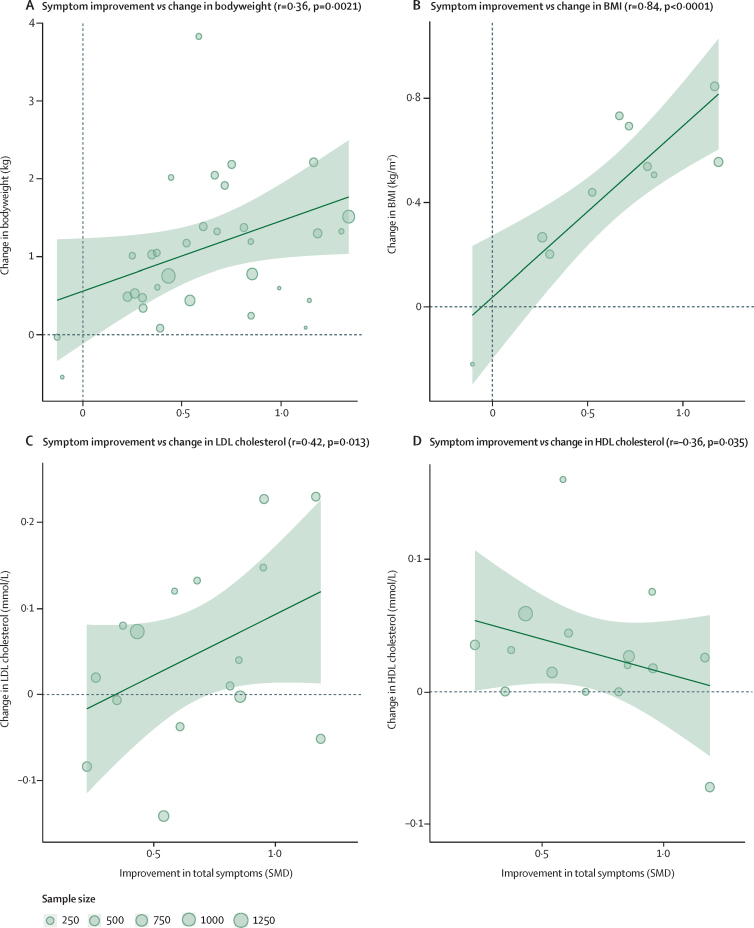
BACKGROUND: Antipsychotic treatment is associated with metabolic disturbance. However, the degree to which metabolic alterations occur in treatment with different antipsychotics is unclear. Predictors of metabolic dysregulation are poorly understood and the association between metabolic change and change in psychopathology is uncertain. We aimed to compare and rank antipsychotics on the basis of their metabolic side-effects, identify physiological and demographic predictors of antipsychotic-induced metabolic dysregulation, and investigate the relationship between change in psychotic symptoms and change in metabolic parameters with antipsychotic treatment. METHODS: We searched MEDLINE, EMBASE, and PsycINFO from inception until June 30, 2019. We included blinded, randomised controlled trials comparing 18 antipsychotics and placebo in acute treatment of schizophrenia. We did frequentist random-effects network meta-analyses to investigate treatment-induced changes in body weight, BMI, total cholesterol, LDL cholesterol, HDL cholesterol, triglyceride, and glucose concentrations. We did meta-regressions to examine relationships between metabolic change and age, sex, ethnicity, baseline weight, and baseline metabolic parameter level. We examined the association between metabolic change and psychopathology change by estimating the correlation between symptom severity change and metabolic parameter change. FINDINGS: (0·90 to 1·25) for olanzapine; for total-cholesterol from -0·09 mmol/L (-0·24 to 0·07) for cariprazine to 0·56 mmol/L (0·26-0·86) for clozapine; for LDL cholesterol from -0·13 mmol/L (-0.21 to -0·05) for cariprazine to 0·20 mmol/L (0·14 to 0·26) for olanzapine; for HDL cholesterol from 0·05 mmol/L (0·00 to 0·10) for brexpiprazole to -0·10 mmol/L (-0·33 to 0·14) for amisulpride; for triglycerides from -0·01 mmol/L (-0·10 to 0·08) for brexpiprazole to 0·98 mmol/L (0·48 to 1·49) for clozapine; for glucose from -0·29 mmol/L (-0·55 to -0·03) for lurasidone to 1·05 mmol/L (0·41 to 1·70) for clozapine. Greater increases in glucose were predicted by higher baseline weight (p=0·0015) and male sex (p=0·0082). Non-white ethnicity was associated with greater increases in total cholesterol (p=0·040) compared with white ethnicity. Improvements in symptom severity were associated with increases in weight (r=0·36, p=0·0021), BMI (r=0·84, p<0·0001), total-cholesterol (r=0·31, p=0·047), and LDL cholesterol (r=0·42, p=0·013), and decreases in HDL cholesterol (r=-0·35, p=0·035). INTERPRETATION: Marked differences exist between antipsychotics in terms of metabolic side-effects, with olanzapine and clozapine exhibiting the worst profiles and aripiprazole, brexpiprazole, cariprazine, lurasidone, and ziprasidone the most benign profiles. Increased baseline weight, male sex, and non-white ethnicity are predictors of susceptibility to antipsychotic-induced metabolic change, and improvements in psychopathology are associated with metabolic disturbance. Treatment guidelines should be updated to reflect our findings. However, the choice of antipsychotic should be made on an individual basis, considering the clinical circumstances and preferences of patients, carers, and clinicians. FUNDING: UK Medical Research Council, Wellcome Trust, National Institute for Health Research Oxford Health Biomedical Research Centre.
Overview
The claims and statistics of this paper haven’t been checked yet.
Run the check — free, no account needed. It reads the open-access text and checks the sources it cites.
Integrity signals
Registry
Cites
Statistics
Figures
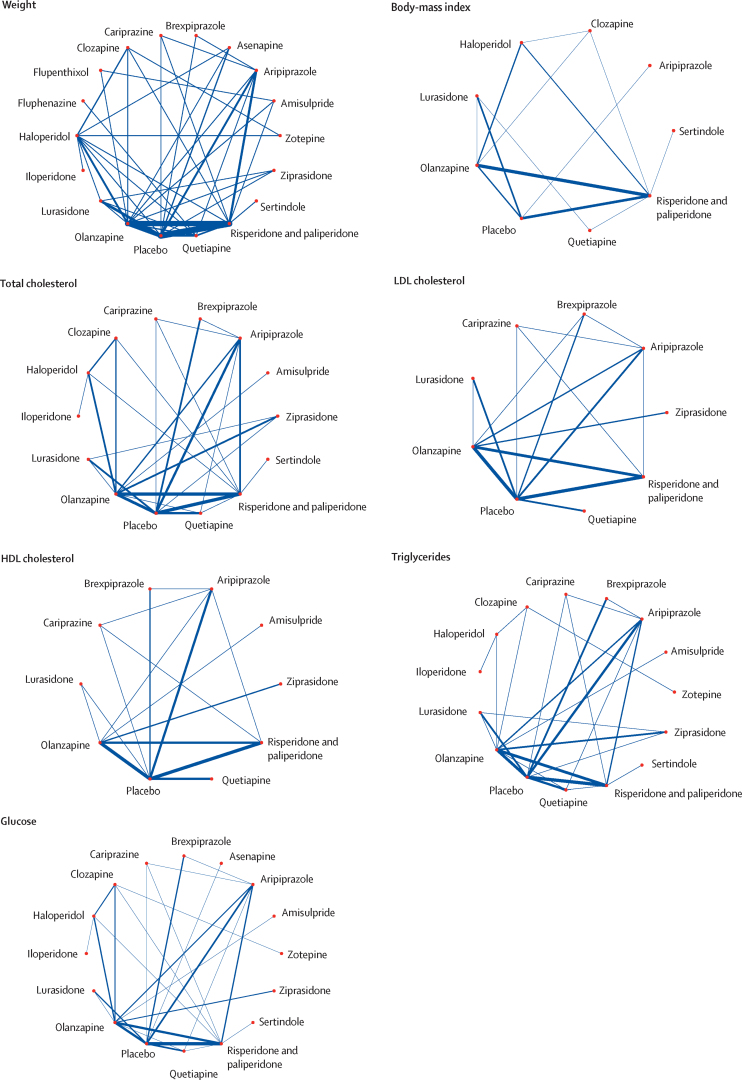
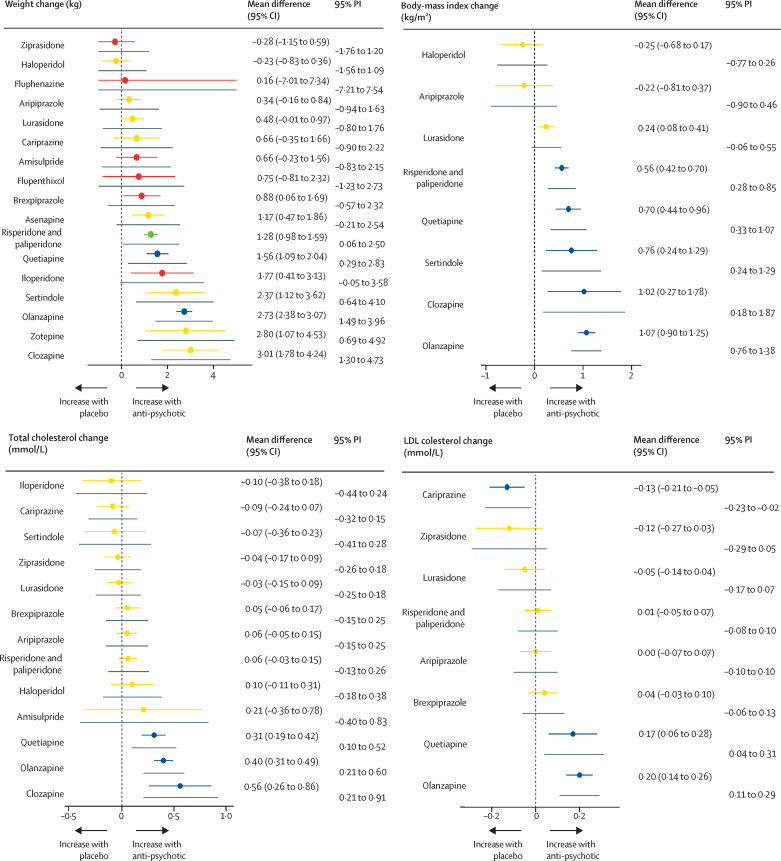
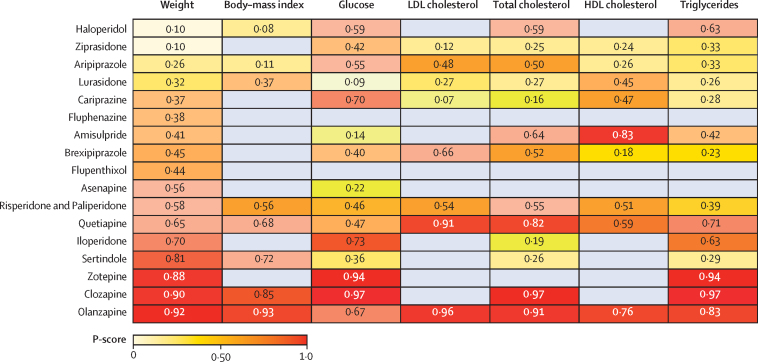
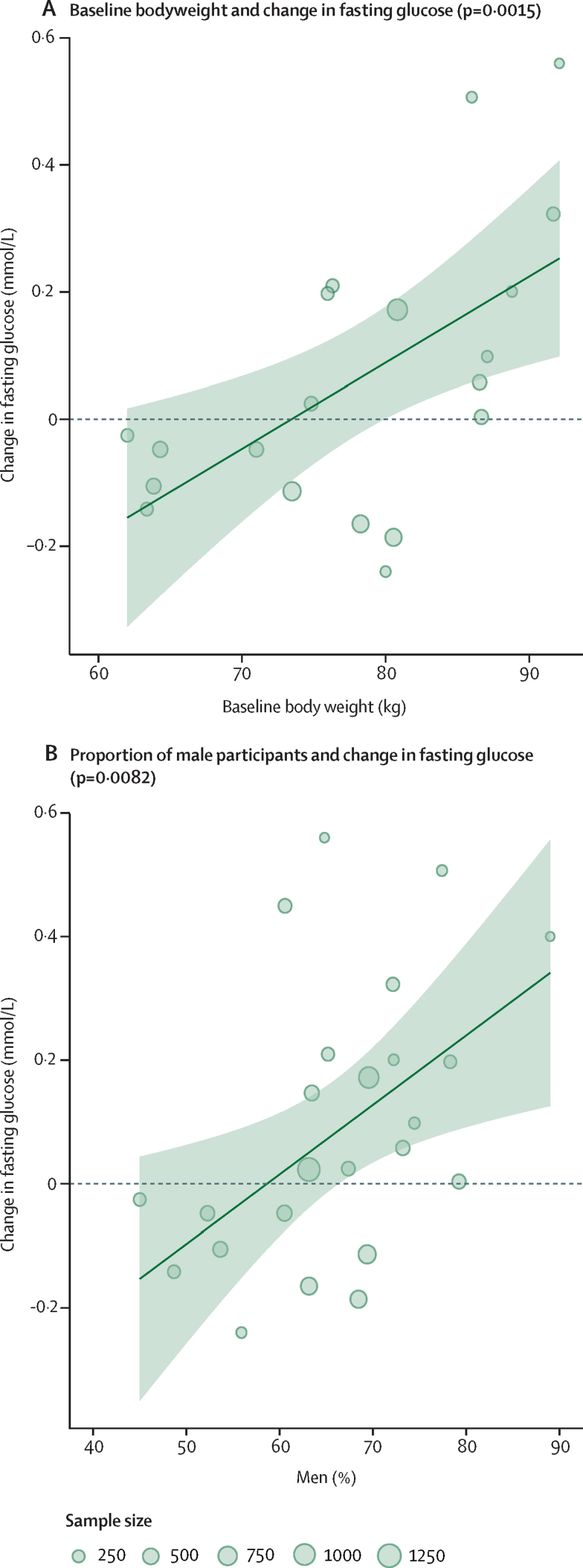
Verification
Claims the paper makes
The claims and statistics of this paper haven’t been checked yet.
Run the check — free, no account needed. It reads the open-access text and checks the sources it cites.
Claims other papers make about this one
Each is checked against this paper’s own text: does it say what the citing paper says it does?
In the citing paper
“Antipsychotic drugs produce metabolic side effects with a different extent depending on their type.”
From Lipids in Psychiatric Disorders: Functional and Potential Diagnostic Role as Blood Biomarkers (2024) · cites this paper as [131]
In the citing paper
“Among others, neuroleptic therapy affects lipid homeostasis [130,131].”
From Lipids in Psychiatric Disorders: Functional and Potential Diagnostic Role as Blood Biomarkers (2024) · cites this paper as [131]
In the citing paper
“In particular, it was shown that typical and atypical antipsychotics increase the levels of cholesterol, TG, and LDL.”
From Lipids in Psychiatric Disorders: Functional and Potential Diagnostic Role as Blood Biomarkers (2024) · cites this paper as [131]
Self-check
Percentages, sums and reported differences re-computed from the paper’s own numbers.
The self-check needs the paper’s full text.
Citations
Cites
Preferred Reporting Items for Systematic Reviews and Meta-Analyses: the PRISMA statement
Moher, D., Liberati, A., Tetzlaff, J., Altman, D. G., & for the PRISMA Group (2009) · BMJ · doi:10.1136/bmj.b2535 · Cited by 83,823
Preferred reporting items for systematic reviews and meta-analyses: the PRISMA Statement.
(2009) · PubMed Central · Cited by 44,859
The Cochrane Collaboration's tool for assessing risk of bias in randomised trials
Higgins, J. P. T., Altman, D. G., Gotzsche, P. C., Juni, P., Moher, D., Oxman, A. D., Savovic, J., Schulz, K. F., Weeks, L., Sterne, J. A. C., et al. (2011) · BMJ · doi:10.1136/bmj.d5928 · Cited by 33,817
Dermyshi, E., Wang, Y., Yan, C., Hong, W., Qiu, G., Gong, X., & Zhang, T. (2017) · Neonatology · doi:10.1159/000454668 · Cited by 24,586
Conducting Meta-Analyses in R with the metafor Package
Viechtbauer, W. (2010) · Journal of Statistical Software · doi:10.18637/jss.v036.i03 · Cited by 20,464
Preferred Reporting Items for Systematic Reviews and Meta-Analyses: The PRISMA Statement
Moher, D., Liberati, A., Tetzlaff, J., & Altman, D. G. (2009) · Journal of Clinical Epidemiology · doi:10.1016/j.jclinepi.2009.06.005 · Cited by 19,575
Stone, N. J., Robinson, J. G., Lichtenstein, A. H., Bairey Merz, C. N., Blum, C. B., Eckel, R. H., Goldberg, A. C., Gordon, D., Levy, D., Lloyd-Jones, D. M., et al. (2014) · Circulation · doi:10.1161/01.cir.0000437738.63853.7a · Cited by 7,081
Obesity and the risk of heart failure
Kenchaiah, S., Evans, J. C., Levy, D., Wilson, P. W. F., Benjamin, E. J., Larson, M. G., Kannel, W. B., & Vasan, R. S. (2002) · New England Journal of Medicine · doi:10.1056/nejmoa020245 · Cited by 3,093
Scientists rise up against statistical significance
Amrhein, V., Greenland, S., & McShane, B. (2019) · Nature · doi:10.1038/d41586-019-00857-9 · Cited by 2,983
Consistency and inconsistency in network meta-analysis: concepts and models for multi-arm studies
Higgins, J. P. T., Jackson, D., Barrett, J. K., Lu, G., Ades, A. E., & White, I. R. (2012) · Research Synthesis Methods · doi:10.1002/jrsm.1044 · Cited by 2,098
Cited by
Sorted by citations
Jauhar, S., Johnstone, M., & McKenna, P. J. (2022) · The Lancet · doi:10.1016/s0140-6736(21)01730-x · Cited by 1,116
Correll, C. U., Solmi, M., Croatto, G., Schneider, L. K., Rohani-Montez, S. C., Fairley, L., Smith, N., Bitter, I., Gorwood, P. A. P. M., Taipale, H. T., et al. (2022) · World Psychiatry · doi:10.1002/wps.20994 · Cited by 758
Atypical Antipsychotics and Metabolic Syndrome: From Molecular Mechanisms to Clinical Differences
Carli, M., Kolachalam, S., Longoni, B., Pintaudi, A. M., Baldini, M., Aringhieri, S., Fasciani, I., Annibale, P., Maggio, R., & Scarselli, M. (2021) · Pharmaceuticals · doi:10.3390/ph14030238 · Cited by 270
Sabé, M., Pillinger, T., Kaiser, S., Chen, C., Taipale, H. T., Tanskanen, A. J., Tiihonen, J., Leucht, S., Correll, C. U., & Solmi, M. (2022) · Neuroscience & Biobehavioral Reviews · doi:10.1016/j.neubiorev.2022.104608 · Cited by 222
Mazereel, V., Detraux, J., Vancampfort, D., van Winkel, R., & Binder, M. D. (2020) · Frontiers in Endocrinology · doi:10.3389/fendo.2020.573479 · Cited by 233
Metadata
- Authors
- Pillinger, T., McCutcheon, R. A., Vano, L., Mizuno, Y., Arumuham, A., Hindley, G., Beck, K., Natesan, S., Efthimiou, O., Cipriani, A., & Howes, O. D.
- Affiliations
- King's College London (GB)
- University of Bern (CH)
- Oxford Health NHS Foundation Trust (GB)
- Corresponding author
- Pillinger, Toby
- ORCID
- Venue
- The Lancet Psychiatry
- Publisher
- Elsevier BV
- Published
- 2020-01
- Volume
- 7
- Issue
- 1
- Pages
- 64-77
- ISSN
- 2215-0366 (ISSN-L)
- PMC
- PMC7029416
- OpenAlex
- W2982167270
- Cited by
- 1,090
- References
- 46
- Citations by year
- 2026: 213 · 2025: 204 · 2024: 172 · 2023: 163 · 2022: 145 · 2021: 129 · 2020: 58
- FWCI
- 14.06
- Type
- journal article
- Language
- en
- Open access
- hybrid
- doi.org
- Licence
- Locations
- The Lancet Psychiatry (publishedVersion, cc-by)
- Europe PMC (PubMed Central) (publishedVersion, cc-by)
- PubMed Central (publishedVersion, cc-by)
- PubMed (publishedVersion)
- BORIS (University Library Bern) (submittedVersion, cc-by)
- Research Portal (King's College London) (submittedVersion, cc-by)
- Open Access CRIS of the University of Bern
- Funders
- Medical Research Council (MC-A656-5QD30)
- Brain and Behavior Research Foundation
- National Institute for Health and Care Research
- South London and Maudsley NHS Foundation Trust
- King's College London (200102/Z/15/Z)
- Royal College of Psychiatrists
- Schweizerischer Nationalfonds zur Förderung der Wissenschaftlichen Forschung (180083)
- Wellcome Trust (094849/Z/10/Z)
- NIHR Oxford Biomedical Research Centre (BRC-1215-20005)
- Maudsley Charity (666)
- Topics
- Health Sciences › Medicine › Psychiatry and Mental health › Schizophrenia research and treatment
- Health Sciences › Medicine › Pharmacology (medical) › Pharmacology and Obesity Treatment
- Social Sciences › Arts and Humanities › Philosophy › Mental Health and Psychiatry
- Keywords
- antipsychotic drugs, schizophrenia, metabolic dysfunction, antipsychotic-induced metabolic side effects, body weight, body mass index, lipid profile, cholesterol, triglycerides, blood glucose, psychopathology, olanzapine, clozapine, cariprazine, brexpiprazole, amisulpride, atypical antipsychotics
- MeSH terms
- Blood Glucose, Humans, Schizophrenia, Antipsychotic Agents, Weight Gain, Body Mass Index, Randomized Controlled Trials as Topic, Lipid Metabolism
About these checks
Registry, retraction, Cites and statistics results are computed, not judged, with one exception: a printed reference that no index lists is read once by a model before it counts as a citation error. Claims are extracted by a model and kept only when their quote appears verbatim in the text; each cited source is then checked, with a model’s help, for whether it says what the claim relies on. Those verdicts can be wrong — read the claim’s quote and the cited source before relying on one.
Statistics and arithmetic are recomputed, not judged.
Confidence bands are shown only for fields calibrated on our annotated test set. None is calibrated yet, so no band is shown.
What counts as a claim ›How we measure confidence ›How we check this ›
Are you an author, or do you see a problem with this page? Request a review
