

Effectiveness of psychological interventions in prison to reduce recidivism: a systematic review and meta-analysis of randomised controlled trials
Open accessThe DOI matches its Crossref record; 90 of the 96 references it cites were found in a registry or an index, and 2 are not checked yet; 12 of the 67 sources its claims cite were checked for support.
Abstract
BACKGROUND: Repeat offending, also known as criminal recidivism, in people released from prison has remained high over many decades. To address this, psychological treatments have been increasingly used in criminal justice settings; however, there is little evidence about their effectiveness. We aimed to evaluate the effectiveness of interventions in prison to reduce recidivism after release. METHODS: For this systematic review and meta-analysis, we searched the Cochrane Central Register of Controlled Trials, Embase, Global Health, MEDLINE, PsycINFO, and Google Scholar for articles published from database inception to Feb 17, 2021, without any language restrictions. We searched for randomised controlled trials (RCTs) that evaluated the effect of psychological interventions, delivered to adolescents and adults during incarceration, on recidivism outcomes after release. We excluded studies of solely pharmacological interventions and of participants in secure psychiatric hospitals or special residential units, or attending therapies mainly delivered outside of the prison setting. We extracted summary estimates from eligible RCTs. Data were extracted and appraised according to a prespecified protocol, with effect sizes converted to odds ratios. We used a standardised form to extract the effects of interventions on recidivism and estimated risk of bias for each RCT. Planned sensitivity analyses were done by removing studies with fewer than 50 participants. Our primary outcome was recidivism. Data from individual RCTs were combined in a random-effects meta-analysis as pooled odds ratios (ORs) and we explored sources of heterogeneity by comparing effect sizes by study size, control group, and intervention type. The protocol was pre-registered with PROSPERO, CRD42020167228. FINDINGS: Of 6345 articles retrieved, 29 RCTs (9443 participants, 1104 [11·7%] females, 8111 [85·9%] males, and 228 [2·4%] unknown) met the inclusion criteria for the primary outcome. Mean ages were 31·4 years (SD 4·9, range 24·5-41·5) for adult participants and 17·5 years (SD 1·9; range 14·6-20·2) for adolescent participants. Race or ethnicity data were not sufficiently reported to be aggregated. If including all 29 RCTs, psychological interventions were associated with reduced reoffending outcomes (OR 0·72, 95% CI 0·56-0·92). However, after excluding smaller studies (<50 participants in the intervention group), there was no significant reduction in recidivism (OR 0.87, 95% CI 0·68-1·11). Based on two studies, therapeutic communities were associated with decreased rates of recidivism (OR 0·64, 95% CI 0·46-0·91). These risk estimates did not significantly differ by type of control group and other study characteristics. INTERPRETATION: Widely implemented psychological interventions for people in prison to reduce offending after release need improvement. Publication bias and small-study effects appear to have overestimated the reported modest effects of such interventions, which were no longer present when only larger studies were included in analyses. Findings suggest that therapeutic communities and interventions that ensure continuity of care in community settings should be prioritised for future research. Developing new treatments should focus on addressing modifiable risk factors for reoffending. FUNDING: Wellcome Trust, Fonds de recherche du Québec - Santé.
Verified 2026-11-25 · 2 references not checked yet
Overview
CoChat Summary
TL;DR
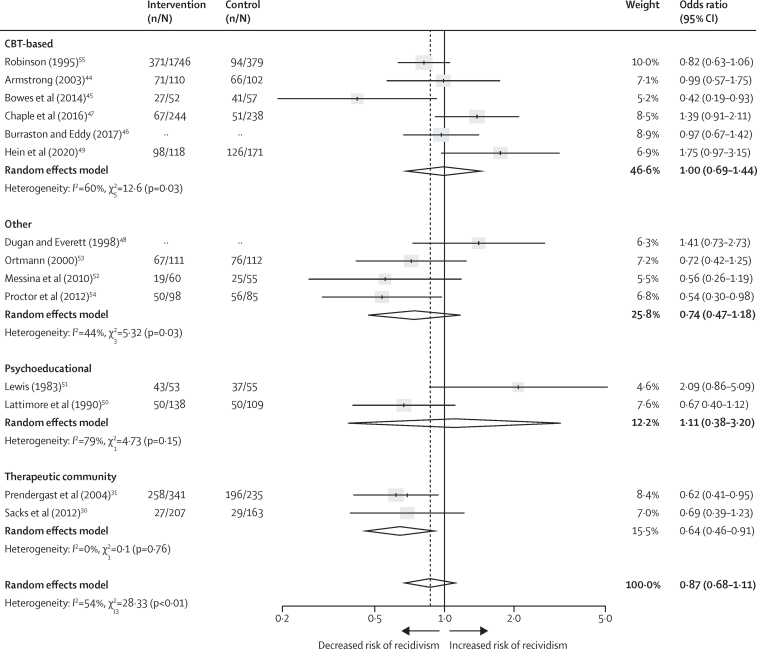
This systematic review and meta-analysis of 29 RCTs (9443 participants) found psychological interventions in prison were associated with reduced recidivism overall (OR 0.72, 95% CI 0.56–0.92), but the effect was no longer significant after excluding smaller studies (<50 intervention participants; OR 0.87, 95% CI 0.68–1.11). Therapeutic communities were associated with reduced recidivism based on two studies (OR 0.64, 95% CI 0.46–0.91), while CBT-based interventions were not (OR 1.00, 95% CI 0.69–1.44).
Key findings
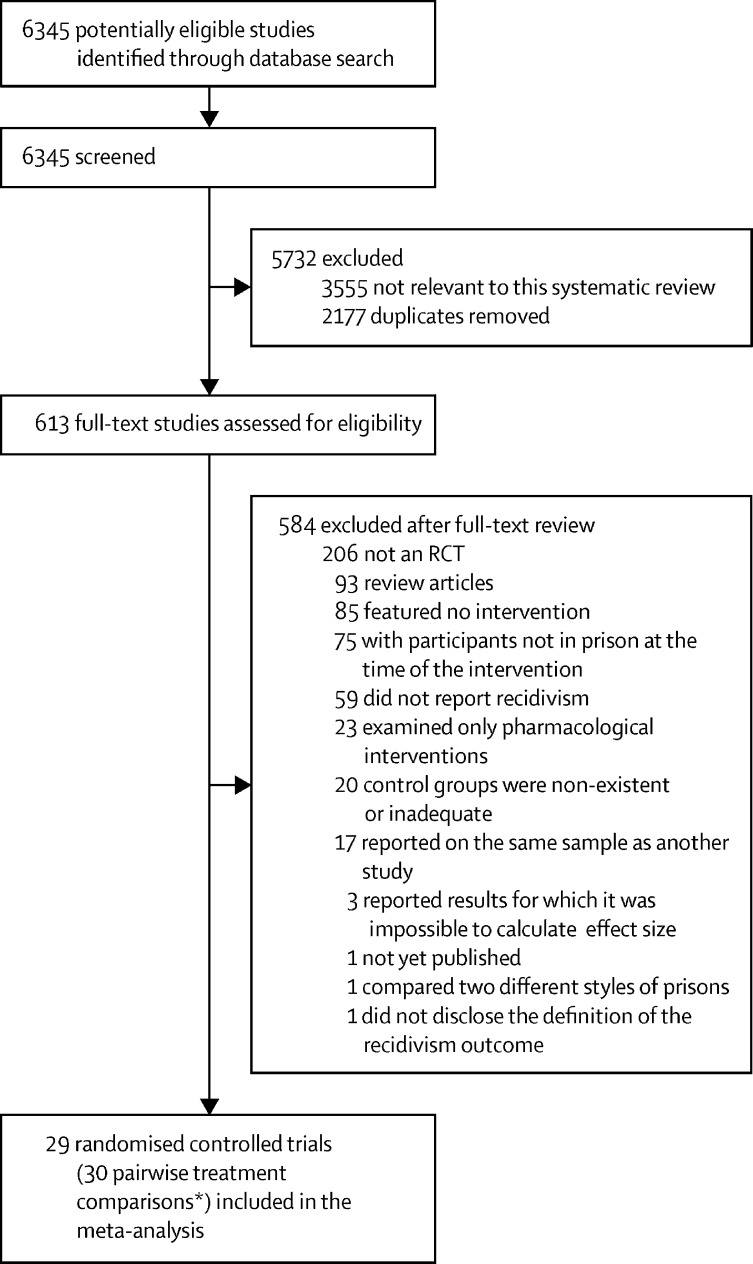
- Of 6345 articles retrieved, 29 RCTs (9443 participants; 1104 [11.7%] female, 8111 [85.9%] male, 228 [2.4%] unknown sex) met inclusion criteria for the primary outcome; 6528 participants had recidivism outcome data.
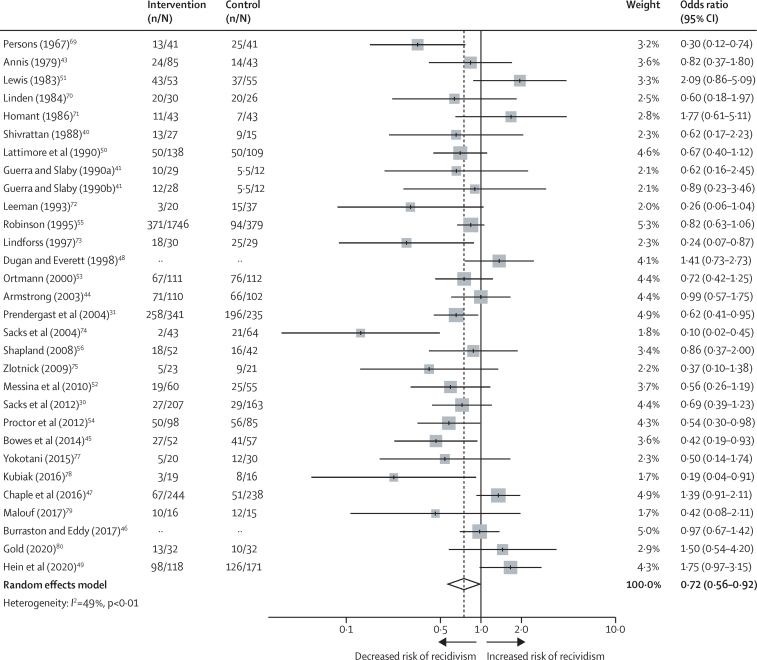
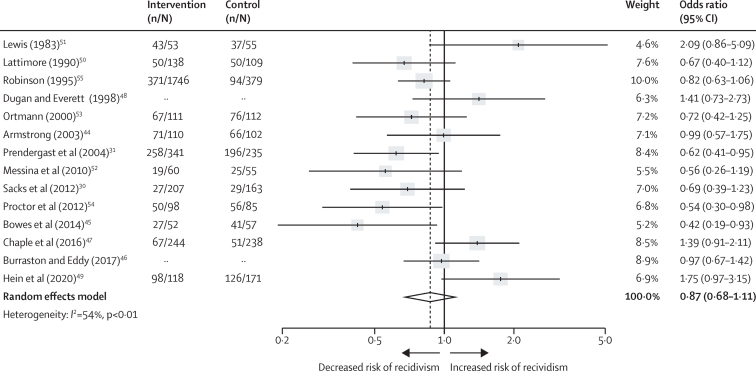
- In all 29 RCTs, psychological interventions were associated with reduced reoffending (OR 0.72, 95% CI 0.56–0.92; I²=49%); after excluding studies with fewer than 50 participants in the intervention group, 14 trials (6446 followed-up participants) showed no significant reduction (OR 0.87, 95% CI 0.68–1.11; I²=54%).
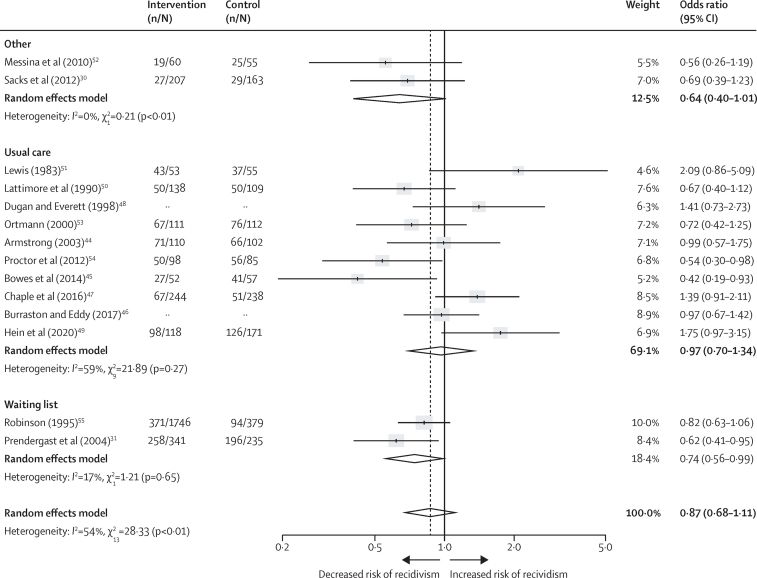
- By intervention type in the larger-study analysis, therapeutic communities were associated with reduced recidivism (OR 0.64, 95% CI 0.46–0.91; I²=0%), whereas CBT-based interventions (OR 1.00, 95% CI 0.69–1.44; I²=60%) and psychoeducational interventions (OR 1.11, 95% CI 0.38–3.20; I²=79%) were not.
- Evidence of publication bias was found (Egger’s test t=−2.12, p=0.04); trim-and-fill adjusted OR was 0.86 (95% CI 0.65–1.15), and restricting to studies with ≥100 intervention participants gave OR 0.90 (95% CI 0.71–1.14).
Methods
- Systematic review and meta-analysis of RCTs; searched Cochrane Central Register of Controlled Trials, Embase, Global Health, MEDLINE, PsycINFO, and Google Scholar from database inception to Feb 17, 2021, without language restrictions; included psychological or psychoeducational interventions delivered in jail or prison to incarcerated adolescents and adults, with recidivism after release as an outcome.
- Data were extracted and appraised per a prespecified protocol; risk of bias assessed with Cochrane RoB 2; effect sizes converted to odds ratios; primary outcome recidivism; random-effects meta-analysis used, with planned sensitivity analysis excluding studies with fewer than 50 participants and subgroup/meta-regression analyses by study size, control group, and intervention type; protocol registered with PROSPERO, CRD42020167228.
- Included 29 RCTs (27 two-arm, 2 three-arm) describing 31 psychological interventions combined into 30 pairwise comparisons; 9443 participants; mean age 31.4 years (SD 4.9) for adults and 17.5 years (SD 1.9) for adolescents; trials were from the USA (19), Canada (4), UK (2), Germany (1), Sweden (1), Japan (1), and Norway (1).
Limitations
- Stated in the paper: study selection up to full-text screening was done by a single reviewer; included trials were from high-income countries; only 29 studies were included; high dropout rates often resulted in small and selective samples; only 2 (7%) of 29 studies had low risk of bias, with randomisation and deviations from intended interventions the most affected domains; masking difficulties likely contributed to bias; evidence of selective publication of small studies; sex-specific analyses comparing females and males could not be done because of insufficient female-only samples.
- Evident from the text: race or ethnicity data were not sufficiently reported to be aggregated; most RCTs were rated as having concerns (n=18, 60%) or high risk of bias (n=10, 33%); the therapeutic community finding was based on only two studies; heterogeneity was moderate to substantial in several analyses.
- Evident from the text: the overall significant effect was attenuated and no longer significant after excluding smaller studies, and publication bias analyses suggested the initial pooled estimate was overestimated.
Model-written summary. Check it against the paper before relying on it.
Integrity signals
Registry
Cites
Statistics
Figures
Verification
Claims the paper makes
6 Valid · 3 Not valid · 21 Not checked · 54 Own results and interpretations
Some cited sources support this claim and some don’t — read each source’s verdict below.
In the paper
“In addition, the number of included studies was not large (n=29), which underlines the legal, practical, and ethical challenges of doing high-quality research in prisons.58, 90, 91”
§ Effectiveness of psychological interventions in prison to reduce recidivism: a systematic review and meta-analysis of randomised controlled trials > Discussion
What the sources say
- Not checked — no full text of the sourcecites [58] Farrington DP Welsh BC Randomized experiments in criminology: what have we learned in the last two decades? J Exp Criminol 1 2005 9 38 source
- Disputedcites [90] Yoon IA Slade K Fazel S Outcomes of psychological therapies for prisoners with mental health problems: a systematic review and meta-analysis J Consult Clin Psychol 85 2017 783 802 28569518 PMC5518650 sourceExperimental — accuracy not yet measured
The Discussion (Strengths and Limitations; page unavailable) says this review included 37 trials, not 29. The Results (Metaregression Results; page unavailable) likewise describes 37 studies included in its quantitative analysis. (LLM, conf=0.90)
Checked by a reasoning model — may be wrong.
- Supportedcites [91] Quina K Garis AV Stevenson J Through the bullet-proof glass: conducting research in prison settings J Trauma Dissociation 8 2007 123 139 17804387 source
The citation is attached to the clause about the legal, practical and ethical challenges of doing high-quality prison research, not to the n=29 figure (which is the citing review's own count). Our copy supports that clause throughout: the INTRODUCTION frames the paper as 'identifying important ethical and pragmatic considerations for those hoping to work within prison systems'; the ETHICAL ISSUES section lists the 'laundry list of ethical codes' (DOC Code of Ethics, university IRB, NIJ regulations, APA principles, state licensure codes), the federal/state assurances obtained for data protection, and legal limits on the questions they could ask ('might place them in legal jeopardy'); and CONCERNS, CHALLENGES, AND CREATIVE SOLUTIONS details the practical hassles (CO obstruction, bed checks, lock downs, staff resistance, psychometric inadequacy in incarcerated populations). (LLM, conf=0.85)
plainn = 29- Asserted: passes — The authors put it forward as true.
- Checkable: passes — It can be checked against evidence.
- Load-bearing: unclear — It is unclear whether the paper’s conclusions depend on it.
- Based: passes — The paper gives a reason why it holds.
The sources with a verdict support this claim; the rest weren’t checked yet, have no full text we could read, or their verdicts aren’t rated yet.
In the paper
“Previous reviews have often focused on specific groups—eg, women,26, 29 adolescents,20, 23 individuals who use drugs,25 people living with a mental health condition,18 and people with sexual21, 28 or other violent19, 27 index offences.”
§ Effectiveness of psychological interventions in prison to reduce recidivism: a systematic review and meta-analysis of randomised controlled trials > Introduction
What the sources say
- Not checked — no full text of the sourcecites [26] Tripodi SJ Bledsoe SE Kim JS Bender K Effects of correctional-based programs for female inmates: a systematic review Res Soc Work Pract 21 2011 15 31 source
- Not checked — no full text of the sourcecites [29] Dowden C Andrews DA What works for female offenders: a meta-analytic review Crime Delinq 45 1999 438 452 source
- Not checked — no full text of the sourcecites [20] Koehler JA Lösel F Akoensi TD Humphreys DK A systematic review and meta-analysis on the effects of young offender treatment programs in Europe J Exp Criminol 9 2013 19 43 23207239 source
- Not checked — no full text of the sourcecites [23] Lipsey MW Wilson D Effective intervention for serious juvenile offenders: a synthesis of research Loeber RM Farrington DP Serious and violent juvenile offenders: risk factors and successful intervention 1998 Sage Publications Thousand Oaks, CA 313 345 source
- Supportedcites [18] Hopkin G Evans-Lacko S Forrester A Shaw J Thornicroft G Interventions at the transition from prison to the community for prisoners with mental illness: a systematic review Adm Policy Ment Health 45 2018 623 634 29362981 PMC5999162 source
Citation 18 is attached to the example of reviews focused on people living with a mental health condition, not to the other groups listed. The Introduction states that this systematic review focuses on prisoners diagnosed with a mental health condition during the transition from prison to the community. (LLM, conf=0.94)
plain- Asserted: passes — The authors put it forward as true.
- Checkable: passes — It can be checked against evidence.
- Load-bearing: passes — The paper’s conclusions depend on it.
- Based: passes — The paper gives a reason why it holds.
The cited sources support only part of this claim — read each source’s verdict below.
In the paper
“Overall, the effectiveness of most prison-based treatments on recidivism remains unclear because the evidence is inconsistent and subject to a range of limitations.18, 19, 20, 21, 22, 23, 24, 25, 26, 27, 28”
§ Effectiveness of psychological interventions in prison to reduce recidivism: a systematic review and meta-analysis of randomised controlled trials > Introduction
What the sources say
- Partly supportedcites [18] Hopkin G Evans-Lacko S Forrester A Shaw J Thornicroft G Interventions at the transition from prison to the community for prisoners with mental illness: a systematic review Adm Policy Ment Health 45 2018 623 634 29362981 PMC5999162 sourceExperimental — accuracy not yet measured
The Conclusion says evidence on reoffending is equivocal, and the Results’ quality assessment identifies weaknesses in the included studies. But this review examines interventions for prisoners with mental illness at the transition to the community; it does not establish that the effectiveness of most prison-based treatments generally is unclear. (LLM, conf=0.86)
- Not matchedcites [19] Jolliffe D Farrington DP A systematic review of the national and international evidence on the effectiveness of interventions with violent offenders 2007 Ministry of Justice London
Its entry has no title and year that we can search by.
- Not checked — no full text of the sourcecites [20] Koehler JA Lösel F Akoensi TD Humphreys DK A systematic review and meta-analysis on the effects of young offender treatment programs in Europe J Exp Criminol 9 2013 19 43 23207239 source
- Partly supportedcites [21] Långström N Enebrink P Laurén E-M Lindblom J Werkö S Hanson RK Preventing sexual abusers of children from reoffending: systematic review of medical and psychological interventions BMJ 347 2013 f4630 PMC3739685 23935058 sourceExperimental — accuracy not yet measured
The Discussion (page unavailable) says the adult trial was too small to establish an effect and that the observational studies had limitations preventing reliable conclusions. The study table includes prison-based interventions, but the review concerns sexual reoffending against children; it does not establish that most prison-based treatments for recidivism generally have unclear effectiveness. (LLM, conf=0.87)
- Not checked — no full text of the sourcecites [22] Lipsey MW Cullen FT The effectiveness of correctional rehabilitation: a review of systematic reviews Annu Rev Law Soc Sci 3 2007 297 320 source
- Not checked — no full text of the sourcecites [23] Lipsey MW Wilson D Effective intervention for serious juvenile offenders: a synthesis of research Loeber RM Farrington DP Serious and violent juvenile offenders: risk factors and successful intervention 1998 Sage Publications Thousand Oaks, CA 313 345 source
- Not checked — no full text of the sourcecites [24] Papalia N Spivak B Daffern M Ogloff JR A meta-analytic review of the efficacy of psychological treatments for violent offenders in correctional and forensic mental health settings Clin Psychol Sci Pract 26 2019 e12282 source
- Partly supportedcites [25] Perry AE Woodhouse R Neilson M Are non-pharmacological interventions effective in reducing drug use and criminality? A systematic and meta-analytical review with an economic appraisal of these interventions Int J Environ Res Public Health 13 2016 966 PMC5086705 27690077 sourceExperimental — accuracy not yet measured
The Limitations section says evidence for most reviewed interventions for drug-using offenders is limited, citing heterogeneous findings and study limitations including small samples, attrition, and selection bias. But the review is not about prison-based treatments generally, and it expressly excepts therapeutic communities, for which it reports a reduction in re-arrests (Discussion; Results §3.2.4). (LLM, conf=0.84)
- Not checked — no full text of the sourcecites [26] Tripodi SJ Bledsoe SE Kim JS Bender K Effects of correctional-based programs for female inmates: a systematic review Res Soc Work Pract 21 2011 15 31 source
- Not checked — no full text of the sourcecites [27] Papalia N Spivak B Daffern M Ogloff JR Are psychological treatments for adults with histories of violent offending associated with change in dynamic risk factors? A meta-analysis of intermediate treatment outcomes Crim Justice Behav 47 2020 1585 1608 source
plain- Asserted: passes — The authors put it forward as true.
- Checkable: passes — It can be checked against evidence.
- Load-bearing: passes — The paper’s conclusions depend on it.
- Based: passes — The paper gives a reason why it holds.
- Partly supported
The cited sources support only part of this claim — read each source’s verdict below.
In the paper
“Two studies49, 74 that contributed disproportionately to the pooled effect were identified using influence analyses in all RCTs.”
§ Effectiveness of psychological interventions in prison to reduce recidivism: a systematic review and meta-analysis of randomised controlled trials > Results
What the sources say
- Partly supportedcites [49] Hein S Weeland J Square A Effectiveness of a social problem solving training in youth in detention or on probation: an RCT and pre-post community implementation Int J Law Psychiatry 72 2020 101626 32889425 sourceExperimental — accuracy not yet measured
Section 8.1 (Participants; page unavailable) confirms that this paper reports a randomized trial, so the citation identifies a relevant RCT. The paper does not report an influence analysis across RCTs or establish that its study contributed disproportionately to a pooled effect; searches for those terms returned only analyses within this study. (LLM, conf=0.83)
- Not checked — no full text of the sourcecites [74] Sacks S Sacks JY McKendrick K Banks S Stommel J Modified TC for MICA offenders: crime outcomes Behav Sci Law 22 2004 477 501 15282836 source
plainstates an association- Asserted: passes — The authors put it forward as true.
- Checkable: passes — It can be checked against evidence.
- Load-bearing: unclear — It is unclear whether the paper’s conclusions depend on it.
- Based: passes — The paper gives a reason why it holds.
- Partly supported
The cited sources support only part of this claim — read each source’s verdict below.
In the paper
“we pooled results excluding studies with fewer than 50 participants in the experimental group, as a planned sensitivity analysis”
§ Effectiveness of psychological interventions in prison to reduce recidivism: a systematic review and meta-analysis of randomised controlled trials > Results
What the sources say
- Not checked — no full text of the sourcecites [65] Schwarzer G Carpenter JR Rücker G Meta-analysis with R 2015 Springer London source
- Partly supportedcites [66] Turner RM Bird SM Higgins JPT The impact of study size on meta-analyses: examination of underpowered studies in Cochrane reviews PLoS One 8 2013 e59202 PMC3609745 23544056 sourceExperimental — accuracy not yet measured
The Introduction (page unavailable) says small studies tend to report larger effects, and the Impact of Underpowered Studies section compares meta-analysis results with and without underpowered studies. But the paper defines its exclusion by less than 50% power to detect a 30% relative risk reduction—not fewer than 50 participants in the experimental group—and does not establish the citing authors’ analysis as planned. (LLM, conf=0.88)
plainn = 6,446- Asserted: passes — The authors put it forward as true.
- Checkable: passes — It can be checked against evidence.
- Load-bearing: passes — The paper’s conclusions depend on it.
- Based: passes — The paper gives a reason why it holds.
43 more claims · 1 with their cited sources checked
Create a free account to see all 84 claims and to verify the 3 references still open.
- It may state two separate claims as one. 14
- Probably not a substantial claim. 26
Self-check
Percentages, sums and reported differences re-computed from the paper’s own numbers.
Each contradiction between two passages listed here was confirmed by an independent check.
Rated major: it would touch a result — a value a result rests on, reported and recomputed p-values on opposite sides of the significance level, two passages that conflict with no sign which is right, or a cited work retracted before this paper was published.
In the paper
§ Effectiveness of psychological interventions in prison to reduce recidivism: a systematic review and meta-analysis of randomised controlled trials > Results
“The reduction in recidivism was attenuated in the 14 trials (6446 followed-up participants) with an intervention group of at least 50 participants”
§ Effectiveness of psychological interventions in prison to reduce recidivism: a systematic review and meta-analysis of randomised controlled trials > Results
“and 6528 (1118 [17·1%] adolescents and 5410 [82·9%] adults) had recidivism outcome data.”
Citations
Cites
R: A Language and Environment for Statistical Computing
R Core Team (2025) · doi:10.32614/r.manuals · Cited by 352,181
Preferred Reporting Items for Systematic Reviews and Meta-Analyses: the PRISMA statement
Moher, D., Liberati, A., Tetzlaff, J., Altman, D. G., & for the PRISMA Group (2009) · BMJ · doi:10.1136/bmj.b2535 · Cited by 83,823
Bias in meta-analysis detected by a simple, graphical test
Egger, M., Smith, G. D., Schneider, M., & Minder, C. (1997) · BMJ · doi:10.1136/bmj.315.7109.629 · Cited by 56,722
Preferred reporting items for systematic reviews and meta-analyses: the PRISMA Statement.
(2009) · PubMed Central · Cited by 44,859
Preferred reporting items for systematic reviews and meta-analyses: The PRISMA statement
Moher, D., Liberati, A., Tetzlaff, J., Altman, D. G., & the PRISMA Group* (2009) · Annals of Internal Medicine · doi:10.7326/0003-4819-151-4-200908180-00135 · Cited by 37,554
RoB 2: a revised tool for assessing risk of bias in randomised trials
Sterne, J. A. C., Savović, J., Page, M. J., Elbers, R. G., Blencowe, N. S., Boutron, I., Cates, C. J., Cheng, H.-Y., Corbett, M. S., Eldridge, S. M., et al. (2019) · BMJ · doi:10.1136/bmj.l4898 · Cited by 34,787
Duval, S., & Tweedie, R. (2000) · Biometrics · doi:10.1111/j.0006-341x.2000.00455.x · Cited by 14,099
Borenstein, M., Hedges, L. V., Higgins, J. P. T., & Rothstein, H. R. (2021) · doi:10.1002/9781119558378 · Cited by 9,799
Classification for Effective Rehabilitation: Rediscovering Psychology
ANDREWS, D. A., BONTA, J., & HOGE, R. D. (1990) · Criminal Justice and Behavior · doi:10.1177/0093854890017001004 · Cited by 1,895
(2010) · Paediatric and Perinatal Epidemiology · doi:10.1111/j.1365-3016.2010.01108.x · Cited by 1,443
Research works printed but not linked: 3
- Petersilia J Beyond the prison bubble Wilson Q 35 2011 50 55
- Jolliffe D Farrington DP A systematic review of the national and international evidence on the effectiveness of interventions with violent offenders 2007 Ministry of Justice London
- Higgins J Altman D Sterne J Cochrane handbook for systematic reviews of interventions. Version 5.0 2011 John Wiley & Sons Chichester
Cited by
Fazel, S., Hurton, C., Burghart, M., DeLisi, M., & Yu, R. (2024) · Journal of Criminal Justice · doi:10.1016/j.jcrimjus.2024.102197 · Cited by 96
Self-citationForensic mental health: envisioning a more empirical future
Tully, J., Hafferty, J. D., Whiting, D., Dean, K., & Fazel, S. (2024) · The Lancet Psychiatry · doi:10.1016/s2215-0366(24)00164-0 · Cited by 51
Self-citationQiu, H., Liang, K., Lu, L., Gao, Y., Li, H., Hu, X., Xing, H., Huang, X., & Gong, Q. (2023) · Journal of Affective Disorders · doi:10.1016/j.jad.2022.09.060 · Cited by 41
Multilevel network interventions: Goals, actions, and outcomes
Robins, G. L., Lusher, D., Broccatelli, C., Bright, D. A., Gallagher, H. C., Karkavandi, M. A., Matouš, P., Coutinho, J. A., Wang, P., Koskinen, J. H., et al. (2022) · Social Networks · doi:10.1016/j.socnet.2022.09.005 · Cited by 41
Kang, L., Shang, W., Gao, P., Wang, Y., Liu, J., & Liu, M. (2022) · Vaccines · doi:10.3390/vaccines10091569 · Cited by 34
“We also performed sensitivity analysis by excluding studies with a number of PLWH < 100 as studies with small sizes are susceptible to selection bias and tend to have larger treatment effects than large studies [35].”
MethodChow, R. T. S., Yu, R., Geddes, J. R., & Fazel, S. (2024) · The British Journal of Psychiatry · doi:10.1192/bjp.2024.226 · Cited by 48
Self-citationDuan, W., Wang, Z., Cai-yun, Y., & Ke, S. (2023) · Journal of Experimental Criminology · doi:10.1007/s11292-022-09550-w · Cited by 33
“Limitations Similar to previous research in the field of criminology (Beaudry et al., 2021; Malik et al., 2021), the specificity of community corrections offenders (in terms of factors such as offense type and risk level) makes rigorous randomized controlled trials difficult to conduct, and the effectiveness of activi…”
Holper, L., Mokros, A., & Habermeyer, E. (2023) · Sexual Abuse · doi:10.1177/10790632231159071 · Cited by 39
“This relatively low treatment ef fi cacy is in line with fi ndings from the Sex Offender Treatment Programme (SOTP) (Dennis et al., 2012; V¨ollm, 2018) and is not unique to sexual recidivism but has also been reported with respect to general recidivism (Beaudry et al., 2021), for example.”
BackgroundResultSousa, M., Andrade, J., Rodrigues, A. D. C., Caridade, S., & Cunha, O. S. (2024) · Trauma Violence & Abuse · doi:10.1177/15248380241270063 · Cited by 37
“…for assessing intervention program effectiveness; however, its utility is increasingly scrutinized due to the absence of a universally accepted definition and the presence of unreported cases that obscure accurate interpretation of results (Andersen & Skardhamar, 2017; Beaudry et al., 2021).”
BackgroundThe Effectiveness of Schema Therapy in Individuals Who Committed Crimes: A Systematic Review
Sousa, M., Gouveia, C. P. F., Cunha, O. S., & Rodrigues, A. D. C. (2024) · Trauma Violence & Abuse · doi:10.1177/15248380241254082 · Cited by 29
“This approach deviated from the traditional method of assessing effectiveness (i.e., recidi-vism rates), as reported in the literature (Andersen & Skardhamar, 2017; Beaudry et al., 2021).”
BackgroundMethodResultConducting Randomized Controlled Trials of Complex Interventions in Prisons: A Sisyphean Task?
Lennox, C., Leonard, S., Senior, J., Stevenson, C., Rybczynska‐Bunt, S., Quinn, C., Byng, R., & Shaw, J. J. (2022) · Frontiers in Psychiatry · doi:10.3389/fpsyt.2022.839958 · Cited by 28
Mathlin, G., Freestone, M., & Jones, H. (2024) · Journal of Experimental Criminology · doi:10.1007/s11292-022-09547-5 · Cited by 22
“However, interpersonal-and structural-level factors such as securing housing, gaining employment (Pleace & Minton, 2009), and community aftercare focussing on maintaining therapeutic gains from in-prison therapeutic treatment (Beaudry et al., 2021) may also influence successful reintegration.”
Snacken, S., Devynck, C., & Uzieblo, K. (2022) · International Journal of Offender Therapy and Comparative Criminology · doi:10.1177/0306624x221099489 · Cited by 30
“And finally, although there is increasing evidence for the efficacy of specific prison-based treatment programs (Bosma et al., 2020; Olver et al., 2020), not all prison-based programs have established an evidence base (see for an overview, Beaudry et al., 2021).”
BackgroundUrgent issues and prospects in correctional rehabilitation practice and research
Ward, T. J., Arrigo, B. A., Barnao, M., Beech, A. R., Brown, D. A., Cording, J. R., Day, A., Durrant, R., Gannon, T. A., Hart, S. D., et al. (2022) · Legal and Criminological Psychology · doi:10.1111/lcrp.12211 · Cited by 31
Blonigen, D. M., Cucciare, M. A., Byrne, T. H., Shaffer, P. M., Giordano, B., Smith, J. S., Timko, C., Rosenthal, J., & Smelson, D. A. (2022) · Journal of Consulting and Clinical Psychology · doi:10.1037/ccp0000721 · Cited by 28
Szifris, K., Roberts, A., Maruna, S., & Fox, C. (2025) · The Howard Journal of Crime and Justice · doi:10.1111/hojo.12597 · Cited by 20
The effects of reward systems in prison: A systematic review
Elbers, J. M., van Ginneken, E. F. J. C., Nieuwbeerta, P., Boone, M., & Palmen, H. M. H. (2022) · International journal of law, crime and justice · doi:10.1016/j.ijlcj.2022.100556 · Cited by 24
Ogilvie, J., Tzoumakis, S., Thompson, C., Allard, T. J., Dennison, S. M., Kisely, S. R., & Stewart, A. (2023) · BMC Psychiatry · doi:10.1186/s12888-023-04839-0 · Cited by 19
“Further, therapeutic communities and interventions facilitating continuity of care in community settings show promise in reducing reoffending for prisoners with psychiatric illness [37].”
BackgroundCunha, O. S., Pereira, B., Sousa, M., & Rodrigues, A. D. C. (2024) · Aggression and Violent Behavior · doi:10.1016/j.avb.2024.101923 · Cited by 25
Revisiting the effectiveness of HOPE/swift‐certain‐fair supervision programs: A meta‐analytic review
Pattavina, A., Long, J. S., Petrich, D. M., Byrne, J. M., Cullen, F. T., & Taxman, F. S. (2023) · Criminology & Public Policy · doi:10.1111/1745-9133.12635 · Cited by 21
Recovery Capital Correlates With Less Methamphetamine Use and Crime in the Community
Bormann, N. L., Weber, A. N., Miskle, B., Arndt, S. V., & Lynch, A. C. (2023) · Journal of Addiction Medicine · doi:10.1097/adm.0000000000001200 · Cited by 13
Marquant, T., Nuffel, M. V., Sabbe, B., & Goethals, K. (2021) · Frontiers in Psychiatry · doi:10.3389/fpsyt.2021.777141 · Cited by 15
Morgan, M. A., Long, J. S., Logan, M. W., & Benton, F. (2025) · Behavioral Sciences & the Law · doi:10.1002/bsl.2716 · Cited by 14
“Similarly, these concerns align with Beaudry et al. (2021) optimistic yet circumscribed findings regarding the use of therapeutic communities directly targeting substance abuse— programs which were likewise shown to reduce institutional violence in another systematic review (Auty, Cope, and…”
Economic evaluations of mental health interventions in criminal justice
Knapp, M. R. J., & Wong, G. H. Y. (2023) · Criminal Behaviour and Mental Health · doi:10.1002/cbm.2286 · Cited by 16
Granados, L., Martínez, R. S., Perea, C., Santos, C. P., Pujalte, L. S., & Aparisi, D. (2023) · Frontiers in Public Health · doi:10.3389/fpubh.2022.1116802 · Cited by 24
Addressing the challenges of remorse in the criminal justice system
Proeve, M. J. (2023) · Psychiatry Psychology and Law · doi:10.1080/13218719.2022.2112101 · Cited by 17
“…which are described in the previous section, and evidence of limited effects on recidivism of rehabilitation programmes that address related concepts such as victim empathy (Beaudry et al., 2021), it may be that these emotions are less relevant to individual-level psychological rehabilitation.”
BackgroundPerry, A., Marshall, D. C., Moe‐Byrne, T., Knowles, S. E., Churchill, R. C., Harden, M., Parrott, S., Schofield, J., Williamson, K., & Ashton, L. (2023) · The Lancet Healthy Longevity · doi:10.1016/s2666-7568(23)00111-3 · Cited by 15
Self-citationSeid, A. K., Thylstrup, B., Henriksen, S. H., & Hesse, M. (2023) · Journal of Substance Use and Addiction Treatment · doi:10.1016/j.josat.2023.209264 · Cited by 10
Lawson, S. G., Foudray, C. M. A., Lowder, E. M., Ray, B. R., & Carey, K. L. (2023) · Journal of Substance Use and Addiction Treatment · doi:10.1016/j.josat.2023.209192 · Cited by 9
Yosep, I., Fitria, N., Mardhiyah, A., & Hikmat, R. (2025) · Child and Adolescent Psychiatry and Mental Health · doi:10.1186/s13034-025-00998-y · Cited by 11
“For adolescents, psychological well-being plays a more significant role, because adolescence is a critical period in the formation of self-identity, the development of emotional independence, and the formation of self-confidence [3].”
Management of ADHD in Prisoners—Evidence Gaps and Reasons for Caution
Tully, J. (2022) · Frontiers in Psychiatry · doi:10.3389/fpsyt.2022.771525 · Cited by 11
On (Measuring) Recidivism, Penal Populism and the Future of Recidivism Research
Kalac, A.-M. G., & Feuerbach, L. (2023) · Godišnjak Akademije pravnih znanosti Hrvatske · doi:10.32984/gapzh.14.1.1 · Cited by 11
Behavioral Health Interventions for Incarcerated Adults With Histories of Trauma: A Scoping Review
Grady, M. D., Tripodi, S. J., Herod, L., & Rudzinski, M. (2023) · Research on Social Work Practice · doi:10.1177/10497315231189177 · Cited by 11
“…prison-based mental health treatment programs concluded that “ Publication bias and small-study effects appear to have overestimated the reported modest effects of such interventions, which were no longer present when only larger studies were included in analyses ” (Beaudry et al., 2021, p. 759).”
BackgroundJordan, A. E., Kashino, W., Suhartono, S., Campello, G., & Busse, A. (2023) · Criminal Justice and Behavior · doi:10.1177/00938548231166155 · Cited by 5
“…were not specifically tailored to prison settings, future work may benefit from adaptations specifically to the prison environment and population (Beaudry et al., 2021; McLeod et al., 2020). concluSion The global burden from SUDs and other MHDs is increasing, as are disparities in disorder…”
BackgroundInfluentialOmega-3 and vitamin D supplementation to reduce recidivism: a pilot study
Raine, A., Choy, O., Leung, C.-C., Singh, M., & Kaur, J. (2023) · Journal of Experimental Criminology · doi:10.1007/s11292-023-09552-2 · Cited by 5
“A recent and methodologically strong meta-analysis of all RCTs of psychological interventions conducted within prisons reported an overall odds ratio of 0.72 for later recidivism, equivalent to an effect size of d = 0.181 (Beaudry et al., 2021).”
InfluentialEdwards, E. R., Epshteyn, G., Snyder, S., Gorman, D., Coolidge, B., Marcano, E., Tsai, J., & Goodman, M. S. (2023) · Psychological Services · doi:10.1037/ser0000766 · Cited by 4
Ede, M. O., Okeke, C. I. O., & Onah, S. O. (2022) · Criminal Behaviour and Mental Health · doi:10.1002/cbm.2269 · Cited by 7
Schleifer, R., Wyler, H., Smith, A. J., Heer, M., van Voren, R., & Liebrenz, M. (2022) · International Journal of Law and Psychiatry · doi:10.1016/j.ijlp.2022.101829 · Cited by 5
Negi, S., Chatterjee, D., Tripathy, S., Subramaniyan, E. U., Kumar, D. T., & Mehta, V. (2026) · International Journal of Offender Therapy and Comparative Criminology · doi:10.1177/0306624x251409814 · Cited by 15
“According to another systematic review of 29 RCTs, psychological therapies were linked to a slight decrease in reoffending outcomes (Beaudry et al., 2021).”
Turning Points: An Evaluation of Formal and Informal Interventions in the Life of Ex-Offenders
Sharma, K. (2024) · Themis Research Journal of Justice Studies and Forensic Science · doi:10.55917/2324-6561.1132 · Cited by 6
Investigation Into the Implementation of Rehabilitation in the Penal System
Simmons, E., Kito, A., Thind, K., & Kuzmuk, K. (2023) · Crossing Borders Student Reflections on Global Social Issues · doi:10.31542/4g94x768 · Cited by 9
“However, psychological treatments in prison do not always appear to be effective (Beaudry et al., 2021).”
BackgroundInfluentialHediger, K., Marti, R., Urfer, V., Schenk, A., Gutwein, V., & Dörr, C. (2022) · International Journal of Environmental Research and Public Health · doi:10.3390/ijerph191710553 · Cited by 7
“The common structured therapeutic programmes developed for prisoners mainly use verbal and cognitive methods, for which there is often a lack of evidence in prison settings [10] and which have little effect on recidivism [11].”
BackgroundThe tip of the iceberg? Climate change, detention settings and mental health
Smith, A. J., Ogunwale, A., & Liebrenz, M. (2022) · International Journal of Social Psychiatry · doi:10.1177/00207640221106690 · Cited by 5
“Substance and alcohol use disorders require sufficient treatment given their correlates with recidivism (de Andrade et al., 2018), and therapeutic communities, which have good efficacy, should be utilised (Beaudry et al., 2021).”
BackgroundTrajtenberg, N., de Ribera, O. S., & Cook, S. (2022) · Psychology Crime and Law · doi:10.1080/1068316x.2022.2081687 · Cited by 4
Merkmale und Perspektiven der (psycho–)therapeutischen Behandlung im Justizvollzug
Moosburner, M., Etzler, S., & Rettenberger, M. (2022) · Zeitschrift für Klinische Psychologie und Psychotherapie · doi:10.1026/1616-3443/a000655 · Cited by 4
Logan, A. C., Mishra, P., Berryessa, C. M., Caruso, G. D., Hagenbeek, F. A., Denson, T. F., Robinson, J. M., & Prescott, S. L. (2026) · Frontiers in Psychology · doi:10.3389/fpsyg.2026.1791262 · Cited by 5
“Contrary to common assumptions, evidence supporting its broad effectiveness in reducing recidivism among justice-involved populations is weak (Beaudry et al., 2021; Rosenfeld et al., 2024).”
Beaudry, G. M., Harney, B. L., Larney, S., Plugge, E., Spaulding, A. C., & Kronfli, N. (2026) · The Lancet Public Health · doi:10.1016/s2468-2667(25)00277-4 · Cited by 6
Self-citationButler, T. G., Akpanekpo, E. I., Knight, L., Robledo, K. P., Greenberg, D., Ellis, A., Allnutt, S. H., Wilhelm, K. A., Jones, A., Scott, R. J., et al. (2025) · EClinicalMedicine · doi:10.1016/j.eclinm.2025.103668 · Cited by 7
“15 Therefore, the effect size observed in this trial represents the incremental benefit of sertraline when added to intensive psychosocial support; the absolute magnitude of sertraline’s effect in settings lacking such comprehensive support remains undetermined by these data.”
Using physiological biomarkers in forensic psychiatry: a scoping review
Mens, J., Masthoff, E., Bogaerts, S., & Heus, P. (2025) · Frontiers in Psychiatry · doi:10.3389/fpsyt.2025.1580615 · Cited by 5
Criminal Violence, the State, and Society
García‐Ponce, O. (2025) · Annual Review of Political Science · doi:10.1146/annurev-polisci-033123-014751 · Cited by 9
Egaña, I., Nogales-Garcia, M., Akhrimenko, V., González-Gómez, X., Quintana, J. B., Villanueva‐Blasco, V. J., Orive, G., & Lertxundi, U. (2025) · Wiley Interdisciplinary Reviews Forensic Science · doi:10.1002/wfs2.70004 · Cited by 7
Current Models for the Rehabilitation and Prevention of Offending Behaviour
Durkin, M. A. (2025) · Emerald Group Publishing Limited eBooks · doi:10.1108/978-1-83549-556-820251008 · Cited by 2
Weber, S., & Lynch, S. M. (2024) · Journal of Interpersonal Violence · doi:10.1177/08862605241307227 · Cited by 7
“Providing effective treatments may also decrease women’s risk of subsequent reoffend-ing (Beaudry et al., 2021).”
Average treatment effects on binary outcomes with stochastic covariates
Kiefer, C., Woud, M. L., Blackwell, S. E., & Mayer, A. (2024) · British Journal of Mathematical and Statistical Psychology · doi:10.1111/bmsp.12355 · Cited by 3
Perry, A., Moe‐Byrne, T., Knowles, S. E., Schofield, J., Changsiripun, C., Churchill, R. C., Williamson, K., Marshall, D., & Parrott, S. (2024) · International Journal of Law and Psychiatry · doi:10.1016/j.ijlp.2024.102002 · Cited by 7
Self-citationDattagupta, J., Banerjee, A., Maji, B. K., & Chattopadhyay, P. K. (2024) · International Journal of Adolescent Medicine and Health · doi:10.1515/ijamh-2024-0052 · Cited by 5
Querengässer, J. (2023) · Fortschritte der Neurologie · Psychiatrie · doi:10.1055/a-2136-5850 · Cited by 3
“Neben deutlicher meta-analytischer Evidenz, dass TG in der Straftäterbehandlung allgemein mit niedrigeren Raten an Re-Delinquenz und erneuter Inhaftierung korreliert [20], liegen entsprechende Befunde mittlerweile auch für forensische Suchttherapie vor [16, 21, 22] – teilweise mit eindrücklichen Langzeiteffekten [23].”
Mahoney, A., Sutcliffe, G., & Connolly, B. (2022) · Abuse An International Impact Journal · doi:10.37576/abuse.2022.037 · Cited by 3
Prison-based democratic therapeutic communities, medication, and the power to exclude
Ross, C. C., & Page, R. (2022) · Medicine Science and the Law · doi:10.1177/00258024221131451 · Cited by 4
del Campo, M. D., Moreno‐Poyato, A. R., Llobet, M. P., et al. (2022) · Scientific Reports · doi:10.1038/s41598-022-17422-6 · Cited by 3
Rodrigues, A. D. C., Candus, F., Cruz, A. R., Gelsthorpe, L. R., Knittel, S., Sousa, M., Silva, E. D. T. D., & Cunha, O. S. (2026) · Trauma Violence & Abuse · doi:10.1177/15248380261439135 · Cited by 6
The foundational deficits of correctional rehabilitation
Logan, M. W., Long, J. S., Dulisse, B. C., Adams, I. T., & Morgan, M. A. (2026) · Evidence Base · doi:10.1080/30679125.2025.2602958 · Cited by 3
“This conclusion was drawn by Beaudry et al. (2021), who meta-analyzed 29 RCTs based on over 9000 participants.”
InfluentialPiyasena, P., Malcolm, K. A., Coghlan, S., Patterson, R. H., Virgili, G., Chan, V. F., Donnelly, P., Kennedy, N., Emmett, S. D., Hampton, T., et al. (2025) · EClinicalMedicine · doi:10.1016/j.eclinm.2025.103590 · Cited by 4
“65,66 Some studies suggest that healthcare can contribute to preventing juvenile incarceration.”
Self-citationSchnyder, N., Endrass, J., Albrecht, J. N., Dreyer, J., Graf, M., Habermeyer, E., & Rossegger, A. (2025) · BMC Psychiatry · doi:10.1186/s12888-025-07255-8 · Cited by 8
Bellum, D., Dahl-Popolizio, S., Bay, R. C., Zhu, A., Fine, J., Kotter, B., Glenn, M. A., & Wolf, R. L. (2025) · The Open Journal of Occupational Therapy · doi:10.15453/2168-6408.2348 · Cited by 3
Klapow, M. C., Shea, K., Bohn, T., & Hoffman, D. (2025) · The Journal of Positive Psychology · doi:10.1080/17439760.2025.2461532 · Cited by 10
“More robust intervention models such as therapeutic communities (TCs) suffer from attrition and little evidence of sustained effects (Malivert et al., 2012) without substantial aftercare both during incarceration and after release (Beaudry et al., 2021).”
van der Schoot, A., Wilpert, J., & van Horn, J. E. (2024) · Frontiers in Psychology · doi:10.3389/fpsyg.2024.1354997 · Cited by 4
Lester, M., Scanlon, F., & Batastini, A. B. (2024) · Journal of Criminal Psychology · doi:10.1108/jcp-01-2024-0005 · Cited by 2
Baggio, S., Billieux, J., Dirkzwager, A., Iglesias, K., Moschetti, K., Perroud, N. A., Schneider, M. P., Vernaz, N., Wolff, H. J., & Heller, P. (2024) · Trials · doi:10.1186/s13063-023-07827-7 · Cited by 2
Bright, A., Higgins, A., & Grealish, A. (2023) · International Journal of Prison Health · doi:10.1108/ijoph-09-2022-0056 · Cited by 3
Martín-Coca, A., & Herrero, J. A. M. (2026) · Substance Abuse Treatment Prevention and Policy · doi:10.1186/s13011-026-00710-z · Cited by 2
“…is consistent with systematic reviews highlighting the need for evidence-based interventions and continuity of care following release in order to optimise outcomes and reduce subsequent risks, within a field characterised by heterogeneity across programmes and methodological gaps [7, 16].”
InfluentialGuo, S. (2025) · Journal of Research on Adolescence · doi:10.1111/jora.70111 · Cited by 1
Beyond CBT: exploring transformative learning theory as a framework for offending rehabilitation
Youssef, C. (2025) · Journal of Forensic Psychiatry and Psychology · doi:10.1080/14789949.2025.2558837 · Cited by 2
“The findings were concerning after excluding smaller studies, with less than 50 participants; ‘there was no significant reduction in recidivism’ (p. 759, Beaudry et al., 2021).”
InfluentialBarone, R., & Farcomeni, A. (2025) · Journal of the Royal Statistical Society Series A (Statistics in Society) · doi:10.1093/jrsssa/qnaf139 · Cited by 2
Tostlebe, J. J., Pyrooz, D. C., Labrecque, R. M., & Useem, B. (2025) · Journal of Criminal Justice · doi:10.1016/j.jcrimjus.2025.102466 · Cited by 5
Maity, K., Majumdar, V., Patra, S., & Anand, A. (2025) · Frontiers in Human Neuroscience · doi:10.3389/fnhum.2025.1553845 · Cited by 3
Shang, Y., Xue, D., & Zhang, J. (2024) · International journal of law, crime and justice · doi:10.1016/j.ijlcj.2024.100717 · Cited by 2
Bower, M., Howard, M. V. A., Stapinski, L. A., Doyle, M., Newton, N. C., & Barrett, E. L. (2024) · Journal of Criminal Justice · doi:10.1016/j.jcrimjus.2024.102294 · Cited by 3
Yesuf, Y. M., Birhan, A. A., Birara, A. G., Adimas, B. D., Bezabh, A. B., & Agmase, N. G. (2024) · Frontiers in Psychiatry · doi:10.3389/fpsyt.2024.1426787 · Cited by 5
Zielinski, M. J., Jahangir, T., Praseuth, A., Wilson, S., & McLaughlan, C. L. (2024) · Journal of Correctional Health Care · doi:10.1089/jchc.23.12.0098 · Cited by 2
“…settings indicates that programs focused on the priorities identi fi ed throughout assessment may confer many bene fi ts, including reduced recidivism (Beaudry et al., 2021; Davis et al., 2013; Hyde et al., 2022); lower depression, anxiety, suicidal ideation, self-harm, and substance use (Fazel…”
Gantt, H. S., Diambra, J. F., Makupson, M., & Tipton, J. L. (2024) · Journal of Addictions & Offender Counseling · doi:10.1002/jaoc.12138 · Cited by 2
The Offender Personality Disorder Pathway
O’Loughlin, A. (2024) · Oxford University Press eBooks · doi:10.1093/9780191875434.003.0005 · Cited by 1
Trauma-Informed Criminal Justice Responses: Being “Sweet, Nice and Kind”?
McLachlan, K. J. (2024) · Springer eBooks · doi:10.1007/978-3-031-59290-4_5 · Cited by 1
Recognising the Relationships Between Trauma and Offending
McLachlan, K. J. (2024) · Springer eBooks · doi:10.1007/978-3-031-59290-4_3 · Cited by 1
Effect of Meditation on Neuropsychological Profile of Prisoners
Maity, K., Majumdar, V., Lal, P., Patra, S., Avti, P., & Kumar, K. (2024) · Springer eBooks · doi:10.1007/978-981-97-2851-0_12 · Cited by 1
Thahır, A., Wiranto, B. B., Fitri, T. A., & Wahyuni, C. (2023) · KnE Social Sciences · doi:10.18502/kss.v8i16.14055
Average Treatment Effects on Binary Outcomes with Stochastic CovariatesPreprint
Kiefer, C., Woud, M. L., Blackwell, S. E., et al. (2023) · doi:10.31234/osf.io/pj7gf · Cited by 1
Exploring the black box of French community supervision
Herzog-Evans, M., Berjot, S., & Vos, M. K. (2022) · European Journal of Probation · doi:10.1177/20662203221140643 · Cited by 1
“We also know that treatment programmes are not very efficient when administered in prison as a recent meta-analysis has confirmed (Beaudry et al., 2021).”
ResultFung, C. S. L., Chow, C. C., Fung, Y. L., Tsang, S., CHAN, C. D. C., & Wong, P. W. C. (2026) · Social Sciences & Humanities Open · doi:10.1016/j.ssaho.2026.103673
Lussier, P., Masson, G., Giguère, G., & Payant, M. (2026) · Journal of Interpersonal Violence · doi:10.1177/08862605261476696
Beyond the Prison Walls: Re-Examining the Influence of Visitation on Re-Incarceration
Ferdik, F. V., McNeeley, S., & Smith, H. P. (2026) · Criminal Justice Policy Review · doi:10.1177/08874034261478473
A Psychodrama-Based Group Intervention with Probationers: A Mixed-Methods Study
Akgün, R. (2026) · IBAD Sosyal Bilimler Dergisi · doi:10.21733/ibad.1953456
Hartzler, B. J., Feltner, A., Wig, C., Tran, J., Nugent, M., Verbeck, J., Payne, K. S., & McIlveen, J. W. (2026) · Frontiers in Public Health · doi:10.3389/fpubh.2026.1907828
Syauqila, G., & Kaloeti, D. V. S. (2026) · Journal of Forensic Practice · doi:10.1108/jfp-02-2026-0023
Akpanekpo, E. I., Knight, L., Gullotta, M., Schofield, P. W., & Butler, T. G. (2026) · Frontiers in Psychiatry · doi:10.3389/fpsyt.2026.1843657
“…psychological interventions for incarcerated populations has shown modest aggregate effects that attenuate when small-study bias is accounted for (12); meta-analyses of batterer intervention programmes have reported weak effects on proven reoffending (62, 63); and a more recent meta-analysis of…”
What can art therapy contribute to rehabilitation in correctional settings? A narrative review
Akkaya, G., Dağ, B. N., & Nergız, H. (2026) · The Arts in Psychotherapy · doi:10.1016/j.aip.2026.102519 · Cited by 1
Avertogenic Deaths: How Upstream Justice Decisions Shape Police Lethal Force
Adams, I. T., Logan, M. W., & Mourtgos, S. M. (2026) · Theory and Society · doi:10.1007/s11186-026-09737-4 · Cited by 2
“Recent meta-analyses find that cognitive-behavioral therapies produce statisti - cally meaningful but small effect sizes, gains that may not translate into robust public safety benefits for entrenched violent offenders (Beaudry et al., 2021; Duan et al., 2024 ; Fazel et al., 2012).”
Uche, I. B., Uche, O. A., & Nzewuji, A. U. (2026) · The Prison Journal · doi:10.1177/00328855261473197
“Without trained social workers, psychologists, or educators, programs lacked consistency and credibility (Beaudry et al., 2021; Johnston, 2017).”
Andersson, A., Oskarsson, S., Garcia‐Argibay, M., Tuvblad, C., Larsson, H., Latvala, A., & Evans, B. E. (2026) · Social Science & Medicine · doi:10.1016/j.socscimed.2026.119596
Raza, S. H., & Shoukat, A. (2026) · Qlantic journal of social sciences. · doi:10.55737/qjss.vii-iii.26555
Metadata
- Authors
- Beaudry, G., Yu, R., Perry, A. E., & Fazel, S.
- Affiliations
- University of Oxford (GB)
- University of York (GB)
- Corresponding author
- Fazel, Seena
- Venue
- The Lancet Psychiatry
- Publisher
- Elsevier BV
- Published
- 2021-09
- Volume
- 8
- Issue
- 9
- Pages
- 759-773
- ISSN
- 2215-0366 (ISSN-L)
- PMC
- PMC8376657
- OpenAlex
- W3194307914
- Cited by
- 196
- References
- 96
- Citations by year
- 2026: 51 · 2025: 47 · 2024: 48 · 2023: 22 · 2022: 24 · 2021: 4
- FWCI
- 4.71
- Type
- journal article
- Language
- en
- Open access
- hybrid
- doi.org
- Licence
- cc-by
- www.elsevier.com/tdm/userlicense/1.0/ (tdm)
- www.elsevier.com/legal/tdmrep-license (tdm)
- creativecommons.org/licenses/by/4.0/ (vor)
- Locations
- The Lancet Psychiatry (publishedVersion, cc-by)
- PubMed Central (publishedVersion, cc-by)
- PubMed (publishedVersion)
- Funders
- Wellcome Trust (202836/Z/16/Z)
- Fonds de Recherche du Québec - Santé (282526)
- Topics
- Social Sciences › Sociology and Political Science › Criminal Justice and Corrections Analysis
- Social Sciences › Psychology › Clinical Psychology › Psychopathy, Forensic Psychiatry, Sexual Offending
- Social Sciences › Sociology and Political Science › Crime Patterns and Interventions
- Keywords
- recidivism, psychological intervention, prisons, incarceration, offenders, follow-up care, substance use disorders, antisocial behavior, adolescents, adults, treatment effectiveness, risk of bias, effect size heterogeneity, risk of bias assessment, risk of bias assessment tools
- MeSH terms
- Recidivism, Psychosocial Intervention, Humans, Prisons, Randomized Controlled Trials as Topic, Treatment Outcome, Criminals
About these checks
Registry, retraction, Cites and statistics results are computed, not judged, with one exception: a printed reference that no index lists is read once by a model before it counts as a citation error. Claims are extracted by a model and kept only when their quote appears verbatim in the text; each cited source is then checked, with a model’s help, for whether it says what the claim relies on. Those verdicts can be wrong — read the claim’s quote and the cited source before relying on one.
The claim verdicts this report counts are experimental: their accuracy is not yet measured.
A language model drew the claims from the paper on 2026-09-30, under version 3 of the claim definition (model deepseek-v4.1-flash, prompt extract-v3).
A second model labelled each claim on 2026-09-30 (model jev-1.13-20260917, definition revision gold-guideline-v0.2).
Cited sources are checked with a language model’s help (gpt-6-sol and qwen3.8-omni-flash).
Statistics and arithmetic are recomputed, not judged.
Confidence bands are shown only for fields calibrated on our annotated test set. None is calibrated yet, so no band is shown.
What counts as a claim ›How we measure confidence ›How we check this ›
Are you an author, or do you see a problem with this page? Request a review
Data sources
Bibliographic data: Semantic Scholar, OpenAlex, Crossref.
Contains information from the Semantic Scholar Academic Graph Datasets, made available under the ODC Attribution License (ODC-BY 1.0).
Semantic Scholar’s data is described in: Kinney, R., et al. (2023). The Semantic Scholar Open Data Platform. arXiv:2301.10140.
