

Effectiveness of psychological interventions in prison to reduce recidivism: a systematic review and meta-analysis of randomised controlled trials
Open accessThe DOI matches its Crossref record; 90 of the 96 references it cites were found in a registry or an index, and 2 are not checked yet; 12 of the 67 sources its claims cite were checked for support.
Abstract
BACKGROUND: Repeat offending, also known as criminal recidivism, in people released from prison has remained high over many decades. To address this, psychological treatments have been increasingly used in criminal justice settings; however, there is little evidence about their effectiveness. We aimed to evaluate the effectiveness of interventions in prison to reduce recidivism after release. METHODS: For this systematic review and meta-analysis, we searched the Cochrane Central Register of Controlled Trials, Embase, Global Health, MEDLINE, PsycINFO, and Google Scholar for articles published from database inception to Feb 17, 2021, without any language restrictions. We searched for randomised controlled trials (RCTs) that evaluated the effect of psychological interventions, delivered to adolescents and adults during incarceration, on recidivism outcomes after release. We excluded studies of solely pharmacological interventions and of participants in secure psychiatric hospitals or special residential units, or attending therapies mainly delivered outside of the prison setting. We extracted summary estimates from eligible RCTs. Data were extracted and appraised according to a prespecified protocol, with effect sizes converted to odds ratios. We used a standardised form to extract the effects of interventions on recidivism and estimated risk of bias for each RCT. Planned sensitivity analyses were done by removing studies with fewer than 50 participants. Our primary outcome was recidivism. Data from individual RCTs were combined in a random-effects meta-analysis as pooled odds ratios (ORs) and we explored sources of heterogeneity by comparing effect sizes by study size, control group, and intervention type. The protocol was pre-registered with PROSPERO, CRD42020167228. FINDINGS: Of 6345 articles retrieved, 29 RCTs (9443 participants, 1104 [11·7%] females, 8111 [85·9%] males, and 228 [2·4%] unknown) met the inclusion criteria for the primary outcome. Mean ages were 31·4 years (SD 4·9, range 24·5-41·5) for adult participants and 17·5 years (SD 1·9; range 14·6-20·2) for adolescent participants. Race or ethnicity data were not sufficiently reported to be aggregated. If including all 29 RCTs, psychological interventions were associated with reduced reoffending outcomes (OR 0·72, 95% CI 0·56-0·92). However, after excluding smaller studies (<50 participants in the intervention group), there was no significant reduction in recidivism (OR 0.87, 95% CI 0·68-1·11). Based on two studies, therapeutic communities were associated with decreased rates of recidivism (OR 0·64, 95% CI 0·46-0·91). These risk estimates did not significantly differ by type of control group and other study characteristics. INTERPRETATION: Widely implemented psychological interventions for people in prison to reduce offending after release need improvement. Publication bias and small-study effects appear to have overestimated the reported modest effects of such interventions, which were no longer present when only larger studies were included in analyses. Findings suggest that therapeutic communities and interventions that ensure continuity of care in community settings should be prioritised for future research. Developing new treatments should focus on addressing modifiable risk factors for reoffending. FUNDING: Wellcome Trust, Fonds de recherche du Québec - Santé.
Verified 2026-11-22 · 2 references not checked yet
Overview
CoChat Summary
TL;DR
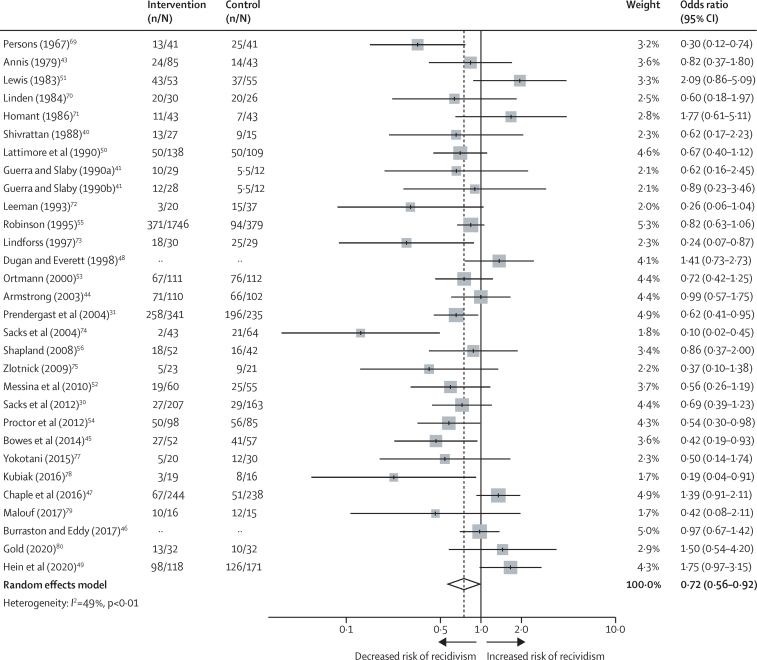
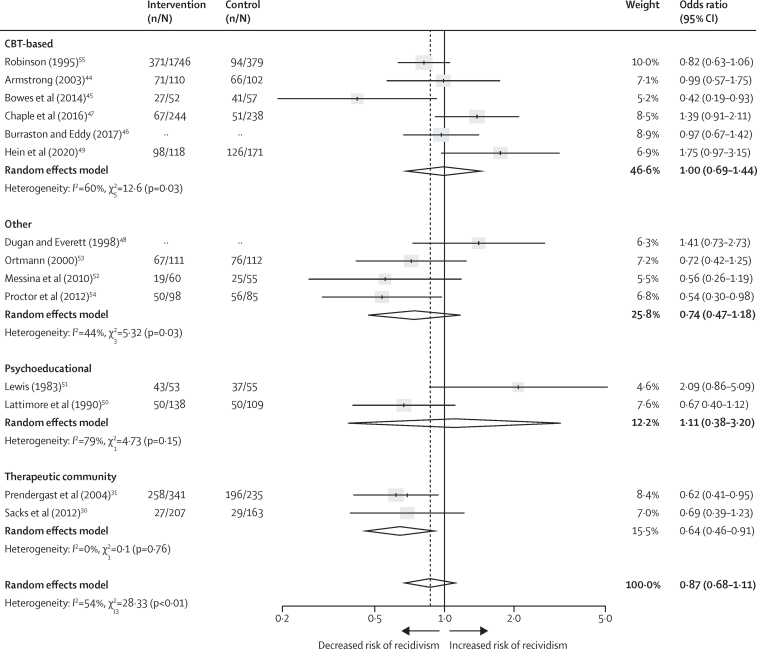
This systematic review and meta-analysis of 29 RCTs (9443 participants) found psychological interventions in prison were associated with reduced recidivism overall (OR 0.72, 95% CI 0.56–0.92), but the effect was no longer significant after excluding smaller studies (<50 intervention participants; OR 0.87, 95% CI 0.68–1.11). Therapeutic communities were associated with reduced recidivism based on two studies (OR 0.64, 95% CI 0.46–0.91), while CBT-based interventions were not (OR 1.00, 95% CI 0.69–1.44).
Key findings
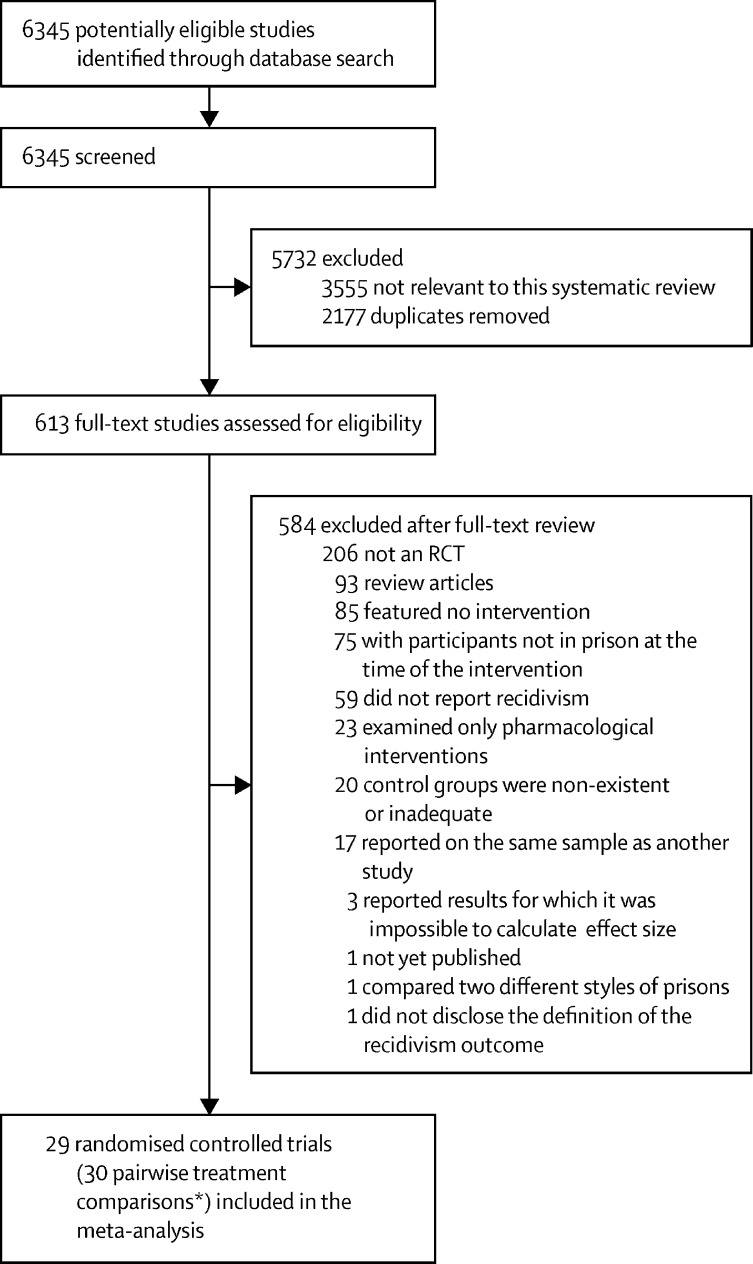
- Of 6345 articles retrieved, 29 RCTs (9443 participants; 1104 [11.7%] female, 8111 [85.9%] male, 228 [2.4%] unknown sex) met inclusion criteria for the primary outcome; 6528 participants had recidivism outcome data.
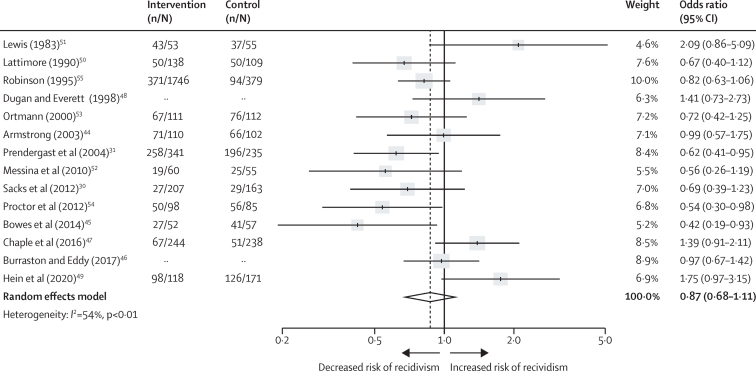
- In all 29 RCTs, psychological interventions were associated with reduced reoffending (OR 0.72, 95% CI 0.56–0.92; I²=49%); after excluding studies with fewer than 50 participants in the intervention group, 14 trials (6446 followed-up participants) showed no significant reduction (OR 0.87, 95% CI 0.68–1.11; I²=54%).
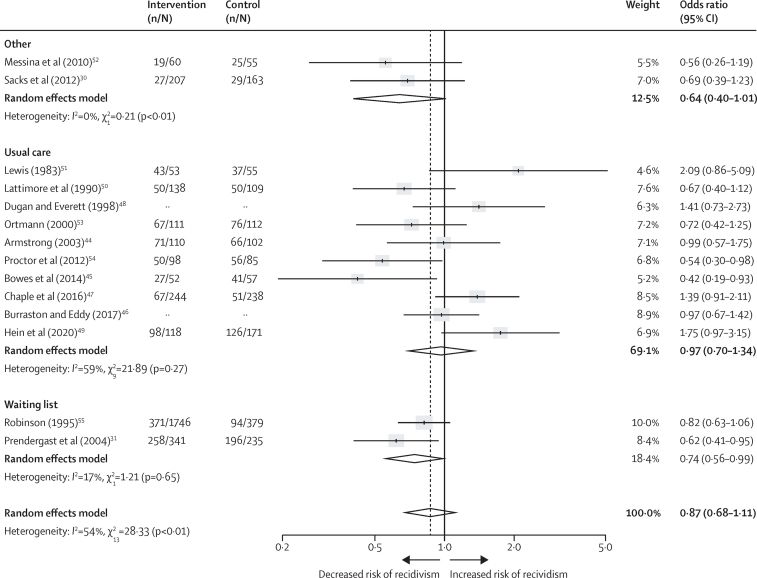
- By intervention type in the larger-study analysis, therapeutic communities were associated with reduced recidivism (OR 0.64, 95% CI 0.46–0.91; I²=0%), whereas CBT-based interventions (OR 1.00, 95% CI 0.69–1.44; I²=60%) and psychoeducational interventions (OR 1.11, 95% CI 0.38–3.20; I²=79%) were not.
- Evidence of publication bias was found (Egger’s test t=−2.12, p=0.04); trim-and-fill adjusted OR was 0.86 (95% CI 0.65–1.15), and restricting to studies with ≥100 intervention participants gave OR 0.90 (95% CI 0.71–1.14).
Methods
- Systematic review and meta-analysis of RCTs; searched Cochrane Central Register of Controlled Trials, Embase, Global Health, MEDLINE, PsycINFO, and Google Scholar from database inception to Feb 17, 2021, without language restrictions; included psychological or psychoeducational interventions delivered in jail or prison to incarcerated adolescents and adults, with recidivism after release as an outcome.
- Data were extracted and appraised per a prespecified protocol; risk of bias assessed with Cochrane RoB 2; effect sizes converted to odds ratios; primary outcome recidivism; random-effects meta-analysis used, with planned sensitivity analysis excluding studies with fewer than 50 participants and subgroup/meta-regression analyses by study size, control group, and intervention type; protocol registered with PROSPERO, CRD42020167228.
- Included 29 RCTs (27 two-arm, 2 three-arm) describing 31 psychological interventions combined into 30 pairwise comparisons; 9443 participants; mean age 31.4 years (SD 4.9) for adults and 17.5 years (SD 1.9) for adolescents; trials were from the USA (19), Canada (4), UK (2), Germany (1), Sweden (1), Japan (1), and Norway (1).
Limitations
- Stated in the paper: study selection up to full-text screening was done by a single reviewer; included trials were from high-income countries; only 29 studies were included; high dropout rates often resulted in small and selective samples; only 2 (7%) of 29 studies had low risk of bias, with randomisation and deviations from intended interventions the most affected domains; masking difficulties likely contributed to bias; evidence of selective publication of small studies; sex-specific analyses comparing females and males could not be done because of insufficient female-only samples.
- Evident from the text: race or ethnicity data were not sufficiently reported to be aggregated; most RCTs were rated as having concerns (n=18, 60%) or high risk of bias (n=10, 33%); the therapeutic community finding was based on only two studies; heterogeneity was moderate to substantial in several analyses.
- Evident from the text: the overall significant effect was attenuated and no longer significant after excluding smaller studies, and publication bias analyses suggested the initial pooled estimate was overestimated.
Model-written summary. Check it against the paper before relying on it.
Integrity signals
Registry
Cites
Statistics
Figures
Verification
Claims the paper makes
6 Valid · 3 Not valid · 21 Not checked · 54 Own results and interpretations
Some cited sources support this claim and some don’t — read each source’s verdict below.
In the paper
“In addition, the number of included studies was not large (n=29), which underlines the legal, practical, and ethical challenges of doing high-quality research in prisons.58, 90, 91”
§ Effectiveness of psychological interventions in prison to reduce recidivism: a systematic review and meta-analysis of randomised controlled trials > Discussion
What the sources say
- Not checked — no full text of the sourcecites [58] Farrington DP Welsh BC Randomized experiments in criminology: what have we learned in the last two decades? J Exp Criminol 1 2005 9 38 source
- Disputedcites [90] Yoon IA Slade K Fazel S Outcomes of psychological therapies for prisoners with mental health problems: a systematic review and meta-analysis J Consult Clin Psychol 85 2017 783 802 28569518 PMC5518650 sourceExperimental — accuracy not yet measured
The Discussion (Strengths and Limitations; page unavailable) says this review included 37 trials, not 29. The Results (Metaregression Results; page unavailable) likewise describes 37 studies included in its quantitative analysis. (LLM, conf=0.90)
Checked by a reasoning model — may be wrong.
- Supportedcites [91] Quina K Garis AV Stevenson J Through the bullet-proof glass: conducting research in prison settings J Trauma Dissociation 8 2007 123 139 17804387 source
The citation is attached to the clause about the legal, practical and ethical challenges of doing high-quality prison research, not to the n=29 figure (which is the citing review's own count). Our copy supports that clause throughout: the INTRODUCTION frames the paper as 'identifying important ethical and pragmatic considerations for those hoping to work within prison systems'; the ETHICAL ISSUES section lists the 'laundry list of ethical codes' (DOC Code of Ethics, university IRB, NIJ regulations, APA principles, state licensure codes), the federal/state assurances obtained for data protection, and legal limits on the questions they could ask ('might place them in legal jeopardy'); and CONCERNS, CHALLENGES, AND CREATIVE SOLUTIONS details the practical hassles (CO obstruction, bed checks, lock downs, staff resistance, psychometric inadequacy in incarcerated populations). (LLM, conf=0.85)
plainn = 29- Asserted: passes — The authors put it forward as true.
- Checkable: passes — It can be checked against evidence.
- Load-bearing: unclear — It is unclear whether the paper’s conclusions depend on it.
- Based: passes — The paper gives a reason why it holds.
The sources with a verdict support this claim; the rest weren’t checked yet, have no full text we could read, or their verdicts aren’t rated yet.
In the paper
“Previous reviews have often focused on specific groups—eg, women,26, 29 adolescents,20, 23 individuals who use drugs,25 people living with a mental health condition,18 and people with sexual21, 28 or other violent19, 27 index offences.”
§ Effectiveness of psychological interventions in prison to reduce recidivism: a systematic review and meta-analysis of randomised controlled trials > Introduction
What the sources say
- Not checked — no full text of the sourcecites [26] Tripodi SJ Bledsoe SE Kim JS Bender K Effects of correctional-based programs for female inmates: a systematic review Res Soc Work Pract 21 2011 15 31 source
- Not checked — no full text of the sourcecites [29] Dowden C Andrews DA What works for female offenders: a meta-analytic review Crime Delinq 45 1999 438 452 source
- Not checked — no full text of the sourcecites [20] Koehler JA Lösel F Akoensi TD Humphreys DK A systematic review and meta-analysis on the effects of young offender treatment programs in Europe J Exp Criminol 9 2013 19 43 23207239 source
- Not checked — no full text of the sourcecites [23] Lipsey MW Wilson D Effective intervention for serious juvenile offenders: a synthesis of research Loeber RM Farrington DP Serious and violent juvenile offenders: risk factors and successful intervention 1998 Sage Publications Thousand Oaks, CA 313 345 source
- Supportedcites [18] Hopkin G Evans-Lacko S Forrester A Shaw J Thornicroft G Interventions at the transition from prison to the community for prisoners with mental illness: a systematic review Adm Policy Ment Health 45 2018 623 634 29362981 PMC5999162 source
Citation 18 is attached to the example of reviews focused on people living with a mental health condition, not to the other groups listed. The Introduction states that this systematic review focuses on prisoners diagnosed with a mental health condition during the transition from prison to the community. (LLM, conf=0.94)
plain- Asserted: passes — The authors put it forward as true.
- Checkable: passes — It can be checked against evidence.
- Load-bearing: passes — The paper’s conclusions depend on it.
- Based: passes — The paper gives a reason why it holds.
The cited sources support only part of this claim — read each source’s verdict below.
In the paper
“Overall, the effectiveness of most prison-based treatments on recidivism remains unclear because the evidence is inconsistent and subject to a range of limitations.18, 19, 20, 21, 22, 23, 24, 25, 26, 27, 28”
§ Effectiveness of psychological interventions in prison to reduce recidivism: a systematic review and meta-analysis of randomised controlled trials > Introduction
What the sources say
- Partly supportedcites [18] Hopkin G Evans-Lacko S Forrester A Shaw J Thornicroft G Interventions at the transition from prison to the community for prisoners with mental illness: a systematic review Adm Policy Ment Health 45 2018 623 634 29362981 PMC5999162 sourceExperimental — accuracy not yet measured
The Conclusion says evidence on reoffending is equivocal, and the Results’ quality assessment identifies weaknesses in the included studies. But this review examines interventions for prisoners with mental illness at the transition to the community; it does not establish that the effectiveness of most prison-based treatments generally is unclear. (LLM, conf=0.86)
- Not matchedcites [19] Jolliffe D Farrington DP A systematic review of the national and international evidence on the effectiveness of interventions with violent offenders 2007 Ministry of Justice London
Its entry has no title and year that we can search by.
- Not checked — no full text of the sourcecites [20] Koehler JA Lösel F Akoensi TD Humphreys DK A systematic review and meta-analysis on the effects of young offender treatment programs in Europe J Exp Criminol 9 2013 19 43 23207239 source
- Partly supportedcites [21] Långström N Enebrink P Laurén E-M Lindblom J Werkö S Hanson RK Preventing sexual abusers of children from reoffending: systematic review of medical and psychological interventions BMJ 347 2013 f4630 PMC3739685 23935058 sourceExperimental — accuracy not yet measured
The Discussion (page unavailable) says the adult trial was too small to establish an effect and that the observational studies had limitations preventing reliable conclusions. The study table includes prison-based interventions, but the review concerns sexual reoffending against children; it does not establish that most prison-based treatments for recidivism generally have unclear effectiveness. (LLM, conf=0.87)
- Not checked — no full text of the sourcecites [22] Lipsey MW Cullen FT The effectiveness of correctional rehabilitation: a review of systematic reviews Annu Rev Law Soc Sci 3 2007 297 320 source
- Not checked — no full text of the sourcecites [23] Lipsey MW Wilson D Effective intervention for serious juvenile offenders: a synthesis of research Loeber RM Farrington DP Serious and violent juvenile offenders: risk factors and successful intervention 1998 Sage Publications Thousand Oaks, CA 313 345 source
- Not checked — no full text of the sourcecites [24] Papalia N Spivak B Daffern M Ogloff JR A meta-analytic review of the efficacy of psychological treatments for violent offenders in correctional and forensic mental health settings Clin Psychol Sci Pract 26 2019 e12282 source
- Partly supportedcites [25] Perry AE Woodhouse R Neilson M Are non-pharmacological interventions effective in reducing drug use and criminality? A systematic and meta-analytical review with an economic appraisal of these interventions Int J Environ Res Public Health 13 2016 966 PMC5086705 27690077 sourceExperimental — accuracy not yet measured
The Limitations section says evidence for most reviewed interventions for drug-using offenders is limited, citing heterogeneous findings and study limitations including small samples, attrition, and selection bias. But the review is not about prison-based treatments generally, and it expressly excepts therapeutic communities, for which it reports a reduction in re-arrests (Discussion; Results §3.2.4). (LLM, conf=0.84)
- Not checked — no full text of the sourcecites [26] Tripodi SJ Bledsoe SE Kim JS Bender K Effects of correctional-based programs for female inmates: a systematic review Res Soc Work Pract 21 2011 15 31 source
- Not checked — no full text of the sourcecites [27] Papalia N Spivak B Daffern M Ogloff JR Are psychological treatments for adults with histories of violent offending associated with change in dynamic risk factors? A meta-analysis of intermediate treatment outcomes Crim Justice Behav 47 2020 1585 1608 source
plain- Asserted: passes — The authors put it forward as true.
- Checkable: passes — It can be checked against evidence.
- Load-bearing: passes — The paper’s conclusions depend on it.
- Based: passes — The paper gives a reason why it holds.
- Partly supported
The cited sources support only part of this claim — read each source’s verdict below.
In the paper
“Two studies49, 74 that contributed disproportionately to the pooled effect were identified using influence analyses in all RCTs.”
§ Effectiveness of psychological interventions in prison to reduce recidivism: a systematic review and meta-analysis of randomised controlled trials > Results
What the sources say
- Partly supportedcites [49] Hein S Weeland J Square A Effectiveness of a social problem solving training in youth in detention or on probation: an RCT and pre-post community implementation Int J Law Psychiatry 72 2020 101626 32889425 sourceExperimental — accuracy not yet measured
Section 8.1 (Participants; page unavailable) confirms that this paper reports a randomized trial, so the citation identifies a relevant RCT. The paper does not report an influence analysis across RCTs or establish that its study contributed disproportionately to a pooled effect; searches for those terms returned only analyses within this study. (LLM, conf=0.83)
- Not checked — no full text of the sourcecites [74] Sacks S Sacks JY McKendrick K Banks S Stommel J Modified TC for MICA offenders: crime outcomes Behav Sci Law 22 2004 477 501 15282836 source
plainstates an association- Asserted: passes — The authors put it forward as true.
- Checkable: passes — It can be checked against evidence.
- Load-bearing: unclear — It is unclear whether the paper’s conclusions depend on it.
- Based: passes — The paper gives a reason why it holds.
- Partly supported
The cited sources support only part of this claim — read each source’s verdict below.
In the paper
“we pooled results excluding studies with fewer than 50 participants in the experimental group, as a planned sensitivity analysis”
§ Effectiveness of psychological interventions in prison to reduce recidivism: a systematic review and meta-analysis of randomised controlled trials > Results
What the sources say
- Not checked — no full text of the sourcecites [65] Schwarzer G Carpenter JR Rücker G Meta-analysis with R 2015 Springer London source
- Partly supportedcites [66] Turner RM Bird SM Higgins JPT The impact of study size on meta-analyses: examination of underpowered studies in Cochrane reviews PLoS One 8 2013 e59202 PMC3609745 23544056 sourceExperimental — accuracy not yet measured
The Introduction (page unavailable) says small studies tend to report larger effects, and the Impact of Underpowered Studies section compares meta-analysis results with and without underpowered studies. But the paper defines its exclusion by less than 50% power to detect a 30% relative risk reduction—not fewer than 50 participants in the experimental group—and does not establish the citing authors’ analysis as planned. (LLM, conf=0.88)
plainn = 6,446- Asserted: passes — The authors put it forward as true.
- Checkable: passes — It can be checked against evidence.
- Load-bearing: passes — The paper’s conclusions depend on it.
- Based: passes — The paper gives a reason why it holds.
43 more claims · 1 with their cited sources checked
Create a free account to see all 84 claims and to verify the 3 references still open.
- It may state two separate claims as one. 14
- Probably not a substantial claim. 26
Self-check
Percentages, sums and reported differences re-computed from the paper’s own numbers.
Each contradiction between two passages listed here was confirmed by an independent check.
Rated major: it would touch a result — a value a result rests on, reported and recomputed p-values on opposite sides of the significance level, two passages that conflict with no sign which is right, or a cited work retracted before this paper was published.
In the paper
§ Effectiveness of psychological interventions in prison to reduce recidivism: a systematic review and meta-analysis of randomised controlled trials > Results
“The reduction in recidivism was attenuated in the 14 trials (6446 followed-up participants) with an intervention group of at least 50 participants”
§ Effectiveness of psychological interventions in prison to reduce recidivism: a systematic review and meta-analysis of randomised controlled trials > Results
“and 6528 (1118 [17·1%] adolescents and 5410 [82·9%] adults) had recidivism outcome data.”
Citations
Cites
R: A Language and Environment for Statistical Computing
R Core Team (2025) · doi:10.32614/r.manuals · Cited by 352,181
Preferred Reporting Items for Systematic Reviews and Meta-Analyses: the PRISMA statement
Moher, D., Liberati, A., Tetzlaff, J., Altman, D. G., & for the PRISMA Group (2009) · BMJ · doi:10.1136/bmj.b2535 · Cited by 83,823
Bias in meta-analysis detected by a simple, graphical test
Egger, M., Smith, G. D., Schneider, M., & Minder, C. (1997) · BMJ · doi:10.1136/bmj.315.7109.629 · Cited by 56,722
Preferred reporting items for systematic reviews and meta-analyses: the PRISMA Statement.
(2009) · PubMed Central · Cited by 44,859
Preferred reporting items for systematic reviews and meta-analyses: The PRISMA statement
Moher, D., Liberati, A., Tetzlaff, J., Altman, D. G., & the PRISMA Group* (2009) · Annals of Internal Medicine · doi:10.7326/0003-4819-151-4-200908180-00135 · Cited by 37,554
RoB 2: a revised tool for assessing risk of bias in randomised trials
Sterne, J. A. C., Savović, J., Page, M. J., Elbers, R. G., Blencowe, N. S., Boutron, I., Cates, C. J., Cheng, H.-Y., Corbett, M. S., Eldridge, S. M., et al. (2019) · BMJ · doi:10.1136/bmj.l4898 · Cited by 34,787
Duval, S., & Tweedie, R. (2000) · Biometrics · doi:10.1111/j.0006-341x.2000.00455.x · Cited by 14,099
Borenstein, M., Hedges, L. V., Higgins, J. P. T., & Rothstein, H. R. (2021) · doi:10.1002/9781119558378 · Cited by 9,799
Classification for Effective Rehabilitation: Rediscovering Psychology
ANDREWS, D. A., BONTA, J., & HOGE, R. D. (1990) · Criminal Justice and Behavior · doi:10.1177/0093854890017001004 · Cited by 1,895
(2010) · Paediatric and Perinatal Epidemiology · doi:10.1111/j.1365-3016.2010.01108.x · Cited by 1,443
Schwarzer, G., Carpenter, J. R., & Rücker, G. (2015) · Use R! · doi:10.1007/978-3-319-21416-0 · Cited by 1,230
The heterogeneity statistic I2 can be biased in small meta-analyses
von Hippel, P. T. (2015) · BMC Medical Research Methodology · doi:10.1186/s12874-015-0024-z · Cited by 1,229
Rehabilitating criminal justice policy and practice
Andrews, D. A., & Bonta, J. (2010) · Psychology, Public Policy, and Law · doi:10.1037/a0018362 · Cited by 1,223
Landenberger, N. A., & Lipsey, M. W. (2005) · Journal of Experimental Criminology · doi:10.1007/s11292-005-3541-7 · Cited by 850
The effectiveness of treatment for sexual offenders: a comprehensive meta-analysis
L�sel, F., & Schmucker, M. (2005) · Journal of Experimental Criminology · doi:10.1007/s11292-004-6466-7 · Cited by 806
The Principles of Effective Correctional Treatment Also Apply To Sexual Offenders: A Meta-Analysis
Hanson, R. K., Bourgon, G., Helmus, L., & Hodgson, S. (2009) · Criminal Justice and Behavior · doi:10.1177/0093854809338545 · Cited by 774
The effectiveness of correctional rehabilitation: a review of systematic reviews
Lipsey, M. W., & Cullen, F. T. (2007) · Annual Review of Law and Social Science · doi:10.1146/annurev.lawsocsci.3.081806.112833 · Cited by 763
Baujat, B., Mahé, C., Pignon, J., & Hill, C. (2002) · Statistics in Medicine · doi:10.1002/sim.1221 · Cited by 744
Peters, J. L., Sutton, A. J., Jones, D. R., Abrams, K. R., & Rushton, L. (2007) · Statistics in Medicine · doi:10.1002/sim.2889 · Cited by 716
The impact of study size on meta-analyses: examination of underpowered studies in Cochrane reviews
Turner, R. M., Bird, S. M., & Higgins, J. P. T. (2013) · PLoS ONE · doi:10.1371/journal.pone.0059202 · Cited by 672
Cuijpers, P., van Straten, A., Bohlmeijer, E., Hollon, S. D., & Andersson, G. (2010) · Psychological Medicine · doi:10.1017/s0033291709006114 · Cited by 533
A Quantitative Review of Structured, Group-Oriented, Cognitive-Behavioral Programs for Offenders
Wilson, D. B., Bouffard, L. A., & Mackenzie, D. L. (2005) · Criminal Justice and Behavior · doi:10.1177/0093854804272889 · Cited by 445
Effective Intervention for Serious Juvenile Offenders: A Synthesis of Research
Lipsey, M. W., & Wilson, D. B. (1999) · Serious & Violent Juvenile Offenders: Risk Factors and Successful Interventions · doi:10.4135/9781452243740.n13 · Cited by 443
What works for female offenders: a meta-analytic review
Dowden, C., & Andrews, D. A. (1999) · Crime & Delinquency · doi:10.1177/0011128799045004002 · Cited by 423
Cognitive mediators of aggression in adolescent offenders: II. Intervention.
Guerra, N. G., & Slaby, R. G. (1990) · Developmental Psychology · doi:10.1037//0012-1649.26.2.269 · Cited by 386
Schmucker, M., & Lösel, F. (2015) · Journal of Experimental Criminology · doi:10.1007/s11292-015-9241-z · Cited by 376
Effective correctional treatment and violent reoffending: A meta-analysis
Dowden, C., & Andrews, D. A. (2000) · Canadian Journal of Criminology · doi:10.3138/cjcrim.42.4.449 · Cited by 367
Does research design affect study outcomes in criminal justice?
Weisburd, D., Lum, C. M., & Petrosino, A. (2001) · The ANNALS of the American Academy of Political and Social Science · doi:10.1177/000271620157800104 · Cited by 335
The Effects of Behavioral/Cognitive-Behavioral Programs on Recidivism
Pearson, F. S., Lipton, D. S., Cleland, C. M., & Yee, D. S. (2002) · Crime & Delinquency · doi:10.1177/001112870204800306 · Cited by 314
Randomized experiments in criminology: what have we learned in the last two decades?
Farrington, D. P., & Welsh, B. C. (2005) · Journal of Experimental Criminology · doi:10.1007/s11292-004-6460-0 · Cited by 297
WEXLER, H. K., MELNICK, G., LOWE, L., & PETERS, J. (1999) · The Prison Journal · doi:10.1177/0032885599079003003 · Cited by 280
Effects of Cognitive‐Behavioral Programs for Criminal Offenders
Lipsey, M. W., Landenberger, N. A., & Wilson, S. J. (2007) · Campbell Systematic Reviews · doi:10.4073/csr.2007.6 · Cited by 268
Zlotnick, C., Johnson, J., & Najavits, L. M. (2009) · Behavior Therapy · doi:10.1016/j.beth.2008.09.004 · Cited by 221
A Randomized Experimental Study of Gender-Responsive Substance Abuse Treatment for Women in Prison
Messina, N., Grella, C. E., Cartier, J., & Torres, S. (2010) · Journal of Substance Abuse Treatment · doi:10.1016/j.jsat.2009.09.004 · Cited by 211
A systematic review and meta-analysis on the effects of young offender treatment programs in Europe
Koehler, J. A., Lösel, F., Akoensi, T. D., & Humphreys, D. K. (2013) · Journal of Experimental Criminology · doi:10.1007/s11292-012-9159-7 · Cited by 190
Amity prison-based therapeutic community: 5-year outcomes
Prendergast, M. L., Hall, E. A., Wexler, H. K., Melnick, G., & Cao, Y. (2004) · The Prison Journal · doi:10.1177/0032885503262454 · Cited by 188
The Amity Prison TC Evaluation: Reincarceration Outcomes
WEXLER, H. K., De LEON, G., THOMAS, G., KRESSEL, D., & PETERS, J. (1999) · Criminal Justice and Behavior · doi:10.1177/0093854899026002001 · Cited by 184
Does restorative justice affect reconviction? The fourth report from the evaluation of three schemes
Shapland, J., Atkinson, A., Atkinson, H., Dignan, J., Edwards, L. F. T. I. B. D., Hibbert, J. R., Howes, M., Johnstone, J., Robinson, G., & Sorsby, A. (2008) · Newcastle University ePrints (Newcastle Univesity) · doi:10.25405/ncl.34185459 · Cited by 184
Akoensi, T. D., Koehler, J., Lösel, F. A., & Humphreys, D. K. (2012) · International Journal of Offender Therapy and Comparative Criminology · doi:10.1177/0306624x12468110 · Cited by 182
Effects of cognitive-behavioral programs for criminal offenders
Lipsey, M. W., Landenberger, N. A., & Wilson, S. J. (2007) · Universitätsbibliothek Tübingen · doi:10.15496/publikation-6061 · Cited by 171
Yoon, I. A., Slade, K., & Fazel, S. (2017) · Journal of Consulting and Clinical Psychology · doi:10.1037/ccp0000214 · Cited by 167
Self-citationA systematic review and meta-analysis on the effectiveness of CBT informed anger management
Henwood, K. S., Chou, S., & Browne, K. D. (2015) · Aggression and Violent Behavior · doi:10.1016/j.avb.2015.09.011 · Cited by 158
Langstrom, N., Enebrink, P., Lauren, E.-M., Lindblom, J., Werko, S., & Hanson, R. K. (2013) · BMJ · doi:10.1136/bmj.f4630 · Cited by 147
Parole, Desistance from Crime, and Community Integration
Rosenfeld, R. (2008) · National Academies Press eBooks · doi:10.17226/11988 · Cited by 139
Modified TC for MICA offenders: crime outcomes
Sacks, S., Sacks, J. Y., McKendrick, K., Banks, S., & Stommel, J. (2004) · Behavioral Sciences & the Law · doi:10.1002/bsl.599 · Cited by 130
Papalia, N., Spivak, B., Daffern, M., & Ogloff, J. R. P. (2019) · Clinical Psychology: Science and Practice · doi:10.1111/cpsp.12282 · Cited by 130
How to prove that your therapy is effective, even when it is not: a guideline
Cuijpers, P., & Cristea, I. A. (2016) · Epidemiology and Psychiatric Sciences · doi:10.1017/s2045796015000864 · Cited by 122
Hopkin, G., Evans-Lacko, S., Forrester, A., Shaw, J., & Thornicroft, G. (2018) · Administration and Policy in Mental Health and Mental Health Services Research · doi:10.1007/s10488-018-0848-z · Cited by 119
Sacks, S., Chaple, M., Sacks, J. Y., McKendrick, K., & Cleland, C. M. (2011) · Journal of Substance Abuse Treatment · doi:10.1016/j.jsat.2011.07.011 · Cited by 104
Fazel, S., Chang, Z., Fanshawe, T., Långström, N., Lichtenstein, P., Larsson, H., & Mallett, S. (2016) · The Lancet Psychiatry · doi:10.1016/s2215-0366(16)00103-6 · Cited by 100
Self-citationA systematic review of criminal recidivism rates worldwide: 3-year update
Yukhnenko, D., Sridhar, S., & Fazel, S. (2020) · Wellcome Open Research · doi:10.12688/wellcomeopenres.14970.3 · Cited by 88
Self-citationWelsh, B. C., Peel, M. E., Farrington, D. P., Elffers, H., & Braga, A. A. (2011) · Journal of Experimental Criminology · doi:10.1007/s11292-010-9117-1 · Cited by 79
Sacks, J. Y., McKendrick, K., & Hamilton, Z. (2012) · Journal of Addictive Diseases · doi:10.1080/10550887.2012.694601 · Cited by 77
Scared Straight — California Style: Evaluation of the San Quentin Squires Program
LEWIS, R. V. (1983) · Criminal Justice and Behavior · doi:10.1177/0093854883010002005 · Cited by 67
Long-Term Outcomes of a RCT Intervention Study for Women with Violent Crimes
Kubiak, S. P., Fedock, G. L., Kim, W. J., & Bybee, D. I. (2016) · Journal of the Society for Social Work and Research · doi:10.1086/689356 · Cited by 65
Effects of Correctional-Based Programs for Female Inmates: A Systematic Review
Tripodi, S. J., Bledsoe, S. E., Kim, J. S., & Bender, K. (2011) · Research on Social Work Practice · doi:10.1177/1049731509352337 · Cited by 63
Solution-Focused Therapy in Prison
Lindforss, L., & Magnusson, D. (1997) · Contemporary Family Therapy · doi:10.1023/a:1026114501186 · Cited by 60
Effectiveness of Correctional Programs With Ethnically Diverse Offenders: A Meta-Analytic Study
Usher, A. M., & Stewart, L. A. (2012) · International Journal of Offender Therapy and Comparative Criminology · doi:10.1177/0306624x12469507 · Cited by 56
Malouf, E. T., Youman, K., Stuewig, J., Witt, E. A., & Tangney, J. P. (2017) · Mindfulness · doi:10.1007/s12671-016-0636-3 · Cited by 55
Interventions for drug-using offenders with co-occurring mental health problems
Perry, A., James, M. M., Burns, L., Hewitt, C. E., Glanville, J., Aboaja, A. M., Thakkar, P. B., Kumar, K. M. S., Pearson, C., Wright, K. E., et al. (2019) · Cochrane Database of Systematic Reviews · doi:10.1002/14651858.cd010901.pub3 · Cited by 55
Self-citationArmstrong, T. A. (2003) · Criminal Justice and Behavior · doi:10.1177/0093854803256452 · Cited by 53
Integrating the therapeutic community and work release for drug-involved offenders
Nielsen, A. L., Scarpitti, F. R., & Inciardi, J. A. (1996) · Journal of Substance Abuse Treatment · doi:10.1016/s0740-5472(96)00112-2 · Cited by 53
Psychoeducational programs for reducing prison violence: a systematic review
Auty, K. M., Cope, A., & Liebling, A. (2017) · Aggression and Violent Behavior · doi:10.1016/j.avb.2017.01.018 · Cited by 50
Lipsey, M. W., & Landenberger, N. A. (2007) · Campbell Systematic Reviews: Better Evidence for a Better World · doi:10.1002/cl2.42 · Cited by 46
Experimental Assessment of the Effect of Vocational Training On Youthful Property Offenders
Lattimore, P. K., Witte, A. D., & Baker, J. R. (1990) · Evaluation Review · doi:10.1177/0193841x9001400201 · Cited by 45
The Effectiveness of Social Therapy in Prison—A Randomized Experiment
Ortmann, R. (2000) · Crime & Delinquency · doi:10.1177/0011128700046002005 · Cited by 45
An Evaluation of a Prison Education Program
Linden, R., & Perry, L. (1984) · Canadian Journal of Criminology · doi:10.3138/cjcrim.26.1.65 · Cited by 44
Proctor, S. L., Hoffmann, N. G., & Allison, S. (2012) · International Journal of Offender Therapy and Comparative Criminology · doi:10.1177/0306624x11399274 · Cited by 43
Interrupting the mental illness–incarceration–recidivism cycle
Hirschtritt, M. E., & Binder, R. L. (2017) · JAMA · doi:10.1001/jama.2016.20992 · Cited by 41
A systematic review of criminal recidivism rates worldwide: 3-year update
Yukhnenko, D., Sridhar, S., & Fazel, S. (2019) · Wellcome Open Research · doi:10.12688/wellcomeopenres.14970.1 · Cited by 39
Self-citationInterventions for female drug-using offenders
Perry, A., Neilson, M., James, M. M., Glanville, J., Woodhouse, R., & Hewitt, C. E. (2015) · Cochrane Database of Systematic Reviews · doi:10.1002/14651858.cd010910.pub2 · Cited by 38
Self-citationThrough the bullet-proof glass: conducting research in prison settings
Quina, K., Garis, A. V., Stevenson, J., Garrido, M., Brown, J., Richman, R., Renzi, J., Fox, J., & Mitchell, K. (2007) · Journal of Trauma & Dissociation · doi:10.1300/j229v08n02_08 · Cited by 36
Farrell, A. S. (2000) · Women & Criminal Justice · doi:10.1300/j012v11n01_02 · Cited by 32
An Experimental Test of Chemical Dependency Therapy for Jail Inmates
Dugan, J. R., & Everett, R. S. (1998) · International Journal of Offender Therapy and Comparative Criminology · doi:10.1177/0306624x9804200407 · Cited by 27
Beyond the prison bubble: (725192011-005)
Petersilia, J. (2011) · PsycEXTRA Dataset · doi:10.1037/e725192011-005 · Cited by 27
Relationship between psychotherapy with institutionalized boys and subsequent community adjustment
Persons, R. W. (1967) · Journal of Consulting Psychology · doi:10.1037/h0024443 · Cited by 26
A randomised controlled trial of a cognitive skills programme for offenders with mental illness
Kingston, D. A., Olver, M. E., McDonald, J., & Cameron, C. (2018) · Criminal Behaviour and Mental Health · doi:10.1002/cbm.2077 · Cited by 26
Treatment research in prison: Problems and solutions in a randomized trial
Lobmaier, P. P. K., Kunøe, N., & Waal, H. (2009) · Addiction Research & Theory · doi:10.3109/16066350802531273 · Cited by 25
Group Treatment of Incarcerated Offenders with Alcohol and Drug Problems: A Controlled Evaluation
Annis, H. M. (1979) · Canadian Journal of Criminology · doi:10.3138/cjcrim.21.1.3 · Cited by 24
Interventions for female drug-using offenders
Perry, A., James, M. M., Burns, L., Hewitt, C. E., Glanville, J., Aboaja, A. M., Thakkar, P. B., Kumar, K. M. S., Pearson, C., & Wright, K. E. (2019) · Cochrane Database of Systematic Reviews · doi:10.1002/14651858.cd010910.pub3 · Cited by 23
Self-citationA comparative study of the therapeutic education system for incarcerated substance-abusing offenders
Chaple, M., Sacks, S., McKendrick, K., Marsch, L. A., Belenko, S., Leukefeld, C., Prendergast, M., & French, M. (2016) · The Prison Journal · doi:10.1177/0032885516636858 · Cited by 22
Social lnteractional Training and Incarcerated Juvenile Delinquents
Shivratian, J. L. (1988) · Canadian Journal of Criminology · doi:10.3138/cjcrim.30.2.145 · Cited by 20
Perry, A., Woodhouse, R., Neilson, M., Martyn St James, M., Glanville, J., Hewitt, C., & Trépel, D. (2016) · International Journal of Environmental Research and Public Health · doi:10.3390/ijerph13100966 · Cited by 19
Self-citationPapalia, N., Spivak, B., Daffern, M., & Ogloff, J. R. P. (2020) · Criminal Justice and Behavior · doi:10.1177/0093854820956377 · Cited by 19
Effects of Personalized Feedback Interventions on Drug-Related Reoffending: a Pilot Study
Yokotani, K., & Tamura, K. (2015) · Prevention Science · doi:10.1007/s11121-015-0571-x · Cited by 17
(2013) · Europe PMC (PubMed Central) · Cited by 15
Burraston, B. O., & Eddy, J. M. (2017) · Smith College Studies in Social Work · doi:10.1080/00377317.2017.1248634 · Cited by 15
Gold, C., Due, F. B., Thieu, E. K., Hjørnevik, K., Tuastad, L., & Assmus, J. (2021) · International Journal of Offender Therapy and Comparative Criminology · doi:10.1177/0306624x20909216 · Cited by 14
Treating alcohol-related violence: a feasibility study of a randomized controlled trial in prisons
Bowes, N., McMurran, M., Evans, C., Oatley, G., Williams, B., & David, S. (2014) · The Journal of Forensic Psychiatry & Psychology · doi:10.1080/14789949.2014.895025 · Cited by 13
Hein, S., Weeland, J., Square, A., Haeffel, G. J., Chapman, J., Macomber, D., Lee, M., Foley Geib, C., & Grigorenko, E. L. (2020) · International Journal of Law and Psychiatry · doi:10.1016/j.ijlp.2020.101626 · Cited by 12
Ten years after: A follow-up of therapy effectiveness
Homant, R. J. (1986) · Journal of Offender Rehabilitation · doi:10.1080/10509674.1986.9963827 · Cited by 8
Evaluation of a multi-component group treatment program for juvenile delinquents
Leeman, L. W., Gibbs, J. C., & Fuller, D. (1993) · Aggressive Behavior · doi:10.1002/1098-2337(1993)19:4<281::aid-ab2480190404>3.0.co;2-w
Research works printed but not linked: 3
- Petersilia J Beyond the prison bubble Wilson Q 35 2011 50 55
- Jolliffe D Farrington DP A systematic review of the national and international evidence on the effectiveness of interventions with violent offenders 2007 Ministry of Justice London
- Higgins J Altman D Sterne J Cochrane handbook for systematic reviews of interventions. Version 5.0 2011 John Wiley & Sons Chichester
Cited by
Fazel, S., Hurton, C., Burghart, M., DeLisi, M., & Yu, R. (2024) · Journal of Criminal Justice · doi:10.1016/j.jcrimjus.2024.102197 · Cited by 96
Self-citationForensic mental health: envisioning a more empirical future
Tully, J., Hafferty, J. D., Whiting, D., Dean, K., & Fazel, S. (2024) · The Lancet Psychiatry · doi:10.1016/s2215-0366(24)00164-0 · Cited by 51
Self-citationQiu, H., Liang, K., Lu, L., Gao, Y., Li, H., Hu, X., Xing, H., Huang, X., & Gong, Q. (2023) · Journal of Affective Disorders · doi:10.1016/j.jad.2022.09.060 · Cited by 41
Multilevel network interventions: Goals, actions, and outcomes
Robins, G. L., Lusher, D., Broccatelli, C., Bright, D. A., Gallagher, H. C., Karkavandi, M. A., Matouš, P., Coutinho, J. A., Wang, P., Koskinen, J. H., et al. (2022) · Social Networks · doi:10.1016/j.socnet.2022.09.005 · Cited by 41
Kang, L., Shang, W., Gao, P., Wang, Y., Liu, J., & Liu, M. (2022) · Vaccines · doi:10.3390/vaccines10091569 · Cited by 34
“We also performed sensitivity analysis by excluding studies with a number of PLWH < 100 as studies with small sizes are susceptible to selection bias and tend to have larger treatment effects than large studies [35].”
Method
Metadata
- Authors
- Beaudry, G., Yu, R., Perry, A. E., & Fazel, S.
- Affiliations
- University of Oxford (GB)
- University of York (GB)
- Corresponding author
- Fazel, Seena
- Venue
- The Lancet Psychiatry
- Publisher
- Elsevier BV
- Published
- 2021-09
- Volume
- 8
- Issue
- 9
- Pages
- 759-773
- ISSN
- 2215-0366 (ISSN-L)
- PMC
- PMC8376657
- OpenAlex
- W3194307914
- Cited by
- 196
- References
- 96
- Citations by year
- 2026: 51 · 2025: 47 · 2024: 48 · 2023: 22 · 2022: 24 · 2021: 4
- FWCI
- 4.71
- Type
- journal article
- Language
- en
- Open access
- hybrid
- doi.org
- Licence
- cc-by
- www.elsevier.com/tdm/userlicense/1.0/ (tdm)
- www.elsevier.com/legal/tdmrep-license (tdm)
- creativecommons.org/licenses/by/4.0/ (vor)
- Locations
- The Lancet Psychiatry (publishedVersion, cc-by)
- PubMed Central (publishedVersion, cc-by)
- PubMed (publishedVersion)
- Funders
- Wellcome Trust (202836/Z/16/Z)
- Fonds de Recherche du Québec - Santé (282526)
- Topics
- Social Sciences › Sociology and Political Science › Criminal Justice and Corrections Analysis
- Social Sciences › Psychology › Clinical Psychology › Psychopathy, Forensic Psychiatry, Sexual Offending
- Social Sciences › Sociology and Political Science › Crime Patterns and Interventions
- Keywords
- recidivism, psychological intervention, prisons, incarceration, offenders, follow-up care, substance use disorders, antisocial behavior, adolescents, adults, treatment effectiveness, risk of bias, effect size heterogeneity, risk of bias assessment, risk of bias assessment tools
- MeSH terms
- Recidivism, Psychosocial Intervention, Humans, Prisons, Randomized Controlled Trials as Topic, Treatment Outcome, Criminals
About these checks
Registry, retraction, Cites and statistics results are computed, not judged, with one exception: a printed reference that no index lists is read once by a model before it counts as a citation error. Claims are extracted by a model and kept only when their quote appears verbatim in the text; each cited source is then checked, with a model’s help, for whether it says what the claim relies on. Those verdicts can be wrong — read the claim’s quote and the cited source before relying on one.
The claim verdicts this report counts are experimental: their accuracy is not yet measured.
A language model drew the claims from the paper on 2026-09-30, under version 3 of the claim definition (model deepseek-v4.1-flash, prompt extract-v3).
A second model labelled each claim on 2026-09-30 (model jev-1.13-20260917, definition revision gold-guideline-v0.2).
Cited sources are checked with a language model’s help (gpt-6-sol and qwen3.8-omni-flash).
Statistics and arithmetic are recomputed, not judged.
Confidence bands are shown only for fields calibrated on our annotated test set. None is calibrated yet, so no band is shown.
What counts as a claim ›How we measure confidence ›How we check this ›
Are you an author, or do you see a problem with this page? Request a review
Data sources
Bibliographic data: Semantic Scholar, OpenAlex, Crossref.
Contains information from the Semantic Scholar Academic Graph Datasets, made available under the ODC Attribution License (ODC-BY 1.0).
Semantic Scholar’s data is described in: Kinney, R., et al. (2023). The Semantic Scholar Open Data Platform. arXiv:2301.10140.
