

The DOI matches its Crossref record; 26 of the 26 references it cites were found in a registry or an index.
Effectiveness of a brief lay counsellor-delivered, problem-solving intervention for adolescent mental health problems in urban, low-income schools in India: a randomised controlled trial
Open accessAbstract
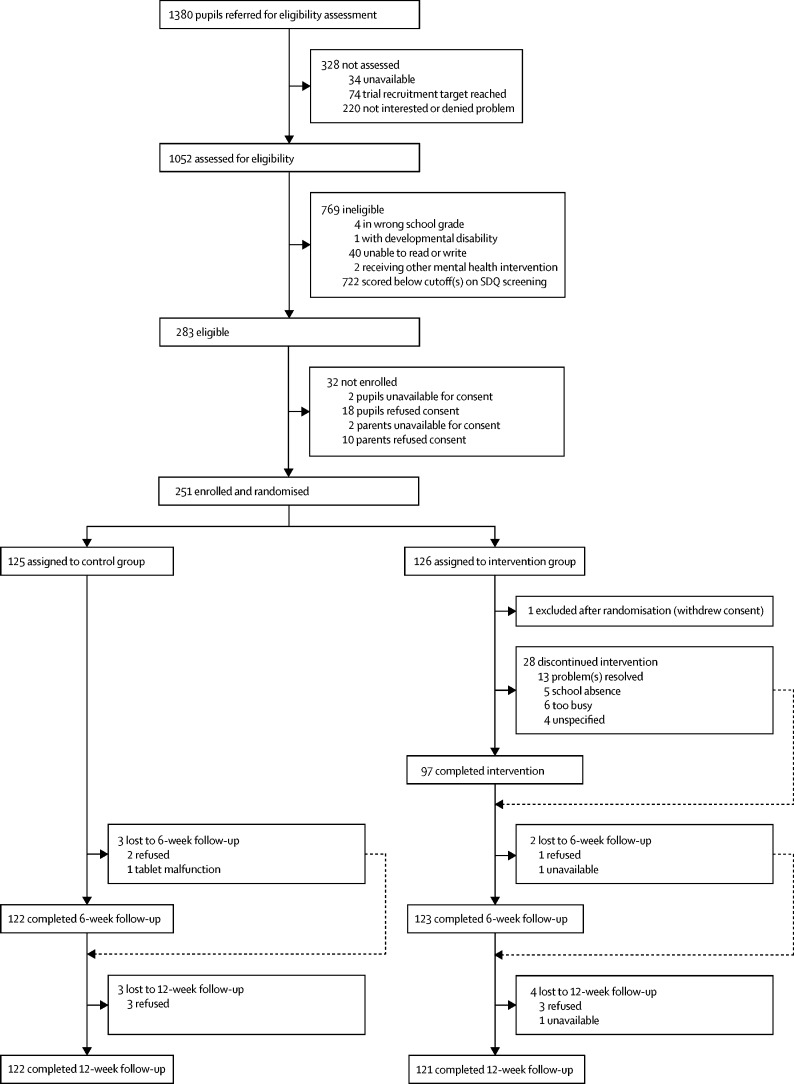
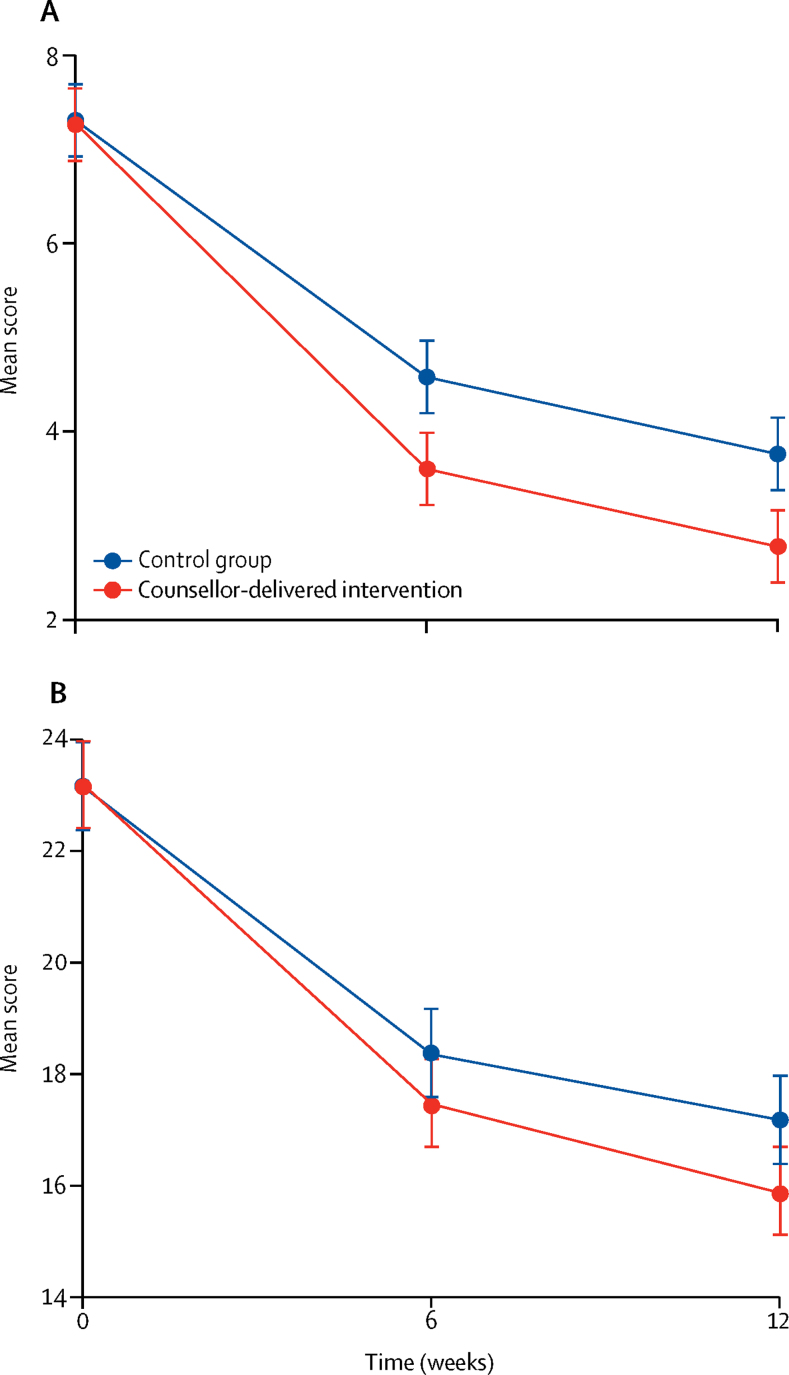
BACKGROUND: Mental health problems are a leading cause of disability in adolescents worldwide. Problem solving is a well-tested mental health intervention in many populations. We aimed to investigate the effectiveness of a brief, transdiagnostic problem-solving intervention for common adolescent mental health problems when delivered by non-specialist school counsellors in New Delhi, India. METHODS: This randomised trial was done in six government-run schools (three all-boys schools, two all-girls schools, and one co-educational school) that serve low-income communities. We recruited participants from grades 9 to 12 (ages 12-20 years) by selecting students with persistently elevated mental health symptoms accompanied by distress or functional impairment. Clinical eligibility criteria were assessed by research assistants using the Hindi-language version of the Strengths and Difficulties Questionnaire (SDQ), with reference to locally validated borderline cutoff scores of 19 or greater for boys and 20 or greater for girls on the SDQ Total Difficulties scale, an abnormal score of 2 or more on the SDQ Impact scale, and persistence of more than 1 month on the SDQ Chronicity index. Participants were randomly allocated (1:1) to problem solving delivered through a brief (2-3 week) counsellor-led intervention with supporting printed materials (intervention group), or problem solving delivered via printed booklets alone (control group). Primary outcomes were adolescent-reported mental health symptoms (SDQ Total Difficulties scale) and idiographic psychosocial problems (Youth Top Problems [YTP]) at 6 weeks. Primary analyses were done on an intention-to-treat basis at the 6-week endpoint. The trial is registered with ClinicalTrials.gov, NCT03630471. FINDINGS: Participants were enrolled between Aug 20, and Dec 4, 2018. 283 eligible adolescents were referred to the trial, and 251 (89%) of these were enrolled (mean age 15·61 years; 174 [69%] boys). 125 participants were allocated to each group (after accounting for one participant in the intervention group who withdrew consent after randomisation). Primary outcome data were available for 245 (98%) participants. At 6 weeks, the mean YTP scores were 3·52 (SD 2·66) in the intervention group and 4·60 (2·75) in the control group (adjusted mean difference -1·01, 95% CI -1·63 to -0·38; adjusted effect size 0·36, 95% CI 0·11 to 0·61; p=0·0015). The mean SDQ Total Difficulties scores were 17·48 (5·45) in the intervention group and 18·33 (5·45) in the control group (-0·86, -2·14 to 0·41; 0·16, -0·09 to 0·41; p=0·18). We observed no adverse events. INTERPRETATION: A brief lay counsellor-delivered problem-solving intervention combined with printed booklets seemed to have a modest effect on psychosocial outcomes among adolescents with diverse mental health problems compared with problem-solving booklets alone. This counsellor-delivered intervention might be a suitable first-line intervention in a stepped care approach, which is being evaluated in ongoing studies. FUNDING: Wellcome Trust.
Overview
The claims and statistics of this paper haven’t been checked yet.
Run the check — free, no account needed. It reads the open-access text and checks the sources it cites.
Integrity signals
Registry
Cites
Statistics
Figures
Verification
Claims the paper makes
The claims and statistics of this paper haven’t been checked yet.
Run the check — free, no account needed. It reads the open-access text and checks the sources it cites.
Claims other papers make about this one
Each is checked against this paper’s own text: does it say what the citing paper says it does?
The source backs part of the claim, not all of it — or backs it for a different population, condition or comparison.
In the citing paper
“A fully powered randomised controlled trial showed that step one (a lay counsellor-delivered, brief problem-solving intervention) reduced youth-reported psychosocial problem severity and that these effects were sustained over a year.”
From The Lancet Psychiatry Commission on youth mental health (2024) · cites this paper as [338]
Experimental — accuracy not yet measured
Self-check
Percentages, sums and reported differences re-computed from the paper’s own numbers.
The self-check needs the paper’s full text.
Citations
Cites
Baron, R. M., & Kenny, D. A. (1986) · Journal of Personality and Social Psychology · doi:10.1037/0022-3514.51.6.1173 · Cited by 91,532
A Global Measure of Perceived Stress
Cohen, S., Kamarck, T., & Mermelstein, R. (1983) · Journal of Health and Social Behavior · doi:10.2307/2136404 · Cited by 32,807
Global burden of disease in young people aged 10–24 years: a systematic analysis
Gore, F. M., Bloem, P. J., Patton, G. C., Ferguson, J., Joseph, V., Coffey, C., Sawyer, S. M., & Mathers, C. D. (2011) · The Lancet · doi:10.1016/s0140-6736(11)60512-6 · Cited by 2,301
Adolescence and the social determinants of health
Viner, R. M., Ozer, E. M., Denny, S., Marmot, M., Resnick, M., Fatusi, A., & Currie, C. (2012) · The Lancet · doi:10.1016/s0140-6736(12)60149-4 · Cited by 2,199
Bower, P., & Gilbody, S. (2005) · British Journal of Psychiatry · doi:10.1192/bjp.186.1.11 · Cited by 1,084
Suicide mortality in India: a nationally representative survey
Patel, V., Ramasundarahettige, C. F., Vijayakumar, L., Thakur, J., Gajalakshmi, V., Gururaj, G., Suraweera, W., & Jha, P. (2012) · The Lancet · doi:10.1016/s0140-6736(12)60606-0 · Cited by 966
Self-citationAdult mental health disorders and their age at onset
Jones, P. B. (2013) · British Journal of Psychiatry · doi:10.1192/bjp.bp.112.119164 · Cited by 701
Erskine, H. E., Moffitt, T. E., Copeland, W. E., Costello, E. J., Ferrari, A. J., Patton, G., Degenhardt, L., Vos, T., Whiteford, H. A., & Scott, J. G. (2015) · Psychological Medicine · doi:10.1017/s0033291714002888 · Cited by 688
Interventions for Adolescent Mental Health: An Overview of Systematic Reviews
Das, J. K., Salam, R. A., Lassi, Z. S., Khan, M. N., Mahmood, W., Patel, V., & Bhutta, Z. A. (2016) · Journal of Adolescent Health · doi:10.1016/j.jadohealth.2016.06.020 · Cited by 528
Self-citationClarke, A., Friede, T., Putz, R., Ashdown, J., Martin, S., Blake, A., Adi, Y., Parkinson, J., Flynn, P., Platt, S., et al. (2011) · BMC Public Health · doi:10.1186/1471-2458-11-487 · Cited by 493
Weisz, J. R., Chorpita, B. F., Frye, A. A., Ng, M. Y., Lau, N., Bearman, S. K., Ugueto, A. M., Langer, D. A., & Hoagwood, K. (2011) · Journal of Consulting and Clinical Psychology · doi:10.1037/a0023307 · Cited by 406
Self-citationAnnual Research Review: Ecological momentary assessment studies in child psychology and psychiatry
Russell, M. A., & Gajos, J. M. (2020) · Journal of Child Psychology and Psychiatry · doi:10.1111/jcpp.13204 · Cited by 252
Conceptualization and Measurement of Coping During Adolescence: A Review of the Literature
Garcia, C. (2010) · Journal of Nursing Scholarship · doi:10.1111/j.1547-5069.2009.01327.x · Cited by 178
Bennett, S. D., Cuijpers, P., Ebert, D. D., McKenzie Smith, M., Coughtrey, A. E., Heyman, I., Manzotti, G., & Shafran, R. (2019) · Journal of Child Psychology and Psychiatry · doi:10.1111/jcpp.13010 · Cited by 162
Self-citationCommon Elements of Adolescent Prevention Programs: Minimizing Burden While Maximizing Reach
Boustani, M. M., Frazier, S. L., Becker, K. D., Bechor, M., Dinizulu, S. M., Hedemann, E. R., Ogle, R. R., & Pasalich, D. S. (2014) · Administration and Policy in Mental Health and Mental Health Services Research · doi:10.1007/s10488-014-0541-9 · Cited by 119
“It is like a mind attack”: stress and coping among urban school-going adolescents in India
Parikh, R., Sapru, M., Krishna, M., Cuijpers, P. J., Patel, V., & Michelson, D. (2019) · BMC Psychology · doi:10.1186/s40359-019-0306-z · Cited by 78
Self-citationMichelson, D., Malik, K., Krishna, M., Sharma, R., Mathur, S., Bhat, B., Parikh, R., Roy, K., Joshi, A., Sahu, R., et al. (2019) · Behaviour Research and Therapy · doi:10.1016/j.brat.2019.103439 · Cited by 71
Self-citationWolpert, M., Görzig, A., Deighton, J., Fugard, A. J. B., Newman, R., & Ford, T. J. (2014) · Child and Adolescent Mental Health · doi:10.1111/camh.12080 · Cited by 70
Parikh, R., Michelson, D., Sapru, M., Sahu, R., Singh, A., Cuijpers, P. J., & Patel, V. (2019) · Cambridge Prisms Global Mental Health · doi:10.1017/gmh.2019.16 · Cited by 70
Self-citationLee, C. M., Horvath, C. A., & Hunsley, J. D. (2013) · Professional Psychology Research and Practice · doi:10.1037/a0031133 · Cited by 62
Bhola, P., Sathyanarayanan, V., Rekha, D. P., Daniel, S., & Thomas, T. S. (2016) · Indian Journal of Community Medicine · doi:10.4103/0970-0218.177536 · Cited by 46
Individualised or Standardised Outcome Measures: A Co-habitation?
Ashworth, M. J., Guerra, D., & Kordowicz, M. (2019) · Administration and Policy in Mental Health and Mental Health Services Research · doi:10.1007/s10488-019-00928-z · Cited by 43
Parikh, R., Michelson, D., Malik, K., Shinde, S., Weiss, H. A., Hoogendoorn, A. W., Ruwaard, J., Krishna, M., Sharma, R., Bhat, B., et al. (2019) · Trials · doi:10.1186/s13063-019-3573-3 · Cited by 29
Self-citationSharpe, H., Patalay, P., Vostanis, P., Belsky, J., Humphrey, N., & Wolpert, M. (2017) · European Child & Adolescent Psychiatry · doi:10.1007/s00787-016-0889-3 · Cited by 23
Childhood and Adolescent Mental Health: Understanding the Lifetime Impacts
John, T. S., León, L. S., & McCulloch, A. (2005) · Monographs · Cited by 22
Promoting Global Adolescent Health: Realizing the Transformative Potential of Schools
Regan, M. C., Fawzi, W. W., & Patel, V. (2020) · Journal of Adolescent Health · doi:10.1016/j.jadohealth.2020.02.004 · Cited by 21
Self-citation
Cited by
Sorted by citations
Time for united action on depression: a Lancet–World Psychiatric Association Commission
Herrman, H., Patel, V., Kieling, C., Berk, M., Buchweitz, C., Cuijpers, P., Furukawa, T. A., Kessler, R. C., Kohrt, B. A., Maj, M., et al. (2022) · The Lancet · doi:10.1016/s0140-6736(21)02141-3 · Cited by 1,104
Self-citationThapar, A., Eyre, O., Patel, V., & Brent, D. (2022) · The Lancet · doi:10.1016/s0140-6736(22)01012-1 · Cited by 869
Self-citationThe Lancet Psychiatry Commission on youth mental health
McGorry, P. D., Mei, C., Dalal, N., Alvarez-Jimenez, M., Blakemore, S.-J., Browne, V., Dooley, B., Hickie, I. B., Jones, P. B., McDaid, D., et al. (2024) · The Lancet Psychiatry · doi:10.1016/s2215-0366(24)00163-9 · Cited by 663
van Ginneken, N., Chin, W. Y., Lim, Y. C., Ussif, A., Singh, R. K., Shahmalak, U., Purgato, M., Rojas‐García, A., Uphoff, E., McMullen, S., et al. (2021) · Cochrane Database of Systematic Reviews · doi:10.1002/14651858.cd009149.pub3 · Cited by 198
Osborn, T. L., Venturo‐Conerly, K. E., Susana Arango, G., Roe, E., Rodriguez, M., Alemu, R. E. G., Gan, J. Y., Wasil, A. R., Otieno, B. H., Rusch, T. W., et al. (2021) · JAMA Psychiatry · doi:10.1001/jamapsychiatry.2021.1129 · Cited by 118
Metadata
- Authors
- Michelson, D., Malik, K., Parikh, R., Weiss, H. A., Doyle, A. M., Bhat, B., Sahu, R., Chilhate, B., Mathur, S., Krishna, M., Sharma, R., Sudhir, P., King, M., Cuijpers, P., Chorpita, B., Fairburn, C. G., & Patel, V.
- Affiliations
- University of Sussex (GB)
- Vrije Universiteit Amsterdam (NL)
- London School of Hygiene & Tropical Medicine (GB)
- Sangath (IN)
- National Institute of Mental Health and Neurosciences (IN)
- University College London (GB)
- University of California, Los Angeles (US)
- University of Oxford (GB)
- Harvard University (US)
- Corresponding author
- Patel, Vikram
- ORCID
- Venue
- The Lancet Child & Adolescent Health
- Publisher
- Elsevier BV
- Published
- 2020-08
- Volume
- 4
- Issue
- 8
- Pages
- 571-582
- ISSN
- 2352-4642 (ISSN-L)
- PMC
- PMC7386943
- OpenAlex
- W3036153869
- Cited by
- 121
- References
- 26
- Citations by year
- 2026: 5 · 2025: 17 · 2024: 19 · 2023: 41 · 2022: 21 · 2021: 13 · 2020: 5
- FWCI
- 28.50
- Type
- journal article
- Language
- en
- Update notices
- erratum (2020-09-01)
- Open access
- hybrid
- doi.org
- Licence
- Locations
- The Lancet Child & Adolescent Health (publishedVersion, cc-by)
- PubMed Central (publishedVersion, cc-by)
- PubMed (publishedVersion)
- VU Research Portal (publishedVersion, other-oa)
- LSHTM Research Online (London School of Hygiene and Tropical Medicine) (acceptedVersion)
- UCL Discovery (University College London) (submittedVersion)
- eScholarship (California Digital Library) (submittedVersion, cc-by)
- Figshare (submittedVersion, cc-by)
- Research Portal (King's College London) (submittedVersion, other-oa)
- Sussex Research Online (University of Sussex) (submittedVersion, cc-by)
- Data Archiving and Networked Services (DANS) (submittedVersion, other-oa)
- Greater South Information System
- Funders
- Wellcome Trust (106919/A/15/Z)
- National Institute for Health and Care Research (NF-SI-0611-10210)
- Medical Research Council (MR/R010161/1)
- Topics
- Social Sciences › Psychology › Applied Psychology › Problem Solving Skills Development
- Health Sciences › Medicine › Psychiatry and Mental health › Mental Health Treatment and Access
- Social Sciences › Psychology › Clinical Psychology › Child and Adolescent Psychosocial and Emotional Development
- Keywords
- problem-solving intervention, adolescent mental health, school counselors, transdiagnostic treatment, low-income schools, urban schools, Strengths and Difficulties Questionnaire, psychiatric symptoms, psychosocial problems, New Delhi, India, public schools, intervention effectiveness, school mental health
- MeSH terms
- Adolescent, Mental Disorders, Child, Counseling, Female, Humans, India, Male, Poverty, Problem Solving, Schools, Urban Health, Treatment Outcome, Young Adult
About these checks
Registry, retraction, Cites and statistics results are computed, not judged, with one exception: a printed reference that no index lists is read once by a model before it counts as a citation error. Claims are extracted by a model and kept only when their quote appears verbatim in the text; each cited source is then checked, with a model’s help, for whether it says what the claim relies on. Those verdicts can be wrong — read the claim’s quote and the cited source before relying on one.
Statistics and arithmetic are recomputed, not judged.
Confidence bands are shown only for fields calibrated on our annotated test set. None is calibrated yet, so no band is shown.
What counts as a claim ›How we measure confidence ›How we check this ›
Are you an author, or do you see a problem with this page? Request a review
