

Rates and time trends in the consumption of breastmilk, formula, and animal milk by children younger than 2 years from 2000 to 2019: analysis of 113 countries
Open accessThe DOI matches its Crossref record; 26 of the 27 references it cites were found in a registry or an index.
Abstract
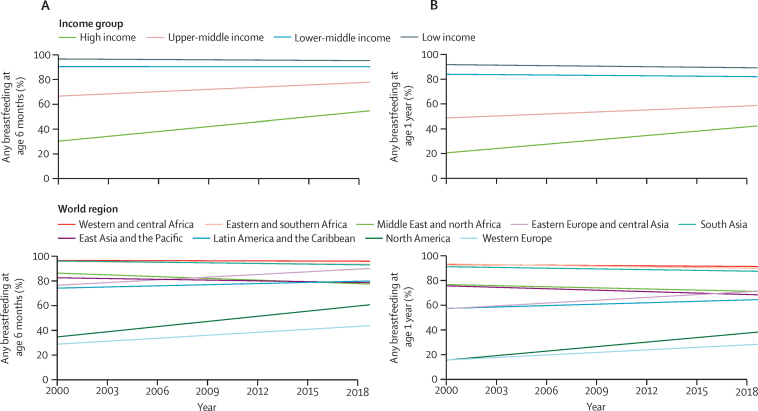
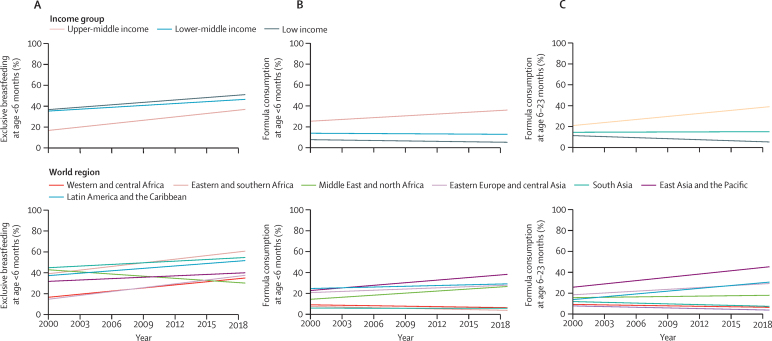
BACKGROUND: Previous analyses of trends in feeding indicators of children younger than 2 years have been limited to low-income and middle-income countries. We aimed to assess time trends in the consumption of different types of milk (breastmilk, formula, and animal milk) by children younger than 2 years from 2000 to 2019 at a global level. METHODS: In this time-series analysis, we combined cross-sectional data from 487 nationally representative surveys from low-income and middle-income countries and information from high-income countries to estimate seven infant and young child feeding indicators in up to 113 countries. Multilevel linear models were used in pooled analyses to estimate annual changes in feeding practices from 2000 to 2019 for country income groups and world regions. FINDINGS: For the absolute average annual changes, we found significant gains in any breastfeeding at age 6 months in high-income countries (1·29 percentage points [PPs] per year [95% CI 1·12 to 1·45]; p<0·0001) and at age 1 year in high-income countries (1·14 PPs per year [0·99 to 1·28]; p<0·0001) and upper-middle-income countries (0·53 PPs per year [0·23 to 0·82]; p<0·0001). We also found a small reduction in low-income countries for any breastfeeding at age 6 months (-0·07 PPs per year [-0·11 to -0·03]; p<0·0001) and age 1 year (-0·13 PPs per year [-0·18 to -0·09]; p<0·0001). Data on exclusive breastfeeding and consumption of formula and animal milk were only available for low-income and middle-income countries, where exclusive breastfeeding in the first 6 months of life increased by 0·70 PPs per year (0·51-0·88; p<0·0001) to reach 48·6% (41·9-55·2) in 2019. Exclusive breastfeeding increased in all world regions except for the Middle East and north Africa. Formula consumption in the first 6 months of life increased in upper-middle-income countries and in east Asia and the Pacific, Latin America and the Caribbean, the Middle East and north Africa, and eastern Europe and central Asia, whereas the rates remained below 8% in sub-Saharan Africa and south Asia. Animal milk consumption by children younger than 6 months decreased significantly (-0·41 PPs per year [-0·51 to -0·31]; p<0·0001) in low-income and middle-income countries. INTERPRETATION: We found some increases in exclusive and any breastfeeding at age 6 months in various regions and income groups, while formula consumption increased in upper-middle-income countries. To achieve the global target of 70% exclusive breastfeeding by 2030, however, rates of improvement will need to be accelerated. FUNDING: Bill & Melinda Gates Foundation, through WHO.
Overview
The claims and statistics of this paper haven’t been checked yet.
Free: it reads the open-access text and checks the first 5 claims that cite a source we can check. Create a free account to check every claim.
Integrity signals
Registry
Cites
Statistics
Figures
Verification
Claims the paper makes
The claims and statistics of this paper haven’t been checked yet.
Free: it reads the open-access text and checks the first 5 claims that cite a source we can check. Create a free account to check every claim.
Claims other papers make about this one
Each is checked against this paper’s own text: does it say what the citing paper says it does?
The source backs part of the claim, not all of it — or backs it for a different population, condition or comparison.
In the citing paper
“In all regions except the Middle East and north Africa, optimal breastfeeding has increased slightly.49”
From Worldwide trends in underweight and obesity from 1990 to 2022: a pooled analysis of 3663 population-representative studies with 222 million children, adolescents, and adults (2024) · cites this paper as [49]
Experimental — accuracy not yet measured
Self-check
Percentages, sums and reported differences re-computed from the paper’s own numbers.
The self-check needs the paper’s full text.
Citations
Cites
Breastfeeding in the 21st century: epidemiology, mechanisms, and lifelong effect
Victora, C. G., Bahl, R., Barros, A. J. D., França, G. V. A., Horton, S., Krasevec, J., Murch, S., Sankar, M. J., Walker, N., & Rollins, N. C. (2016) · The Lancet · doi:10.1016/s0140-6736(15)01024-7 · Cited by 8,040
Self-citationWhy invest, and what it will take to improve breastfeeding practices?
Rollins, N. C., Bhandari, N., Hajeebhoy, N., Horton, S., Lutter, C. K., Martines, J. C., Piwoz, E. G., Richter, L. M., & Victora, C. G. (2016) · The Lancet · doi:10.1016/s0140-6736(15)01044-2 · Cited by 2,944
Self-citationThe cost of not breastfeeding: Global results from a new tool
Walters, D. D., Phan, L. T. H., & Mathisen, R. (2019) · Health Policy and Planning · doi:10.1093/heapol/czz050 · Cited by 479
Maternity and paternity at work: Law and practice across the world
Addati, L., Cassirer, N., & Gilchrist, K. (2014) · Cited by 298
Hancioglu, A., & Arnold, F. (2013) · PLoS Medicine · doi:10.1371/journal.pmed.1001391 · Cited by 271
Breastfeeding indicators trends in Brazil for three decades
Boccolini, C. S., Boccolini, P. D. M. M., Monteiro, F. R., Venâncio, S. I., & Giugliani, E. R. J. (2017) · Revista de Saúde Pública · doi:10.11606/s1518-8787.2017051000029 · Cited by 250
Pérez-Escamilla, R., Curry, L., Minhas, D., Taylor, L., & Bradley, E. (2012) · Advances in Nutrition · doi:10.3945/an.112.002873 · Cited by 236
Baker, P., Santos, T., Neves, P. A., Machado, P., Smith, J., Piwoz, E., Barros, A. J. D., Victora, C. G., & McCoy, D. (2021) · Maternal & Child Nutrition · doi:10.1111/mcn.13097 · Cited by 182
Self-citationBlack, M. M., Behrman, J. R., Daelmans, B. M. E. G., Prado, E. L., Richter, L., Tomlinson, M., Trude, A. C. B., Wertlieb, D. L., Wuermli, A. J., & Yoshikawa, H. (2021) · BMJ Global Health · doi:10.1136/bmjgh-2020-004436 · Cited by 177
McFadden, A., Siebelt, L., Marshall, J. L., Gavine, A., Girard, L.-C., Symon, A., & MacGillivray, S. (2019) · International Breastfeeding Journal · doi:10.1186/s13006-019-0235-8 · Cited by 169
Research works printed but not linked: 1
- Al-Jawaldeh A Abul-fadl A Trends in infant feeding in countries of the eastern Mediterranean region 1995 to 2020: time for action Egyptian J Breastfeed 17 2020 25 52
Cited by
Phelps, N. H., Singleton, R. K., Zhou, B., Heap, R. A., Mishra, A., Bennett, J. E., Paciorek, C. J., Lhoste, V. P., Carrillo-Larco, R. M., Stevens, G. A., et al. (2024) · The Lancet · doi:10.1016/s0140-6736(23)02750-2 · Cited by 2,544
Breastfeeding: crucially important, but increasingly challenged in a market-driven world
Pérez-Escamilla, R., Tomori, C., Hernández-Cordero, S., Baker, P., Barros, A. J. D., Bégin, F., Chapman, D. J., Grummer-Strawn, L. M., McCoy, D., Menon, P., et al. (2023) · The Lancet · doi:10.1016/s0140-6736(22)01932-8 · Cited by 618
Self-citationBreastfeeding in a Global Context: Epidemiology, Impact, and Future Directions
North, K., Gao, M., Allen, G., & Lee, A. C. (2022) · Clinical Therapeutics · doi:10.1016/j.clinthera.2021.11.017 · Cited by 218
Baker, P., Smith, J. P., Garde, A., Grummer-Strawn, L. M., Wood, B., Sen, G., Hastings, G., Pérez-Escamilla, R., Ling, C. Y., Rollins, N., et al. (2023) · The Lancet · doi:10.1016/s0140-6736(22)01933-x · Cited by 197
Self-citationΤίγκα, Μ., Metallinou, D., Nanou, C., Iliodromiti, Z., & Lykeridou, A. (2022) · Children · doi:10.3390/children9010043 · Cited by 182
“On the contrary, upper-middle-income countries reached a rate of 37% in 2019, indicating a struggle to reach the international goal [9].”
BackgroundResultΤίγκα, Μ., Metallinou, D., Pardali, L., & Lykeridou, A. (2022) · European Journal of Midwifery · doi:10.18332/ejm/149830 · Cited by 168
Overcoming barriers to breastfeeding
Tomori, C. (2022) · Best Practice & Research Clinical Obstetrics & Gynaecology · doi:10.1016/j.bpobgyn.2022.01.010 · Cited by 107
Segura‐Pérez, S., Richter, L., Rhodes, E., Hromi‐Fiedler, A. J., Vilar‐Compte, M., Adnew, M., Nyhan, K., & Pérez‐Escamilla, R. (2022) · Maternal and Child Nutrition · doi:10.1111/mcn.13353 · Cited by 99
“Although several countries have been able to improve BF outcomes over the past two decades (Bhattacharjee et al., 2021; Neves et al., 2021), these improvements are not happening fast enough to achieve the 70% EBF goal by 2030 set by the Global Breastfeeding Collective led by WHO and UNICEF…”
BackgroundRicci, C., Otterman, V., Bennett, T.-L., Metcalfe, S., Darling, E., Semenic, S. E., Dzakpasu, S., & System, F. T. C. P. S. (2023) · BMC Pregnancy and Childbirth · doi:10.1186/s12884-023-05382-2 · Cited by 66
“The 2012 World Health Assembly (WHA) set a target of 50% six-month exclusive breastfeeding by 2025 and 70% by 2030 [12].”
BackgroundSamarasimha Reddy, N., Dharmaraj, A., Jacob, J., & Sindhu, K. N. (2023) · International Breastfeeding Journal · doi:10.1186/s13006-023-00602-z · Cited by 67
“Data from low-and middle-income countries (LMIC) between 2000 and 2019 among children younger than 2 years of age showed that the overall EBF rate increased to 48.6% (41.9–55.2) in 2019 [3].”
BackgroundInfluentialBoccolini, C. S., Lacerda, E. M. D. A., Bertoni, N., Oliveira, N., Alves‐Santos, N. H., Farias, D. R., Crispim, S. P., Carneiro, L. B. V., Schincaglia, R. M., Giugliani, E. R. J., et al. (2023) · BMJ Global Health · doi:10.1136/bmjgh-2023-012529 · Cited by 66
Knowledge, attitude, and practice of exclusive breastfeeding among mothers of childbearing age
Sabo, A., Abba, J., Usman, U. S., Ibrahim, M. S., Alzoubi, M. M., Al‐Mugheed, K., Alsenany, S. A., & Abdelaliem, S. M. F. (2023) · Frontiers in Public Health · doi:10.3389/fpubh.2023.1277813 · Cited by 50
Hernández‐Cordero, S., Pérez‐Escamilla, R., Zambrano, P., Michaud‐Létourneau, I., Lara‐Mejía, V., & Franco‐Lares, B. (2022) · Maternal and Child Nutrition · doi:10.1111/mcn.13358 · Cited by 59
“Unfortunately, only 48.6% of infants younger than 6 months are exclusively breastfed in low‐ and middle‐income countries (Neves et al., 2021).”
BackgroundInfluentialPopkin, B. M., & Laar, A. K. (2025) · Pediatric Obesity · doi:10.1111/ijpo.70002 · Cited by 53
Global lessons for strengthening breastfeeding as a key pillar of food security
Tomori, C. (2023) · Frontiers in Public Health · doi:10.3389/fpubh.2023.1256390 · Cited by 46
Ibrahim, C., Bookari, K., Sacre, Y., Hanna‐Wakim, L., & Hoteit, M. (2022) · Nutrients · doi:10.3390/nu14194201 · Cited by 40
A Systematic Review of Multifactorial Barriers Related to Breastfeeding
Moret-Tatay, A., Pérez-Bermejo, M., Asins-Cubells, A., Moret‐Tatay, C., & Murillo-Llorente, M. T. (2025) · Healthcare · doi:10.3390/healthcare13111225 · Cited by 39
“For example, increases in both exclusive and any breastfeeding at six months have been observed across regions and income groups, while increases in formula consumption have been observed in upper-middle-income countries [2].”
Review of the Nutrition Situation in Jordan: Trends and Way Forward
Al-Awwad, N. J., Ayoub, J. J., Barham, R., Sarhan, W., Al‐Holy, M., Abughoush, M. H., Hourani, H. M. A., Olaimat, A. N., & Al‐Jawaldeh, A. (2021) · Nutrients · doi:10.3390/nu14010135 · Cited by 47
“The proportion of ever breastfed children (0–23 months) and that of continued breastfeeding (12–23 months) decreased [15], while that of formula consumption (<6 months) increased over time [37].”
BackgroundResultInfluentialReynolds, R., Kingsland, M., Daly, J., Licata, M., Tully, B., Doherty, E. L., Farragher, E., Desmet, C., Lecathelinais, C., McKie, J., et al. (2023) · International Breastfeeding Journal · doi:10.1186/s13006-023-00545-5 · Cited by 37
Neves, P. A. R., Armenta-Paulino, N., Arroyave, L., Ricardo, L. I. C., Vaz, J. D. S., Boccolini, C. S., Richter, L., Pérez‐Escamilla, R., & Barros, A. J. D. (2022) · Journal of Global Health · doi:10.7189/jogh.12.04104 · Cited by 42
“Furthermore, in the last two decades, CMF consumption has increased in LMICs, but especially in upper-middle income countries [10].”
BackgroundInfluentialSelf-citationKoray, M. H., Wanjiru, J. N., Kerkula, J. S., Dushimirimana, T., Mieh, S. E., Curry, T., Mugisha, J., & Kanu, L. K. (2025) · BMC Public Health · doi:10.1186/s12889-025-23045-z · Cited by 35
Climate change effects on the human gut microbiome: complex mechanisms and global inequities
Litchman, E. (2025) · The Lancet Planetary Health · doi:10.1016/s2542-5196(24)00332-2 · Cited by 36
Birukov, A., Guasch‐Ferré, M., Ley, S. H., Tobias, D. K., Wang, F., Wittenbecher, C., Yang, J., Manson, J. E., Chavarro, J. E., Hu, F. B., et al. (2024) · Diabetes Care · doi:10.2337/dc23-1494 · Cited by 33
What will it take to increase breastfeeding?
Hernández‐Cordero, S., & Pérez‐Escamilla, R. (2022) · Maternal and Child Nutrition · doi:10.1111/mcn.13371 · Cited by 33
“Recently, Neves et al. reported that 48.6% of children under 6 months of age in low‐ and middle‐income countries were exclusively breastfed and 81.1% aged 12 months were still being breastfed with strong variations across countries (Neves et al., 2021).”
BackgroundInfluentialThe Changing Landscape of Children’s Diet and Nutrition: New Threats, New Opportunities
Saavedra, J. M. (2022) · Annals of Nutrition and Metabolism · doi:10.1159/000524328 · Cited by 31
Health professionals’ competencies regarding breastfeeding beyond 12 months: a systematic review
Ojantausta, O., Pöyhönen, N., Ikonen, R., & Kaunonen, M. (2023) · International Breastfeeding Journal · doi:10.1186/s13006-023-00591-z · Cited by 30
“…to those published in The Organisation for Economic Co-operation and Development (OECD) countries because breastfeeding as a phenomenon is different and World Health Organization (WHO) breastfeeding recommendations are met differently in high-income countries than in developing countries [27].”
BackgroundHernández‐Cordero, S., Vilar‐Compte, M., Litwan, K., Lara‐Mejía, V., Rovelo-Velázquez, N., Ancira‐Moreno, M., Sachse, M., & Cobo-Armijo, F. (2022) · International Journal of Environmental Research and Public Health · doi:10.3390/ijerph19042315 · Cited by 33
“6% in infants aged <6 months and almost 25% of children younger than 12 months were formula fed [6].”
BackgroundBreastfeeding duration and subsequent risk of mortality among US women: A prospective cohort study
Wang, Y., Arvizu, M., Rich-Edwards, J. W., Manson, J. E., Wang, L., Missmer, S. A., & Chavarro, J. E. (2022) · EClinicalMedicine · doi:10.1016/j.eclinm.2022.101693 · Cited by 27
Why women discontinue exclusive breastfeeding: a scoping review
Olalere, O., & Harley, C. (2024) · British Journal of Midwifery · doi:10.12968/bjom.2024.0044 · Cited by 27
Impact of COVID-19 on breastfeeding intention and behaviour among postpartum women in five countries
Chien, L., Lee, E. Y., Coca, K. P., Paek, S. C., Hong, S. A., & Chang, Y. (2022) · Women and Birth · doi:10.1016/j.wombi.2022.06.006 · Cited by 24
“However, nearly two-thirds of infants are not exclusively breastfed for the recommended six months [1] and breast-feeding rates vary widely across cultures and countries [7].”
Smith, J., Borg, B., Nguyen, T. T., Iellamo, A. D., Pramono, A., & Mathisen, R. (2024) · Frontiers in Nutrition · doi:10.3389/fnut.2024.1371036 · Cited by 23
Wang, Y., & Chang, Y. (2023) · International Breastfeeding Journal · doi:10.1186/s13006-022-00539-9 · Cited by 22
Vesel, L., Benotti, E., Somji, S., Bellad, R., Charantimath, U., Dhaded, S. M., Goudar, S. S., Karadiguddi, C., Mungarwadi, G., Vernekar, S. S., et al. (2023) · International Breastfeeding Journal · doi:10.1186/s13006-023-00597-7 · Cited by 24
“Prioritizing the care for SVNs, of which feeding is key, can contribute to a reduction of nearly 600,000 newborn deaths a year [11–15].”
BackgroundA proposal to recognize investment in breastfeeding as a carbon offset
Smith, J., Baker, P., Mathisen, R., Long, A., Rollins, N. C., & Waring, M. (2024) · Bulletin of the World Health Organization · doi:10.2471/blt.23.290210 · Cited by 22
Self-citationArtificial intelligence applied to the study of human milk and breastfeeding: a scoping review
Agudelo‐Pérez, S., Botero‐Rosas, D. A., Rodríguez-Alvarado, L., Espitia-Angel, J., & Raigoso-Díaz, L. (2024) · International Breastfeeding Journal · doi:10.1186/s13006-024-00686-1 · Cited by 22
“Although breastfeeding is a public health policy with various implemented actions, breastfeeding indicators remain below targets [1].”
Why do mothers mix milk feed their infants? Results from a systematic review
Monge-Montero, C., van der Merwe, L. F., Tagliamonte, S., Agostoni, C. V., & Vitaglione, P. (2023) · Nutrition Reviews · doi:10.1093/nutrit/nuad134 · Cited by 20
Content analysis of breast milk substitutes marketing on Chinese e‐commerce platforms
Han, S., Chen, H., Wu, Y., & Pérez‐Escamilla, R. (2022) · Maternal and Child Nutrition · doi:10.1111/mcn.13332 · Cited by 18
Zhu, Z., Narayan, A., Zhang, S., Wang, L., Zhu, Y., Yang, W., Cheng, Y., Zeng, L., & Chang, S. (2023) · BMJ Global Health · doi:10.1136/bmjgh-2023-012803 · Cited by 18
Infant growth and body composition from birth to 24 months: are infants developing the same?
Norris, S. A., Nyati, L. H., Murphy‐Alford, A. J., Lucas, N., Santos, I. S., Costa, C. S., Kuriyan, R., Wickramasinghe, P., Ariff, S., Jayasinghe, S. U., et al. (2024) · European Journal of Clinical Nutrition · doi:10.1038/s41430-023-01386-5 · Cited by 18
Liu, C. Y., Pan, M., Lu, X., Gao, Y., Xu, J., & Chen, X. (2024) · Breastfeeding Medicine · doi:10.1089/bfm.2024.0041 · Cited by 22
Intestinal newborn regulatory B cell antibodies modulate microbiota communities
Gu, Q., Draheim, M., Planchais, C., He, Z., Mu, F., Gong, S., Shen, C., Zhu, H., Zhivaki, D., Shahin, K., et al. (2024) · Cell Host & Microbe · doi:10.1016/j.chom.2024.08.010 · Cited by 17
Smith, J., Lande, B., Johansson, L., Baker, P., & Bærug, A. B. (2022) · Public Health Nutrition · doi:10.1017/s1368980022001495 · Cited by 19
“of trends as countries develop their market economy(9).”
BackgroundSelf-citationPapadopoulos, N. G., Balan, T. A., van der Merwe, L. F., Pang, W. W., Michaelis, L. J., Shek, L. P., Vandenplas, Y., Teoh, O. H., Fiocchi, A. G., Chong, Y. S., et al. (2022) · Nutrients · doi:10.3390/nu14112190 · Cited by 16
“’s 2021 publication on the global rates and trends in the consumption of breast milk, formula, and animal milk in 113 countries, for instance, reports on previously collected feeding rates data for exclusive BF, any BF, and FF and animal milk feeding [5].”
BackgroundA balancing act—midwives' and public health nurses' experiences with breastfeeding counselling
Hamnøy, I. L., Kjelsvik, M., Bærug, A. B., & Dahl, B. M. (2023) · Scandinavian Journal of Caring Sciences · doi:10.1111/scs.13198 · Cited by 19
Su, Y.-Y., Chen, C., Chen, M., Chang, H. C., Chen, C., Lin, H., Guo, Y. L., Hsieh, W., & Chen, P. (2024) · Pediatrics & Neonatology · doi:10.1016/j.pedneo.2024.06.007 · Cited by 16
Socioeconomic determinants and inequalities in exclusive breastfeeding among children in Peru
Hernández‐Vásquez, A., & Vargas‐Fernández, R. (2022) · Frontiers in Nutrition · doi:10.3389/fnut.2022.1073838 · Cited by 17
Jeyakumar, A., Babar, P., Menon, P. G., Nair, R., Jungari, S. B., Tamboli, A., Dhamdhere, D., Hendre, K., Tushar, L., Dhiman, A., et al. (2022) · PLoS ONE · doi:10.1371/journal.pone.0278152 · Cited by 22
“Bottle feeding is known to increase the frequency of diarrhea, and have long-term effects on maternal feeding, and child-feeding behavior [42, 49].”
Breastfeeding Aversion Response (BAR): A Descriptive Study
Morns, M. A., Steel, A., McIntyre, E., & Burns, E. (2023) · Journal of Midwifery & Women s Health · doi:10.1111/jmwh.13474 · Cited by 19
Glaubius, R. L., Stover, J., Johnson, L. F., Mahiane, S. G., Mahy, M. I., & Eaton, J. W. (2024) · JAIDS Journal of Acquired Immune Deficiency Syndromes · doi:10.1097/qai.0000000000003317 · Cited by 15
“33 These previous studies included most surveys included in our analysis.”
ResultLearning from mothers' success in breastfeeding maintenance: coping strategies and cues to action
Liao, Q., Yuan, J., Lok, K. Y. W., Ngu, S., Chen, Y., & Lam, W. (2023) · Frontiers in Psychology · doi:10.3389/fpsyg.2023.1167272 · Cited by 15
“, 2022), exclusive breastfeeding for up to 6 months of an infant’s age remained worldwide low (Neves et al., 2021).”
BackgroundSmith, J., Borg, B., Iellamo, A. D., Nguyen, T. T., & Mathisen, R. (2023) · Frontiers in Sustainable Food Systems · doi:10.3389/fsufs.2023.1155279 · Cited by 15
“It is a limitation of the analysis that this assumes exclusive breastfeeding is replaced by CMF, rather than animal milk, which can overestimate the GHG and water use relating to CMF production and use (Neves et al., 2021).”
BackgroundInfluentialFewtrell, M. S., Bandsma, R., Baur, L. A., Duggan, C., Dumrongwongsiri, O., Hojsak, I., Khatami, K., Koletzko, B. V., Kovalskys, I., Li, Z., et al. (2023) · Annals of Nutrition and Metabolism · doi:10.1159/000534004 · Cited by 13
“Despite positive trends in exclusive breastfeeding, with 47% of infants under 6 months of age exclusively breast-fed compared to 37% a decade earlier, the rate of improvement is insuf-fi cient for reaching the global target of at least 70% global prevalence by 2030 [4, 6].”
BackgroundInfluentialWan, X., Yang, J., & Pan, Y. (2024) · Nursing Open · doi:10.1002/nop2.2157 · Cited by 12
“Although breastfeeding is recognised as the most beneficial feeding method for infant growth and development worldwide (WHO, 2003), the breastfeeding rate in many countries still needs to be improved (Neves et al., 2021).”
BackgroundInfluentialThe struggles of breastfeeding mothers of preterm infants: a qualitative study
Chen, L., Shang, Y., Tian, X., Huang, Y., Sun, Y., Fu, C., Bai, J., & Liu, Y. (2025) · BMC Pregnancy and Childbirth · doi:10.1186/s12884-025-07597-x · Cited by 16
“…infants based on numerous positive effects for both premature infants and their mothers [3–6], the current status of low breastfeeding rates among premature infants worldwide is concerning, (e.g., Vietnam,24.3% [7], in 2014; England,34% [8], in 2017), specifically exclusive breastfeeding rates [9].”
InfluentialCetthakrikul, N., Kelly, M., Baker, P., Banwell, C. L., & Smith, J. (2022) · International Breastfeeding Journal · doi:10.1186/s13006-022-00503-7 · Cited by 12
“A recent study [13] in uppermiddle-income countries found that between 2000–19, there was a significant increase of 0.”
BackgroundSelf-citationde Souza, G. R., Ribeiro‐Silva, R. D. C., Felisbino-Mendes, M. S., Silva, N. D. J., de Andrade, R. D. C. S., Pedroso, J., Spaniol, A. M., Bortolini, G. A., Nilson, E. A. F., da Silva, S. A., et al. (2023) · Public Health Nutrition · doi:10.1017/s1368980023001039 · Cited by 12
Healthcare professionals and commercial milk formula recommendations in the urban Mexican context
Hernández‐Cordero, S., Vilar‐Compte, M., Tomori, C., Lara‐Mejía, V., Rovelo-Velázquez, N., Hayes, K., & Pérez‐Escamilla, R. (2023) · Frontiers in Public Health · doi:10.3389/fpubh.2023.1260222 · Cited by 11
Gridneva, Z., Warden, A. H., McEachran, J. L., Perrella, S. L., Lai, C. T., & Geddes, D. T. (2025) · Nutrients · doi:10.3390/nu17020366 · Cited by 11
“However, whilst most mothers in high-income countries, where breast pumps are used more frequently [41,42], initiate breastfeeding, at 6 months of age only 55% of infants are fed any breast milk [43], and the global prevalence of breastfeeding at 12 months in these countries is less than 20% [40].”
Transmission and Persistence of Infant Gut-Associated Bifidobacteria
Hilliard, M. A., & Sela, D. A. (2024) · Microorganisms · doi:10.3390/microorganisms12050879 · Cited by 10
“Consistent with previous hypotheses [10,79], we posit that reduced breastfeeding levels diminish HMOs in the infant diet to drive the reduction of Bifidobacterium in Western populations.”
Impact of nutrition and health interventions on undernutrition: an overview of systematic reviews
Vilar‐Compte, M., Rovelo-Velázquez, N., Nguyen, H. T. M., & Mehta, M. A. (2025) · International Journal for Equity in Health · doi:10.1186/s12939-025-02525-z · Cited by 11
“However, this rate varies considerably across different income groups: 51.2% in low-income, 46.7% in lower-middle-income, and 37.0% in upper-middle-income countries in 2019, highlighting the need for improvement, particularly in upper-middle-income countries [3, 4].”
InfluentialNigussiee, L., Demeke, T., Bagilkar, V. V., Firetsidk, Y., Abageda, M., & Belachew, T. (2025) · PLoS ONE · doi:10.1371/journal.pone.0317763 · Cited by 9
Adams, L., Pell, J. P., Mackay, D., Clark, D., King, A., & Fleming, M. (2023) · PLoS Medicine · doi:10.1371/journal.pmed.1004191 · Cited by 9
“It has been reported that overall prevalence of breastfeeding varies from 30.7% in high-income countries to over 90% in low-and middle-income countries [58].”
BackgroundInfluentialIsayama, T., Miyake, F., Rohsiswatmo, R., Dewi, R., Ozawa, Y., Tomotaki, S., Morisaki, N., Chee, S. C., Neoh, S. H., Imperial, M. L. S., et al. (2024) · BMJ Open · doi:10.1136/bmjopen-2023-082712 · Cited by 8
Rosen-Carole, C. B., Prieto, E., Alhreashy, F. A., AlJaafar, F., Cornelio, M., DeLeon, C. M., Hernández-Aguilar, M.-T., Paz, M. J., Kariuki, C., LeFort, Y., et al. (2025) · Breastfeeding Medicine · doi:10.1089/bfm.2025.65870.abm · Cited by 8
“13,14 What gets in the way of breastfeeding and human milk feeding?”
Rosalina, L., Yustanta, B. F., Wardani, N. W., Mahendika, D., Sari, P. I. A., & Djafar, T. (2023) · Jurnal Penelitian Pendidikan IPA · doi:10.29303/jppipa.v9i8.4194 · Cited by 8
Pramono, A., Smith, J., & Desborough, J. (2025) · International Breastfeeding Journal · doi:10.1186/s13006-025-00754-0 · Cited by 7
“Sociodemographic factors [35] have a strong influence on breastfeeding practice [36–38].”
Cavallé‐Abasolo, E., Dikmen‐Yildiz, P., Gómez‐Gómez, I., Barros‐Martins, L., & Motrico, E. (2025) · Obstetric Anesthesia Digest · doi:10.1097/01.aoa.0001237888.47497.ae · Cited by 7
Mitchell, J., Jones, W., Morris, S., Cohen, M., Breckenridge, F., Baruah-Young, J., Fletcher, G., Edwards, S., White, M., & Wiles, M. D. (2026) · Anaesthesia · doi:10.1111/anae.70128 · Cited by 8
“[24], active measures are in place to encourage and support ongoing breastfeeding.”
High but decreasing prevalence of overweight in preschool children: encouragement for further action
Maessen, S. E., Nichols, M. S., Cutfield, W. S., Norris, S. A., Beger, C., & Ong, K. K. (2023) · BMJ · doi:10.1136/bmj-2023-075736 · Cited by 7
Kristiansen, A. L., Myhre, J. B., Paulsen, M. M., Totland, T. H., Lande, B., & Andersen, L. F. (2023) · British Journal Of Nutrition · doi:10.1017/s0007114523002246 · Cited by 7
“Even with the great advantages of breast-feeding, duration often falls short of recommendations (19,20) .”
BackgroundMethodAli, M. S., Zegeye, A. F., Workneh, B. S., Zeleke, G. A., Mekonen, E. G., Aemro, A., Tekeba, B., Tamir, T. T., Wassie, M., & Terefe, B. (2024) · PLoS ONE · doi:10.1371/journal.pone.0311945 · Cited by 8
Nutrition for Optimal Lactation
Perichart‐Perera, O. (2025) · Annals of Nutrition and Metabolism · doi:10.1159/000541757 · Cited by 7
“Countries that have successfully increased breastfeeding practices have implemented multiple interventions, including the Code of Marketing of Breastmilk Substitutes, breastfeeding counseling, and different regulations to improve women’s maternity leave periods and working conditions [8].”
InfluentialMaccarini, B., Loperfido, F., Bianco, I., Sottotetti, F., Masri, D. E., Ferrara, C., Verme, F., Cangelosi, E., Meriggi, N., Filippo, C. D., et al. (2025) · Frontiers in Nutrition · doi:10.3389/fnut.2025.1597746 · Cited by 7
Pascual, M., Migliorelli, F., Tricas, J. G., Arranz, Á., Archs, J., Martí-Soler, H., Marcè, N., & Manresa, M. (2025) · Breastfeeding Medicine · doi:10.1177/15568253251386459 · Cited by 6
“12 In response to this issue, several international organizations have highlighted the urgency of initiating breastfeeding support programs in health care facilities that incorporate certi fi ed lactation consultants as key fi gures in supporting women throughout this process.”
Father's influence on breastfeeding continuity or interruption: meta-synthesis
Alvarenga, W. D. A., Gomes, T. R. D. C., da Silva, C. H. R., Machado, G. C. C., de Montigny, F., Leite, A. M., & Nascimento, L. C. (2025) · Revista da Escola de Enfermagem da USP · doi:10.1590/1980-220x-reeusp-2024-0303en · Cited by 6
Improving the lagging rates of breastfeeding
Williams, J., Kuttumuratova, A., Breda, J., Wickramasinghe, K. K., Zhiteneva, O., & Weber, M. W. (2021) · The Lancet Child & Adolescent Health · doi:10.1016/s2352-4642(21)00189-9 · Cited by 8
Understanding Insufficient Maternal Milk Production: Clinical Causes and Remedies
Muktamath, V. U., Sunitha, N. H., Ravi, Y., Hegde, P. R., Biradar, S., Saptagiri, T. V., & Ilager, S. (2025) · IntechOpen eBooks · doi:10.5772/intechopen.1009947 · Cited by 8
Salviano, A. F., Guedes, B. D. M., Carioca, A. A. F., Venâncio, S. I., Buccini, G., & Lourenço, B. H. (2024) · Public Health · doi:10.1016/j.puhe.2024.06.030 · Cited by 5
Mohammed, S., Calvert, C., Webb, E. L., Glynn, J. R., Filteau, S., Price, A., Dube, A. L. N., Mugisha, J. O., Makanga, R., Marston, M., et al. (2025) · BMJ Public Health · doi:10.1136/bmjph-2024-001298 · Cited by 5
Martin, M. A., & Glass, D. J. (2025) · Ecology of Food and Nutrition · doi:10.1080/03670244.2025.2480084 · Cited by 5
“Across populations, the majority of breastfed infants are introduced to complementary feeding (CF) with solids and/or non-human milk liquids before the recommended age of 6 months (Arabi et al. 2012; Lutter and Morrow 2013; Neves et al. 2021).”
Kianian, B., Leidman, E. Z., & Bilukha, O. O. (2023) · Maternal and Child Nutrition · doi:10.1111/mcn.13568 · Cited by 5
“…have a substantially higher prevalence of exclusive breastfeeding under 6 months and longer breastfeeding duration than high ‐ income countries, and that household income is inversely associated with adherence to recommended breastfeeding practices (Neves et al., 2021; Victora et al., 2016).”
BackgroundCarrandi, A., Bull, C. F., Hu, Y., Grzeskowiak, L. E., Teede, H. J., Black, K. I., & Callander, E. J. (2023) · BMJ Sexual & Reproductive Health · doi:10.1136/bmjsrh-2023-201830 · Cited by 5
Meira, C. A. R., Buccini, G., Azeredo, C. M., Conde, W. L., & Rinaldi, A. E. M. (2023) · Frontiers in Nutrition · doi:10.3389/fnut.2023.1239503 · Cited by 5
Tran, H. T., Luu, H. M., Le, T. D., Pham, N. T. Q., Sobel, H. L., & Murray, J. (2023) · Journal of Global Health · doi:10.7189/jogh.13.04121 · Cited by 7
“EBF rates for preterm infants at six months in our study were higher than those for all children in Vietnam and globally, estimated to be 49% in 2019 and 46% in 2020 [4,16].”
ResultFarrag, N. H., Haile, Z. T., Ice, G. H., Berryman, D. E., Ruhil, A. V. S., & Fadl, N. (2024) · Breastfeeding Medicine · doi:10.1089/bfm.2023.0202 · Cited by 7
“27 Compared with 30 high-income countries, prevalence of exclusive breastfeeding at 6 months ranged from 0.1% in Brunei Darussalam up to 57% in Chile, with a median of 18%.”
InfluentialSilva, K. C., de Castro, I. R. R., de Carvalho, C. M. P., & de Camargo, K. R. (2022) · Frontiers in Public Health · doi:10.3389/fpubh.2022.984385 · Cited by 5
Global Microbiome: Core and Unique Signatures Across Diverse Populations
Huang, S., Chaudhari, D. S., Shukla, R., Kanani, P., Zeidan, R. S., Lin, Y., Burrow, W., Mankowski, R. T., Jain, S., & Yadav, H. (2026) · International Journal of Molecular Sciences · doi:10.3390/ijms27041776 · Cited by 4
“As the incidence of breastfed infants 6 months around the world is around 88%, the enrichment of Proteobacteria in our AG01 analyses may therefore reflect the predominance of neonate stool samples in our pediatric population [55].”
Breastfeeding Intentions, Attitudes, and Knowledge Among Medical Students in Croatia
Franić, S., Čatipović, M., & Zakarija‐Grković, I. (2024) · Journal of Human Lactation · doi:10.1177/08903344241296043 · Cited by 4
Fatherhood and breastfeeding: a qualitative exploration of counselling experiences
Hamnøy, I. L., Kjelsvik, M., Bærug, A. B., & Dahl, B. M. (2025) · International Breastfeeding Journal · doi:10.1186/s13006-025-00730-8 · Cited by 4
Mamun, A. A., Zou, C., Lishman, H., Stenlund, S., Xie, M. W., Chuang, E., & Patrick, D. M. (2024) · Frontiers in Allergy · doi:10.3389/falgy.2024.1456077 · Cited by 4
Detection of nontoxic BoNT/A levels in post-facial Botox injection breastmilk
Gu, H., Xu, Z., Koviazina, R., Tan, P., Zheng, C., Kappes, F., Kotsifaki, D. G., Shen, F., & Tsigkou, A. (2025) · Frontiers in Drug Safety and Regulation · doi:10.3389/fdsfr.2024.1480515 · Cited by 5
Levels and associated factors for early cessation of EBF among under six month children in Ethiopia
Kebede, F., & Kebede, T. (2024) · Cogent Public Health · doi:10.1080/27707571.2025.2452234 · Cited by 4
Gitz, E. (2023) · World Nutrition · doi:10.26596/wn.20231423-12 · Cited by 3
“The transition for infants and young children to diets that are higher in CMF has accelerated in recent decades, alongside rapid growth of ultra-processed food markets (Baker et al. 2021; Neves et al. 2021; Baker et al. 2020; FAO 2019).”
BackgroundWorld Trends in Infant Formulas Composition Enhancement
Belyaeva, I. A., Namazova-Baranova, L. S., Петровна, Б. Е., & Turti, T. V. (2022) · Вопросы современной педиатрии · doi:10.15690/vsp.v21i6.2479 · Cited by 3
Evolution of a Pathogenic Microbiome
Wong, P. Y., Yip, C., Lemberg, D. A., Day, A. S., & Leach, S. T. (2023) · Journal of Clinical Medicine · doi:10.3390/jcm12227184 · Cited by 4
“…acquisition and gut microbiome profiles are hypothesised to be driven by many factors including host genetics [53], sanitation levels [52], variations of vaginal and skin microbial composition in mothers [52], and higher formula feeding rates in Western and other upper-middle income countries [54].”
BackgroundChristou, E., Liakou, E., Pouliakis, A., Sokou, R., Volaki, P., Paliatsou, S., Boutsikou, Τ., Iacovidou, N. M., & Iliodromiti, Z. (2024) · Children · doi:10.3390/children11080932 · Cited by 3
“…rate is a problem of upper–middle-income countries, and according to the 2019 available data, the rate of exclusive breastfeeding (EBF) was 37% [1], standing in contrast to that of low-and middle-income countries, which was 44%, as reported by the UNICEF study for the period 2014–2020 [2].”
ResultSomaraki, M., de Lauzon‐Guillain, B., Bernard, J. Y., Tafflet, M., Charles, M.-A. A., & Nicklaus, S. (2023) · British Journal Of Nutrition · doi:10.1017/s0007114523000211 · Cited by 4
Swift, B., Taneri, B., Çağnan, I., Becker, C. M., Zondervan, K. T., QUIGLEY, M. A., & Rahmioğlu, N. (2023) · PLoS ONE · doi:10.1371/journal.pone.0287469 · Cited by 4
“3%, which is lower than Türkiye (87%) [33], higher than the Republic of Cyprus (32.”
BackgroundMelov, S. J., Elhindi, J., White, L., McNab, J., Lee, V. W., Donnolley, K., Alahakoon, T. I., Padmanabhan, S., Cheung, N. W., & Pasupathy, D. (2023) · Nutrients · doi:10.3390/nu16010028 · Cited by 3
“However, exclusive breastfeeding rates remain obstinately low, with little chance that the WHO global target of 70% exclusive breastfeeding during the first six months will be met by the target year of 2030 [7].”
BackgroundAssociations between maternal diet quality in pregnancy and infant feeding practices
Sexton-Dhamu, M. J., Livingstone, K. M., Szymlek‐Gay, E. A., Wen, L. M., & Zheng, M. (2025) · British Journal Of Nutrition · doi:10.1017/s000711452500025x · Cited by 3
“Despite these recommendations, suboptimal infant feeding practices are highly prevalent globally (11) and in Australia (12) .”
Metadata
- Authors
- Neves, P. A. R., Vaz, J. S., Maia, F. S., Baker, P., Gatica-Domínguez, G., Piwoz, E., Rollins, N., & Victora, C. G.
- Affiliations
- Universidade Federal de Pelotas (BR)
- Deakin University (AU)
- Gates Foundation (US)
- World Health Organization (CH)
- Corresponding author
- Neves, Paulo A R
- ORCID
- Venue
- The Lancet Child & Adolescent Health
- Publisher
- Elsevier BV
- Published
- 2021-09
- Volume
- 5
- Issue
- 9
- Pages
- 619-630
- ISSN
- 2352-4642 (ISSN-L)
- PMC
- PMC8376656
- OpenAlex
- W3178300564
- Cited by
- 169
- References
- 27
- Citations by year
- 2026: 22 · 2025: 38 · 2024: 41 · 2023: 43 · 2022: 22 · 2021: 3
- FWCI
- 19.63
- Type
- journal article
- Language
- en
- Open access
- hybrid
- doi.org
- Licence
- cc-by
- www.elsevier.com/tdm/userlicense/1.0/ (tdm)
- www.elsevier.com/legal/tdmrep-license (tdm)
- creativecommons.org/licenses/by/3.0/igo/ (vor)
- Locations
- The Lancet Child & Adolescent Health (publishedVersion, cc-by)
- PubMed Central (publishedVersion, cc-by)
- PubMed (publishedVersion)
- Figshare (submittedVersion, cc-by)
- Funders
- Associação Brasileira de Saúde Coletiva
- Bill and Melinda Gates Foundation
- World Health Organization (INV-007594/OPP1148933)
- Wellcome Trust (101815/Z/13/Z)
- Topics
- Health Sciences › Medicine › Epidemiology › Breastfeeding Practices and Influences
- Health Sciences › Nursing › Nutrition and Dietetics › Infant Nutrition and Health
- Health Sciences › Nursing › Nutrition and Dietetics › Child Nutrition and Water Access
- Keywords
- infant and young child feeding, breastfeeding, exclusive breastfeeding, infant formula consumption, breast milk, temporal trends, low-income countries, middle-income countries, high-income countries, country income groups, world regions, infant feeding practices, pooled analysis, multilevel linear models
- MeSH terms
- Animals, Breast Feeding, Cross-Sectional Studies, Feeding Behavior, Feeding Methods, Female, Humans, Infant, Infant Nutritional Physiological Phenomena, Male, Milk, Milk, Human, Socioeconomic Factors, Global Health, Infant Formula
About these checks
Registry, retraction, Cites and statistics results are computed, not judged, with one exception: a printed reference that no index lists is read once by a model before it counts as a citation error. Claims are extracted by a model and kept only when their quote appears verbatim in the text; each cited source is then checked, with a model’s help, for whether it says what the claim relies on. Those verdicts can be wrong — read the claim’s quote and the cited source before relying on one.
Statistics and arithmetic are recomputed, not judged.
Confidence bands are shown only for fields calibrated on our annotated test set. None is calibrated yet, so no band is shown.
What counts as a claim ›How we measure confidence ›How we check this ›
Are you an author, or do you see a problem with this page? Request a review
Data sources
Bibliographic data: Semantic Scholar, OpenAlex, Crossref.
Contains information from the Semantic Scholar Academic Graph Datasets, made available under the ODC Attribution License (ODC-BY 1.0).
Semantic Scholar’s data is described in: Kinney, R., et al. (2023). The Semantic Scholar Open Data Platform. arXiv:2301.10140.
