

Rates and time trends in the consumption of breastmilk, formula, and animal milk by children younger than 2 years from 2000 to 2019: analysis of 113 countries
Open accessThe DOI matches its Crossref record; 26 of the 27 references it cites were found in a registry or an index.
Abstract
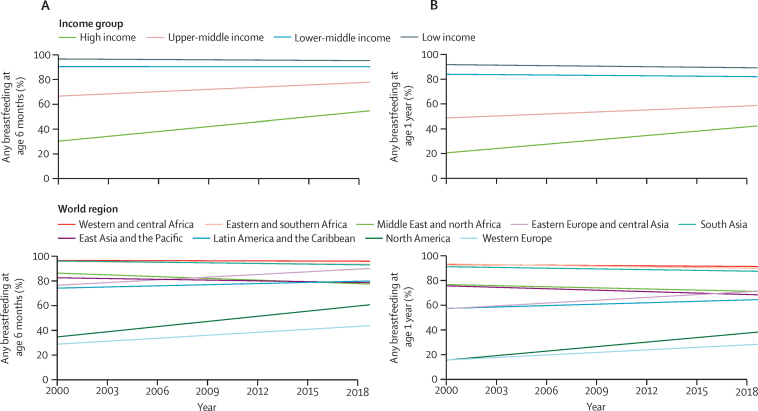
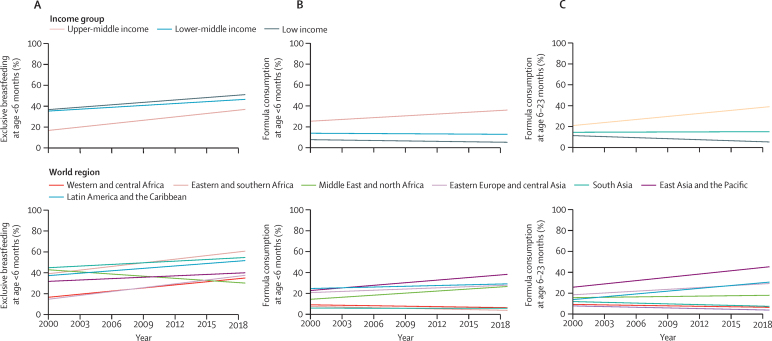
BACKGROUND: Previous analyses of trends in feeding indicators of children younger than 2 years have been limited to low-income and middle-income countries. We aimed to assess time trends in the consumption of different types of milk (breastmilk, formula, and animal milk) by children younger than 2 years from 2000 to 2019 at a global level. METHODS: In this time-series analysis, we combined cross-sectional data from 487 nationally representative surveys from low-income and middle-income countries and information from high-income countries to estimate seven infant and young child feeding indicators in up to 113 countries. Multilevel linear models were used in pooled analyses to estimate annual changes in feeding practices from 2000 to 2019 for country income groups and world regions. FINDINGS: For the absolute average annual changes, we found significant gains in any breastfeeding at age 6 months in high-income countries (1·29 percentage points [PPs] per year [95% CI 1·12 to 1·45]; p<0·0001) and at age 1 year in high-income countries (1·14 PPs per year [0·99 to 1·28]; p<0·0001) and upper-middle-income countries (0·53 PPs per year [0·23 to 0·82]; p<0·0001). We also found a small reduction in low-income countries for any breastfeeding at age 6 months (-0·07 PPs per year [-0·11 to -0·03]; p<0·0001) and age 1 year (-0·13 PPs per year [-0·18 to -0·09]; p<0·0001). Data on exclusive breastfeeding and consumption of formula and animal milk were only available for low-income and middle-income countries, where exclusive breastfeeding in the first 6 months of life increased by 0·70 PPs per year (0·51-0·88; p<0·0001) to reach 48·6% (41·9-55·2) in 2019. Exclusive breastfeeding increased in all world regions except for the Middle East and north Africa. Formula consumption in the first 6 months of life increased in upper-middle-income countries and in east Asia and the Pacific, Latin America and the Caribbean, the Middle East and north Africa, and eastern Europe and central Asia, whereas the rates remained below 8% in sub-Saharan Africa and south Asia. Animal milk consumption by children younger than 6 months decreased significantly (-0·41 PPs per year [-0·51 to -0·31]; p<0·0001) in low-income and middle-income countries. INTERPRETATION: We found some increases in exclusive and any breastfeeding at age 6 months in various regions and income groups, while formula consumption increased in upper-middle-income countries. To achieve the global target of 70% exclusive breastfeeding by 2030, however, rates of improvement will need to be accelerated. FUNDING: Bill & Melinda Gates Foundation, through WHO.
Overview
The claims and statistics of this paper haven’t been checked yet.
Free: it reads the open-access text and checks the first 5 claims that cite a source we can check. Create a free account to check every claim.
Integrity signals
Registry
Cites
Statistics
Figures
Verification
Claims the paper makes
The claims and statistics of this paper haven’t been checked yet.
Free: it reads the open-access text and checks the first 5 claims that cite a source we can check. Create a free account to check every claim.
Claims other papers make about this one
Each is checked against this paper’s own text: does it say what the citing paper says it does?
The source backs part of the claim, not all of it — or backs it for a different population, condition or comparison.
In the citing paper
“In all regions except the Middle East and north Africa, optimal breastfeeding has increased slightly.49”
From Worldwide trends in underweight and obesity from 1990 to 2022: a pooled analysis of 3663 population-representative studies with 222 million children, adolescents, and adults (2024) · cites this paper as [49]
Experimental — accuracy not yet measured
Self-check
Percentages, sums and reported differences re-computed from the paper’s own numbers.
The self-check needs the paper’s full text.
Citations
Cites
Breastfeeding in the 21st century: epidemiology, mechanisms, and lifelong effect
Victora, C. G., Bahl, R., Barros, A. J. D., França, G. V. A., Horton, S., Krasevec, J., Murch, S., Sankar, M. J., Walker, N., & Rollins, N. C. (2016) · The Lancet · doi:10.1016/s0140-6736(15)01024-7 · Cited by 8,040
Self-citationWhy invest, and what it will take to improve breastfeeding practices?
Rollins, N. C., Bhandari, N., Hajeebhoy, N., Horton, S., Lutter, C. K., Martines, J. C., Piwoz, E. G., Richter, L. M., & Victora, C. G. (2016) · The Lancet · doi:10.1016/s0140-6736(15)01044-2 · Cited by 2,944
Self-citationThe cost of not breastfeeding: Global results from a new tool
Walters, D. D., Phan, L. T. H., & Mathisen, R. (2019) · Health Policy and Planning · doi:10.1093/heapol/czz050 · Cited by 479
Maternity and paternity at work: Law and practice across the world
Addati, L., Cassirer, N., & Gilchrist, K. (2014) · Cited by 298
Hancioglu, A., & Arnold, F. (2013) · PLoS Medicine · doi:10.1371/journal.pmed.1001391 · Cited by 271
Breastfeeding indicators trends in Brazil for three decades
Boccolini, C. S., Boccolini, P. D. M. M., Monteiro, F. R., Venâncio, S. I., & Giugliani, E. R. J. (2017) · Revista de Saúde Pública · doi:10.11606/s1518-8787.2017051000029 · Cited by 250
Pérez-Escamilla, R., Curry, L., Minhas, D., Taylor, L., & Bradley, E. (2012) · Advances in Nutrition · doi:10.3945/an.112.002873 · Cited by 236
Baker, P., Santos, T., Neves, P. A., Machado, P., Smith, J., Piwoz, E., Barros, A. J. D., Victora, C. G., & McCoy, D. (2021) · Maternal & Child Nutrition · doi:10.1111/mcn.13097 · Cited by 182
Self-citationBlack, M. M., Behrman, J. R., Daelmans, B. M. E. G., Prado, E. L., Richter, L., Tomlinson, M., Trude, A. C. B., Wertlieb, D. L., Wuermli, A. J., & Yoshikawa, H. (2021) · BMJ Global Health · doi:10.1136/bmjgh-2020-004436 · Cited by 177
McFadden, A., Siebelt, L., Marshall, J. L., Gavine, A., Girard, L.-C., Symon, A., & MacGillivray, S. (2019) · International Breastfeeding Journal · doi:10.1186/s13006-019-0235-8 · Cited by 169
Research works printed but not linked: 1
- Al-Jawaldeh A Abul-fadl A Trends in infant feeding in countries of the eastern Mediterranean region 1995 to 2020: time for action Egyptian J Breastfeed 17 2020 25 52
Cited by
Items 101–195 of 195
A longitudinal study of breastmilk feeding duration, EEG power and early academic skills
Husain, S. F., Lim, S., Pang, W. W., Ong, Y. Y., Fok, D., Rifkin‐Graboi, A., Chong, M. F., Chong, Y. S., Chua, M. C., Daniel, L. M., et al. (2024) · Early Human Development · doi:10.1016/j.earlhumdev.2024.106110 · Cited by 2
Takano, T., Okawa, S., Nanishi, K., Iwamoto, A., Obara, H., Baba, H., Seino, K., Amano, Y., Hachiya, M., & Tabuchi, T. (2024) · PLoS ONE · doi:10.1371/journal.pone.0310967 · Cited by 2
Meira, C. A. R., Azeredo, C. M., & Rinaldi, A. E. M. (2024) · Cadernos de Saúde Pública · doi:10.1590/0102-311xpt007024 · Cited by 2
Influencia del padre en la continuidad o interrupción de la lactancia materna: metasíntesis
Alvarenga, W. D. A., Gomes, T. R. D. C., da Silva, C. H. R., Machado, G. C. C., de Montigny, F., Leite, A. M., & Nascimento, L. C. (2025) · Revista da Escola de Enfermagem da USP · doi:10.1590/1980-220x-reeusp-2024-0303es · Cited by 2
Breastfeeding Promotion in Maternity Wards From a Socioeconomic View
Kürten, C., Hockamp, N., Sinningen, K., Sievers, E., Lücke, T., & Kersting, M. (2025) · Food Science & Nutrition · doi:10.1002/fsn3.71045 · Cited by 2
Phung, M. P., Thi, T. T., Phuong, H. B. T., Do, K. V., & Xuan, H. L. (2025) · European Food Research and Technology · doi:10.1007/s00217-025-04954-0 · Cited by 2
“Amid the global decline in breastfeeding rates and the increasing reliance on infant formula, clarifying the functional properties of bioactive peptides has become an urgent need [19].”
Durgun, S. K., & Ulaş, S. C. (2026) · BMC Pregnancy and Childbirth · doi:10.1186/s12884-026-09274-z · Cited by 2
Ayub, F., Anjum, M., Bibi, S., Khan, A., Soomro, S., & Sardar, A. (2023) · Pakistan Armed Forces Medical Journal · doi:10.51253/pafmj.v73i4.7895 · Cited by 2
Theory-based antecedents of breastfeeding among pregnant women in the United States
Sharma, M., Johansen, C. M., Fudolig, M. A., Dai, C., Kapukotuwa, S., Davalos, L., & Bonsu, L. (2024) · Health Promotion Perspectives · doi:10.34172/hpp.42599 · Cited by 2
Exploring Exclusive Breastfeeding and Childhood Cancer Using Linked Data
Bailey, H. D. (2024) · JAMA Network Open · doi:10.1001/jamanetworkopen.2024.3075 · Cited by 2
Zhang, L., Zhu, Y., Wang, H., Zu, P., Luo, W., Chen, Y., Zhou, C., Tao, F., & Zhu, P. (2024) · Environmental Research · doi:10.1016/j.envres.2024.119463 · Cited by 4
Februhartanty, J., Agustin, C. A., & Fadlina, A. (2024) · Malaysian Journal of Nutrition · doi:10.31246/mjn-2023-0097 · Cited by 2
“These figures are higher than those of the Health Surveillance System in Indonesia (BKKBN et al. , 2018) and Asia Pacific (Neves et al. , 2021).”
ResultInfluentialFrancis, J., Gelner, E., & Dickton, D. (2024) · Nutrients · doi:10.3390/nu16193239 · Cited by 3
“Breastfeeding is widely recognized as essential for promoting optimal health and development in infants and mothers [15–17].”
BackgroundMastiur Julianti, B., Tambunan, I. Y., Siringo-ringo, E., Febrianti, R., & Gurning, K. (2024) · International Journal of Advancement in Life Sciences Research · doi:10.31632/ijalsr.2024.v07i04.010 · Cited by 2
Vieira, T. D. S., Morais, T. C., & de Castro, T. G. (2024) · Journal of Human Growth and Development · doi:10.36311/jhgd.v34.16851 · Cited by 2
Results of Rooming-in After Caesarean Section in Breastfeeding: A Cohort Study
Conde, J. S., Casquero-Martín, H., Gómez-Martín, A., Pozas-Flores, O., Sanchón-Gómez, L., & Vázquez-Herrero, M. J. (2023) · International Journal of Medical Science and Clinical Research Studies · doi:10.47191/ijmscrs/v3-i9-46 · Cited by 1
(2024) · Journal of Gynecology & Reproductive Medicine · doi:10.33140/jgrm.08.02.02 · Cited by 1
dos Santos, M. V., Alves, V. H., Pereira, A. V., Rodrigues, D. P., Calandrini, T. D. S. D. S., Borborema, R. D. B., do Carmo, R. R. D. A. C., & da Silva, B. C. M. (2024) · Revista gaúcha de enfermagem · doi:10.1590/1983-1447.2024.20230260.pt · Cited by 1
Sheffler, R., Rebolloso, S. L., Scott, I., Buchweitz, J. P., & Puschner, B. (2025) · Toxics · doi:10.3390/toxics13060445 · Cited by 1
Wan, X., Yang, J., & Pan, Y. (2025) · Journal of Nursing Management · doi:10.1155/jonm/5842526 · Cited by 1
“Working women usually breastfeed after returning to work, and improving breastfeeding rates in infants has been the focus of global research [6].”
Qasem, N. W., Al‐Shdaifat, A., Abu-Khader, D., Jaraa, S., AlOthman, J., Shatat, L., & Alsaif, L. (2025) · Frontiers in Public Health · doi:10.3389/fpubh.2025.1644659 · Cited by 1
de Paula, M. B., Clemente, M. M. M., & Grünewald, S. T. F. (2025) · Journal of Paediatrics and Child Health · doi:10.1111/jpc.70195 · Cited by 2
“[8].”
InfluentialHan, Q., Gao, T., Li, C., & Jing, X. (2025) · BMC Medical Education · doi:10.1186/s12909-025-08033-6 · Cited by 1
“However, breastfeeding has exhibited a declining trend in low-income countries, and there are still large disparities within different countries [8].”
Breastfeeding, Human Milk and Infant Feeding Alternatives: Evidence, Barriers and Global Guidance
Ahmad, R., & Haque, M. (2025) · Advances in Human Biology · doi:10.4103/aihb.aihb_195_25 · Cited by 2
Navigating Without a Compass: A Qualitative Study on Parents' Infant Formula Handling
Andresen, E., Oras, P., Norrman, G., Målqvist, M., & Funkquist, E. (2026) · Food Science & Nutrition · doi:10.1002/fsn3.71432 · Cited by 1
“Nevertheless, less than 50% of infants are exclusively breastfed at 6 months (UNICEF 2023), and the use of commercial infant formula is widespread (Neves et al. 2021).”
Ventura, E. F., Guseva, D., Hübert, V., Samarra, A., Ensenauer, R. E., & Collado, M. C. (2026) · Molecular Nutrition & Food Research · doi:10.1002/mnfr.70390 · Cited by 1
Salviano, A. F., Guedes, B. D. M., Barros, L., de Oliveira, N. T., Farias, D. R., & Lourenço, B. H. (2026) · American Journal of Human Biology · doi:10.1002/ajhb.70315 · Cited by 1
MEDNARODNI KODEKS O TRŽENJU NADOMESTKOV MATERINEGA MLEKA V PRAKSI – NARATIVNI PREGLED LITERATURE
Vettorazzi, R., Rajkovič, U., & Pađen, L. (2023) · Slovenska pediatrija revija pediatrov Slovenije in specialistov šolske ter visokošolske medicine Slovenije · doi:10.38031/slovpediatr-2023-1-05 · Cited by 1
Zafrakas, Μ., Papasozomenou, P., Gerede, A., Mikos, T., Athanasiadis, A. P., & Grimbizis, G. (2024) · Cureus · doi:10.7759/cureus.66465 · Cited by 1
“Furthermore, trends in rates and duration of breastfeeding have been steadily increasing in recent years [13].”
BackgroundOgah, A. O. (2024) · medRxiv · doi:10.1101/2024.10.30.24316420 · Cited by 1
“This study observation aligns with the findings of Neves et al. (2021).”
New Strategies for Enhancement of Infant Milk Formulas Composition
Belyaeva, I. A., Петровна, Б. Е., & Turti, T. V. (2022) · Вопросы современной педиатрии · doi:10.15690/vsp.v21i6.2468
Vettorazzi, R., Rajkovič, U., & Pađen, L. (2023) · Slovenska pediatrija revija pediatrov Slovenije in specialistov šolske ter visokošolske medicine Slovenije · doi:10.38031/slovpediatr-2023-1-05en
Descarpentrie, A., Poquet, D., Brugaillères, P., Sauvegrain, P., Frénoy, P., Richard, É., Bernard, J. Y., de Lauzon‐Guillain, B., Vandentorren, S., & Lioret, S. (2023) · European Journal of Public Health · doi:10.1093/eurpub/ckad096
Mosquera, P. S. (2023) · Digital Library of Theses and Dissertations (Universidade de São Paulo) · doi:10.11606/t.6.2023.tde-26072023-134824 · Cited by 2
Statistical indicators of milk consumption in Slovakia
Matušek, V. (2023) · Mathematics in Education Research and Applications · doi:10.15414/meraa.2023.09.01.34-41
Özdemir, S., Sayıner, F. D., & KÖKSAL, H. C. (2023) · Artuklu International Journal of Health Sciences · doi:10.58252/artukluder.1285971
Análisis de prevalencias de lactancia materna y prácticas relacionadas en la región de Murcia
Mañas-Uxó, M. I., Leante‐Castellanos, J. L., Hernández-Gil, M.-D., Martínez-Moreno, C., & Garnica-Martínez, B. (2024) · Anales de Pediatría · doi:10.1016/j.anpedi.2024.05.013
Analysis of breastfeeding and related practices rates in Murcia
Mañas-Uxó, M. I., Leante‐Castellanos, J. L., Hernández-Gil, M.-D., Martínez-Moreno, C., & Garnica-Martínez, B. (2024) · Anales de Pediatría (English Edition) · doi:10.1016/j.anpede.2024.05.015
Climate Change, Breastfeeding and Health
Smith, J. (2024) · CABI eBooks · doi:10.1079/9781800620025.0028
Learning from Global Food and Nutrition Insecurity
(2024) · Frontiers research topics · doi:10.3389/978-2-8325-5636-8
The Politics of the Commercial Determinants of Health
(2024) · Frontiers research topics · doi:10.3389/978-2-8325-5702-0 · Cited by 1
The (dis)continuity of breastfeeding care in prison: perception of health professionals and managers
dos Santos, M. V., Alves, V. H., Pereira, A. V., Rodrigues, D. P., Calandrini, T. D. S. D. S., Borborema, R. D. B., do Carmo, R. R. D. A. C., & da Silva, B. C. M. (2024) · Revista gaúcha de enfermagem · doi:10.1590/1983-1447.2024.20230260.en
Salviano, A. F. (2024) · Digital Library of Theses and Dissertations (Universidade de São Paulo) · doi:10.11606/t.6.2024.tde-13022025-115930 · Cited by 2
Influência do pai na continuidade ou interrupção do aleitamento materno: metassíntese
Alvarenga, W. D. A., Gomes, T. R. D. C., da Silva, C. H. R., Machado, G. C. C., de Montigny, F., Leite, A. M., & Nascimento, L. C. (2025) · Revista da Escola de Enfermagem da USP · doi:10.1590/1980-220x-reeusp-2024-0303pt
Hamadneh, M. (2023) · Clinical Endocrinology and Metabolism · doi:10.31579/2834-8761/012
Lifetime breastfeeding and mortality among parous women in the Mexican Teacher's Cohort
Lozano‐Esparza, S., Unar‐Munguía, M., Trabert, B. L., Gómez‐Flores‐Ramos, L., Brochier, M., Hernández‐Ávila, J. E., Stern, D., & Lajous, M. (2025) · International Journal of Gynecology & Obstetrics · doi:10.1002/ijgo.70183
López, D. G., & Berjano, R. M. (2025) · Análisis y Modificación de Conducta · doi:10.33776/amc.v51i186.8400
“Ya que la prevalencia de la LM en algunas regiones del mundo (en especial, en Europa y en Norte América, como se ha indicado) es muy inferior a la que debería darse según las recomendaciones de la OMS, su promoción requiere de actuaciones de apoyo multinivel con intervenciones implementadas a través de distintas vías,…”
InfluentialPopulation-level communication interventions for breastfeeding: Protocol for a scoping review
Hanratty, J., McGrath, K., Matvienko‐Sikar, K., Lehane, E. A., Long, A., Rawdon, C., & Leahy‐Warren, P. (2025) · HRB Open Research · doi:10.12688/hrbopenres.14088.1
Infant Feeding from Hong Kong China Perspectives
Lok, K. Y. W. (2025) · Springer eBooks · doi:10.1007/978-3-031-32047-7_111-1
NZ has opted out of an infant formula standard – the evidence says that’s a backward step
Toldi, G., & Muelbert, M. (2024) · The Conversation · doi:10.64628/aa.5kgv4dh6c
Milk Feeding Practices in Infants: A Survey in a Pediatric Outpatient Setting
Lall, P. (2025) · Research and reviews in pediatrics. · doi:10.4103/rrp.rrp_12_25
Abraham, J. (2025) · Open Access Victoria University of Wellington | Te Herenga Waka (Figshare) · doi:10.26686/66jw-vz63
Barbosa, L. P., Lima, R. B. D. S., Lima, K. F., Lima, F. E. T., de Oliveira, B. L. C. A., Dalcin, C. B., Gavine, A. J., & McFadden, A. (2025) · Ciência & Saúde Coletiva · doi:10.1590/1413-812320253011.03922024
Reddy N, S., Dharmaraj, A., Jacob, J., & Sindhu, K. N. (2023) · Figshare · doi:10.6084/m9.figshare.24883571
Vesel, L., Benotti, E., Somji, S., Bellad, R., Charantimath, U., Dhaded, S. M., Goudar, S. S., Karadiguddi, C., Mungarwadi, G., Vernekar, S., et al. (2023) · Figshare · doi:10.6084/m9.figshare.24531953
Reynolds, R., Kingsland, M., Daly, J., Licata, M., Tully, B., Doherty, E., Farragher, E., Desmet, C., Lecathelinais, C., McKie, J., et al. (2023) · Figshare · doi:10.6084/m9.figshare.22605770
Ojantausta, O., Pöyhönen, N., Ikonen, R., & Kaunonen, M. (2024) · Figshare · doi:10.6084/m9.figshare.26634165
Cetthakrikul, N., Kelly, M., Baker, P., Banwell, C. L., & Smith, J. (2022) · Figshare · doi:10.6084/m9.figshare.20786896
Self-citationJiménez Vázquez, M. E. (2023) · RUC (Universidade Da Coruña)
Yakandawala, U. (2022) · Mspace (University of Manitoba)
Kohti perhelähtöisyyttä vastasyntyneiden hoidossa: Vauvamyönteisyys-ohjelman käyttöönotto
Mäkelä, H. (2025) · UTUPub (University of Turku)
Challenge to Eliminate HIV Mother-to-Child Transmission by 2030: Risk Factors and Prevention
Latupeirissa, D. (2025) · Infectious diseases · doi:10.5772/intechopen.1012839
Singh, B. K., Bista, S., Yogesh, S., & Khanal, V. (2026) · PLoS ONE · doi:10.1371/journal.pone.0339128
Huda, A. C., Bachtiar, B. A., Janah, M., Syukri, I., Ardhana, F. M., & Pusponegoro, N. H. (2025) · Media Edukasi Data Ilmiah dan Analisis · doi:10.64679/median.v8i02.120
Monthé‐Drèze, C., Bhushan, B., Andrews, C., Cherkerzian, S., Perng, W., Ahmed, S., Baqui, A. H., Chowdhury, N. H., Khanam, R., Rahman, S., et al. (2026) · Journal of Nutrition · doi:10.1016/j.tjnut.2026.101394
“Unfortunately, research in this area is scarce in LMICs, especially in South Asia, where 21% of women of reproductive age are underweight [28,29] and > 80% of women are breastfeeding at 12 mo [30].”
Attitudes Toward Breastfeeding in Social Settings and Breastfeeding Beyond Infancy in US Mothers
Doughty, K. N., Poskitt, C., & Taylor, S. N. (2026) · Academic Pediatrics · doi:10.1016/j.acap.2026.103229
Ullah, S., Hayat, M., Ali, S., Muhammad, M., Waqar, M., & Ullah, D. I. (2025) · Journal of Health Wellness and Community Research · doi:10.61919/690jtv08
Stanikzai, M. H., Tawfiq, E., Ezadi, Z., Jafari, M., Dadras, F., Sayam, H., & Dadras, O. (2026) · Discover Public Health · doi:10.1186/s12982-026-01578-x
“%) is comparable to the global estimate of 11.6% among infants aged 0–5 months [42].”
InfluentialOjantausta, O. (2024) · Tampere University Institutional Repository (Tampere University) · Cited by 1
Acute food protein–induced enterocolitis syndrome in Switzerland: a 10-year retrospective review
Atzert, N., & Fischer, I. (2026) · European Journal of Pediatrics · doi:10.1007/s00431-026-06856-z
Bertacchi, V., Daiy, K., Kemper, L., Vesi, L., Lupematasila, V. F., Kima, F., Rafael, P.-E., Hromi‐Fiedler, A. J., Take, N., Soti‐Ulberg, C., et al. (2026) · American Journal of Human Biology · doi:10.1002/ajhb.70241
“…low-middle income nation in the Pacific—has a strong history of breastfeeding promotion and protection (Ministry of Health, Samoa 2024; Soti-Ulberg et al. 2020)—with rates of initiation and exclusive breastfeeding to 6 months of age often markedly higher than its peer nations (Neves et al. 2021).”
Study of human perinatal B cells in the context of intestinal microbial colonization
Gu, Q. (2024) · theses.fr (ABES) · doi:10.70675/fdf94bf2z3bd1z42bezb8f0z3bb3a42a8771
Rose, D. U. D., Consales, A., Salvatori, G., Giannì, M. L., Fumagalli, M., Orfeo, L., Mosca, F., Agosti, M., & Dotta, A. (2026) · Pediatric Research · doi:10.1038/s41390-026-05011-6
Cao, J., Li, J., Li, Y., & Xiong, Z. (2026) · Frontiers in Public Health · doi:10.3389/fpubh.2026.1544227
“Previous research has also shown that the growth rates of preterm children are regulated by the expression levels of serum IGF-I and IGFBP-3 through the GH/IGF-1 axis (5).”
Prahesti, F. E., Indrawati, E. M., Suwardono, A., Setyawan, D., & Nurrohim, M. D. (2026) · Jurnal Edukasi Elektro · doi:10.21831/jee.v10i1.95781
“The Central Bureau of Statistics shows that national milk consumption has increased by an average of 5 – 7% per year [1], along with growing public awareness of nutrition and health.”
Thorsted, M. (2026) · Theseus (Ammattikorkeakoulujen)
Saintila, J., & Paz-Olivas, Y. (2026) · Nutrients · doi:10.3390/nu18132083
“Within this context, liquid milk has received particular attention as dietary exposure [19,20], given its characteristic nutritional profile and its frequent consumption during childhood across diverse cultural [21] and socioeconomic settings [22].”
Kaminer, J., Kartsonaki, C., Sherliker, P., Yang, L., Iona, A., Pei, P., Chen, Y., Sun, D., Yang, X., Lu, Y., et al. (2026) · BMJ Open · doi:10.1136/bmjopen-2025-109377
Bivariate Inverse Gaussian Regression on Stunting and Malnutrition in Children
Nisa, E. K., Prasetyo, H., & Yuliani, W. (2026) · Jurnal Statistika dan Komputasi · doi:10.32665/statkom.v5i1.6407
Gunasekaran, V., Woo, S., Shetty, A. K., Kaufman, D., & Garg, P. M. (2026) · American Journal of Perinatology · doi:10.1055/a-2918-3933
“…profound consequences for maternal and neonatal safety (cid:129) The rapid transition to telemedicine introduced new dimensions of inequality, excluding women with limited digital access and widening existing disparities in antenatal monitoring quality, as physical examination cannot be…”
Freeman‐Romilly, N., Kasadha, B., Tariq, S., Namiba, A., Nyatsanza, F., Phillips, N., & Rai, T. (2026) · Frontiers in Reproductive Health · doi:10.3389/frph.2026.1902552
Milk Production and Body Weight Response to Suggested Protocol in Obese Lactating Women
Shafei, M. M. E., Kamel, D. M., Botla, A. M. M., Ossman, A. M. E., & Awad, N. M. (2026) · International Journal of Drug Delivery Technology · doi:10.25258/ijddt.16.72s.61
Cherubini, K. A. (2025) · Lume (Universidade Federal do Rio Grande do Sul)
Sidiq, M. K., Mohammed, S., Alghofaili, F., Mohammed, S. J., Ahmad, S. D., & Najmuldeen, H. H. R. (2026) · Journal of the American Nutrition Association · doi:10.1080/27697061.2026.2719480 · Cited by 2
Jaber, M., Bali, O. A., Tahayneh, M., Alhashlamon, A., Turkey, B. A., Radwan, M. W., Ibraheem, M., Hamad, A., Nazzal, N. B. M., & AbuAlrub, I. (2026) · Frontiers in Public Health · doi:10.3389/fpubh.2026.1908532
“At the same time, infant formula use has increased in many regions, including the Middle East and North Africa (3, 4).”
Boas, A. S. D. C. V., Wernet, M., Ruiz, M. T., Silveira, A. O., Charepe, Z. B., Linares, A. M., & da Silva, J. A. (2026) · Revista da Escola de Enfermagem da USP · doi:10.1590/1980-220x-reeusp-2025-0394en
“Despite these recommendations, exclusive breastfeeding rates remain below the recommended levels (3) , with frequent use of supplements and infant formula in Brazil and worldwide (4) .”
Boas, A. S. D. C. V., Wernet, M., Ruiz, M. T., Silveira, A. O., Charepe, Z. B., Linares, A. M., & da Silva, J. A. (2026) · Revista da Escola de Enfermagem da USP · doi:10.1590/1980-220x-reeusp-2025-0394es
Boas, A. S. D. C. V., Wernet, M., Ruiz, M. T., Silveira, A. O., Charepe, Z. B., Linares, A. M., & da Silva, J. A. (2026) · Revista da Escola de Enfermagem da USP · doi:10.1590/1980-220x-reeusp-2025-0394pt
Sakihara, M. A. T., Hernández‐Vásquez, A., & Saavedra‐Garcia, L. (2026) · Sage Open Pediatrics · doi:10.1177/30502225261485785
Fang, X., Niu, Z., Shao, W., Du, S., Tang, H., Jin, S. Y., Li, J., Zhu, Y., Zhong, Y., Yan, C., et al. (2026) · Environmental Pollution · doi:10.1016/j.envpol.2026.129252
Mashadi, A., Hasibuan, R., Riasti, N., Nusroh, K., & Sa'adah, I. I. (2025) · Jurnal Kesehatan Saelmakers PERDANA (JKSP) · doi:10.32524/jksp.v8i3.1687
Rizvi, A., Bhutta, A., Sajid, M., Soofi, S. B., & Bhutta, Z. A. (2026) · Nutrients · doi:10.3390/nu18203389
“Relatively little information exists on the use of formula milk and animal milk among children 6–23 months of age, and its association with nutritional status [14].”
Britten, F. L., Duncan, E. L., & Callaway, L. K. (2026) · Diabetologia · doi:10.1007/s00125-026-06879-z
Metadata
- Authors
- Neves, P. A. R., Vaz, J. S., Maia, F. S., Baker, P., Gatica-Domínguez, G., Piwoz, E., Rollins, N., & Victora, C. G.
- Affiliations
- Universidade Federal de Pelotas (BR)
- Deakin University (AU)
- Gates Foundation (US)
- World Health Organization (CH)
- Corresponding author
- Neves, Paulo A R
- ORCID
- Venue
- The Lancet Child & Adolescent Health
- Publisher
- Elsevier BV
- Published
- 2021-09
- Volume
- 5
- Issue
- 9
- Pages
- 619-630
- ISSN
- 2352-4642 (ISSN-L)
- PMC
- PMC8376656
- OpenAlex
- W3178300564
- Semantic Scholar
- 383257e2ed59138819bcda7b2b6e7f327dd3b638
- Cited by
- 169
- References
- 27
- Citations by year
- 2026: 22 · 2025: 38 · 2024: 41 · 2023: 43 · 2022: 22 · 2021: 3
- FWCI
- 19.63
- Type
- journal article
- Language
- en
- Open access
- hybrid
- doi.org
- Licence
- cc-by
- www.elsevier.com/tdm/userlicense/1.0/ (tdm)
- www.elsevier.com/legal/tdmrep-license (tdm)
- creativecommons.org/licenses/by/3.0/igo/ (vor)
- Locations
- The Lancet Child & Adolescent Health (publishedVersion, cc-by)
- PubMed Central (publishedVersion, cc-by)
- PubMed (publishedVersion)
- Figshare (submittedVersion, cc-by)
- Funders
- Associação Brasileira de Saúde Coletiva
- Bill and Melinda Gates Foundation
- World Health Organization (INV-007594/OPP1148933)
- Wellcome Trust (101815/Z/13/Z)
- Topics
- Health Sciences › Medicine › Epidemiology › Breastfeeding Practices and Influences
- Health Sciences › Nursing › Nutrition and Dietetics › Infant Nutrition and Health
- Health Sciences › Nursing › Nutrition and Dietetics › Child Nutrition and Water Access
- Keywords
- infant and young child feeding, breastfeeding, exclusive breastfeeding, infant formula consumption, breast milk, temporal trends, low-income countries, middle-income countries, high-income countries, country income groups, world regions, infant feeding practices, pooled analysis, multilevel linear models
- MeSH terms
- Animals, Breast Feeding, Cross-Sectional Studies, Feeding Behavior, Feeding Methods, Female, Humans, Infant, Infant Nutritional Physiological Phenomena, Male, Milk, Milk, Human, Socioeconomic Factors, Global Health, Infant Formula
About these checks
Registry, retraction, Cites and statistics results are computed, not judged, with one exception: a printed reference that no index lists is read once by a model before it counts as a citation error. Claims are extracted by a model and kept only when their quote appears verbatim in the text; each cited source is then checked, with a model’s help, for whether it says what the claim relies on. Those verdicts can be wrong — read the claim’s quote and the cited source before relying on one.
Statistics and arithmetic are recomputed, not judged.
Confidence bands are shown only for fields calibrated on our annotated test set. None is calibrated yet, so no band is shown.
What counts as a claim ›How we measure confidence ›How we check this ›
Are you an author, or do you see a problem with this page? Request a review
Data sources
Bibliographic data: Semantic Scholar, OpenAlex, Crossref.
Contains information from the Semantic Scholar Academic Graph Datasets, made available under the ODC Attribution License (ODC-BY 1.0).
Semantic Scholar’s data is described in: Kinney, R., et al. (2023). The Semantic Scholar Open Data Platform. arXiv:2301.10140.
