

Effects of gastroprotectant drugs for the prevention and treatment of peptic ulcer disease and its complications: a meta-analysis of randomised trials
Open accessThe DOI matches its Crossref record; 27 of the 27 references it cites were found in a registry or an index.
Abstract
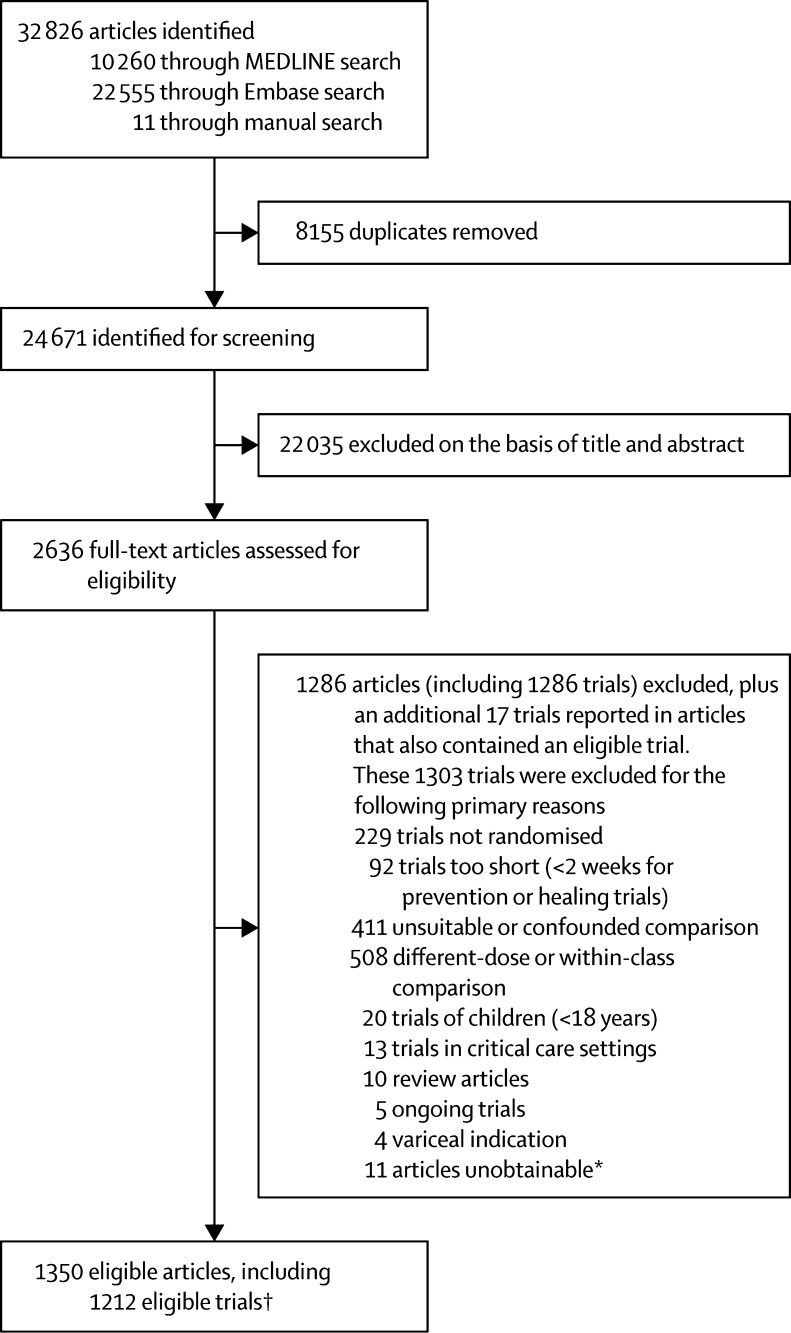
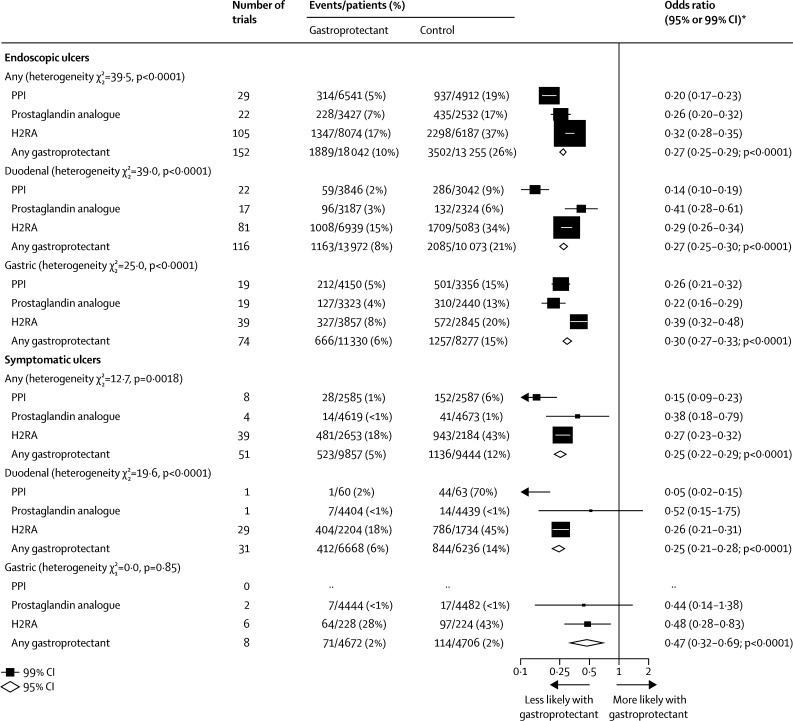
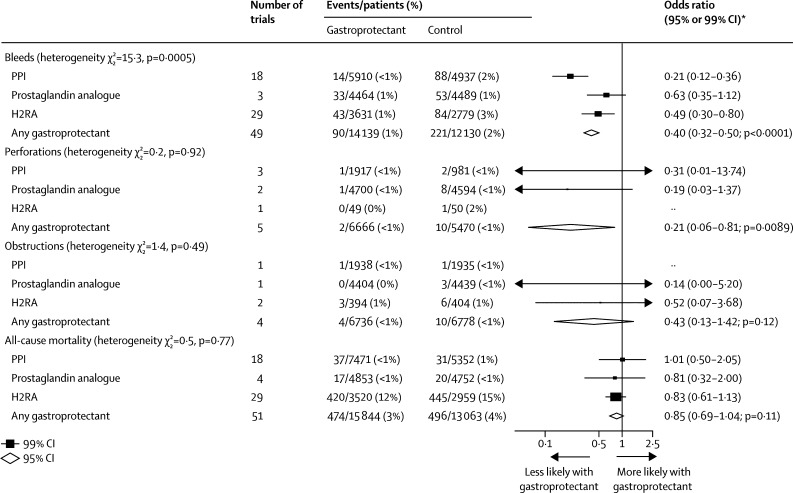
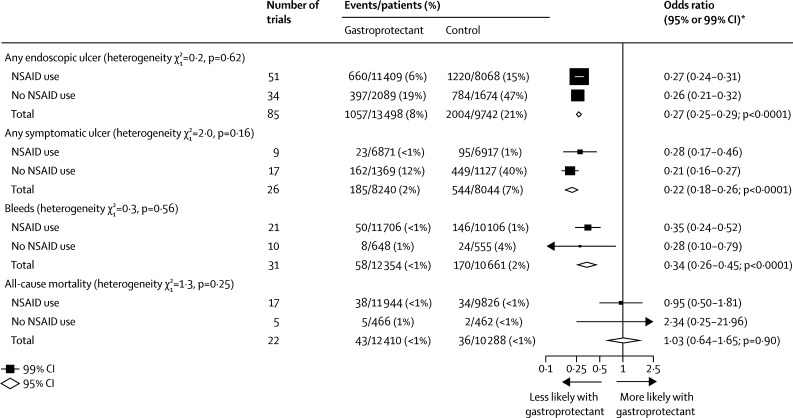
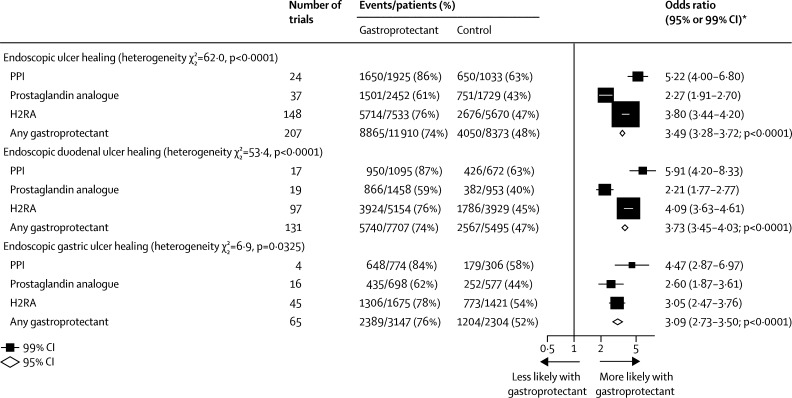
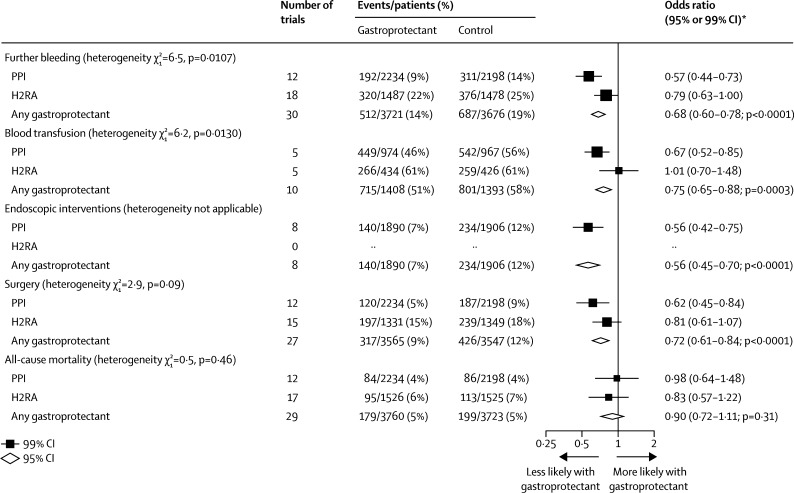
BackgroundGastroprotectant drugs are used for the prevention and treatment of peptic ulcer disease and might reduce its associated complications, but reliable estimates of the effects of gastroprotectants in different clinical settings are scarce. We aimed to examine the effects of proton-pump inhibitors (PPIs), prostaglandin analogues, and histamine-2 receptor antagonists (H2RAs) in different clinical circumstances by doing meta-analyses of tabular data from all relevant unconfounded randomised trials of gastroprotectant drugs.MethodsWe searched MEDLINE and Embase from Jan 1, 1950, to Dec 31, 2015, to identify unconfounded, randomised trials of a gastroprotectant drug (defined as a PPI, prostaglandin analogue, or H2RA) versus control, or versus another gastroprotectant. Two independent researchers reviewed the search results and extracted the prespecified outcomes and key characteristics for each trial. We did meta-analyses of the effects of gastroprotectant drugs on ulcer development, bleeding, and mortality overall, according to the class of gastroprotectant, and according to the individual drug within a gastroprotectant class.FindingsWe identified comparisons of gastroprotectant versus control in 849 trials (142 485 participants): 580 prevention trials (110 626 participants), 233 healing trials (24 033 participants), and 36 trials for the treatment of acute upper gastrointestinal bleeding (7826 participants). Comparisons of one gastroprotectant drug versus another were available in 345 trials (64 905 participants), comprising 160 prevention trials (32 959 participants), 167 healing trials (28 306 participants), and 18 trials for treatment of acute upper gastrointestinal bleeding (3640 participants). The median number of patients in each trial was 78 (IQR 44·0–210·5) and the median duration was 1·4 months (0·9–2·8). In prevention trials, gastroprotectant drugs reduced development of endoscopic ulcers (odds ratio [OR] 0·27, 95% CI 0·25–0·29; p<0·0001), symptomatic ulcers (0·25, 0·22–0·29; p<0·0001), and upper gastrointestinal bleeding (0·40, 0·32–0·50; p<0·0001), but did not significantly reduce mortality (0·85, 0·69–1·04; p=0·11). Larger proportional reductions in upper gastrointestinal bleeding were observed for PPIs than for other gastroprotectant drugs (PPIs 0·21, 99% CI 0·12–0·36; prostaglandin analogues 0·63, 0·35–1·12; H2RAs 0·49, 0·30–0·80; phet=0·0005). Gastroprotectant drugs were effective in preventing bleeding irrespective of the use of non-steroidal anti-inflammatory drugs (phet=0·56). In healing trials, gastroprotectants increased endoscopic ulcer healing (3·49, 95% CI 3·28–3·72; p<0·0001), with PPIs more effective (5·22, 99% CI 4·00–6·80) than prostaglandin analogues (2·27, 1·91–2·70) and H2RAs (3·80, 3·44–4·20; phet<0·0001). In trials among patients with acute bleeding, gastroprotectants reduced further bleeding (OR 0·68, 95% CI 0·60–0·78; p<0·0001), blood transfusion (0·75, 0·65–0·88; p=0·0003), further endoscopic intervention (0·56, 0·45–0·70; p<0·0001), and surgery (0·72, 0·61–0·84; p<0·0001), but did not significantly reduce mortality (OR 0·90, 0·72–1·11; p=0·31). PPIs had larger protective effects than did H2RAs for further bleeding (phet=0·0107) and blood transfusion (phet=0·0130).InterpretationGastroprotectants, in particular PPIs, reduce the risk of peptic ulcer disease and its complications and promote healing of peptic ulcers in a wide range of clinical circumstances. However, this meta-analysis might have overestimated the benefits owing to small study bias.FundingUK Medical Research Council and the British Heart Foundation.
Overview
The claims and statistics of this paper haven’t been checked yet.
Free: it reads the open-access text and checks the first 5 claims that cite a source we can check. Create a free account to check every claim.
Integrity signals
Registry
Cites
Statistics
Figures
Verification
Claims the paper makes
The claims and statistics of this paper haven’t been checked yet.
Free: it reads the open-access text and checks the first 5 claims that cite a source we can check. Create a free account to check every claim.
Claims other papers make about this one
Each is checked against this paper’s own text: does it say what the citing paper says it does?
The cited source doesn’t support the claim as written.
In the citing paper
“This benefit was also observed in the pre-specified subgroup of 6732 patients with diabetes in the COMPASS trial”
From 2023 ESC guidelines for the management of cardiovascular disease in patients with diabetes. (2023) · cites this paper as [352]
Checked by a reasoning model — may be wrong.
Experimental — accuracy not yet measuredThe check wasn’t confident either way, so it gives no verdict — never disputed.
In the citing paper
“Regarding CV safety, the composite of MI, stroke, CV death, CHD, and acute limb ischaemia was similar between pantoprazole and placebo, as was the rate of new-onset diabetes.”
From 2023 ESC guidelines for the management of cardiovascular disease in patients with diabetes. (2023) · cites this paper as [352]
Experimental — accuracy not yet measured
Self-check
Percentages, sums and reported differences re-computed from the paper’s own numbers.
The self-check needs the paper’s full text.
Citations
Cites
Rivaroxaban with or without aspirin in stable cardiovascular disease
Eikelboom, J. W., Connolly, S. J., Bosch, J., Dagenais, G. R., Hart, R. G., Shestakovska, O., Diaz, R., Alings, M., Lonn, E. M., Anand, S. S., et al. (2017) · New England Journal of Medicine · doi:10.1056/nejmoa1709118 · Cited by 2,438
Malfertheiner, P., Chan, F. K., & McColl, K. E. (2009) · The Lancet · doi:10.1016/s0140-6736(09)60938-7 · Cited by 1,488
Clopidogrel with or without Omeprazole in Coronary Artery Disease
Bhatt, D. L., Cryer, B. L., Contant, C. F., Cohen, M., Lanas, A., Schnitzer, T. J., Shook, T. L., Lapuerta, P., Goldsmith, M. A., Laine, L., et al. (2010) · New England Journal of Medicine · doi:10.1056/nejmoa1007964 · Cited by 1,240
Self-citationLanas, A., & Chan, F. K. L. (2017) · The Lancet · doi:10.1016/s0140-6736(16)32404-7 · Cited by 984
Publication bias in clinical trials due to statistical significance or direction of trial results
Hopewell, S., Loudon, K., Clarke, M. J., Oxman, A. D., & Dickersin, K. (2009) · Cochrane Database of Systematic Reviews · doi:10.1002/14651858.mr000006.pub3 · Cited by 898
Gomm, W., von Holt, K., Thomé, F., Broich, K., Maier, W., Fink, A., Doblhammer, G., & Haenisch, B. (2016) · JAMA Neurology · doi:10.1001/jamaneurol.2015.4791 · Cited by 563
Small study effects in meta-analyses of osteoarthritis trials: meta-epidemiological study
Nuesch, E., Trelle, S., Reichenbach, S., Rutjes, A. W. S., Tschannen, B., Altman, D. G., Egger, M., & Juni, P. (2010) · BMJ · doi:10.1136/bmj.c3515 · Cited by 559
Clostridium difficile-associated diarrhea and proton pump inhibitor therapy: a meta-analysis
Janarthanan, S., Ditah, I., Adler, D. G., & Ehrinpreis, M. N. (2012) · American Journal of Gastroenterology · doi:10.1038/ajg.2012.179 · Cited by 538
Research works printed but not linked: 1
- Early Breast Cancer Trialists' Collaborative Group Treatment of early breast cancer: worldwide evidence 1985–1990 1990 Oxford University Press Oxford
Cited by
Items 101–200 of 287
How to advise patients on the risk of chronic proton pump inhibitor therapy
Moayyedi, P. (2020) · Current Opinion in Gastroenterology · doi:10.1097/mog.0000000000000641 · Cited by 11
“PPI therapy is also effective at reducing peptic ulcer bleeding in patients on long-term nonsteroidal antiinflammatory drugs [16].”
BackgroundDrug Safety in Episodic Migraine Management in Adults Part 1: Acute Treatments
Orlova, Y. Y., Mehla, S., & Chua, A. L. (2022) · Current Pain and Headache Reports · doi:10.1007/s11916-022-01057-3 · Cited by 12
Patrono, C. (2019) · Elsevier eBooks · doi:10.1016/b978-0-12-813456-6.00050-3 · Cited by 11
Self-citationConte, C., Maggiore, U., Cappelli, G., Ietto, G., Lai, Q., Salis, P., Marchetti, P., Piemonti, L., Secchi, A., Capocasale, E., et al. (2020) · Nutrition Metabolism and Cardiovascular Diseases · doi:10.1016/j.numecd.2020.05.004 · Cited by 10
“When lowdose aspirin is used, proton pump inhibitors should be considered to reduce the risk of gastrointestinal bleeding [86,87].”
Gao, S., Song, W., Lin, T., Chen, W., He, W., Wei, Q., & Li, Z. (2021) · Frontiers in Medicine · doi:10.3389/fmed.2021.725359 · Cited by 9
Weng, J., Song, Y., Kuai, D., Dai, W., Yao, Y., Xu, W., Li, Y., Fan, L., & Xu, B. (2024) · BMC Gastroenterology · doi:10.1186/s12876-024-03265-0 · Cited by 9
“At present, PPIs are the first-line drugs for the prevention and treatment of GI adverse reactions associated with NSAIDs and have been shown to be more effective than histamine-2 receptor antagonists in repairing GI mucosal damage [11, 12].”
BackgroundPPIs for prevention and treatment of peptic ulcer
Kuipers, E. J. (2018) · The Lancet. Gastroenterology & hepatology · doi:10.1016/s2468-1253(18)30047-5 · Cited by 9
Selecting the Appropriate Patients for Proton Pump Inhibitor Discontinuation: A Teachable Moment
Platt, K. D., Saini, S. D., & Kurlander, J. E. (2019) · JAMA Internal Medicine · doi:10.1001/jamainternmed.2019.2382 · Cited by 9
Caterina, R. D., Aimo, A., & Ridker, P. M. (2019) · Thrombosis and Haemostasis · doi:10.1055/s-0039-3400294 · Cited by 11
Tian, L., Xiang, D., Yue, F., Li, R., & Zhou, Y. (2024) · Frontiers in Nutrition · doi:10.3389/fnut.2024.1436993 · Cited by 8
Prayoga, D. K., Aulifa, D. L., Budiman, A., Levita, J., & Jiranusornkul, S. (2025) · Journal of Experimental Pharmacology · doi:10.2147/jep.s524517 · Cited by 8
“20,21 22–25 For instance, discontinuing proton pump inhibitors (PPIs) may lead to rebound acid hypersecretion (RAHS), where acid production exceeds pre-treatment levels.”
Potassium-competitive acid blockers
Davis, T. A., & Gyawali, C. P. (2025) · Current Opinion in Gastroenterology · doi:10.1097/mog.0000000000001127 · Cited by 8
Mizokami, Y., Yamamoto, T., Atarashi, H., Yamashita, T., Akao, M., Ikeda, T., Koretsune, Y., Okumura, K., Shimizu, W., Tsutsui, H., et al. (2020) · PLoS ONE · doi:10.1371/journal.pone.0240859 · Cited by 8
Kurlander, J. E., Helminski, D., Lanham, M. S. M., Henstock, J. L., Kidwell, K., Krein, S. L., Saini, S. D., Richardson, C. R., Vries, R. G. D., Resnicow, K., et al. (2022) · Implementation Science Communications · doi:10.1186/s43058-022-00256-8 · Cited by 8
Aspirin for Primary Prevention of Cardiovascular Disease
Kim, J. H., Shim, M. J., Lee, S., Oh, J., & Kim, S. H. (2019) · Journal of Lipid and Atherosclerosis · doi:10.12997/jla.2019.8.2.162 · Cited by 8
Ansari, M. N., Mishra, R., Aier, S., Singh, N., Madkhali, H. A., & Goel, R. (2025) · Inflammopharmacology · doi:10.1007/s10787-025-02021-4 · Cited by 7
“Proton pump inhibitors and H 2 receptor antago - nists are used to prevent NSAID-induced stomach ulcers, but prolonged use has led to adverse effects, high recur - rence rates, and drug resistance (Scally et al. 2018).”
Khalil, M., Perniola, V., Lanza, E., Mahdi, L., Sallustio, P., Idone, V., Semeraro, D., Mastrodonato, M., Testini, M., Desaphy, J., et al. (2025) · International Journal of Molecular Sciences · doi:10.3390/ijms26020791 · Cited by 7
“Mucosal protective agents (MPAs) are also commonly used, either alone or in combination with PPIs, and have been effective in reducing symptoms [17].”
Current Status of Chemoprevention in Barrett’s Esophagus
Moayyedi, P., & El‐Serag, H. B. (2020) · Gastrointestinal Endoscopy Clinics of North America · doi:10.1016/j.giec.2020.08.008 · Cited by 7
Lü, C., & Zhang, Y. (2022) · Medicine · doi:10.1097/md.0000000000031953 · Cited by 7
“[55] Scally et al performed a meta-analysis of randomized trials and found that PPIs could reduce the risk of peptic ulcers and their complications.[56] PPIs are recommended for preventing and treating GI bleeding by numerous clinical guidelines.”
BackgroundКошурба, І. В., Hladkykh, F. V., & Chyzh, M. (2023) · Modern medical technology · doi:10.34287/mmt.2(57).2023.10 · Cited by 7
Lin, M., Zhang, S., Zhang, M., Shi, J., Zhang, C., Luo, R., You, J., Sun, J., Zhang, J., & Gao, F. (2020) · Medicine · doi:10.1097/md.0000000000023103 · Cited by 7
“In the past 30 years, the incidence of PU has been rapidly declined due to H pylori eradication therapy using proton pump inhibitors (PPIs) and antibiotics.([1,2]) PPIs can protect the gastric mucosal barrier by suppressing the secretion of gastric acid.”
BackgroundVater, C., Mehnert, E., Bretschneider, H., Bolte, J., Findeisen, L., Matuszewski, L.-M., & Zwingenberger, S. (2021) · Biomedicines · doi:10.3390/biomedicines9111712 · Cited by 7
Li, X., Li, L., Na, S. H., Santilli, F., Shi, Z., & Blaha, M. J. (2022) · American Journal of Preventive Cardiology · doi:10.1016/j.ajpc.2022.100363 · Cited by 8
“8 As the benefits of PPIs are not affected by concomitant low dose aspirin therapy, this suggests the potential for the use of PPIs in older patients, for whom low dose aspirin therapy is often contraindicated due to a high bleeding risk [121].”
BackgroundDeprescribing Proton Pump Inhibitors
Kurlander, J. E., González, J. J., & Saini, S. D. (2020) · JAMA Internal Medicine · doi:10.1001/jamainternmed.2020.2441 · Cited by 7
Kim, S. H. (2025) · The Korean Journal of Helicobacter and Upper Gastrointestinal Research · doi:10.7704/kjhugr.2024.0075 · Cited by 6
Evaluation of gastroprotectant administration in hospitalized cats in a tertiary referral hospital
Ullal, T., Marks, S. L., Evenhuis, J. V., Figueroa, M., Pomerantz, L., & Forsythe, L. R. E. (2023) · Journal of Feline Medicine and Surgery · doi:10.1177/1098612x231201769 · Cited by 6
Lee, Y. K., Lim, H. S., Choi, Y. I., Choe, E. J., Kim, S., You, S. C., Lee, K. J., Kim, Y., Park, D., Shin, W. G., et al. (2023) · Pharmaceuticals · doi:10.3390/ph16091213 · Cited by 6
“Proton pump inhibitors (PPIs) promote peptic ulcer recovery by suppressing gastric acid secretion and reduce the incidence of complications from ulcers such as perforation or bleeding [1].”
BackgroundSurgical Therapy of Gastric Ulcer Disease
Masoudpour, H., Wassef, J., Saladziute, S., & Sherman, J. (2024) · Surgical Clinics of North America · doi:10.1016/j.suc.2024.06.013 · Cited by 6
Avogaro, A., Barillà, F., Cavalot, F. L., Consoli, A., Federici, M., Mancone, M., Paolillo, S., Pedrinelli, R., Perseghin, G., Filardi, P. P., et al. (2021) · Nutrition Metabolism and Cardiovascular Diseases · doi:10.1016/j.numecd.2021.02.029 · Cited by 6
Liu, Y.-H., Cao, Z.-Y., Dai, Y.-N., Zeng, L., Zhang, Y., Fan, H., Duan, C., Tan, N., & He, P. (2022) · Frontiers in Medicine · doi:10.3389/fmed.2022.882341 · Cited by 7
Drapkina, O. M., Вавилова, Т. В., IuA, K., Kobalava, Z. D., Lomakin, N. V., Ai, M., Ройтман, Е. В., & Sychev, D. A. (2023) · CARDIOVASCULAR THERAPY AND PREVENTION · doi:10.15829/1728-8800-2022-3487 · Cited by 6
Linee guida ESC 2023 per il trattamento delle malattie cardiovascolari nei pazienti diabetici
Marx, N., Federici, M., Schütt, K. S., Müller‐Wieland, D., Ajjan, R., Antunes, M. J., Christodorescu, R., Crawford, C. A., Angelantonio, E. D., Eliasson, B., et al. (2024) · Giornale Ialiano di Cardiologia · doi:10.1714/4162.41558 · Cited by 6
Lim, N. R., & Chung, W. C. (2025) · World Journal of Gastrointestinal Endoscopy · doi:10.4253/wjge.v17.i6.104234 · Cited by 8
Hassan, M. A. T., Soliman, A. M., & Mohamed, A. S. (2024) · Recent Advances in Inflammation & Allergy Drug Discovery · doi:10.2174/0127722708283559240405075921 · Cited by 5
Rameau, A., Lee, M., Andreadis, K., & Sulica, L. (2021) · Journal of Voice · doi:10.1016/j.jvoice.2021.05.006 · Cited by 5
Starup‐Linde, J., Langdahl, B. L., Vestergaard, P., & Harsløf, T. (2022) · Osteoporosis International · doi:10.1007/s00198-022-06315-z · Cited by 5
Alimi, H., Mabrouk, F. H., Zouari, N., Sakly, M., & Rhouma, K. B. (2023) · Toxicology Research · doi:10.1093/toxres/tfad006 · Cited by 5
A Conservative Management of Perforated Peptic Ulcer: A Case Report
Abdalgalil, H. H., Ismail, A. S., Alshmaily, H. O., & Alshammari, D. (2024) · Cureus · doi:10.7759/cureus.56491 · Cited by 5
A sound approach to choosing nonsteroidal anti-inflammatory drugs for osteoarthritis
Владимировна, З. Е., & Karateev, A. E. (2018) · Modern Rheumatology Journal · doi:10.14412/1996-7012-2018-4-47-53 · Cited by 6
Stein, E. M., Sloan, J. A., Sonu, I. S., Kathpalia, P., & Jodorkovsky, D. (2020) · Annals of the New York Academy of Sciences · doi:10.1111/nyas.14496 · Cited by 5
Toya, Y., Endo, M., Sugai, K., Yamada, S., Oizumi, T., Morishita, T., Akasaka, R., Yanai, S., Nakamura, S., Eizuka, M., et al. (2020) · Scandinavian Journal of Gastroenterology · doi:10.1080/00365521.2020.1862906 · Cited by 5
Overt gastrointestinal bleeding in patients with cancer: Clinical characteristics and outcomes
Kerbage, A., Hamadeh, N., Hashash, J. G., Rockey, D. C., & Barada, K. A. (2024) · The American Journal of the Medical Sciences · doi:10.1016/j.amjms.2024.05.023 · Cited by 4
Park, J.-M., & Hahm, K. B. (2024) · International Journal of Molecular Sciences · doi:10.3390/ijms25137239 · Cited by 4
He, Y., Xiang, G., & Zhu, T. (2025) · Journal of Clinical Neuroscience · doi:10.1016/j.jocn.2025.111056 · Cited by 4
Elkerdasy, H., & Mousa, H. R. (2020) · The Egyptian Journal of Histology · doi:10.21608/ejh.2020.28223.1277 · Cited by 4
Limaprost and the Risk of Bleeding: A Self-Controlled Case Series Study
Lee, E.-J., Jeong, H., Chang, Y., & Shin, J.-Y. (2023) · Neurospine · doi:10.14245/ns.2346640.320 · Cited by 3
Toward less invasive coloproctology: The future is out there
Emile, S. H., & Ragheb, J. G. (2024) · World Journal of Gastroenterology · doi:10.3748/wjg.v30.i3.199 · Cited by 4
Kurlander, J. E., Mafi, J. N., Racz, M. J., Barnes, G. D., Saini, S. D., Meek, P. D., Tapper, E. B., Kullgren, J. T., Rubenstein, J. H., Richardson, C. R., et al. (2024) · Clinical Gastroenterology and Hepatology · doi:10.1016/j.cgh.2024.01.047 · Cited by 4
Cetin, N., Menevşe, E., Ceylan, C., Çelik, Z. E., Akdam, N., Rama, Ş. T., Büyükyıldırım, T., Paşayeva, L., Tuğay, O., & Gümüş, M. (2024) · PubMed Central · doi:10.22038/ijbms.2024.78382.16941 · Cited by 6
Li, X., Liu, S., Zhang, Y.-M., Huang, C., & Lou, D. (2025) · Fitoterapia · doi:10.1016/j.fitote.2025.106397 · Cited by 4
Utilisation et gestion des inhibiteurs de la pompe à protons : une étude observationnelle
Gramont, B., Bertoletti, L., Roy, M., Roblin, X., Tardy, B., & Cathébras, P. J. (2020) · Therapies · doi:10.1016/j.therap.2020.03.002 · Cited by 4
Kim, K. J., Kim, E. S., Kang, W. S., Jeon, M., Choi, H., Lee, K. H., Kim, M.-H., Kim, J. S., Na, C.-S., & Kim, S. (2021) · Dose-Response · doi:10.1177/15593258211044329 · Cited by 4
Lee, S.-H., Heo, K., Lee, M. Y., Kim, W., Ah, Y., Shin, J., & Lee, J. (2022) · Drug Safety · doi:10.1007/s40264-022-01150-x · Cited by 4
“Our study investigated the prophylactic use of H2-receptor antagonists (H2RAs) as well as PPIs because some guidelines recommend the use of PPI or H2RA in NSAID users [16], and H2RA is commonly prescribed to prevent NSAID-associated GI complications in clinical practice [4].”
BackgroundSotiropoulos, C., Papantoniou, K., Tsounis, E., Διαμαντοπούλου, Γ., Konstantakis, C., Theocharis, G. J., Triantos, C. K., & Θωμόπουλος, Κ. (2022) · Gastroenterology Research · doi:10.14740/gr1534 · Cited by 4
“Prescriptions for NSAIDs in the UK had been increased by about 13% and aspirin 75 mg by 460% in the general population in a previous study [21].”
BackgroundInfluentialResumption of Antiplatelet Therapy after Major Bleeding
Geisler, T., Poli, S., Huber, K., Rath, D., Aidery, P., Kristensen, S. D., Storey, R. F., Ball, A., Collet, J., & ten Berg, J. M. (2022) · Thrombosis and Haemostasis · doi:10.1055/s-0042-1750419 · Cited by 4
Aspirin and Helicobacter pylori interaction
Lanas, A., & Santilli, F. (2022) · The Lancet · doi:10.1016/s0140-6736(22)02000-1 · Cited by 4
Self-citationRomstad, K. K., Thomas, O. M. T., Søberg, T., Detlie, T. E., Ricanek, P., Jahnsen, M. E., Lerang, F., & Jahnsen, J. (2025) · Scandinavian Journal of Gastroenterology · doi:10.1080/00365521.2025.2594780 · Cited by 3
Aspirin Eugenol Ester Alleviates Gastric Injury by Inhibiting Ferroptosis and Oxidative Stress
Tao, Q., Zhang, Z., Feng, J., Fan, L., Yang, Y., & Li, J. (2026) · Antioxidants · doi:10.3390/antiox15020225 · Cited by 3
“Commonly used drugs include proton pump inhibitors, H2 receptor antagonists, antacids, acid neutralizers, and gastric mucosal protectants, which neutralize gastric acid or inhibit gastric acid secretion [4,19,20].”
Rationalizing Proton Pump Inhibitor Use: Southeast Asia Consensus Recommendations
Leelakusolvong, S., Chua, T. S., Quach, D. T., Ong, A. M., Syam, A. F., Galang, A. J. G., Cheah, W. K., Dao, H. V., Sollano, J. D., Khaira, K. S., et al. (2026) · Journal of Gastroenterology and Hepatology · doi:10.1111/jgh.70350 · Cited by 3
“Strong clinical evidence supports PPI initiation in patients with documented peptic ulcer disease [38–40].”
Complex therapy of musculoskeletal pain: the role of centrally acting muscle relaxants
Karateev, A. E., Алексеева, Л. И., Akhtyamov, I. F., Antonenko, L. M., Девликамова, Ф. И., Дыдыкина, И. С., Живолупов, С. А., Kuzin, A. V., Parfenov, V. A., Samartsev, I. N., et al. (2024) · Modern Rheumatology Journal · doi:10.14412/1996-7012-2024-5-141-151 · Cited by 3
Tabaa, M. M. E., Harty, M. E. E., Mohsen, M. A., Rashad, E., Negm, W. A., elmorshedy, K., & Abu-Risha, S. E.-S. (2025) · The Journal of Nutritional Biochemistry · doi:10.1016/j.jnutbio.2025.109934 · Cited by 3
He, Y., Li, Y., Lao, Q., Qin, T., Xie, X., & Jiang, W. (2025) · The American Journal of the Medical Sciences · doi:10.1016/j.amjms.2025.04.020 · Cited by 3
Zarad, M., El-Lehleh, A., El-Abd, N., & Gohar, S. F. (2019) · Menoufia Medical Journal · doi:10.4103/mmj.mmj_186_19 · Cited by 3
Xu, T., Tian, Y., Wang, Y., Yi, Z., Li, C., Wang, S., Fan, Y., Yao, C., Peng, G., & Lu, H. (2022) · Gastroenterology Research and Practice · doi:10.1155/2022/7944849 · Cited by 3
“However, due to the lack of active repair measures of gastric mucosa injury, the treatment time is relatively long, and the adverse effects are often inevitable [9].”
BackgroundNeeds-based considerations for the role of low-dose aspirin along the CV risk continuum
Santilli, F., Albrecht, G., Blaha, M. J., Lanas, Á., Li, L., & Sibbing, D. (2024) · American Journal of Preventive Cardiology · doi:10.1016/j.ajpc.2024.100675 · Cited by 3
“PPIs, when combined with low-dose aspirin, are associated with an 80 % risk reduction in bleeding but are still underused for gastroprotection [32].”
BackgroundKurlander, J. E., Helminski, D., Tao, X., Saini, S. D., Krein, S. L., Richardson, C. R., Kidwell, K., Lanham, M. S. M., Henstock, J. L., Resnick, J. M., et al. (2025) · Thrombosis and Haemostasis · doi:10.1055/a-2544-6104 · Cited by 3
Chien, Y., Chen, Y., & Wu, C. (2025) · Pharmacotherapy The Journal of Human Pharmacology and Drug Therapy · doi:10.1002/phar.70043 · Cited by 3
Efficacy and safety of Sijunzi Decoction for peptic ulcers: A systematic review and meta-analysis
Huang, X., Sun, X., Yu, X. L., & Qian, H. (2018) · Journal of Traditional Chinese Medical Sciences · doi:10.1016/j.jtcms.2018.11.001 · Cited by 3
The best stress ulcer prophylaxis in burn patients: The gap between research and practice
Madadizadeh, F., & Afzal, G. S. (2024) · Burns · doi:10.1016/j.burns.2024.107341 · Cited by 2
Gastrointestinal Bleeding in the Older Adult: Pathophysiology, Evaluation, and Management
Sobani, Z. A., & Hung, K. W. (2025) · Current Treatment Options in Gastroenterology · doi:10.1007/s11938-025-00469-5 · Cited by 2
“Proton pump inhibitors (PPIs) or potassium competitive acid blockers can facilitate healing of esophagitis or peptic ulcers and therefore reduce the rebleeding risk [116, 117].”
Edem, O. V. (2025) · African Journal of Biology and Medical Research · doi:10.52589/ajbmr-ad2ysahf · Cited by 2
Elizabeth, M. A., Anyim, G., Babarinde, S. O., Chikadibia, O., Dangana, R. S., & Oyedepo, T. A. (2026) · Next research. · doi:10.1016/j.nexres.2026.101492 · Cited by 2
Primary prevention of cardiovascular diseases in diabetes mellitus: 2020 strategy
Novikov, V. I., & Novikov, K. Y. (2020) · Meditsinskiy sovet = Medical Council · doi:10.21518/2079-701x-2020-4-42-49 · Cited by 2
Kwok, K., & Tejani, A. M. (2020) · The Canadian Journal of Hospital Pharmacy · doi:10.4212/cjhp.v73i3.3000 · Cited by 3
Chen, X., Ma, Y., Yang, M.-L., You, P., Liu, D., Ye, X., Yanfang, Y., Zhou, A., & Liu, Y. (2020) · Natural Product Communications · doi:10.1177/1934578x20935216 · Cited by 2
Ku, M., & Je, N. K. (2022) · Current Medical Research and Opinion · doi:10.1080/03007995.2022.2159147 · Cited by 2
Sıkder, S. (2022) · International Journal of Agriculture and Veterinary Sciences · doi:10.34104/ijavs.022.086093 · Cited by 2
Yang, L., Halasz, J., Novak, K. L., & Congly, S. E. (2023) · Medicines · doi:10.3390/medicines10070044 · Cited by 2
“Preendoscopy PPI, largely given intravenously (IV), reduces stigmata of high-risk bleeding at endoscopy and the need for endoscopic therapy but has no effect on rebleeding, surgery, or mortality [3,4].”
BackgroundWei, G., Xie, Y., Pei, M.-R., Yang, J., Yu, Y.-J., Cheng, Y., Chen, B., Guo, J., Yang, Z., & Feng, J. (2023) · Heliyon · doi:10.1016/j.heliyon.2023.e19108 · Cited by 2
“2 GU [1], a set of issues following the current treatment options such as high recurrence rate, increasing antimicrobial resistance, and long treatment course, have generated serious challenges in treating GU [2].”
BackgroundHuang, X., Sun, X., Yu, X. L., & Qian, H. (2018) · Journal of Traditional Chinese Medical Sciences · doi:10.1016/j.jtcms.2018.07.001 · Cited by 2
RetractedAspirin, cancer, and bleeding: an equation to solve
Lanas, Á. (2019) · The Lancet. Gastroenterology & hepatology · doi:10.1016/s2468-1253(19)30290-0 · Cited by 2
Matsuda, H., Nosaka, T., Akazawa, Y., Saitō, Y., Ozaki, Y., Takahashi, K., Naito, T., Ofuji, K., Ohtani, M., Hiramatsu, K., et al. (2020) · Gastroenterology Research and Practice · doi:10.1155/2020/7168621 · Cited by 2
Gonzales-Uscamayta, M., Chávez, J., Obregón-Tinoco, H., Toro, F. P. C., Simirgiotis, M. J., Bórquez, J., & Caycho, J. M. R. (2020) · RASAYAN Journal of Chemistry · doi:10.31788/rjc.2020.1345955 · Cited by 2
Cavallari, I., Nobile, E., Filippis, A. D., Veneziano, F. A., Maddaloni, E., Ussia, G. P., & Grigioni, F. (2022) · Diabetes Research and Clinical Practice · doi:10.1016/j.diabres.2022.110043 · Cited by 2
Siau, K., Hearnshaw, S., Stanley, A. J., Estcourt, L. J., Rasheed, A. M., Walden, A., Thoufeeq, M., Donnelly, M., Drummond, R. S., Veitch, A., et al. (2019) · Gut · doi:10.1136/gutjnl-2019-bsgabstracts.274 · Cited by 2
Editorial: moving towards the appropriate use of proton pump inhibitors
Kurlander, J. E., & Rubenstein, J. H. (2019) · Alimentary Pharmacology & Therapeutics · doi:10.1111/apt.15564 · Cited by 2
Long Term Use of Proton Pump Inhibitors: Where to Draw the Line
Haque, M. M. (2018) · Integrative Gastroenterology and Hepatology · doi:10.18314/igh.v1i1.1185 · Cited by 1
“It confirms that gastroprotection, in particular, by means of PPIs, is associated with a roughly five times reduced risk of ulcer incidence as well as ulcer bleeding when compared with no protection [45].”
BackgroundAntithrombotics and Gastrointestinal Prophylaxis: A Systematic Review
Lancaster, I. M., Sethi, V. S., Patel, D., Tamboli, C., Pacer, E., Steinhoff, J., Mizrahi, M., & Willinger, A. (2023) · Cardiology in Review · doi:10.1097/crd.0000000000000543 · Cited by 2
Choudhary, R., Khan, M. A., Dosi, R., Choudhari, S., Pawar, D., Shahavi, V., & Sharma, A. (2024) · Indian Heart Journal · doi:10.1016/j.ihj.2024.07.007 · Cited by 1
Iwano, T., Takeda, T., Oki, S., Uemura, Y., Yamamoto, M., Uchida, R., Utsunomiya, H., Abe, D., Suzuki, N., Ikeda, A., et al. (2024) · Case Reports in Gastroenterology · doi:10.1159/000540185 · Cited by 1
“Misoprostol reduces endoscopic ulcers in patients taking NSAIDs [16].”
Grady, K. M., Gould, E. N., & Tolbert, M. K. (2024) · Journal of the American Veterinary Medical Association · doi:10.2460/javma.24.07.0434 · Cited by 1
Yi, K.-Q., Ma, Y., Zhang, P., He, H., Lin, Y., & Sun, D. (2025) · Journal of the American Medical Directors Association · doi:10.1016/j.jamda.2024.105412 · Cited by 1
Aalam, S. M., Sarvar, M., Bhat, M. N., Raza, M. M. H., & Ali, J. (2025) · ChemistrySelect · doi:10.1002/slct.202404683 · Cited by 1
Chemoprevention in Barrett’s Esophagus: An Updated Review
Samnani, S. S., Jankowski, J. A., & Moayyedi, P. (2025) · Gastrointestinal Endoscopy Clinics of North America · doi:10.1016/j.giec.2025.05.004 · Cited by 1
Drapkina, O. M., Ivashkin, V. T., Maev, I. V., Livzan, M. A., Abdulganieva, D. I., Бакулин, И. Г., Бакулина, Н. В., Gaus, O. V., Ipatov, P. V., Mamutova, E. M., et al. (2025) · Primary Health Care (Russian Federation) · doi:10.15829//3034-4123-2025-40 · Cited by 1
The Use of Proton Pump Inhibitors Among Adults in Norway—A Nationwide Drug Utilization Study
Fossmark, R., Molnes, S., Sagatun, L., Salvesen, Ø. O., & Spigset, O. (2025) · Pharmacology Research & Perspectives · doi:10.1002/prp2.70182 · Cited by 1
Samoilov, Y., & HNATIUK, V. (2025) · Medicine Today and Tomorrow · doi:10.35339/msz.2025.94.3.sah · Cited by 1
Kang, D. O., CHOI, C. U., Lee, J. H., Hong, Y. J., Kim, J.-S., Lee, H. W., Rhew, J. Y., Cho, J. H., & Kim, W. (2026) · Journal of Clinical Medicine · doi:10.3390/jcm15031289 · Cited by 1
“Although the efficacy of PPIs in reducing upper GI (UGI) bleeding is well-established across various clinical settings [12], the optimal agent and dosage for patients receiving antithrombotic therapy remain uncertain.”
Adam, S. I., Kabbashi, A. S., Ahmed, B. M., & Hamad, A. E. H. (2026) · Journal of Chemistry · doi:10.1155/joch/5197319 · Cited by 1
Heinzl, M. W., Resl, M., Maier, J., Steinwender, C., Falkensammer, J., Fellinger, P., Steinmaurer, T., Saely, C. H., Hoppichler, F., Stingl, H., et al. (2026) · Wiener klinische Wochenschrift · doi:10.1007/s00508-025-02667-8 · Cited by 1
“Das gastrointestinale Blutungsrisiko sowie die Ent-wicklung gastroduodenaler Ulzera kann durch eine antazide Therapie reduziert werden [166, 167], wobei diesbezüglich Protonenpumpenhemmer (PPI) anderen Präparaten wie H 2 -Blockern überlegen sind [168].”
Metadata
- Authors
- Scally, B., Emberson, J. R., Spata, E., Reith, C., Davies, K., Halls, H., Holland, L., Wilson, K., Bhala, N., Hawkey, C., Hochberg, M., Hunt, R., Laine, L., Lanas, A., Patrono, C., & Baigent, C.
- Affiliations
- Glasgow Royal Infirmary (GB)
- MRC Population Health Research Unit (GB)
- University of Oxford (GB)
- Queen Elizabeth Hospital Birmingham (GB)
- Queen's Medical Centre (GB)
- University of Maryland, Baltimore (US)
- McMaster University (CA)
- Yale University (US)
- Università Cattolica del Sacro Cuore (IT)
- Corresponding author
- Baigent, Colin
- ORCID
- Venue
- The Lancet Gastroenterology & Hepatology
- Publisher
- Elsevier BV
- Published
- 2018-04
- Volume
- 3
- Issue
- 4
- Pages
- 231-241
- ISSN
- 2468-1156 (ISSN-L)
- 2468-1253
- PMC
- PMC5842491
- OpenAlex
- W2788189477
- Semantic Scholar
- 56970a7095af478974a1d3579bf2a1e8bc7d4ceb
- Cited by
- 259
- References
- 27
- Citations by year
- 2026: 25 · 2025: 37 · 2024: 35 · 2023: 30 · 2022: 34 · 2021: 25 · 2020: 38 · 2019: 23 · 2018: 12
- FWCI
- 5.45
- Type
- journal article
- Language
- en
- Open access
- hybrid
- doi.org
- Licence
- cc-by
- www.elsevier.com/tdm/userlicense/1.0/ (tdm)
- creativecommons.org/licenses/by/4.0/ (vor)
- Locations
- The Lancet. Gastroenterology & hepatology (publishedVersion, cc-by)
- PubMed Central (publishedVersion, cc-by)
- PubMed (publishedVersion)
- Zaguan (Universidad de Zaragoza) (submittedVersion, cc-by)
- Funders
- British Heart Foundation
- Medical Research Council
- Topics
- Health Sciences › Medicine › Gastroenterology › Helicobacter pylori-related gastroenterology studies
- Health Sciences › Medicine › Gastroenterology › Gastrointestinal Bleeding Diagnosis and Treatment
- Health Sciences › Medicine › Pharmacology (medical) › Inflammatory mediators and NSAID effects
- Keywords
- peptic ulcer, proton pump inhibitors, prostaglandin analogues, H2 receptor antagonists, ulcer prevention, ulcer healing, upper gastrointestinal bleeding, peptic ulcer mortality, drug comparison, adverse effects, drug safety, bleeding complications, drug interactions with anticoagulants, drug
- MeSH terms
- Anti-Inflammatory Agents, Non-Steroidal, Anti-Ulcer Agents, Histamine H2 Antagonists, Humans, Peptic Ulcer, Peptic Ulcer Hemorrhage, Prostaglandins, Synthetic, Proton Pump Inhibitors, Secondary Prevention
About these checks
Registry, retraction, Cites and statistics results are computed, not judged, with one exception: a printed reference that no index lists is read once by a model before it counts as a citation error. Claims are extracted by a model and kept only when their quote appears verbatim in the text; each cited source is then checked, with a model’s help, for whether it says what the claim relies on. Those verdicts can be wrong — read the claim’s quote and the cited source before relying on one.
Statistics and arithmetic are recomputed, not judged.
Confidence bands are shown only for fields calibrated on our annotated test set. None is calibrated yet, so no band is shown.
What counts as a claim ›How we measure confidence ›How we check this ›
Are you an author, or do you see a problem with this page? Request a review
Data sources
Bibliographic data: Semantic Scholar, OpenAlex, Crossref.
Contains information from the Semantic Scholar Academic Graph Datasets, made available under the ODC Attribution License (ODC-BY 1.0).
Semantic Scholar’s data is described in: Kinney, R., et al. (2023). The Semantic Scholar Open Data Platform. arXiv:2301.10140.
