

Effects of gastroprotectant drugs for the prevention and treatment of peptic ulcer disease and its complications: a meta-analysis of randomised trials
Open accessThe DOI matches its Crossref record; 27 of the 27 references it cites were found in a registry or an index.
Abstract
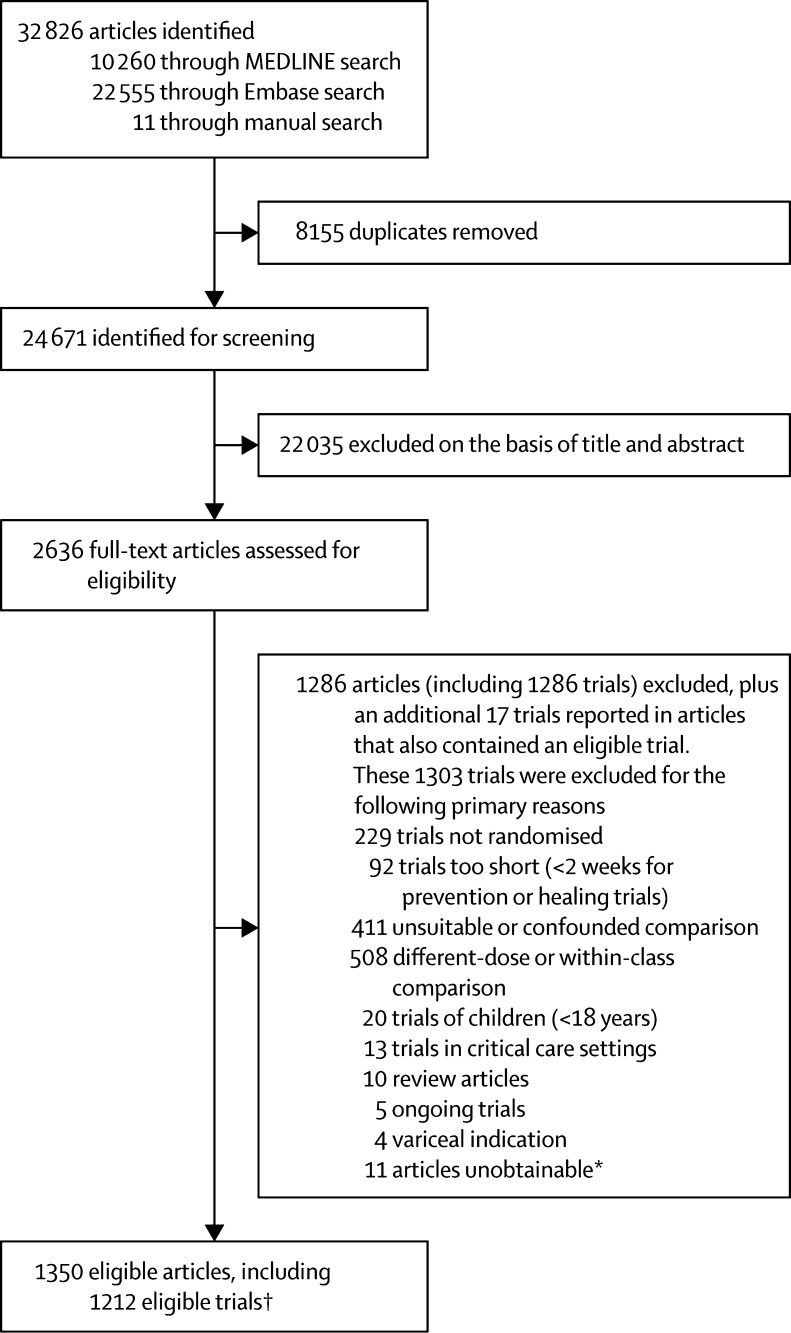
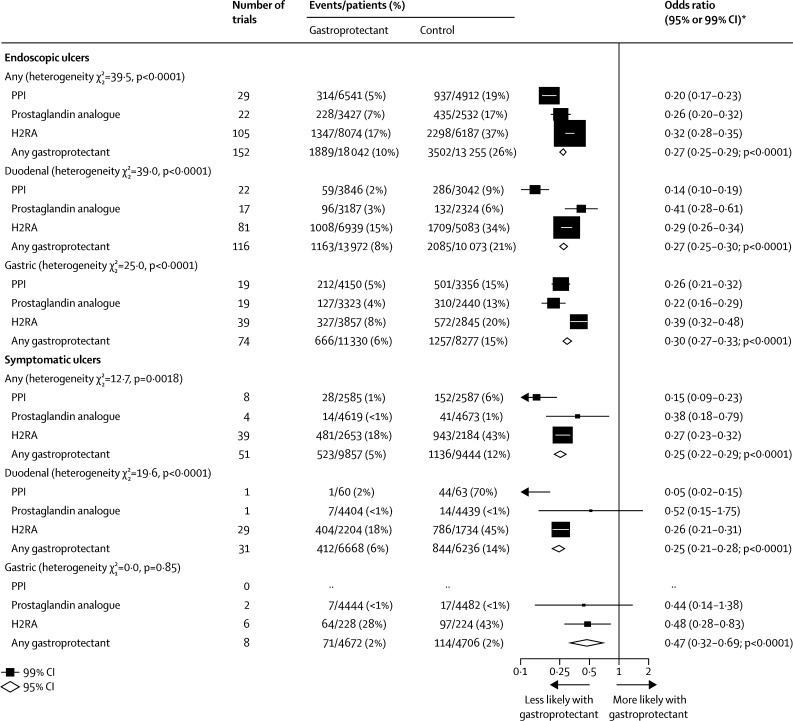
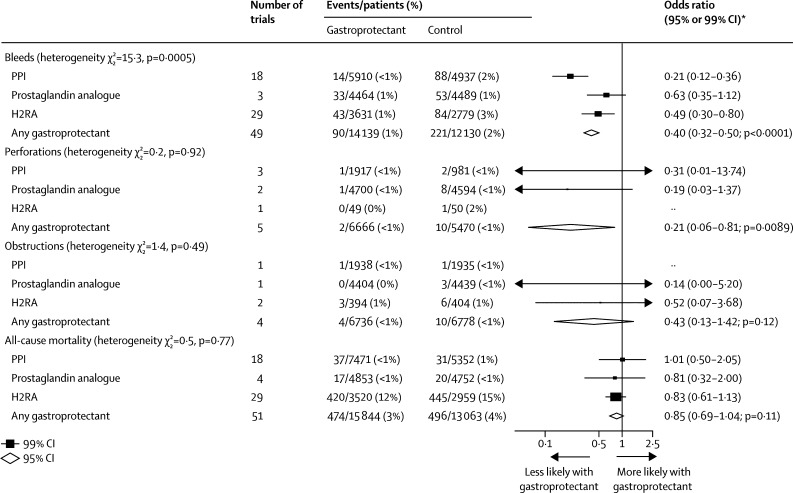
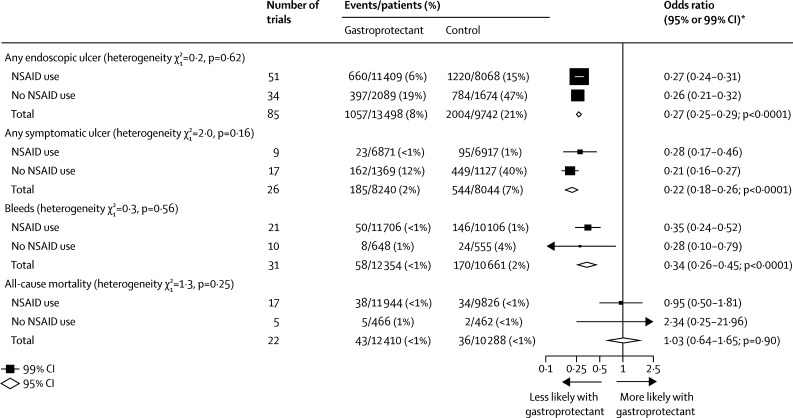
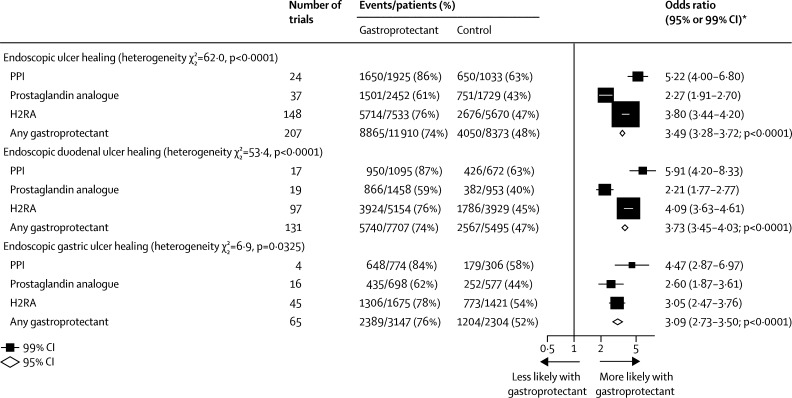
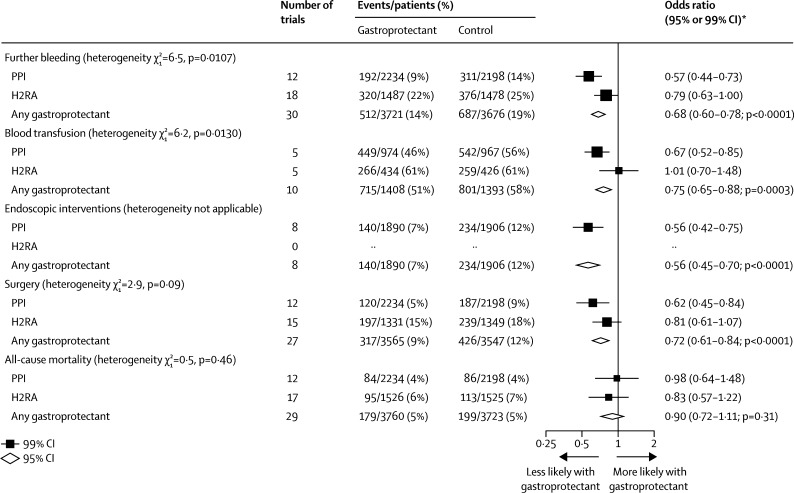
BackgroundGastroprotectant drugs are used for the prevention and treatment of peptic ulcer disease and might reduce its associated complications, but reliable estimates of the effects of gastroprotectants in different clinical settings are scarce. We aimed to examine the effects of proton-pump inhibitors (PPIs), prostaglandin analogues, and histamine-2 receptor antagonists (H2RAs) in different clinical circumstances by doing meta-analyses of tabular data from all relevant unconfounded randomised trials of gastroprotectant drugs.MethodsWe searched MEDLINE and Embase from Jan 1, 1950, to Dec 31, 2015, to identify unconfounded, randomised trials of a gastroprotectant drug (defined as a PPI, prostaglandin analogue, or H2RA) versus control, or versus another gastroprotectant. Two independent researchers reviewed the search results and extracted the prespecified outcomes and key characteristics for each trial. We did meta-analyses of the effects of gastroprotectant drugs on ulcer development, bleeding, and mortality overall, according to the class of gastroprotectant, and according to the individual drug within a gastroprotectant class.FindingsWe identified comparisons of gastroprotectant versus control in 849 trials (142 485 participants): 580 prevention trials (110 626 participants), 233 healing trials (24 033 participants), and 36 trials for the treatment of acute upper gastrointestinal bleeding (7826 participants). Comparisons of one gastroprotectant drug versus another were available in 345 trials (64 905 participants), comprising 160 prevention trials (32 959 participants), 167 healing trials (28 306 participants), and 18 trials for treatment of acute upper gastrointestinal bleeding (3640 participants). The median number of patients in each trial was 78 (IQR 44·0–210·5) and the median duration was 1·4 months (0·9–2·8). In prevention trials, gastroprotectant drugs reduced development of endoscopic ulcers (odds ratio [OR] 0·27, 95% CI 0·25–0·29; p<0·0001), symptomatic ulcers (0·25, 0·22–0·29; p<0·0001), and upper gastrointestinal bleeding (0·40, 0·32–0·50; p<0·0001), but did not significantly reduce mortality (0·85, 0·69–1·04; p=0·11). Larger proportional reductions in upper gastrointestinal bleeding were observed for PPIs than for other gastroprotectant drugs (PPIs 0·21, 99% CI 0·12–0·36; prostaglandin analogues 0·63, 0·35–1·12; H2RAs 0·49, 0·30–0·80; phet=0·0005). Gastroprotectant drugs were effective in preventing bleeding irrespective of the use of non-steroidal anti-inflammatory drugs (phet=0·56). In healing trials, gastroprotectants increased endoscopic ulcer healing (3·49, 95% CI 3·28–3·72; p<0·0001), with PPIs more effective (5·22, 99% CI 4·00–6·80) than prostaglandin analogues (2·27, 1·91–2·70) and H2RAs (3·80, 3·44–4·20; phet<0·0001). In trials among patients with acute bleeding, gastroprotectants reduced further bleeding (OR 0·68, 95% CI 0·60–0·78; p<0·0001), blood transfusion (0·75, 0·65–0·88; p=0·0003), further endoscopic intervention (0·56, 0·45–0·70; p<0·0001), and surgery (0·72, 0·61–0·84; p<0·0001), but did not significantly reduce mortality (OR 0·90, 0·72–1·11; p=0·31). PPIs had larger protective effects than did H2RAs for further bleeding (phet=0·0107) and blood transfusion (phet=0·0130).InterpretationGastroprotectants, in particular PPIs, reduce the risk of peptic ulcer disease and its complications and promote healing of peptic ulcers in a wide range of clinical circumstances. However, this meta-analysis might have overestimated the benefits owing to small study bias.FundingUK Medical Research Council and the British Heart Foundation.
Overview
The claims and statistics of this paper haven’t been checked yet.
Free: it reads the open-access text and checks the first 5 claims that cite a source we can check. Create a free account to check every claim.
Integrity signals
Registry
Cites
Statistics
Figures
Verification
Claims the paper makes
The claims and statistics of this paper haven’t been checked yet.
Free: it reads the open-access text and checks the first 5 claims that cite a source we can check. Create a free account to check every claim.
Claims other papers make about this one
Each is checked against this paper’s own text: does it say what the citing paper says it does?
The cited source doesn’t support the claim as written.
In the citing paper
“This benefit was also observed in the pre-specified subgroup of 6732 patients with diabetes in the COMPASS trial”
From 2023 ESC guidelines for the management of cardiovascular disease in patients with diabetes. (2023) · cites this paper as [352]
Checked by a reasoning model — may be wrong.
Experimental — accuracy not yet measuredThe check wasn’t confident either way, so it gives no verdict — never disputed.
In the citing paper
“Regarding CV safety, the composite of MI, stroke, CV death, CHD, and acute limb ischaemia was similar between pantoprazole and placebo, as was the rate of new-onset diabetes.”
From 2023 ESC guidelines for the management of cardiovascular disease in patients with diabetes. (2023) · cites this paper as [352]
Experimental — accuracy not yet measured
Self-check
Percentages, sums and reported differences re-computed from the paper’s own numbers.
The self-check needs the paper’s full text.
Citations
Cites
Rivaroxaban with or without aspirin in stable cardiovascular disease
Eikelboom, J. W., Connolly, S. J., Bosch, J., Dagenais, G. R., Hart, R. G., Shestakovska, O., Diaz, R., Alings, M., Lonn, E. M., Anand, S. S., et al. (2017) · New England Journal of Medicine · doi:10.1056/nejmoa1709118 · Cited by 2,438
Malfertheiner, P., Chan, F. K., & McColl, K. E. (2009) · The Lancet · doi:10.1016/s0140-6736(09)60938-7 · Cited by 1,488
Clopidogrel with or without Omeprazole in Coronary Artery Disease
Bhatt, D. L., Cryer, B. L., Contant, C. F., Cohen, M., Lanas, A., Schnitzer, T. J., Shook, T. L., Lapuerta, P., Goldsmith, M. A., Laine, L., et al. (2010) · New England Journal of Medicine · doi:10.1056/nejmoa1007964 · Cited by 1,240
Self-citationLanas, A., & Chan, F. K. L. (2017) · The Lancet · doi:10.1016/s0140-6736(16)32404-7 · Cited by 984
Publication bias in clinical trials due to statistical significance or direction of trial results
Hopewell, S., Loudon, K., Clarke, M. J., Oxman, A. D., & Dickersin, K. (2009) · Cochrane Database of Systematic Reviews · doi:10.1002/14651858.mr000006.pub3 · Cited by 898
Gomm, W., von Holt, K., Thomé, F., Broich, K., Maier, W., Fink, A., Doblhammer, G., & Haenisch, B. (2016) · JAMA Neurology · doi:10.1001/jamaneurol.2015.4791 · Cited by 563
Small study effects in meta-analyses of osteoarthritis trials: meta-epidemiological study
Nuesch, E., Trelle, S., Reichenbach, S., Rutjes, A. W. S., Tschannen, B., Altman, D. G., Egger, M., & Juni, P. (2010) · BMJ · doi:10.1136/bmj.c3515 · Cited by 559
Clostridium difficile-associated diarrhea and proton pump inhibitor therapy: a meta-analysis
Janarthanan, S., Ditah, I., Adler, D. G., & Ehrinpreis, M. N. (2012) · American Journal of Gastroenterology · doi:10.1038/ajg.2012.179 · Cited by 538
Research works printed but not linked: 1
- Early Breast Cancer Trialists' Collaborative Group Treatment of early breast cancer: worldwide evidence 1985–1990 1990 Oxford University Press Oxford
Cited by
Items 201–287 of 287
Management of Peptic Ulcer Disease in Patients Taking Antithrombotic Agents
Bang, C. S., & Gong, E. J. (2026) · The Korean Journal of Helicobacter and Upper Gastrointestinal Research · doi:10.7704/kjhugr.2026.0002 · Cited by 1
“29 Traditional agents, such as sucralfate and misoprostol, have been used for gastric mucosal protection, whereas newer agents, including rebamipide, teprenone, and eupatilin, are increas-118”
Guo, Z.-S., Zhang, J., Lv, F., Lv, J.-T., Cai, Y.-S., Jian-bo, F., Yan, P., & Gu, J.-R. (2026) · Immunopharmacology and Immunotoxicology · doi:10.1080/08923973.2026.2679470 · Cited by 1
“…like proton pump inhibitors (PPis) and h2 receptor antagonists, are available for the protection against mucosal damage and the prevention of GU [8–10], their long-term use is associated with significant adverse effects [11,12]. therefore, there is an urgent need to develop novel prophylactic…”
Negovan, A. E., Mester, A., & Dumitrascu, D. L. (2018) · Journal of Cardiovascular Emergencies · doi:10.2478/jce-2018-0006 · Cited by 1
Abdelfadeel, K., & Alazouny, Z. M. (2019) · Journal of Medical Histology/Journal of Medical Histology · doi:10.21608/jmh.2019.15148.1059 · Cited by 1
Study of Development problems dynamics of Ukrainian market of stomach ulcer treatment drugs
Panfilova, H., Samborskyi, О. S., Bogdan, N. S., Цурікова, О., & Simonian, L. (2021) · Research Journal of Pharmacy and Technology · doi:10.52711/0974-360x.2021.00441 · Cited by 1
AINS : la prévention des complications
Berenbaum, F. (2022) · Revue du Rhumatisme Monographies · doi:10.1016/j.monrhu.2022.05.003 · Cited by 4
Bai, G., Yi, J., Yu, Y., & Du, H. (2022) · Medicine · doi:10.1097/md.0000000000030898 · Cited by 1
“If not effectively and timely controlled, PU can become aggravated, and lead to serious complications such as perforation, ulcer bleeding, and even gastric cancer, which endangers the patient’s health and affects the quality of life.[3] The specific pathogenesis of PU is not clear.”
BackgroundA incidência de úlcera péptica em usuários crônicos de anti-inflamatórios não esteroides
Dornelas, A. J. S., Dantas, A. L., Distler, A. C., Scarin, G. P., Colomietz, I. F., Guedes, I. P. D. A., Okata, K. M. S. D. O., Martins, M. E. A., Cabeda, R., & Juliani, A. (2023) · Revista Eletrônica Acervo Médico · doi:10.25248/reamed.e12007.2023 · Cited by 1
Herszényi, L., Aradi, D., Békássy, S., Járai, Z., Juhász, M. F., Kiss, R. G., Kolossváry, E., Nardai, S., Simonyi, G., Szőnyi, M., et al. (2023) · Cardiologia Hungarica · doi:10.26430/chungarica.2023.53.2.150 · Cited by 1
Current use of proton pump inhibitors and when to limit, stop or not start treatment
Helgadóttir, H., & Bjornsson, E. S. (2023) · Læknablaðið · doi:10.17992/lbl.2023.0708.752 · Cited by 1
Principles for the use of non-steroidal anti-inflammatory drugs with proton pump inhibitors
Pietrzak, A. M. (2023) · Polish Journal of Surgery · doi:10.5604/01.3001.0053.7274 · Cited by 2
Cao, X. K., Tran, M. V. N., & Kieu, N. D. (2023) · Journal of Science and Technology · doi:10.55401/2y5rj432 · Cited by 1
Hernanda, E. T., & Adawiyah, P. R. (2023) · Pubmedia Social Sciences and Humanities · doi:10.47134/pssh.v1i2.120 · Cited by 1
SKRANDŽIO IR DVYLIKAPIRŠTĖS ŽARNOS OPALIGĖ: PATOGENEZĖ IR DIAGNOSTIKA
Airapetian, A., Martusevičius, D., & Filipavičiūtė, J. (2023) · Health Sciences · doi:10.35988/sm-hs.2023.293 · Cited by 1
Optimal Timing of Endoscopy in Patients Taking Anticoagulants with Upper Gastrointestinal Bleeding
Durak, M. B. (2024) · Digestive Diseases and Sciences · doi:10.1007/s10620-024-08397-7 · Cited by 1
“Contrary to some previous studies [6–8].”
Hammami, I., Mafham, M. M., Emberson, J., Offer, A. R., Hopewell, J. C., Armitage, J., Baigent, C., & Parish, S. (2025) · Heart · doi:10.1136/heartjnl-2024-324841 · Cited by 1
“22 By contrast, the Cardiovascular Outcomes for People Using Anticoagulation Strategies (COMPASS) trial of pantoprazole versus placebo (mean follow-up ~3 years) found a more modest protective effect of PPI therapy (12% (95% CI −15% to 33”
Self-citationShah, P., Pundarikakshudu, K., Kevlani, V., & Zaveri, M. (2025) · Proceedings of the Indian National Science Academy · doi:10.1007/s43538-025-00419-w · Cited by 2
“The current management of PUD includes antacids, anti-secretory drugs (Proton Pump Inhibitors (PPI), H 2 receptor blockers), potassium-competitive acid blockers and cyto-protective agents (Lanas and Chan 2017; Scally et al. 2018).”
Ingason, A. B., Hreinsson, J. P., & Bjornsson, E. S. (2022) · Clinical Gastroenterology and Hepatology · doi:10.1016/j.cgh.2022.10.018 · Cited by 1
Дутка, І. І., & Grynchuk, F. V. (2018) · Reports of Vinnytsia National Medical University · doi:10.31393/reports-vnmedical-2018-22(3)-12
Current Physician's Perception of Proton Pump Inhibitor-related Adverse Effects
Choi, C. W. (2020) · The Korean Journal of Helicobacter and Upper Gastrointestinal Research · doi:10.7704/kjhugr.2020.0034
“또는 항응고제를 복용 중인 환자들이기 때문에 PPI 투여 중단으 로 발생할 수 있는 상부위장관 출혈이 예방되지 않을 경우, 상부 위장관 출혈로 인해 사망에 이를 수도 있다.(5) 그러므로 약제 처방 에 대한 근거가 명확한 환자에게 PPI 투여를 중단하거나 부적절 한 대체 처방을 하는 것은 우려할 만하다.”
Kurbonovich, T. M., & Tukhtaeva, N. M. (2021) · E3S Web of Conferences · doi:10.1051/e3sconf/202126506008
Cavallari, I., Filippis, A. D., Nobile, E., Veneziano, F. A., Melfi, R., Nusca, A., Ussia, G. P., & Grigioni, F. (2021) · L Endocrinologo · doi:10.1007/s40619-021-00954-w
Magen-Darm-Mittel und Lebertherapeutika
Lohse, A. W., & Huber, S. (2021) · Springer eBooks · doi:10.1007/978-3-662-63825-5_32
Tayyebi, A., Abbasi, M. A., Shijlawi, M., Nematollahi, S., & Olamaeian, F. (2021) · Journal of Research in Applied and Basic Medical Sciences · doi:10.52547/rabms.7.3.128
“In more critical situations, bleeding and perforation are two major adverse issues of peptic ulcers that can occur due to chronic illnesses and stress (6).”
BackgroundAspirin and Non-Steroidal Anti-Inflammatory Drugs (NSAIDs)
Lanas-Gimeno, A., & Lanas, Á. (2018) · Elsevier eBooks · doi:10.1016/b978-0-12-801238-3.65620-9
Magen-Darm-Mittel und Lebertherapeutika
Lohse, A. W., & Mössner, J. (2019) · Springer eBooks · doi:10.1007/978-3-662-59046-1_34
Magen-Darm-Mittel und Lebertherapeutika
Lohse, A. W., & Huber, S. (2020) · Springer eBooks · doi:10.1007/978-3-662-62168-4_31
Magen/Darm- und Lebererkrankungen
Lohse, A. W., & Huber, S. (2022) · Springer eBooks · doi:10.1007/978-3-662-66303-5_12
Abordagem multimodal para prevenção e manejo clínico e cirúrgico da úlcera péptica
Sá, R. A. E., Cardoso, A. F. O., Cerqueira, A. C. D. S., Silva, C. G. F. D., Rocha, E. D. O., Pinto, K. K., Rocha, M. F. S., Queiroz, M. Z. C. D., Ferreira, T. S., & Santos, V. C. D. (2023) · Brazilian Journal of Development · doi:10.34117/bjdv9n3-225
Alzahrani, M. M., Alharthi, A., Shanbari, N. A., Bakry, S., Kambiji, G., Nahar, K., AlQurashi, A., Alharthi, F., & Elhefny, M. (2023) · Journal of Umm Al-Qura University for Medical Sciences · doi:10.54940/ms74558041
Batool, S., Noreen, S., Malik, T., Fatima, J., Shaheen, B., & Qammar, S. M. (2023) · Pakistan Armed Forces Medical Journal · doi:10.51253/pafmj.v73i6.6904
Surgical approaches to the treatment of complicated ulcers of the stomach and duodenum
Ivanchov, P. V., & Biliachenko, M. V. (2023) · Experimental and Clinical Medicine · doi:10.35339/ekm.2023.92.3.ivb
Magen/Darm- und Lebererkrankungen
Bock, K., & Seifert, R. (2023) · Springer eBooks · doi:10.1007/978-3-662-68371-2_12
Yan, Y., Ai, C., Xie, J., Ji, Z., Zhou, X., Chen, Z., & Wu, J. (2024) · European Journal of Hospital Pharmacy · doi:10.1136/ejhpharm-2024-004126
Herszényi, L., Aradi, D., Békássy, S., Járai, Z., Juhász, M., Kiss, R. G., Kolossváry, E., Nardai, S., Simonyi, G., Szőnyi, M., et al. (2024) · Magyar Belorvosi Archívum · doi:10.59063/mba.2024.77.3.1
Johnson, A., Piplani, S., Akpan, E. J., Khan, Z., Bachan, M., & Radulovic, M. (2024) · Translational Gastroenterology and Hepatology · doi:10.21037/tgh-24-5
“This observation aligns with our finding of decreased mortality among CTD patients, suggesting a plausible mechanism through which ulcer management in CTD patients may contribute to GI bleed prevention and ultimately reduce mortality (30).”
ResultUnveiling Leaders and Trends in Gastroprotective Nutraceuticals: A Global Bibliometric Analysis
Salazar-Leguía, D., Quinteros-Leon, R. B., Chumpitaz-Huanqui, G. P., Socantaype, F. V. H., Cueva-Mestanza, R., & Alvarez-Yanamango, E. G. (2024) · LACCEI International Multi-Conference for Engineering, Education and Technology (LACCEI) · doi:10.18687/laccei2024.1.1.1217
Li, F., Huang, F., Lu, Y., Wang, X., Li, M., Zhang, F., Jiang, H., Chen, J., & Lv, B. (2024) · British Journal Of Nutrition · doi:10.1017/s0007114524002368 · Cited by 1
Fox, E., & McKay, G. (2024) · Practical Diabetes · doi:10.1002/pdi.2521
Qiao, C., Qin, X., Song, Y., Guan, R., Bai, L., Zuo, Y., Wei, W., Han, T., & Jiang, W. (2025) · Journal of Affective Disorders · doi:10.1016/j.jad.2025.03.114
Magen-, Darm- und Lebererkrankungen
Bock, K., & Seifert, R. (2025) · Springer eBooks · doi:10.1007/978-3-662-70594-0_12
Hladkykh, F. V., Кошурба, І. В., Liadova, T. I., Chyzh, M., & Matvieienko, M. S. (2025) · doi:10.46879/2025.3
Montalto, C., Cerutti, A. A., & Leonardi, S. (2025) · European Heart Journal - Quality of Care and Clinical Outcomes · doi:10.1093/ehjqcco/qcaf106
Zhang, S., Gui, B., Wu, Z., Wei, Y., Deng, H. X., Li, K., Guo, C., & Chen, Y. (2025) · Journal of Holistic Integrative Pharmacy · doi:10.1016/j.jhip.2025.09.007
Comprehensive Rehabilitation Nursing Management of Bariatric Surgery: Chinese Expert ConsensusPreprint
Kuang, L., Xu, D., Yang, Y., Yan, Y., Shen, M., Chen, X., Sun, L., Wang, Y., & Xu, H. (2025) · Research Square · doi:10.21203/rs.3.rs-7033052/v1
Thakur, A., & Chorawala, M. R. (2025) · Naunyn-Schmiedeberg s Archives of Pharmacology · doi:10.1007/s00210-025-04843-z
Shin, M.-R., An, H. Y., Kim, M. J., Bae, S. E., Park, H.-J., & Roh, S. (2025) · Journal of the Korean Society of Food Science and Nutrition · doi:10.3746/jkfn.2025.54.11.911
Chen, X., Ma, Y.-C., Yang, M., You, P., Liu, D., Ye, X., Yanfang, Y., Zhou, A., & Liu, Y. (2020) · Sage Journals Data · doi:10.25384/sage.c.5070065
Kurlander, J. E., Helminski, D., Lanham, M. S. M., Henstock, J. L., Kidwell, K., Krein, S. L., Saini, S. D., Richardson, C. R., Vries, R. G. D., Resnicow, K., et al. (2022) · Figshare · doi:10.6084/m9.figshare.19090827
Kurlander, J. E., Helminski, D., Lanham, M. S. M., Henstock, J. L., Kidwell, K., Krein, S. L., Saini, S. D., Richardson, C. R., Vries, R. G. D., Resnicow, K., et al. (2022) · Figshare · doi:10.6084/m9.figshare.19090836
Kurlander, J. E., Helminski, D., Lanham, M. S. M., Henstock, J. L., Kidwell, K., Krein, S. L., Saini, S. D., Richardson, C. R., Vries, R. G. D., Resnicow, K., et al. (2022) · Figshare · doi:10.6084/m9.figshare.19090830
Kurlander, J. E., Helminski, D., Lanham, M. S. M., Henstock, J. L., Kidwell, K., Krein, S. L., Saini, S. D., Richardson, C. R., Vries, R. G. D., Resnicow, K., et al. (2022) · Figshare · doi:10.6084/m9.figshare.19090812
Kurlander, J. E., Helminski, D., Lanham, M. S. M., Henstock, J. L., Kidwell, K., Krein, S. L., Saini, S. D., Richardson, C. R., Vries, R. G. D., Resnicow, K., et al. (2022) · Figshare · doi:10.6084/m9.figshare.19090839
Kurlander, J. E., Helminski, D., Lanham, M. S. M., Henstock, J. L., Kidwell, K., Krein, S. L., Saini, S. D., Richardson, C. R., Vries, R. G. D., Resnicow, K., et al. (2022) · Figshare · doi:10.6084/m9.figshare.19090845
Kurlander, J. E., Helminski, D., Lanham, M. S. M., Henstock, J. L., Kidwell, K., Krein, S. L., Saini, S. D., Richardson, C. R., Vries, R. G. D., Resnicow, K., et al. (2022) · Figshare · doi:10.6084/m9.figshare.19090818
Kurlander, J. E., Helminski, D., Lanham, M. S. M., Henstock, J. L., Kidwell, K., Krein, S. L., Saini, S. D., Richardson, C. R., Vries, R. G. D., Resnicow, K., et al. (2022) · Figshare · doi:10.6084/m9.figshare.19090842
Kurlander, J. E., Helminski, D., Lanham, M. S. M., Henstock, J. L., Kidwell, K., Krein, S. L., Saini, S. D., Richardson, C. R., Vries, R. G. D., Resnicow, K., et al. (2022) · Figshare · doi:10.6084/m9.figshare.19090824
Kurlander, J. E., Helminski, D., Lanham, M. S. M., Henstock, J. L., Kidwell, K., Krein, S. L., Saini, S. D., Richardson, C. R., Vries, R. G. D., Resnicow, K., et al. (2022) · Figshare · doi:10.6084/m9.figshare.19090833
Kurlander, J. E., Helminski, D., Lanham, M. S. M., Henstock, J. L., Kidwell, K., Krein, S. L., Saini, S. D., Richardson, C. R., Vries, R. G. D., Resnicow, K., et al. (2022) · Figshare · doi:10.6084/m9.figshare.19090821
Patrono, C. (2025) · Springer eBooks · doi:10.1007/978-3-031-96360-5_1
Self-citationJain, K., Shaikh, M., Butt, A. S., Mansha, M. M., Madathiparambu, N. C., Rizwan, A., Younas, S., & Khan, M. A. Z. (2026) · Cureus · doi:10.7759/cureus.100702
“Despite advances in cardiovascular care, GI hemorrhage remains one of the most frequent causes of hospitalization among patients treated with long-term anti-thrombotics [11].”
Xie, C. H., Yue, J., He, W., & Yu, C. B. (2026) · International Immunopharmacology · doi:10.1016/j.intimp.2026.116240
Modern Clinical Guidelines for the Management of Patients with Gastroesophageal Reflux Disease
Alexeyeva, A. A., Apkhanova, T. V., Baranov, A. A., Bataev, S. M., Batysheva, T. T., Belmer, S. V., Belyaeva, I. D., Budkina, T. N., Bykova, O. A., Vishneva, Е. A., et al. (2026) · Педиатрическая фармакология · doi:10.15690/pf.v22i6.2982
Leyderman, I. N., Kirov, M. Y., Kokarev, E. A., Lyapustin, S. B., Potapov, A. L., Александровна, Р. А., Sokolova, M. M., Sytov, A. V., Strukov, E. Y., Сергеевич, Т. И., et al. (2026) · Annals of critical care · doi:10.21320/1818-474x-2026-1-7-19
IN SILICO STUDY OF FARNESOL AND ITS USE IN EMULSION AS A POTENTIAL TREATMENT FOR GASTRIC ULCER
da Silva, R. C., Sousa, L. T. N. E., dos Santos, I. S., Silva, F. T. B., Rodrigues, A. M. X., Lima, F. D. C. A., Mendes, A. N., & Oliveira, R. D. C. M. (2026) · Derecho y cambio social. · doi:10.54899/dcs.v23i87.4445
Idiopathic recurrent pericarditis: Yesterday, today, and tomorrow
Safiullina, A. A., Анатольевна, П. А., Osmolovskaya, Y. F., Жиров, И. В., & Tereshchenko, S. N. (2026) · Terapevticheskii arkhiv · doi:10.26442/00403660.2025.12.203447
Magen-, Darm- und Lebererkrankungen
Bock, K., & Seifert, R. (2026) · Springer eBooks · doi:10.1007/978-3-662-72738-6_12
Kim, M., Chi, S. A., Kim, J. E., Kim, E. R., Hong, S. N., Kim, Y.-H., Kim, K., & Chang, D. K. (2026) · World Journal of Gastroenterology · doi:10.3748/wjg.v32.i14.115790
Taha, H., & Adham, A. N. (2026) · Zanco Journal of Medical Sciences · doi:10.15218/zjms.2026.016
Bahy, A., Chemli, M., Dammak, M. I., Jandoubi, O., Hamden, K., Cerf, D. L., Majdoub, H., Jaffrezic-Renault, N. J., & Halima, H. B. (2026) · International Journal of Biological Macromolecules · doi:10.1016/j.ijbiomac.2026.152650 · Cited by 1
Lee, D. S., Lee, S. W., Kang, S. H., Moon, H. S., Sung, J. K., Kim, S. H., Lee, D. K., Kim, K. B., Kim, S. M., Cho, Y. S., et al. (2026) · World Journal of Gastroenterology · doi:10.3748/wjg.119434
Miciuda, P., Bździuch, P., Cencelewicz, K., & Buziak, J. (2026) · Quality in Sport · doi:10.12775/qs.2026.64.73321
“Nevertheless, compared with other gastroprotective drugs, PPIs showed greater effectiveness in reducing the risk of upper GI bleeding and promoting the healing of existing lesions [18].”
Aspirin in Primary Prevention of CVD: A Pragmatic Outline and Advice for Treatment Personalization
Santilli, F., Sibbing, D., & Cobo, A. L. (2026) · Journal of Clinical Medicine · doi:10.3390/jcm15155936
“PPIs significantly reduce upper gastrointestinal bleeding incidence [35] and may therefore be considered in patients who require aspirin but possess elevated gastrointestinal bleeding risk, particularly older adults or those with a prior history of ulcer disease.”
Evidence-based clinical practice guidelines for peptic ulcer disease 2026
Sugimoto, M., Kamada, T., Ito, M., Iwamoto, J., Okimoto, T., Ono, S., Kanno, T., Chiba, T., Tokunaga, K., Nomura, S., et al. (2026) · Journal of Gastroenterology · doi:10.1007/s00535-026-02504-3
“Scally et al. [61] showed that PPIs had greater protective effects than H 2 RAs or PG analogs against peptic ulcers and further bleeding; therefore, PPIs are suggested as a first-line therapy.”
Kourek, C., & Bouras, G. (2026) · Journal of Clinical Medicine · doi:10.3390/jcm15176607
“…are consistent with the established gastroprotective effect of proton pump inhibitor co-therapy in patients receiving antithrombotic treatment [36–38], while exploring whether protection can be achieved with a lower maintenance dose in a population in whom bleeding risk is clinically important.”
Song, Y., Yao, F., Zhang, Y., Chen, J., Wang, Q., Wen, Y., Wen, G., & Zeng, J. (2026) · Journal of Functional Foods · doi:10.1016/j.jff.2026.107479
Irigoyen, A., Gasmi, M., Barthet, M. A., & Gonzalez, J. (2026) · Therapeutic Advances in Gastrointestinal Endoscopy · doi:10.1177/26317745251405741
Głowacka, P., Bartkowska, A., Orzechowska, P., Mastej-Witek, G., Okupniak, A., Budziszewska, G., Nieczyporuk, M., Dziurdź, A., Łupicka, A., & Ziemba, M. (2026) · Biuletyn Głównej Biblioteki Lekarskiej · doi:10.2478/bgbl-2026-0015
“…this reason, current gastroenterology and cardiology guidelines recommend PPI use as gastroprotective therapy in patients receiving long-term NSAIDs, antiplatelet, or anti-coagulant treatments if they present with factors that increase the risk of upper gastrointestinal bleeding [12-13 ,15-16 15-16”
InfluentialPrevalence of Upper Gastrointestinal Bleeding in Paktia Regional Hospital (Paktia, 2024 – 2025)
Stanikzai, R., & Hafiz, W. U. (2026) · Ghalib Medical Journal · doi:10.58342/mj.v.3.i.2.10
Guidelines for the prevention and treatment of stress ulcers in critically ill patients (2026)
Chen, D., Kang, Y., Guan, X., Zhang, S., Yu, Y., Gong, Y., Hu, B., Li, C., 廖雪莲, Liu, F., et al. (2026) · Journal of Intensive Medicine · doi:10.1016/j.jointm.2026.06.003 · Cited by 1
Lee, S. H., Na, S.-I., Park, S. C., Cho, B. R., Lee, B., Cho, Y., Cho, H., Youk, H.-J., & Ryu, D. R. (2026) · Frontiers in Cellular and Infection Microbiology · doi:10.3389/fcimb.2026.1942212
“Considering the increased risk of gastrointestinal (GI) bleeding associated with long-term antiplatelet therapy, concomitant acid suppression therapy for gastroprotection is considered particularly in patients at a high risk of GI bleeding (Abraham et al., 2010; Scally et al., 2018).”
КЛІНІЧНО-ЛАБОРАТОРНІ ПАРАЛЕЛІ ЗА ВИРАЗКОВИХ КРОВОТЕЧ
Дутка, І. І., & Дутка, І. І. (2018) · Art of Medicine
Suprapti, B., Yunus, Y., Andarsari, M. R., Agustina, F. R., & Ngantung, Y. E. (2026) · Indonesian Journal of Pharmaceutical Education · doi:10.37311/ijpe.v6i3.38581
Agoston, R., Damacus, D. I., Agoşton-Coldea, L., Seicean, A., Khoury, T., & Orzan, R. I. (2026) · European Journal of Clinical Pharmacology · doi:10.1007/s00228-026-04226-0
Metadata
- Authors
- Scally, B., Emberson, J. R., Spata, E., Reith, C., Davies, K., Halls, H., Holland, L., Wilson, K., Bhala, N., Hawkey, C., Hochberg, M., Hunt, R., Laine, L., Lanas, A., Patrono, C., & Baigent, C.
- Affiliations
- Glasgow Royal Infirmary (GB)
- MRC Population Health Research Unit (GB)
- University of Oxford (GB)
- Queen Elizabeth Hospital Birmingham (GB)
- Queen's Medical Centre (GB)
- University of Maryland, Baltimore (US)
- McMaster University (CA)
- Yale University (US)
- Università Cattolica del Sacro Cuore (IT)
- Corresponding author
- Baigent, Colin
- ORCID
- Venue
- The Lancet Gastroenterology & Hepatology
- Publisher
- Elsevier BV
- Published
- 2018-04
- Volume
- 3
- Issue
- 4
- Pages
- 231-241
- ISSN
- 2468-1156 (ISSN-L)
- 2468-1253
- PMC
- PMC5842491
- OpenAlex
- W2788189477
- Semantic Scholar
- 56970a7095af478974a1d3579bf2a1e8bc7d4ceb
- Cited by
- 259
- References
- 27
- Citations by year
- 2026: 25 · 2025: 37 · 2024: 35 · 2023: 30 · 2022: 34 · 2021: 25 · 2020: 38 · 2019: 23 · 2018: 12
- FWCI
- 5.45
- Type
- journal article
- Language
- en
- Open access
- hybrid
- doi.org
- Licence
- cc-by
- www.elsevier.com/tdm/userlicense/1.0/ (tdm)
- creativecommons.org/licenses/by/4.0/ (vor)
- Locations
- The Lancet. Gastroenterology & hepatology (publishedVersion, cc-by)
- PubMed Central (publishedVersion, cc-by)
- PubMed (publishedVersion)
- Zaguan (Universidad de Zaragoza) (submittedVersion, cc-by)
- Funders
- British Heart Foundation
- Medical Research Council
- Topics
- Health Sciences › Medicine › Gastroenterology › Helicobacter pylori-related gastroenterology studies
- Health Sciences › Medicine › Gastroenterology › Gastrointestinal Bleeding Diagnosis and Treatment
- Health Sciences › Medicine › Pharmacology (medical) › Inflammatory mediators and NSAID effects
- Keywords
- peptic ulcer, proton pump inhibitors, prostaglandin analogues, H2 receptor antagonists, ulcer prevention, ulcer healing, upper gastrointestinal bleeding, peptic ulcer mortality, drug comparison, adverse effects, drug safety, bleeding complications, drug interactions with anticoagulants, drug
- MeSH terms
- Anti-Inflammatory Agents, Non-Steroidal, Anti-Ulcer Agents, Histamine H2 Antagonists, Humans, Peptic Ulcer, Peptic Ulcer Hemorrhage, Prostaglandins, Synthetic, Proton Pump Inhibitors, Secondary Prevention
About these checks
Registry, retraction, Cites and statistics results are computed, not judged, with one exception: a printed reference that no index lists is read once by a model before it counts as a citation error. Claims are extracted by a model and kept only when their quote appears verbatim in the text; each cited source is then checked, with a model’s help, for whether it says what the claim relies on. Those verdicts can be wrong — read the claim’s quote and the cited source before relying on one.
Statistics and arithmetic are recomputed, not judged.
Confidence bands are shown only for fields calibrated on our annotated test set. None is calibrated yet, so no band is shown.
What counts as a claim ›How we measure confidence ›How we check this ›
Are you an author, or do you see a problem with this page? Request a review
Data sources
Bibliographic data: Semantic Scholar, OpenAlex, Crossref.
Contains information from the Semantic Scholar Academic Graph Datasets, made available under the ODC Attribution License (ODC-BY 1.0).
Semantic Scholar’s data is described in: Kinney, R., et al. (2023). The Semantic Scholar Open Data Platform. arXiv:2301.10140.
