

Forecasting the care needs of the older population in England over the next 20 years: estimates from the Population Ageing and Care Simulation (PACSim) modelling study
Open accessThe DOI matches its Crossref record; 33 of the 34 references it cites were found in a registry or an index.
Abstract
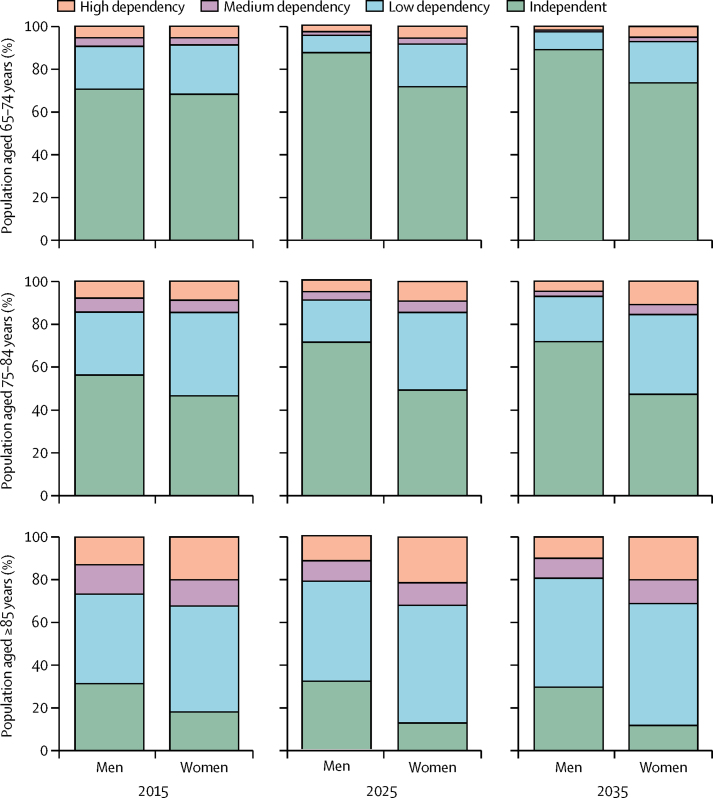
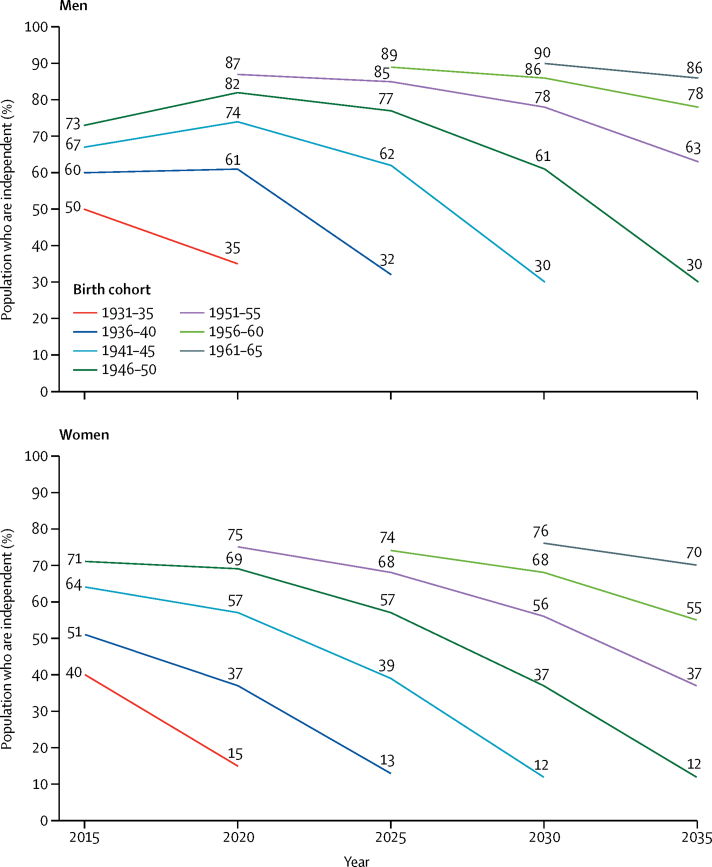
BACKGROUND: Existing models for forecasting future care needs are limited in the risk factors included and in the assumptions made about incoming cohorts. We estimated the numbers of people aged 65 years or older in England and the years lived in older age requiring care at different intensities between 2015 and 2035 from the Population Ageing and Care Simulation (PACSim) model. METHODS: PACSim, a dynamic microsimulation model, combined three studies (Understanding Society, the English Longitudinal Study of Ageing, and the Cognitive Function and Ageing Study II) to simulate individuals' sociodemographic factors, health behaviours, 12 chronic diseases and geriatric conditions, and dependency (categorised as high [24-h care], medium [daily care], or low [less than daily] dependency; or independent). Transition probabilities for each characteristic were estimated by modelling state changes from baseline to 2-year follow-up. Years in dependency states were calculated by Sullivan's method. FINDINGS: Between 2015 and 2035 in England, both the prevalence of and numbers of people with dependency will fall for young-old adults (65-74 years). For very old adults (≥85 years), numbers with low dependency will increase by 148·0% (range from ten simulations 140·0-152·0) and with high dependency will almost double (increase of 91·8%, range 87·3-94·1) although prevalence will change little. Older adults with medium or high dependency and dementia will be more likely to have at least two other concurrent conditions (increasing from 58·8% in 2015 to 81·2% in 2035). Men aged 65 years will see a compression of dependency with 4·2 years (range 3·9-4·2) of independence gained compared with life expectancy gains of 3·5 years (3·1-4·1). Women aged 65 years will experience an expansion of mainly low dependency, with 3·0 years (3·0-3·6) gained in life expectancy compared with 1·4 years (1·2-1·4) with low dependency and 0·7 years (0·6-0·8) with high dependency. INTERPRETATION: In the next 20 years, the English population aged 65 years or over will see increases in the number of individuals who are independent but also in those with complex care needs. This increase is due to more individuals reaching 85 years or older who have higher levels of dependency, dementia, and comorbidity. Health and social care services must adapt to the complex care needs of an increasing older population. FUNDING: UK Economic and Social Research Council and the National Institute for Health Research.
Overview
The claims and statistics of this paper haven’t been checked yet.
Free: it reads the open-access text and checks the first 5 claims that cite a source we can check. Create a free account to check every claim.
Integrity signals
Registry
Cites
Statistics
Figures
Verification
Claims the paper makes
The claims and statistics of this paper haven’t been checked yet.
Free: it reads the open-access text and checks the first 5 claims that cite a source we can check. Create a free account to check every claim.
Claims other papers make about this one
Each is checked against this paper’s own text: does it say what the citing paper says it does?
The cited source says what the claim attributes to it.
In the citing paper
“Models also suggest that there will be future increases both in the number of individuals who are independent and those with complex care needs.6”
From Dementia prevention, intervention, and care: 2020 report of the Lancet Commission (2020) · cites this paper as [6]
The check wasn’t confident either way, so it gives no verdict — never disputed.
In the citing paper
“In contrast, age-specific dementia prevalence in Japan, South Korea, Hong Kong, and Taiwan looks as if it is increasing, as is Alzheimer's in LMIC, although whether diagnostic methods are always the same in comparison studies is unclear.5, 6, 7”
From Dementia prevention, intervention, and care: 2020 report of the Lancet Commission (2020) · cites this paper as [6]
Experimental — accuracy not yet measured
Self-check
Percentages, sums and reported differences re-computed from the paper’s own numbers.
The self-check needs the paper’s full text.
Citations
Cites
Folstein, M. F., Folstein, S. E., & McHugh, P. R. (1975) · Journal of Psychiatric Research · doi:10.1016/0022-3956(75)90026-6 · Cited by 88,282
Kok, J. S., Berg, I. J., & Scherder, E. J. A. (2013) · Dementia and Geriatric Cognitive Disorders Extra · doi:10.1159/000353441 · Cited by 20,589
Older Adults' Reasons for Using Technology while Aging in Place
Peek, S. T. M., Luijkx, K. G., Rijnaard, M. D., Nieboer, M. E., van der Voort, C. S., Aarts, S., van Hoof, J., Vrijhoef, H. J. M., & Wouters, E. J. M. (2016) · Gerontology · doi:10.1159/000430949 · Cited by 19,690
Sensitivity and False Alarm Rate of a Fall Sensor in Long-Term Fall Detection in the Elderly
Kangas, M., Korpelainen, R., Vikman, I., Nyberg, L., & Jämsä, T. (2015) · Gerontology · doi:10.1159/000362720 · Cited by 18,909
Global status report on noncommunicable diseases 2010.
Alwan, A. (2011) · Cited by 8,494
Aging with multimorbidity: A systematic review of the literature
Marengoni, A., Angleman, S., Melis, R., Mangialasche, F., Karp, A., Garmen, A., Meinow, B., & Fratiglioni, L. (2011) · Ageing Research Reviews · doi:10.1016/j.arr.2011.03.003 · Cited by 3,092
Stuck, A. E., Walthert, J. M., Nikolaus, T., Büla, C. J., Hohmann, C., & Beck, J. C. (1999) · Social Science & Medicine · doi:10.1016/s0277-9536(98)00370-0 · Cited by 1,868
A Single Index of Mortality and Morbidity
Sullivan, D. F. (1971) · HSMHA Health Reports · doi:10.2307/4594169 · Cited by 1,450
Multiple Imputation by Chained Equations (MICE): Implementation in Stata
Royston, P., & White, I. (2011) · Journal of Statistical Software · doi:10.18637/jss.v045.i04 · Cited by 1,248
National, regional, and global trends in adult overweight and obesity prevalences
Stevens, G. A., Singh, G. M., Lu, Y., Danaei, G., Lin, J. K., Finucane, M. M., Bahalim, A. N., McIntire, R. K., Gutierrez, H. R., Cowan, M., et al. (2012) · Population Health Metrics · doi:10.1186/1478-7954-10-22 · Cited by 929
Cited by
Items 201–285 of 285
Competing in the “war for talent” in nursing homes: A quantitative investigation
Gabutti, I., Martini, L., Pandolfi, D., Apuzzo, L., & Mantoan, D. (2024) · Health Services Management Research · doi:10.1177/09514848241270767 · Cited by 2
Implementing care-related services in care units - an interview study
Reichert, D., Gummesson, K., Wallin, L., & Dahlström, T. (2024) · BMC Health Services Research · doi:10.1186/s12913-024-11465-3 · Cited by 2
“Most notably, the population aged 80 and above, who have the highest healthcare needs, is expected to grow in Sweden as well as elsewhere in the western hemisphere [2–4].”
BackgroundDemographic Perspective on the Study of Aging
García-Chanes, R. E., & Huerta, A. V. R. (2024) · Springer eBooks · doi:10.1007/978-3-031-76469-1_4 · Cited by 1
Bevilacqua, G., D’Angelo, S., Laskou, F., Zaballa, E., Harvey, N. C., & Dennison, E. M. (2025) · Calcified Tissue International · doi:10.1007/s00223-024-01307-z · Cited by 2
“In 2019, around 20% of men and 30% of women in the United Kingdom aged over 65 years required assistance with performing at least one of their daily life activities [6], and it has been estimated that these proportions are likely to increase by approximately a third within the next decade [7].”
Historical and future drivers of long-term care demand
Hu, B., & Wittenberg, R. (2025) · Cambridge University Press eBooks · doi:10.1017/9781009563444.002 · Cited by 2
Tavares, S., Reisberg, A., Belsey, D., Henley, A., & Downey, L. E. (2025) · PLoS ONE · doi:10.1371/journal.pone.0328016 · Cited by 1
Lin, Y.-C., Chien, Y., Yang, W., Lai, C.-Y. Y., Chang, K., Huang, S., Liou, T., & Chiou, H. (2025) · BMC Geriatrics · doi:10.1186/s12877-025-06457-9 · Cited by 2
“Kingston et al. (2018) projected that the number of elderly adults with four or more diseases would double between 2015 and 2035 [13], potentially driving an increase in disabilities among the elderly population.”
InfluentialMikoshiba, M., Kawamura, A., Awatani, T., & Noguchi, H. (2025) · BMC Geriatrics · doi:10.1186/s12877-025-06854-0 · Cited by 1
“It assesses individual care levels and actual use of care services as determined by trained professionals, rather than relying on self-reported disability status [26].”
Baniasad, A., Baei, M. S., & Tala-Tapeh, S. M. (2025) · Materials Chemistry and Physics · doi:10.1016/j.matchemphys.2025.132003 · Cited by 1
Development of Deep Learning Models for AI-Enhanced Telemedicine in Nursing Home Care
Reigal, N. L., Cantón-Habas, V., Rich‐Ruiz, M., Sabater-García, G., Cosculluela-Fernández, Á., & Ávila-Jiménez, J. L. (2026) · Journal of Clinical Medicine · doi:10.3390/jcm15020828 · Cited by 2
“However, this increase does not always translate into years lived in full health, resulting in higher levels of dependency [6] and the need for specialized care.”
Wang, X. (., Li, A., Li, Z., Chen, X., & Li, Q. (2026) · Habitat International · doi:10.1016/j.habitatint.2026.103783 · Cited by 1
Tavares, S., Beaney, T. E., Reisberg, A., Henley, A., Belsey, D., Edwards, A., & Downey, L. E. (2026) · Journal of Multimorbidity and Comorbidity · doi:10.1177/26335565261451686 · Cited by 1
Midttun, S., Lydersen, S., Kaminsky, L. A., Wisløff, U., & Stensvold, D. (2026) · Medicine & Science in Sports & Exercise · doi:10.1249/mss.0000000000004028 · Cited by 1
“Projections from the United Kingdom estimate a 36% increase in older adults (>65 yr) requiring high care needs by 2035 (36), underscoring the importance of strategies that may preserve functional capacity.”
Zhang, Y.-L., Qin, L., Bai, W.-B., Shen, N., & Qin, J. (2026) · Medicine · doi:10.1097/md.0000000000049589 · Cited by 1
“[11,12] BADL represent the ability to perform fundamental self-care tasks, whereas IADL represent the capacity to live independently within the community.”
Gamification in Dementia and Mild Cognitive Impairment
Simões-Silva, V., Gregório, S. A. M., Luz, T. D. T. M., Lapa, A. F. C. C., & Marques, A. J. (2020) · Advances in medical technologies and clinical practice book series · doi:10.4018/978-1-7998-7472-0.ch008 · Cited by 2
Intranasal applications in Alzheimer's treatment
Konaklı, M. İ. (2020) · Demiroglu Science University Florence Nightingale Journal of Medicine · doi:10.5606/fng.btd.2020.25038 · Cited by 2
Can't Afford the Laurels?: Care Provision in Ambridge in 2045
Heilbronn, R., & Janssen, R. (2021) · Emerald Group Publishing Limited eBooks · doi:10.1108/978-1-80071-386-420211016 · Cited by 1
An Attempt to Replace System Dynamics with Discrete Rate Modeling in Demographic Simulations
Zabawa, J., & Mielczarek, B. (2021) · Lecture notes in computer science · doi:10.1007/978-3-030-77970-2_21 · Cited by 1
Thompson, J., Hill, M., Bainbridge, L., Cowie, D., & Flewers, E. (2021) · Housing Care and Support · doi:10.1108/hcs-03-2021-0008 · Cited by 1
Cell senescence is a cause of frailty
Wan, T., Miwa, S., & von Zglinicki, T. (2021) · Elsevier eBooks · doi:10.1016/b978-0-12-822514-1.00013-4 · Cited by 2
Informal care for adults: a comparison of Time Use Surveys of 2004 and 2013
Zajkowska, O., & Rokicka, M. (2021) · Studia Demograficzne · doi:10.33119/sd.2021.1.3 · Cited by 1
Professional, legal and ethical dimensions of prescribing. Part 2: legal and ethical
Gould, J., & Bain, H. (2022) · Primary Health Care · doi:10.7748/phc.2022.e1774 · Cited by 1
Davies, L. E., Todd, A., Sinclair, D. R., Robinson, L. A., & Kingston, A. (2023) · British Journal of Clinical Pharmacology · doi:10.1111/bcp.15858 · Cited by 1
“Thus, this observation might be due to individual resilience and coping mechanisms, or those living alone having more support from family members, given that living with others does not necessarily imply that assistance with medication is available: for example, older spouses may not be capable of providing assistance…”
BackgroundSelf-citationBrotherhood, K., Searle, B., Spiers, G., Caiado, C., & Hanratty, B. (2023) · British Medical Bulletin · doi:10.1093/bmb/ldad033 · Cited by 1
Agarwal, N., MacLullich, A. M. J., & Clement, N. D. (2025) · Bone & Joint Open · doi:10.1302/2633-1462.61.bjo-2024-0076.r1 · Cited by 1
Disabilities and Care Needs among Older People: Evidence from Vietnam
Nguyen, C. V., & Nguyen, Q. (2025) · Population and Economics · doi:10.3897/popecon.9.e118461 · Cited by 1
“Recent studies have discussed care needs in relation to individuals’ difficulties in functional domains or performing daily activities (e.g., Vlachantoni et al. 2011; Allen et al. 2014; Kingston et al. 2018).”
Bao, B., Qin, A., Wang, M., Qin, W., Hu, F., Xin, T., & Xu, L. (2025) · Geriatric Nursing · doi:10.1016/j.gerinurse.2025.03.008 · Cited by 1
Dementia research 2018: current and future population relevance
Brayne, C. (2018) · The Lancet Neurology · doi:10.1016/s1474-4422(18)30465-4 · Cited by 2
Mielczarek, B. (2021) · Journal of Computational Science · doi:10.1016/j.jocs.2021.101393 · Cited by 1
Comas‐Herrera, A. (2022) · Oxford University Press eBooks · doi:10.1093/oso/9780192859808.003.0009 · Cited by 3
Self-citationSocial Isolation, Towards a Monastic Epidemic
Rad, D. (2020) · Psychology & Psychological Research International Journal · doi:10.23880/pprij-16000237
Constructions of childlessness and ageing: legitimising dependency on unpaid care?
Hall, A., Spiers, G., & Hanratty, B. (2022) · Quality in Ageing and Older Adults · doi:10.1108/qaoa-10-2021-0078 · Cited by 3
Ham, C. (2019) · BMJ · doi:10.1136/bmj.l252 · Cited by 1
McNelly, A. S., Flower, L., Stephens, T., Fowler, A., Pearse, R. M., Prowle, J. R., & Puthucheary, Z. (2020) · medRxiv · doi:10.1101/2020.06.03.20121293 · Cited by 1
Davies, T., Watson, N., Pilkington, J., McClelland, T., Azzopardi, G., Pearse, R. M., Prowle, J. R., & Puthucheary, Z. (2023) · medRxiv · doi:10.1101/2023.07.03.23292166 · Cited by 1
Long-Term Care Organization and Financing
Freeman, E., Knapp, M. R. J., Jadoolal, S., & Somani, A. (2023) · Elsevier eBooks · doi:10.1016/b978-0-323-99967-0.00098-3 · Cited by 2
Care Worker Perceptions of Recruitment and Retention in Adult Social Care Settings
Pitarella, E. (2020) · doi:10.46289/thnq7462 · Cited by 1
Frailty and Dementia in Japan's Aging Population: Projected Needs and Economic Costs of CarePreprint
Kasajima, M., Kusaka, S., Matsui, H., Tanaka, T., Son, B., Iijima, K., Goda, K., Kitsuregawa, M., Eggleston, K. N., Bhattacharya, J., et al. (2021) · SSRN Electronic Journal · doi:10.2139/ssrn.3969822
Faulkner, D. (2021) · Springer eBooks · doi:10.1007/978-3-030-22009-9_740
Why it is too soon to celebrate the Alzheimer's 'wonder drug'
(2021) · Pharmaceutical journal/The pharmaceutical journal · doi:10.1211/pj.2021.1.104265
Faulkner, D. (2020) · Springer eBooks · doi:10.1007/978-3-319-69892-2_740-1
An Exploration of the Concept of Well-being In Relation to the Care of Older People
Allen, M. C. (2022) · Cronfa (Swansea University) · doi:10.23889/suthesis.60835
Dysphagia in nursing home residents: a cross-sectional study
Oliveira, I., Ferreira, F. F. S., & Fernandes, L. V. R. (2022) · Working with Older People · doi:10.1108/wwop-06-2022-0024
Chalitsios, C. V., Santoso, C. M. A., Nartey, Y., Khan, N., Simpson, G., Islam, N., Stuart, B. L., Farmer, A. A., & Dambha‐Miller, H. (2023) · medRxiv · doi:10.1101/2023.05.18.23290151
“Globally, the prevalence of MLTC among older people is reported to be between 55-98% (5), and in the UK, this is expected to rise from 54% in 2015 to 68% in 2035 (2).”
BackgroundHacıoğlu, C., Kar, F., & Şahin, M. C. (2023) · Biological Trace Element Research · doi:10.1007/s12011-023-03908-5
Barber-Fleming, V., Mann, M. K., Mead, G. E., & Gleeson, A. (2023) · Journal of Long-Term Care · doi:10.31389/jltc.225 · Cited by 7
An overview on Alzheimer’s disease, diagnosis and treatment approach
Nivetha, S. R., Shivani, K., Vigneshwaran, R., Prasanna, G. L., & Veeramani, M. (2023) · International Journal of Allied Medical Sciences and Clinical Research · doi:10.61096/ijamscr.v11.iss4.2023.379-391 · Cited by 1
Davies, L. E., Spiers, G., Kingston, A., Todd, A., & Hanratty, B. (2024) · Health & Social Care in the Community · doi:10.1155/2024/9849110
“Older spouse carers are likely to be living with disabilities themselves [3], whilst the supply of unpaid care by adult children cannot keep pace with the growing need for care [21].”
BackgroundSelf-citationAl-Essah, Z., Curlewis, K., Chan, G., Tokeisham, K., Ghosh, K., Stott, P. M., & Rogers, B. A. (2024) · BMC Musculoskeletal Disorders · doi:10.1186/s12891-024-07340-1
“It should be accepted that a THR is a more complex procedure that is associated with a higher risk of dislocation than hemi-arthroplasty [13, 14].”
BackgroundThe specialist community practitioner district nurse's role in optimising COPD
Aitken, A., & Lavery, J. P. (2024) · British Journal of Community Nursing · doi:10.12968/bjcn.2024.29.6.275
Papadaki, A., Willis, P. B., Armstrong, M. E. G., & Cameron, A. (2024) · Health Expectations · doi:10.1111/hex.14106
How to Facilitate Hybrid Model Development by Rebuilding the Demographic Simulation Model
Zabawa, J. (2024) · Lecture notes in computer science · doi:10.1007/978-3-031-63759-9_21
“…quantities, is useful for studying issues such as: prediction of premature mortality [2], support needs in certain age groups in the coming decades [8], demand for housing [9], economic reform scenario analysis [3], consumption levels study [7], long-term care expenditure analysis [10], methods of…”
Elabasy, S. H. M., Fouda, L. M., Mohamed, R. A., & El-Gamal, S. M. A. (2024) · Tanta Scientific Nursing Journal · doi:10.21608/tsnj.2024.367614 · Cited by 1
Social care research: international cooperation is vital to prepare for future health shocks
Comas‐Herrera, A. (2024) · BMJ · doi:10.1136/bmj.q2145
Self-citationKhalil, S., Abbasi, W. A., Abbas, S. A., Bibi, M., Andleeb, S., & Shabir, A. (2024) · Applied Computational Intelligence and Soft Computing · doi:10.1155/2024/7914178
Martínez, E. I. P., Esquivel-Prados, E., Martínez, F. M., & García‐Corpas, J. P. (2024) · Ars Pharmaceutica (Internet) · doi:10.30827/ars.v65i4.29993
Yang, X., Yuan, S., & Hu, Y. (2025) · JBI Evidence Synthesis · doi:10.11124/jbies-23-00315
Yigezu, A., Galvin, R., & Trépel, D. (2025) · HRB Open Research · doi:10.12688/hrbopenres.14066.1 · Cited by 1
“With increasing life expectancy and changes in demography 1 , the demand for healthcare is increasingly rapidly in line with the growth of the older population 2 .”
InfluentialПРОГНОЗ ЧИСЛЕННОСТИ НАСЕЛЕНИЯ И ВЛИЯНИЕ ДЕМОГРАФИЧЕСКИХ ФАКТОРОВ НА СИСТЕМУ ЗДРАВООХРАНЕНИЯ
Kanatbekova, G. K. (2024) · ИЗВЕСТИЯ ВУЗОВ КЫРГЫЗСТАНА · doi:10.26104/ivk.2024.72.38.007
Tabanoğlu, M., & Demir, İ. H. (2025) · Research Square · doi:10.21203/rs.3.rs-6470770/v1
French, T., Singh, S., Giordano, V., Koutsogiannidis, C.-P. C., Lim, K., Pessotto, R., & Zamvar, V. (2025) · World Journal of Cardiology · doi:10.4330/wjc.v17.i4.102669
Challenges of Health and Ageing in Portugal's Population: Promote dignity and non-discrimination
de Campos, M. M. (2025) · Oñati Socio-legal Series · doi:10.35295/osls.iisl.2338 · Cited by 1
Boonda, P., Markboon, M., & Wiromjeam, W. (2025) · SSRN Electronic Journal · doi:10.2139/ssrn.5385153
Drijkoningen, F., der Auwera, V. V., Broeckx, L., Adriaensen, I., Witte, N. A. J. D., & Helsen, K. (2025) · Research Square · doi:10.21203/rs.3.rs-7508877/v1
Cheng, S., Hou, C., Wu, Y., Du, X., Liu, H., Li, R., Lei, S., Yue, X., & Guo, Y. (2025) · European Geriatric Medicine · doi:10.1007/s41999-025-01306-9 · Cited by 1
“…difficulty in high-dependency items; (3) low dependency: difficulty in bathing, managing money, shopping for groceries, using the telephone, or cleaning the house, but no difficulty in medium-or high-dependency items; and (4) independent (no disability): no difficulty in the items above [20, 21].”
Ng, H. H. L., Mahmood, I., Aggrey, F., Dearden, H. C., Baxter, M. A., & Zucker, K. (2025) · Cancers · doi:10.3390/cancers17203303
“Over the past decade, research around the concepts of multi-morbidity and frailty has had growing interest [15,16].”
Platt, N. A., & Kelly, A. (2025) · Injury · doi:10.1016/j.injury.2025.112809
Jung, S., & Hadjri, K. (2025) · International Journal of Architectural Research Archnet-IJAR · doi:10.1108/arch-05-2025-0222
Burns, D., Simpson, G., Zlatev, Z., Smith, L., Dylag, J., Santer, M., Boniface, M., Farmer, A. A., & Dambha‐Miller, H. (2025) · BMC Family Practice · doi:10.1186/s12875-025-03107-2
“The higher reporting of SCNs for dementia and multiple sclerosis may be related to the significant functional and cognitive impairments associated with these LTCs, which increase dependency and require holistic care across a range of domains, including social care interventions [2, 32].”
Additional file 1 of Implementing care-related services in care units - an interview study
Reichert, D., Gummesson, K., Wallin, L., & Dahlström, T. (2024) · Figshare · doi:10.6084/m9.figshare.26825441
Bahrami, T., Ahmadi, F., Khoobi, M., Kazemnejad, A., & Vaismoradi, M. (2025) · International Journal of Qualitative Methods · doi:10.1177/16094069251362625
“In contrast, in individualistic cultures, elderly care tends to rely more on formal social support systems and government institutions, with a greater emphasis on independence and self-reliance (Davey et al., 2005; Davey & Patsios, 1999; Kingston et al., 2018).”
Suhag, A., Webb, T. L., & Holmes, J. (2026) · medRxiv · doi:10.64898/2026.02.13.26346295 · Cited by 1
Polat, K., Uzunlar, H., Uçurum, S. G., & Kaya, D. Ö. (2026) · Physical & Occupational Therapy In Geriatrics · doi:10.1080/02703181.2026.2632955
Intranasal Drug Delivery in Treating Alzheimer’s Disease
Kumar, N., Nivatya, H. K., Singh, A. K., Sonam, Sharma, L., & Singh, V. (2026) · BENTHAM SCIENCE PUBLISHERS eBooks · doi:10.2174/9798898814953126010015
Forecast of dementia prevalence in Germany and subnational regions until 2060 using microsimulation
Schüssel, K., Brückner, G., Schröder, H., Doblhammer, G., Jessen, F., Ernst, J., Caratiola, C., & Münnich, R. (2026) · European Journal of Epidemiology · doi:10.1007/s10654-026-01392-4
“However, microsimulation studies from other countries with available epidemiologic data have included dementia-spe-cific risk factors [21 – 23 , 25 ].”
Devi, R., Haunch, K. J., Dalkin, S. M., Bate, A., King, N. V., Wright, J., Jones, L., Goodman, C. M., Winterburn, K., Feenan, E., et al. (2026) · Health and Social Care Delivery Research · doi:10.3310/gjrd0408 · Cited by 1
Al-Massabi, R. F., & Albalawi, M. (2026) · Arabian Journal of Chemistry · doi:10.25259/ajc_1369_2025
Fang, Y., Xu, W., Li, X., Wu, G., & Cai, Y. (2026) · Experimental Gerontology · doi:10.1016/j.exger.2026.113209
Tavares, S., Beaney, T. E., Reisberg, A., Henley, A., Edwards, A., Belsey, D., & Downey, L. E. (2026) · JMIR Research Protocols · doi:10.2196/99217
“The coexistence of 2 or more long-term (chronic) conditions, commonly referred to as multiple long-term conditions (MLTCs) or multimorbidity, is a major global public-health problem with rates expected to rise over the next 30 years as populations live longer [1].”
Walsh, B. M., Fogg, C., England, T., Brailsford, S., Vernon, M. J., Griffiths, P., Fenge, L., Muktadir, G., Galimov, E. R., Barkham, A., et al. (2026) · Age and Ageing · doi:10.1093/ageing/afag256
“Projected growth in frailty will be associated with increased service use costs in these services of £10 billion by 2040 [ 2, 3] and numbers of people with complex care needs are predicted to increase substantially by 2035 [ 9].”
Does long-term care insurance affect labor supply? Empirical evidence from China
Guo, H., Wu, X., & Liu, Z. (2026) · International Journal of Health Economics and Management · doi:10.1007/s10754-026-09421-1
“Meanwhile, many older people will have difficulties in performing activities of daily living and cannot live independently, and their quality of life depends largely on different forms of care services (Gong et al., 2022; Kingston et al., 2018).”
Ang, A. (2026) · Journal of Applied Gerontology · doi:10.1177/07334648261485628
AGEING AND THE POLITICAL ECONOMY OF CARE
Bell, D., & Lemmon, E. (2026) · National Institute Economic Review · doi:10.1017/nie.2026.10105
“Kingston et al. (2018) use the PACSim model to forecast care needs by level of dependency.”
Metadata
- Authors
- Kingston, A., Comas-Herrera, A., & Jagger, C.
- Affiliations
- Newcastle University (GB)
- Corresponding author
- Jagger, Carol
- Venue
- The Lancet Public Health
- Publisher
- Elsevier BV
- Published
- 2018-09
- Volume
- 3
- Issue
- 9
- Pages
- e447-e455
- ISSN
- 2468-2667 (ISSN-L)
- PMC
- PMC6123499
- OpenAlex
- W2888964760
- Semantic Scholar
- db8569efdd695f1540ca459ab93f742ed5a3ee3f
- Cited by
- 287
- References
- 34
- Citations by year
- 2026: 18 · 2025: 43 · 2024: 39 · 2023: 43 · 2022: 43 · 2021: 40 · 2020: 38 · 2019: 19 · 2018: 3
- FWCI
- 51.55
- Type
- journal article
- Language
- en
- Open access
- gold
- doi.org
- Licence
- cc-by
- www.elsevier.com/tdm/userlicense/1.0/ (tdm)
- creativecommons.org/licenses/by/4.0/ (vor)
- Locations
- The Lancet Public Health (publishedVersion, cc-by)
- Europe PMC (PubMed Central) (publishedVersion, cc-by)
- PubMed Central (publishedVersion, cc-by)
- PubMed (publishedVersion)
- London School of Economics and Political Science Research Online (London School of Economics and Political Science) (acceptedVersion)
- DOAJ (DOAJ: Directory of Open Access Journals) (submittedVersion)
- Newcastle University ePrints (Newcastle Univesity) (cc-by)
- Funders
- London School of Economics and Political Science
- National Institute for Health and Care Research (SPCR-136, ES/L001896/1)
- AXA Research Fund (2010-15)
- Economic and Social Research Council (ES/L001896/1, ES/I017399/1)
- Australian Research Council
- Topics
- Social Sciences › Demography › Insurance, Mortality, Demography, Risk Management
- Health Sciences › Medicine › Public Health, Environmental and Occupational Health › Aging, Health, and Disability
- Health Sciences › Medicine › Geriatrics and Gerontology › Geriatric Care and Nursing Homes
- Keywords
- older adults, dependency, long-term care, microsimulation model, population aging, dementia, multimorbidity, life expectancy, gender differences, oldest old, England, chronic disease, geriatric conditions
- MeSH terms
- Aged, Aged, 80 and over, Computer Simulation, England, Female, Forecasting, Health Services for the Aged, Health Services Needs and Demand, Humans, Longitudinal Studies, Male
About these checks
Registry, retraction, Cites and statistics results are computed, not judged, with one exception: a printed reference that no index lists is read once by a model before it counts as a citation error. Claims are extracted by a model and kept only when their quote appears verbatim in the text; each cited source is then checked, with a model’s help, for whether it says what the claim relies on. Those verdicts can be wrong — read the claim’s quote and the cited source before relying on one.
Statistics and arithmetic are recomputed, not judged.
Confidence bands are shown only for fields calibrated on our annotated test set. None is calibrated yet, so no band is shown.
What counts as a claim ›How we measure confidence ›How we check this ›
Are you an author, or do you see a problem with this page? Request a review
Data sources
Bibliographic data: Semantic Scholar, OpenAlex, Crossref.
Contains information from the Semantic Scholar Academic Graph Datasets, made available under the ODC Attribution License (ODC-BY 1.0).
Semantic Scholar’s data is described in: Kinney, R., et al. (2023). The Semantic Scholar Open Data Platform. arXiv:2301.10140.
