

Forecasting the care needs of the older population in England over the next 20 years: estimates from the Population Ageing and Care Simulation (PACSim) modelling study
Open accessThe DOI matches its Crossref record; 33 of the 34 references it cites were found in a registry or an index.
Abstract
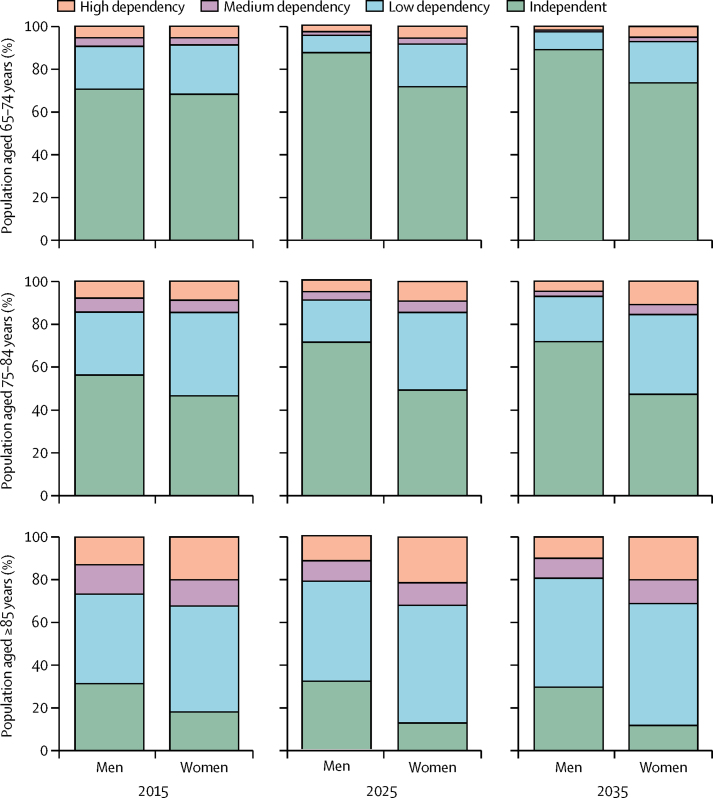
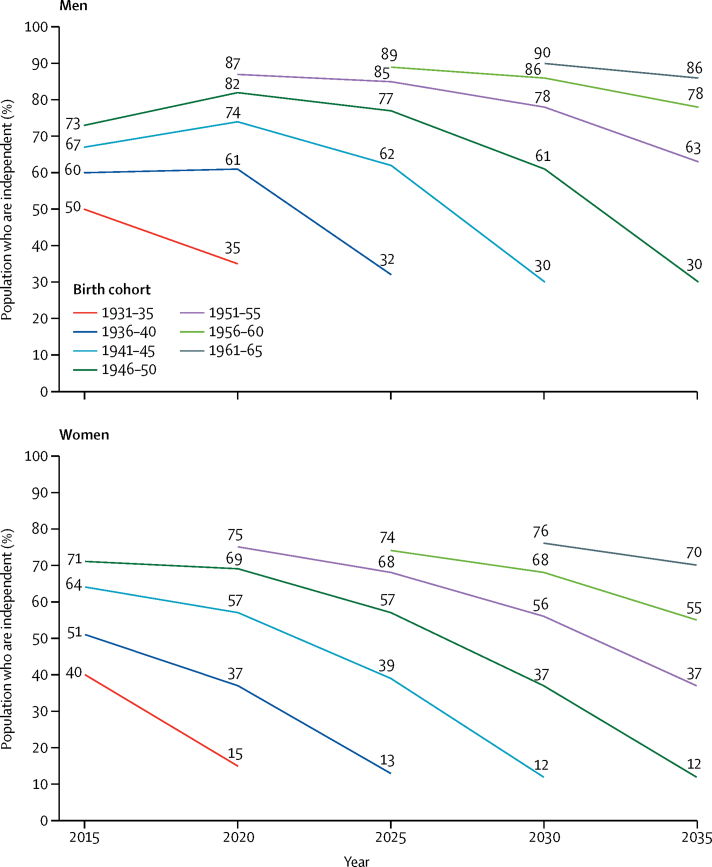
BACKGROUND: Existing models for forecasting future care needs are limited in the risk factors included and in the assumptions made about incoming cohorts. We estimated the numbers of people aged 65 years or older in England and the years lived in older age requiring care at different intensities between 2015 and 2035 from the Population Ageing and Care Simulation (PACSim) model. METHODS: PACSim, a dynamic microsimulation model, combined three studies (Understanding Society, the English Longitudinal Study of Ageing, and the Cognitive Function and Ageing Study II) to simulate individuals' sociodemographic factors, health behaviours, 12 chronic diseases and geriatric conditions, and dependency (categorised as high [24-h care], medium [daily care], or low [less than daily] dependency; or independent). Transition probabilities for each characteristic were estimated by modelling state changes from baseline to 2-year follow-up. Years in dependency states were calculated by Sullivan's method. FINDINGS: Between 2015 and 2035 in England, both the prevalence of and numbers of people with dependency will fall for young-old adults (65-74 years). For very old adults (≥85 years), numbers with low dependency will increase by 148·0% (range from ten simulations 140·0-152·0) and with high dependency will almost double (increase of 91·8%, range 87·3-94·1) although prevalence will change little. Older adults with medium or high dependency and dementia will be more likely to have at least two other concurrent conditions (increasing from 58·8% in 2015 to 81·2% in 2035). Men aged 65 years will see a compression of dependency with 4·2 years (range 3·9-4·2) of independence gained compared with life expectancy gains of 3·5 years (3·1-4·1). Women aged 65 years will experience an expansion of mainly low dependency, with 3·0 years (3·0-3·6) gained in life expectancy compared with 1·4 years (1·2-1·4) with low dependency and 0·7 years (0·6-0·8) with high dependency. INTERPRETATION: In the next 20 years, the English population aged 65 years or over will see increases in the number of individuals who are independent but also in those with complex care needs. This increase is due to more individuals reaching 85 years or older who have higher levels of dependency, dementia, and comorbidity. Health and social care services must adapt to the complex care needs of an increasing older population. FUNDING: UK Economic and Social Research Council and the National Institute for Health Research.
Overview
The claims and statistics of this paper haven’t been checked yet.
Free: it reads the open-access text and checks the first 5 claims that cite a source we can check. Create a free account to check every claim.
Integrity signals
Registry
Cites
Statistics
Figures
Verification
Claims the paper makes
The claims and statistics of this paper haven’t been checked yet.
Free: it reads the open-access text and checks the first 5 claims that cite a source we can check. Create a free account to check every claim.
Claims other papers make about this one
Each is checked against this paper’s own text: does it say what the citing paper says it does?
The cited source says what the claim attributes to it.
In the citing paper
“Models also suggest that there will be future increases both in the number of individuals who are independent and those with complex care needs.6”
From Dementia prevention, intervention, and care: 2020 report of the Lancet Commission (2020) · cites this paper as [6]
The check wasn’t confident either way, so it gives no verdict — never disputed.
In the citing paper
“In contrast, age-specific dementia prevalence in Japan, South Korea, Hong Kong, and Taiwan looks as if it is increasing, as is Alzheimer's in LMIC, although whether diagnostic methods are always the same in comparison studies is unclear.5, 6, 7”
From Dementia prevention, intervention, and care: 2020 report of the Lancet Commission (2020) · cites this paper as [6]
Experimental — accuracy not yet measured
Self-check
Percentages, sums and reported differences re-computed from the paper’s own numbers.
The self-check needs the paper’s full text.
Citations
Cites
Folstein, M. F., Folstein, S. E., & McHugh, P. R. (1975) · Journal of Psychiatric Research · doi:10.1016/0022-3956(75)90026-6 · Cited by 88,282
Kok, J. S., Berg, I. J., & Scherder, E. J. A. (2013) · Dementia and Geriatric Cognitive Disorders Extra · doi:10.1159/000353441 · Cited by 20,589
Older Adults' Reasons for Using Technology while Aging in Place
Peek, S. T. M., Luijkx, K. G., Rijnaard, M. D., Nieboer, M. E., van der Voort, C. S., Aarts, S., van Hoof, J., Vrijhoef, H. J. M., & Wouters, E. J. M. (2016) · Gerontology · doi:10.1159/000430949 · Cited by 19,690
Sensitivity and False Alarm Rate of a Fall Sensor in Long-Term Fall Detection in the Elderly
Kangas, M., Korpelainen, R., Vikman, I., Nyberg, L., & Jämsä, T. (2015) · Gerontology · doi:10.1159/000362720 · Cited by 18,909
Global status report on noncommunicable diseases 2010.
Alwan, A. (2011) · Cited by 8,494
Aging with multimorbidity: A systematic review of the literature
Marengoni, A., Angleman, S., Melis, R., Mangialasche, F., Karp, A., Garmen, A., Meinow, B., & Fratiglioni, L. (2011) · Ageing Research Reviews · doi:10.1016/j.arr.2011.03.003 · Cited by 3,092
Stuck, A. E., Walthert, J. M., Nikolaus, T., Büla, C. J., Hohmann, C., & Beck, J. C. (1999) · Social Science & Medicine · doi:10.1016/s0277-9536(98)00370-0 · Cited by 1,868
A Single Index of Mortality and Morbidity
Sullivan, D. F. (1971) · HSMHA Health Reports · doi:10.2307/4594169 · Cited by 1,450
Multiple Imputation by Chained Equations (MICE): Implementation in Stata
Royston, P., & White, I. (2011) · Journal of Statistical Software · doi:10.18637/jss.v045.i04 · Cited by 1,248
National, regional, and global trends in adult overweight and obesity prevalences
Stevens, G. A., Singh, G. M., Lu, Y., Danaei, G., Lin, J. K., Finucane, M. M., Bahalim, A. N., McIntire, R. K., Gutierrez, H. R., Cowan, M., et al. (2012) · Population Health Metrics · doi:10.1186/1478-7954-10-22 · Cited by 929
Cited by
Dementia prevention, intervention, and care: 2020 report of the Lancet Commission
Livingston, G., Huntley, J., Sommerlad, A., Ames, D., Ballard, C., Banerjee, S., Brayne, C., Burns, A., Cohen-Mansfield, J., Cooper, C., et al. (2020) · The Lancet · doi:10.1016/s0140-6736(20)30367-6 · Cited by 10,430
RetractedFrailty: implications for clinical practice and public health
Hoogendijk, E. O., Afilalo, J., Ensrud, K. E., Kowal, P., Onder, G., & Fried, L. P. (2019) · The Lancet · doi:10.1016/s0140-6736(19)31786-6 · Cited by 3,282
Current and Future Treatments in Alzheimer Disease: An Update
Yiannopoulou, K. G., & Papageorgiou, S. G. (2020) · Journal of Central Nervous System Disease · doi:10.1177/1179573520907397 · Cited by 966
“Furthermore, the design of the studies became more specific and targeted: the characteristics of amyloid-related imaging abnormalities were associated with the dose of antibodies and APOε4 genotyping, higher dosing necessity was recognized, and accurate measures for specific targets, such as reduction of Aβ plaque bur…”
BackgroundMethodInfluentialAbdi, S., Spann, A., Borilovic, J., de Witte, L., & Hawley, M. (2019) · BMC Geriatrics · doi:10.1186/s12877-019-1189-9 · Cited by 609
Gong, J., Wang, G., Wang, Y., Chen, X., Chen, Y., Meng, Q., Yang, P., Yao, Y., & Zhao, Y. (2022) · The Lancet Public Health · doi:10.1016/s2468-2667(22)00203-1 · Cited by 349
Yiannopoulou, K. G., Anastasiou, A. I., Zachariou, V., & Pelidou, S.-H. (2019) · Biomedicines · doi:10.3390/biomedicines7040097 · Cited by 330
“Given the fact that AD concerns mostly people older than 65 years, the increasing expansion of life span, leads to a fast growing number of AD patients [1].”
BackgroundLu, X., Yao, Y., & Jin, Y. (2022) · eClinicalMedicine · doi:10.1016/j.eclinm.2022.101708 · Cited by 170
The burden of skin and subcutaneous diseases: findings from the global burden of disease study 2019
Yakupu, A., Aimaier, R., Yuan, B., Chen, B., Cheng, J., Zhao, Y., Peng, Y., Dong, J., & Lu, S. (2023) · Frontiers in Public Health · doi:10.3389/fpubh.2023.1145513 · Cited by 226
Head, A., Fleming, K., Kypridemos, C., Schofield, P., Pearson-Stuttard, J., & O'Flaherty, M. (2021) · The Lancet Healthy Longevity · doi:10.1016/s2666-7568(21)00146-x · Cited by 160
The costs of dementia in England
Wittenberg, R., Knapp, M., Hu, B., Comas‐Herrera, A., King, D., Rehill, A., Shi, C., Banerjee, S., Patel, A., Jagger, C., et al. (2019) · International Journal of Geriatric Psychiatry · doi:10.1002/gps.5113 · Cited by 156
“Full details of validation of the PACSim model have previously been described.(13)”
MethodSelf-citationShould I Care or Should I Work? The Impact of Work on Informal Care
Carrino, L., Nafilyan, V., & Avendaño, M. (2022) · Journal of Policy Analysis and Management · doi:10.1002/pam.22457 · Cited by 164
Tracking Universal Health Coverage: 2021 Global Monitoring Report
Bank, W. (2021) · The World Bank Open Knowledge Repository (World Bank) · doi:10.1596/36724 · Cited by 344
Scott, A. J. (2021) · The Lancet Healthy Longevity · doi:10.1016/s2666-7568(21)00247-6 · Cited by 184
Operational Research: methods and applications
Petropoulos, F., Laporte, G., Aktaş, E., Alumur, S. A., Archetti, C., Ayhan, H., Battarra, M., Bennell, J. A., Bourjolly, J.-M., Boylan, J. E., et al. (2023) · Journal of the Operational Research Society · doi:10.1080/01605682.2023.2253852 · Cited by 192
Rahman, M. M., Rosenberg, M., Flores, G., Parsell, N., Akter, S., Alam, M. A., Rahman, M. M., & Edejer, T. T.-T. (2022) · Health Economics Review · doi:10.1186/s13561-022-00398-4 · Cited by 147
Tari, A. R., Nauman, J., Zisko, N., Skjellegrind, H. K., Bosnes, I., Bergh, S., Stensvold, D., Selbæk, G., & Wisløff, U. (2019) · The Lancet Public Health · doi:10.1016/s2468-2667(19)30183-5 · Cited by 100
Kasajima, M., Eggleston, K. N., Kusaka, S., Matsui, H., Tanaka, T., Son, B., Iijima, K., Goda, K., Kitsuregawa, M., Bhattacharya, J., et al. (2022) · The Lancet Public Health · doi:10.1016/s2468-2667(22)00044-5 · Cited by 100
“9,10,33 In Japan, decreased prevalence among those younger than 95 years, and increased prevalence thereafter, seem to counterbalance the increased number of older people with dementia caused by extended life expectancy.”
InfluentialIn the Quest of a Standard Index of Intrinsic Capacity. A Critical Literature Review
González-Bautista, E., Andrieu, S., Gutiérrez‐Robledo, L. M., García-Chanes, R. E., & Barreto, P. D. S. (2020) · The journal of nutrition health & aging · doi:10.1007/s12603-020-1503-4 · Cited by 100
“With the increase of the older adult population worldwide, in particular regarding people 80 or over who are at increased risk for care dependency (12), having a standardised, valid and simple way of stratifying people according to their risk of decline in IC (which are linked to body functions)…”
Devi, R., Goodman, C. M., Dalkin, S. M., Bate, A., Wright, J. M., Jones, L., & Spilsbury, K. (2020) · Age and Ageing · doi:10.1093/ageing/afaa109 · Cited by 69
“The care home population is 20 projected to rise by 127% over the next 20 years [5].”
BackgroundIntrinsic Capacity to Predict Future Adverse Health Outcomes in Older Adults: A Scoping Review
Zhou, J., Chang, H., Leng, M., & Wang, Z. (2023) · Healthcare · doi:10.3390/healthcare11040450 · Cited by 73
“With respect to the studies using measures of physical function as the main outcome, most scholars use activities of daily living (ADLs) and instrumental activities of daily living (IADLs) as measurement variables [36].”
MethodOhri, S. K., Benedetto, U., Luthra, S., Grant, S. W., Goodwin, A. T., Trivedi, U., Kendall, S. W. H., & Jenkins, D. P. (2021) · European Journal of Cardio-Thoracic Surgery · doi:10.1093/ejcts/ezab391 · Cited by 64
Interventions for preventing delirium in older people in institutional long-term care
Woodhouse, R., Burton, J. K., Rana, N., Pang, Y. L., Lister, J., & Siddiqi, N. (2019) · Cochrane Database of Systematic Reviews · doi:10.1002/14651858.cd009537.pub3 · Cited by 72
“Considering the combined eJects of population ageing, multimorbidity and dementia prevalence, it is likely that LTC facility provision will need to expand to provide care for increasing numbers of dependent older adults (Kingston 2018).”
BackgroundHarwood, R. H., Goldberg, S. E., Brand, A., van Der Wardt, V., Booth, V., Di Lorito, C., Hoare, Z., Hancox, J., Bajwa, R., Burgon, C., et al. (2023) · BMJ · doi:10.1136/bmj-2023-074787 · Cited by 53
Tsekleves, E., Darby, A., Whicher, A., & Swiatek, P. (2017) · Archives of Design Research · doi:10.15187/adr.2017.05.30.2.5 · Cited by 71
Kocman, D., Regen, E., Phelps, K., Martin, G. P., Parker, S. G., Gilbert, T., & Conroy, S. (2019) · Age and Ageing · doi:10.1093/ageing/afz025 · Cited by 55
The Effect of Aging Physiology on Critical Care
Darden, D. B., Moore, F. A., Brakenridge, S. C., Navarro, E., Anton, S. D., Leeuwenburgh, C., Moldawer, L. L., Mohr, A. M., Efron, P. A., & Mankowski, R. T. (2020) · Critical Care Clinics · doi:10.1016/j.ccc.2020.08.006 · Cited by 61
Ai, Z., Tang, C., Peng, P., Wen, X., & Tang, S. (2023) · Frontiers in Public Health · doi:10.3389/fpubh.2023.1110216 · Cited by 50
Trends in health expectancies: a systematic review of international evidence
Spiers, G., Kunonga, P., Beyer, F. R., Craig, D., Hanratty, B., & Jagger, C. (2021) · BMJ Open · doi:10.1136/bmjopen-2020-045567 · Cited by 56
Self-citationThe Challenges of Measuring Informal Care Time: A Review of the Literature
Urwin, S., Lau, Y., Grande, G., & Sutton, M. (2021) · PharmacoEconomics · doi:10.1007/s40273-021-01053-2 · Cited by 49
Knoedler, S. A., Matar, D. Y., Friedrich, S., Knoedler, L., Haug, V., Hundeshagen, G., Kauke‐Navarro, M., Kneser, U., Pomahač, B., Orgill, D. P., et al. (2023) · International Journal of Surgery · doi:10.1097/js9.0000000000000511 · Cited by 62
Trajectories of family care over the lifecourse: evidence from Canada
Fast, J. E., Keating, N. C., Eales, J., Kim, C., & Lee, Y. (2020) · Ageing and Society · doi:10.1017/s0144686x19001806 · Cited by 55
“In the Global North, drivers of population ageing such as low birth rates, increased longevity and improved survival of people with disabilities have been celebrated as evidence of effective public health strategies (Crosignani, 2010; Public Health Agency of Canada, 2014; Kingston et al., 2018).”
BackgroundA critique of the marketisation of long-term residential and nursing home care
Walker, C. C., Druckman, A., & Jackson, T. P. (2022) · The Lancet Healthy Longevity · doi:10.1016/s2666-7568(22)00040-x · Cited by 45
Aldridge, Z., Burns, A. S., & Dening, K. H. (2019) · Dementia · doi:10.1177/1471301219838086 · Cited by 48
Oliveira, D., Bosco, A., & Lorito, C. D. (2019) · Maturitas · doi:10.1016/j.maturitas.2019.03.010 · Cited by 50
Ramström, H., Martini, S., Borgendahl, J., Ågerstrand, M., Lärfars, G., & Ovesjö, M. (2020) · European Journal of Clinical Pharmacology · doi:10.1007/s00228-020-02885-1 · Cited by 40
Semmarath, W., Seesen, M., Yodkeeree, S., Sapbamrer, R., Ayood, P., Malasao, R., Siviroj, P., & Limtrakul, P. (2019) · International Journal of Environmental Research and Public Health · doi:10.3390/ijerph16183457 · Cited by 40
“This cross-sectional study involved the recruitment of 526 early-old members of an aging population (The “early-old population” definition is based on previously described [21,22], with the early-old population encompassing people between the ages of 65–74 years), who are community-dwelling adults that live in Pasang…”
Spiers, G., Liddle, J., Stow, D., Searle, B., Whitehead, I. O., Kingston, A., Moffatt, S., Matthews, F. E., & Hanratty, B. (2022) · Journal of Epidemiology & Community Health · doi:10.1136/jech-2021-218265 · Cited by 45
Self-citationTypology of Family Support in Home Care for Iranian Older People: A Qualitative Study
Shamsikhani, S., Ahmadi, F., Kazemnejad, A., & Vaismoradi, M. (2021) · International Journal of Environmental Research and Public Health · doi:10.3390/ijerph18126361 · Cited by 43
“Though the number of independent older people aged 65–74 years has dramatically increased, growing independence does not necessarily mean that they do not need support and care, because they usually have complex care needs that should be fulfilled by healthcare services and social care systems [17].”
BackgroundTherapeutic Advances in Diabetes, Autoimmune, and Neurological Diseases
Liu, J., Ting, J. P., Al-Azzam, S., Ding, Y., & Afshar, S. (2021) · International Journal of Molecular Sciences · doi:10.3390/ijms22062805 · Cited by 40
Skinner, M. S., & Sogstad, M. (2022) · SAGE Open Nursing · doi:10.1177/23779608221130585 · Cited by 34
“In European societies, demographic changes are putting national welfare schemes under increasing pressure (Geerts et al., 2012; Kingston et al., 2018).”
BackgroundMusa, M. K., Akdur, G., Brand, S. L., Killett, A., Spilsbury, K., Peryer, G., Burton, J. K., Gordon, A. L., Hanratty, B., Towers, A., et al. (2022) · BMC Geriatrics · doi:10.1186/s12877-021-02705-w · Cited by 40
“About 420,000 older people in England and Wales live in care homes [3, 4].”
BackgroundDambha‐Miller, H., Simpson, G., Hobson, L., Roderick, P. J., Little, P. S., Everitt, H., & Santer, M. (2021) · BMC Geriatrics · doi:10.1186/s12877-021-02618-8 · Cited by 40
“[1, 2] Recent prediction forecasting of care dependency pro les suggests that 80% of the ageing population will require medium or high dependency care due to multimorbidity.[3] In this context, it is essential that primary care is capable of working closely with social services and wider community care providers to ha…”
BackgroundKowal, P. R., Corso, B., Anindya, K., Andrade, F. C. D., Giang, L. T., Calzada, M. T., Pothisiri, W., Quashie, N. T., Reina, H. A. R., Rosenberg, M., et al. (2023) · Population Health Metrics · doi:10.1186/s12963-023-00308-8 · Cited by 45
“Care needs in adult populations are often inferred from rates of disease and disability, or administrative data on service utilization [4].”
BackgroundBellelli, F., Angioni, D., Arosio, B., Vellas, B. J., & Barreto, P. D. S. (2025) · Ageing Research Reviews · doi:10.1016/j.arr.2025.102699 · Cited by 37
Lepsy, E., Radwańska, E., Żurek, G., Żurek, A., Kaczorowska, A., Radajewska, A., & Kołcz, A. (2021) · BMC Geriatrics · doi:10.1186/s12877-021-02421-5 · Cited by 36
Khamouli, S., Belaıdı, S., Bakhouch, M., Chtita, S., Hashmi, M. A., & Qais, F. A. (2022) · Journal of Molecular Structure · doi:10.1016/j.molstruc.2022.132659 · Cited by 32
Atef, R. Z., Michalowsky, B., Raedke, A., Platen, M., Mohr, W., Mühlichen, F., Thyrian, J. R., & Hoffmann, W. U. (2023) · Journal of Alzheimer s Disease · doi:10.3233/jad-220938 · Cited by 39
“:+493834868530; E-mail: bernhard.michalowsky@dzne.de. cognitive decline became more prevalent among older populations, presenting urgent public health issues [1].”
Xie, B., Champion, J. D., Kwak, J., & Fleischmann, K. R. (2018) · Journal of Medical Internet Research · doi:10.2196/11682 · Cited by 25
“As the population ages, increasing numbers of older adults with dementia and/or other conditions will require care so that reliance on informal caregivers will not be sustainable in the long run [69].”
Yu, Q., Li, Z., Yang, C., Zhang, L., Xing, M., & Li, W. (2023) · Archives of Gerontology and Geriatrics · doi:10.1016/j.archger.2023.105124 · Cited by 27
Forecasting Future Demand of Nursing Staff for the Oldest-Old in China by 2025 Based on Markov Model
Zhang, L., Shen, S., Guo, Y., & Fang, Y. (2021) · International Journal of Health Policy and Management · doi:10.34172/ijhpm.2021.63 · Cited by 39
Population Ageing in High-Longevity Countries: Demographic Dynamics and Socio-economic Challenges
Bonnet, C., Cambois, E., Fontaine, R., Dutreuilh, C., & Alkema, B. V. H. (2021) · Population (English Edition) · doi:10.3917/popu.2102.0225 · Cited by 57
Devi, R., Martin, G. P., Banerjee, J., Gladman, J. R. F., Dening, T., Barat, A., & Gordon, A. L. (2022) · BMJ Quality & Safety · doi:10.1136/bmjqs-2021-014345 · Cited by 27
van Oppen, J. D., Thompson, D., Tite, M., Griffiths, S., Martin, F. C., & Conroy, S. (2019) · European Geriatric Medicine · doi:10.1007/s41999-019-00177-1 · Cited by 21
Teggi, D. (2020) · Social Science & Medicine · doi:10.1016/j.socscimed.2020.113150 · Cited by 21
The Impact of Smoking and Obesity on Disability-Free Life Expectancy in Older Australians
Kingston, A., Byles, J., Kiely, K., Anstey, K., & Jagger, C. (2020) · The journals of gerontology. Series A, Biological sciences and medical sciences · doi:10.1093/gerona/glaa290 · Cited by 18
“In England, this is forecast to continue for the next decades, though there is some evidence for compression of dependency in men (2).”
BackgroundSelf-citationYakupu, A., Wang, H., Huang, L., Zhou, J., Wu, F., Lu, Y., & Lu, S. (2022) · The International Journal of Lower Extremity Wounds · doi:10.1177/15347346221092265 · Cited by 25
“29,30 The highest positive EAPC of ASIR occurred in Barbados, followed by the Mainland of China.”
Hong, S., Lu, B., Wang, S., & Jiang, Y. (2025) · BMC Psychiatry · doi:10.1186/s12888-025-06577-x · Cited by 23
Homecare workers needs and experiences in end of life care: rapid review
Forward, C., Bayley, Z., Walker, L., Krygier, J., White, C., Mwaba, K., Elliott-Button, H. L., Taylor, P., & Johnson, M. J. (2024) · BMJ Supportive & Palliative Care · doi:10.1136/spcare-2023-004737 · Cited by 24
Rouhi, N., Chakeri, Z., Ghorbani Nejad, B., Rahimzadegan, M., Rafi Khezri, M., Kamali, H., & Nosrati, R. (2024) · Heliyon · doi:10.1016/j.heliyon.2024.e37533 · Cited by 20
Nie, P., & Li, Q. (2024) · Social Science & Medicine · doi:10.1016/j.socscimed.2024.117614 · Cited by 22
Musa, M. K., Akdur, G., Hanratty, B., Kelly, S., Gordon, A. L., Peryer, G., Spilsbury, K., Killett, A., Burton, J. K., Meyer, J. E., et al. (2020) · BMJ Open · doi:10.1136/bmjopen-2020-040397 · Cited by 24
Patterns of help and care by adult only children and children with siblings
Chanfreau, J., & Goisis, A. (2022) · Ageing and Society · doi:10.1017/s0144686x22000198 · Cited by 24
“…since the country has been characterised as facing a care crisis due to reliance on informal care, increasing longevity and the need for parent-carers projected to increase and even exceed the availability of filial care-givers (Pickard et al. , 2007; Pickard, 2015; Kingston et al. , 2018).”
BackgroundWalker, C. C., Druckman, A., & Jackson, T. P. (2024) · Ecological Economics · doi:10.1016/j.ecolecon.2024.108159 · Cited by 23
Trends in Decubitus Ulcer Disease Burden in European Union 15+ Countries, from 1990 to 2017
Goodall, R. J., Armstrong, A., Hughes, W., Fries, C. A., Marshall, D. C., Harbinson, E., Salciccioli, J. D., & Shalhoub, J. (2020) · Plastic & Reconstructive Surgery Global Open · doi:10.1097/gox.0000000000003252 · Cited by 24
Guo, X., Shen, H., Wen, Q., Liu, S., Yang, Y., & Zhang, H. (2023) · BMC Geriatrics · doi:10.1186/s12877-023-03924-z · Cited by 19
“are seriously insufficient, and pension services fail to fully meet the pension needs [10].”
BackgroundMethodModelling demographic changes using simulation: Supportive analyses for socioeconomic studies
Mielczarek, B., & Zabawa, J. (2020) · Socio-Economic Planning Sciences · doi:10.1016/j.seps.2020.100938 · Cited by 19
Maintaining and improving mouth care for care home residents: A participatory research project
Griffiths, A. W., Devi, R., Cheetham, B., Heaton, L., Randle, A., Ellwood, A., Douglas, G. V. A., Csikar, J. I., Vinall‐Collier, K. A., Wright, J. M., et al. (2021) · International Journal of Older People Nursing · doi:10.1111/opn.12394 · Cited by 23
Davies, T. W., Watson, N., Pilkington, J. J., McClelland, T. J., Azzopardi, G., Pearse, R. M., Prowle, J., & Puthucheary, Z. (2024) · Journal of Parenteral and Enteral Nutrition · doi:10.1002/jpen.2607 · Cited by 18
Ren, L., Zhou, Y., Liu, K., Zhang, H., Li, S., Hu, Y., Shirai, K., Jiang, Y., Wu, Y., Yu, M., et al. (2025) · The Lancet Public Health · doi:10.1016/s2468-2667(25)00253-1 · Cited by 28
Fowler, H., Clifford, R. E., Sutton, P. A., Watson, A., Fearnhead, N. S., Bach, S. P., Moran, B. J., Rose, A., Jackson, R., Vimalachandran, D., et al. (2020) · Colorectal Disease · doi:10.1111/codi.15366 · Cited by 17
Yang, L., & Peng, W. (2021) · Frontiers in Public Health · doi:10.3389/fpubh.2021.634123 · Cited by 17
“Population aging has led to increased care needs (3) and overburdened healthcare system (4).”
BackgroundSong, Q., Shu, X., Li, Y., Zhao, Y., & Yue, J. (2024) · Journal of Global Health · doi:10.7189/jogh.14.04047 · Cited by 21
Zhao, S., Cao, Y., Lei, Y., Liu, F., Shao, S., Liu, J., Nie, D., Yang, N., & Liu, M. (2019) · BMJ Open · doi:10.1136/bmjopen-2018-028292 · Cited by 17
“Social care needs of elderly people are driven by their inability to self-care and live independently, most often assessed by needing help to undertake one or more basic activities of daily living such as bathing, dressing or toileting.(20) These function impairments are all risk factors for Table 2 Proportion of elde…”
BackgroundZhou, W., Guo, M., Hu, B. X., Jiang, Y., & Yao, Y. (2025) · The Lancet Healthy Longevity · doi:10.1016/j.lanhl.2025.100697 · Cited by 23
Conversational user interfaces in smart homecare interactions: a conversation analytic case study
Albert, S., Hamann, M., & Stokoe, E. (2023) · Proceedings of the 5th International Conference on Conversational User Interfaces · doi:10.1145/3571884.3597140 · Cited by 17
“Policymakers are increasingly looking to new assistive technologies to augment social care services in the context of a demographic ageing crisis [55], suggesting that “[d]ata-driven services and emerging robotic and artificial intelligence (AI) technologies could provide services to help maintain independence for old…”
BackgroundCo-created Technological Solutions for Caregivers in Health Care: Systematic Review
Merchán-Baeza, J. A., Borralleras, C., Minobes‐Molina, E., Grau, S., Romero-Mas, M., & Ramon‐Aribau, A. (2023) · Journal of Medical Internet Research · doi:10.2196/41260 · Cited by 22
Giunchi, V., Fusaroli, M., Linder, E., Villén, J., Wettermark, B., Nekoro, M., Raschi, E., Lunghi, C., & Poluzzi, E. (2023) · British Journal of Clinical Pharmacology · doi:10.1111/bcp.15761 · Cited by 18
Costs, consequences and value for money in non-medical prescribing: a scoping review
Babashahi, S., Carey, N., Jani, Y. H., Hart, K. H., & Hounsome, N. (2023) · BMJ Open · doi:10.1136/bmjopen-2022-067907 · Cited by 15
Frequent identical admission–readmission episodes are associated with increased mortality
Fry, C. H., Fluck, D. S., & Han, T. S. (2021) · Clinical Medicine · doi:10.7861/clinmed.2020-0930 · Cited by 16
Sheng, J., Wu, S., Zhang, Q., Li, Z., & Huang, H. (2022) · IEEE Access · doi:10.1109/access.2022.3186888 · Cited by 18
“The extension of life expectancy leads to a rapid increase in the number of patients with dementia [1] .”
BackgroundChen, S., Yang, J., Ma, B., Meng, J., Chen, Y., Ma, T., Zhang, X., Wang, Y., Huang, Y., Zhao, Y., et al. (2024) · International Journal of Nursing Studies · doi:10.1016/j.ijnurstu.2024.104699 · Cited by 14
Cameron, A., Johnson, E. K., & Evans, S. C. (2020) · Journal of Integrated Care · doi:10.1108/jica-09-2019-0040 · Cited by 14
Street, A., Maynou, L., & Conroy, S. (2023) · BMJ Quality & Safety · doi:10.1136/bmjqs-2022-015832 · Cited by 14
Sustainable Social Care: The Potential of Mainstream “Smart” Technologies
Hamblin, K. A. (2022) · Sustainability · doi:10.3390/su14052754 · Cited by 24
Liu, X., Chen, J.-H., Gao, B., & Zhang, W.-J. (2025) · Journal of Affective Disorders · doi:10.1016/j.jad.2025.01.156 · Cited by 20
Forecasting of the Prevalence of Dementia Using the LSTM Neural Network in Taiwan
Yang, S. F., Chen, H., Wu, C.-H., Wu, M.-N., & Yang, C.-H. (2021) · Mathematics · doi:10.3390/math9050488 · Cited by 16
“With the increasing number of patients with dementia [33], the cost of care is also increasing, which is one of the focuses of this study.”
BackgroundTonga, E., Srikesavan, C. S., Williamson, E. M., & Lamb, S. E. (2020) · Journal of Telemedicine and Telecare · doi:10.1177/1357633x20927587 · Cited by 18
Human resources in long-term care for older adults in China: Challenges amid population aging
Aximu, N., Yimingniyazi, B., Lin, D., Zhang, J., Jiang, M., & Sun, Y. (2025) · BioScience Trends · doi:10.5582/bst.2025.01155 · Cited by 12
Strauss, R., Kurdyak, P. A., & Glazier, R. H. (2020) · The Canadian Journal of Psychiatry · doi:10.1177/0706743720927812 · Cited by 13
Hybrid simulation modelling for dementia care services planning
Evenden, D., Brailsford, S., Kipps, C., Roderick, P., & Walsh, B. M. (2020) · Journal of the Operational Research Society · doi:10.1080/01605682.2020.1772020 · Cited by 13
“The PACSim model (Kingston et al., 2018, 2018) uses microsimulation to predict a decrease in care need for those aged 65 – 74 and an increase in the number of people with high care dependencies in the over 85 s.”
Jiang, Y., & Li, L. (2024) · Global Health Research and Policy · doi:10.1186/s41256-024-00357-y · Cited by 15
“First, the proportions of functionally dependent older Chinese people will rise rapidly in the coming decades to a comparable level in the US and UK [12, 15].”
BackgroundMethodZhang, L., Shen, S., Zhang, W., & Fang, Y. (2024) · BMC Public Health · doi:10.1186/s12889-024-19747-5 · Cited by 16
“Kingston [17] used a dynamic micro-simulation model to estimate the probability of metastasis of each feature by simulating the state changes during a two-year follow-up, and the results showed that the number of older adults aged 85 and above in the UK who needed 24-hour care would double from…”
MethodPan, T. S., Li, C., & Zhou, Y. (2024) · EClinicalMedicine · doi:10.1016/j.eclinm.2024.102994 · Cited by 15
Elefante, C., Brancati, G. E., Ismail, Z., Ricciardulli, S., Beatino, M. F., Lepri, V., Famà, A., Ferrari, E., Giampietri, L., Baldacci, F., et al. (2023) · Journal of Clinical Medicine · doi:10.3390/jcm12165423 · Cited by 11
Singh, H., Tahsin, F., Nie, J. X., McKinstry, B., Thavorn, K., Upshur, R. E. G., Harvey, S., Wodchis, W. P., & Gray, C. S. (2021) · BMC Medical Informatics and Decision Making · doi:10.1186/s12911-021-01734-0 · Cited by 15
“Background Primary care providers estimate that about a quarter of patients for whom they provide direct care are “complex” [1], and this number is anticipated to grow as the world’s population ages [2].”
BackgroundYang, Y., Li, C., Ye, H., Sun, J., Chen, G., & Ji, K. (2024) · Heliyon · doi:10.1016/j.heliyon.2024.e37821 · Cited by 16
“This measure divides the functional dependency types according to the various care need categories in England [27], specifically classified as “ high dependency ” (requiring around-the-clock care), “ medium dependency ” (necessitating care several times per day), “ low dependency ” (needing care…”
Public preferences for paying for social care in later life in England: A latent class analysis
Read, S., Erens, B., Wittenberg, R., Wistow, G., Dickinson, F., Knapp, M. R. J., Cyhlarova, E., & Mays, N. (2021) · Social Science & Medicine · doi:10.1016/j.socscimed.2021.113803 · Cited by 10
Dementia—so much done, so much to do, so much to gain by doing so
Banerjee, S. (2022) · Age and Ageing · doi:10.1093/ageing/afac204 · Cited by 10
Exercise: the miracle cure for surgeons to fix the NHS and social care
McNally, S. (2020) · Bulletin of The Royal College of Surgeons of England · doi:10.1308/rcsbull.2020.28 · Cited by 12
Harwood, R., Goldberg, S. E., Brand, A., van der Wardt, V., Booth, V., Lorito, C. D., Hoare, Z., Hancox, J. E., Bajwa, R. K., Burgon, C., et al. (2022) · medRxiv · doi:10.1101/2022.12.20.22283699 · Cited by 10
“It creates high levels of demand on health and social care services, families and other informal carers [9].”
Background
Metadata
- Authors
- Kingston, A., Comas-Herrera, A., & Jagger, C.
- Affiliations
- Newcastle University (GB)
- Corresponding author
- Jagger, Carol
- Venue
- The Lancet Public Health
- Publisher
- Elsevier BV
- Published
- 2018-09
- Volume
- 3
- Issue
- 9
- Pages
- e447-e455
- ISSN
- 2468-2667 (ISSN-L)
- PMC
- PMC6123499
- OpenAlex
- W2888964760
- Semantic Scholar
- db8569efdd695f1540ca459ab93f742ed5a3ee3f
- Cited by
- 287
- References
- 34
- Citations by year
- 2026: 18 · 2025: 43 · 2024: 39 · 2023: 43 · 2022: 43 · 2021: 40 · 2020: 38 · 2019: 19 · 2018: 3
- FWCI
- 51.55
- Type
- journal article
- Language
- en
- Open access
- gold
- doi.org
- Licence
- cc-by
- www.elsevier.com/tdm/userlicense/1.0/ (tdm)
- creativecommons.org/licenses/by/4.0/ (vor)
- Locations
- The Lancet Public Health (publishedVersion, cc-by)
- Europe PMC (PubMed Central) (publishedVersion, cc-by)
- PubMed Central (publishedVersion, cc-by)
- PubMed (publishedVersion)
- London School of Economics and Political Science Research Online (London School of Economics and Political Science) (acceptedVersion)
- DOAJ (DOAJ: Directory of Open Access Journals) (submittedVersion)
- Newcastle University ePrints (Newcastle Univesity) (cc-by)
- Funders
- London School of Economics and Political Science
- National Institute for Health and Care Research (SPCR-136, ES/L001896/1)
- AXA Research Fund (2010-15)
- Economic and Social Research Council (ES/L001896/1, ES/I017399/1)
- Australian Research Council
- Topics
- Social Sciences › Demography › Insurance, Mortality, Demography, Risk Management
- Health Sciences › Medicine › Public Health, Environmental and Occupational Health › Aging, Health, and Disability
- Health Sciences › Medicine › Geriatrics and Gerontology › Geriatric Care and Nursing Homes
- Keywords
- older adults, dependency, long-term care, microsimulation model, population aging, dementia, multimorbidity, life expectancy, gender differences, oldest old, England, chronic disease, geriatric conditions
- MeSH terms
- Aged, Aged, 80 and over, Computer Simulation, England, Female, Forecasting, Health Services for the Aged, Health Services Needs and Demand, Humans, Longitudinal Studies, Male
About these checks
Registry, retraction, Cites and statistics results are computed, not judged, with one exception: a printed reference that no index lists is read once by a model before it counts as a citation error. Claims are extracted by a model and kept only when their quote appears verbatim in the text; each cited source is then checked, with a model’s help, for whether it says what the claim relies on. Those verdicts can be wrong — read the claim’s quote and the cited source before relying on one.
Statistics and arithmetic are recomputed, not judged.
Confidence bands are shown only for fields calibrated on our annotated test set. None is calibrated yet, so no band is shown.
What counts as a claim ›How we measure confidence ›How we check this ›
Are you an author, or do you see a problem with this page? Request a review
Data sources
Bibliographic data: Semantic Scholar, OpenAlex, Crossref.
Contains information from the Semantic Scholar Academic Graph Datasets, made available under the ODC Attribution License (ODC-BY 1.0).
Semantic Scholar’s data is described in: Kinney, R., et al. (2023). The Semantic Scholar Open Data Platform. arXiv:2301.10140.
