

The DOI matches its Crossref record; 17 of the 19 references it cites were found in a registry or an index.
Effects on mental health of a UK welfare reform, Universal Credit: a longitudinal controlled study
Open accessAbstract
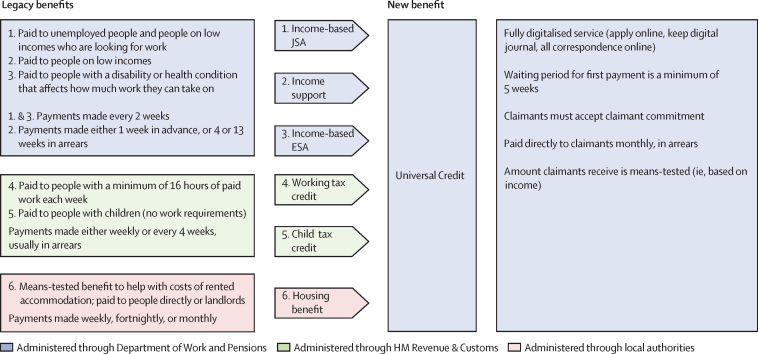
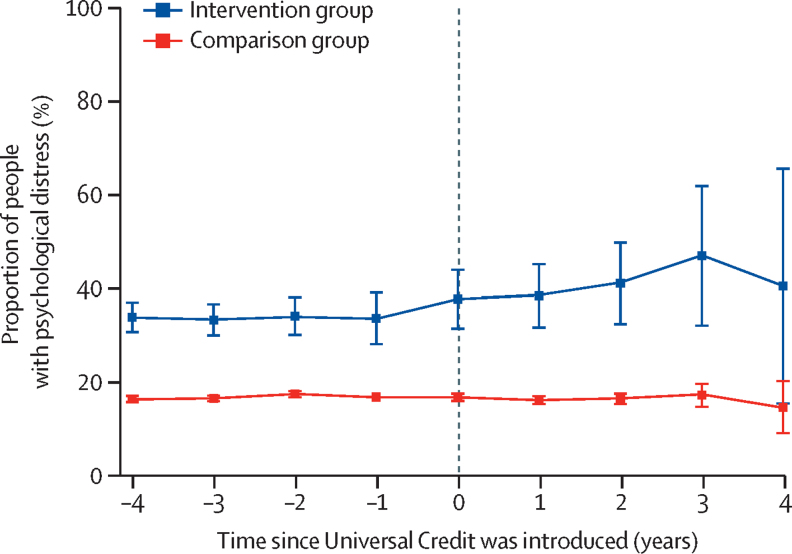
BACKGROUND: Universal Credit, a welfare benefit reform in the UK, began to replace six existing benefit schemes in April, 2013, starting with the income-based Job Seekers Allowance. We aimed to determine the effects on mental health of the introduction of Universal Credit. METHODS: In this longitudinal controlled study, we linked 197 111 observations from 52 187 individuals of working age (16-64 years) in England, Wales, and Scotland who participated in the Understanding Society UK Longitudinal Household Panel Study between 2009 and 2018 with administrative data on the month when Universal Credit was introduced into the area in which each respondent lived. We included participants who had data on employment status, local authority area of residence, psychological distress, and confounding variables. We excluded individuals from Northern Ireland and people out of work with a disability. We used difference-in-differences analysis of this nationally representative, longitudinal, household survey and separated respondents into two groups: unemployed people who were eligible for Universal Credit (intervention group) and people who were not unemployed and therefore would not have generally been eligible for Universal Credit (comparison group). Using the phased roll-out of Universal Credit, we compared the change in psychological distress (self-reported via General Health Questionnaire-12) between the intervention group and the comparison group over time as the reform was introduced in the area in which each respondent lived. We defined clinically significant psychological distress as a score of greater than 3 on the General Health Questionnaire-12. We tested whether there were differential effects across subgroups (age, sex, and education). FINDINGS: The prevalence of psychological distress increased in the intervention group by 6·57 percentage points (95% CI 1·69-11·42) after the introduction of Universal Credit relative to the comparison group, after accounting for potential confounders. We estimate that between April 29, 2013, and Dec 31, 2018, an additional 63 674 (95% CI 10 042-117 307) unemployed people will have experienced levels of psychological distress that are clinically significant due to the introduction of Universal Credit; 21 760 of these individuals might reach the diagnostic threshold for depression. INTERPRETATION: Our findings suggest that the introduction of Universal Credit led to an increase in psychological distress, a measure of mental health difficulties, among those affected by the policy. Future changes to government welfare systems should be evaluated not only on a fiscal basis but on their potential to affect health and wellbeing. FUNDING: Wellcome Trust, UK National Institute for Health Research, and Medical Research Council.
Overview
The claims and statistics of this paper haven’t been checked yet.
Run the check — free, no account needed. It reads the open-access text and checks the sources it cites.
Integrity signals
Registry
Cites
Statistics
Figures
Verification
Claims the paper makes
The claims and statistics of this paper haven’t been checked yet.
Run the check — free, no account needed. It reads the open-access text and checks the sources it cites.
Claims other papers make about this one
Each is checked against this paper’s own text: does it say what the citing paper says it does?
In the citing paper
“However, this “proportional” policy means that trustees receiving less will have reduced capacity to reciprocate, further diminishing their subsequent allocation – and thus locking them into a cycle of ever-diminishing resources.”
From Deep reinforcement learning can promote sustainable human behaviour in a common-pool resource problem (2025) · cites this paper as [31]
In the citing paper
“For example, cutting unemployment benefits may itself create circumstances unfavourable to reemployment30, such as long-term ill-health31, leading to workers being permanently excluded from the labour market.”
From Deep reinforcement learning can promote sustainable human behaviour in a common-pool resource problem (2025) · cites this paper as [31]
Self-check
Percentages, sums and reported differences re-computed from the paper’s own numbers.
The self-check needs the paper’s full text.
Citations
Cites
A scaled version of the General Health Questionnaire
Goldberg, D. P., & Hillier, V. F. (1979) · Psychological Medicine · doi:10.1017/s0033291700021644 · Cited by 5,639
The Validity of Two Versions of the GHQ in the WHO Study of Mental Illness in General Health Care
GOLDBERG, D. P., GATER, R., SARTORIUS, N., USTUN, T. B., PICCINELLI, M., GUREJE, O., & RUTTER, C. (1997) · Psychological Medicine · doi:10.1017/s0033291796004242 · Cited by 3,657
Craig, P., Cooper, C. C., Gunnell, D., Haw, S. J., Lawson, K. D., Macintyre, S., Ogilvie, D., Petticrew, M. P., Reeves, B. C., Sutton, M., et al. (2012) · Journal of Epidemiology & Community Health · doi:10.1136/jech-2011-200375 · Cited by 966
Puhani, P. A. (2011) · Economics Letters · doi:10.1016/j.econlet.2011.11.025 · Cited by 623
Austerity and health: the impact in the UK and Europe
Stückler, D., Reeves, A., Loopstra, R., Karanikolos, M., & McKee, M. (2017) · European Journal of Public Health · doi:10.1093/eurpub/ckx167 · Cited by 408
Barr, B., Taylor-Robinson, D. C., Stückler, D., Loopstra, R., Reeves, A., & Whitehead, M. M. (2015) · Journal of Epidemiology & Community Health · doi:10.1136/jech-2015-206209 · Cited by 267
Self-citationVilagut, G., Forero, C. G., Pinto‐Meza, A., Haro, J. M., de Graaf, R., Bruffaerts, R., Kovess–Masféty, V., de Girolamo, G., Matschinger, H., Ferrer, M., et al. (2013) · Value in Health · doi:10.1016/j.jval.2013.01.006 · Cited by 261
Barr, B., Kinderman, P., & Whitehead, M. (2015) · Social Science & Medicine · doi:10.1016/j.socscimed.2015.11.009 · Cited by 198
Self-citationThe structure of the General Health Questionnaire (GHQ-12): two meta-analytic factor analyses
Gnambs, T., & Staufenbiel, T. (2018) · Health Psychology Review · doi:10.1080/17437199.2018.1426484 · Cited by 137
Austerity and old-age mortality in England: a longitudinal cross-local area analysis, 2007–2013
Loopstra, R., McKee, M., Katikireddi, S. V., Taylor-Robinson, D. C., Barr, B., & Stückler, D. (2016) · Journal of the Royal Society of Medicine · doi:10.1177/0141076816632215 · Cited by 126
Self-citation
Cited by
Sorted by citations
Items 101–151 of 151
Wellbeing: Alternative Policy Perspectives
Besley, T., & Bucelli, I. (2022) · LSE Press eBooks · doi:10.31389/lsepress.well · Cited by 3
Cheetham, M., Gorman, S., Pollard, F., Ward, S., & Wiseman, A. (2022) · BMJ Open · doi:10.1136/bmjopen-2021-052623 · Cited by 1
Okoroji, C., Ibison, Y., & Robotham, D. (2023) · Journal of Mental Health · doi:10.1080/09638237.2023.2182410 · Cited by 1
“That is to say, the discrimination faced by Black people in the labour market coupled with a long-term health condition may contribute to the exacerbation of an existing health condition, particularly poor mental health (Wickham et al., 2020).”
Brown, H., Xiang, H., Cheetham, M., Morris, S. L., Gibson, M., Katikireddi, S. V., Munford, L. A., Taylor-Robinson, D. C., Finney, H., Bartle, V., et al. (2023) · BMC Public Health · doi:10.1186/s12889-023-15483-4 · Cited by 1
Self-citationBetkó, J., Spierings, N., Gesthuizen, M., & Scheepers, P. L. H. (2023) · Journal of Social Policy · doi:10.1017/s0047279423000545 · Cited by 1
“…a large number of studies on the effects of benefit sanctions, and overall, tight benefit sanctions seemed to cause material hardship and health problems instead of promoting structural labour market reintegration (see also Wright et al., 2018; Dwyer et al., 2020; Wickham, 2020; Williams, 2021).”
Pandemic income support programs and adolescent mental health in the UK, Ireland, and Australia
Mari, G. (2024) · Social Science & Medicine · doi:10.1016/j.socscimed.2024.117612 · Cited by 2
Ward, B., Weatherhead, S., & Greenhill, B. (2025) · Journal of Applied Research in Intellectual Disabilities · doi:10.1111/jar.70000 · Cited by 3
Welfare as Freedom, the Human Economy, and Varieties of Capitalist State
Haagh, L. (2021) · Springer eBooks · doi:10.1007/978-3-030-56735-4_7 · Cited by 1
Allan, S., Roberts, H., Clancy, M., Nair, V., MacKenzie-Nash, C., Braekkan, K., Matrunola, C., Blanche, M., Jamieson, M., Stuart, S., et al. (2022) · Clinical Psychology Forum · doi:10.53841/bpscpf.2022.1.353.36 · Cited by 1
“Interactions with social security systems have the potential to be predisposing (Wickham et al., 2020), precipitating (Dwyer et al.”
BackgroundUniversal credit linked to psychological distress but not employment
Mahase, E. (2020) · BMJ · doi:10.1136/bmj.m817 · Cited by 1
Local Government Funding and Stalling Life Expectancy in England: A Longitudinal Ecological StudyPreprint
Alexiou, A., Fahy, K., Mason, K., Bennett, D. L., Brown, H., Bambra, C. L., Taylor-Robinson, D. C., & Barr, B. (2020) · SSRN Electronic Journal · doi:10.2139/ssrn.3738652 · Cited by 1
Self-citationFamilies of Austerity: Benefit Cuts and Family Stress in the UKPreprint
Mari, G., & Keizer, R. (2020) · doi:10.31235/osf.io/vdej8 · Cited by 1
Paul, E., & Fancourt, D. E. (2022) · medRxiv · doi:10.1101/2022.11.15.22282337 · Cited by 1
Bilbao-Goyoaga, E. (2023) · doi:10.31235/osf.io/wv7xt · Cited by 1
Noonan, R. J. (2024) · Community Health Equity Research & Policy · doi:10.1177/2752535x241259241 · Cited by 2
“…the most in need areas 65,66 – contrary to their own Levelling Up policy, 67 and strong evidence showing the adverse effect that their welfare policies have had on food security, mental health and health inequalities 68 – 72 - is a shameful indictment of how the social contract is being torn up.”
Mansfield, R., Richards, M., Ploubidis, G. B., Henderson, M., & Patalay, P. (2024) · medRxiv · doi:10.1101/2024.08.05.24311494 · Cited by 2
“…effects of some social isolation experiences in mid-life were therefore more pronounced for those born in 1958 (mid-life survey 2004) when compared to those born in 1970 (mid-life survey 2012) (see Supplementary Figure S1. a, b, c and d for marginal mean plots for the significant…”
Getting personal: investigating how living with universal credit affects emotions and identities
Negus, S. C. (2021) · Sheffield Hallam University · doi:10.7190/shu-thesis-00413
Bauer, A. (2021) · LSE Public Policy Review · doi:10.31389/lseppr.45
Perkins, R., & Repper, J. (2020) · Mental Health and Social Inclusion · doi:10.1108/mhsi-05-2020-064
The impact of universal credit rollout on homelessness assistance need in Scottish local authorities
Hardie, I. (2023) · Social Policy and Administration · doi:10.1111/spol.12918
The Hardening of Policies, Government Discourse, and Public Attitudes Towards Welfare Claimants
Barrett, V., Gray, E., & Farrall, S. D. (2023) · Springer eBooks · doi:10.1007/978-3-031-27477-0_4
Sheldon, F. H., Barr, B., & Wickham, S. L. (2023) · Journal of Epidemiology & Community Health · doi:10.1136/jech-2022-220248
“We know that mental ill-health as measured in our analysis encompasses low mood and socioemotional behavioural problems, through to clinical diagnoses of depression (31).”
Self-citationOliveira, B. D. (2023) · Housing Care and Support · doi:10.1108/hcs-10-2022-0027
Bai, Y., Kim, C., Cao, P., Ienciu, K., Grignon, M., Ramraj, O., Tiwana, J., & Chum, A. (2026) · Social Psychiatry and Psychiatric Epidemiology · doi:10.1007/s00127-026-03108-1
“Another study evaluated the mental health impact of UC among 52,187 working-age individuals [10 ].”
Bambra, C. L., Lynch, J. F., & Smith, K. E. (2025) · Policy Press eBooks · doi:10.51952/9781447372882 · Cited by 2
Vaitsman, J., Cinacchi, G. B., Lobato, L. D. V. C., Senna, M. D. C. M., Barreto, S. D. A., & Simpson, M. X. (2025) · Saúde em Debate · doi:10.1590/2358-289820251459978p
Vaitsman, J., Cinacchi, G. B., Lobato, L. D. V. C., Senna, M. D. C. M., Barreto, S. D. A., & Simpson, M. X. (2025) · Saúde em Debate · doi:10.1590/2358-289820251459978i
Oswald, T. K., Papoulias, C., Williams, J., & Das‐Munshi, J. (2025) · Health Expectations · doi:10.1111/hex.70367
“Examples include higher levels of unemployment [8] and impacts of welfare reform and conditionalities [9, 10].”
How the UK’s austerity policies caused life expectancy to fall
McCartney, G., & Walsh, D. (2024) · doi:10.64628/ab.t6vr36rfx
McCartney, G., & Walsh, D. (2025) · Bundesgesundheitsblatt - Gesundheitsforschung - Gesundheitsschutz · doi:10.1007/s00103-025-04126-1
Takagi, Y., & Hashimoto, H. (2025) · International Journal of Environmental Research and Public Health · doi:10.3390/ijerph22091458
“Instead, more recent arguments call for the well-being of recipients to be the target of welfare programs including labor participation support [7,8].”
Fahy, K., Alexiou, A., Daras, K., Mason, K., Bennett, D., Taylor-Robinson, D. C., & Barr, B. (2024) · Figshare · doi:10.6084/m9.figshare.26607079
Self-citationSaunders, K. R. K., McGuinness, E., Barnett, P., Foye, U., Sears, J., Carlisle, S., Allman, F., Tzouvara, V., Schlief, M., Juan, N. V. S., et al. (2023) · Figshare · doi:10.6084/m9.figshare.23902795
Weerdesteijn, K. H. N., Schaafsma, F. G., Bonefaas-Groenewoud, K., Heymans, M. W., van der Beek, A. J., & Anema, J. (2020) · Figshare · doi:10.6084/m9.figshare.12644490
Saunders, K. R. K., McGuinness, E., Barnett, P., Foye, U., Sears, J., Carlisle, S., Allman, F., Tzouvara, V., Schlief, M., Juan, N. V. S., et al. (2023) · Figshare · doi:10.6084/m9.figshare.23902789
Saunders, K. R. K., McGuinness, E., Barnett, P., Foye, U., Sears, J., Carlisle, S., Allman, F., Tzouvara, V., Schlief, M., Juan, N. V. S., et al. (2023) · Figshare · doi:10.6084/m9.figshare.23902792
Saunders, K. R. K., McGuinness, E., Barnett, P., Foye, U., Sears, J., Carlisle, S., Allman, F., Tzouvara, V., Schlief, M., Juan, N. V. S., et al. (2023) · Figshare · doi:10.6084/m9.figshare.23902786
Weerdesteijn, K. H. N., Schaafsma, F. G., Bonefaas-Groenewoud, K., Heymans, M. W., van der Beek, A. J., & Anema, J. (2020) · Figshare · doi:10.6084/m9.figshare.12644487
The mental health impact for adolescents ageing out of South Africa’s child support grant
Khumalo, T., Burger, R., & von Fintel, M. (2026) · Journal of Development Economics · doi:10.1016/j.jdeveco.2026.103863 · Cited by 1
Social Murder in the Department of Health
McCartney, G., & Hearty, W. (2026) · Scottish Affairs · doi:10.3366/scot.2026.0599
Portielje, M., Roosma, F., & Ballafkih, H. (2026) · Journal of International and Comparative Social Policy · doi:10.1017/ics.2026.10101
Taulbut, M., Rendall, G. C., Scobie, G., Greci, S., & Pulford, A. (2026) · International Journal of Social Determinants of Health and Health Services · doi:10.1177/27551938261464081
Thongsalab, J. (2026) · Hatyai Academic Journal · doi:10.67884/haj.2026.e278125
The Associations Between Income and Depression: A Cross‐National Analysis
Li, R., & Yang, X. (2026) · Depression and Anxiety · doi:10.1155/da/5511191
“In the United Kingdom, incorporating stronger mental health safeguards and reducing administrative burdens within universal credit may help prevent the income-support process itself from contributing to psychological distress [81].”
Wilson, C., Rouf, K., & Hewitt, O. M. (2026) · Mental Health Review Journal · doi:10.1108/mhrj-02-2026-0016
Kousta, M., & Geiger, B. B. (2026) · Journal of Epidemiology & Community Health · doi:10.1136/jech-2026-225938
Mental Health Trends in the United Kingdom, 1991–2025: A Time-Series Analysis
Prati, G. (2026) · European Journal of Mental Health · doi:10.5708/ejmh.21.2026.0063
“In addition, Wickham et al. (2020) found that the introduction of Universal Credit in 2013, a major UK welfare policy change, led to an increase in mental health symptoms among unemployed individuals affected by the policy.”
Financial Functioning Before Mental Health Disclosure to a Retail Bank
Trendl, A., Bremner, G., Harrison, J. R., Llewellyn, D. J., & Leake, D. (2026) · JAMA Network Open · doi:10.1001/jamanetworkopen.2026.41077
Metadata
- Authors
- Wickham, S., Bentley, L., Rose, T., Whitehead, M., Taylor-Robinson, D., & Barr, B.
- Affiliations
- University of Liverpool (GB)
- University of Copenhagen (DK)
- Corresponding author
- Wickham, Sophie
- Venue
- The Lancet Public Health
- Publisher
- Elsevier BV
- Published
- 2020-03
- Volume
- 5
- Issue
- 3
- Pages
- e157-e164
- ISSN
- 2468-2667 (ISSN-L)
- PMC
- PMC7208537
- OpenAlex
- W3007476043
- Cited by
- 151
- References
- 19
- Citations by year
- 2026: 17 · 2025: 21 · 2024: 21 · 2023: 28 · 2022: 26 · 2021: 18 · 2020: 20
- FWCI
- 24.01
- Type
- journal article
- Language
- en
- Open access
- gold
- doi.org
- Licence
- Locations
- The Lancet Public Health (publishedVersion, cc-by)
- PubMed Central (publishedVersion, cc-by)
- PubMed (publishedVersion)
- Research at the University of Copenhagen (University of Copenhagen) (publishedVersion, cc-by)
- DOAJ (DOAJ: Directory of Open Access Journals) (submittedVersion, cc-by-sa)
- Funders
- Wellcome Trust (200335/Z/15/Z)
- Medical Research Council (MR/P008577/1)
- Topics
- Health Sciences › Medicine › Public Health, Environmental and Occupational Health › Employment and Welfare Studies
- Social Sciences › Political Science and International Relations › Social Policy and Reform Studies
- Health Sciences › Medicine › Public Health, Environmental and Occupational Health › Food Security and Health in Diverse Populations
- Keywords
- Universal Credit, welfare reform, psychological distress, mental health, unemployment, welfare benefits, policy impact, depression, working-age adults, GHQ-12, policy evaluation
- MeSH terms
- Psychological Distress, Adolescent, Adult, Female, United Kingdom, Humans, Longitudinal Studies, Male, Mental Health, Middle Aged, Social Welfare, Young Adult
About these checks
Registry, retraction, Cites and statistics results are computed, not judged, with one exception: a printed reference that no index lists is read once by a model before it counts as a citation error. Claims are extracted by a model and kept only when their quote appears verbatim in the text; each cited source is then checked, with a model’s help, for whether it says what the claim relies on. Those verdicts can be wrong — read the claim’s quote and the cited source before relying on one.
Statistics and arithmetic are recomputed, not judged.
Confidence bands are shown only for fields calibrated on our annotated test set. None is calibrated yet, so no band is shown.
What counts as a claim ›How we measure confidence ›How we check this ›
Are you an author, or do you see a problem with this page? Request a review
