

Beyond misinformation: developing a public health prevention framework for managing information ecosystems
Open accessThe DOI matches its Crossref record; 89 of the 90 references it cites were found in a registry or an index.
Abstract
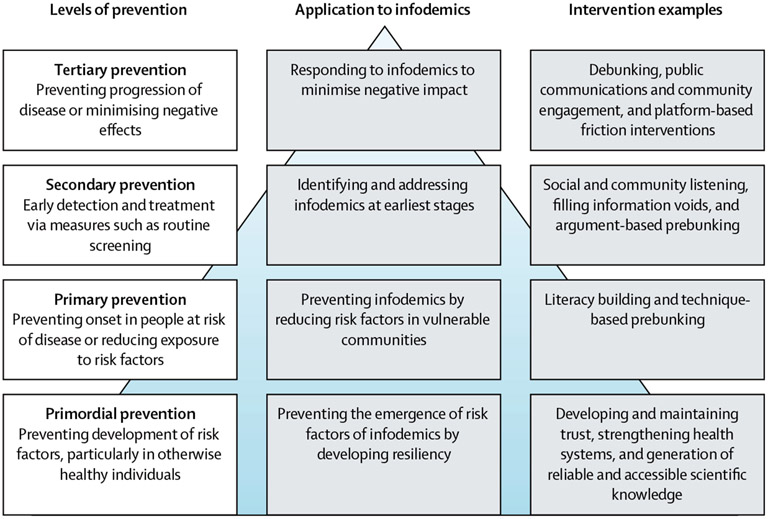
The COVID-19 pandemic has highlighted how infodemics (defined as an overabundance of information, including misinformation and disinformation) pose a threat to public health and could hinder individuals from making informed health decisions. Although public health authorities and other stakeholders have implemented measures for managing infodemics, existing frameworks for infodemic management have been primarily focused on responding to acute health emergencies rather than integrated in routine service delivery. We review the evidence and propose a framework for infodemic management that encompasses upstream strategies and provides guidance on identifying different interventions, informed by the four levels of prevention in public health: primary, secondary, tertiary, and primordial prevention. On the basis of a narrative review of 54 documents (peer-reviewed and grey literature published from 1961 to 2023), we present examples of interventions that belong to each level of prevention. Adopting this framework requires proactive prevention and response through managing information ecosystems, beyond reacting to misinformation or disinformation.
Overview
The claims and statistics of this paper haven’t been checked yet.
Free: it reads the open-access text and checks the first 5 claims that cite a source we can check. Create a free account to check every claim.
Integrity signals
Registry
Cites
Statistics
Figures
Verification
Claims the paper makes
The claims and statistics of this paper haven’t been checked yet.
Free: it reads the open-access text and checks the first 5 claims that cite a source we can check. Create a free account to check every claim.
Claims other papers make about this one
Each is checked against this paper’s own text: does it say what the citing paper says it does?
The source backs part of the claim, not all of it — or backs it for a different population, condition or comparison.
In the citing paper
“The consequences of health misinformation are not confined to the pandemic context; rather, they persistently permeate the entire continuum of prevention, diagnosis, and treatment (10).”
From Health misinformation, digital health literacy, and attitudes toward science among university students: an exploratory cross-sectional survey (2026) · cites this paper as [10]
Experimental — accuracy not yet measured
Self-check
Percentages, sums and reported differences re-computed from the paper’s own numbers.
The self-check needs the paper’s full text.
Citations
Cites
The spread of true and false news online
Vosoughi, S., Roy, D., & Aral, S. (2018) · Science · doi:10.1126/science.aap9559 · Cited by 8,847
The COVID-19 social media infodemic
Cinelli, M., Quattrociocchi, W., Galeazzi, A., Valensise, C. M., Brugnoli, E., Schmidt, A. L., Zola, P., Zollo, F., & Scala, A. (2020) · Scientific Reports · doi:10.1038/s41598-020-73510-5 · Cited by 2,313
The echo chamber effect on social media
Cinelli, M., De Francisci Morales, G., Galeazzi, A., Quattrociocchi, W., & Starnini, M. (2021) · Proceedings of the National Academy of Sciences · doi:10.1073/pnas.2023301118 · Cited by 2,092
Measuring the impact of COVID-19 vaccine misinformation on vaccination intent in the UK and USA
Loomba, S., de Figueiredo, A., Piatek, S. J., de Graaf, K., & Larson, H. J. (2021) · Nature Human Behaviour · doi:10.1038/s41562-021-01056-1 · Cited by 1,800
Pennycook, G., McPhetres, J., Zhang, Y., Lu, J. G., & Rand, D. G. (2020) · Psychological Science · doi:10.1177/0956797620939054 · Cited by 1,715 · cited 1×
“91 92-94 Visual cues to signal verified accounts has also been proposed as a strategy to highlight domain-specific expertise and, consequently, prevent pseudoscientific claims on social media.”
Shifting attention to accuracy can reduce misinformation online
Pennycook, G., Epstein, Z., Mosleh, M., Arechar, A. A., Eckles, D., & Rand, D. G. (2021) · Nature · doi:10.1038/s41586-021-03344-2 · Cited by 1,155 · cited 1×
“91 92-94 Visual cues to signal verified accounts has also been proposed as a strategy to highlight domain-specific expertise and, consequently, prevent pseudoscientific claims on social media.”
Countering Misinformation and Fake News Through Inoculation and Prebunking
Lewandowsky, S., & van der Linden, S. (2021) · European Review of Social Psychology · doi:10.1080/10463283.2021.1876983 · Cited by 773 · cited 3×
“66 66-68 For example, short videos can be used to inoculate individuals against commonly used persuasion techniques, such as presentation of false dichotomies or use of emotionally evocative content.”
Predatory journals: no definition, no defence
Grudniewicz, A., Moher, D., Cobey, K. D., Bryson, G. L., Cukier, S., Allen, K., Ardern, C., Balcom, L., Barros, T., Berger, M., et al. (2019) · Nature · doi:10.1038/d41586-019-03759-y · Cited by 726
International encyclopedia of public health
(2009) · Choice Reviews Online · doi:10.5860/choice.46-3012 · Cited by 651
Tangcharoensathien, V., Calleja, N., Nguyen, T., Purnat, T., D’Agostino, M., Garcia-Saiso, S., Landry, M., Rashidian, A., Hamilton, C., AbdAllah, A., et al. (2020) · Journal of Medical Internet Research · doi:10.2196/19659 · Cited by 561 · cited 1×
“1 Scales and colleagues applied epidemiological models to outline a process for managing the COVID-19 infodemic through real-time surveillance and rapid response to misinformation.”
Research works printed but not linked: 1
- WHO. Communicating risk in public health emergencies: a WHO guideline for emergency risk communication (ERC) policy and practice. Geneva: World Health Organization, 2017. 31059213
Cited by
An ecological framework for population health and well-being
Pronk, N. P., Woodard, C., Zimmerman, F. J., & Arena, R. A. (2025) · Progress in Cardiovascular Diseases · doi:10.1016/j.pcad.2025.03.013 · Cited by 31
Purnat, T. D., Wilhelm, E., Scales, D. A., Wardle, C., Bastien, S., Ganatra, B., Lavelanet, A. F., Mburu, G., Tamrat, T., & Nihlén, Å. (2025) · JMIR Infodemiology · doi:10.2196/83747 · Cited by 23
“Scholars and public health leaders increasingly recognize that interventions focused solely on individual knowledge, fact-checking, or improved digital marketing are insufficient in addressing the structural and systemic nature of the problem [3,9,14-17].”
Self-citationRai, S., Kornides, M. L., Morgan, J. C., Kumar, A., Cappella, J. N., & Guntuku, S. C. (2024) · Scientific Reports · doi:10.1038/s41598-024-64703-3 · Cited by 16
Taba, M., Ayre, J., McCaffery, K. J., Vassilenko, D., Ma, I. C. K., Haynes, T., Leask, J., Wilson, A. J., & Bonner, C. (2025) · Health Expectations · doi:10.1111/hex.70203 · Cited by 19
The Role of Social Media for Health Communication During COVID-19: A Scoping Review
Wella, K., Mtambo, J., Lazaro, M., & Mapulanga, P. (2025) · Journal of Consumer Health on the Internet · doi:10.1080/15398285.2025.2463047 · Cited by 11
Huang, Y., Leng, X., & Tian, Z. (2026) · Frontiers in Public Health · doi:10.3389/fpubh.2026.1709812 · Cited by 10
Advocating for a community-centred model for responding to potential information harms
Wardle, C., & Scales, D. A. (2025) · Nature Human Behaviour · doi:10.1038/s41562-025-02233-2 · Cited by 12
“As scholars who sit both in public health and in the sociological study of information, we see important lessons (as others have noted 7,24,37,38 ) to be learned from epidemiological surveillance that can be applied to monitoring information ecosystems beyond health and medicine.”
Self-citationThe Political Economy of Wellness: Commercial Determinants of a Burgeoning Industry
KARREMAN, N., ZENONE, M., MAANI, N., & HAWKINS, B. (2026) · The Milbank Quarterly · doi:10.1111/1468-0009.70088 · Cited by 7
Leslie, A., Kaschalk, E., van den Broek‐Altenburg, E. M., Stein, G. S., & Carney, J. K. (2025) · Frontiers in Public Health · doi:10.3389/fpubh.2025.1594833 · Cited by 13
Stop Asking Communities to Trust You: Make Public Health Trustworthy
Nnaji, C., & Bowleg, L. (2025) · American Journal of Public Health · doi:10.2105/ajph.2025.308336 · Cited by 5
Fitzpatrick, M., Moore, A., Kichuk, S. A., Pittenger, C., & Zaboski, B. A. (2025) · Cyberpsychology Behavior and Social Networking · doi:10.1177/21522715251370135 · Cited by 7
“This effect has been shown in conjunction with health misinformation surrounding COVID-19/vaccinations 11,14 and overall political polarization.”
Human Papillomavirus Vaccination Policies and Discourse on Social Media
Zhang, L., Zhang, S., Liu, S., & Jian, W. (2026) · JAMA Health Forum · doi:10.1001/jamahealthforum.2025.6425 · Cited by 5
Ruani, M. A., Reiss, M. J., & Kalea, A. Z. (2026) · Scientific Reports · doi:10.1038/s41598-026-40534-2 · Cited by 7
“…as a foundational model for constructing highly specialised misinformation risk assessment tools across other high-impact areas, such as medicine 77,78 , mental health 79,80 , sustainability 43,81 , consumer food choice 82,83 , food insecurity 84–86 , sociocultural phenomena (e.g. misogyny 87…”
Soeder, J., Wagner, A., Neunhöffer, A. T., Martus, P., Papenfuss, F., Wittich, A., Schwille‐Kiuntke, J., Rind, E., & Rieger, M. A. (2024) · Frontiers in Public Health · doi:10.3389/fpubh.2024.1388996 · Cited by 6
John, J. N., Gorman, S. E., & Scales, D. A. (2025) · JMIR Infodemiology · doi:10.2196/67119 · Cited by 9
Emerging public health risk of seasonal human metapneumovirus infection
Shanmugaraj, B., Murugan, C., Sudalai, R. P., & Jayaraj, K. (2025) · Discover Public Health · doi:10.1186/s12982-025-00782-5 · Cited by 4
“Moving forward, proactive communication, dissemination of evidence-based information and strengthening public health initiatives is essential to prepare for and manage future health threats [69].”
Omojowo, F. A. (2025) · Journal of Electrical Systems and Information Technology · doi:10.1186/s43067-025-00281-2 · Cited by 3
Comparing US prevention efforts to other high-income countries
Papanicolas, I., Sawaya, T., Bleich, S. N., & Figueroa, J. F. (2025) · The Lancet Public Health · doi:10.1016/s2468-2667(25)00222-1 · Cited by 4
Gaba, A., & Bennett, R. (2024) · JMIR Formative Research · doi:10.2196/63281 · Cited by 3
Kutscher, E. J., Arshed, A., Greene, R. E., & Kladney, M. (2024) · Harm Reduction Journal · doi:10.1186/s12954-024-01121-8 · Cited by 3
Trust typologies and HPV awareness in the U.S.: a latent class analysis
Stimpson, J. P., Tamirisa, K., Morenz, A. M., Adhikari, E. H., & Francis, J. (2025) · Vaccine · doi:10.1016/j.vaccine.2025.127606 · Cited by 3
Wehrli, S., Hartner, A.-M., Boender, T. S., Arnrich, B., & Irrgang, C. (2025) · Journal of Medical Internet Research · doi:10.2196/76309 · Cited by 6
“The information ecosystem is central to this, that is, the supply and demand of information by various actors and their interplay [13].”
Taba, M., Ayre, J., McCaffery, K. J., Blanch, C., Leask, J., Wilson, A. J., & Bonner, C. (2026) · Journal of Health Communication · doi:10.1080/10810730.2026.2613851 · Cited by 3
“Thus, there is a need for public health agencies to create effective social media health communication that resonates with young people and counteracts the presence of unreliable health information online (Gabarron et al., 2021; Ishizumi et al., 2024).”
Zhou, J., Rekola, H., Sormunen, M., & Mäki-Opas, T. E. (2026) · International Journal of Public Health · doi:10.3389/ijph.2026.1609337 · Cited by 3
“The COVID-19 pandemic further highlighted the critical importance of health literacy for understanding health information and making informed health decisions [10–12].”
Chung, H., & Muntaner, C. (2026) · Health Politics · doi:10.66534/hp.2026.0002 · Cited by 3
Amin, A., & Hong, Y. (2026) · Telematics and Informatics Reports · doi:10.1016/j.teler.2026.100326 · Cited by 4
Moyano, D. L., Tomás, M. S. A., & Menéndez, M. A. (2024) · Social Sciences · doi:10.3390/socsci13120640 · Cited by 3
Aronoff-Spencer, E. S., Carpiano, R. M., & Vojnov, L. (2025) · The Lancet · doi:10.1016/s0140-6736(24)02721-1 · Cited by 2
Comment améliorer le niveau d’éducation (littératie) de la population sur les produits de santé ?
Locher, C., Manaud, N., Molimard, M., Cassé‐Perrot, C., Cracowski, J., Palma, C. D., Duchossoy, L., Gatignol, C., Goldgewicht, A., Hertel, O., et al. (2025) · Therapies · doi:10.1016/j.therap.2025.11.011 · Cited by 2
Sarcone, A., Pileggi, C., Nobile, C., Simeone, S., & Mercuri, C. (2026) · Frontiers in Public Health · doi:10.3389/fpubh.2026.1931903 · Cited by 1
Zaifuddin, N. S., Adzharuddin, N. A., Osman, M. N., & Zawawi, J. W. M. (2025) · International Journal of Academic Research in Business and Social Sciences · doi:10.6007/ijarbss/v15-i1/23905 · Cited by 2
Internet Memes as Drivers of Health Narratives and Infodemics: Integrative Review
Carmona, Á., Herrera‐Peco, I., Jiménez-Gómez, B., & Suárez-Llevat, C. (2025) · JMIR Infodemiology · doi:10.2196/77029 · Cited by 6
“Ishizumi et al [56] report that interventions focused on critical thinking and peer education build long-term resilience.”
Fiammenghi, C., Ceretti, E., Covolo, L., Pelizzari, N., Taranto, M. A., Penna, L., Brunelli, L., Brusaferro, S., & Gelatti, U. (2025) · Human Vaccines & Immunotherapeutics · doi:10.1080/21645515.2025.2567680 · Cited by 2
“28 The present study is part of a larger project analyzing the press review of the Italian National Health Institute ( Istituto Superiore di Sanità, ISS; Italian National Health Institute ) during the first 2 years of the COVID-19 pandemic.”
Álvarez‐Gálvez, J., Carretero-Bravo, J., Lagares, C., Ramos-Fiol, B., & Ortega‐Martin, E. (2025) · JMIR Public Health and Surveillance · doi:10.2196/62693 · Cited by 8
“…and taxonomies on misinformation, for example, linked to specific topics such as vaccines [28,29] or preventive measures to combat misinformation [30-32], to the best of our knowledge, there is still no conceptual model that allows for an adequate operationalization of the concept of health…”
How can the level of health product education (literacy) be raised among the general public?
Locher, C., Manaud, N., Molimard, M., Cassé‐Perrot, C., Cracowski, J., Palma, C. D., Duchossoy, L., Gatignol, C., Goldgewicht, A., Hertel, O., et al. (2025) · Therapies · doi:10.1016/j.therap.2025.11.010 · Cited by 1
Topic evolution in social media discourse during global health emergencies
Omojowo, F. A. (2026) · Journal of Electrical Systems and Information Technology · doi:10.1186/s43067-025-00311-z · Cited by 1
Nurses as public educators: A scoping review of literature on misinformation mitigation
Stubbs, M. A., Wissen, K. A. V., Blanchard, D. L., & Reis, J. (2026) · Teaching and learning in nursing · doi:10.1016/j.teln.2026.01.008 · Cited by 2
Scrolling toward smiles: The role of social media in dental health promotion
Arora, M., Sachdeva, P., Gupta, N., Gambhir, N., Singh, D., & Tuli, A. (2025) · Santosh University Journal of Health Sciences · doi:10.4103/sujhs.sujhs_91_25 · Cited by 1
Muellmann, S., Jahnel, T., Barnils, N. P., Pan, C.-C., & Gerhardus, A. (2026) · BMC Public Health · doi:10.1186/s12889-026-27174-x · Cited by 2
“Additionally, there are frameworks tailored to specific public health interventions, concentrating on areas such as disease prevention [5], health promotion [6, 7], crisis response [8, 9], or infodemic management [10].”
Jamison, A., Saiyed, S., & Gardner, L. (2026) · Vaccine · doi:10.1016/j.vaccine.2026.128568 · Cited by 2
Bounded Rationality, Disinformation, and Infodemic in COVID-19 Times
Roazzi, A., Sobral, A. I. G. D. P., de Santana, A. N., de Melo, N. P. T. B., Savoldi, R., & Silva, R. É. D. N. (2025) · Psicologia Teoria e Pesquisa · doi:10.1590/0102.3772e41501.en · Cited by 1
Singhania, M. A., Kohli, K. K., & Aggarwal, P. (2025) · Annals of the National Academy of Medical Sciences (India) · doi:10.25259/anams_172_2025 · Cited by 2
Empowering Patients to Make Goal-Aligned Decisions in Unhealthy Information Environments
Faherty, L. J., & Scales, D. A. (2025) · Medical Care · doi:10.1097/mlr.0000000000002215 · Cited by 1
Purnat, T. D., Wilhelm, E., Scales, D. A., Wardle, C., Bastien, S., Ganatra, B., Lavelanet5, A., Mburu, G., Tamrat, T., & Nihlén, Å. (2025) · Research Square · doi:10.21203/rs.3.rs-7245117/v1 · Cited by 1
Self-citationVaccine hesitancy: How social and technological issues converged to spawn mistrust
Blasioli, E., & Hassini, E. (2025) · doi:10.64628/aam.9qamtagvn · Cited by 1
Papathanassopoulos, S., & Giannouli, I. (2025) · Encyclopedia · doi:10.3390/encyclopedia5040195 · Cited by 3
John, J. N., Gorman, S. E., & Scales, D. A. (2024) · doi:10.2196/preprints.67119
Alsaid, M. (2024) · University of North Texas Digital Library (University of North Texas) · doi:10.12794/metadc2415908
Protocolo de acceso abierto y clasificación de la literatura científica sobre espirometría
Valadez, M. A. F., Michán, L., Muñoz‐Velasco, I., & Romero-Pérez, M. (2024) · NCT Neumología y Cirugía de Tórax · doi:10.35366/119446
Valadez, M. A. F., Michán, L., Muñoz‐Velasco, I., & Romero-Pérez, M. (2024) · NCT Neumología y Cirugía de Tórax · doi:10.35366/119447
Policymaking in Health and Security
Barbar, A. E., & Bricknell, M. C. M. (2025) · Wiley eBooks · doi:10.1002/9781394326129.ch15
Damásio, L. C. V. D. C., & Wender, M. C. O. (2025) · Femina · doi:10.61622/0100-7254536202502
Harutyunyan, T. L., Hayrumyan, V., Aslanyan, L., Sedrakyan, T., & Sargsyan, Z. (2025) · BMC Public Health · doi:10.1186/s12889-025-24235-5 · Cited by 1
“Also, a number of other influences, which were not the focus of the present analysis, including trust in institutions [35], misinformation exposure [36, 37], and conspiracy beliefs [38] wear a mask because others can think they are afraid of getting infected, were also mentioned by some authors,…”
Stillbirth Discourse on Instagram and X (Formerly Twitter): Content Analysis
Vit, A. P., Fraidin, D., & Ovadia, Y. S. (2025) · JMIR Infodemiology · doi:10.2196/73980
“Engaging authoritative figures is critical to steer the narrative [70].”
Savas, S., Crichton, K., Wiseman, J., Taylor-Cutting, J., & Slaney, T. (2025) · Current Oncology · doi:10.3390/curroncol32100579
Nava-Zavala, A. H. (2025) · Salud Jalisco · doi:10.35366/121802
Technology to Support Communication in Palliative Care Practice
Nwosu, A. C., Stanley, S., Norris, J., & Taubert, M. (2025) · Synthesis lectures on technology and health · doi:10.1007/978-3-032-04277-4_4
Hussain, B., Marson-Smith, H., Duke, B., Gbadesire, M. S., Khurshid, S., & Timmons, S. (2025) · Journal of Health Services Research & Policy · doi:10.1177/13558196251409115
“22 Our fi ndings also found perceptions of perceived coercion to increase vaccine uptake generated more doubts among ethnic minority groups.”
Chigozie, V. U., Nnamani Monica, N., Igwe, K. N., & Ogbonna, B. O. (2026) · Journal of Communications In Healthcare · doi:10.1080/17538068.2026.2623348 · Cited by 2
“A more targeted approach, informed by localized data, could increase the effectiveness of infodemics management strategies [64,65] Infodemics management plays a critical role in addressing VH by countering misinformation that undermines public confidence in vaccines.”
Scholar, E. S. F., & Maasa, S. (2026) · Greener Journal of Biomedical and Health Sciences · doi:10.15580/gjbhs.2026.1.011226006
Kong, J. D., Gillies, M., Gardner, E. G., & Bragazzi, N. L. (2026) · One Health · doi:10.1016/j.onehlt.2026.101357 · Cited by 1
“…surveillance infrastructures have improved over the past two decades, they remain constrained by delays in data collection, fragmented communication across stakeholders, and limited capacity to address the dynamics of misinformation and public risk perception in real-time contexts [12,13].”
Okore, L. A., Aggarwal, R., Awuor, D. R., & Owuor, P. M. (2026) · Frontiers in Oral Health · doi:10.3389/froh.2026.1775671 · Cited by 1
“Misinformation can lead to public health issues, as seen during the COVID-19 pandemic when people turned to traditional methods to treat or prevent the disease (51).”
Wei, J., & Ren, H. (2026) · Frontiers in Public Health · doi:10.3389/fpubh.2026.1780596 · Cited by 1
Erim, A., Lansana, P. M., Badmus, O. A., & Olanrewaju, M. (2026) · medRxiv · doi:10.64898/2026.04.09.26350557
Nanthanasit, A., Ppali, S., She, W.-J., Siriaraya, P., Piumsomboon, T., Sukittanon, S., Ang, C. S., & Covaci, A. (2026) · CHI Conference on Human Factors in Computing Systems · doi:10.1145/3772318.3791965 · Cited by 1
“Uneven digital and health literacy, limited training and supervision for VHVs, and risks of misinformation and unsafe content constrain effective use [9, 36, 39].”
Meslamani, A. Z. A., Abu‐Naser, D., & Mohammed, E. M. A. (2026) · International Journal of Environmental Health Research · doi:10.1080/09603123.2026.2657446
“…comparisons made between Mpox and COVID-19 during recent outbreaks have increased concerns globally, highlighting how an infodemic, defined as an overabundance of information, including misinformation, can undermine public health by hindering informed decision-making (Ishizumi et al. 2024).”
Almenara, C. A., Anastasiadou, D. T., & Flint, S. W. (2026) · doi:10.2196/preprints.102913
Kozhekenova, N., Glushkova, N., Idayat, M., Nurgaliyeva, Z., Oshibayeva, A., Kyrykbayeva, S., Zhagiparova, Z., Nuskabayeva, G. N., Miller, A. A., Smasheva, A., et al. (2026) · Scientific Reports · doi:10.1038/s41598-026-58200-y
“The significance of legislation and regulatory public health measures during a pandemic can be distorted by assessments of their effectiveness 4,5 .”
Vita, E. D., Arzilli, G., Gesualdo, F., Casigliani, V., Pasquale, M., Cruschelli, G., Tecchio, F., Tosi, F., Porretta, A. D., Romersi, D., et al. (2026) · BMC Public Health · doi:10.1186/s12889-026-28242-y
“Also infodemic management was identified as an underdeveloped area, despite its growing recognition as a core public health function [218, 219].”
Xu, W., & Li, N. (2026) · Frontiers in Public Health · doi:10.3389/fpubh.2026.1875500
“In the next phase of research and policy, broader information ecosystems—such as overload, information gaps, competing interpretations, and platform dynamics—need to be investigated (71).”
Japan's health system toward 2040: structural challenges and a renewed social contract
Yamasaki, L., Sakamoto, H., Hashimoto, H., Kondo, N., Kunii, O., Tsugawa, Y., Abe, S. K., Ezoe, S., Egawa, S., Guinto, R., et al. (2026) · The Lancet Regional Health - Western Pacific · doi:10.1016/j.lanwpc.2026.101920 · Cited by 4
“60”
Purnat, T. D., White, B. K., Boender, T. S., Wilhelm, E., Senft, T. M., Winters, M., Barragan, S., Lihemo, G., Abeyesekera, S., Ho, E., et al. (2026) · doi:10.2196/preprints.105487
Self-citationEtherington, C., Meyer, S. B., Brehaut, A., Olson, J. L., Palumbo, A., Bennett, M., Gibson, E., Shorr, R., Vesnaver, E., Fontaine, G., et al. (2026) · Social Science & Medicine · doi:10.1016/j.socscimed.2026.119623
Ragendu, R., Naman, Gupta, R., Arya, R., Jindal, R., & Kanozia, R. (2026) · Journal of Cancer Policy · doi:10.1016/j.jcpo.2026.100783 · Cited by 1
Na, K. (2026) · Journal of Health Communication · doi:10.1080/10810730.2026.2716163
Carreira, H. M. R. O., Coelho, P. B., Costeira, C. R. B., Andrade, T., Reis, I., Gomes, J. C., & Morgado, T. M. M. (2026) · IGI Global eBooks · doi:10.4018/979-8-3373-7670-7.ch001
Kiggundu, R., Waswa, J. P., Lwigale, F., Mwanja, H., Mackline, H., Tumwine, C., Ayebare, R. R., Kambugu, A., Byonanebye, D. M., & Kakooza, F. (2026) · Frontiers in Public Health · doi:10.3389/fpubh.2026.1782858
Purnat, T. D., Wilhelm, E., Tamrat, T., Bertrand-Ferrandis, C., Scales, D. A., Wardle, C., & Nihlén, Å. (2026) · doi:10.2196/preprints.113430
Self-citationKickbusch, I. (2026) · The Lancet Public Health · doi:10.1016/s2468-2667(26)00188-x
Metadata
- Authors
- Ishizumi, A., Kolis, J., Abad, N., Prybylski, D., Brookmeyer, K. A., Voegeli, C., Wardle, C., & Chiou, H.
- Affiliations
- Centers for Disease Control and Prevention (US)
- Brown University (US)
- Corresponding author
- Kolis, Jessica
- ORCID
- Venue
- The Lancet Public Health
- Publisher
- Elsevier BV
- Published
- 2024-06
- Volume
- 9
- Issue
- 6
- Pages
- e397-e406
- ISSN
- 2468-2667 (ISSN-L)
- PMC
- PMC11369959
- OpenAlex
- W4394980099
- Semantic Scholar
- 2b90fdc4cf57fe3449f18a25d46b0b82c903491e
- Cited by
- 79
- References
- 90
- Citations by year
- 2026: 34 · 2025: 36 · 2024: 9
- FWCI
- 8.25
- Type
- journal article
- Language
- en
- Open access
- gold
- doi.org
- Licence
- cc-by-nc-nd
- www.elsevier.com/tdm/userlicense/1.0/ (tdm)
- www.elsevier.com/legal/tdmrep-license (tdm)
- creativecommons.org/licenses/by-nc-nd/4.0/ (vor)
- Locations
- The Lancet Public Health (publishedVersion, cc-by-nc-nd)
- PubMed (publishedVersion)
- PubMed Central (acceptedVersion, cc-by-nc-nd)
- DOAJ (DOAJ: Directory of Open Access Journals) (submittedVersion, cc-by-sa)
- Funders
- U.S. Department of Health and Human Services
- Brown University
- National Institutes of Health (CC999999)
- Centers for Disease Control and Prevention
- Topics
- Social Sciences › Sociology and Political Science › Misinformation and Its Impacts
- Social Sciences › Communication › Communication and COVID-19 Impact
- Social Sciences › Communication › Public Relations and Crisis Communication
- Keywords
- infodemic, misinformation, disinformation, infodemic management, levels of prevention, primordial prevention, primary prevention, secondary prevention, tertiary prevention, information ecosystem, COVID-19 pandemic, public health communication, health decision-making
- MeSH terms
- COVID-19, Communication, Humans, Public Health
About these checks
Registry, retraction, Cites and statistics results are computed, not judged, with one exception: a printed reference that no index lists is read once by a model before it counts as a citation error. Claims are extracted by a model and kept only when their quote appears verbatim in the text; each cited source is then checked, with a model’s help, for whether it says what the claim relies on. Those verdicts can be wrong — read the claim’s quote and the cited source before relying on one.
Statistics and arithmetic are recomputed, not judged.
Confidence bands are shown only for fields calibrated on our annotated test set. None is calibrated yet, so no band is shown.
What counts as a claim ›How we measure confidence ›How we check this ›
Are you an author, or do you see a problem with this page? Request a review
Data sources
Bibliographic data: Semantic Scholar, OpenAlex, Crossref.
Contains information from the Semantic Scholar Academic Graph Datasets, made available under the ODC Attribution License (ODC-BY 1.0).
Semantic Scholar’s data is described in: Kinney, R., et al. (2023). The Semantic Scholar Open Data Platform. arXiv:2301.10140.
