

Beyond misinformation: developing a public health prevention framework for managing information ecosystems
Open accessThe DOI matches its Crossref record; 89 of the 90 references it cites were found in a registry or an index.
Abstract
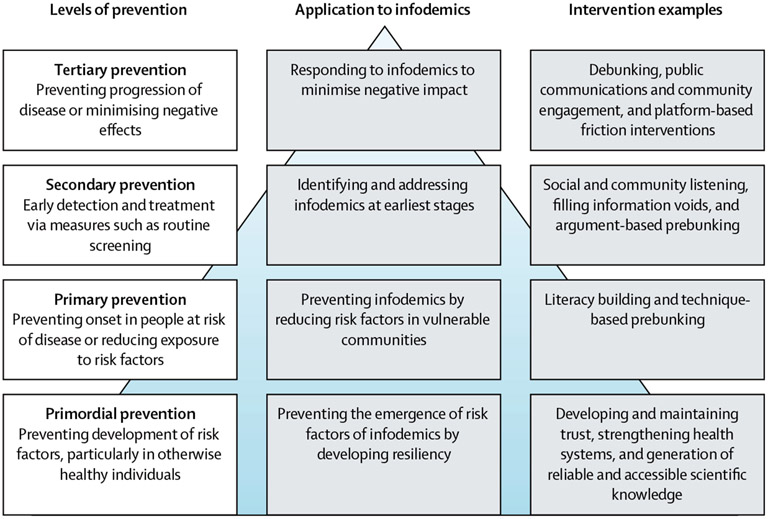
The COVID-19 pandemic has highlighted how infodemics (defined as an overabundance of information, including misinformation and disinformation) pose a threat to public health and could hinder individuals from making informed health decisions. Although public health authorities and other stakeholders have implemented measures for managing infodemics, existing frameworks for infodemic management have been primarily focused on responding to acute health emergencies rather than integrated in routine service delivery. We review the evidence and propose a framework for infodemic management that encompasses upstream strategies and provides guidance on identifying different interventions, informed by the four levels of prevention in public health: primary, secondary, tertiary, and primordial prevention. On the basis of a narrative review of 54 documents (peer-reviewed and grey literature published from 1961 to 2023), we present examples of interventions that belong to each level of prevention. Adopting this framework requires proactive prevention and response through managing information ecosystems, beyond reacting to misinformation or disinformation.
Overview
The claims and statistics of this paper haven’t been checked yet.
Free: it reads the open-access text and checks the first 5 claims that cite a source we can check. Create a free account to check every claim.
Integrity signals
Registry
Cites
Statistics
Figures
Verification
Claims the paper makes
The claims and statistics of this paper haven’t been checked yet.
Free: it reads the open-access text and checks the first 5 claims that cite a source we can check. Create a free account to check every claim.
Claims other papers make about this one
Each is checked against this paper’s own text: does it say what the citing paper says it does?
The source backs part of the claim, not all of it — or backs it for a different population, condition or comparison.
In the citing paper
“The consequences of health misinformation are not confined to the pandemic context; rather, they persistently permeate the entire continuum of prevention, diagnosis, and treatment (10).”
From Health misinformation, digital health literacy, and attitudes toward science among university students: an exploratory cross-sectional survey (2026) · cites this paper as [10]
Experimental — accuracy not yet measured
Self-check
Percentages, sums and reported differences re-computed from the paper’s own numbers.
The self-check needs the paper’s full text.
Citations
Cites
The spread of true and false news online
Vosoughi, S., Roy, D., & Aral, S. (2018) · Science · doi:10.1126/science.aap9559 · Cited by 8,847
The COVID-19 social media infodemic
Cinelli, M., Quattrociocchi, W., Galeazzi, A., Valensise, C. M., Brugnoli, E., Schmidt, A. L., Zola, P., Zollo, F., & Scala, A. (2020) · Scientific Reports · doi:10.1038/s41598-020-73510-5 · Cited by 2,313
The echo chamber effect on social media
Cinelli, M., De Francisci Morales, G., Galeazzi, A., Quattrociocchi, W., & Starnini, M. (2021) · Proceedings of the National Academy of Sciences · doi:10.1073/pnas.2023301118 · Cited by 2,092
Measuring the impact of COVID-19 vaccine misinformation on vaccination intent in the UK and USA
Loomba, S., de Figueiredo, A., Piatek, S. J., de Graaf, K., & Larson, H. J. (2021) · Nature Human Behaviour · doi:10.1038/s41562-021-01056-1 · Cited by 1,800
Pennycook, G., McPhetres, J., Zhang, Y., Lu, J. G., & Rand, D. G. (2020) · Psychological Science · doi:10.1177/0956797620939054 · Cited by 1,715 · cited 1×
“91 92-94 Visual cues to signal verified accounts has also been proposed as a strategy to highlight domain-specific expertise and, consequently, prevent pseudoscientific claims on social media.”
Shifting attention to accuracy can reduce misinformation online
Pennycook, G., Epstein, Z., Mosleh, M., Arechar, A. A., Eckles, D., & Rand, D. G. (2021) · Nature · doi:10.1038/s41586-021-03344-2 · Cited by 1,155 · cited 1×
“91 92-94 Visual cues to signal verified accounts has also been proposed as a strategy to highlight domain-specific expertise and, consequently, prevent pseudoscientific claims on social media.”
Countering Misinformation and Fake News Through Inoculation and Prebunking
Lewandowsky, S., & van der Linden, S. (2021) · European Review of Social Psychology · doi:10.1080/10463283.2021.1876983 · Cited by 773 · cited 3×
“66 66-68 For example, short videos can be used to inoculate individuals against commonly used persuasion techniques, such as presentation of false dichotomies or use of emotionally evocative content.”
Predatory journals: no definition, no defence
Grudniewicz, A., Moher, D., Cobey, K. D., Bryson, G. L., Cukier, S., Allen, K., Ardern, C., Balcom, L., Barros, T., Berger, M., et al. (2019) · Nature · doi:10.1038/d41586-019-03759-y · Cited by 726
International encyclopedia of public health
(2009) · Choice Reviews Online · doi:10.5860/choice.46-3012 · Cited by 651
Tangcharoensathien, V., Calleja, N., Nguyen, T., Purnat, T., D’Agostino, M., Garcia-Saiso, S., Landry, M., Rashidian, A., Hamilton, C., AbdAllah, A., et al. (2020) · Journal of Medical Internet Research · doi:10.2196/19659 · Cited by 561 · cited 1×
“1 Scales and colleagues applied epidemiological models to outline a process for managing the COVID-19 infodemic through real-time surveillance and rapid response to misinformation.”
How to Fight an Infodemic: The Four Pillars of Infodemic Management
Eysenbach, G. (2020) · Journal of Medical Internet Research · doi:10.2196/21820 · Cited by 551 · cited 1×
“24 Kirk Sell and colleagues similarly presented priorities for a national strategy to address health misinformation in the USA, which includes detailed descriptions of potential interventions (eg, establishing guidelines for reporting on misinformation).”
McGuire, W. J., & Papageorgis, D. (1961) · The Journal of Abnormal and Social Psychology · doi:10.1037/h0042026 · Cited by 476 · cited 1×
“66 66-68 For example, short videos can be used to inoculate individuals against commonly used persuasion techniques, such as presentation of false dichotomies or use of emotionally evocative content.”
Psychological inoculation improves resilience against misinformation on social media
Roozenbeek, J., van der Linden, S., Goldberg, B., Rathje, S., & Lewandowsky, S. (2022) · Science Advances · doi:10.1126/sciadv.abo6254 · Cited by 472 · cited 1×
“67 Similarly, technique-based prebunking can also be used in the form of an online browser game, in which players create and spread hypothetical social media posts while learning how to use common misinformation techniques.”
Prevention of stroke: a global perspective
Pandian, J. D., Gall, S. L., Kate, M. P., Silva, G. S., Akinyemi, R. O., Ovbiagele, B. I., Lavados, P. M., Gandhi, D. B. C., & Thrift, A. G. (2018) · The Lancet · doi:10.1016/s0140-6736(18)31269-8 · Cited by 450 · cited 2×
“…policy, or social conditions; 28,31 primary prevention, which aims to prevent the onset of a specific condition in people who are already at risk; 28,32,33 secondary prevention, which aims to detect and treat a condition in its early or preclinical stage by implementing measures such as routine…”
Why do people believe COVID-19 conspiracy theories?
Uscinski, J. E., Enders, A. M., Klofstad, C., Seelig, M., Funchion, J., Everett, C., Wuchty, S., Premaratne, K., & Murthi, M. (2020) · Harvard Kennedy School Misinformation Review · doi:10.37016/mr-2020-015 · Cited by 429
(2008) · Springer eBooks · doi:10.1007/978-1-4020-5614-7 · Cited by 364
The biggest pandemic risk? Viral misinformation
Larson, H. J. (2018) · Nature · doi:10.1038/d41586-018-07034-4 · Cited by 323
De Coninck, D., Frissen, T., Matthijs, K., d’Haenens, L., Lits, G., Champagne-Poirier, O., Carignan, M.-E., David, M. D., Pignard-Cheynel, N., Salerno, S., et al. (2021) · Frontiers in Psychology · doi:10.3389/fpsyg.2021.646394 · Cited by 308
Basol, M., Roozenbeek, J., Berriche, M., Uenal, F., McClanahan, W. P., & Linden, S. V. D. (2021) · Big Data & Society · doi:10.1177/20539517211013868 · Cited by 271 · cited 2×
“69”
Dohle, S., Wingen, T., & Schreiber, M. (2020) · Social Psychological Bulletin · doi:10.32872/spb.4315 · Cited by 238
Cancer prevention and screening: the next step in the era of precision medicine
Loomans-Kropp, H. A., & Umar, A. (2019) · npj Precision Oncology · doi:10.1038/s41698-018-0075-9 · Cited by 205 · cited 1×
“36,37 38-41 Examples of the use of this model include a review of approaches to cancer prevention in low-income and middle-income settings 38 and a guide for nurse practitioners to plan a regimen for the prevention of cardiovascular disease in patients who are HIV positive.”
A digital media literacy intervention for older adults improves resilience to fake news
Moore, R. C., & Hancock, J. T. (2022) · Scientific Reports · doi:10.1038/s41598-022-08437-0 · Cited by 196 · cited 1×
“63,64 Similarly, an intervention with an asynchronous online course has been used to improve the ability of American college students to evaluate the credibility of online sources.”
Post retraction citations in context: a case study
Bar-Ilan, J., & Halevi, G. (2017) · Scientometrics · doi:10.1007/s11192-017-2242-0 · Cited by 191 · cited 1×
“2,58 Moreover, transparency from social media platforms can facilitate the creation of scientific evidence, especially in the realm of infodemic management.”
Martins, C., Godycki-Cwirko, M., Heleno, B., & Brodersen, J. (2018) · European Journal of General Practice · doi:10.1080/13814788.2017.1422177 · Cited by 186 · cited 1×
“106,107 This approach is especially crucial when considering the potentially unethical or harmful consequences of infodemic management interventions, 108 such as concerns about privacy, the effect of content moderation on free speech, and the monitoring of closed social media.”
Correction as a Solution for Health Misinformation on Social Media
Vraga, E. K., & Bode, L. (2020) · American Journal of Public Health · doi:10.2105/ajph.2020.305916 · Cited by 186 · cited 1×
“80 Debunking can include the use of credible information with links to expert sources, offering an alternative explanation for the misinformation, and delivering repeated corrections.”
Melki, J., Tamim, H., Hadid, D., Makki, M., El Amine, J., & Hitti, E. (2021) · PLOS ONE · doi:10.1371/journal.pone.0252830 · Cited by 182
COVID-19 infodemic and digital health literacy in vulnerable populations: A scoping review
Choukou, M.-A., Sanchez-Ramirez, D. C., Pol, M., Uddin, M., Monnin, C., & Syed-Abdul, S. (2022) · DIGITAL HEALTH · doi:10.1177/20552076221076927 · Cited by 180 · cited 1×
“60-62 For example, self-directed online modules and in-person lectures have been used in places such as the USA and South Korea to teach older adults concepts and skills related to online misinformation, web search engines, or reliable information sources.”
Pian, W., Chi, J., & Ma, F. (2021) · Information Processing & Management · doi:10.1016/j.ipm.2021.102713 · Cited by 179
Healthcare professionals’ acts of correcting health misinformation on social media
Bautista, J. R., Zhang, Y., & Gwizdka, J. (2021) · International Journal of Medical Informatics · doi:10.1016/j.ijmedinf.2021.104375 · Cited by 171
Calleja, N., AbdAllah, A., Abad, N., Ahmed, N., Albarracin, D., Altieri, E., Anoko, J. N., Arcos, R., Azlan, A. A., Bayer, J., et al. (2021) · JMIR Infodemiology · doi:10.2196/30979 · Cited by 166 · cited 2×
“22,23 Public health practitioners and academics have proposed various frameworks to describe the crucial components of addressing infodemics.”
Self-citationPrescription Fill Patterns for Commonly Used Drugs During the COVID-19 Pandemic in the United States
Vaduganathan, M., van Meijgaard, J., Mehra, M. R., Joseph, J., O’Donnell, C. J., & Warraich, H. J. (2020) · JAMA · doi:10.1001/jama.2020.9184 · Cited by 165
Berg, S. H., O'Hara, J. K., Shortt, M. T., Thune, H., Brønnick, K., Lungu, D. A., Røislien, J., & Wiig, S. (2021) · BMC Public Health · doi:10.1186/s12889-021-11468-3 · Cited by 164
Why the WHO took two years to say COVID is airborne
Lewis, D. (2022) · Nature · doi:10.1038/d41586-022-00925-7 · Cited by 158
Research progress on digital health literacy of older adults: A scoping review
Wang, X., & Luan, W. (2022) · Frontiers in Public Health · doi:10.3389/fpubh.2022.906089 · Cited by 146
Risk communication and community engagement strategies for COVID-19 in 13 African countries
Adebisi, Y. A., Rabe, A. P. J., & Lucero‐Prisno, D. E. (2021) · Health Promotion Perspectives · doi:10.34172/hpp.2021.18 · Cited by 145 · cited 1×
“84 In addition to the traditional channels used to disseminate evidence-based health information, the optimisation of web traffic and search engine visibility can be used.”
Overdiagnosis: How cancer screening can turn indolent pathology into illness
Brodersen, J., Schwartz, L. M., & Woloshin, S. (2014) · Apmis · doi:10.1111/apm.12278 · Cited by 138 · cited 1×
“106,107 This approach is especially crucial when considering the potentially unethical or harmful consequences of infodemic management interventions, 108 such as concerns about privacy, the effect of content moderation on free speech, and the monitoring of closed social media.”
PREVENTIVE MEDICINE FOR THE DOCTOR IN HIS COMMUNITY: AN EPIDEMIOLOGIC APPROACH
Clark, D. W. (1958) · American Journal of Public Health and the Nations Health · doi:10.2105/ajph.48.7.947-a · Cited by 125
Infodemics: a new challenge for public health
Briand, S. C., Cinelli, M., Nguyen, T., Lewis, R., Prybylski, D., Valensise, C. M., Colizza, V., Tozzi, A. E., Perra, N., Baronchelli, A., et al. (2021) · Cell · doi:10.1016/j.cell.2021.10.031 · Cited by 125 · cited 1×
“27 The overall aim of this Health Policy is to propose a unifying, expansive framework that addresses these gaps in existing frameworks—namely their little focus on upstream strategies beyond emergency response, insufficient guidance on identifying and categorising different types of interventions,…”
Self-citationZhao, S., Hu, S., Zhou, X., Song, S., Wang, Q., Zheng, H., Zhang, Y., & Hou, Z. (2023) · JMIR Public Health and Surveillance · doi:10.2196/40201 · Cited by 125
Shen, A. K., Browne, S., Srivastava, T., Kornides, M. L., & Tan, A. S. L. (2023) · Vaccine · doi:10.1016/j.vaccine.2023.02.045 · Cited by 113 · cited 2×
“48,86 Partnerships with the media sector can also be considered to prevent inaccuracies or exaggeration in reporting.”
Purnat, T. D., Vacca, P., Czerniak, C., Ball, S., Burzo, S., Zecchin, T., Wright, A., Bezbaruah, S., Tanggol, F., Dubé, È., et al. (2021) · JMIR Infodemiology · doi:10.2196/30971 · Cited by 111 · cited 1×
“70 This process is commonly referred to as social listening and involves monitoring of digital, social, and traditional media.”
The Covid-19 Infodemic — Applying the Epidemiologic Model to Counter Misinformation
Scales, D., Gorman, J., & Jamieson, K. H. (2021) · New England Journal of Medicine · doi:10.1056/nejmp2103798 · Cited by 110 · cited 1×
“26 Although these frameworks are useful for public health practitioners, they collectively leave gaps that limit their applicability to the complex and evolving challenges posed by infodemics.”
Haber, N., Smith, E. R., Moscoe, E., Andrews, K., Audy, R., Bell, W., Brennan, A. T., Breskin, A., Kane, J. C., Karra, M., et al. (2018) · PLoS ONE · doi:10.1371/journal.pone.0196346 · Cited by 97
Governmental actions to address COVID-19 misinformation
Pomeranz, J. L., & Schwid, A. (2021) · Journal of Public Health Policy · doi:10.1057/s41271-020-00270-x · Cited by 96 · cited 1×
“112 These strategies are typically not within the purview of public health and were therefore not included in our framework.”
Developing an accuracy-prompt toolkit to reduce COVID-19 misinformation online
Epstein, Z., Berinsky, A. J., Cole, R., Gully, A., Pennycook, G., & Rand, D. G. (2021) · Harvard Kennedy School Misinformation Review · doi:10.37016/mr-2020-71 · Cited by 93
Lateral reading: College students learn to critically evaluate internet sources in an online course.
Breakstone, J., Smith, M., Connors, P., Ortega, T., Kerr, D., & Wineburg, S. (2021) · Harvard Kennedy School Misinformation Review · doi:10.37016/mr-2020-56 · Cited by 91 · cited 1×
“61 Free digital literacy training curriculum and materials are also available.”
The spread of COVID-19 conspiracy theories on social me-dia and the effect of content moderation
Papakyriakopoulos, O., Medina Serrano, J. C., & Hegelich, S. (2020) · Harvard Kennedy School Misinformation Review · doi:10.37016/mr-2020-034 · Cited by 87 · cited 2×
“89,90 For example, by removing or flagging conspiratorial content on platforms such as X (formerly known as Twitter), Reddit, and Facebook, they become less likely to reappear in the information ecosystem.”
Systematic review: YouTube recommendations and problematic content
Yesilada, M., & Lewandowsky, S. (2022) · Internet Policy Review · doi:10.14763/2022.1.1652 · Cited by 85 · cited 1×
“7 Additionally, the absence of credible and accessible health information, often referred to as information voids, can promote misinformation.”
Hromatko, I., Tonković, M., & Vranić, A. (2021) · Frontiers in Psychology · doi:10.3389/fpsyg.2021.664554 · Cited by 79
Vivion, M., Sidi, E. A. L., Betsch, C., Dionne, M., Dubé, È., Driedger, S. M., Gagnon, D., Graham, J., Greyson, D. L., Hamel, D., et al. (2022) · Journal of Communications In Healthcare · doi:10.1080/17538068.2022.2044606 · Cited by 74 · cited 1×
“79 Tertiary prevention: acute responses to minimise negative effects of infodemics Tertiary prevention in public health and preventive medicine involves preventing disease progression or alleviating symptoms.”
Watkins, J. A., Griffiths, F. E., & Goudge, J. (2021) · BMJ Open · doi:10.1136/bmjopen-2020-044065 · Cited by 61 · cited 1×
“48,49 More focused interventions can also be used to increase trust.”
van der Linden, S., Albarracín, D., Fazio, L. K., Freelon, D., Roozenbeek, J., Swire‐Thompson, B., & Bavel, J. J. V. (2026) · American Psychologist · doi:10.1037/amp0001598 · Cited by 61
Agley, J., Xiao, Y., Thompson, E. E., Chen, X., & Golzarri-Arroyo, L. (2021) · Journal of Medical Internet Research · doi:10.2196/32425 · Cited by 60 · cited 1×
“51”
Freitas, L. D., Basdeo, D., & Wang, H. (2021) · The Lancet Regional Health - Americas · doi:10.1016/j.lana.2021.100051 · Cited by 57 · cited 2×
“42-46 Examples of interventions to develop trust include communication practices by public health authorities and officials that follow established principles of risk communication.”
Mourali, M., & Drake, C. (2022) · Journal of Medical Internet Research · doi:10.2196/34831 · Cited by 55
Disease Prevention: An Overview
Outwater, A. H., Leshabari, S., & Nolte, E. (2016) · Elsevier eBooks · doi:10.1016/b978-0-12-803678-5.00117-x · Cited by 51 · cited 1×
“…which aims to detect and treat a condition in its early or preclinical stage by implementing measures such as routine medical screening; 34,35 and tertiary prevention, which includes interventions that are designed to prevent progression of disease, minimise suffering, or alleviate…”
Reducing Health Misinformation in Science: A Call to Arms
Swire‐Thompson, B., & Lazer, D. M. J. (2022) · The Annals of the American Academy of Political and Social Science · doi:10.1177/00027162221087686 · Cited by 50 · cited 4×
“2 At an organisational level, academic and public health institutions can establish policies ensuring that their published outputs are freely accessible to the public, similar to WHO’s open access policy.”
InfluentialChang, S. J., Lee, K.-E., Yang, E., & Ryu, H. (2022) · BMC Geriatrics · doi:10.1186/s12877-022-03545-y · Cited by 49 · cited 1×
“63,64 Similarly, an intervention with an asynchronous online course has been used to improve the ability of American college students to evaluate the credibility of online sources.”
Combating Misinformation as a Core Function of Public Health
Knudsen, J., Perlman-Gabel, M., Uccelli, I. G., Jeavons, J., & Chokshi, D. A. (2023) · NEJM Catalyst · doi:10.1056/cat.22.0198 · Cited by 49 · cited 1×
“76 Similarly, during the first wave of the COVID-19 pandemic in 2020 in Madagascar, the non-governmental organisation Doctors for Madagascar had informal interviews with community leaders, health-care workers, and local health authorities to understand the effect of misinformation.”
A socio-ecological framework for cancer prevention in low and middle-income countries
Akinyemiju, T., Ogunsina, K., Gupta, A., Liu, I., Braithwaite, D., & Hiatt, R. A. (2022) · Frontiers in Public Health · doi:10.3389/fpubh.2022.884678 · Cited by 48 · cited 1×
“36,37 38-41 Examples of the use of this model include a review of approaches to cancer prevention in low-income and middle-income settings 38 and a guide for nurse practitioners to plan a regimen for the prevention of cardiovascular disease in patients who are HIV positive.”
Mackey, T. K., Purushothaman, V. L., Haupt, M. R., Nali, M. C., & Li, J. (2021) · The Lancet Digital Health · doi:10.1016/s2589-7500(20)30318-6 · Cited by 47
The American Heart Association’s Focus on Primordial Prevention
Lloyd‐Jones, D. M., Albert, M. A., & Elkind, M. S. V. (2021) · Circulation · doi:10.1161/circulationaha.121.057125 · Cited by 47 · cited 1×
“…are: primordial prevention, which seeks to prevent the emergence of risk factors by addressing environmental, policy, or social conditions; 28,31 primary prevention, which aims to prevent the onset of a specific condition in people who are already at risk; 28,32,33 secondary prevention,…”
WHO and digital agencies: how to effectively tackle COVID-19 misinformation online
Germani, F., Pattison, A. B., & Reinfelde, M. (2022) · BMJ Global Health · doi:10.1136/bmjgh-2022-009483 · Cited by 46 · cited 1×
“91 92-94 Visual cues to signal verified accounts has also been proposed as a strategy to highlight domain-specific expertise and, consequently, prevent pseudoscientific claims on social media.”
When Physicians Spread Unscientific Information About COVID-19
Rubin, R. (2022) · JAMA · doi:10.1001/jama.2022.1083 · Cited by 45 · cited 1×
“110,111 In Europe, the law enforcement agency Europol has removed online links to advertisements or marketplaces promoting fake COVID-19 pharmaceutical products.”
Wilhelm, E., Ballalai, I., Belanger, M.-E., Benjamin, P., Bertrand-Ferrandis, C., Bezbaruah, S., Briand, S., Brooks, I., Bruns, R., Bucci, L. M., et al. (2023) · JMIR Infodemiology · doi:10.2196/44207 · Cited by 45 · cited 2×
“…could also have broader effects than negative outcomes for that specific health epidemic, such as reduction of public trust in health institutions and economic burden due to increased morbidity and mortality, 11,19 including costs that take away resources from other public health activities.”
Self-citationScience and Ethics of “Curing” Misinformation
Freiling, I., Krause, N. M., & Scheufele, D. A. (2023) · The AMA Journal of Ethic · doi:10.1001/amajethics.2023.228 · Cited by 43 · cited 1×
“106,107 This approach is especially crucial when considering the potentially unethical or harmful consequences of infodemic management interventions, 108 such as concerns about privacy, the effect of content moderation on free speech, and the monitoring of closed social media.”
COVID-19 and misinformation: how an infodemic fuelled the prominence of vitamin D
Henrina, J., Lim, M. A., & Pranata, R. (2020) · British Journal Of Nutrition · doi:10.1017/s0007114520002950 · Cited by 42
Concrete Recommendations for Cutting Through Misinformation During the COVID-19 Pandemic
Donovan, J. (2020) · American Journal of Public Health · doi:10.2105/ajph.2020.305922 · Cited by 41 · cited 1×
“85 To further enhance engagement with hard-to-reach communities, public health practitioners have also adopted strategies such as working with messengers trusted by the community (eg, faith leaders, small business owners, and community-based organisations).”
A Multifaceted Campaign to Combat COVID-19 Misinformation in the Hispanic Community
Silesky, M. D., Panchal, D., Fields, M., Peña, A. S., Diez, M., Magdaleno, A., Frausto-Rodriguez, P., & Bonnevie, E. (2022) · Journal of Community Health · doi:10.1007/s10900-022-01170-9 · Cited by 41
Prevention of depression in adults with long-term physical conditions
Kampling, H., Baumeister, H., Bengel, J., & Mittag, O. (2021) · Cochrane Database of Systematic Reviews · doi:10.1002/14651858.cd011246.pub2 · Cited by 38
Helfers, A., & Ebersbach, M. (2022) · Journal of Communications In Healthcare · doi:10.1080/17538068.2022.2047497 · Cited by 37 · cited 1×
“80 81-83”
COVID-19 Vaccine Fact-Checking Posts on Facebook: Observational Study
Xue, H., Gong, X., & Stevens, H. (2022) · Journal of Medical Internet Research · doi:10.2196/38423 · Cited by 35
Boender, T. S., Schneider, P. H., Houareau, C., Wehrli, S., Purnat, T. D., Ishizumi, A., Wilhelm, E., Voegeli, C., Wieler, L. H., & Leuker, C. (2023) · JMIR Infodemiology · doi:10.2196/43646 · Cited by 35 · cited 1×
“53 Another potential intervention is capacity building for health-care workers and public health professionals in areas such as social listening, generation of infodemic insights, and intervention development.”
Self-citationMahdavi, S. A., Kolahi, A., Akhgari, M., Gheshlaghi, F., Gholami, N., Moshiri, M., Mohtasham, N., Ebrahimi, S., Ziaeefar, P., McDonald, R., et al. (2021) · Alcoholism Clinical and Experimental Research · doi:10.1111/acer.14680 · Cited by 29
Scales, D. A., Gorman, J. M., DiCaprio, P., Hurth, L., Radhakrishnan, M., Windham, S., Akunne, A., Florman, J., Leininger, L. J., & Starks, T. J. (2022) · Computers in Human Behavior · doi:10.1016/j.chb.2022.107609 · Cited by 29
Infodemic Management in the Twenty-First Century
Briand, S. C., Hess, S., Nguyen, T., & Purnat, T. D. (2023) · Springer eBooks · doi:10.1007/978-3-031-27789-4_1 · Cited by 28
Stephenson-Hunter, C., Yusuf, Y., Larson, R., Campanella, J., & Gutnick, D. N. (2023) · Preventive Medicine Reports · doi:10.1016/j.pmedr.2023.102253 · Cited by 27 · cited 2×
“50 Another example includes the use of infographics to explain the process of scientific research to increase trust in science.”
White, B. K., Gombert, A., Nguyen, T., Yau, B., Ishizumi, A., Kirchner, L., León, A., Wilson, H., Jaramillo-Gutierrez, G., Cerquides, J., et al. (2023) · JMIR Infodemiology · doi:10.2196/47317 · Cited by 25 · cited 1×
“73 Once quantitative and qualitative data are analysed and synthesised, infodemic insights (ie, learnings about circulating narratives and their level of risk to public health) can be generated to inform activities and intervention development.”
Self-citationVincent, E. M., Théro, H., & Shabayek, S. (2022) · Harvard Kennedy School Misinformation Review · doi:10.37016/mr-2020-100 · Cited by 22 · cited 1×
“89,90 For example, by removing or flagging conspiratorial content on platforms such as X (formerly known as Twitter), Reddit, and Facebook, they become less likely to reappear in the information ecosystem.”
Addressing Mis- and Disinformation on Social Media
Canela, G., Claesson, A., & Pollack, R. (2023) · Springer eBooks · doi:10.1007/978-3-031-27789-4_9 · Cited by 13
Training health professionals in infodemic management to mitigate the harm caused by infodemics
Purnat, T. D., Bertrand-Ferrandis, C., Yau, B., Ishizumi, A., White, B. K., Briand, S. C., & Ngueyn, T. (2022) · European Journal of Public Health · doi:10.1093/eurpub/ckac129.324 · Cited by 7 · cited 1×
“54 Likewise, the European Centre for Disease Prevention and Control has launched an electronic-learning course designed to assist public health practitioners and risk communicators in addressing the spread of vaccination misinformation online.”
Self-citationJones-Parker, H. (2011) · Journal of the Association of Nurses in AIDS Care · doi:10.1016/j.jana.2011.08.001 · Cited by 6 · cited 1×
“39 In addition to the widespread use of this model in public health and preventive medicine, its different levels of prevention comprehensively capture both acute and upstream interventions.”
Prevention of unintentional injury in children
Patel, D., & Sandell, J. M. (2013) · Paediatrics and Child Health · doi:10.1016/j.paed.2013.06.001 · Cited by 6
Impact of misinformation on ivermectin internet searches and prescribing trends during COVID-19
Ostrovsky, A. M., & Parikh, C. (2022) · Journal of Public Health · doi:10.1093/pubmed/fdac152 · Cited by 6
Reisig, V., & Wildner, M. (2008) · Springer eBooks · doi:10.1007/978-1-4020-5614-7_2759 · Cited by 6
Leveraging infodemiologists to counteract online misinformation: Experience with COVID-19 vaccines
Gorman, J. M., & Scales, D. A. (2022) · Harvard Kennedy School Misinformation Review · doi:10.37016/mr-2020-92 · Cited by 5
Wildner, M., & Nennstiel, U. (2008) · Springer eBooks · doi:10.1007/978-1-4020-5614-7_2760 · Cited by 5
Covid-19: Spreading vaccine “misinformation” puts licence at risk, US boards tell physicians
Doshi, P. (2021) · BMJ · doi:10.1136/bmj.n2417 · Cited by 4 · cited 1×
“110,111 In Europe, the law enforcement agency Europol has removed online links to advertisements or marketplaces promoting fake COVID-19 pharmaceutical products.”
Grill, E., Reinhardt, J. D., & Stucki, G. (2008) · Springer eBooks · doi:10.1007/978-1-4020-5614-7_2762 · Cited by 2
Research works printed but not linked: 1
- WHO. Communicating risk in public health emergencies: a WHO guideline for emergency risk communication (ERC) policy and practice. Geneva: World Health Organization, 2017. 31059213
Cited by
An ecological framework for population health and well-being
Pronk, N. P., Woodard, C., Zimmerman, F. J., & Arena, R. A. (2025) · Progress in Cardiovascular Diseases · doi:10.1016/j.pcad.2025.03.013 · Cited by 31
Purnat, T. D., Wilhelm, E., Scales, D. A., Wardle, C., Bastien, S., Ganatra, B., Lavelanet, A. F., Mburu, G., Tamrat, T., & Nihlén, Å. (2025) · JMIR Infodemiology · doi:10.2196/83747 · Cited by 23
“Scholars and public health leaders increasingly recognize that interventions focused solely on individual knowledge, fact-checking, or improved digital marketing are insufficient in addressing the structural and systemic nature of the problem [3,9,14-17].”
Self-citationRai, S., Kornides, M. L., Morgan, J. C., Kumar, A., Cappella, J. N., & Guntuku, S. C. (2024) · Scientific Reports · doi:10.1038/s41598-024-64703-3 · Cited by 16
Taba, M., Ayre, J., McCaffery, K. J., Vassilenko, D., Ma, I. C. K., Haynes, T., Leask, J., Wilson, A. J., & Bonner, C. (2025) · Health Expectations · doi:10.1111/hex.70203 · Cited by 19
The Role of Social Media for Health Communication During COVID-19: A Scoping Review
Wella, K., Mtambo, J., Lazaro, M., & Mapulanga, P. (2025) · Journal of Consumer Health on the Internet · doi:10.1080/15398285.2025.2463047 · Cited by 11
Metadata
- Authors
- Ishizumi, A., Kolis, J., Abad, N., Prybylski, D., Brookmeyer, K. A., Voegeli, C., Wardle, C., & Chiou, H.
- Affiliations
- Centers for Disease Control and Prevention (US)
- Brown University (US)
- Corresponding author
- Kolis, Jessica
- ORCID
- Venue
- The Lancet Public Health
- Publisher
- Elsevier BV
- Published
- 2024-06
- Volume
- 9
- Issue
- 6
- Pages
- e397-e406
- ISSN
- 2468-2667 (ISSN-L)
- PMC
- PMC11369959
- OpenAlex
- W4394980099
- Semantic Scholar
- 2b90fdc4cf57fe3449f18a25d46b0b82c903491e
- Cited by
- 79
- References
- 90
- Citations by year
- 2026: 34 · 2025: 36 · 2024: 9
- FWCI
- 8.25
- Type
- journal article
- Language
- en
- Open access
- gold
- doi.org
- Licence
- cc-by-nc-nd
- www.elsevier.com/tdm/userlicense/1.0/ (tdm)
- www.elsevier.com/legal/tdmrep-license (tdm)
- creativecommons.org/licenses/by-nc-nd/4.0/ (vor)
- Locations
- The Lancet Public Health (publishedVersion, cc-by-nc-nd)
- PubMed (publishedVersion)
- PubMed Central (acceptedVersion, cc-by-nc-nd)
- DOAJ (DOAJ: Directory of Open Access Journals) (submittedVersion, cc-by-sa)
- Funders
- U.S. Department of Health and Human Services
- Brown University
- National Institutes of Health (CC999999)
- Centers for Disease Control and Prevention
- Topics
- Social Sciences › Sociology and Political Science › Misinformation and Its Impacts
- Social Sciences › Communication › Communication and COVID-19 Impact
- Social Sciences › Communication › Public Relations and Crisis Communication
- Keywords
- infodemic, misinformation, disinformation, infodemic management, levels of prevention, primordial prevention, primary prevention, secondary prevention, tertiary prevention, information ecosystem, COVID-19 pandemic, public health communication, health decision-making
- MeSH terms
- COVID-19, Communication, Humans, Public Health
About these checks
Registry, retraction, Cites and statistics results are computed, not judged, with one exception: a printed reference that no index lists is read once by a model before it counts as a citation error. Claims are extracted by a model and kept only when their quote appears verbatim in the text; each cited source is then checked, with a model’s help, for whether it says what the claim relies on. Those verdicts can be wrong — read the claim’s quote and the cited source before relying on one.
Statistics and arithmetic are recomputed, not judged.
Confidence bands are shown only for fields calibrated on our annotated test set. None is calibrated yet, so no band is shown.
What counts as a claim ›How we measure confidence ›How we check this ›
Are you an author, or do you see a problem with this page? Request a review
Data sources
Bibliographic data: Semantic Scholar, OpenAlex, Crossref.
Contains information from the Semantic Scholar Academic Graph Datasets, made available under the ODC Attribution License (ODC-BY 1.0).
Semantic Scholar’s data is described in: Kinney, R., et al. (2023). The Semantic Scholar Open Data Platform. arXiv:2301.10140.
