

The DOI matches its Crossref record; 27 of the 27 references it cites were found in a registry or an index.
Inequalities in life expectancy in six large Latin American cities from the SALURBAL study: an ecological analysis
Open accessAbstract
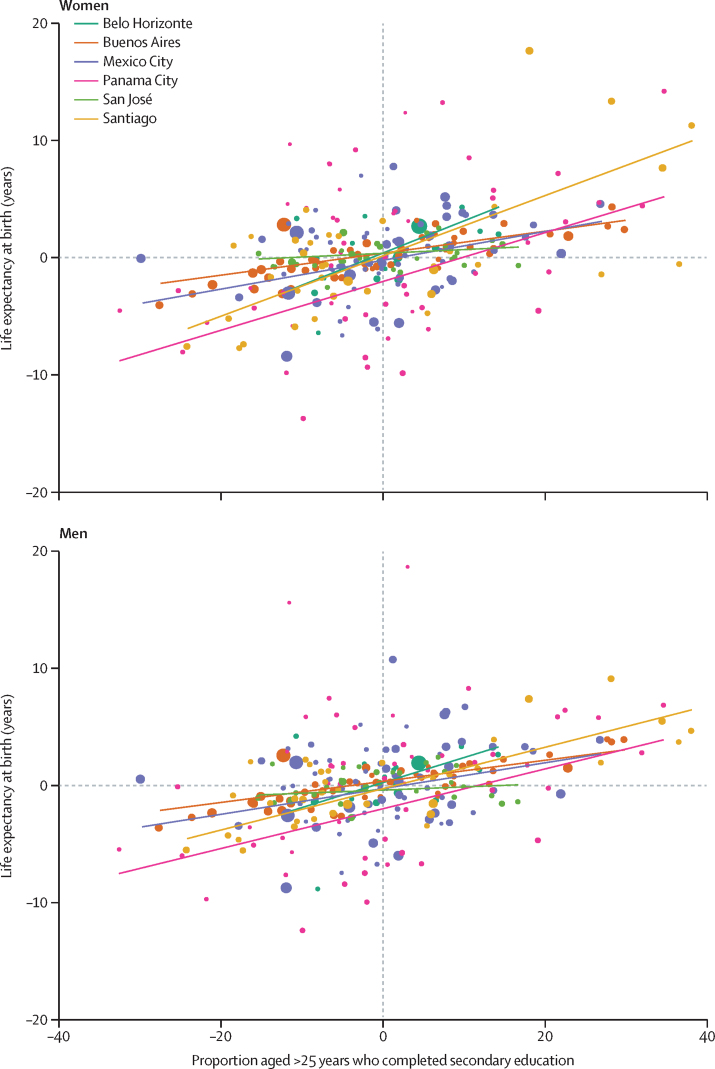
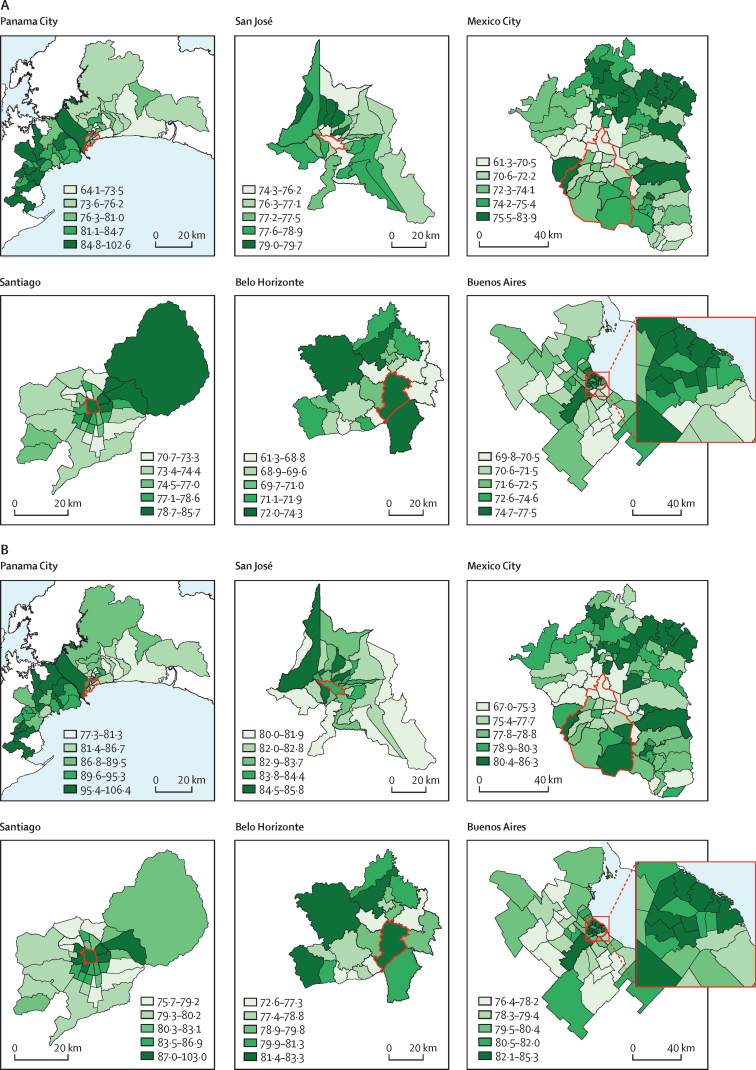
BACKGROUND: Latin America is one of the most unequal regions in the world, but evidence is lacking on the magnitude of health inequalities in urban areas of the region. Our objective was to examine inequalities in life expectancy in six large Latin American cities and its association with a measure of area-level socioeconomic status. METHODS: In this ecological analysis, we used data from the Salud Urbana en America Latina (SALURBAL) study on six large cities in Latin America (Buenos Aires, Argentina; Belo Horizonte, Brazil; Santiago, Chile; San José, Costa Rica; Mexico City, Mexico; and Panama City, Panama), comprising 266 subcity units, for the period 2011-15 (expect for Panama city, which was for 2012-16). We calculated average life expectancy at birth by sex and subcity unit with life tables using age-specific mortality rates estimated from a Bayesian model, and calculated the difference between the ninth and first decile of life expectancy at birth (P90-P10 gap) across subcity units in cities. We also analysed the association between life expectancy at birth and socioeconomic status at the subcity-unit level, using education as a proxy for socioeconomic status, and whether any geographical patterns existed in cities between subcity units. FINDINGS: We found large spatial differences in average life expectancy at birth in Latin American cities, with the largest P90-P10 gaps observed in Panama City (15·0 years for men and 14·7 years for women), Santiago (8·9 years for men and 17·7 years for women), and Mexico City (10·9 years for men and 9·4 years for women), and the narrowest in Buenos Aires (4·4 years for men and 5·8 years for women), Belo Horizonte (4·0 years for men and 6·5 years for women), and San José (3·9 years for men and 3·0 years for women). Higher area-level socioeconomic status was associated with higher life expectancy, especially in Santiago (change in life expectancy per P90-P10 change unit-level of educational attainment 8·0 years [95% CI 5·8-10·3] for men and 11·8 years [7·1-16·4] for women) and Panama City (7·3 years [2·6-12·1] for men and 9·0 years [2·4-15·5] for women). We saw an increase in life expectancy at birth from east to west in Panama City and from north to south in core Mexico City, and a core-periphery divide in Buenos Aires and Santiago. Whereas for San José the central part of the city had the lowest life expectancy and in Belo Horizonte the central part of the city had the highest life expectancy. INTERPRETATION: Large spatial differences in life expectancy in Latin American cities and their association with social factors highlight the importance of area-based approaches and policies that address social inequalities in improving health in cities of the region. FUNDING: Wellcome Trust.
Overview
The claims and statistics of this paper haven’t been checked yet.
Run the check — free, no account needed. It reads the open-access text and checks the sources it cites.
Integrity signals
Registry
Cites
Statistics
Figures
Verification
Claims the paper makes
The claims and statistics of this paper haven’t been checked yet.
Run the check — free, no account needed. It reads the open-access text and checks the sources it cites.
Claims other papers make about this one
Each is checked against this paper’s own text: does it say what the citing paper says it does?
The source backs part of the claim, not all of it — or backs it for a different population, condition or comparison.
In the citing paper
“Although urban areas are generally wealthier than rural areas, wide disparities in socioeconomic status (SES) and segregation into wealthy and poor sub-city units mean that cities contain a microcosm of social gradients – and inequities in health – present in the rest of the country [7–9].”
From Social epidemiology of urban COVID-19 inequalities in Latin America and Canada (2024) · cites this paper as [9]
Experimental — accuracy not yet measuredIn the citing paper
“The lack of association between IFR and SES in the oldest age group can be attributed to a lower life expectancy (23), which is factored into the estimation of SES (see methods for details), and the fact that elderly people might be, in general, healthier enough to survive until that age.”
From Socioeconomic status determines COVID-19 incidence and related mortality in Santiago, Chile (2021) · cites this paper as [23]
Self-check
Percentages, sums and reported differences re-computed from the paper’s own numbers.
The self-check needs the paper’s full text.
Citations
Cites
Multiple Imputation for Nonresponse in Surveys
Rubin, D. B. (1987) · Wiley Series in Probability and Statistics · doi:10.1002/9780470316696 · Cited by 20,701
(2017) · The SHAFR Guide Online · doi:10.1163/2468-1733_shafr_sim010030025 · Cited by 2,357
Demography, Measuring and Modeling Population Processes
Véron, J., Preston, S. H., Heuveline, P., & Guillot, M. (2002) · Population · doi:10.2307/1535065 · Cited by 1,709
Multiple Imputation for Nonresponse in Surveys.
Kershaw, C. D., & Rubin, D. B. (1989) · Biometrics · doi:10.2307/2532070 · Cited by 392
Data Mining for Scientific and Engineering Applications
(2001) · Massive computing · doi:10.1007/978-1-4615-1733-7 · Cited by 280
International Handbook of Adult Mortality
Bonneux, L. G. A., Rogers, R. G., & Crimmins, E. M. (2011) · International handbooks of population · doi:10.1007/978-90-481-9996-9 · Cited by 272
Introduction: Income distribution and economics
Atkinson, A. B., & Bourguignon, F. (2000) · Handbook of income distribution · doi:10.1016/s1574-0056(00)80003-2 · Cited by 268
Educational inequality and intergenerational mobility in Latin America: A new database
Neidhöfer, G., Serrano, J., & Gasparini, L. (2018) · Journal of Development Economics · doi:10.1016/j.jdeveco.2018.05.016 · Cited by 198
Telles, E., Flores, R. D., & Urrea-Giraldo, F. (2015) · Research in Social Stratification and Mobility · doi:10.1016/j.rssm.2015.02.002 · Cited by 167
Building a Data Platform for Cross-Country Urban Health Studies: the SALURBAL Study
the SALURBAL Group, Quistberg, D. A., Roux, A. V. D., Bilal, U., Moore, K., Ortigoza, A. F., Rodrı́guez, D. A., Sarmiento, O. L., Frenz, P., Friche, A. A. D. L., et al. (2018) · Journal of Urban Health · doi:10.1007/s11524-018-00326-0 · Cited by 163
Self-citationEstimating the completeness of death registration: An empirical method
Adair, T., & López, A. D. (2018) · PLoS ONE · doi:10.1371/journal.pone.0197047 · Cited by 120
Roux, A. V. D., Slesinski, S. C., Alazraqui, M., Caiaffa, W. T., Frenz, P., Fuchs, R. J., Miranda, J. J., Rodrı́guez, D. A., Sarmiento, O. L., Siri, J. G., et al. (2018) · Global Challenges · doi:10.1002/gch2.201800013 · Cited by 117
Self-citationDeath distribution methods for estimating adult mortality
Hill, K., You, D., & Choi, Y. (2009) · Demographic Research · doi:10.4054/demres.2009.21.9 · Cited by 91
Rosero‐Bixby, L., & Dow, W. H. (2016) · Proceedings of the National Academy of Sciences · doi:10.1073/pnas.1521917112 · Cited by 60
Inequality, Zika epidemics, and the lack of reproductive rights in Latin America
Vélez, A. C. G., & Diniz, S. G. (2016) · Reproductive Health Matters · doi:10.1016/j.rhm.2016.11.008 · Cited by 58
Dwyer‐Lindgren, L., Stubbs, R. W., Bertozzi-Villa, A., Morozoff, C., Callender, C. S. K. H., Finegold, S., Shirude, S., Flaxman, A. D., Laurent, A. A., Kern, E., et al. (2017) · The Lancet Public Health · doi:10.1016/s2468-2667(17)30165-2 · Cited by 54
Adult Mortality in Latin America and the Caribbean
Palloni, A., & Aguirre, G. P. (2011) · International handbooks of population · doi:10.1007/978-90-481-9996-9_5 · Cited by 53
Intraurban Variations in Adult Mortality in a Large Latin American City
Roux, A. V. D., Franklin, T. G., Alazraqui, M., & Spinelli, H. (2007) · Journal of Urban Health · doi:10.1007/s11524-007-9159-5 · Cited by 52
Self-citationPeralta, A., Benach, J., Borrell, C., Espinel-Flores, V., Cash‐Gibson, L., Queiroz, B. L., & Marí-Dell’Olmo, M. (2019) · Population Health Metrics · doi:10.1186/s12963-019-0183-y · Cited by 47
Spatial Dependence in Data Mining
LeSage, J. P., & Pace, R. K. (2001) · Massive computing · doi:10.1007/978-1-4615-1733-7_24 · Cited by 35
Hunt, B. R., Tran, G., & Whitman, S. (2015) · Journal of Racial and Ethnic Health Disparities · doi:10.1007/s40615-015-0089-8 · Cited by 32
Featured Graphic. Lives on the Line: Mapping Life Expectancy along the London Tube Network
N/A (2012) · Environment and Planning A Economy and Space · doi:10.1068/a45341 · Cited by 31
High life expectancy and reversed socioeconomic gradients of elderly people in Mexico and Costa Rica
Rosero‐Bixby, L. (2018) · Demographic Research · doi:10.4054/demres.2018.38.3 · Cited by 31
US Mayors’ and Health Commissioners’ Opinions About Health Disparities in Their Cities
Purtle, J., Henson, R. M., Carroll‐Scott, A., Kolker, J., Joshi, R., & Roux, A. V. D. (2018) · American Journal of Public Health · doi:10.2105/ajph.2017.304298 · Cited by 30
Jonker, M. F., Congdon, P. D., van Lenthe, F. J., Donkers, B., Burdorf, A., & Mackenbach, J. P. (2013) · Health & Place · doi:10.1016/j.healthplace.2013.04.003 · Cited by 26
Data Resource Profile: IPUMS-International
Jeffers, K., King, M. L., Cleveland, L., & Hall, P. K. (2017) · International Journal of Epidemiology · doi:10.1093/ije/dyw321 · Cited by 9
Los censos y la falacia de la planificación: el caso de Chile
Neupert, R. F. (2017) · Revista Latinoamericana de Población · doi:10.31406/relap2017.v11.i1.n20.5 · Cited by 3
Cited by
Sorted by citations
Socioeconomic status determines COVID-19 incidence and related mortality in Santiago, Chile
Mena, G. E., Martinez, P. P., Mahmud, A. S., Marquet, P. A., Buckee, C. O., & Santillana, M. (2021) · Science · doi:10.1126/science.abg5298 · Cited by 431
Life expectancy and mortality in 363 cities of Latin America
the SALURBAL group, Bilal, U., Hessel, P., Ferrer, C. P., Michael, Y. L., Alfaro, T., Tenorio‐Mucha, J., Friche, A. A. D. L., de Pina, M. D. F., Vives, A., et al. (2021) · Nature Medicine · doi:10.1038/s41591-020-01214-4 · Cited by 288
Self-citationHealthcare for older people in Central and South America
Gutiérrez‐Robledo, L. M., Cano, C. A., & García, E. V. (2022) · Age and Ageing · doi:10.1093/ageing/afac017 · Cited by 202
“Large spatial differences in average life expectancy at birth in our cities exist that illustrate these gaps [11].”
COVID-19 and the worsening of health inequities in Santiago, Chile
Bilal, U., Alfaro, T., & Vives, A. (2021) · International Journal of Epidemiology · doi:10.1093/ije/dyab007 · Cited by 181
“Latin America is also one of the most urbanized and unequal regions in the world, with wide inequities in longevity in its cities.(2) Wide inequities in COVID-19 outcomes have been reported in other settings.”
BackgroundSelf-citationCoelho, L. E., Torres, T. S., Veloso, V. G., Grinsztejn, B. G. J., Jalil, E. M., Wilson, E. C., & McFarland, W. (2021) · AIDS and Behavior · doi:10.1007/s10461-021-03180-5 · Cited by 131
Metadata
- Authors
- Bilal, U., Alazraqui, M., Caiaffa, W. T., Lopez-Olmedo, N., Martinez-Folgar, K., Miranda, J. J., Rodriguez, D. A., Vives, A., & Diez-Roux, A. V.
- Affiliations
- Drexel University (US)
- Universidad Nacional de Lanús (AR)
- Universidade Federal de Minas Gerais (BR)
- Universidad Peruana Cayetano Heredia (PE)
- Pontificia Universidad Católica de Chile (CL)
- Corresponding author
- Bilal, Usama
- Venue
- The Lancet Planetary Health
- Publisher
- Elsevier BV
- Published
- 2019-12
- Volume
- 3
- Issue
- 12
- Pages
- e503-e510
- ISSN
- 2542-5196 (ISSN-L)
- PMC
- PMC6926471
- OpenAlex
- W2994707839
- Cited by
- 153
- References
- 27
- Citations by year
- 2026: 11 · 2025: 18 · 2024: 22 · 2023: 24 · 2022: 23 · 2021: 45 · 2020: 8 · 2019: 2
- FWCI
- 18.94
- Type
- journal article
- Language
- en
- Update notices
- erratum (2020-01-01)
- Open access
- gold
- doi.org
- Licence
- Locations
- The Lancet Planetary Health (publishedVersion, cc-by)
- PubMed Central (publishedVersion, cc-by)
- PubMed (publishedVersion)
- LSHTM Research Online (London School of Hygiene and Tropical Medicine) (acceptedVersion)
- Florida International University Digital Commons (Florida International University) (submittedVersion, cc-by)
- DOAJ (DOAJ: Directory of Open Access Journals) (submittedVersion, cc-by-sa)
- Funders
- National Institutes of Health (DP5OD26429)
- Wellcome Trust (205177/Z/16/Z)
- Topics
- Social Sciences › Health › Health disparities and outcomes
- Social Sciences › Health › Public Health and Social Inequalities
- Social Sciences › Demography › Insurance, Mortality, Demography, Risk Management
- Keywords
- life expectancy, health disparities, urban health, area-level socioeconomic status, educational attainment, regional variation in mortality, Latin American cities, sex differences in longevity, life tables, Panama City, Santiago, Mexico City, Buenos Aires, Belo Horizonte
- MeSH terms
- Adolescent, Adult, Aged, Argentina, Brazil, Child, Child, Preschool, Chile, Cities, Costa Rica, Female, Humans, Infant, Infant, Newborn, Life Expectancy, Male, Mexico, Middle Aged, Panama, Socioeconomic Factors, Young Adult
About these checks
Registry, retraction, Cites and statistics results are computed, not judged, with one exception: a printed reference that no index lists is read once by a model before it counts as a citation error. Claims are extracted by a model and kept only when their quote appears verbatim in the text; each cited source is then checked, with a model’s help, for whether it says what the claim relies on. Those verdicts can be wrong — read the claim’s quote and the cited source before relying on one.
Statistics and arithmetic are recomputed, not judged.
Confidence bands are shown only for fields calibrated on our annotated test set. None is calibrated yet, so no band is shown.
What counts as a claim ›How we measure confidence ›How we check this ›
Are you an author, or do you see a problem with this page? Request a review
