

The DOI matches its Crossref record; 27 of the 27 references it cites were found in a registry or an index.
Inequalities in life expectancy in six large Latin American cities from the SALURBAL study: an ecological analysis
Open accessAbstract
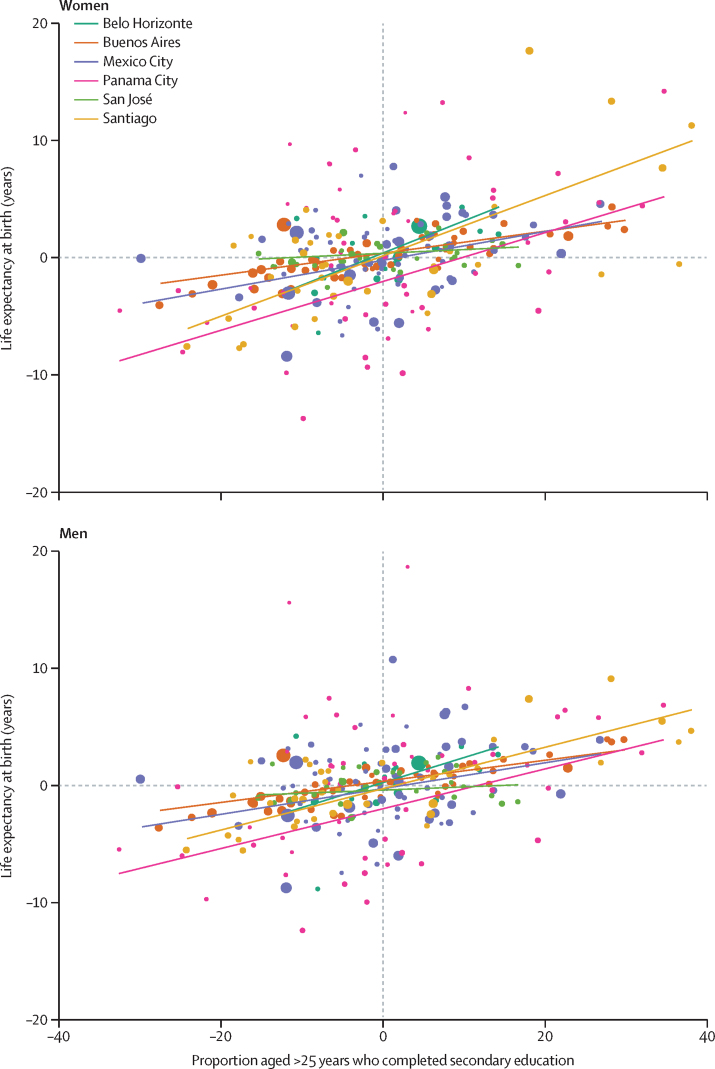
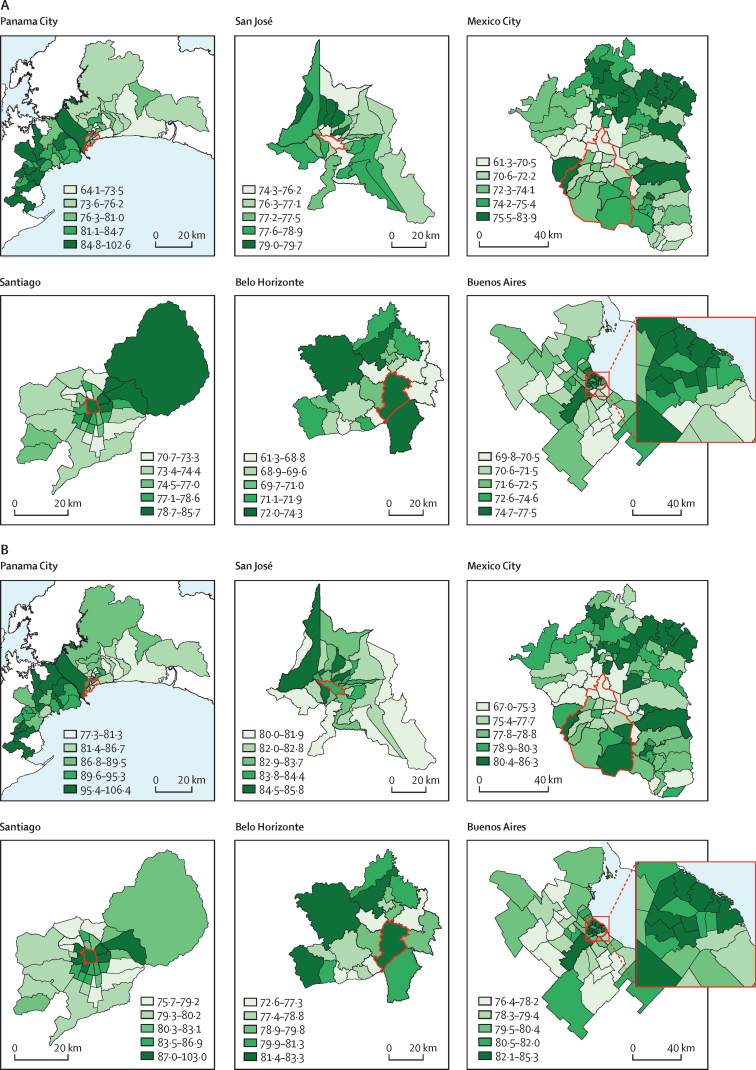
BACKGROUND: Latin America is one of the most unequal regions in the world, but evidence is lacking on the magnitude of health inequalities in urban areas of the region. Our objective was to examine inequalities in life expectancy in six large Latin American cities and its association with a measure of area-level socioeconomic status. METHODS: In this ecological analysis, we used data from the Salud Urbana en America Latina (SALURBAL) study on six large cities in Latin America (Buenos Aires, Argentina; Belo Horizonte, Brazil; Santiago, Chile; San José, Costa Rica; Mexico City, Mexico; and Panama City, Panama), comprising 266 subcity units, for the period 2011-15 (expect for Panama city, which was for 2012-16). We calculated average life expectancy at birth by sex and subcity unit with life tables using age-specific mortality rates estimated from a Bayesian model, and calculated the difference between the ninth and first decile of life expectancy at birth (P90-P10 gap) across subcity units in cities. We also analysed the association between life expectancy at birth and socioeconomic status at the subcity-unit level, using education as a proxy for socioeconomic status, and whether any geographical patterns existed in cities between subcity units. FINDINGS: We found large spatial differences in average life expectancy at birth in Latin American cities, with the largest P90-P10 gaps observed in Panama City (15·0 years for men and 14·7 years for women), Santiago (8·9 years for men and 17·7 years for women), and Mexico City (10·9 years for men and 9·4 years for women), and the narrowest in Buenos Aires (4·4 years for men and 5·8 years for women), Belo Horizonte (4·0 years for men and 6·5 years for women), and San José (3·9 years for men and 3·0 years for women). Higher area-level socioeconomic status was associated with higher life expectancy, especially in Santiago (change in life expectancy per P90-P10 change unit-level of educational attainment 8·0 years [95% CI 5·8-10·3] for men and 11·8 years [7·1-16·4] for women) and Panama City (7·3 years [2·6-12·1] for men and 9·0 years [2·4-15·5] for women). We saw an increase in life expectancy at birth from east to west in Panama City and from north to south in core Mexico City, and a core-periphery divide in Buenos Aires and Santiago. Whereas for San José the central part of the city had the lowest life expectancy and in Belo Horizonte the central part of the city had the highest life expectancy. INTERPRETATION: Large spatial differences in life expectancy in Latin American cities and their association with social factors highlight the importance of area-based approaches and policies that address social inequalities in improving health in cities of the region. FUNDING: Wellcome Trust.
Overview
The claims and statistics of this paper haven’t been checked yet.
Run the check — free, no account needed. It reads the open-access text and checks the sources it cites.
Integrity signals
Registry
Cites
Statistics
Figures
Verification
Claims the paper makes
The claims and statistics of this paper haven’t been checked yet.
Run the check — free, no account needed. It reads the open-access text and checks the sources it cites.
Claims other papers make about this one
Each is checked against this paper’s own text: does it say what the citing paper says it does?
The source backs part of the claim, not all of it — or backs it for a different population, condition or comparison.
In the citing paper
“Although urban areas are generally wealthier than rural areas, wide disparities in socioeconomic status (SES) and segregation into wealthy and poor sub-city units mean that cities contain a microcosm of social gradients – and inequities in health – present in the rest of the country [7–9].”
From Social epidemiology of urban COVID-19 inequalities in Latin America and Canada (2024) · cites this paper as [9]
Experimental — accuracy not yet measuredIn the citing paper
“The lack of association between IFR and SES in the oldest age group can be attributed to a lower life expectancy (23), which is factored into the estimation of SES (see methods for details), and the fact that elderly people might be, in general, healthier enough to survive until that age.”
From Socioeconomic status determines COVID-19 incidence and related mortality in Santiago, Chile (2021) · cites this paper as [23]
Self-check
Percentages, sums and reported differences re-computed from the paper’s own numbers.
The self-check needs the paper’s full text.
Citations
Cites
Multiple Imputation for Nonresponse in Surveys
Rubin, D. B. (1987) · Wiley Series in Probability and Statistics · doi:10.1002/9780470316696 · Cited by 20,701
(2017) · The SHAFR Guide Online · doi:10.1163/2468-1733_shafr_sim010030025 · Cited by 2,357
Demography, Measuring and Modeling Population Processes
Véron, J., Preston, S. H., Heuveline, P., & Guillot, M. (2002) · Population · doi:10.2307/1535065 · Cited by 1,709
Multiple Imputation for Nonresponse in Surveys.
Kershaw, C. D., & Rubin, D. B. (1989) · Biometrics · doi:10.2307/2532070 · Cited by 392
Data Mining for Scientific and Engineering Applications
(2001) · Massive computing · doi:10.1007/978-1-4615-1733-7 · Cited by 280
International Handbook of Adult Mortality
Bonneux, L. G. A., Rogers, R. G., & Crimmins, E. M. (2011) · International handbooks of population · doi:10.1007/978-90-481-9996-9 · Cited by 272
Introduction: Income distribution and economics
Atkinson, A. B., & Bourguignon, F. (2000) · Handbook of income distribution · doi:10.1016/s1574-0056(00)80003-2 · Cited by 268
Educational inequality and intergenerational mobility in Latin America: A new database
Neidhöfer, G., Serrano, J., & Gasparini, L. (2018) · Journal of Development Economics · doi:10.1016/j.jdeveco.2018.05.016 · Cited by 198
Telles, E., Flores, R. D., & Urrea-Giraldo, F. (2015) · Research in Social Stratification and Mobility · doi:10.1016/j.rssm.2015.02.002 · Cited by 167
Building a Data Platform for Cross-Country Urban Health Studies: the SALURBAL Study
the SALURBAL Group, Quistberg, D. A., Roux, A. V. D., Bilal, U., Moore, K., Ortigoza, A. F., Rodrı́guez, D. A., Sarmiento, O. L., Frenz, P., Friche, A. A. D. L., et al. (2018) · Journal of Urban Health · doi:10.1007/s11524-018-00326-0 · Cited by 163
Self-citation
Cited by
Sorted by citations
Socioeconomic status determines COVID-19 incidence and related mortality in Santiago, Chile
Mena, G. E., Martinez, P. P., Mahmud, A. S., Marquet, P. A., Buckee, C. O., & Santillana, M. (2021) · Science · doi:10.1126/science.abg5298 · Cited by 431
Life expectancy and mortality in 363 cities of Latin America
the SALURBAL group, Bilal, U., Hessel, P., Ferrer, C. P., Michael, Y. L., Alfaro, T., Tenorio‐Mucha, J., Friche, A. A. D. L., de Pina, M. D. F., Vives, A., et al. (2021) · Nature Medicine · doi:10.1038/s41591-020-01214-4 · Cited by 288
Self-citationHealthcare for older people in Central and South America
Gutiérrez‐Robledo, L. M., Cano, C. A., & García, E. V. (2022) · Age and Ageing · doi:10.1093/ageing/afac017 · Cited by 202
“Large spatial differences in average life expectancy at birth in our cities exist that illustrate these gaps [11].”
COVID-19 and the worsening of health inequities in Santiago, Chile
Bilal, U., Alfaro, T., & Vives, A. (2021) · International Journal of Epidemiology · doi:10.1093/ije/dyab007 · Cited by 181
“Latin America is also one of the most urbanized and unequal regions in the world, with wide inequities in longevity in its cities.(2) Wide inequities in COVID-19 outcomes have been reported in other settings.”
BackgroundSelf-citationCoelho, L. E., Torres, T. S., Veloso, V. G., Grinsztejn, B. G. J., Jalil, E. M., Wilson, E. C., & McFarland, W. (2021) · AIDS and Behavior · doi:10.1007/s10461-021-03180-5 · Cited by 131
Torres, T. S., Hoagland, B., Bezerra, D. R. B., Garner, A., Jalil, E. M., Coelho, L. E., Benedetti, M., Pimenta, C., Grinsztejn, B. G. J., & Veloso, V. G. (2020) · AIDS and Behavior · doi:10.1007/s10461-020-02984-1 · Cited by 124
Perception of the built environment and walking in pericentral neighbourhoods in Santiago, Chile
Herrmann‐Lunecke, M. G., Mora, R., & Salgado, P. V. (2021) · Travel Behaviour and Society · doi:10.1016/j.tbs.2021.01.002 · Cited by 120
Veloso, V. G., Cáceres, C. F., Hoagland, B., Moreira, R. I., Vega-Ramírez, H., Konda, K. A., Leite, I. C., Bautista-Arredondo, S. A., Lacerda, M., Madruga, J. V., et al. (2022) · The Lancet HIV · doi:10.1016/s2352-3018(22)00331-9 · Cited by 86
van de Vijver, S. J. M., Tensen, P., Asiki, G., Requena‐Méndez, A., Heidenrijk, M., Stronks, K., Cobelens, F. G. J., Bont, J., & Agyemang, C. O. (2023) · Digital Health · doi:10.1177/20552076231185434 · Cited by 92
“7 and 30 years, respectively.(42,43) Therefore, several cities have committed to minimizing health inequalities and ensuring that every citizen reaches their health potential, in part through the support of digital health.”
BackgroundSmiley, C., Rebeiro, P. F., César, C., Belaunzarán-Zamudio, P. F., Crabtree‐Ramírez, B., Padgett, D., Gotuzzo, E., Cortés, C. P., Pape, J. W., Veloso, V. G., et al. (2021) · The Lancet HIV · doi:10.1016/s2352-3018(20)30358-1 · Cited by 75
Antonio‐Villa, N. E., Fernández‐Chirino, L., Pisanty-Alatorre, J., Mancilla-Galindo, J., Kammar‐García, A., Vargas‐Vázquez, A., González-Díaz, A., Fermín‐Martínez, C. A., Márquez‐Salinas, A., Guerra, E. C., et al. (2021) · Clinical Infectious Diseases · doi:10.1093/cid/ciab577 · Cited by 70
Torres, T. S., Teixeira, S. L. M., Hoagland, B., Konda, K. A., Derrico, M., Moreira, R. I., Guanira, J. V., Benedetti, M., Nazer, S., Calvo, G., et al. (2023) · The Lancet Regional Health - Americas · doi:10.1016/j.lana.2023.100642 · Cited by 61
“34 SGM are exposed to homo-phobia and transphobia, being further impacted by intersectional discrimination related to racism and classism.”
BackgroundQuistberg, D. A., Hessel, P., Rodrı́guez, D. A., Sarmiento, O. L., Bilal, U., Caiaffa, W. T., Miranda, J. J., de Pina, M. D. F., Hernández‐Vásquez, A., & Roux, A. V. D. (2022) · The Lancet Planetary Health · doi:10.1016/s2542-5196(21)00323-5 · Cited by 52
Self-citationVecchio, G., Tiznado-Aitken, I., & Mora, R. (2021) · Case Studies on Transport Policy · doi:10.1016/j.cstp.2021.10.002 · Cited by 49
Ortigoza, A. F., Granados, J. A. T., Miranda, J. J., Alazraqui, M., Higuera-Mendieta, D. R., Villamonte, G., Friche, A. A. D. L., Gutiérrez, T. B., & Roux, A. V. D. (2020) · Journal of Epidemiology & Community Health · doi:10.1136/jech-2020-215137 · Cited by 48
Self-citationMoran, M. R., Bilal, U., Dronova, I., Ju, Y., Gouveia, N., Caiaffa, W. T., Friche, A. A. D. L., Moore, K., Miranda, J. J., & Rodrı́guez, D. A. (2021) · Health & Place · doi:10.1016/j.healthplace.2021.102703 · Cited by 47
“However, this limitation might be less severe given prior studies from the same databased as ours that showed consistent associations between education and mortality in Latin American cities (Bilal et al., 2021; Bilal et al., 2019).”
ResultSelf-citationVecchio, G., Tiznado-Aitken, I., Castillo, B., & Steiniger, S. (2022) · Transportation · doi:10.1007/s11116-022-10346-0 · Cited by 36
“Moreover, they are characterised by significant socioeconomic inequalities, which determine remarkable differences in their life expectancy even within the same city (Bilal et al. 2019).”
Czepielewski, L. S., Alliende, L. M., Castañeda, C. P., Castro, M. N., Guinjoan, S. M., Massuda, R., Berberian, A. D. A., Fonseca, A. O., Gadelha, A., Bressan, R. A., et al. (2021) · Psychological Medicine · doi:10.1017/s0033291721002403 · Cited by 38
Aging in Latin America and the Caribbean: social protection and quality of life of older persons
Aranco, N., Bosch, M., Stampini, M., Herrera, O. A., Goyeneche, L., Ibarrarán, P., Oliveira, D., Torre, M. R. R., Savedoff, W. D., & Ramirez, E. T. (2022) · Inter-American Development Bank eBooks · doi:10.18235/0004287 · Cited by 50
Moreno, X., Lera, L., & Cecilia Albala, B. (2020) · PLoS ONE · doi:10.1371/journal.pone.0232445 · Cited by 35
“7 years for women in LE at birth, between the most deprived and the least deprived areas of Santiago, the capital city of Chile [65].”
BackgroundVecchio, G., Castillo, B., & Steiniger, S. (2020) · Revista de Urbanismo · doi:10.5354/0717-5051.2020.57090 · Cited by 34
Health inequalities in Latin America: persistent gaps in life expectancy
Dávila-Cervantes, C. A., & Agudelo‐Botero, M. (2019) · The Lancet Planetary Health · doi:10.1016/s2542-5196(19)30244-x · Cited by 33
Social disparities in neighborhood flood exposure in 44,698 urban neighborhoods in Latin America
Kephart, J. L., Bilal, U., Gouveia, N., Sarmiento, O. L., Shingara, E., Rangel-Moreno, K., Bakhtsiyarava, M., Rodriguez, J. P., Ayala, S., Carrasco‐Escobar, G., et al. (2025) · Nature Cities · doi:10.1038/s44284-025-00203-3 · Cited by 32
“However, other facets of neighborhood SES, as well as Includes cities in the countries of Costa Rica ( n = 1 city), Guatemala ( n = 1) and Panama ( n = 3).”
InfluentialSelf-citationMoreno, H., Lera, L., Moreno, F. G., & Cecilia Albala, B. (2021) · BMC Geriatrics · doi:10.1186/s12877-021-02126-9 · Cited by 32
Braverman‐Bronstein, A., Hessel, P., González-Uribe, C., Kroker, M. F., Diez‐Canseco, F., Langellier, B. A., Lucumí, D., Rodríguez, L., Trotta, A., & Roux, A. V. D. (2021) · Journal of Epidemiology & Community Health · doi:10.1136/jech-2020-216116 · Cited by 29
“…have higher incomes, better infrastructure (including housing), and higher proportion of people with higher education levels may also paradoxically exhibit greater educational inequalities in chronic disease risk, 18 19 because beneficial resources and environments may be unequally distributed.”
Urban health and health equity in Latin American cities: what COVID-19 is teaching us
Roux, A. V. D., Barrientos‐Gutiérrez, T., Caiaffa, W. T., Miranda, J. J., Rodrı́guez, D. A., Sarmiento, O. L., Slesinski, S. C., & Vives, A. (2020) · Cities & Health · doi:10.1080/23748834.2020.1809788 · Cited by 28
“Latin American cities are also characterized by large health inequities, as recently illustrated by the SALURBAL study which documented significant inequities in life expectancy within cities (Bilal et al. 2019).”
BackgroundSelf-citationTorres, T. S., Coelho, L. E., Konda, K. A., Vega-Ramírez, H., Reyes, O. A. E., Díaz-Sosa, D. M., Hoagland, B., Pimenta, C., Benedetti, M., Grinsztejn, B. G. J., et al. (2021) · BMC Infectious Diseases · doi:10.1186/s12879-021-06455-3 · Cited by 25
“comes [5] and studies to understand these disparities are of utmost importance in the region.”
BackgroundWang, S., Ren, Z., Liu, X., & Yin, Q. (2021) · Social Science & Medicine · doi:10.1016/j.socscimed.2021.114660 · Cited by 25
Alfaro, T., Martínez-Folgar, K., Vives, A., & Bilal, U. (2022) · Journal of Urban Health · doi:10.1007/s11524-022-00658-y · Cited by 25
“Chile is a country with very wide inequalities [64], including health inequalities [28, 65].”
BackgroundResultSelf-citationMena, G. E., & Aburto, J. M. (2022) · BMJ Open · doi:10.1136/bmjopen-2021-059201 · Cited by 25
Baeza, F., Vives, A., González, F., Orlando, L., Valdebenito, R., Cortínez-O’Ryan, A., Slesinski, S. C., & Roux, A. V. D. (2021) · BMC Public Health · doi:10.1186/s12889-021-10739-3 · Cited by 24
“As a result of segregation, both individual-level socioeconomic characteristics and health are spatially clustered, and substantial differences across neighborhoods emerge, such as major inequalities in life expectancy [26, 27].”
BackgroundSelf-citationMullachery, P. H., Rodrı́guez, D. A., Miranda, J. J., López‐Olmedo, N., Martínez-Folgar, K., Barreto, M. L., Roux, A. V. D., & Bilal, U. (2021) · International Journal of Epidemiology · doi:10.1093/ije/dyab137 · Cited by 23
“defined as the percentage of the total land area that is covered by urban patches.(29) This adjustment was done to ac-”
Self-citationBilal, U., McCulley, E. M., Li, R., Rollins, H., Schnake-Mahl, A. S., Mullachery, P. H., Vaidya, V., Koh, C., Dureja, K., Sharaf, A., et al. (2022) · American Journal of Public Health · doi:10.2105/ajph.2021.306708 · Cited by 22
Self-citationLinking Urban Sprawl and Surface Urban Heat Island in the Teresina–Timon Conurbation Area in Brazil
Carneiro, E. L. N. D. C., Lopes, W. G. R., & de Espíndola, G. M. (2021) · Land · doi:10.3390/land10050516 · Cited by 21
“In addition to the urban sprawl’s adverse effects on the environment, it is also crucial to discuss and investigate the social impacts of sprawling cities on segregation and housing availability [14,15].”
Backgrounddos Santos, M. I., dos Santos, G. F., Freitas, A., Filho, J. F. D. S., de Castro, C. P., Paiva, A. S. S., Friche, A. A. D. L., Barber, S., Caiaffa, W. T., & Barreto, M. L. (2021) · SSM - Population Health · doi:10.1016/j.ssmph.2021.100819 · Cited by 21
Self-citationLópez-Contreras, N., Puig‐Barrachina, V., Vives, A., Olave-Müller, P., & Gotsens, M. (2021) · Health & Place · doi:10.1016/j.healthplace.2021.102511 · Cited by 20
Self-citationAburto, M. J., Romero, D., Rezende, L. F. M., Sanchez, Z. M., Bolados, C. C., Guzman-Habinger, J. M., Rios, M., Suárez‐Reyes, M., Marques, A., Drenowatz, C. J., et al. (2021) · Scientific Reports · doi:10.1038/s41598-021-01167-9 · Cited by 20
Severino, R., Espinoza, M., & Cabieses, B., V (2022) · International Journal for Equity in Health · doi:10.1186/s12939-022-01770-w · Cited by 20
“7 years for women, with worse results in the most vulnerable sectors [12].”
BackgroundWomen’s empowerment and infant mortality in Latin America: evidence from 286 cities
Ortigoza, A. F., Braverman‐Bronstein, A., Hessel, P., Cecco, V. D., Friche, A. A. D. L., Caiaffa, W. T., & Roux, A. V. D. (2021) · Cities & Health · doi:10.1080/23748834.2021.1908794 · Cited by 20
“%) based on a separate analysis of adult mortality (Bilal et al .”
Self-citationEducational and social inequalities and cause-specific mortality in Mexico City: a prospective study
Addey, T., Alegre-Díaz, J., Bragg, F., Trichia, E., Wade, R. L., Santacruz-Benítez, R., Ramírez-Reyes, R., Garcilazo‐Ávila, A., Gonzáles-Carballo, C., Bello‐Chavolla, O. Y., et al. (2023) · The Lancet Public Health · doi:10.1016/s2468-2667(23)00153-6 · Cited by 19
Building a Methodological Foundation for Impactful Urban Planetary Health Science
Pineo, H., Audia, C., Black, D., French, M., Gemmell, E., Lovasi, G. S., Milner, J., Montes, F., Niu, Y., Ferrer, C. P., et al. (2020) · Journal of Urban Health · doi:10.1007/s11524-020-00463-5 · Cited by 19
Prieto-Flores, M.-E., & Rosenberg, M. W. (2021) · International Journal of Environmental Research and Public Health · doi:10.3390/ijerph182412984 · Cited by 21
“In Latin America, the characteristics of the physical and social environment of the cities contribute in many cases to increase the vulnerability of older people, and governmental solutions are often insufficient and far from the needs of this population [24].”
BackgroundInfluentialBezerra, D. R. B., Jalil, C. M., Jalil, E. M., Coelho, L. E., Netto, E. C., Freitas, J., Monteiro, L., Santos, T., Souza, C., Hoagland, B., et al. (2022) · AIDS and Behavior · doi:10.1007/s10461-022-03609-5 · Cited by 17
“These deep social inequalities have great consequences for health access, use, and outcomes [19], including increased HIV risk and inadequate HIV care [20].”
BackgroundThe shifting rural–urban gap in mortality over the life course in low- and middle-income countries
Menashe‐Oren, A., & Masquelier, B. (2022) · Population Studies · doi:10.1080/00324728.2021.2020326 · Cited by 17
Heterogeneity in Disparities in Life Expectancy Across US Metropolitan Areas
Schnake-Mahl, A. S., Mullachery, P. H., Purtle, J., Li, R., Roux, A. V. D., & Bilal, U. (2022) · Epidemiology · doi:10.1097/ede.0000000000001537 · Cited by 14
Self-citationEducational inequalities and premature mortality: the Cuba Prospective Study
Ross, S., Rojas, N. B. A., Sawatzky, J., Varona-Pérez, P., Burrett, J. A., Martínez, M. C., Lorenzo-Vázquez, E., Constantén, S. B., Sherliker, P., Rigau, J. M. M., et al. (2022) · The Lancet Public Health · doi:10.1016/s2468-2667(22)00237-7 · Cited by 14
Sobrepeso y obesidad en Chile: Consideraciones para su abordaje en un contexto de inequidad social
Thomas-Lange, J. (2023) · Revista chilena de nutrición · doi:10.4067/s0717-75182023000400457 · Cited by 14
Alvarez, A., Bagshaw, S. M., Biccard, B. M., Boccalatte, L. A., Borunda, D., Calvache, J. A., Carmona, M. J. C., Castillo-Huerta, N. M., Charles, S., Medina, A. R. D.-L., et al. (2025) · The Lancet Global Health · doi:10.1016/s2214-109x(24)00558-8 · Cited by 14
COVID-19, Ambient Air Pollution, and Environmental Health Inequities in Latin American Cities
Kephart, J. L., Ávila-Palència, I., Bilal, U., Gouveia, N., Caiaffa, W. T., & Roux, A. V. D. (2021) · Journal of Urban Health · doi:10.1007/s11524-020-00509-8 · Cited by 13
Self-citationHealth disparities in Russia at the regional and global scales
Shartova, N. V., Tikunov, V. S., & Chereshnia, O. Y. (2021) · International Journal for Equity in Health · doi:10.1186/s12939-021-01502-6 · Cited by 13
“Large spatial differences in life expectancy at birth were found in Latin American cities, including the capitals – Panama City, Santiago, Mexico City and Buenos Aires [15].”
BackgroundDelclòs‐Alió, X., Rodrı́guez, D. A., Olmedo, N. L., Ferrer, C. P., Moore, K., Stern, D., de Menezes, M. C., Cardoso, L. D. O., Wang, X., Guimarães, J. M. N., et al. (2022) · Cities · doi:10.1016/j.cities.2022.103899 · Cited by 13
Self-citationWei, J., Huang, H., & Fan, L. (2025) · Scientific Reports · doi:10.1038/s41598-025-94259-9 · Cited by 12
“Additionally, social factors related to health, such as insufficient sexual health education and the cultural stigma surrounding infertility, also aggravate the situation 49,50 .”
Agudelo‐Botero, M., Dávila-Cervantes, C. A., Velasco-Calderón, O., & Giraldo‐Rodríguez, L. (2023) · PLoS ONE · doi:10.1371/journal.pone.0293881 · Cited by 12
Heggeness, M. L., & León, A. S. (2025) · Review of Economics of the Household · doi:10.1007/s11150-025-09766-5 · Cited by 11
“Segregation prevails in urban centers and has been linked to shifts in human capital and life expectancy before and during the pandemic (Bilal et al., 2019; Garreton, Basauri and Valenzuela, 2020; Mena et al., 2021).”
Bezerra, D. R. B., Jalil, C. M., Jalil, E. M., Coelho, L. E., Netto, E. C., Freitas, J., Monteiro, L., Santos, T., Souza, C., Hoagland, B., et al. (2022) · JMIR Formative Research · doi:10.2196/33309 · Cited by 11
“These social inequalities have great consequences for health access [7], including inadequate HIV care and prevention [8], which were intensified after the onset of the COVID-19 pandemic [9].”
BackgroundGómez-Ugarte, A. C., & García-Guerrero, V. M. (2023) · Population Research and Policy Review · doi:10.1007/s11113-023-09806-x · Cited by 12
“Existing studies of the relation between mortality and socioeconomic disparities in Latin America have limited their analyses to average indicators, such as LE or to ecological analysis using area-level socioeconomic status (Bilal et al., 2019; Fantin et al., 2023; Mena & Aburto, 2022).”
BackgroundTranslation and validation in Brazilian Portuguese of the reactions to homosexuality scale
Torres, T. S., Luz, P. M., Bezerra, D. R. B., Almeida-Brasil, C. C., Marins, L. M. S., Veloso, V. G., Grinsztejn, B. G. J., Harel, D., & Thombs, B. D. (2021) · Psychology Health & Medicine · doi:10.1080/13548506.2021.1936580 · Cited by 10
Torres, T. S., Luz, P. M., Coelho, L. E., Jalil, C. M., Falco, G. G., Sousa, L. P., Jalil, E. M., Bezerra, D. R. B., Cardoso, S. W., Hoagland, B., et al. (2021) · The Brazilian Journal of Infectious Diseases · doi:10.1016/j.bjid.2021.101600 · Cited by 11
Planning for health equity in the Americas: an analysis of national health plans
Kavanagh, M. M., Norato, L. F., Friedman, E., & Armbrister, A. N. (2021) · Revista Panamericana de Salud Pública · doi:10.26633/rpsp.2021.29 · Cited by 10
Rosário, E., Severo, M., Francisco, D., Brito, M., & Costa, D. (2021) · BMC Public Health · doi:10.1186/s12889-021-11003-4 · Cited by 12
“Overcrowding conditions were considered when there were more than three people per room [47].”
BackgroundYu, J., Dwyer‐Lindgren, L., Bennett, J. E., Ezzati, M., Gustafson, P., Tran, M., & Brauer, M. D. (2021) · Health & Place · doi:10.1016/j.healthplace.2021.102692 · Cited by 10
“These results on wide intra-urban gaps in Metro Vancouver, along with previously reported studies in the USA (12,39), UK (17,18), Netherlands (22), and Latin America (21), can be combined with spatially varying data on built environment, socioeconomic and municipal services to evaluate mechanisms underlying these obse…”
InfluentialSocioeconomic inequities of COVID-19 mortality in vulnerable Comunas of the City of Buenos Aires
Marconi, A., Salgado, C. C., Sarrouf, E. B., Zamora, R. J., Irurzun, A. M., & Islam, N. (2023) · Scientific Reports · doi:10.1038/s41598-023-40911-1 · Cited by 9
López, S. R., Tumas, N., Bilal, U., Moore, K., Acharya, B., Quick, H. S., Quistberg, D. A., Acevedo, G. E., & Roux, A. V. D. (2022) · BMJ Open · doi:10.1136/bmjopen-2022-061277 · Cited by 9
“These within-cities heterogeneity that are likely present or emerging in many small-sized and middle-sized cities all over the world are of major relevance for urban policies to promote health and achieve health equity in low-income and middle-income countries.”
InfluentialSelf-citationThe need for data describing the surgical population in Latin America
Stefani, L. P. C., Hajjar, L. A., Biccard, B. M., & Pearse, R. M. (2022) · British Journal of Anaesthesia · doi:10.1016/j.bja.2022.02.029 · Cited by 9
Wei, L., Jia, H., Geng, Y., Dou, Z., Zhao, D., Gan, X., & Zhao, Y. (2025) · China CDC Weekly · doi:10.46234/ccdcw2025.136 · Cited by 8
Advancing equitable and sustainable urban health
Roux, A. V. D., & Bilal, U. (2025) · Nature Medicine · doi:10.1038/s41591-025-04031-9 · Cited by 11
Self-citationSpatial Inequities in Life Expectancy in Small Areas of Buenos Aires, Argentina 2015–2017
Trotta, A., Bilal, U., Acharya, B., Quick, H. S., Moore, K., Perner, M. S., Alazraqui, M., & Roux, A. V. D. (2023) · Journal of Urban Health · doi:10.1007/s11524-023-00730-1 · Cited by 8
“The median of the posterior distribution of LE at birth serves as the point estimate of LE, while the 2.5th and 97.5th percentiles of the posterior distribution of LE serve as the lower and upper credible intervals, respectively”
InfluentialSelf-citationCosta, A. C. D. O., Ramos, D. D. O., & Paes-Sousa, R. (2024) · Ciência & Saúde Coletiva · doi:10.1590/1413-81232024298.19602022 · Cited by 7
Urban Environments, Health, and Environmental Sustainability: Findings From the SALURBAL Study
Roux, A. V. D., Alazraqui, M., Alfaro, T., Barrientos‐Gutiérrez, T., Caiaffa, W. T., Kroker-Lobos, M. F., Miranda, J. J., Rodrı́guez, D. A., Sarmiento, O. L., Vives, A., et al. (2024) · Journal of Urban Health · doi:10.1007/s11524-024-00932-1 · Cited by 7
Self-citationElderly Walking Access to Street Markets in Chile: An Asset for Food Security in an Unequal Country
Vecchio, G., Castillo, B., Rodrigo Villegas, R., Rojas, C., Steiniger, S., & Carrasco, J. A. (2023) · Sustainability · doi:10.3390/su15053893 · Cited by 7
Health inequalities in a middle-income country: a systematic review of the Costa Rican case
Barboza‐Solís, C., Herrero, R., & Fantin, R. (2024) · Frontiers in Public Health · doi:10.3389/fpubh.2024.1397576 · Cited by 7
“For instance, Bilal et al. (12) described geographical disparities but did not find a significant link between ecological socioeconomic level and life expectancy.”
BackgroundHealth inequalities in cause-specific mortality in Costa Rica: a population-based cohort study
Fantin, R., Delpierre, C., & Barboza‐Solís, C. (2023) · Revista de Saúde Pública · doi:10.11606/s1518-8787.2023057004331 · Cited by 7
Analysis of Latin American Theme Parks in a Tourism Context
Florido‐Benítez, L. (2024) · Tourism and Hospitality · doi:10.3390/tourhosp5010009 · Cited by 6
“Latin America is one of the most unequal regions in the world in terms of income and social inequalities relating to gender, education, race and indigenous origin [64].”
BackgroundGullón, P., Bilal, U., Sánchez, P., Díez, J., Lovasi, G. S., & Franco, M. (2020) · Cities & Health · doi:10.1080/23748834.2020.1715117 · Cited by 6
“[39] In fact, following Geoffrey Rose’s population approach, comparing cities could uncover relationships that were non-significant in previous studies as all populations lived under the same mass influence.”
Self-citationFantin, R., Delpierre, C., Kelly‐Irving, M., & Barboza‐Solís, C. (2021) · Odovtos - International Journal of Dental Sciences · doi:10.15517/ijds.2021.46128 · Cited by 6
“In Latin America, a recent study using an ecological approach showed that higher area-level socioeconomic position was associated with higher life expectancy, especially in Santiago (Chile) and Panama City (Panama) (11).”
BackgroundVecchio, G. (2022) · REGION · doi:10.18335/region.v9i2.390 · Cited by 6
“For example, in Latin America, more attention has been given to issues such as life expectancy, pensions and welfare services (Bilal et al. 2019, Jeong 2013, Rotarou, Sakellariou 2019), in comparison to the spatial dimensions of ageing (Sánchez González 2015).”
BackgroundIntraurban Geographic and Socioeconomic Inequalities of Mortality in Four Cities in Colombia
Rodríguez-Villamizar, L. A., Marín, D., Piñeros, J. G., Rojas-Sánchez, O. A., Serrano-Lomelin, J. A., & Herrera, V. (2023) · International Journal of Environmental Research and Public Health · doi:10.3390/ijerph20020992 · Cited by 7
“Environmental and socioeconomic attributes are important determinants of health at the intra-urban level; however, the richness and high heterogeneity of most Latin American cities’ landscapes translates into complex, difficult to unveil spatial patterns [19].”
BackgroundResultInfluentialTiznado-Aitken, I., Vecchio, G., Mora, R., Gonzalez, L., & Marshall, C. (2023) · Area Development and Policy · doi:10.1080/23792949.2023.2261530 · Cited by 6
“The inequality of the city is visible in objective indicators such as the income of its inhabitants (Fuentes et al., 2017) or their life expectancy (Bilal et al., 2019), leading to significant differences both among and inside municipalities (Candia Cid et al., 2021), and influencing also how local…”
Estimaciones de esperanza de vida al nacer en áreas menores de la región pampeana
Sacco, N., Williams, I., & Queiroz, B. L. (2021) · Revista Brasileira de Estudos de População · doi:10.20947/s0102-3098a0160 · Cited by 6
“La Agenda 2030 y los Objetivos de Desarrollo Sostenible: una oportunidad para América Latina y el Caribe (LC/G.2681-”
BackgroundInfluentialKavanagh, M. M., Norato, L. F., Friedman, E., & Armbrister, A. N. (2021) · Revista Panamericana de Salud Pública · doi:10.26633/rpsp.2021.106 · Cited by 6
Social epidemiology of urban COVID-19 inequalities in Latin America and Canada
Poirier, M. J., Morales Caceres, A., Dykstra, T. E., Dayrell Ferreira Sales, A., & Caiaffa, W. T. (2024) · International Journal for Equity in Health · doi:10.1186/s12939-024-02301-5 · Cited by 5
“Although urban areas are generally wealthier than rural areas, wide disparities in socioeconomic status (SES) and segregation into wealthy and poor sub-city units mean that cities contain a microcosm of social gradients – and inequities in health – present in the rest of the country [7–9].”
BackgroundSelf-citationDecoloniality as the Only Pathway to the Right to Development in Latin America
Beghin, N. (2022) · Development · doi:10.1057/s41301-022-00349-w · Cited by 5
Accessibility and ageing neighbourhoods: a cluster-based taxonomy to promote ageing in place
Vecchio, G., Medina, D., & Steiniger, S. (2025) · Cities & Health · doi:10.1080/23748834.2025.2501721 · Cited by 5
Comodificação dos climas urbanos e criação de injustiças socioclimáticas em Santiago do Chile
Aravena, H. I. R., & Mendes, F. H. (2020) · ENTRE-LUGAR · doi:10.30612/el.v11i22.12868 · Cited by 5
Amado, J., Oscanoa, T. J., Ponce, R. A. L., & Delgado-Guay, M. O. (2024) · BMC Palliative Care · doi:10.1186/s12904-024-01596-z · Cited by 4
“Having an aging population growing faster than Europe and North America, Latin America faces a population with increasing burden of chronic illness and a health care system suffering from several shortcomings and significant inequalities [12].”
Mortalidad juvenil, marginación social e inequidad en salud en México
Pérez, G. J. G., & López, M. G. V. (2021) · Ciência & Saúde Coletiva · doi:10.1590/1413-81232021267.08292021 · Cited by 4
“Rev Panam Salud Publica 2013; 33(2):122-130.”
Social inequalities and COVID-19 mortality between neighborhoods of Bariloche city, Argentina
Perner, M. S., Trotta, A., Bilal, U., Acharya, B., Quick, H. S., Pacífico, N., Berazategui, R., Alazraqui, M., & Roux, A. V. D. (2023) · International Journal for Equity in Health · doi:10.1186/s12939-023-02019-w · Cited by 4
“This assumption was studied in previous work for other countries from SALURBAL project, and found that socioeconomic rankings did not change much across time [48].”
ResultSelf-citationSocio-spatial trajectories and health disparities among older adults in Chile
Vidal, S., Madero-Cabib, I., Bogolasky, F., & Valente, R. (2024) · Health & Place · doi:10.1016/j.healthplace.2024.103324 · Cited by 4
“As for health, a comparative analysis of six large Latin American cities presented by Bilal et al. (2019) showed that life expectancy at birth in Santiago varies significantly according to area-level socio-economic status and education attainment.”
BackgroundThe Cross-Provincial Data of Life Expectancy Effect on Pension Fund in Indonesia
Ridho, S. L. Z., Sabli, H. B. H. M., & Setiawan, H. (2021) · International Journal of Social Science and Business · doi:10.23887/ijssb.v5i2.33672 · Cited by 4
Yannone, I. J., Alazraqui, M., Hernandez, J. R., Sarmiento, O. L., Rodríguez, D. A., Ferrer, C. P., Guzmán, L. A., Perner, M. S., Trotta, A., Roux, A. V. D., et al. (2025) · Injury Epidemiology · doi:10.1186/s40621-025-00611-y · Cited by 3
“To account for incomplete death registration, population projections were corrected using an ensemble of death distribution methods [20, 22], multiplying the population estimate for each year by a year-specific correction factor.”
Self-citationInclusive Cities: Healthy Cities for All
de Duren, N. R. L., Benítez, B. L., Bonilla, J. P., Regalía, F., Bilal, U., Ibáñez, A. M., Schady, N., Chauvin, J. P., Pinillos, J., Hoffmann, B., et al. (2022) · Inter-American Development Bank eBooks · doi:10.18235/0004459 · Cited by 5
Self-citationTrends in socioeconomic inequalities in life expectancy and lifespan variation in Chile
Silva-Illanes, N. (2024) · Frontiers in Public Health · doi:10.3389/fpubh.2024.1404410 · Cited by 4
“Using area-level information in Santiago to compare life expectancy at birth between the first and ninth deciles of subcity units in terms of socioeconomic status, Bilal et al. (7) found a 8.9-year gap for men and a 17.7-year gap for women.”
MethodInfluentialCuidar el territorio que envejece: Envejecimiento demográfico y marginalidad territorial en Chile
Vecchio, G. (2022) · Eídos · doi:10.29019/eidos.v14i19.1028 · Cited by 3
Gender differences in life expectancy free of depressive symptoms in Chile between 2003 and 2016
Moreno, X., Monsalves, M. J., Rueda, S., Dagnino, P., & Borghero, F. (2024) · Cambridge Prisms Global Mental Health · doi:10.1017/gmh.2024.9 · Cited by 3
“Additionally, a marked socioeconomic gap in life expectancy among women in Chile has been reported, which is broader than that observed among men (Bilal et al., 2019).”
ResultEarly-life external exposome in children 2–5 years old in Colombia
Marín, D., Basagaña, X., Amaya-Fernández, F. O., Aristizábal, L. M., Muñoz, D. A., Domínguez, A., Molina, F., Ramos-Contreras, C. D., Morales, R., Hincapie, R. C., et al. (2024) · Environmental Research · doi:10.1016/j.envres.2024.118913 · Cited by 3
Valentino, G., Auchincloss, A. H., Acharya, B., Tumas, N., López‐Olmedo, N., Ortigoza, A. F., de Menezes, M. C., Kroker-Lobos, M. F., & Carolina Nazzal, N. (2025) · Journal of Nutritional Science · doi:10.1017/jns.2024.93 · Cited by 3
“Education is an important determinant of overall health (30) ; however, across varied Latin American contexts, educational advancements do not necessarily confer economic growth, development, and lower inequality (31) .”
The impact of standardized disease-specific healthcare coverage
Menares, F., & Muñoz, P. (2025) · Journal of Public Economics · doi:10.1016/j.jpubeco.2025.105312 · Cited by 4
Murillo, J. P., Campillay, M. L., & Pesse-Sorensen, K. (2019) · Anales de la Facultad de Medicina · doi:10.15381/anales.v80i4.17250 · Cited by 3
Cities and Public Health in Latin America
Chauvin, J. P. (2021) · doi:10.18235/0003692 · Cited by 3
Chandio, A. A., Amin, A., Sethi, N., Haouas, I., & Ahmad, F. (2024) · Journal of Public Affairs · doi:10.1002/pa.2963 · Cited by 2
Metadata
- Authors
- Bilal, U., Alazraqui, M., Caiaffa, W. T., Lopez-Olmedo, N., Martinez-Folgar, K., Miranda, J. J., Rodriguez, D. A., Vives, A., & Diez-Roux, A. V.
- Affiliations
- Drexel University (US)
- Universidad Nacional de Lanús (AR)
- Universidade Federal de Minas Gerais (BR)
- Universidad Peruana Cayetano Heredia (PE)
- Pontificia Universidad Católica de Chile (CL)
- Corresponding author
- Bilal, Usama
- Venue
- The Lancet Planetary Health
- Publisher
- Elsevier BV
- Published
- 2019-12
- Volume
- 3
- Issue
- 12
- Pages
- e503-e510
- ISSN
- 2542-5196 (ISSN-L)
- PMC
- PMC6926471
- OpenAlex
- W2994707839
- Cited by
- 153
- References
- 27
- Citations by year
- 2026: 11 · 2025: 18 · 2024: 22 · 2023: 24 · 2022: 23 · 2021: 45 · 2020: 8 · 2019: 2
- FWCI
- 18.94
- Type
- journal article
- Language
- en
- Update notices
- erratum (2020-01-01)
- Open access
- gold
- doi.org
- Licence
- Locations
- The Lancet Planetary Health (publishedVersion, cc-by)
- PubMed Central (publishedVersion, cc-by)
- PubMed (publishedVersion)
- LSHTM Research Online (London School of Hygiene and Tropical Medicine) (acceptedVersion)
- Florida International University Digital Commons (Florida International University) (submittedVersion, cc-by)
- DOAJ (DOAJ: Directory of Open Access Journals) (submittedVersion, cc-by-sa)
- Funders
- National Institutes of Health (DP5OD26429)
- Wellcome Trust (205177/Z/16/Z)
- Topics
- Social Sciences › Health › Health disparities and outcomes
- Social Sciences › Health › Public Health and Social Inequalities
- Social Sciences › Demography › Insurance, Mortality, Demography, Risk Management
- Keywords
- life expectancy, health disparities, urban health, area-level socioeconomic status, educational attainment, regional variation in mortality, Latin American cities, sex differences in longevity, life tables, Panama City, Santiago, Mexico City, Buenos Aires, Belo Horizonte
- MeSH terms
- Adolescent, Adult, Aged, Argentina, Brazil, Child, Child, Preschool, Chile, Cities, Costa Rica, Female, Humans, Infant, Infant, Newborn, Life Expectancy, Male, Mexico, Middle Aged, Panama, Socioeconomic Factors, Young Adult
About these checks
Registry, retraction, Cites and statistics results are computed, not judged, with one exception: a printed reference that no index lists is read once by a model before it counts as a citation error. Claims are extracted by a model and kept only when their quote appears verbatim in the text; each cited source is then checked, with a model’s help, for whether it says what the claim relies on. Those verdicts can be wrong — read the claim’s quote and the cited source before relying on one.
Statistics and arithmetic are recomputed, not judged.
Confidence bands are shown only for fields calibrated on our annotated test set. None is calibrated yet, so no band is shown.
What counts as a claim ›How we measure confidence ›How we check this ›
Are you an author, or do you see a problem with this page? Request a review
