

The medical algorithmic audit
Open accessThe DOI matches its Crossref record; 44 of the 45 references it cites were found in a registry or an index; 14 of the 30 sources its claims cite were checked for support.
Abstract
Artificial intelligence systems for health care, like any other medical device, have the potential to fail. However, specific qualities of artificial intelligence systems, such as the tendency to learn spurious correlates in training data, poor generalisability to new deployment settings, and a paucity of reliable explainability mechanisms, mean they can yield unpredictable errors that might be entirely missed without proactive investigation. We propose a medical algorithmic audit framework that guides the auditor through a process of considering potential algorithmic errors in the context of a clinical task, mapping the components that might contribute to the occurrence of errors, and anticipating their potential consequences. We suggest several approaches for testing algorithmic errors, including exploratory error analysis, subgroup testing, and adversarial testing, and provide examples from our own work and previous studies. The medical algorithmic audit is a tool that can be used to better understand the weaknesses of an artificial intelligence system and put in place mechanisms to mitigate their impact. We propose that safety monitoring and medical algorithmic auditing should be a joint responsibility between users and developers, and encourage the use of feedback mechanisms between these groups to promote learning and maintain safe deployment of artificial intelligence systems.
Overview
CoChat Summary
TL;DR
This Viewpoint proposes a "medical algorithmic audit" framework, adapting Raji and colleagues' SMACTR internal audit process (scoping, mapping, artifact collection, testing, reflection) and failure modes and effects analysis (FMEA) for clinical AI systems. It argues that AI errors differ from human errors and that proactive, structured error investigation is needed before and during deployment.
Key findings
- The authors define algorithmic errors as any inaccurate outputs, including outputs that are correct but produced via a flawed decision-making process, and define a failure mode as a systematic tendency to malfunction under certain conditions.
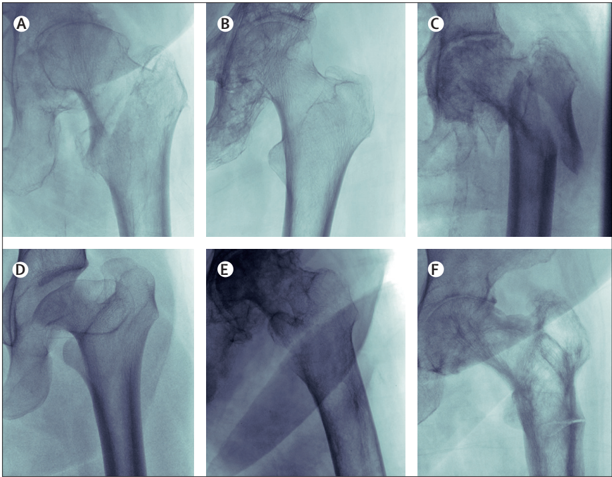
- In the illustrative hip fracture detection audit, the overall error rate was 2.5%, but the error rate for the subset of cases with abnormal bones or joints (Paget's disease and femoral head deformity) was 50%.
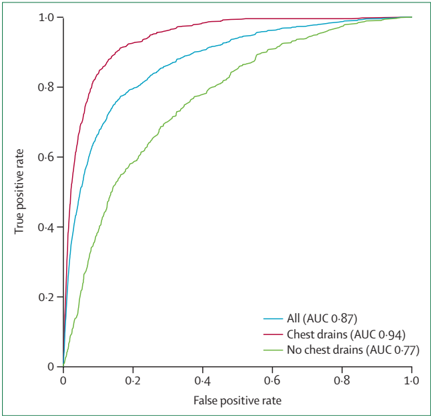
- In the pneumothorax detection example, the model achieved an overall AUC of 0.87, but AUC was 0.94 for cases with chest drains versus 0.77 for cases without, indicating the model learned artifacts of clinical care rather than the pathology.
- The paper reports that 60–70% of human errors in medical imaging are related to perceptual failure, whereas AI is not susceptible to incomplete searches or satisfaction syndrome, so equal-performance AI systems can be expected to produce different errors and clinical outcomes.
Methods
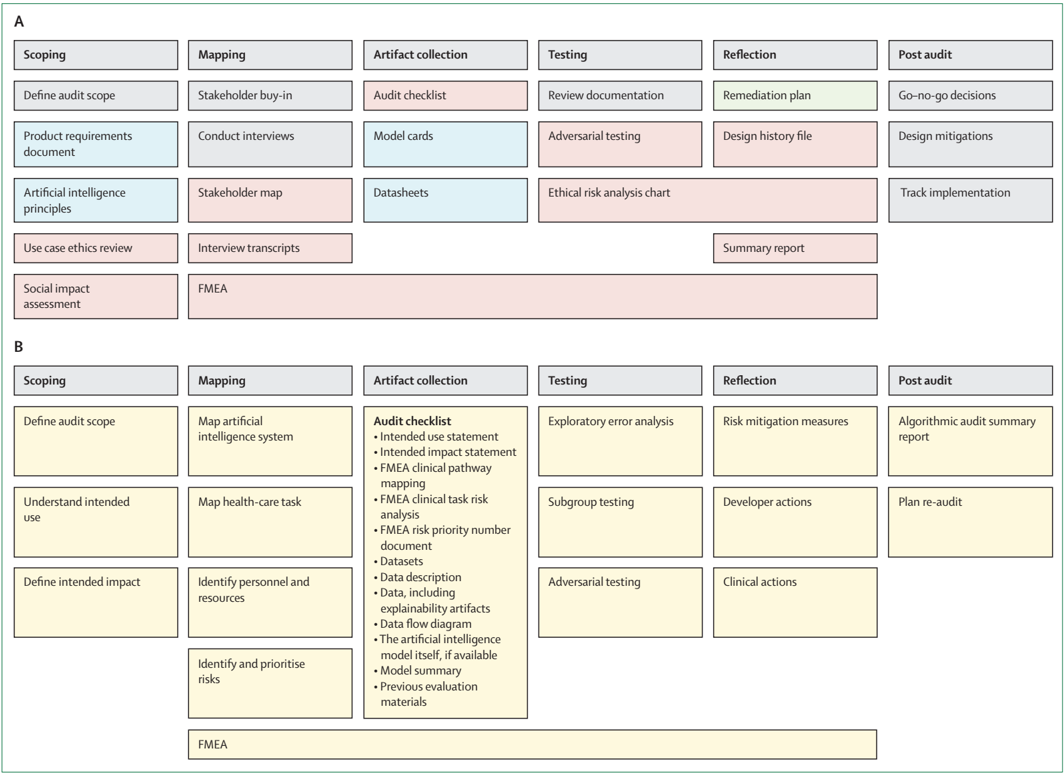
- Design: a conceptual Viewpoint article proposing a framework, not an empirical study; it adapts the SMACTR framework (scoping, mapping, artifact collection, testing, reflection) and applies FMEA principles for risk assessment, prioritisation, and mitigation.
- The framework is presented from two perspectives—developers (who can modify the system) and users (who cannot modify it but can implement deployment-specific risk mitigation)—with a table of actions for each audit stage.
- Testing is described as comprising exploratory error analysis, subgroup testing (patient-specific, task-specific, and exploratory-error-discovered subgroups), and adversarial testing; illustrative examples are drawn from published studies (hip fracture audit, pneumothorax detection, diabetic retinopathy evaluation by Ting and colleagues).
Limitations
- The paper states that FMEA "must be interpreted with care due to issues around reproducibility and incompleteness," and that the risk priority number is not a measure of safety and should not be used with arbitrary acceptability thresholds.
- The paper states that subgroup analysis is not performed to test hypotheses, and that reduced power in subsets plus inflated type 1 error from multiple testing mean results "should not be considered reliable or definitive" and should be confirmed in a sufficiently powered sample.
- The paper states that who should conduct the medical algorithmic audit remains an unanswered question, that the required skills are not taught in combination in standard medical curricula, and that appropriately trained clinicians are rare in both the UK and Australia.
Model-written summary. Check it against the paper before relying on it.
Integrity signals
Registry
Cites
Statistics
Figures
Verification
Claims the paper makes
6 Valid · 7 Not valid · 12 Not checked · 54 Own results and interpretations
Every source the paper cites for this claim was checked and supports it.
In the paper
“For example, an artificial intelligence system might learn to detect surgical skin markings to diagnose skin cancer, rather than looking for features related to the lesion itself.9”
§ The medical algorithmic audit > Introduction
What the sources say
- Supportedcites [9] matched to “Association between surgical skin markings in dermoscopic images and diagnostic performance of a deep learning convolutional neural network for melanoma recognition” (2019) source
The Discussion (page unavailable) says a CNN may associate surgical skin markings with a melanoma diagnosis, and the study found that markings increased false-positive melanoma classifications. The claim presents this as a possibility, not a proven account of how the CNN made every decision; the paper says the underlying mechanism remains unclear. (LLM, conf=0.88)
hedgedstates a possible cause- Asserted: passes — The authors put it forward as true.
- Checkable: passes — It can be checked against evidence.
- Load-bearing: passes — The paper’s conclusions depend on it.
- Based: passes — The paper gives a reason why it holds.
- Supported
Every source the paper cites for this claim was checked and supports it.
In the paper
“Furthermore, this drop in performance might not be obvious at the aggregate level of typical artificial intelligence testing, but rather in subsets of the target cohort or specific strata within the input data, a concept that has been described as hidden stratification.13”
§ The medical algorithmic audit > Introduction
What the sources say
- Supportedcites [13] matched to “Hidden stratification causes clinically meaningful failures in machine learning for medical imaging” (2020) source
Split into 2 atoms — 2 confirmed, 0 partially supported, 0 disputed, 0 misattributed, 0 unverifiable. Expand the claim to see per-atom verdicts.
hedged- Asserted: passes — The authors put it forward as true.
- Checkable: passes — It can be checked against evidence.
- Load-bearing: passes — The paper’s conclusions depend on it.
- Based: passes — The paper gives a reason why it holds.
- Supported
The cited sources support only part of this claim — read each source’s verdict below.
In the paper
“Indeed, the analysis of error cases is a minimum reporting requirement of the SPIRIT-AI (Standard Protocol Items: Recommendations for Interventional Trials-Artificial Intelligence) and CONSORT-AI (Consolidated Standards of Reporting Trials-Artificial Intelligence) guidelines for clinical trial protocols and reports of artificial intelligence interventions.7,8”
§ The medical algorithmic audit > Introduction
What the sources say
- Partly supportedcites [7] matched to “Reporting guidelines for clinical trial reports for interventions involving artificial intelligence: the CONSORT-AI extension” (2020) sourceExperimental — accuracy not yet measured
The Results section’s CONSORT-AI item 19 requires reporting the results of any performance-error analysis where applicable, or explaining why none was planned or done. The Discussion describes CONSORT-AI as minimum reporting guidance, but this paper does not establish the corresponding SPIRIT-AI error-analysis requirement. It also does not require investigators to conduct an error analysis in every trial. (LLM, conf=0.86)
- Partly supportedcites [8] matched to “Guidelines for clinical trial protocols for interventions involving artificial intelligence: the SPIRIT-AI extension” (2020) sourceExperimental — accuracy not yet measured
The Abstract and Discussion describe SPIRIT-AI as minimum reporting guidance that includes error cases. But the Monitoring section (SPIRIT-AI item 22) requires protocols to specify plans to identify and analyze performance errors—or explain why there are no plans—not to report a completed analysis. This paper identifies CONSORT-AI as the companion guideline for trial reports but does not establish its error-analysis requirement. (LLM, conf=0.88)
plain- Asserted: passes — The authors put it forward as true.
- Checkable: passes — It can be checked against evidence.
- Load-bearing: passes — The paper’s conclusions depend on it.
- Based: passes — The paper gives a reason why it holds.
- Partly supported
The cited sources that could be checked couldn’t confirm or dispute this claim.
In the paper
“In the hip fracture detection audit, 20 the discovery of algorithmic errors in cases with abnormal bones prompted an additional labelling exercise of all hips with abnormal bones and joints to find that the error rate in those cases was 50%, compared with 2•5% in the overall dataset (figure 2).”
- Also stated in: § Conclusions · plain
“The overall error rate was 2•5%, but the error rate for this subset was 50%.”
§ The medical algorithmic audit > Subgroup testing
What the sources say
- Could not verifycites [20] matched to “Causality matters in medical imaging” (2020) sourceExperimental — accuracy not yet measured
The Data mismatch sections discuss dataset shift and selection bias, but do not report a hip-fracture detection audit or error rates for abnormal bones and joints. Searches for the audit, the labelling exercise, and the 50% and 2.5% figures found no passage addressing those results; page numbers were not available in our copy. (LLM, conf=0.76)
plainstates an association- Asserted: passes — The authors put it forward as true.
- Checkable: passes — It can be checked against evidence.
- Load-bearing: passes — The paper’s conclusions depend on it.
- Based: passes — The paper gives a reason why it holds.
- Also stated in: § Conclusions · plain
The cited sources that could be checked couldn’t confirm or dispute this claim.
In the paper
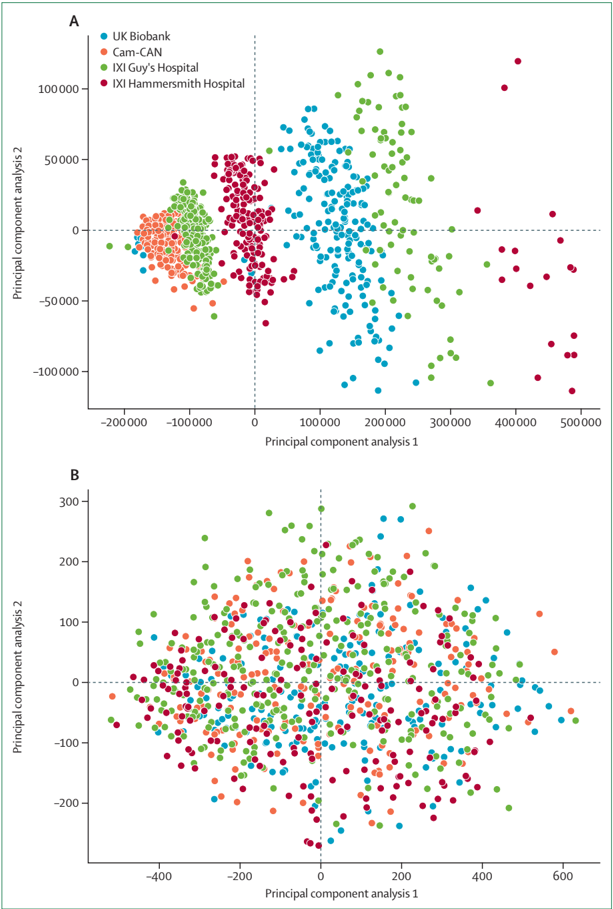
“Almost all studies report demographic and non-demographic characteristics of the study population, such as age, sex, ethnicity, socioeconomic status, disease severity, and comorbidities, and some studies also include information on geographical location and study site.”
§ The medical algorithmic audit > Subgroup testing
What the sources say
- Could not verifycites [31] matched to “A deep learning system for differential diagnosis of skin diseases” (2020) sourceExperimental — accuracy not yet measured
Our copy of Liu et al. (2020) contains no statement about what prior studies report: the only passages on demographics describe this study's own dataset (Dataset section — 'metadata such as patient demographic information and medical history'; Importance of input data section — '45 types of non-image metadata (demographic information and medical history)'; Fig. 3 legend — ages, sex, Fitzpatrick skin type) and its 17 sites across 2 U.S. states. Where the paper does characterize earlier work (DISCUSSION), the criticism concerns scope (skin-cancer screening, dermoscopic images), educational datasets and oversimplified labels — not the reporting of age, sex, ethnicity, socioeconomic status, disease severity, comorbidities, or geographical location. Searches on 'demographic characteristics reported', 'ethnicity/sex', 'socioeconomic status, comorbidities, geographical location, study site', and 'lack of reporting/transparency in existing studies' returned nothing addressing the claim's point, so the sweeping 'almost all studies report...' assertion can be neither confirmed nor contradicted from our copy. (LLM, conf=0.72)
- Could not verifycites [32] matched to “AI for radiographic COVID-19 detection selects shortcuts over signal” (2021) sourceExperimental — accuracy not yet measured
In “Evaluation of models on new hospital systems,” the paper recommends routine reporting of metadata on patient and hospital-system confounds; it does not assess how often other studies report population characteristics. “Shortcuts have a variable effect on generalization” discusses patient sex in the authors’ own datasets. Searches for age, ethnicity, socioeconomic status, disease severity, comorbidities, and demographic reporting found no passage supporting the claim that almost all studies report these characteristics. (LLM, conf=0.75)
- Not matchedcites [33]
The reference list we hold has no entry [33].
plain- Asserted: passes — The authors put it forward as true.
- Checkable: passes — It can be checked against evidence.
- Load-bearing: unclear — It is unclear whether the paper’s conclusions depend on it.
- Based: passes — The paper gives a reason why it holds.
- Could not verify
18 more claims
Create a free account to see all 79 claims and to verify the 1 reference still open.
- It may state two separate claims as one. 23
- Probably not a substantial claim. 52
- The quote only partly states this claim. 1
Claims other papers make about this one
Each is checked against this paper’s own text: does it say what the citing paper says it does?
The source backs part of the claim, not all of it — or backs it for a different population, condition or comparison.
In the citing paper
“Research on AI auditing has focused on evaluating whether specific applications meet predefined industry requirements.”
From Is it all hype? ChatGPT’s performance and disruptive potential in the accounting and auditing industries (2024) · cites this paper as Liu et al. 2022
Experimental — accuracy not yet measuredThe cited source says what the claim attributes to it.
In the citing paper
“For instance, researchers have created procedures for auditing AI systems used in recruitment (Kazim et al. 2021), online search (Robertson et al. 2018), and medical diagnostics (Liu et al. 2022).”
From Is it all hype? ChatGPT’s performance and disruptive potential in the accounting and auditing industries (2024) · cites this paper as Liu et al. 2022
Self-check
Percentages, sums and reported differences re-computed from the paper’s own numbers.
Each contradiction between two passages listed here was confirmed by an independent check.
Rated minor: it would not touch a result — a value no result rests on, a p-value that stays on the same side of the significance level, or a conflict that is clerical, resolved elsewhere in the paper, or outside its own findings.
In the paper
§ The medical algorithmic audit > Viewpoint Reflection
“These data are taken from a study by Ting and colleagues 31 and show the performance of their artificial intelligence model stratified by the clinical origin of the data.Reproduced with permission from JAMA 2016; 316: 2402-10.”
§ The medical algorithmic audit > References
“32. Gulshan V, Peng L, Coram M, et al. Development and validation of a deep learning algorithm for detection of diabetic retinopathy in retinal fundus photographs. JAMA 2016; 316: 2402-10.”
Citations
Cites
Gulshan, V., Peng, L., Coram, M., Stumpe, M. C., Wu, D., Narayanaswamy, A., Venugopalan, S., Widner, K., Madams, T., Cuadros, J., et al. (2016) · JAMA · doi:10.1001/jama.2016.17216 · Cited by 7,697
International evaluation of an AI system for breast cancer screening
McKinney, S. M., Sieniek, M., Godbole, V., Godwin, J., Antropova, N., Ashrafian, H., Back, T., Chesus, M., Corrado, G. S., Darzi, A., et al. (2020) · Nature · doi:10.1038/s41586-019-1799-6 · Cited by 3,287
Model Cards for Model Reporting
Mitchell, M., Wu, S., Zaldivar, A., Barnes, P., Vasserman, L., Hutchinson, B., Spitzer, E., Raji, I. D., & Gebru, T. (2019) · Proceedings of the Conference on Fairness, Accountability, and Transparency · doi:10.1145/3287560.3287596 · Cited by 2,681
Clinically applicable deep learning for diagnosis and referral in retinal disease
De Fauw, J., Ledsam, J. R., Romera-Paredes, B., Nikolov, S., Tomasev, N., Blackwell, S., Askham, H., Glorot, X., O’Donoghue, B., Visentin, D., et al. (2018) · Nature Medicine · doi:10.1038/s41591-018-0107-6 · Cited by 2,639
Gebru, T., Morgenstern, J., Vecchione, B., Vaughan, J. W., Wallach, H., Daumé, H., & Crawford, K. (2018) · arXiv · doi:10.48550/arxiv.1803.09010 · Cited by 2,474
Gebru, T., Morgenstern, J., Vecchione, B., Vaughan, J. W., Wallach, H., III, H. D., & Crawford, K. (2021) · Communications of the ACM · doi:10.1145/3458723 · Cited by 2,469
Ting, D. S. W., Cheung, C. Y.-L., Lim, G., Tan, G. S. W., Quang, N. D., Gan, A., Hamzah, H., Garcia-Franco, R., San Yeo, I. Y., Lee, S. Y., et al. (2017) · JAMA · doi:10.1001/jama.2017.18152 · Cited by 2,402
Raji, I. D., Smart, A., White, R. N., Mitchell, M., Gebru, T., Hutchinson, B., Smith-Loud, J., Theron, D., & Barnes, P. (2020) · Proceedings of the 2020 Conference on Fairness, Accountability, and Transparency · doi:10.1145/3351095.3372873 · Cited by 2,245
Liu, X., Faes, L., Kale, A. U., Wagner, S. K., Fu, D. J., Bruynseels, A., Mahendiran, T., Moraes, G., Shamdas, M., Kern, C., et al. (2019) · The Lancet Digital Health · doi:10.1016/s2589-7500(19)30123-2 · Cited by 1,883
Self-citation2013 IEEE 10th International Symposium on Biomedical Imaging
(2013) · doi:10.1109/isbi20048.2013 · Cited by 1,625
Research works printed but not linked: 1
- Topol E. The Topol review: preparing the healthcare workforce to deliver the digital future. National Health Service Health Education England, 2019.
Cited by
Items 101–200 of 238
Kwong, J. C. C., Al‐Daqqaq, Z., Chelliahpillai, Y., Lee, S., Kim, K. J., Ringa, M., Feifer, A. H., Lajkosz, K., Wettstein, M. S., Chan, A., et al. (2025) · European Urology · doi:10.1016/j.eururo.2025.09.4145 · Cited by 13
Integration of AI in surgical decision support: improving clinical judgment
Balch, J. A., Shickel, B., Bihorac, A., Upchurch, G. R., & Loftus, T. J. (2024) · Global Surgical Education - Journal of the Association for Surgical Education · doi:10.1007/s44186-024-00257-2 · Cited by 10
“We recommend medical algorithmic audits and model cards that report on these metrics as well as why, when, and how the models fail [47, 48].”
Hatherley, J. J. (2024) · Journal of Medical Ethics · doi:10.1136/jme-2024-109905 · Cited by 12
“42 In short, many of these risks have the potential to be sufficiently minimised now, so long as regulators, hospitals, researchers and clinicians are willing to devote the time and money towards improving and implementing these various strategies.”
Denniston, A. K., Kale, A. U., Lee, W. H., Mollan, S. P., & Keane, P. A. (2022) · Current Opinion in Ophthalmology · doi:10.1097/icu.0000000000000887 · Cited by 12
“It also highlights the need for such technologies to have robust postmarket surveillance measures, which include consideration of errors, adverse events and harms by demographic group, including ethnicity, age and sex [18,19].”
BackgroundSelf-citationKaas, M. H. L., Porter, Z., Lim, E., Higham, A., Khavandi, S., & Habli, I. (2023) · International Symposium on Trustworthy Autonomous Systems (TAS) · doi:10.1145/3597512.3599713 · Cited by 16
eHealth in geriatric rehabilitation: an international consensus study
Kraaijkamp, J. J. M., Persoon, A., Chavannes, N. H., Achterberg, W. P., Choukou, M.-A., Dockery, F., Kim, H., Pérez, L. M., Pompeu, J. E., Topinková, E., et al. (2025) · European Geriatric Medicine · doi:10.1007/s41999-025-01170-7 · Cited by 10
“Big data and AI are undoubtedly promising, but as a fast-emerging technology there are serious concerns regarding safety, transparency, and accuracy [25–27], particularly as the complex and opaque relationships between input and output on which AI relies can yield errors that are difficult to…”
Joo, B. (2025) · Neurointervention · doi:10.5469/neuroint.2025.00283 · Cited by 15
“59 This review has several limitations.”
NESTANets: stable, accurate and efficient neural networks for analysis-sparse inverse problems
Neyra-Nesterenko, M., & Adcock, B. (2022) · Sampling Theory Signal Processing and Data Analysis · doi:10.1007/s43670-022-00043-5 · Cited by 16
AI illuminates paths in oral cancer
Kapoor, D. U., Saini, P. K., Sharma, N., Singh, A., Prajapati, B. G., Elossaily, G. M., & Rashid, S. (2024) · EXCLI journal · doi:10.17179/excli2024-7253 · Cited by 19
Scott, I. A., Shaw, T. J., Slade, C., Wan, T. T., Barmanray, R., Coorey, C. P., Johnson, S. L., Bell, L. M., Herd, M., & Sullivan, C. M. (2025) · Internal Medicine Journal · doi:10.1111/imj.70112 · Cited by 8
Blake, N., Gaifulina, R., Isabelle, M., Dorney, J., Rodriguez‐Justo, M., Lau, K., Ohrel, S., Lloyd, G. R., Shepherd, N. A., Lewis, A. T., et al. (2024) · BJC Reports · doi:10.1038/s44276-024-00080-8 · Cited by 9
“The maximum observed difference in response was between centres 1 and 3 with a slope factor of approximately 15%.”
BackgroundArtificial intelligence in forensic pathology: an Australian and New Zealand perspective
Garland, J., Tse, R. D., Stables, S. R., Broi, U. D., & Ondruschka, B. (2025) · Rechtsmedizin · doi:10.1007/s00194-025-00741-z · Cited by 13
“The use of AI has been applied to other medical disciplines forauditing/qualityassurancepurposes[5, 8, 59], although these systems themselves mustbesubjecttoaseparatequalityassur-ance process [40].”
Pesapane, F., Cecco, C. N. D., Wang, H., Hauglid, M. K., & Sardanelli, F. (2026) · European Radiology · doi:10.1007/s00330-026-12460-4 · Cited by 22
“The “ medical algorithmic audit ” framework [53] operationalizes this link by coupling exploratory error analysis and subgroup testing with feedback loops to developers.”
van Leeuwen, K. G., Becks, M. J., Grob, D., de Lange, F., Rutten, J. H. W., Schalekamp, S., Rutten, M. J. C. M., van Ginneken, B., de Rooij, M., & Meijer, F. J. A. (2023) · Heliyon · doi:10.1016/j.heliyon.2023.e19065 · Cited by 11
“Interaction with existing systems and human-AI interactions may provide different results than retrospective validation [11,12].”
Rethinking our relationship with AI: for better or worse, richer or poorer?
Shelmerdine, S. C. (2024) · European Radiology · doi:10.1007/s00330-024-11007-9 · Cited by 8
“Adopting a medical algorithmic audit framework [12] can promote safety and establish feedback mechanisms between AI vendors and users.”
Allmendinger, S., Hemmer, P., Queisner, M., Sauer, I. M., Müller, L., Jakubik, J., Vössing, M., & Kühl, N. (2024) · Studies in computational intelligence · doi:10.1007/978-3-031-63592-2_4 · Cited by 14
Large Language Models: A Paradigm Shift for Dementia Diagnosis and Care
Harrison, J. R., Tang, S. L., Burston, B., Robertson, A., Liang, H., & Taylor, J. (2025) · British Journal of Hospital Medicine · doi:10.12968/hmed.2024.0666 · Cited by 9
Ethical perspectives on deployment of large language model agents in biomedicine: a survey
Nia, N. G., Amiri, A., Luo, Y., & Kline, A. S. (2025) · AI and Ethics · doi:10.1007/s43681-025-00847-w · Cited by 9
“For instance, a medical algorithmic audit framework published in The Lancet Digital Health demonstrates how systematic audits can enhance transparency and serve as a basis for equitable remediation across demographic subgroups [39].”
Al-Jebrni, A. H., Jiang, Z., Qin, Y., Qiu, Y., Jiang, N., Li, G., Zheng, Y., Wong, T. Y., Kim, S., Jung, Y., et al. (2026) · Computational Visual Media · doi:10.26599/cvm.2026.9450530 · Cited by 11
Clinical Integration of Artificial Intelligence for Breast Imaging
Wilkinson, L., Dunbar, J. K., & Lip, G. (2024) · Radiologic Clinics of North America · doi:10.1016/j.rcl.2023.12.006 · Cited by 8
Software Systems Compliance with the AI Act: Lessons Learned from an International Challenge
Scantamburlo, T., Falcarin, P., Veneri, A., Fabris, A., Gallese, C., Billa, V., Rotolo, F., & Marcuzzi, F. (2024) · doi:10.1145/3643691.3648589 · Cited by 14
Bird, A., Oakden‐Rayner, L., Chakradeo, K., Thomas, R., Gupta, D., Jain, S., Jacob, R., Ray, S., Wechalekar, M. D., Proudman, S., et al. (2025) · Seminars in Arthritis and Rheumatism · doi:10.1016/j.semarthrit.2025.152761 · Cited by 8
Self-citationWang, S. M., Hogg, H. D. J., Sangvai, D. G., Patel, M. R., Weissler, E. H., Kellogg, K. C., Ratliff, W., Balu, S., & Sendak, M. (2023) · JMIR Formative Research · doi:10.2196/43963 · Cited by 11
“The study was motivated by the need to better understand diverse stakeholder needs to improve algorithm documentation, communication, and training materials, which are crucial for the safe and responsible use of ML-driven CDS [17,18].”
Client-Level Differential Privacy via Adaptive Intermediary in Federated Medical Imaging
Jiang, M., Zhong, Y., Le, A., Li, X., & Dou, Q. (2023) · Lecture notes in computer science · doi:10.1007/978-3-031-43895-0_47 · Cited by 15
Domain generalization for mammographic image analysis with contrastive learning
Li, Z., Cui, Z., Zhang, L., Wang, S., Lei, C., Ouyang, X., Chen, D., Zhao, X., Liu, C., Liu, Z., et al. (2024) · Computers in Biology and Medicine · doi:10.1016/j.compbiomed.2024.109455 · Cited by 11
“Domain shift may result in a significant decline in performance across various vendors (Garrucho et al., 2022; Liu et al., 2022).”
Ellis, C. A., Miller, R. L., & Calhoun, V. D. (2022) · bioRxiv (Cold Spring Harbor Laboratory) · doi:10.1101/2022.10.27.514124 · Cited by 6
“Separating dFNC into subtypes represents an important next step towards the eventual development of dFNC-based neuroimaging CDSS, as many proposed approaches for auditing CDSS involve the examination of differences in performance across subtypes [3][4].”
BackgroundInfluentialJhaveri, A., Abolhassani, F., & Fine, B. (2025) · Canadian Association of Radiologists Journal · doi:10.1177/08465371251320938 · Cited by 6
“14 By conducting this prospective evaluation on local data, our goal was to determine whether to deploy the model and how to optimize it for real-world use.”
Preparing healthcare organisations for using artificial intelligence effectively
Scott, I. A., van der Vegt, A. H., Canaris, S., Nolan, P., & Pointon, K. (2025) · Australian Health Review · doi:10.1071/ah25102 · Cited by 9
Schönfelder, A., Eberlein-Gonska, M., Hülsken-Giesler, M., Jovy-Klein, F., Kather, J. N., Kohoutek, E., Lennefer, T., Liebert, E., Lipprandt, M., Mathias, R., et al. (2026) · Journal of Medical Internet Research · doi:10.2196/80754 · Cited by 6
“In addition, algorithmic audits can serve as a framework for continuously monitoring AI systems and understanding errors, how and why these adverse events occurred, while anticipating their potential consequences [136].”
Kale, A. U., Hogg, H. D. J., Pearson, R. V., Glocker, B., Golder, S., Coombe, A., Waring, J. J., Liu, X., Moore, D., & Denniston, A. K. (2024) · JMIR Research Protocols · doi:10.2196/51614 · Cited by 8
“[9] Patient harms • “Injury or damage to the health of people” (as defined in International Organization for Standardization [ISO] 14971-application of risk management for medical devices) [17] • “The totality of possible adverse consequences of an intervention or therapy” [18] Performance…”
BackgroundMethodInfluentialSelf-citationMulticentre prospective risk analysis of a fully automated radiotherapy workflow
Kerf, G. D., Montero, A. M. B., Brouwer, C. L., Pisciotta, P., Biston, M., Fusella, M., Herbin, G., Kneepkens, E., Marrazzo, L., Mason, J., et al. (2025) · Physics and Imaging in Radiation Oncology · doi:10.1016/j.phro.2025.100765 · Cited by 12
Methodological opportunities in genomic data analysis to advance health equity
Lehmann, B., Bräuninger, L., Cho, Y., Falck, F., Jayadeva, S., Katell, M. A., Nguyen, T., Perini, A., Tallman, S., Mackintosh, M. E., et al. (2025) · Nature Reviews Genetics · doi:10.1038/s41576-025-00839-w · Cited by 8
Macdonald, T., Hogg, H. D. J., Dinnes, J., Verrinder, L., Maniatopoulos, G., Taylor‐Phillips, S., Shinkins, B., Dunbar, J. K., Solebo, A. L., Sutton, H., et al. (2025) · Frontiers in Health Services · doi:10.3389/frhs.2025.1537016 · Cited by 5
Self-citationThe ethics of data interoperability: Mapping problems and strategies in biomedical data and beyond
Caplan, A. B., & Koopman, C. (2025) · Big Data & Society · doi:10.1177/20539517251352815 · Cited by 7
State of the AI: Post-Deployment Monitoring of Radiology-Focused Internally Developed AI
Cook, C. J., Klug, J. R., Kandler, B. W., Suárez, A. B., Dachowicz, A. P., Blezek, D. J., Missert, A. D., Conte, G. M., Benfield, J. D., Mensing-Diggs, A., et al. (2026) · Mayo Clinic Proceedings Digital Health · doi:10.1016/j.mcpdig.2026.100342 · Cited by 9
Probst, T. M., Shoss, M. K., Bankins, S., Behrend, T. S., Dragano, N., Jetha, A., Koopman, J., Selenko, E., Tang, P. M., Tay, L., et al. (2026) · Occupational Health Science · doi:10.1007/s41542-026-00262-5 · Cited by 5
“Examples include concerns about erroneous decisions made by diagnostic AI tools in medical contexts (Liu et al., 2022 ).”
Data AUDIT: Identifying Attribute Utility- and Detectability-Induced Bias in Task Models
Pavlak, M., Drenkow, N. G., Petrick, N., Farhangi, M. M., & Unberath, M. (2023) · Lecture notes in computer science · doi:10.1007/978-3-031-43898-1_43 · Cited by 10
Artificial intelligence for prostate cancer histopathology diagnostics
Sandoval, V., Chuang, Z., Power, N. E., & Chin, J. L. (2022) · Canadian Urological Association Journal · doi:10.5489/cuaj.7918 · Cited by 6
“( 17).”
Zhang, J., Li, J., & Oehmen, J. (2023) · SSRN Electronic Journal · doi:10.2139/ssrn.4513915 · Cited by 4
Krause, D. (2025) · SSRN Electronic Journal · doi:10.2139/ssrn.5050631 · Cited by 7
Ellis, C. A., Miller, R. L., & Calhoun, V. D. (2023) · IEEE International Symposium on Biomedical Imaging (ISBI) · doi:10.1109/isbi53787.2023.10230384 · Cited by 3
Patient and Physician Exposure to Artificial Intelligence Hype
Monteith, S., Glenn, T., Geddes, J. R., Whybrow, P. C., Achtyes, E. D., Bauer, R., & Bauer, M. (2025) · Pharmacopsychiatry · doi:10.1055/a-2577-7214 · Cited by 4
“Methods for auditing AI products in healthcare and legal liabilities for medical errors related to the use of AI prod - ucts are omitted in this article [46, 47].”
Auditing Artificial Intelegence Menggunakan COBIT 2019
Rizki, M., & Novianto, E. (2023) · JUSIFOR Jurnal Sistem Informasi dan Informatika · doi:10.33379/jusifor.v2i1.1847 · Cited by 3
Banda, J. M., Shah, N. H., & Periyakoil, V. S. (2023) · JAMIA Open · doi:10.1093/jamiaopen/ooad043 · Cited by 4
“15–18 In the broader ML community, Kleinberg et al 19 showed that a probabilistic classification to be “fair” to different groups should satisfy 3 inherent conditions: (1) calibration within groups, (2) balance for the negative class, and (3) balance for the positive class.”
BackgroundUnsupervised Bias Discovery in Medical Image Segmentation
Gaggion, N., Echeveste, R., Mansilla, L., Milone, D. H., & Ferrante, E. (2023) · Lecture notes in computer science · doi:10.1007/978-3-031-45249-9_26 · Cited by 5
THE MODEL FOR THE AUDIT SYSTEM OF MEDICAL SERVICE QUALITY IN HEALTHCARE INSTITUTIONS
Dovhan, V. I., Hrynzovskyi, A., Bіelaі, S., et al. (2023) · Clinical and Preventive Medicine · doi:10.31612/2616-4868.5.2023.12 · Cited by 3
“This form should contain general information about the healthcare facilities, target patient groups, date range, auditor, and a list of clinical indicators [15, 16] for patients with specific diseases and target values of the analyzed clinical indicators.”
BackgroundHu, B., He, H., Shi, Z., Wang, L., Liu, Q., Sun, Z., & Zhang, L. J. (2025) · Neuroradiology · doi:10.1007/s00234-024-03536-3 · Cited by 5
“Given the proclivity of AI models to behave in ways that are not entirely predictable, the incorporation of an algorithmic audit seems to be a valuable addition [20].”
The Challenge Dataset – simple evaluation for safe, transparent healthcare AI deploymentPreprint
Sanayei, J. K., Abdalla, M., Ahluwalia, M., Seyyed-Kalantari, L., Minotti, S. C., & Fine, B. (2022) · medRxiv · doi:10.1101/2022.12.15.22280619 · Cited by 4
“[ 16,31,32] This should involve a detailed review of false positive and false negative cases focusing on identifying i) examples of critical failure that may indicate a patient safety concern, and ii) persistent patterns of failure.”
BackgroundHierarchy of Ethical Principles for the use of Artificial Intelligence in Medicine and Healthcare
Sokolchik, V., & Razuvanov, A. I. (2024) · Journal of Digital Economy Research · doi:10.24833/14511791-2023-4-48-84 · Cited by 5
How can we promote greater adoption of AI in healthcare?
Scott, I. A., Cresswell, K. M., Williams, R., & van der Vegt, A. H. (2025) · BMJ Quality & Safety · doi:10.1136/bmjqs-2025-019405 · Cited by 2
Sirago, G., Vinci, A., Visci, P., Solarino, B., Dell'Erba, A. S., & Ferorelli, D. (2026) · Journal of Medical Systems · doi:10.1007/s10916-026-02382-5 · Cited by 14
Reclaiming informed consent to train mental health AI with patient data
Larrauri, C. A., Martinez-Martin, N., & Torous, J. (2026) · npj Digital Medicine · doi:10.1038/s41746-026-02843-8 · Cited by 2
Duwe, G., Knoll, T., & Kowalewski, K. (2026) · European Urology · doi:10.1016/j.eururo.2026.05.026 · Cited by 3
Müller, L., Kloeckner, R., Mildenberger, P., & dos Santos, D. P. (2022) · Die Radiologie · doi:10.1007/s00117-022-01097-1 · Cited by 4
The Inverse Data Law: Market Imperatives, Data, and Quality in AI Supported Care
Ameen, S., Wong, M. C., Yee, K. C., Nøhr, C. G., & Turner, P. A. (2023) · Studies in health technology and informatics · doi:10.3233/shti230166 · Cited by 5
Thick Data Analytics (TDA): An Iterative and Inductive Framework for Algorithmic Improvement
Nguyen, M., Eulalio, T. Y., Marafino, B. J., Rose, C. C., Chen, J. H., & Baiocchi, M. (2024) · The American Statistician · doi:10.1080/00031305.2024.2327535 · Cited by 2
“To promote the use of feedback mechanisms in addition to retrospective analysis of model predictions, a recent shift in the literature of model assessment investigates unusual behaviors, errors, and failures (Liu et al. 2022; Raji et al. 2020; Oakden-Rayner et al. 2020, 2022).”
Fahmy, A. M. (2025) · Premier journal of science. · doi:10.70389/pjs.100052 · Cited by 2
Kang, S., Neve, W. D., Rameau, F., & Özbulak, U. (2025) · Lecture notes in computer science · doi:10.1007/978-3-031-77789-9_8 · Cited by 2
“Variations in imaging modalities, the use of different medical devices, and inconsistencies in data annotation all contribute to this complexity [20].”
Kutler, R. B., He, L., Green, R. W., & Rameau, A. (2025) · Current Opinion in Otolaryngology & Head & Neck Surgery · doi:10.1097/moo.0000000000001041 · Cited by 2
Role and Use of Race in Artificial Intelligence and Machine Learning Models Related to Health
Were, M. C., Li, A., Malin, B., Yin, Z., Coco, J., Collins, B. X., Clayton, E. W., Novak, L. L., Hendricks‐Sturrup, R., Oluyomi, A., et al. (2025) · Journal of Medical Internet Research · doi:10.2196/73996 · Cited by 5
“All implemented AI and ML models should be audited prior to deployment and monitored once deployed [87].”
Algorithmic ExclusionPreprint
Albert, K., & Delano, M. K. (2022) · SSRN Electronic Journal · doi:10.2139/ssrn.4122529 · Cited by 2
Global Approaches to Auditing Artificial Intelligence: A Literature Review
(IPIE), I. P. O. T. I. E., Sylvester, P., Chun, W. H. K., Hannák, A., Mendoza, M., Broussard, M., Сергеевич, Е. Р., Nelson, A., Sandvig, C., Sesan, G., et al. (2024) · doi:10.61452/bwym7397 · Cited by 7
Towards A Global AI Auditing Framework: Assessment and Recommendations
(IPIE), I. P. O. T. I. E., Faveri, B., Johnson-León, M., Sylvester, P., Chun, W. H. K., Hannák, A., Mendoza, M., Broussard, M., Сергеевич, Е. Р., Nelson, A., et al. (2025) · doi:10.61452/zwed1485 · Cited by 6
Sokolchik, V., & РАЗУВАНОВ, А. (2024) · Proceedings of the National Academy of Sciences of Belarus Humanitarian Series · doi:10.29235/2524-2369-2024-69-2-95-107 · Cited by 2
Research on the Application of AI Technology in Auditing
Zhang, S. (2024) · Economic management & global business studies. · doi:10.69610/j.emgbs.20240831 · Cited by 2
AI and Quality and Patient Safety
Asif, F., & Qureshi, M. F. H. (2024) · Advances in healthcare information systems and administration book series · doi:10.4018/979-8-3693-7051-3.ch009 · Cited by 1
Bidargaddi, N. P., Patrickson, B., Strobel, J., & Schubert, K. (2025) · Psychiatry Research · doi:10.1016/j.psychres.2024.116339 · Cited by 4
Data-driven decision-making: Turning insights into action
Ribeiro, L., & O’Brien, T. (2025) · Journal of Clinical Urology · doi:10.1177/20514158251348043 · Cited by 1
Visual-action AI agents for medical diagnosis and treatment: advances and future outlook
Yao, Y., Luxue, Y., Chen, X., Shen, C., Yang, H., Lee, S., Chen, T., Ge, H., & Shen, J. (2025) · The Visual Computer · doi:10.1007/s00371-025-04153-8 · Cited by 2
“The Medical algorithmic audits proposed by Liu et al. [81] is an audit framework that helps operationalize these mandates.”
Antun, V., Gottschling, N. M., Hansen, A. C., & Adcock, B. (2025) · Advances in magnetic resonance technology and applications · doi:10.1016/b978-0-443-14109-6.00011-0 · Cited by 1
Vinay, V., Jodalli, P. S., Chavan, M., Satyarup, D., Bhor, K. B., & Buddhikot, C. S. (2026) · International Journal of Dentistry · doi:10.1155/ijod/6730710 · Cited by 1
Ghosh, R., Khezrimotlagh, D., Imanpour, S., et al. (2026) · JMIR Formative Research · doi:10.2196/83918 · Cited by 1
“…trained on such data risks learning these biases and systematically underestimating the readmission risk for marginalized racial, ethnic, or socioeconomic groups, a prominent risk given that safety-net hospitals serving these populations are already disproportionately penalized by the HRRP [24].”
What Utah’s clinical AI sandbox reveals about independent oversight
Gorijavolu, R., Jaiswal, N., Kesselheim, A. S., Sakran, J. V., Hernandez‐Boussard, T., & Celi, L. A. (2026) · Nature Medicine · doi:10.1038/s41591-026-04418-2 · Cited by 1
Perdomo-Lampignano, J. A., Kale, A. U., Kumar, S., Shah, D., Reddy, B., & Lowe, D. J. (2026) · Journal of Medical Systems · doi:10.1007/s10916-026-02426-w · Cited by 7
“Prior work has emphasised the need for such combined clinical, technical, and informatics expertise that is not yet routinely embedded in healthcare organisations [16, 47, 48], underscoring governance capacity as a critical determinant of safe AI deployment.”
Dong, C., Liu, Y., Yin, J., Yan, W., Sun, J., Zhang, X., Huo, S., Yu, F., & Zhou, Y. (2026) · Digital Health · doi:10.1177/20552076261474637 · Cited by 3
“116,117 The emergence of general-purpose large language models in medical domains further highlights these governance needs.”
It is Not Time to Kick Out Radiologists
Nakamura, Y., Sonoda, Y., Yamagishi, Y., Kikuchi, T., Nakao, T., Miki, S., Hanaoka, S., Yoshikawa, T., & Abe, O. (2024) · Asian Bioethics Review · doi:10.1007/s41649-024-00325-1 · Cited by 3
Sapey, E., Gallier, S., Evison, F., McNulty, D., Reeves, K., & Ball, S. T. (2022) · BMJ Open · doi:10.1136/bmjopen-2022-065862 · Cited by 1
Domain Generalization for Mammographic Image Analysis with Contrastive LearningPreprint
Li, Z., Cui, Z., Zhang, L., Wang, S., Lei, C., Ouyang, X., Chen, D., Zhao, X., Liu, C., Liu, Z., et al. (2023) · SSRN Electronic Journal · doi:10.2139/ssrn.4677187 · Cited by 2
Regulação da inteligência artificial na saúde
Dourado, D. D. A. (2024) · Digital Library of Theses and Dissertations (Universidade de São Paulo) · doi:10.11606/t.5.2024.tde-23042024-111255 · Cited by 11
Auditing Algorithmic Medical Systems to Uncover AI Harms and Remedy Racial Injustice
Broussard, M. (2025) · Oxford University Press eBooks · doi:10.1093/9780198945246.003.0020 · Cited by 1
McCradden, M. D., Tng, S., Jeyaseelan, D., Leane, C., Campbell, M., Braund, T., Earle-Bandaralage, L., Ebrahimi, M., Sharma, A. K., & TANG, J. C. Y. (2025) · medRxiv · doi:10.1101/2025.09.30.25336928 · Cited by 1
Self-citationStanborough, R. O., & Garner, H. W. (2022) · American Journal of Roentgenology · doi:10.2214/ajr.22.28053
UK liver transplantation allocation algorithm: transplant benefit score – Authors' reply
Stutchfield, B. M., Attia, A. M., Rowe, I. A. C., et al. (2023) · The Lancet · doi:10.1016/s0140-6736(23)01307-7
Artificial intelligence in respiratory medicine
Gonem, S. (2023) · Elsevier eBooks · doi:10.1016/b978-0-443-15688-5.00027-9
Rubeis, G. (2024) · The International library of ethics, law and technology · doi:10.1007/978-3-031-55744-6_5
Current challenges and ethical hurdles of integrating ChatGPT in radiology (Preprint)Preprint
Kumar, S. S. (2024) · doi:10.2196/preprints.58634
Cortecci, M. B., & Bonetti, M. (2024) · SocArXiv (OSF Preprints) · doi:10.31235/osf.io/beudp · Cited by 2
Incremental Role of Radiomics and Artificial Intelligence
Papp, L., Spielvogel, C. P., Haberl, D., & Ecsedi, B. (2024) · Springer eBooks · doi:10.1007/978-3-031-59341-3_10 · Cited by 1
Linfeng, W., & Pengyu, M. (2024) · Clinical Nutrition · doi:10.1016/j.clnu.2024.07.043
Byfield, A., Poulett, W., Wallace, B., Jose, A., Tyagi, S., Shembekar, S., Qayyum, A., Qadir, J., & Bilal, M. (2024) · IEEE International Symposium on Biomedical Imaging (ISBI) · doi:10.1109/isbi56570.2024.10635870 · Cited by 2
“Xiaoxuan et al. [7] have outlined a comprehensive framework for medical algorithmic audit, detailing processes and documents produced by various stakeholders in the product design.”
BackgroundSafety regulation of machine learning in cardiac surgery
Wang, Z., & Wang, L. (2024) · Journal of Thoracic Disease · doi:10.21037/jtd-24-990
“Safety verification can rely on “black box” evaluation (4), that is, no deep knowledge of the algorithm or dataset is required (5), only methodological transparency, to ensure the safe use of machine learning in the field of cardiothoracic surgical treatment, while also protecting the incentive to…”
BackgroundGrant, P. S. (2024) · Springer eBooks · doi:10.1007/978-3-031-69944-3_11
Dandár, J., Škodová, M., Straka, Z., Kvak, D., & Biros, M. (2025) · Lecture notes in electrical engineering · doi:10.1007/978-981-96-3863-5_4
Efendioğlu, E. M., & Çiğiloğlu, A. (2025) · European Geriatric Medicine · doi:10.1007/s41999-025-01202-2 · Cited by 1
A Lightweight Data Selection Network for Image Classification via Policy Gradient
Yu, Y., Du, X., Yang, Z., Zhang, S., Chen, H., Qu, B., & Hu, J. (2025) · Communications in computer and information science · doi:10.1007/978-981-96-6975-2_23
Wang, Y.-C., Cheng, C.-Y., Wu, C., Lee, C.-C., & Gau, S. S. (2025) · Autism · doi:10.1177/13623613251360271
“Hence, even a model with good performance during initial validation should still be examined in the local setting for practical use (Liu et al., 2022).”
InfluentialA minimal set of prompts to surface reasoning in digital healthPreprint
Kulikovskikh, I., Legović, T., Konovalov, S., Колсанов, А. В., & Šmuc, T. (2025) · medRxiv · doi:10.1101/2025.09.22.25336413
“Existing approaches to digital health design have focused on measuring cognitive burden [45–50] and recognizing fundamental differences between human and digital information processing [14,36,37].”
Rondina, M., Vetrò, A., Coppola, R., Regragui, O., Fabris, A., Silvello, G., Susto, G. A., & Martin, J. C. D. (2025) · Frontiers of artificial intelligence, ethics and multidisciplinary applications. · doi:10.1007/978-981-96-7945-4_15 · Cited by 1
Large Language Models, argumentation, and healthcare: A socio-cognitive perspective
Paglieri, F. (2025) · Journal of Argumentation in Context · doi:10.1075/jaic.25024.pag
The cause and effect of an MR image: Robustness and generalizability
Feragen, A., Petersen, E., & Ganz, M. (2025) · Advances in magnetic resonance technology and applications · doi:10.1016/b978-0-443-14109-6.00016-x · Cited by 1
Metadata
- Authors
- Liu, X., Glocker, B., McCradden, M. M., Ghassemi, M., Denniston, A. K., & Oakden-Rayner, L.
- Affiliations
- University Hospitals Birmingham NHS Foundation Trust (GB)
- Imperial College London (GB)
- Massachusetts Institute of Technology (US)
- Venue
- The Lancet Digital Health
- Publisher
- Elsevier BV
- Published
- 2022-05
- Volume
- 4
- Issue
- 5
- Pages
- e384-e397
- ISSN
- 2589-7500 (ISSN-L)
- OpenAlex
- W4223506650
- Semantic Scholar
- abe10881a02eb68ba0ff7ef1b20a98624a49cc83
- Cited by
- 266
- References
- 44
- Citations by year
- 2026: 67 · 2025: 54 · 2024: 63 · 2023: 61 · 2022: 21
- FWCI
- 3.25
- Type
- journal article
- Language
- en
- Update notices
- erratum (2022-06-01)
- Open access
- gold
- doi.org
- Licence
- cc-by
- www.elsevier.com/tdm/userlicense/1.0/ (tdm)
- www.elsevier.com/legal/tdmrep-license (tdm)
- creativecommons.org/licenses/by/4.0/ (vor)
- Locations
- The Lancet Digital Health (publishedVersion, cc-by)
- PubMed (publishedVersion)
- University of Birmingham Research Portal (University of Birmingham) (submittedVersion, cc-by)
- Spiral (Imperial College London) (submittedVersion, cc-by)
- Funders
- Wellcome Trust (200141/Z/15/Z, /Z/15/Z)
- Alan Turing Institute (TU/ASG/R-SPEH-113)
- H2020 European Research Council (757173)
- Topics
- Health Sciences › Medicine › Health Informatics › Artificial Intelligence in Healthcare and Education
- Physical Sciences › Computer Science › Artificial Intelligence › Explainable Artificial Intelligence (XAI)
- Physical Sciences › Computer Science › Artificial Intelligence › Ethics and Social Impacts of AI
- Keywords
- algorithmic auditing, artificial intelligence in healthcare, algorithmic errors, medical device safety, spurious correlations, generalizability, explainability, adversarial testing, safety monitoring, user-developer collaboration, feedback mechanisms, algorithmic bias
- MeSH terms
- Artificial Intelligence, Delivery of Health Care, Health Facilities
About these checks
Registry, retraction, Cites and statistics results are computed, not judged, with one exception: a printed reference that no index lists is read once by a model before it counts as a citation error. Claims are extracted by a model and kept only when their quote appears verbatim in the text; each cited source is then checked, with a model’s help, for whether it says what the claim relies on. Those verdicts can be wrong — read the claim’s quote and the cited source before relying on one.
The claim verdicts this report counts are experimental: their accuracy is not yet measured.
A language model drew the claims from the paper on 2026-10-07, under version 3 of the claim definition (model deepseek-v4.1-flash, prompt extract-v3).
A second model labelled each claim on 2026-10-07 (model jev-1.13-20260917, definition revision gold-guideline-v0.2).
Cited sources are checked with a language model’s help (gpt-6-sol and qwen3.8-omni-flash).
Statistics and arithmetic are recomputed, not judged.
Confidence bands are shown only for fields calibrated on our annotated test set. None is calibrated yet, so no band is shown.
What counts as a claim ›How we measure confidence ›How we check this ›
Are you an author, or do you see a problem with this page? Request a review
Data sources
Bibliographic data: Semantic Scholar, OpenAlex, Crossref.
Contains information from the Semantic Scholar Academic Graph Datasets, made available under the ODC Attribution License (ODC-BY 1.0).
Semantic Scholar’s data is described in: Kinney, R., et al. (2023). The Semantic Scholar Open Data Platform. arXiv:2301.10140.
