

The medical algorithmic audit
Open accessThe DOI matches its Crossref record; 44 of the 45 references it cites were found in a registry or an index; 14 of the 30 sources its claims cite were checked for support.
Abstract
Artificial intelligence systems for health care, like any other medical device, have the potential to fail. However, specific qualities of artificial intelligence systems, such as the tendency to learn spurious correlates in training data, poor generalisability to new deployment settings, and a paucity of reliable explainability mechanisms, mean they can yield unpredictable errors that might be entirely missed without proactive investigation. We propose a medical algorithmic audit framework that guides the auditor through a process of considering potential algorithmic errors in the context of a clinical task, mapping the components that might contribute to the occurrence of errors, and anticipating their potential consequences. We suggest several approaches for testing algorithmic errors, including exploratory error analysis, subgroup testing, and adversarial testing, and provide examples from our own work and previous studies. The medical algorithmic audit is a tool that can be used to better understand the weaknesses of an artificial intelligence system and put in place mechanisms to mitigate their impact. We propose that safety monitoring and medical algorithmic auditing should be a joint responsibility between users and developers, and encourage the use of feedback mechanisms between these groups to promote learning and maintain safe deployment of artificial intelligence systems.
Overview
CoChat Summary
TL;DR
This Viewpoint proposes a "medical algorithmic audit" framework, adapting Raji and colleagues' SMACTR internal audit process (scoping, mapping, artifact collection, testing, reflection) and failure modes and effects analysis (FMEA) for clinical AI systems. It argues that AI errors differ from human errors and that proactive, structured error investigation is needed before and during deployment.
Key findings
- The authors define algorithmic errors as any inaccurate outputs, including outputs that are correct but produced via a flawed decision-making process, and define a failure mode as a systematic tendency to malfunction under certain conditions.
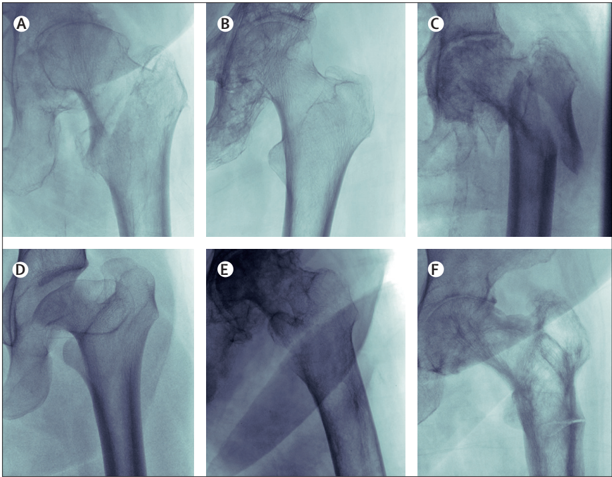
- In the illustrative hip fracture detection audit, the overall error rate was 2.5%, but the error rate for the subset of cases with abnormal bones or joints (Paget's disease and femoral head deformity) was 50%.
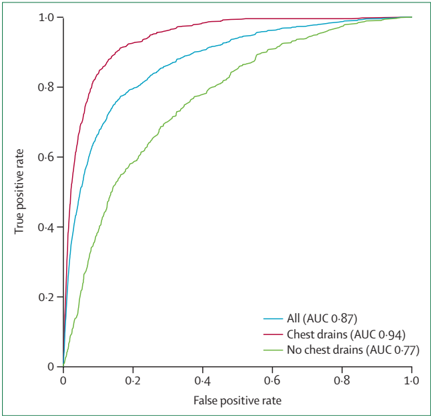
- In the pneumothorax detection example, the model achieved an overall AUC of 0.87, but AUC was 0.94 for cases with chest drains versus 0.77 for cases without, indicating the model learned artifacts of clinical care rather than the pathology.
- The paper reports that 60–70% of human errors in medical imaging are related to perceptual failure, whereas AI is not susceptible to incomplete searches or satisfaction syndrome, so equal-performance AI systems can be expected to produce different errors and clinical outcomes.
Methods
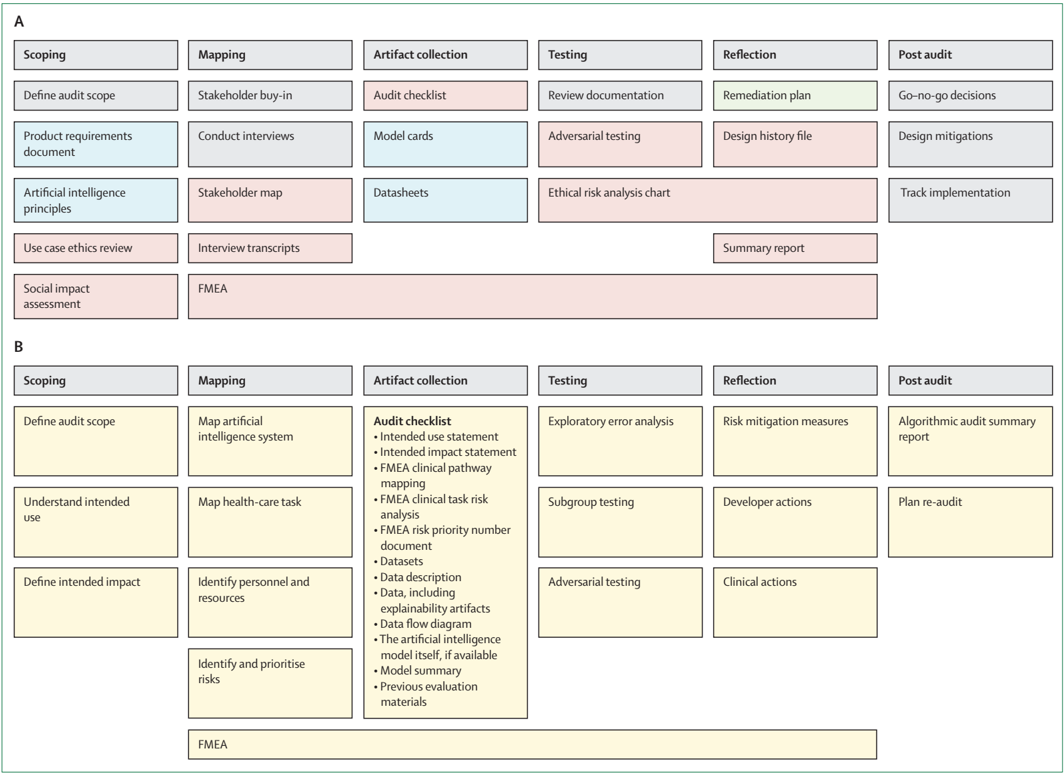
- Design: a conceptual Viewpoint article proposing a framework, not an empirical study; it adapts the SMACTR framework (scoping, mapping, artifact collection, testing, reflection) and applies FMEA principles for risk assessment, prioritisation, and mitigation.
- The framework is presented from two perspectives—developers (who can modify the system) and users (who cannot modify it but can implement deployment-specific risk mitigation)—with a table of actions for each audit stage.
- Testing is described as comprising exploratory error analysis, subgroup testing (patient-specific, task-specific, and exploratory-error-discovered subgroups), and adversarial testing; illustrative examples are drawn from published studies (hip fracture audit, pneumothorax detection, diabetic retinopathy evaluation by Ting and colleagues).
Limitations
- The paper states that FMEA "must be interpreted with care due to issues around reproducibility and incompleteness," and that the risk priority number is not a measure of safety and should not be used with arbitrary acceptability thresholds.
- The paper states that subgroup analysis is not performed to test hypotheses, and that reduced power in subsets plus inflated type 1 error from multiple testing mean results "should not be considered reliable or definitive" and should be confirmed in a sufficiently powered sample.
- The paper states that who should conduct the medical algorithmic audit remains an unanswered question, that the required skills are not taught in combination in standard medical curricula, and that appropriately trained clinicians are rare in both the UK and Australia.
Model-written summary. Check it against the paper before relying on it.
Integrity signals
Registry
Cites
Statistics
Figures
Verification
Claims the paper makes
6 Valid · 7 Not valid · 12 Not checked · 54 Own results and interpretations
Every source the paper cites for this claim was checked and supports it.
In the paper
“For example, an artificial intelligence system might learn to detect surgical skin markings to diagnose skin cancer, rather than looking for features related to the lesion itself.9”
§ The medical algorithmic audit > Introduction
What the sources say
- Supportedcites [9] matched to “Association between surgical skin markings in dermoscopic images and diagnostic performance of a deep learning convolutional neural network for melanoma recognition” (2019) source
The Discussion (page unavailable) says a CNN may associate surgical skin markings with a melanoma diagnosis, and the study found that markings increased false-positive melanoma classifications. The claim presents this as a possibility, not a proven account of how the CNN made every decision; the paper says the underlying mechanism remains unclear. (LLM, conf=0.88)
hedgedstates a possible cause- Asserted: passes — The authors put it forward as true.
- Checkable: passes — It can be checked against evidence.
- Load-bearing: passes — The paper’s conclusions depend on it.
- Based: passes — The paper gives a reason why it holds.
- Supported
Every source the paper cites for this claim was checked and supports it.
In the paper
“Furthermore, this drop in performance might not be obvious at the aggregate level of typical artificial intelligence testing, but rather in subsets of the target cohort or specific strata within the input data, a concept that has been described as hidden stratification.13”
§ The medical algorithmic audit > Introduction
What the sources say
- Supportedcites [13] matched to “Hidden stratification causes clinically meaningful failures in machine learning for medical imaging” (2020) source
Split into 2 atoms — 2 confirmed, 0 partially supported, 0 disputed, 0 misattributed, 0 unverifiable. Expand the claim to see per-atom verdicts.
hedged- Asserted: passes — The authors put it forward as true.
- Checkable: passes — It can be checked against evidence.
- Load-bearing: passes — The paper’s conclusions depend on it.
- Based: passes — The paper gives a reason why it holds.
- Supported
The cited sources support only part of this claim — read each source’s verdict below.
In the paper
“Indeed, the analysis of error cases is a minimum reporting requirement of the SPIRIT-AI (Standard Protocol Items: Recommendations for Interventional Trials-Artificial Intelligence) and CONSORT-AI (Consolidated Standards of Reporting Trials-Artificial Intelligence) guidelines for clinical trial protocols and reports of artificial intelligence interventions.7,8”
§ The medical algorithmic audit > Introduction
What the sources say
- Partly supportedcites [7] matched to “Reporting guidelines for clinical trial reports for interventions involving artificial intelligence: the CONSORT-AI extension” (2020) sourceExperimental — accuracy not yet measured
The Results section’s CONSORT-AI item 19 requires reporting the results of any performance-error analysis where applicable, or explaining why none was planned or done. The Discussion describes CONSORT-AI as minimum reporting guidance, but this paper does not establish the corresponding SPIRIT-AI error-analysis requirement. It also does not require investigators to conduct an error analysis in every trial. (LLM, conf=0.86)
- Partly supportedcites [8] matched to “Guidelines for clinical trial protocols for interventions involving artificial intelligence: the SPIRIT-AI extension” (2020) sourceExperimental — accuracy not yet measured
The Abstract and Discussion describe SPIRIT-AI as minimum reporting guidance that includes error cases. But the Monitoring section (SPIRIT-AI item 22) requires protocols to specify plans to identify and analyze performance errors—or explain why there are no plans—not to report a completed analysis. This paper identifies CONSORT-AI as the companion guideline for trial reports but does not establish its error-analysis requirement. (LLM, conf=0.88)
plain- Asserted: passes — The authors put it forward as true.
- Checkable: passes — It can be checked against evidence.
- Load-bearing: passes — The paper’s conclusions depend on it.
- Based: passes — The paper gives a reason why it holds.
- Partly supported
The cited sources that could be checked couldn’t confirm or dispute this claim.
In the paper
“In the hip fracture detection audit, 20 the discovery of algorithmic errors in cases with abnormal bones prompted an additional labelling exercise of all hips with abnormal bones and joints to find that the error rate in those cases was 50%, compared with 2•5% in the overall dataset (figure 2).”
- Also stated in: § Conclusions · plain
“The overall error rate was 2•5%, but the error rate for this subset was 50%.”
§ The medical algorithmic audit > Subgroup testing
What the sources say
- Could not verifycites [20] matched to “Causality matters in medical imaging” (2020) sourceExperimental — accuracy not yet measured
The Data mismatch sections discuss dataset shift and selection bias, but do not report a hip-fracture detection audit or error rates for abnormal bones and joints. Searches for the audit, the labelling exercise, and the 50% and 2.5% figures found no passage addressing those results; page numbers were not available in our copy. (LLM, conf=0.76)
plainstates an association- Asserted: passes — The authors put it forward as true.
- Checkable: passes — It can be checked against evidence.
- Load-bearing: passes — The paper’s conclusions depend on it.
- Based: passes — The paper gives a reason why it holds.
- Also stated in: § Conclusions · plain
The cited sources that could be checked couldn’t confirm or dispute this claim.
In the paper
“Almost all studies report demographic and non-demographic characteristics of the study population, such as age, sex, ethnicity, socioeconomic status, disease severity, and comorbidities, and some studies also include information on geographical location and study site.”
§ The medical algorithmic audit > Subgroup testing
What the sources say
- Could not verifycites [31] matched to “A deep learning system for differential diagnosis of skin diseases” (2020) sourceExperimental — accuracy not yet measured
Our copy of Liu et al. (2020) contains no statement about what prior studies report: the only passages on demographics describe this study's own dataset (Dataset section — 'metadata such as patient demographic information and medical history'; Importance of input data section — '45 types of non-image metadata (demographic information and medical history)'; Fig. 3 legend — ages, sex, Fitzpatrick skin type) and its 17 sites across 2 U.S. states. Where the paper does characterize earlier work (DISCUSSION), the criticism concerns scope (skin-cancer screening, dermoscopic images), educational datasets and oversimplified labels — not the reporting of age, sex, ethnicity, socioeconomic status, disease severity, comorbidities, or geographical location. Searches on 'demographic characteristics reported', 'ethnicity/sex', 'socioeconomic status, comorbidities, geographical location, study site', and 'lack of reporting/transparency in existing studies' returned nothing addressing the claim's point, so the sweeping 'almost all studies report...' assertion can be neither confirmed nor contradicted from our copy. (LLM, conf=0.72)
- Could not verifycites [32] matched to “AI for radiographic COVID-19 detection selects shortcuts over signal” (2021) sourceExperimental — accuracy not yet measured
In “Evaluation of models on new hospital systems,” the paper recommends routine reporting of metadata on patient and hospital-system confounds; it does not assess how often other studies report population characteristics. “Shortcuts have a variable effect on generalization” discusses patient sex in the authors’ own datasets. Searches for age, ethnicity, socioeconomic status, disease severity, comorbidities, and demographic reporting found no passage supporting the claim that almost all studies report these characteristics. (LLM, conf=0.75)
- Not matchedcites [33]
The reference list we hold has no entry [33].
plain- Asserted: passes — The authors put it forward as true.
- Checkable: passes — It can be checked against evidence.
- Load-bearing: unclear — It is unclear whether the paper’s conclusions depend on it.
- Based: passes — The paper gives a reason why it holds.
- Could not verify
18 more claims
Create a free account to see all 79 claims and to verify the 1 reference still open.
- It may state two separate claims as one. 23
- Probably not a substantial claim. 52
- The quote only partly states this claim. 1
Claims other papers make about this one
Each is checked against this paper’s own text: does it say what the citing paper says it does?
The source backs part of the claim, not all of it — or backs it for a different population, condition or comparison.
In the citing paper
“Research on AI auditing has focused on evaluating whether specific applications meet predefined industry requirements.”
From Is it all hype? ChatGPT’s performance and disruptive potential in the accounting and auditing industries (2024) · cites this paper as Liu et al. 2022
Experimental — accuracy not yet measuredThe cited source says what the claim attributes to it.
In the citing paper
“For instance, researchers have created procedures for auditing AI systems used in recruitment (Kazim et al. 2021), online search (Robertson et al. 2018), and medical diagnostics (Liu et al. 2022).”
From Is it all hype? ChatGPT’s performance and disruptive potential in the accounting and auditing industries (2024) · cites this paper as Liu et al. 2022
Self-check
Percentages, sums and reported differences re-computed from the paper’s own numbers.
Each contradiction between two passages listed here was confirmed by an independent check.
Rated minor: it would not touch a result — a value no result rests on, a p-value that stays on the same side of the significance level, or a conflict that is clerical, resolved elsewhere in the paper, or outside its own findings.
In the paper
§ The medical algorithmic audit > Viewpoint Reflection
“These data are taken from a study by Ting and colleagues 31 and show the performance of their artificial intelligence model stratified by the clinical origin of the data.Reproduced with permission from JAMA 2016; 316: 2402-10.”
§ The medical algorithmic audit > References
“32. Gulshan V, Peng L, Coram M, et al. Development and validation of a deep learning algorithm for detection of diabetic retinopathy in retinal fundus photographs. JAMA 2016; 316: 2402-10.”
Citations
Cites
Gulshan, V., Peng, L., Coram, M., Stumpe, M. C., Wu, D., Narayanaswamy, A., Venugopalan, S., Widner, K., Madams, T., Cuadros, J., et al. (2016) · JAMA · doi:10.1001/jama.2016.17216 · Cited by 7,697
International evaluation of an AI system for breast cancer screening
McKinney, S. M., Sieniek, M., Godbole, V., Godwin, J., Antropova, N., Ashrafian, H., Back, T., Chesus, M., Corrado, G. S., Darzi, A., et al. (2020) · Nature · doi:10.1038/s41586-019-1799-6 · Cited by 3,287
Model Cards for Model Reporting
Mitchell, M., Wu, S., Zaldivar, A., Barnes, P., Vasserman, L., Hutchinson, B., Spitzer, E., Raji, I. D., & Gebru, T. (2019) · Proceedings of the Conference on Fairness, Accountability, and Transparency · doi:10.1145/3287560.3287596 · Cited by 2,681
Clinically applicable deep learning for diagnosis and referral in retinal disease
De Fauw, J., Ledsam, J. R., Romera-Paredes, B., Nikolov, S., Tomasev, N., Blackwell, S., Askham, H., Glorot, X., O’Donoghue, B., Visentin, D., et al. (2018) · Nature Medicine · doi:10.1038/s41591-018-0107-6 · Cited by 2,639
Gebru, T., Morgenstern, J., Vecchione, B., Vaughan, J. W., Wallach, H., Daumé, H., & Crawford, K. (2018) · arXiv · doi:10.48550/arxiv.1803.09010 · Cited by 2,474
Gebru, T., Morgenstern, J., Vecchione, B., Vaughan, J. W., Wallach, H., III, H. D., & Crawford, K. (2021) · Communications of the ACM · doi:10.1145/3458723 · Cited by 2,469
Ting, D. S. W., Cheung, C. Y.-L., Lim, G., Tan, G. S. W., Quang, N. D., Gan, A., Hamzah, H., Garcia-Franco, R., San Yeo, I. Y., Lee, S. Y., et al. (2017) · JAMA · doi:10.1001/jama.2017.18152 · Cited by 2,402
Raji, I. D., Smart, A., White, R. N., Mitchell, M., Gebru, T., Hutchinson, B., Smith-Loud, J., Theron, D., & Barnes, P. (2020) · Proceedings of the 2020 Conference on Fairness, Accountability, and Transparency · doi:10.1145/3351095.3372873 · Cited by 2,245
Liu, X., Faes, L., Kale, A. U., Wagner, S. K., Fu, D. J., Bruynseels, A., Mahendiran, T., Moraes, G., Shamdas, M., Kern, C., et al. (2019) · The Lancet Digital Health · doi:10.1016/s2589-7500(19)30123-2 · Cited by 1,883
Self-citation2013 IEEE 10th International Symposium on Biomedical Imaging
(2013) · doi:10.1109/isbi20048.2013 · Cited by 1,625
Research works printed but not linked: 1
- Topol E. The Topol review: preparing the healthcare workforce to deliver the digital future. National Health Service Health Education England, 2019.
Cited by
Items 201–238 of 238
Ferrara, S. A., & Topaz, M. (2026) · Journal of Pediatric Health Care · doi:10.1016/j.pedhc.2025.12.014 · Cited by 1
The Embodiment Paradox: Integrating Prosthetic Systems to Enhance Human-Machine Integration
Gentile, C., & Gruppioni, E. (2026) · Springer eBooks · doi:10.1007/978-3-032-06713-5_2
From Compliance to Consciousness: Ethical Governance of LLMs in Business Applications Practices
Rismawati, R., Nur, M., Santaria, R., Supriadi, S., & Amir, A. S. (2026) · IGI Global eBooks · doi:10.4018/979-8-3373-3912-2.ch011 · Cited by 1
Hu, C., Shin, S.-Y., Wang, Y., Chen, C., Liu, P., Busuttil, R. A., Wu, Y., McLean, C. A., Shi, H., Kwok, T., et al. (2026) · EBioMedicine · doi:10.1016/j.ebiom.2026.106154
“Although our study primarily focuses on model development and validation, we have aligned it with key principles from the Medical Algorithmic Audit 73 and STANDING Together 74 frameworks by emphasising dataset representativeness, transparency of data sources, and the assessment of potential…”
Experiences of physiotherapists audited by South African medical funding schemes
Lesley, M., van Staden, W., & Mostert, K. (2026) · South African Journal of Physiotherapy · doi:10.4102/sajp.v82i1.2261
“Artificial intelligence can make errors that may result in false positives, leading to audits that may be unjustly conducted (Liu et al. 2022).”
Integration of fairness-awareness into clinical language processing models
Abulibdeh, R., Lin, Y., Ahmadi, S., Sejdić, E., Celi, L. A., Zhao, Q., & Tu, K. (2026) · Communications Medicine · doi:10.1038/s43856-026-01433-9 · Cited by 2
“Achieving long-term accountability requires integrating algorithmic fair-nessaudits 79,80 asaroutinecomponentofmodelevaluationanddeployment.”
Ensuring Ethical and Equitable AI: From Bias Mitigation to Algorithmic Auditing
Rana, R., & Bhambri, P. (2026) · Advances in computational intelligence and robotics book series · doi:10.4018/979-8-2600-0000-7.ch002 · Cited by 2
Chew, B., & Ngiam, K. Y. (2026) · JMIR AI · doi:10.2196/80340
“Pay close attention to performance gaps in specific subgroups (hidden stratification) and systematic algorithmic errors or failure modes [26] [13,30], and the medical algorithmic audit [26]). for Trustworthy Artificial Intelligence] r Postdeployment analysis allows AI systems to be studied as…”
InfluentialVijayasimha, M., & Srikanth, M. (2026) · International Journal of Legal Medicine · doi:10.1007/s00414-026-03769-2
“Medical algorithmic audit provides a structured framework for recording subgroup performance, failure modes, and transparent governance before implementation [5].”
DeepSAM: Self-Awareness to Mitigate Manifestation Shift in Segmentation TasksPreprint
Freitas, S. A., Schmith, J., Zeiser, F. A., da Costa, C. A., & Ramos, G. D. O. (2026) · SSRN Electronic Journal · doi:10.2139/ssrn.6458423
Artificial Intelligence in Proton Therapy: What Works, What Does Not, and What Is Next
Li, H., Yang, M., Ndassi, D. K., Meng, S., & Jia, X. (2026) · The Cancer Journal · doi:10.1097/ppo.0000000000000821 · Cited by 1
Ethical risks and considerations of brain-controlled and neuromodulation technologies
Huang, K., Yang, H., Zhu, S., Chen, Y., Li, T., Zhao, L., Gong, A., Nan, W., Xu, J., & Fu, Y. (2026) · Cognitive Neurodynamics · doi:10.1007/s11571-026-10445-z · Cited by 1
Deng, J., Patel, S. K., Fung, M., Heybati, K., Layard, B., Wang, B., Rubin, B., Simard, T., Hibbert, B., Anderson, T. J., et al. (2026) · BMJ Open · doi:10.1136/bmjopen-2025-108799
“55 56 Subgroup performance and fairness will be audited across sex, age bins and hospital type.”
Leveraging clinical epidemiology concepts to strengthen machine learning fairness evaluations
Guo, L. L., Arciniegas, S. E., Yan, A. P., TOMLINSON, G. A., Beauchemin, M., Pfohl, S. R., & Sung, L. (2026) · Journal of the American Medical Informatics Association · doi:10.1093/jamia/ocag041 · Cited by 1
Dhar, S. R., Alam, M. S., Rony, M. K. K., Rashid, M. M., Shahi, D., Shahidullah, M., Sizan, A. A., Das, S., & Semi, M. M. A. (2026) · International Journal of Developmental Disabilities · doi:10.1080/20473869.2026.2654176 · Cited by 1
Systems biology at the body scale: Toward adaptive digital twins in precision medicine
Montagud, A. (2026) · Current Opinion in Systems Biology · doi:10.1016/j.coisb.2026.100592 · Cited by 1
Geyer, J. D., Gong, J., Cox, P. G., Henderson-Mitchell, R. J., Gomez, C. R., Qureshi, A. I., Branch, S. G., Geisser, S., & Carney, P. R. (2026) · Children · doi:10.3390/children13050602
“Finally, provenance tracking is inconsistent, complicating audit and regulatory evaluation [67].”
Ethical challenges of artificial intelligence in critical care
Saida, I. B., Gaddas, M., & Saad, H. B. (2026) · Elsevier eBooks · doi:10.1016/b978-0-443-36554-6.00023-4
Adapa, K., Metta, M., Kotte, S., Sathuluri, A., Mithal, V., Sethi, R., Kabaniha, G. A., & Mazur, L. M. (2026) · Asia-Pacific Journal of Oncology Nursing · doi:10.1016/j.apjon.2026.100972 · Cited by 2
“21 Bedoya et al. propose that local deployment frameworks should mandate performance monitoring dashboards, trigger-based reassessment protocols, and clear escalation pathways when performance degrades below pre-specified thresholds.”
InfluentialRubeis, G. (2026) · Springer eBooks · doi:10.1007/978-3-032-14301-3_5
Localized AI for stroke care in LMICs: a framework to overcome structural and diagnostic barriers
Liu, Q., Jia, X., He, Y., Hou, Y., Deng, Y., & Yan, Z. (2026) · Frontiers in Public Health · doi:10.3389/fpubh.2026.1859276
“Frameworks must establish clear financial and governance models for continuous maintenance, including periodic online synchronization, safety signal detection, and model retraining to ensure sustained clinical accuracy (85).”
McCradden, M. D., Tng, S., Jeyaseelan, D., Leane, C., Campbell, M., Braund, T., Earle-Bandaralage, L., Ebrahimi, M., Sharma, A., & Tang, J. (2026) · BMJ Open · doi:10.1136/bmjopen-2025-111656
Self-citationAlam, A., Aarif, K. O. M., Begum, S. S., Ahmed, S. S., & Khan, A. M. (2026) · Studies in computational intelligence · doi:10.1007/978-3-032-19543-2_1
Wei, Q., Cui, M., Qi, Y., Zhang, Q., Liu, Z., Yu, C., Hobbs, F. D. R., Christiani, D. C., Li, Y., Zhang, R., et al. (2026) · The Innovation Medicine · doi:10.59717/j.xinn-med.2026.100229
AI agents in drug discovery: A review of evolution, applications, and future directions
Das, S., Ferdaus, M. M., & Dam, T. (2026) · Computer Methods and Programs in Biomedicine · doi:10.1016/j.cmpb.2026.109539 · Cited by 2
Rehman, T., Jarrett, P. C., Lesko, J., Augustine, J. J., Shy, B. D., Sangal, R. B., Genes, N. G., Apakama, D. U., Abbott, E. E., Mehrotra, A., et al. (2026) · Journal of the American College of Emergency Physicians Open · doi:10.1016/j.acepjo.2026.100466
PCSP: Patient-Centric Secret-Sharing Protocol for Privacy-Preserving Biomedical Inference
Wang, Z., Xu, Y., Feng, Y., Guo, S., Tang, X., & Lu, S. (2026) · Lecture notes in computer science · doi:10.1007/978-981-92-3495-0_7
Bridging the Gap — Translating AI in Pathology into Clinical Impact
Su, F.-Y., Marostica, E., Wang, X., Yang, S., Chiang, J.-H., Ogino, S., Golden, J. A., Kather, J. N., Qiu, Y., Chen, D., et al. (2026) · NEJM AI · doi:10.1056/aip2600029
Stobiecka, K. (2026) · Prawo i Bezpieczeństwo · doi:10.4467/29567610pib.26.023.23724
Artificial intelligence and data-driven innovations in medicine
Selvarathinam, A. L. X. R. A., & Azariya, S. D. S. (2026) · Elsevier eBooks · doi:10.1016/b978-0-443-27783-2.00008-9
MUBA: Assuring medical image classifiers with Mix-Up Boundary Analysis
Poulett, W., Byfield, A., Wallace, B., Jose, A., Qayyum, A., Cohen, E. I., Ashraf, S. Q., Qadir, J., & Bilal, M. (2026) · Biomedical Signal Processing and Control · doi:10.1016/j.bspc.2026.111107
A systematic review of standards on bias and data quality from horizontal and vertical perspectives
Schmitz, A., & Poretschkin, M. (2026) · Journal of Data and Information Quality · doi:10.1145/3832313 · Cited by 1
Governing Artificial Intelligence after Deployment in the Medication-Use System
Osei, D., Afriyie, A., & Adu, K. (2025) · Archives of Pharmacy Practice · doi:10.51847/hpznblgkmc
The Right to a Human Reason: Contestability in High-Stakes Clinical Decisions
Mendoza, R., Cruz, I., & Lopez, C. (2026) · Asian Journal of Ethics in Health and Medicine · doi:10.51847/ilmwibqstd
Huy, N. T., Minh, P. Q., & Bich, L. T. (2022) · Journal of Health Informatics and Digital Systems · doi:10.68159/h117919361
Hassan, A., Siddiqui, N., Khan, B., & Malik, S. (2023) · Journal of Health Informatics and Digital Systems · doi:10.68159/v857447659 · Cited by 2
Düffelmeyer, M. (2026) · Advances in computational intelligence and robotics book series · doi:10.4018/979-8-2600-0403-6.ch008
Cantú, E. D., Acharya, M., Berend, J., Rasul, M. G., & Ma, J. (2026) · Companion Publication of the International Conference on Multimodal Interaction (ICMI Companion) · doi:10.1145/3776591.3836730
Metadata
- Authors
- Liu, X., Glocker, B., McCradden, M. M., Ghassemi, M., Denniston, A. K., & Oakden-Rayner, L.
- Affiliations
- University Hospitals Birmingham NHS Foundation Trust (GB)
- Imperial College London (GB)
- Massachusetts Institute of Technology (US)
- Venue
- The Lancet Digital Health
- Publisher
- Elsevier BV
- Published
- 2022-05
- Volume
- 4
- Issue
- 5
- Pages
- e384-e397
- ISSN
- 2589-7500 (ISSN-L)
- OpenAlex
- W4223506650
- Semantic Scholar
- abe10881a02eb68ba0ff7ef1b20a98624a49cc83
- Cited by
- 266
- References
- 44
- Citations by year
- 2026: 67 · 2025: 54 · 2024: 63 · 2023: 61 · 2022: 21
- FWCI
- 3.25
- Type
- journal article
- Language
- en
- Update notices
- erratum (2022-06-01)
- Open access
- gold
- doi.org
- Licence
- cc-by
- www.elsevier.com/tdm/userlicense/1.0/ (tdm)
- www.elsevier.com/legal/tdmrep-license (tdm)
- creativecommons.org/licenses/by/4.0/ (vor)
- Locations
- The Lancet Digital Health (publishedVersion, cc-by)
- PubMed (publishedVersion)
- University of Birmingham Research Portal (University of Birmingham) (submittedVersion, cc-by)
- Spiral (Imperial College London) (submittedVersion, cc-by)
- Funders
- Wellcome Trust (200141/Z/15/Z, /Z/15/Z)
- Alan Turing Institute (TU/ASG/R-SPEH-113)
- H2020 European Research Council (757173)
- Topics
- Health Sciences › Medicine › Health Informatics › Artificial Intelligence in Healthcare and Education
- Physical Sciences › Computer Science › Artificial Intelligence › Explainable Artificial Intelligence (XAI)
- Physical Sciences › Computer Science › Artificial Intelligence › Ethics and Social Impacts of AI
- Keywords
- algorithmic auditing, artificial intelligence in healthcare, algorithmic errors, medical device safety, spurious correlations, generalizability, explainability, adversarial testing, safety monitoring, user-developer collaboration, feedback mechanisms, algorithmic bias
- MeSH terms
- Artificial Intelligence, Delivery of Health Care, Health Facilities
About these checks
Registry, retraction, Cites and statistics results are computed, not judged, with one exception: a printed reference that no index lists is read once by a model before it counts as a citation error. Claims are extracted by a model and kept only when their quote appears verbatim in the text; each cited source is then checked, with a model’s help, for whether it says what the claim relies on. Those verdicts can be wrong — read the claim’s quote and the cited source before relying on one.
The claim verdicts this report counts are experimental: their accuracy is not yet measured.
A language model drew the claims from the paper on 2026-10-07, under version 3 of the claim definition (model deepseek-v4.1-flash, prompt extract-v3).
A second model labelled each claim on 2026-10-07 (model jev-1.13-20260917, definition revision gold-guideline-v0.2).
Cited sources are checked with a language model’s help (gpt-6-sol and qwen3.8-omni-flash).
Statistics and arithmetic are recomputed, not judged.
Confidence bands are shown only for fields calibrated on our annotated test set. None is calibrated yet, so no band is shown.
What counts as a claim ›How we measure confidence ›How we check this ›
Are you an author, or do you see a problem with this page? Request a review
Data sources
Bibliographic data: Semantic Scholar, OpenAlex, Crossref.
Contains information from the Semantic Scholar Academic Graph Datasets, made available under the ODC Attribution License (ODC-BY 1.0).
Semantic Scholar’s data is described in: Kinney, R., et al. (2023). The Semantic Scholar Open Data Platform. arXiv:2301.10140.
