

Combining the strengths of radiologists and AI for breast cancer screening: a retrospective analysis
Open accessThe DOI matches its Crossref record; 31 of the 31 references it cites were found in a registry or an index.
Abstract
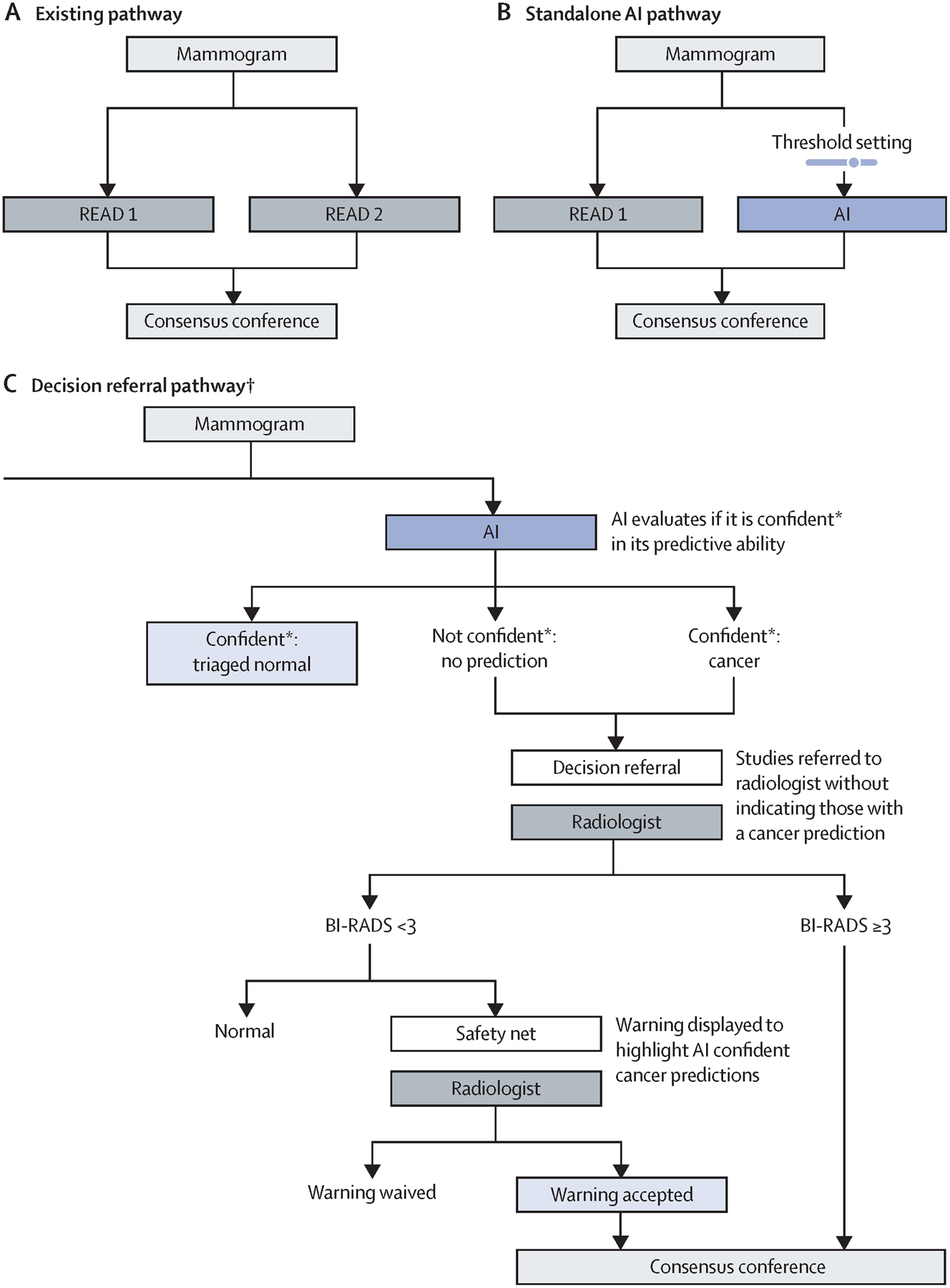
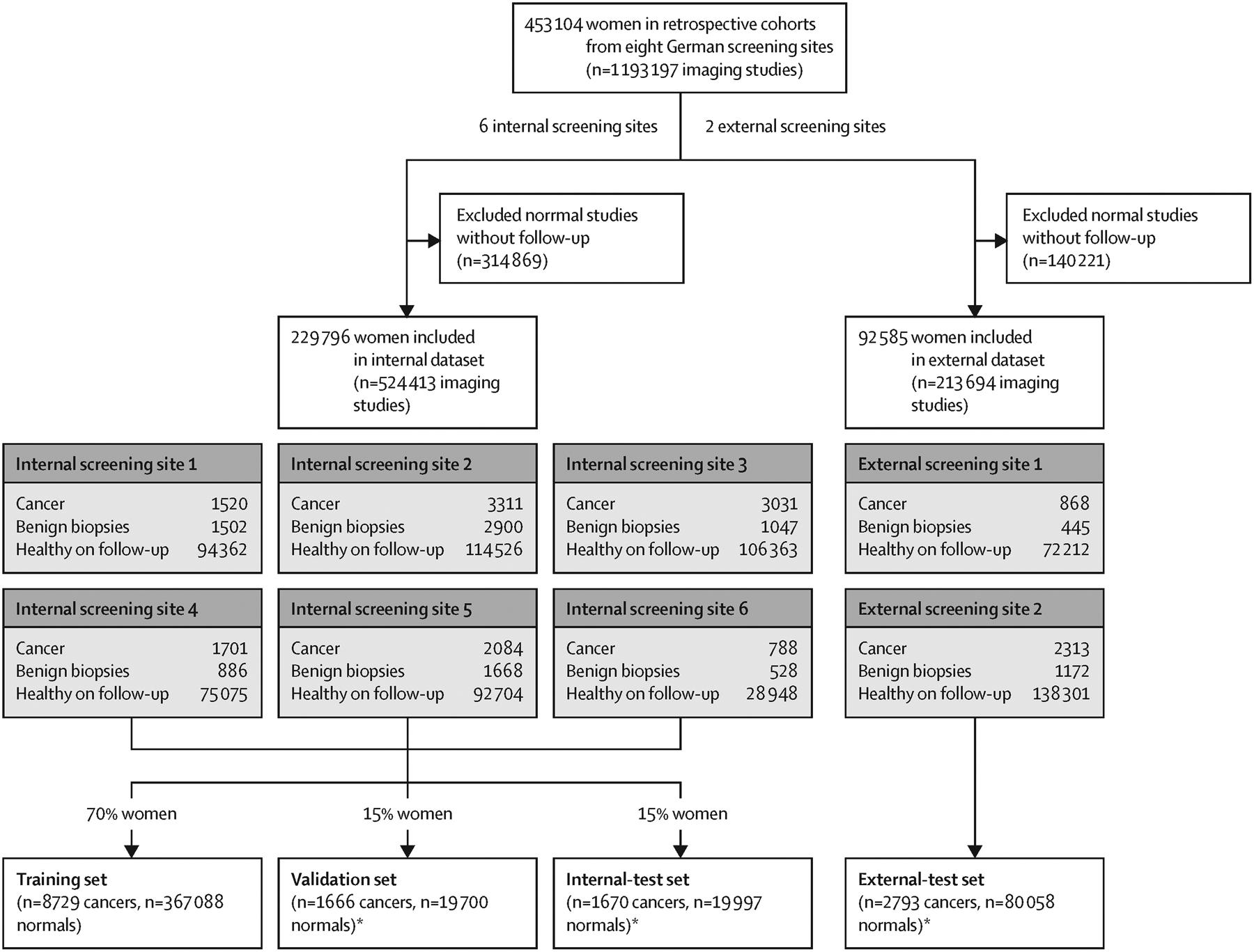
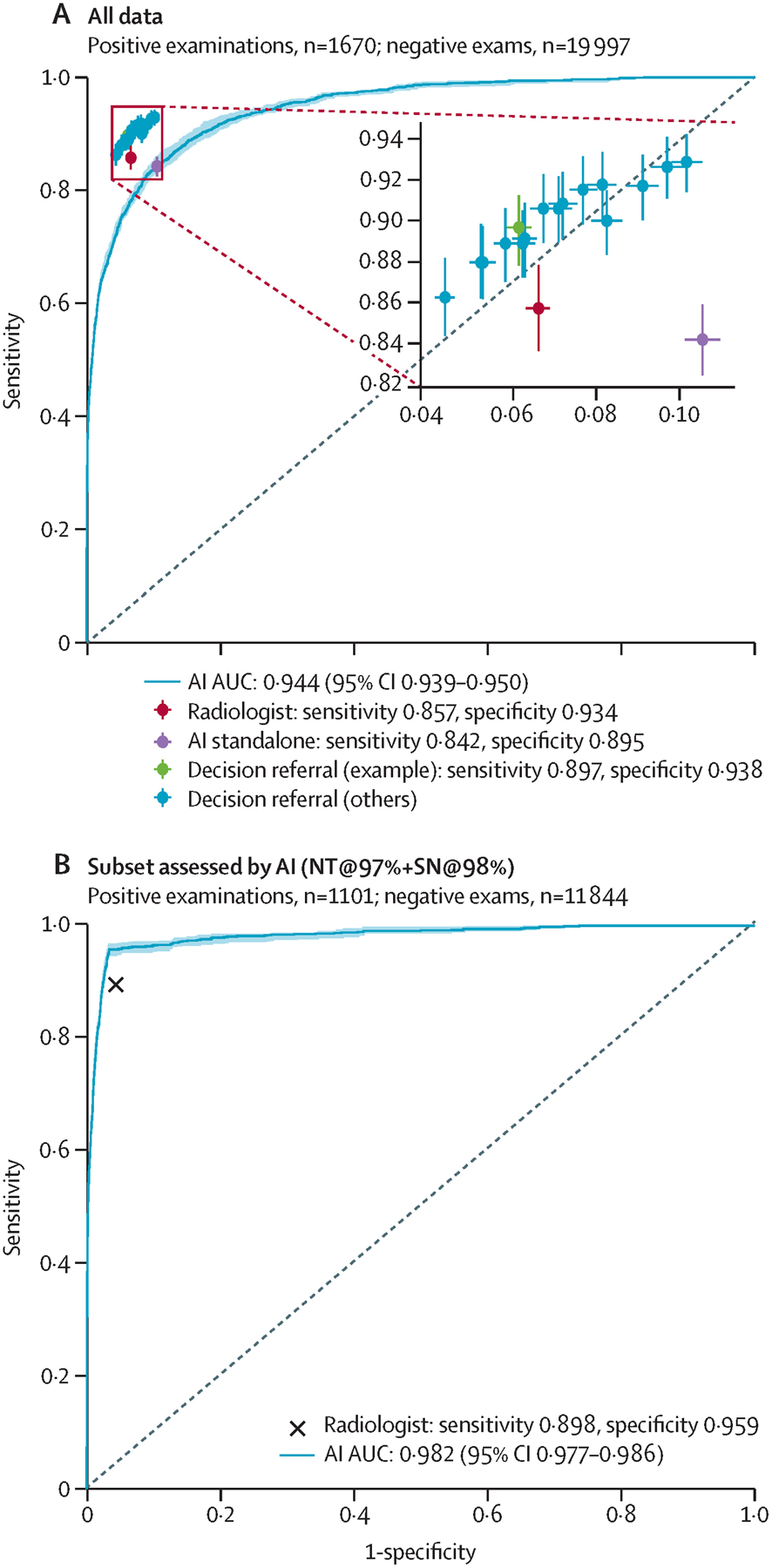
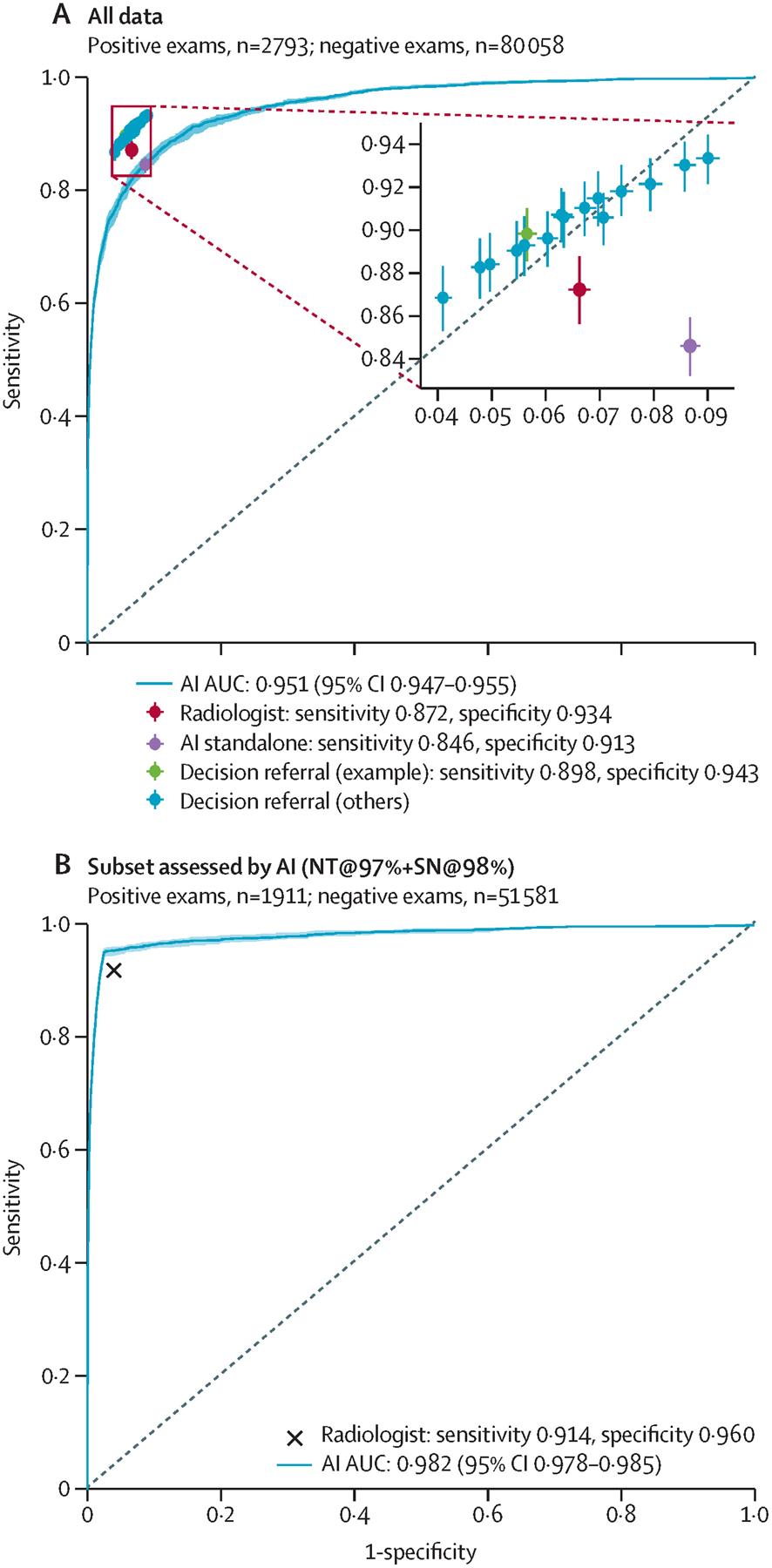
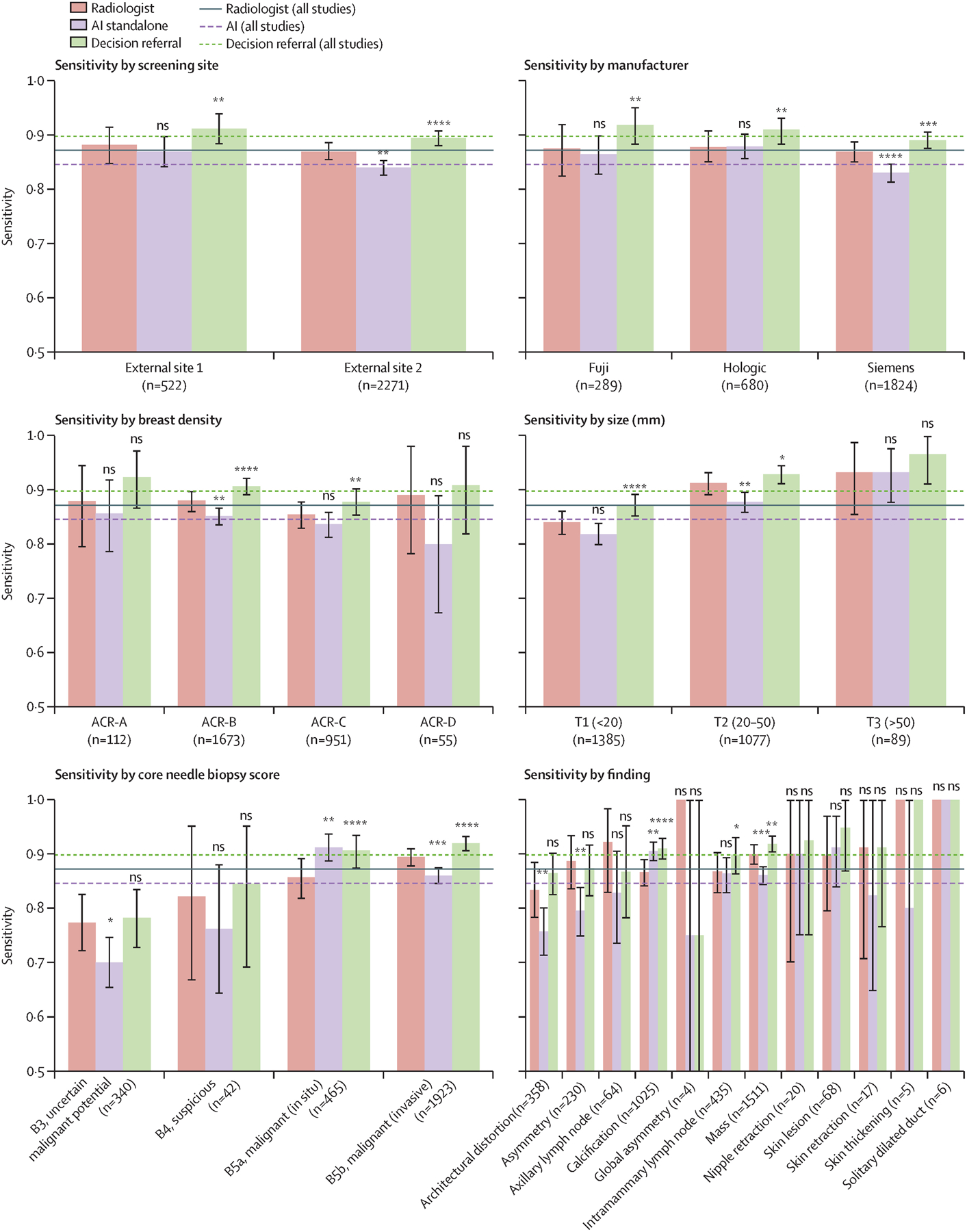
BACKGROUND: We propose a decision-referral approach for integrating artificial intelligence (AI) into the breast-cancer screening pathway, whereby the algorithm makes predictions on the basis of its quantification of uncertainty. Algorithmic assessments with high certainty are done automatically, whereas assessments with lower certainty are referred to the radiologist. This two-part AI system can triage normal mammography exams and provide post-hoc cancer detection to maintain a high degree of sensitivity. This study aimed to evaluate the performance of this AI system on sensitivity and specificity when used either as a standalone system or within a decision-referral approach, compared with the original radiologist decision. METHODS: We used a retrospective dataset consisting of 1 193 197 full-field, digital mammography studies carried out between Jan 1, 2007, and Dec 31, 2020, from eight screening sites participating in the German national breast-cancer screening programme. We derived an internal-test dataset from six screening sites (1670 screen-detected cancers and 19 997 normal mammography exams), and an external-test dataset of breast cancer screening exams (2793 screen-detected cancers and 80 058 normal exams) from two additional screening sites to evaluate the performance of an AI algorithm on sensitivity and specificity when used either as a standalone system or within a decision-referral approach, compared with the original individual radiologist decision at the point-of-screen reading ahead of the consensus conference. Different configurations of the AI algorithm were evaluated. To account for the enrichment of the datasets caused by oversampling cancer cases, weights were applied to reflect the actual distribution of study types in the screening programme. Triaging performance was evaluated as the rate of exams correctly identified as normal. Sensitivity across clinically relevant subgroups, screening sites, and device manufacturers was compared between standalone AI, the radiologist, and decision referral. We present receiver operating characteristic (ROC) curves and area under the ROC (AUROC) to evaluate AI-system performance over its entire operating range. Comparison with radiologists and subgroup analysis was based on sensitivity and specificity at clinically relevant configurations. FINDINGS: The exemplary configuration of the AI system in standalone mode achieved a sensitivity of 84·2% (95% CI 82·4-85·8) and a specificity of 89·5% (89·0-89·9) on internal-test data, and a sensitivity of 84·6% (83·3-85·9) and a specificity of 91·3% (91·1-91·5) on external-test data, but was less accurate than the average unaided radiologist. By contrast, the simulated decision-referral approach significantly improved upon radiologist sensitivity by 2·6 percentage points and specificity by 1·0 percentage points, corresponding to a triaging performance at 63·0% on the external dataset; the AUROC was 0·982 (95% CI 0·978-0·986) on the subset of studies assessed by AI, surpassing radiologist performance. The decision-referral approach also yielded significant increases in sensitivity for a number of clinically relevant subgroups, including subgroups of small lesion sizes and invasive carcinomas. Sensitivity of the decision-referral approach was consistent across the eight included screening sites and three device manufacturers. INTERPRETATION: The decision-referral approach leverages the strengths of both the radiologist and AI, demonstrating improvements in sensitivity and specificity surpassing that of the individual radiologist and of the standalone AI system. This approach has the potential to improve the screening accuracy of radiologists, is adaptive to the requirements of screening, and could allow for the reduction of workload ahead of the consensus conference, without discarding the generalised knowledge of radiologists. FUNDING: Vara.
Overview
The claims and statistics of this paper haven’t been checked yet.
Free: it reads the open-access text and checks the first 5 claims that cite a source we can check. Create a free account to check every claim.
Integrity signals
Registry
Cites
Statistics
Figures
Verification
Claims the paper makes
The claims and statistics of this paper haven’t been checked yet.
Free: it reads the open-access text and checks the first 5 claims that cite a source we can check. Create a free account to check every claim.
Self-check
Percentages, sums and reported differences re-computed from the paper’s own numbers.
The self-check needs the paper’s full text.
Citations
Cites
An Introduction to the Bootstrap
Efron, B., & Tibshirani, R. J. (1994) · doi:10.1201/9780429246593 · Cited by 40,500
A survey on deep learning in medical image analysis
Litjens, G., Kooi, T., Bejnordi, B. E., Setio, A. A. A., Ciompi, F., Ghafoorian, M., van der Laak, J. A. W. M., van Ginneken, B., & Sánchez, C. I. (2017) · Medical Image Analysis · doi:10.1016/j.media.2017.07.005 · Cited by 15,332
An Introduction to Statistical Learning
James, G., Witten, D., Hastie, T., & Tibshirani, R. (2013) · Springer Texts in Statistics · doi:10.1007/978-1-4614-7138-7 · Cited by 12,106
Simple and Scalable Predictive Uncertainty Estimation using Deep Ensembles
Lakshminarayanan, B., Pritzel, A., & Blundell, C. (2016) · arXiv · doi:10.48550/arxiv.1612.01474 · Cited by 3,666 · cited 1×
“Furthermore, decision referral maintained or improved radiologist specificity across all device manufacturers (appendix pp 16, 17).”
International evaluation of an AI system for breast cancer screening
McKinney, S. M., Sieniek, M., Godbole, V., Godwin, J., Antropova, N., Ashrafian, H., Back, T., Chesus, M., Corrado, G. S., Darzi, A., et al. (2020) · Nature · doi:10.1038/s41586-019-1799-6 · Cited by 3,287
Shortcut learning in deep neural networks
Geirhos, R., Jacobsen, J.-H., Michaelis, C., Zemel, R., Brendel, W., Bethge, M., & Wichmann, F. A. (2020) · Nature Machine Intelligence · doi:10.1038/s42256-020-00257-z · Cited by 2,224 · cited 1×
“To verify that the achieved performance of the algorithm was not caused by shortcut learning 19 from signals specific to those six screening sites, but rather generalised to different screening sites, we supplemented this evaluation with an evaluation on out-of-distribution data from two additional…”
European guidelines for quality assurance in breast cancer screening and diagnosis
Amendoeira, I., Perry, N., Broeders, M. J. M., de Wolf, C., Törnberg, S., Holland, R. D., & von Karsa, L. (2013) · Zurich Open Repository and Archive (University of Zurich) · doi:10.2772/13196 · Cited by 1,556
Perry, N., Broeders, M., de Wolf, C., Törnberg, S., Holland, R., & von Karsa, L. (2008) · Annals of Oncology · doi:10.1093/annonc/mdm481 · Cited by 1,020
Diagnostic accuracy of deep learning in medical imaging: a systematic review and meta-analysis
Aggarwal, R., Sounderajah, V., Martin, G., Ting, D. S. W., Karthikesalingam, A., King, D., Ashrafian, H., & Darzi, A. (2021) · npj Digital Medicine · doi:10.1038/s41746-021-00438-z · Cited by 946
Detecting and classifying lesions in mammograms with Deep Learning
Ribli, D., Horváth, A., Unger, Z., Pollner, P., & Csabai, I. (2018) · Scientific Reports · doi:10.1038/s41598-018-22437-z · Cited by 696
Cited by
Items 101–200 of 277
Sossavi, E., Roy, C., & Molière, S. (2026) · European Journal of Radiology Open · doi:10.1016/j.ejro.2026.100727 · Cited by 11
“Triage workflows (gate-keeper [15,27], decision-referral [20,21] and MASAI-type risk allocation [19]) preserved cancer detection — RR 1.02 (0.98 – 1.07) — while reducing recalls by 11 % — RR 0.89 (0.82 – 0.96).”
InfluentialA multimodal uncertainty-aware AI system optimizes ovarian cancer risk assessment workflow
Wang, X., Lv, X., Wang, J., Zou, L., Chen, Z., Zhao, R., Zhao, L., Zhao, M., Zhang, X., Zhang, B., et al. (2025) · npj Digital Medicine · doi:10.1038/s41746-025-01986-4 · Cited by 11
“ThechallengeofUQin medical AI extends beyond technical implementation, and while existing approacheshaveshownsuccessinsingle-modalityapplications 24 – 27 , ovarian cancerdiagnosispresentsuniquemultimodal challenges.”
AI Should Read Mammograms Only When Confident: A Hybrid Breast Cancer Screening Reading Strategy
Verboom, S. D., Kroes, J., Pires, S., Broeders, M. J. M., & Sechopoulos, I. (2025) · Radiology · doi:10.1148/radiol.242594 · Cited by 11
AI in breast cancer screening: a critical overview of what we know
Raya-Povedano, J. L. (2023) · European Radiology · doi:10.1007/s00330-023-10530-5 · Cited by 11
“In general, the conclusion of these publications is that the best application of AI is in combination with human readings, either by replacing one reader [3, 4] or by including AI in a decision algorithm involving the reader [5].”
BackgroundMethodAbdollahifard, S., Farrokhi, A., & Mowla, A. (2022) · Journal of NeuroInterventional Surgery · doi:10.1136/jnis-2022-019627 · Cited by 10
“44 45 The implications oare also observed to be highly appliable in neuroradiology since AI models have proven to improve the metrics of physicians when used as an assistant tool.”
BackgroundChen, I. E., Joines, M. M., Capiro, N. M., Dawar, R., Sears, C., Sayre, J. W., Chalfant, J. S., Fischer, C. P., Hoyt, A. C., Hsu, W. W. Y., et al. (2025) · American Journal of Roentgenology · doi:10.2214/ajr.25.32889 · Cited by 10
Albinsaad, L. S., Almubarak, E. A., Balkhair, R. M. A., Almana, K. A., Almuallim, R. M. A., Alkhamis, H. Y. H., & Alessa, M. Y. (2025) · Current Topics in Nutraceutical Research · doi:10.37290/ctnr.v23i2.24 · Cited by 10
Li, H., Gao, S., Wu, D., Zhu, M., Hu, Z., Fang, K., Chen, X., Ni, Z., Li, J., Zhao, B., et al. (2024) · International Journal of Medical Informatics · doi:10.1016/j.ijmedinf.2024.105765 · Cited by 10
Habli, I., Sujan, M. A., & Lawton, T. (2024) · Future Healthcare Journal · doi:10.1016/j.fhj.2024.100179 · Cited by 9
“35 Rather than teaming the human and AI, the AI’s responsibilities are bounded by what can be assured to be safe – and the human occupies the rest of the decision space as they always have; decisions made by the AI are not rechecked by a human.”
BackgroundAdvanced Artificial Intelligence Methods for Medical Applications
Siriborvornratanakul, T. (2023) · Lecture notes in computer science · doi:10.1007/978-3-031-35748-0_24 · Cited by 9
Omori, M., Basnayake, P., Frazer, H. M. L., Keogh, L. A., Kunicki, K., & Lippey, J. (2025) · Qualitative Health Research · doi:10.1177/10497323251351521 · Cited by 9
“Previous retrospective and prospective studies show that AI interpretation of mammograms can surpass the standalone performance of radiologists and help reduce radiologists ’ reading volumes (Dembrower et al., 2023; Frazer et al., 2024; Larsen et al., 2022; Leibig et al., 2022).”
AI-supported approaches for mammography single and double reading: A controlled multireader study
Brancato, B., Magni, V., Saieva, C., Risso, G. G., Buti, F., Catarzi, S., Ciuffi, F., Peruzzi, F., Regini, F., Ambrogetti, D., et al. (2025) · European Journal of Radiology · doi:10.1016/j.ejrad.2025.112101 · Cited by 9
The use of computer vision for the mammography preventive research
Arzamasov, K. M., Vasilev, Y. A., Vladzymyrskyy, A. V., Omelyanskaya, O. V., Bobrovskaya, T., Семенов, С. С., Четвериков, С. Ф., Kirpichev, Y., Pavlov, N. A., & Андрейченко, А. Е. (2023) · Russian Journal of Preventive Medicine · doi:10.17116/profmed202326061117 · Cited by 9
Yu, S., Young, C. Y., Chan, Y., Chan, Y., Tsoi, C., Choi, M. N., Chan, T., Leung, J. C. S., Chu, C. W., Hung, E. H. Y., et al. (2024) · Hong Kong Medical Journal · doi:10.12809/hkmj2310920 · Cited by 9
Infherno: End-to-end Agent-based FHIR Resource Synthesis from Free-form Clinical Notes
Frei, J., Feldhus, N., Raithel, L., Roller, R., Meyer, A., & Krämer, F. (2026) · Conference of the European Chapter of the Association for Computational Linguistics · doi:10.18653/v1/2026.eacl-demo.13 · Cited by 9
“This limits usability for tasks such as retrospective analysis or study planning with multiple queries over the same data (Coromilas et al., 2021; Leibig et al., 2022).”
Cortes-Rojas, F. D., Hernández-Rodríguez, Y. M., Bayareh-Mancilla, R., & Cigarroa-Mayorga, O. E. (2024) · Diagnostics · doi:10.3390/diagnostics14192144 · Cited by 9
Enhancing Efficiency with an AI-Augmented Clinician in Neurology
Kapadia, K., Ruwali, S., Malav, T., Seshadri, S., Seidmann, A. A., Press, D. Z., & Kolachalama, V. B. (2024) · Aging and Disease · doi:10.14336/ad.2024.1249 · Cited by 8
“Multiple studies have shown that AI assistance can significantly improve clinical performance compared to clinicians working alone, such as in the context of breast cancer [9-11], fracture detection [12, 13], and other conditions [14].”
Steinhauser, S., & Welsch, S. (2025) · Health Policy · doi:10.1016/j.healthpol.2025.105444 · Cited by 8
Varela, M. R. V., Ferreira, F. A. F., Ferreira, N. C. M. Q. F., & Correia, R. J. C. (2023) · International Transactions in Operational Research · doi:10.1111/itor.13336 · Cited by 8
Darvish, M., Holst, J.-H., & Bick, M. (2024) · Hawaii International Conference on System Sciences (HICSS) · doi:10.24251/hicss.2024.402 · Cited by 8
Bassi, E., Russo, A., Oliboni, E. S., Zamboni, F., Santis, C. D., Mansueto, G., Montemezzi, S., & Foti, G. (2023) · La radiologia medica · doi:10.1007/s11547-023-01751-1 · Cited by 8
“Many of these works have used only conventional mammography [13, 14, 16, 29], while others, such as ours, included images acquired by tomosynthesis.”
InfluentialThe case for delegated AI autonomy for Human AI teaming in healthcarePreprint
Jia, Y., Evans, H., Porter, Z., Graham, S., McDermid, J. A., Lawton, T., Snead, D. R. J., & Habli, I. (2025) · White Rose Research Online (University of Leeds, The University of Sheffield, University of York) · doi:10.48550/arxiv.2503.18778 · Cited by 8
“…using AI to autonomously handle a subset of patient cases, guided by the AI’s confidence score in its prediction or recommendation, can improve overall diagnostic performance, e.g. improvements of 2.6% in sensitivity and 1.0% in specificity have been achieved compared with unaided radiologists 10 .”
InfluentialFolkmedical Technologies and the Sociotechnical Systems of Healthcare
Schoenherr, J. R. (2022) · IEEE Technology and Society Magazine · doi:10.1109/mts.2022.3197273 · Cited by 7
“Rather than assuming that autonomous operations are achievable or even desirable, it is perhaps better to focus on how the interaction between human and nonhuman agents should be structured within SSHs [62], [63].”
BackgroundA Narrative Review of the Use of Artificial Intelligence in Breast, Lung, and Prostate Cancer
Patel, K., Huang, S., Rashid, A., Varghese, B. A., & Gholamrezanezhad, A. (2023) · Life · doi:10.3390/life13102011 · Cited by 7
“However, the use of both an AI system and a reading radiologist increased the sensitivity and specificity by 2.6% and 1.0%, respectively, when compared with a sole reading radiologist [26].”
BackgroundResultInfluentialAI at work: understanding its uses and consequences on work activities and organization in radiology
Gamkrelidze, T., Zouinar, M., & Barcellini, F. (2024) · AI & Society · doi:10.1007/s00146-024-01951-x · Cited by 7
“Studies are exploring how AI and radiologists might be “combined”, “collaborate” or “work together” to achieve better performance (Lai et al. 2021; Leibig et al. 2022; Reverberi et al. 2022; Tschandl et al. 2020; Wu et al. 2020), but most of them are experimental or based on the retrospective…”
The Effect of AI on the Radiologist Workforce: A Task-Based AnalysisPreprint
Langlotz, C. P. (2025) · medRxiv · doi:10.64898/2025.12.20.25342714 · Cited by 7
“Several studies have shown that a subset of radiology studies can be identified by AI that are almost certainly normal and require no further human review, including up to 50% of screening mammograms [43,44] and up to 40% of outpatient radiographs [45,46].”
Mansour, S. M., Sweed, E. M. M., Gomaa, M. M. M., Hussein, S. A., Abdallah, E., Nada, Y. M. A. I., Kamal, R. M., Mohamed, G., Taha, S. N., & Moustafa, A. F. I. (2024) · The Egyptian Journal of Radiology and Nuclear Medicine · doi:10.1186/s43055-024-01353-5 · Cited by 7
Ogu, J. C., Ozcan, B. B., Doğan, B. E., Xi, Y., & Knippa, E. E. (2025) · Breast Cancer Research and Treatment · doi:10.1007/s10549-025-07870-9 · Cited by 7
Waugh, J., Evans, J., Miocevic, M., Lockie, D., Aminzadeh, P., Lynch, A., & Bell, R. J. (2023) · European Radiology · doi:10.1007/s00330-023-10396-7 · Cited by 7
Goh, S. S. N., Du, H. Y., Tan, L. Y., Seah, E., Lau, W. K., Ng, A. H. Z., Lim, D. S. W., Ong, H. Y., Lau, S., Tan, Y. L., et al. (2025) · JMIR Formative Research · doi:10.2196/66931 · Cited by 7
“This distinction highlights the complementary strengths of human radiologists and AI [32].”
Lin, Y., Cheng, M., Wu, C., Huang, Y., Zhu, T., Li, J., Gao, H., & Wang, K. (2024) · The Lancet Regional Health - Western Pacific · doi:10.1016/j.lanwpc.2024.101254 · Cited by 6
“113 A decision-referral approach was proposed to leverage the strengths of both the radiologist and AI into breast cancer screening, 123 allowing AI to automatically handle high-certainty assessments while referring uncertain cases to radiologists.”
Zhang, P., Ye, Z., Wei, R., Niu, H., Li, H., Wang, M., Xue, P., & Riggs, S. L. (2025) · Applied Ergonomics · doi:10.1016/j.apergo.2025.104663 · Cited by 6
Warner‐Smith, M., Ren, K., Mistry, C., Walton, R., Roder, D. M., Bhola, N., McGill, S., & O'Brien, T. A. (2024) · BMJ Open · doi:10.1136/bmjopen-2023-082350 · Cited by 6
Hovda, T., Larsen, M., Bergan, M. B., Gjesvik, J., Akslen, L. A., & Hofvind, S. S. H. (2025) · European Radiology · doi:10.1007/s00330-025-11521-4 · Cited by 6
Amokrane, K., Marot, A., Meddeb, M., Dussartre, M., Crochepierre, L., Rozier, A., Renoir, N., Gosselin, S., Hervé, G., Khouadjia, M., et al. (2024) · HAL · Cited by 6
Empirical Optimal Risk to Quantify Model Trustworthiness for Failure Detection
Ao, S., Rüger, S., & Siddharthan, A. (2023) · CEUR Workshop Proceedings · doi:10.48550/arxiv.2308.03179 · Cited by 6
“Despite the wide use of these metrics for such threshold-independent performance evaluation [21, 22, 17], [11] point out that AUROC and AUPR can cause misleading and meaningless results for classification tasks with soft-max function.”
BackgroundAdvancements and Challenges in Breast Cancer: A Comprehensive Review
Sonalika, S., Mishra, S., Mahapatro, S., & Sahoo, D. (2023) · Medical Research Archives · doi:10.18103/mra.v11i6.3944 · Cited by 6
Virtual medicine: medical AI in human health and diseases
Zhang, C., Wang, F.-X., Tang, X., Li, J.-L., Ding, N., Hong, Y., Song, P., Bai, L., & Su, J. (2026) · Military Medical Research · doi:10.1016/j.mmr.2026.100012 · Cited by 5
“This collaboration improved both sensitivity and specificity beyond what either could achieve alone [64].”
Raposo, D. R. A., Júnior, J. S. A., da Silva, D. T. O., Alves, R. D. A., dos Santos, D. C. M., Alves, T. M., da Silva, J. K. S., Aragão, S. F., & Farias, C. M. S. (2024) · Contribuciones a las Ciencias Sociales · doi:10.55905/revconv.17n.7-417 · Cited by 5
Digital Healthcare: Technologies, Technical and Design Challenges
Mascarenhas, E., Abboute, A., Wayne, R., & Kozlakidis, Z. (2024) · Sustainable development goals series · doi:10.1007/978-3-031-62332-5_20 · Cited by 5
Liang, Y., Wei, Z., Yi, D., Chen, X., Siyao, D. U., Wong, C., Xu, Z., Gao, W., Han, C., Chen, K., et al. (2026) · Nature Communications · doi:10.1038/s41467-026-69212-7 · Cited by 5
Martinović, I., Mao, S., Dousty, M., Li, W., Djukanović, M., Colak, E., & Sejdić, E. (2025) · FACETS · doi:10.1139/facets-2024-0229 · Cited by 5
Twilt, J. J., Saha, A., Bosma, J. S., Giannarini, G., Padhani, A. R., Yakar, D., Elschot, M., Veltman, J., Fütterer, J. J., Huisman, H. J., et al. (2026) · Radiology Imaging Cancer · doi:10.1148/rycan.250461 · Cited by 5
Artificial Intelligence in Healthcare with Special Consideration in Radio Imaging
Bandla, M. S., Liju, A. M., Luharia, A. A., & Mishra, G. (2023) · DMIHER International Conference on Artificial Intelligence in Healthcare, Education and Industry (IDICAIHEI) · doi:10.1109/idicaiei58380.2023.10406913 · Cited by 5
“The integration of AI algorithms in this field has the potential to improve the accuracy, efficiency, and effectiveness of breast cancer screening and diagnosis [38].”
MethodYan, Y., Liu, Y., Yao, J., Sui, L., Chen, C., Jiang, T., Liu, X., Wang, Y., Ou, D., Chen, J., et al. (2024) · British Journal of Radiology · doi:10.1093/bjr/tqae147 · Cited by 5
Ma, B., Wu, G., Zhu, H., Liu, Y., Hu, W., Zhao, J., Liu, Y., & Liu, Q. (2025) · Breast Cancer Targets and Therapy · doi:10.2147/bctt.s483496 · Cited by 5
“7,8 The application of computer software not only saves the examination time for ultrasound doctors but also makes up for some of the shortcomings of beginners’ experience and skills.”
Zouinar, M., Amokrane, K., Rousseaux, V., & Vallet, F. (2023) · HAL · Cited by 5
de Araújo, M., Almeida, G., & Nunes, J. L. (2022) · Minds and Machines · doi:10.1007/s11023-024-09660-6 · Cited by 4
“AI collaborators are increasingly knowledgeable (sometimes to a superhuman level) in areas such as medical image analysis, patent law, or biology (Litjens et al., 2017; Jumper et al., 2021; George & Walsh, 2022; Leibig et al., 2022 ).”
Kernbach, J. M., Schroeder, U., Hakvoort, K., Ort, J., Hamou, H. A., Bzdok, D., Temel, Y., Kubben, P., Weyland, C. S., Wiesmann, M., et al. (2025) · npj Precision Oncology · doi:10.1038/s41698-025-01183-2 · Cited by 4
“Instead, hybrid approaches that combine human expertise with AI capabilities have shown greater promise across various clinical applications 39 – 41 .”
E-norms and AI in clinical neurophysiology
Jabre, J. F. (2024) · Clinical Neurophysiology Practice · doi:10.1016/j.cnp.2024.12.001 · Cited by 4
Eckhoff, J. A., Fuchs, H. F., & Meireles, O. R. (2023) · Die Onkologie · doi:10.1007/s00761-023-01318-9 · Cited by 4
“In der Auswertung von Mammographiescreenings zeigt die Kombination von KI-gestützter Software und klinischer Beurteilung eine deutlich verringerte Rate an falsch-negativen Befunden [5], in der Ophthalmologie wird KI zur Optimierung der Retinopathiediagnostik [6] eingesetzt sowie in der Dermatologie im Rahmen des Melan…”
Lu, C., Tan, T., Yu, L., MohammadiNasab, P., Zhang, T., Zhang, H., Soryani, M., Mann, R. M., Kozegar, E., & Bao, L. (2025) · Medical Physics · doi:10.1002/mp.70018 · Cited by 3
“33,34 However, beyond evaluating AI as a stand-alone reader,it is equally important to understand how CADx systems influence radiologists’ decision-making when used in an assistive role.”
Artificial Intelligence-based Mammogram Analysis for Early DetectionPreprint
Ye, S. (2023) · Preprints.org · doi:10.20944/preprints202312.1054.v1 · Cited by 3
Health Care in the Information Society: Volume 1 - From Adventure of Ideas to Anarchy of Transition
Ingram, D. (2023) · Open Book Publishers · doi:10.11647/obp.0335 · Cited by 3
On the Interplay of Transparency and Fairness in AI-Informed Decision-Making
Schoeffer, J. (2023) · Repository KITopen (Karlsruhe Institute of Technology) · doi:10.5445/ir/1000164741 · Cited by 3
Lu, J., Xu, X., Zhang, Y., Zhuang, K., Fang, T., Zhang, C., Chen, K., Huang, X., & Li, Y. (2025) · Clinical Breast Cancer · doi:10.1016/j.clbc.2025.08.013 · Cited by 3
Cuocolo, R., Ponsiglione, A., Agrotis, G., Barrett, T., Brembilla, G., Caglič, I., Falińska, H., Hamm, C. A., Messina, E., Penzkofer, T., et al. (2026) · European Radiology · doi:10.1007/s00330-026-12836-6 · Cited by 3
Ng, A., Glocker, B., Oberije, C., Fox, G., Nash, J., Karpati, E., Kerruish, S., & Kecskemethy, P. D. (2022) · medRxiv · doi:10.1101/2022.06.22.22276751 · Cited by 3
Human-AI Collaboration in Radiology: The Case of Pulmonary EmbolismPreprint
Goldsmith-Pinkham, P. S., Tan, C., & Zentefis, A. (2026) · arXiv · doi:10.48550/arxiv.2601.13379 · Cited by 3
Fang, Z., Zhou, S., Yuan, Z., Si, Y., Li, M., Li, J., Xu, Y., Wenjia, X., Kuang, K., Li, Y., et al. (2024) · arXiv · doi:10.48550/arxiv.2401.08695 · Cited by 3
“While this potentially introduces selection bias and might harm generalizability, in the diagnosis of IK, the excluded samples 14/33 lack features understandable by humans.”
BackgroundArtificial intelligence revolution in breast cancer management: a comprehensive review
Shang, Y., Chen, T., Li, X., Li, J., & Yang, Q. (2026) · Molecular and Digital Medicine · doi:10.1016/j.mdmed.2026.100010 · Cited by 2
Huang, Y., Deng, Y., Liu, Y., Qiang, M., Qiu, W., Xia, W., Jing, B., Feng, C., Chen, H., Cao, X., et al. (2023) · iScience · doi:10.1016/j.isci.2023.108347 · Cited by 2
“The workflow reduces radiologist workload while retaining undamaged performance 18–20 Although sizable reductions in the radiologist workload would be achieved, damaged sensitivity might come with it.”
BackgroundMunawir, A., Srigati, S. A., & Wulandari, P. (2023) · Ganesha Medicine · doi:10.23887/gm.v3i1.55575 · Cited by 2
Puri, S., Bagnall, M., & Erdelyi, G. (2025) · Clinical Radiology · doi:10.1016/j.crad.2025.106872 · Cited by 2
THE APPLICATION OF AI-BASED TECHNIQUES FOR EARLY DETECTION OF BREAST CANCER
Xhako, D., Spahiu, E., Hoxhaj, S., & Hyka, N. (2024) · RAP Conference Proceedings · doi:10.37392/rapproc.2024.07 · Cited by 2
Ao, S. (2025) · Open Research Online (The Open University) · doi:10.21954/ou.ro.00102247 · Cited by 2
Improving breast cancer screening with artificial intelligence
Dahlblom, V. (2024) · Lund University Publications (Lund University) · Cited by 2
Tewari, S., Roy, S., Das, D., Roy, C., & Parida, S. (2026) · International journal of oncology sciences. · doi:10.33545/26649322.2026.v8.i1a.18 · Cited by 2
A non-invasive end-to-end intelligent assistance system for breast ultrasound
Zhou, J., Si, P., Zhang, Y., Song, J., He, T., Liu, Q., Chen, S., Tu, M., Wang, H., Guo, Q., et al. (2026) · Nature Communications · doi:10.1038/s41467-026-73170-5 · Cited by 1
“…CI: 0.827 – 0.846) and accuracies ranging from 0.708 (95% CI: 0.697 – 0.718) to 0.913 (95% CI: T r ue po s i t i v e r a t e AI models have demonstrated remarkable potential in the realm of medical image classi fi cation, at times surpassing the capabilities of experienced physicians 16,19,25 – 27 .”
InfluentialAI Systems for Physicians: A Review from Socio-technical and Human-Computer Interaction Perspectives
Young, J. W., & Nah, F. F. (2026) · Lecture notes in computer science · doi:10.1007/978-3-032-13167-6_12 · Cited by 1
Digital public health technologies: rationale for a multidisciplinary research laboratoryPreprint
Андрейченко, А. Е., Gorbacheva, A. M., Denisova, D., Okhotin, A., Kriuchkova, A., Pushkina, N., & Барчук, А. А. (2022) · OSF Preprints (OSF Preprints) · doi:10.31219/osf.io/2kxbm · Cited by 1
AI applications in routine clinical imaging: detection, segmentation, diagnosis, and prognosis
Vaidyanathan, A. (2023) · Research Publications (Maastricht University) · doi:10.26481/dis.20230228av · Cited by 1
Artificial Intelligence in Early Common Cancer Diagnosis: a Systematic Review
Le, M. B. C., & Bui, T. T. T. (2025) · Pacific Neighborhood Consortium Annual Conference and Joint Meetings (PNC) · doi:10.23919/pnc67749.2025.11245496 · Cited by 1
“Likely Deep Learning (CNN-based) [27] Evaluate the performance of a AI system on sensitivity and specificity when used either as a standalone system or within a decision-referral approach, compared with the original radiologist decision -”
Bukhari, S. M., Kumar, I., & Saini, D. (2026) · Archives of Computational Methods in Engineering · doi:10.1007/s11831-026-10705-5 · Cited by 1
“Multimodal diagnosis and non invasive technologies expand diagnostic accuracy and accessibility [ 34, 58].”
Kritz, M., Holawatsch, E. H., Behrens, D., & Hyll, W. (2026) · Journal of Medical Internet Research · doi:10.2196/80274 · Cited by 1
“Accordingly, AI is increasingly conceptualized as a decision-support tool that may enhance diagnostic efficiency, accuracy, and workflow while preserving clinician responsibility [11-13].”
3. Observation and Measurement: From Cubits to Qubits
Ingram, D. (2023) · Open Book Publishers · doi:10.11647/obp.0335.03 · Cited by 1
5. Information and Engineering: The Interface of Science and Society
Ingram, D. (2023) · Open Book Publishers · doi:10.11647/obp.0335.05 · Cited by 1
4. Models and Simulations: The Third Arm of Science
Ingram, D. (2023) · Open Book Publishers · doi:10.11647/obp.0335.04 · Cited by 1
Artificial Intelligence (AI) in Oncology in the UAE
Shaikh, K., & Bekal, S. V. (2024) · Springer eBooks · doi:10.1007/978-981-99-6794-0_18 · Cited by 1
Personalized Human–Computer Collaboration Decision Making for Enhancing Breast Cancer Diagnosis
Fu, C., Cui, K., & Xue, M. (2025) · International Journal of Human-Computer Interaction · doi:10.1080/10447318.2025.2534071 · Cited by 1
“With HCC, a radiologist and a CAD system work together to diagnose breast lesions (Crouser & Chang, 2012; Leibig et al., 2022).”
The Use of Artificial Intelligence (AI) in Screening: The INCISIVE Project
Zacharias, L., Nabhani‐Gebara, S., Chouvarda, I., & Lončar-Turukalo, T. (2025) · Springer eBooks · doi:10.1007/978-3-031-87158-0_8 · Cited by 1
Classification of mammograms: Comparing a graphical to a geometrical approach
Ghosh, A., Ranjan, P., Shrivastav, K. D., & Janardhanan, R. (2025) · EngMedicine · doi:10.1016/j.engmed.2025.100072 · Cited by 1
Artificial Intelligence in Internal Disease Diagnosis: a Systematic Literature Review
Ghefira, N., & Tjahyadi, R. (2025) · International Conference on Informatics, Multimedia, Cyber and Information System (ICIMCIS) · doi:10.1109/icimcis68501.2025.11327304 · Cited by 1
“[8], [10], [12], [13], [16], [17], [18], [19], [20], [21], [22], [ [24], [25], [27], [28], [29] Specialized AI Systems DeepFlow, eCDSS 0.92 – 0.98 [30], [31], [32]”
InfluentialDarmiati, S., Afifi, R., Billy, C. A., Panigoro, S. S., Kartini, D., & Prihartono, J. (2023) · Indonesian Journal of Cancer · doi:10.33371/ijoc.v17i4.1100 · Cited by 1
“Although not directly comparable, Leibig et al. [37] discovered a trend of decreased sensitivity of standalone AI pathways in assistance was nearly identical, but lower in dense breasts (2.07%, CI –0.12–4.02”
BackgroundMethodInfluentialJang, H., An, S., Jung, S., Ji, H., Kim, M., Lee, S., Choi, K. S., & Ha, S. M. (2026) · npj Digital Medicine · doi:10.1038/s41746-026-03272-3 · Cited by 1
Lin, X.-X., Qian, Y., Zhou, S.-H., Han-bin, S., Zhang, Y., Huang, J.-W., Chen, Y., & Tian, N.-F. (2026) · Radiology · doi:10.1148/radiol.253931 · Cited by 1
Multi-task deep learning assists detection and diagnosis of gliomas and brain metastases
Liu, X., Lv, K., Du, P., Zhou, K., Zhao, Q., Jiao, S., Chen, H., Zhang, D., Fang, H., Han, Q., et al. (2026) · npj Digital Medicine · doi:10.1038/s41746-026-02759-3 · Cited by 1
“This combined approach may provide a generalized solution for applying deep learning algorithms to disease screening and diagnosis, thereby reducing workload and improving accuracy 38 .”
Smith, J. J., Morgan, T. N., Williams, P. R., Malik, Q., & Rasalingham, S. (2023) · arXiv · doi:10.48550/arxiv.2306.16115 · Cited by 1
“The results of this study support the proposition that radiologist expertise should be combined with artificial intelligence tooling to have the best effect on clinical pathways [17].”
ResultLauritzen, A. D., Lillholm, M., Nielsen, M., Karssemeijer, N., & Vejborg, I. (2025) · Research Square · doi:10.21203/rs.3.rs-7487727/v1 · Cited by 1
López Forés, L., Lechardoy, L., Codagnone, C., Boone, A., & Godderis, L. (2024) · Lirias · Cited by 1
A Hypothesis-Driven Approach to Explainable Goal Recognition
Alshehri, A. S., Alotaibi, H., Miller, T., & Vered, M. (2025) · Adaptive Agents and Multi-Agents Systems · doi:10.65109/kgsl5274 · Cited by 1
Ayala, K. Y. J. (2024) · International Journal of Online and Biomedical Engineering (iJOE) · doi:10.3991/ijoe.v20i05.46791 · Cited by 1
The artificial intelligence in breast cancer diagnosis
Los’, D. M., & Михайловна, Ш. Т. (2025) · Science and Innovations · doi:10.29235/1818-9857-2025-3-76-83 · Cited by 1
Alhewiti, A. (2025) · Journal of Pioneering Medical Science · doi:10.47310/jpms2025141103 · Cited by 1
“The integration of advanced AI technologies has demonstrated remarkable potential to revolutionize multiple aspects of healthcare, including diagnosis, treatment planning, personalized medicine, and drug discovery [2-7].”
"Cognitive Chasms" A Grounded Theory of GenAI Adoption
Varma, T. (2024) · Digital Eprints Services at ISB (DESI) (Indian School of Business) · Cited by 1
Radiological trends in convolutional neural networks for breast cancer diagnosis
Li, K. L., Tam, M. G. Z., Li, S. K., & Aftab, F. (2025) · Intelligence-Based Medicine · doi:10.1016/j.ibmed.2025.100322
Medical Artificial Intelligence
Grote, T. (2025) · Oxford University Press eBooks · doi:10.1093/oxfordhb/9780197625835.013.0033
Biosensor-Based Disease Detection System Integrated with Computation Tools
Sharma, S., Verma, S., Saxena, P., Saxena, A., & Kumar, S. (2026) · Springer eBooks · doi:10.1007/978-981-95-9386-6_12
Byng, D. (2022) · doi:10.3990/1.9789036554336
Self-citation
Metadata
- Authors
- Leibig, C., Brehmer, M., Bunk, S., Byng, D., Pinker, K., & Umutlu, L.
- Affiliations
- Essen University Hospital (DE)
- Memorial Sloan Kettering Cancer Center (US)
- Corresponding author
- Leibig, Christian
- Venue
- The Lancet Digital Health
- Publisher
- Elsevier BV
- Published
- 2022-07
- Volume
- 4
- Issue
- 7
- Pages
- e507-e519
- ISSN
- 2589-7500 (ISSN-L)
- PMC
- PMC9839981
- OpenAlex
- W4283272038
- Semantic Scholar
- 3bfa099aafd426086952a65ee537537f2ec6cc8c
- Cited by
- 273
- References
- 30
- Citations by year
- 2026: 56 · 2025: 70 · 2024: 51 · 2023: 80 · 2022: 16
- FWCI
- 11.88
- Type
- journal article
- Language
- en
- Open access
- gold
- doi.org
- Licence
- cc-by
- www.elsevier.com/tdm/userlicense/1.0/ (tdm)
- www.elsevier.com/legal/tdmrep-license (tdm)
- creativecommons.org/licenses/by/4.0/ (vor)
- Locations
- The Lancet Digital Health (publishedVersion, cc-by)
- PubMed (publishedVersion)
- PubMed Central (acceptedVersion, cc-by)
- Funders
- European Commission
- Topics
- Physical Sciences › Computer Science › Artificial Intelligence › AI in cancer detection
- Health Sciences › Medicine › Radiology, Nuclear Medicine and Imaging › Digital Radiography and Breast Imaging
- Health Sciences › Medicine › Health Informatics › Artificial Intelligence in Healthcare and Education
- Keywords
- breast cancer screening, artificial intelligence, mammography, radiologist performance, sensitivity and specificity, full-field digital mammography, AI-assisted reading, consensus conference, subgroup analysis, screen-detected cancer, false positive reduction, false negative reduction
- MeSH terms
- Radiologists, Artificial Intelligence, Breast Neoplasms, Female, Humans, Retrospective Studies, Early Detection of Cancer
About these checks
Registry, retraction, Cites and statistics results are computed, not judged, with one exception: a printed reference that no index lists is read once by a model before it counts as a citation error. Claims are extracted by a model and kept only when their quote appears verbatim in the text; each cited source is then checked, with a model’s help, for whether it says what the claim relies on. Those verdicts can be wrong — read the claim’s quote and the cited source before relying on one.
Statistics and arithmetic are recomputed, not judged.
Confidence bands are shown only for fields calibrated on our annotated test set. None is calibrated yet, so no band is shown.
What counts as a claim ›How we measure confidence ›How we check this ›
Are you an author, or do you see a problem with this page? Request a review
Data sources
Bibliographic data: Semantic Scholar, OpenAlex, Crossref.
Contains information from the Semantic Scholar Academic Graph Datasets, made available under the ODC Attribution License (ODC-BY 1.0).
Semantic Scholar’s data is described in: Kinney, R., et al. (2023). The Semantic Scholar Open Data Platform. arXiv:2301.10140.
