

Combining the strengths of radiologists and AI for breast cancer screening: a retrospective analysis
Open accessThe DOI matches its Crossref record; 31 of the 31 references it cites were found in a registry or an index.
Abstract
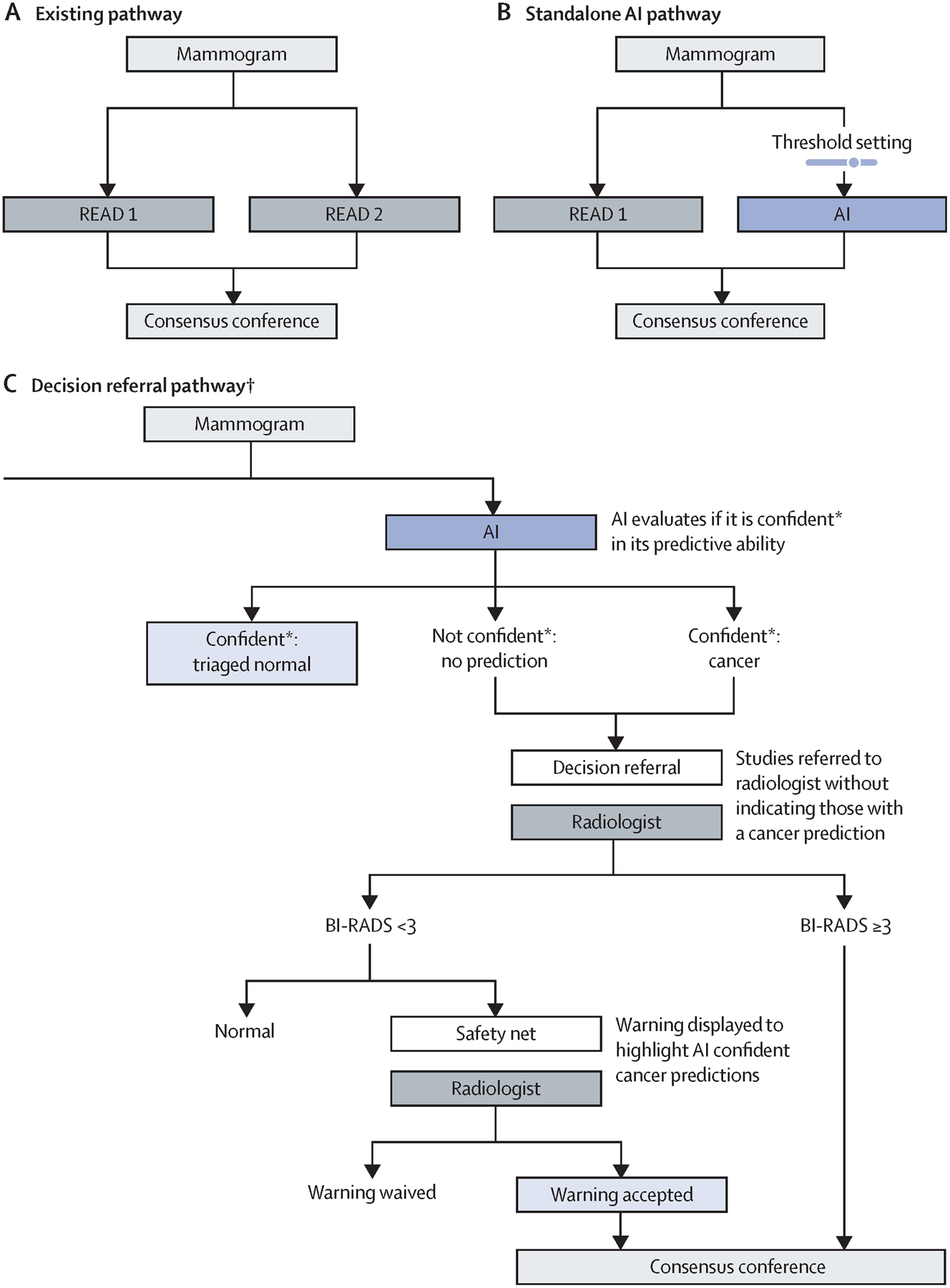
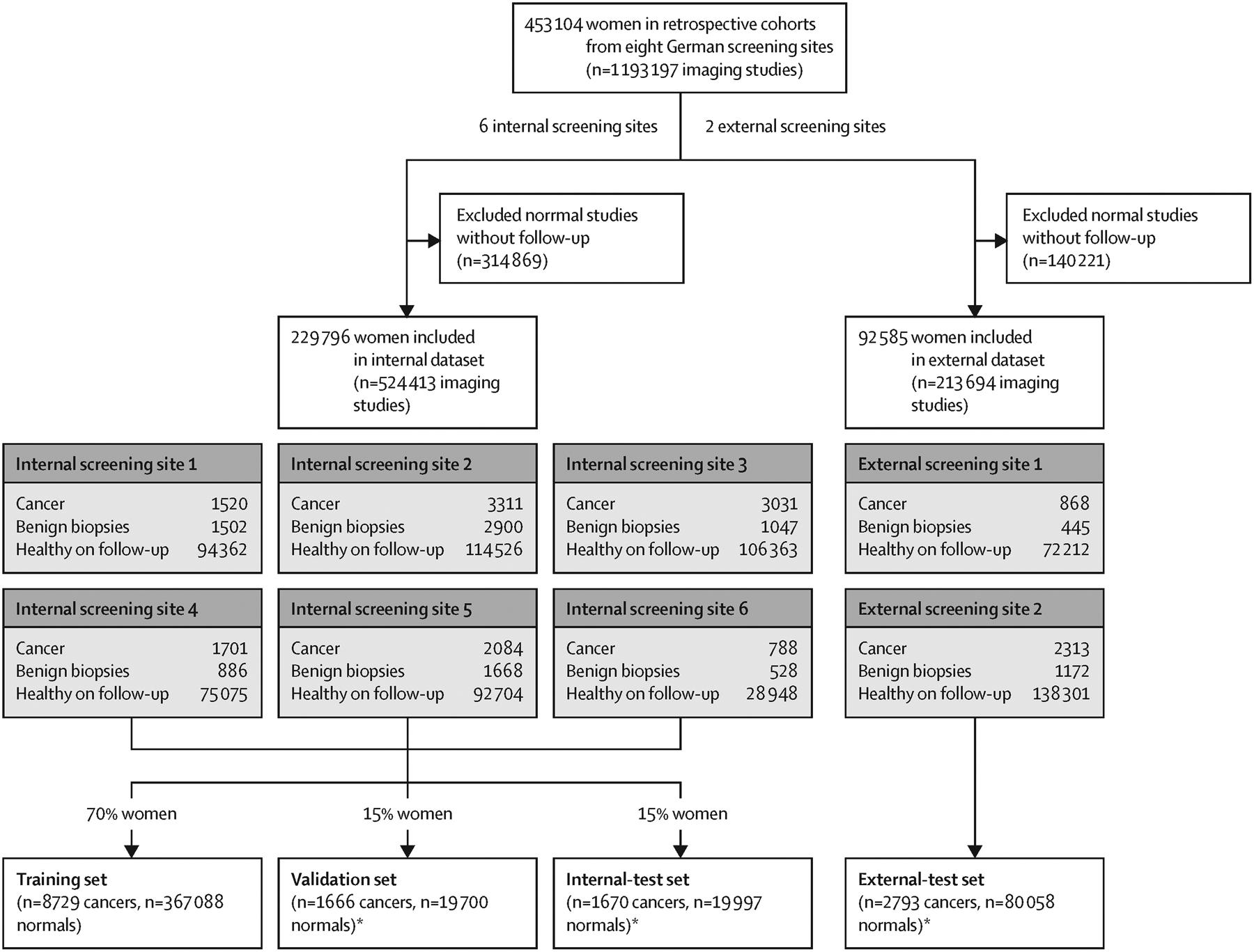
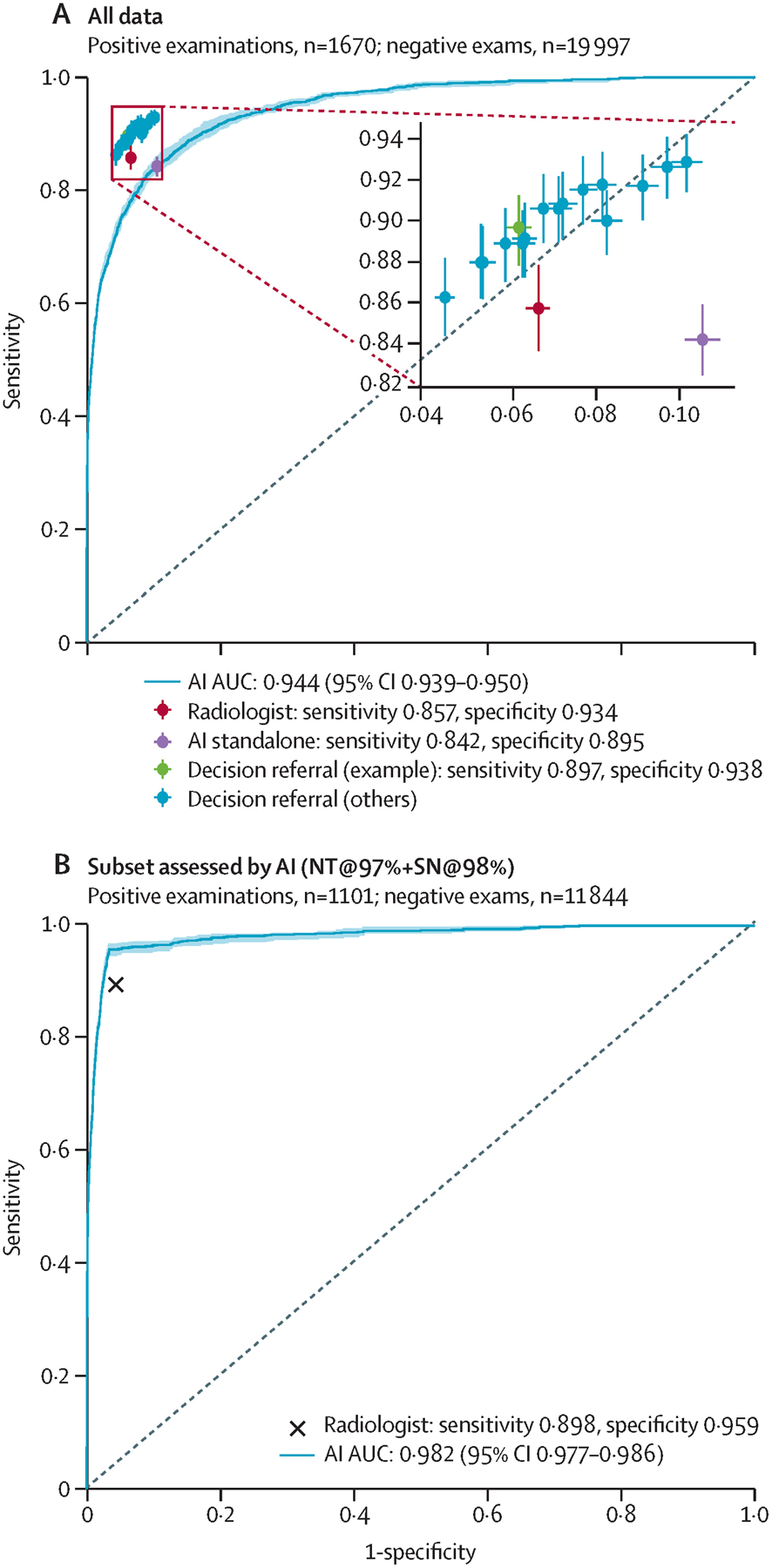
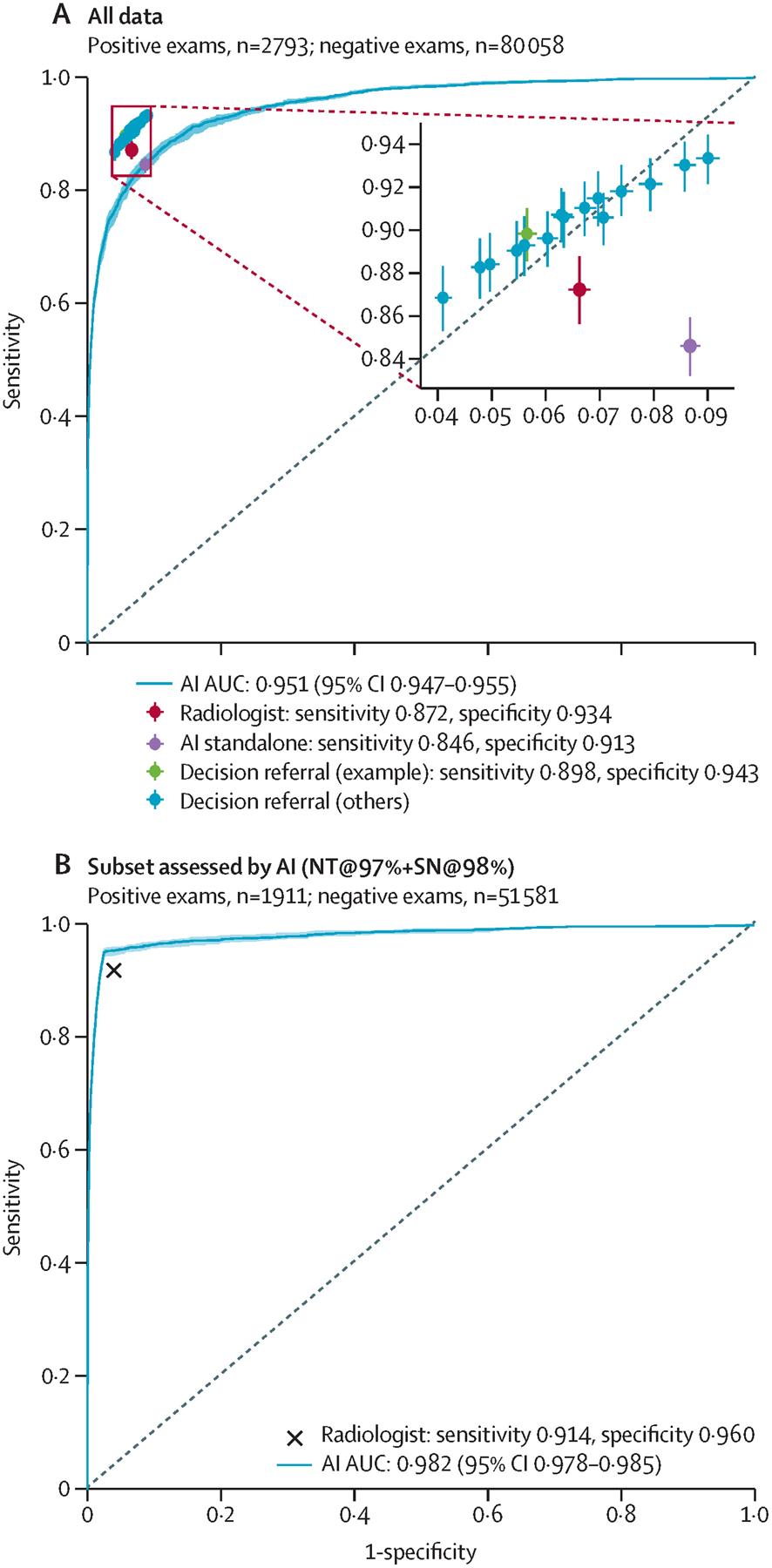
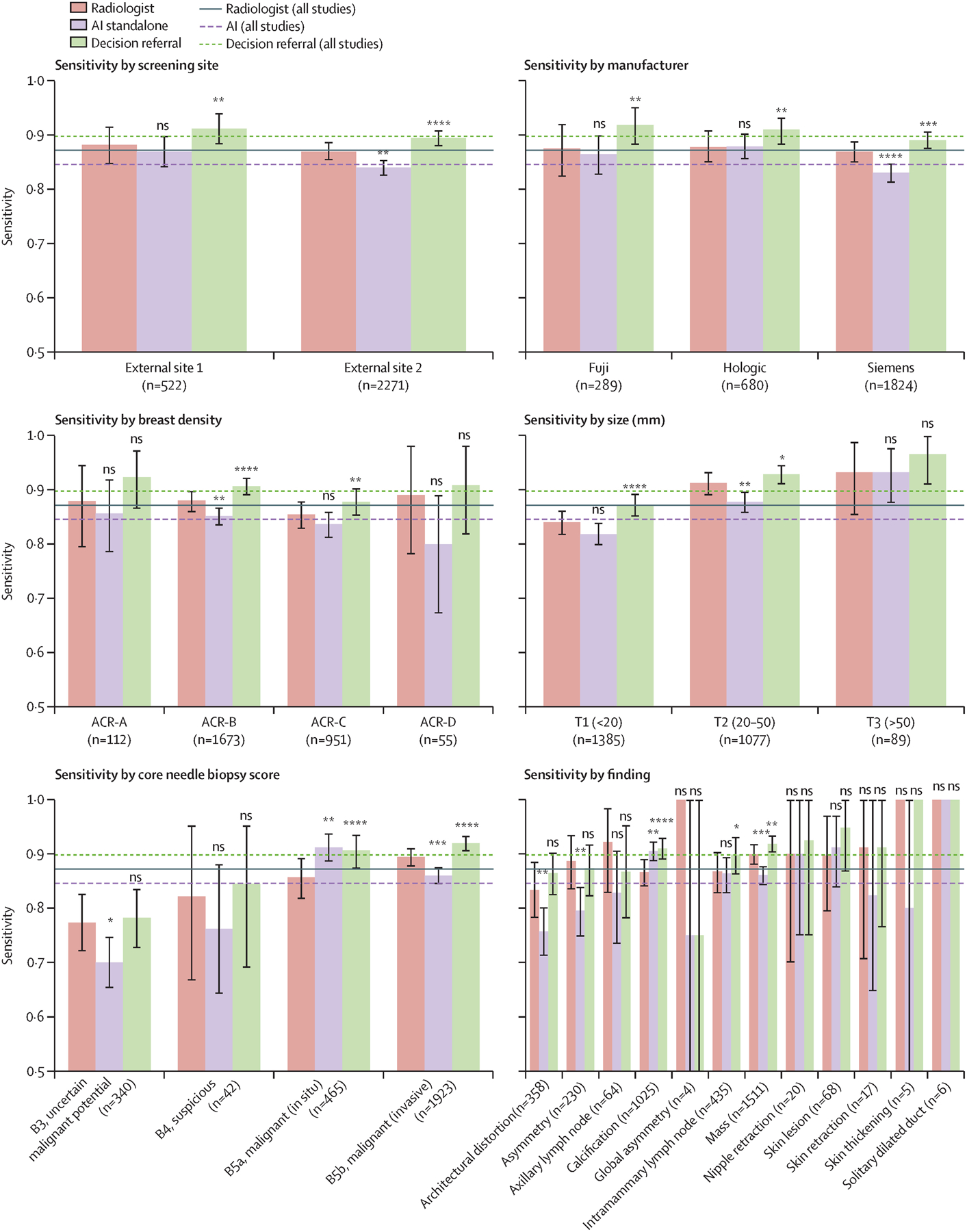
BACKGROUND: We propose a decision-referral approach for integrating artificial intelligence (AI) into the breast-cancer screening pathway, whereby the algorithm makes predictions on the basis of its quantification of uncertainty. Algorithmic assessments with high certainty are done automatically, whereas assessments with lower certainty are referred to the radiologist. This two-part AI system can triage normal mammography exams and provide post-hoc cancer detection to maintain a high degree of sensitivity. This study aimed to evaluate the performance of this AI system on sensitivity and specificity when used either as a standalone system or within a decision-referral approach, compared with the original radiologist decision. METHODS: We used a retrospective dataset consisting of 1 193 197 full-field, digital mammography studies carried out between Jan 1, 2007, and Dec 31, 2020, from eight screening sites participating in the German national breast-cancer screening programme. We derived an internal-test dataset from six screening sites (1670 screen-detected cancers and 19 997 normal mammography exams), and an external-test dataset of breast cancer screening exams (2793 screen-detected cancers and 80 058 normal exams) from two additional screening sites to evaluate the performance of an AI algorithm on sensitivity and specificity when used either as a standalone system or within a decision-referral approach, compared with the original individual radiologist decision at the point-of-screen reading ahead of the consensus conference. Different configurations of the AI algorithm were evaluated. To account for the enrichment of the datasets caused by oversampling cancer cases, weights were applied to reflect the actual distribution of study types in the screening programme. Triaging performance was evaluated as the rate of exams correctly identified as normal. Sensitivity across clinically relevant subgroups, screening sites, and device manufacturers was compared between standalone AI, the radiologist, and decision referral. We present receiver operating characteristic (ROC) curves and area under the ROC (AUROC) to evaluate AI-system performance over its entire operating range. Comparison with radiologists and subgroup analysis was based on sensitivity and specificity at clinically relevant configurations. FINDINGS: The exemplary configuration of the AI system in standalone mode achieved a sensitivity of 84·2% (95% CI 82·4-85·8) and a specificity of 89·5% (89·0-89·9) on internal-test data, and a sensitivity of 84·6% (83·3-85·9) and a specificity of 91·3% (91·1-91·5) on external-test data, but was less accurate than the average unaided radiologist. By contrast, the simulated decision-referral approach significantly improved upon radiologist sensitivity by 2·6 percentage points and specificity by 1·0 percentage points, corresponding to a triaging performance at 63·0% on the external dataset; the AUROC was 0·982 (95% CI 0·978-0·986) on the subset of studies assessed by AI, surpassing radiologist performance. The decision-referral approach also yielded significant increases in sensitivity for a number of clinically relevant subgroups, including subgroups of small lesion sizes and invasive carcinomas. Sensitivity of the decision-referral approach was consistent across the eight included screening sites and three device manufacturers. INTERPRETATION: The decision-referral approach leverages the strengths of both the radiologist and AI, demonstrating improvements in sensitivity and specificity surpassing that of the individual radiologist and of the standalone AI system. This approach has the potential to improve the screening accuracy of radiologists, is adaptive to the requirements of screening, and could allow for the reduction of workload ahead of the consensus conference, without discarding the generalised knowledge of radiologists. FUNDING: Vara.
Overview
The claims and statistics of this paper haven’t been checked yet.
Free: it reads the open-access text and checks the first 5 claims that cite a source we can check. Create a free account to check every claim.
Integrity signals
Registry
Cites
Statistics
Figures
Verification
Claims the paper makes
The claims and statistics of this paper haven’t been checked yet.
Free: it reads the open-access text and checks the first 5 claims that cite a source we can check. Create a free account to check every claim.
Self-check
Percentages, sums and reported differences re-computed from the paper’s own numbers.
The self-check needs the paper’s full text.
Citations
Cites
An Introduction to the Bootstrap
Efron, B., & Tibshirani, R. J. (1994) · doi:10.1201/9780429246593 · Cited by 40,500
A survey on deep learning in medical image analysis
Litjens, G., Kooi, T., Bejnordi, B. E., Setio, A. A. A., Ciompi, F., Ghafoorian, M., van der Laak, J. A. W. M., van Ginneken, B., & Sánchez, C. I. (2017) · Medical Image Analysis · doi:10.1016/j.media.2017.07.005 · Cited by 15,332
An Introduction to Statistical Learning
James, G., Witten, D., Hastie, T., & Tibshirani, R. (2013) · Springer Texts in Statistics · doi:10.1007/978-1-4614-7138-7 · Cited by 12,106
Simple and Scalable Predictive Uncertainty Estimation using Deep Ensembles
Lakshminarayanan, B., Pritzel, A., & Blundell, C. (2016) · arXiv · doi:10.48550/arxiv.1612.01474 · Cited by 3,666 · cited 1×
“Furthermore, decision referral maintained or improved radiologist specificity across all device manufacturers (appendix pp 16, 17).”
International evaluation of an AI system for breast cancer screening
McKinney, S. M., Sieniek, M., Godbole, V., Godwin, J., Antropova, N., Ashrafian, H., Back, T., Chesus, M., Corrado, G. S., Darzi, A., et al. (2020) · Nature · doi:10.1038/s41586-019-1799-6 · Cited by 3,287
Shortcut learning in deep neural networks
Geirhos, R., Jacobsen, J.-H., Michaelis, C., Zemel, R., Brendel, W., Bethge, M., & Wichmann, F. A. (2020) · Nature Machine Intelligence · doi:10.1038/s42256-020-00257-z · Cited by 2,224 · cited 1×
“To verify that the achieved performance of the algorithm was not caused by shortcut learning 19 from signals specific to those six screening sites, but rather generalised to different screening sites, we supplemented this evaluation with an evaluation on out-of-distribution data from two additional…”
European guidelines for quality assurance in breast cancer screening and diagnosis
Amendoeira, I., Perry, N., Broeders, M. J. M., de Wolf, C., Törnberg, S., Holland, R. D., & von Karsa, L. (2013) · Zurich Open Repository and Archive (University of Zurich) · doi:10.2772/13196 · Cited by 1,556
Perry, N., Broeders, M., de Wolf, C., Törnberg, S., Holland, R., & von Karsa, L. (2008) · Annals of Oncology · doi:10.1093/annonc/mdm481 · Cited by 1,020
Diagnostic accuracy of deep learning in medical imaging: a systematic review and meta-analysis
Aggarwal, R., Sounderajah, V., Martin, G., Ting, D. S. W., Karthikesalingam, A., King, D., Ashrafian, H., & Darzi, A. (2021) · npj Digital Medicine · doi:10.1038/s41746-021-00438-z · Cited by 946
Detecting and classifying lesions in mammograms with Deep Learning
Ribli, D., Horváth, A., Unger, Z., Pollner, P., & Csabai, I. (2018) · Scientific Reports · doi:10.1038/s41598-018-22437-z · Cited by 696
Cited by
Items 201–277 of 277
Fattore, G., Cortecci, M. B., Fasoli, R. A., Maggino, T., Mantellini, P., & Deandrea, S. (2026) · BMC Public Health · doi:10.1186/s12889-026-27717-2
“For instance, AI in breast cancer detection demands robust clinical trials to assess accuracy and resource implications [7, 17–19], whereas applications such as voice recognition or automated text generation require different frameworks, such as the QUEST principles [8].”
Detecting Performance Drift in AI Models for Medical Image Analysis Using CUSUM Chart
Prathapan, S., Samala, R. K., Hadjiyski, N., Petrick, N., Zamzmi, G., Nelson, B., Delfino, J. G., D’Haese, P.-F., Maldonado, F., Nguyen, P., et al. (2026) · Journal of Imaging Informatics in Medicine · doi:10.1007/s10278-026-02113-9
Managing the effort-value tradeoff for integrating human judgment into surgery duration predictions
Poreschack, L. M., Fügener, A., Walzner, D. D., Thonemann, U. W., & Denz, C. (2026) · OR Spectrum · doi:10.1007/s00291-026-00855-0
From “Nice-to-Have” to “Must-Have:” AI’s Inevitable Progression?
Korchi, A. (2023) · Applied Radiology · doi:10.37549/ar2860
Galappaththi, D., de Silva, M., Jawed, M., & Shahid, S. M. (2026) · Diagnostics · doi:10.3390/diagnostics16060873
“A German study also revealed that the performance of an AI system either as standalone or combined, improves the screening accuracy and reduction in workload of radiologists [27].”
Elhakim, M. T., Stougaard, S. W., Graumann, O., Nielsen, M., Lång, K., Gerke, O., Larsen, L. B., & Rasmussen, B. S. B. (2023) · Figshare · doi:10.6084/m9.figshare.24883584
Beyond the Hype: Risks, Realism, and Responsibilities in Digital Twins for Alzheimer’s Disease
Guttmann-Flury, E., Zhao, J., & Sawan, M. (2026) · Artificial intelligence · doi:10.5772/intechopen.1014167
Ingram, D. (2023) · Open Book Publishers · doi:10.11647/obp.0335.06
9. Creating and Sustaining the Care Information Utility: How, Where and by Whom?
Ingram, D. (2023) · Open Book Publishers · doi:10.11647/obp.0384.05
7. Health Care and Information Technology: Co-evolving Services
Ingram, D. (2023) · Open Book Publishers · doi:10.11647/obp.0384.02
8. Care Information as a Utility: What Is Needed and Why?
Ingram, D. (2023) · Open Book Publishers · doi:10.11647/obp.0384.03
1. Introduction: Connecting for Health
Ingram, D. (2023) · Open Book Publishers · doi:10.11647/obp.0335.01
Ingram, D. M. (2023) · Open Book Publishers · doi:10.11647/obp.0384.07
8½. Halfway Houses towards openCare: Stories of GEHR, openEHR and OpenEyes
Ingram, D. (2023) · Open Book Publishers · doi:10.11647/obp.0384.04
6. Life and Information: Co-evolving Sciences
Ingram, D. (2023) · Open Book Publishers · doi:10.11647/obp.0384.01
2. Knowledge, Language and Reason: From Ancient Times to the Information Age
Ingram, D. (2023) · Open Book Publishers · doi:10.11647/obp.0335.02
10. Half and Whole: Halfway between Information Age and Information Society
Ingram, D. (2023) · Open Book Publishers · doi:10.11647/obp.0384.06
Ingram, D. (2023) · Open Book Publishers · doi:10.11647/obp.0335.07
Memorisation bias in medical AIPreprint
Knolle, M. A., Menten, M. J., Lux, L., Roschewitz, M., Stanley, E. A. M., Kaissis, G. A., Rueckert, D., & Glocker, B. (2026) · arXiv · doi:10.48550/arxiv.2609.17223
“2 million mammograms sourced from the same screening population it now serves [17, 24].”
Zipperling, D., Deck, L., Lanzl, J., & Kühl, N. (2026) · ACM Transactions on Interactive Intelligent Systems · doi:10.1145/3858913
Eckhoff, J. A., Fuchs, H. F., & Meireles, O. R. (2023) · Wiener klinisches Magazin · doi:10.1007/s00740-023-00504-0
Human-AI Collaboration in Radiology: The Case of Pulmonary EmbolismPreprint
Goldsmith-Pinkham, P. S., Tan, C., & Zentefis, A. (2026) · SSRN Electronic Journal · doi:10.2139/ssrn.6482718
Kwon, M.-R., Chang, Y., Ham, S.-Y., Cho, Y., Kim, E. Y., Kang, J., Park, E. K., Kim, K. H., Kim, M., Kim, T. S., et al. (2024) · Figshare · doi:10.6084/m9.figshare.25670105
Koivogui, A., Abihsera, G., SAIFI, S., Deghaye, M., Lamarque, D., Chérel, P., Herpe, G., & Sellier, N. (2026) · Cancer Epidemiology · doi:10.1016/j.canep.2026.103136
Becker, P., & Serf, G. P. (2025) · Springer eBooks · doi:10.1007/978-3-658-48573-3_4
Artificial Intelligence in Breast Imaging: Basic Principles for Radiologists
Rana, P., & Rangarajan, K. (2025) · Springer eBooks · doi:10.1007/978-981-97-9847-6_20
Sharma, N., Ng, A., James, J. J., Khara, G. S., Ambrózay, É., Austin, C. C., Forrai, G., Fox, G., Glocker, B., Heindl, A., et al. (2024) · Figshare · doi:10.6084/m9.figshare.26590494
Will Artificial Intelligence Augment Global Health Inequalities?
Cleland, C. R., Tsang, K., Taylor, E. H., Thirunavukarasu, A. J., Liu, X., Denniston, A. K., Arunga, S., Mathenge, W. C., Bourne, R., Macleod, D., et al. (2026) · NEJM AI · doi:10.1056/aics2600267
Deepa, R., Shoba, L. K., Swathy, R., Yasotha, B., Thilakavathy, P., & Bennet Prabhu, A. (2026) · IGI Global eBooks · doi:10.4018/979-8-3373-6696-8.ch007
Yapay Zekâ ile Kadın Sağlığında Erken Tanı ve Önleyici Yaklaşımlar
Deniz, I. E. (2025) · Özgür Yayınları eBooks · doi:10.58830/ozgur.pub917.c3822
Chandrasekaran, M. (2026) · Journal of Engineering Research and Sciences · doi:10.55708/js0510001
“Calibrated uncertainty is well studied in clinical prediction [31], and uncertainty-based referral of cases to radiologists has been shown to improve screening performance [32].”
Blum, M., Morant, R., Eichenberger, A., Geißler, A., Subelack, J., Vogel, J., & Ehlig, D. (2026) · Insights into Imaging · doi:10.1186/s13244-026-02383-5
“In our study, the overall screening performance with and without device-speci fi c thresholds was reduced compared to the current double-reading with consensus conferences, adding to mixed evidence of AI performance as a standalone decision-maker [6, 11, 12, 17, 24].”
Deobhakta, A. A., & Tsai, J. C. (2026) · BMJ Connections Digital Health & AI · doi:10.1136/bmjcdh-2026-000031
Artificial Intelligence for Breast Cancer Detection in Mammography: A Review
Kamel, A., Chiba, Z., Moumen, S. E., & Ennaqui, S. (2026) · International Conference on Artificial Intelligence and Big Data (ICAIBD) · doi:10.1109/icaibd69640.2026.11637310
“Furthermore, studies have shown that combining AI predictions with radiologist readings leads to superior diagnostic accuracy compared to either approach alone [29].”
Hu, M., Liu, F., Nie, W., Wang, C., Wang, C., Qu, W., Li, Z., Yuan, X., Zhong, H., & Chu, Q. (2026) · Communications Medicine · doi:10.1038/s43856-026-01938-3
Auditable agentic AI for evidence-grounded thyroid ultrasound diagnosis and reportingPreprint
Li, G., Gong, H., Chen, S., Wang, B., Wang, Y., Wang, S., You, G., Xiong, X., Wang, H., Mao, M., et al. (2026) · Research Square · doi:10.21203/rs.3.rs-10385518/v1
From Competition to Complementarity: Foundations and Evidence for Effective Human-AI Collaboration
Schemmer, M. (2024) · Repository KITopen (Karlsruhe Institute of Technology) · doi:10.5445/ir/1000170595
ARTIFICIAL INTELLIGENCE IN MAMMOGRAPHY: CURRENT APPLICATION AND FUTURE PERSPECTIVES
Mhsb, A. H., Ataky, M. M. A., Zaghloul, B. A. M., Abdelkareem, S. M., Mohammed, E. H., Elsayed, H. H. A., Allah, N. W. M. G., Khaled, M. F., Mansour, T. M. M., El-Aleem, R. A., et al. (2026) · Acta Innovations · doi:10.62441/actainnovations.vi.3019
Development of a virtual biopsy system and diagnosis automation in kidney transplantation
Yoo, D. (2023) · theses.fr (ABES) · doi:10.70675/940bea47z0bc0z4ebcz9356zbd8a1cddd57b
Park, G. E., Kang, B. J., Kim, S. H., & Mun, H. S. (2026) · La radiologia medica · doi:10.1007/s11547-026-02243-8
Krapf, T. (2026) · University of Regensburg Publication Server (University of Regensburg) · doi:10.5283/epub.80355
Li, T., Li, Q., Li, N., & Xie, H. (2026) · arXiv · doi:10.48550/arxiv.2601.01507
Sharma, N., Baldwin, J. P. C., & Hendry, S. (2026) · Diagnostics · doi:10.3390/diagnostics16213491
“Decision-referral and AI-assisted ultrasound studies suggest that combining clinician judgement with algorithmic assessment can reduce false-positive recommendations while preserving sensitivity [7–10].”
Belyaev, D. A., Skripkin, I. N., & Smirnov, M. Y. (2026) · Siberian Journal of Life Sciences and Agriculture · doi:10.12731/2658-6649-2026-18-2-1795
The Implementation of Artificial Intelligence in Breast Cancer Screening
Jin, A., & Tosato, D. (2024) · Journal of Student Research · doi:10.47611/jsrhs.v13i2.6530
“A decision-referral approach is proposed by radiologists instead (Leibig et al., 2022).”
BackgroundImproving Screening Mammography Interpretation: Real Impact Within Reach
Gommers, J. J. J. (2026) · doi:10.54195/9789465152790
Måsbäck, M. (2023) · DiVA (Linnaeus University)
Hassan, A., Siddiqui, N., Khan, B., & Malik, S. (2025) · Journal of Artificial Intelligence for Healthcare Systems · doi:10.68159/v767199809
Improving Clinical Imaging Systems using Cognition based ApproachesPreprint
Dayanandan, K., & Lall, B. (2025) · arXiv · doi:10.48550/arxiv.2504.03251
“Asystems collaborating with clinicians have demonstrated improved performance and reduced diagnosis time [8, 46, 51], emphasizing the need to enhance the adoption of AI-based systems.”
Put Ai to Use: AI Prediction Versus Human Judgement
Göndöcs, D. (2025) · Széchenyi István Egyetem · doi:10.15477/sze.rgdi.2025.004
Álzate-Granados, J. P., Sotomayor-Ricardo, M. J., & Avella-Espinosa, M. K. (2025) · Revista de la Facultad de Medicina · doi:10.15446/revfacmed.v73.114297
Farahani, A. F., Khosravani, P., Alam, M. M. H., & Shams, M. (2026) · Research Square · doi:10.21203/rs.3.rs-11064095/v1
AI triage in mammographic screening: impact on workload, recalls, and safety
Φεζουλίδη, Γ. Ι. (2026) · University of Thessaly Institutional Repository (University of Thessaly)
Cattanach, P. (2026) · CentAUR (University of Reading) · doi:10.48683/1926.00131518
Multi-Modal Explainable AI in Breast Cancer Detection and Research Framework
Kaur, G., Yadav, V. D., Zade, S., Qureshi, I., & Bagde, A. (2025) · International Conference on I-SMAC (IoT in Social, Mobile, Analytics and Cloud) (I-SMAC) · doi:10.1109/i-smac65734.2025.11597763
“Additional retrospective studies include [20] analysing AI performance in screening programs, [21] combining AI with radiologists, [22]comparing AI algorithms with clinical risk models, [23] applying cone-beam breast CT, [24] reviewing DL approaches, [25] validating Deep-LIBRA density…”
When is using AI the rational choice? The importance of counterfactuals in AI deployment decisionsPreprint
Lehner, P., & Yeo, E. (2025) · arXiv · doi:10.48550/arxiv.2504.05333
Answer or Defer? Testing VLMs' Stated Confidence on Brain MRIPreprint
Sabbaghziarani, A., Ghazvinian, P., Salem, S., & Plis, S. (2026) · arXiv · doi:10.48550/arxiv.2611.11833
Shull, J. G. (2023) · Dipòsit Digital de la Universitat de Barcelona (Universitat de Barcelona)
Maral, A. M., Erdem, O. A., & Söğüt, E. (2025) · NWSA Academic Journals · doi:10.12739/nwsa.2025.20.4.1a0501
Radyoloji Başucu Serisi - Meme
Başderici, A. T., Sevgilioglu, Z. E., Arpat, B., Adanır, S. S., Mutlu, İ., Savaş, N. Y., Ulusan, M. B., Ata, E. S., Sarıay, B., Deveci, C. K., et al. (2025) · Akademisyen Kitabevi eBooks · doi:10.37609/akya.3537
Amalia, N., Nurdiana, F., & Pradyaputri, N. S. (2025) · Indonesian Journal of Cancer · doi:10.33371/ijoc.v19i4.1353
A Concept-informed Interpretable Artificial Intelligence Framework for Breast Ultrasound DiagnosisPreprint
Zhong, S., Wang, Z., Li, L., Yan, L., Chen, S., Zou, Y., Zhang, J., Li, W., Zhang, H., Lu, J., et al. (2026) · arXiv · doi:10.48550/arxiv.2610.16128
“In recent years, deep learning has demonstrated a remarkable ability to automatically learn discriminative representations from imaging data [15, 16, 17] and has been increasingly applied to assist BUS diagnosis [18, 19].”
Mostafa, A. F., Mady, R., Halimah, J. H. A., Hassan, N., Elshebiny, A. A., Abdelazeem, M. A. A., Salem, L. N., Abdrabo, A. A., Ibrahem, M., Elzeiny, A., et al. (2026) · La Clinica Terapeutica · doi:10.7417/ct.2026.2172
Coelho, L. (2024) · Portuguese National Funding Agency for Science, Research and Technology (RCAAP Project by FCT)
Statsenko, Y. A., Smetanina, D., Kashapov, A., Voitetskii, R., & Ljubisavljević, M. (2026) · Preprints.org · doi:10.20944/preprints202601.0182.v1
Hussain, J., Ahmed, M. A., Jouhar, R., Alsaqer, A. H. S., Younus, J., & Ahmad, H. F. (2026) · Scientific Reports · doi:10.1038/s41598-026-71323-6
Integration of ROSE cytology and serum tumor markers for rapid subtyping of lung cancer
Zhao, Z., Zou, Q., Fang, Y., Zhao, D., Li, Y., Li, R., Jiang, J., & Ge, X. (2025) · Scientific Reports · doi:10.1038/s41598-025-27770-8
“This capacity to flag ambiguity for expert review is a core safety mechanism of the “decision-referral” paradigm 31,32 , ensuring that challenging cases are automatically routed for mandatory pathologist review, thereby optimizing the allocation of human expertise.”
Brustkrebsvorsorge: künstliche Intelligenz verbessert Diagnose
(2022) · TumorDiagnostik & Therapie · doi:10.1055/a-1875-4985
AI-Powered Analysis of Mammograms for Breast Cancer Detection
Agarwal, A., Dadhich, A., Mishra, R., & Zaidi, T. (2024) · Lecture notes in electrical engineering · doi:10.1007/978-981-97-8043-3_140
430/41, C. S. R. O. V., Hrubý, R., Kvak, D., 430/41, C. S. R. O. V., Chromcová, A., 430/41, C. S. R. O. V., Biros, M., & 430/41, C. S. R. O. V. (2022) · doi:10.35191/medsoft_2022_1_34_50_54
А., В. Ю., А.В., В., К.М., А., Михайлович, Ш. И., Е., А. Л., Д., П. Л., С., С. С., В., Б. Д., & В., С. И. (n.d.) · CyberLeninK (CyberLeninka)
Bruk av AI i mammografi ved screening av brystkreft
Rosic, M. (2024) · NVA (Nasjonalt vitenarkiv)
Meme Radyolojisinde Yapay Zeka
Ulusoy, B. S. S. (2025) · Akademisyen Kitabevi eBooks · doi:10.37609/akya.3537.c4476
Moon, S., Lee, J. Y., Jung, N. Y., Jang, M., Song, S. E., Seo, B. K., & Bae, M. S. (2026) · Korean Journal of Radiology · doi:10.3348/kjr.2026.0453
Martínez-Martínez, J., Holodnak, J. T., Brown, O., Nabavi, S., Aguiar, D., & Wollaber, A. (2026) · Proceedings of Machine Learning Research
Rothwell, J., Hickman, S. E., Payne, N. R., Kaggie, J. D., Black, R. T., Huang, Y., Nanaa, M., Kilburn‐Toppin, F., & Gilbert, F. J. (2026) · European Radiology · doi:10.1007/s00330-026-12997-4
Dan, C., Li, H., & Liu, W. (2026) · Frontiers in Oncology · doi:10.3389/fonc.2026.1944426
Metadata
- Authors
- Leibig, C., Brehmer, M., Bunk, S., Byng, D., Pinker, K., & Umutlu, L.
- Affiliations
- Essen University Hospital (DE)
- Memorial Sloan Kettering Cancer Center (US)
- Corresponding author
- Leibig, Christian
- Venue
- The Lancet Digital Health
- Publisher
- Elsevier BV
- Published
- 2022-07
- Volume
- 4
- Issue
- 7
- Pages
- e507-e519
- ISSN
- 2589-7500 (ISSN-L)
- PMC
- PMC9839981
- OpenAlex
- W4283272038
- Semantic Scholar
- 3bfa099aafd426086952a65ee537537f2ec6cc8c
- Cited by
- 273
- References
- 30
- Citations by year
- 2026: 56 · 2025: 70 · 2024: 51 · 2023: 80 · 2022: 16
- FWCI
- 11.88
- Type
- journal article
- Language
- en
- Open access
- gold
- doi.org
- Licence
- cc-by
- www.elsevier.com/tdm/userlicense/1.0/ (tdm)
- www.elsevier.com/legal/tdmrep-license (tdm)
- creativecommons.org/licenses/by/4.0/ (vor)
- Locations
- The Lancet Digital Health (publishedVersion, cc-by)
- PubMed (publishedVersion)
- PubMed Central (acceptedVersion, cc-by)
- Funders
- European Commission
- Topics
- Physical Sciences › Computer Science › Artificial Intelligence › AI in cancer detection
- Health Sciences › Medicine › Radiology, Nuclear Medicine and Imaging › Digital Radiography and Breast Imaging
- Health Sciences › Medicine › Health Informatics › Artificial Intelligence in Healthcare and Education
- Keywords
- breast cancer screening, artificial intelligence, mammography, radiologist performance, sensitivity and specificity, full-field digital mammography, AI-assisted reading, consensus conference, subgroup analysis, screen-detected cancer, false positive reduction, false negative reduction
- MeSH terms
- Radiologists, Artificial Intelligence, Breast Neoplasms, Female, Humans, Retrospective Studies, Early Detection of Cancer
About these checks
Registry, retraction, Cites and statistics results are computed, not judged, with one exception: a printed reference that no index lists is read once by a model before it counts as a citation error. Claims are extracted by a model and kept only when their quote appears verbatim in the text; each cited source is then checked, with a model’s help, for whether it says what the claim relies on. Those verdicts can be wrong — read the claim’s quote and the cited source before relying on one.
Statistics and arithmetic are recomputed, not judged.
Confidence bands are shown only for fields calibrated on our annotated test set. None is calibrated yet, so no band is shown.
What counts as a claim ›How we measure confidence ›How we check this ›
Are you an author, or do you see a problem with this page? Request a review
Data sources
Bibliographic data: Semantic Scholar, OpenAlex, Crossref.
Contains information from the Semantic Scholar Academic Graph Datasets, made available under the ODC Attribution License (ODC-BY 1.0).
Semantic Scholar’s data is described in: Kinney, R., et al. (2023). The Semantic Scholar Open Data Platform. arXiv:2301.10140.
