

The DOI matches its Crossref record; 50 of the 51 references it cites were found in a registry or an index; 6 of the 16 sources its claims cite were checked for support.
Randomised controlled trials evaluating artificial intelligence in clinical practice: a scoping review
Open accessAbstract
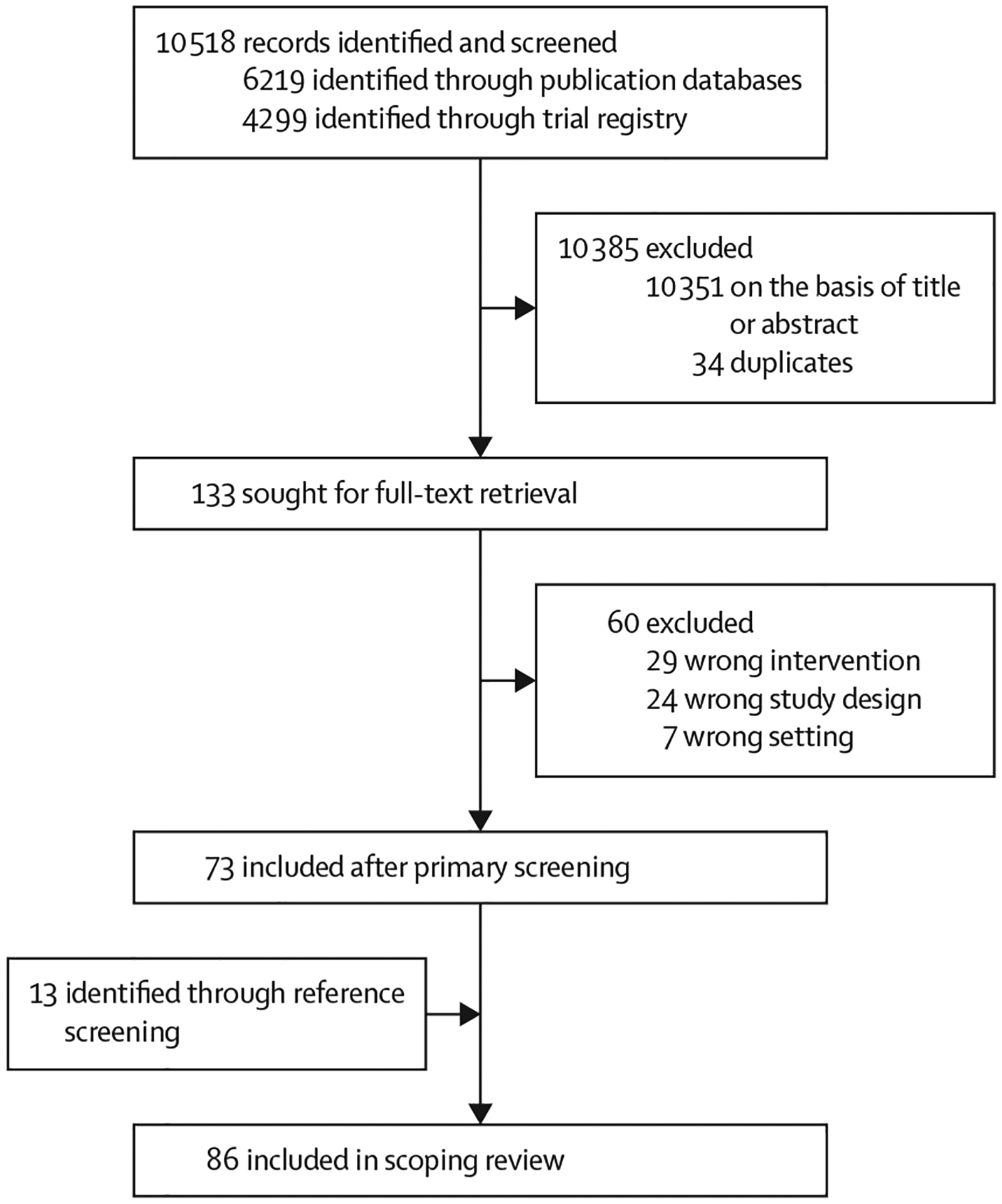
This scoping review of randomised controlled trials on artificial intelligence (AI) in clinical practice reveals an expanding interest in AI across clinical specialties and locations. The USA and China are leading in the number of trials, with a focus on deep learning systems for medical imaging, particularly in gastroenterology and radiology. A majority of trials (70 [81%] of 86) report positive primary endpoints, primarily related to diagnostic yield or performance; however, the predominance of single-centre trials, little demographic reporting, and varying reports of operational efficiency raise concerns about the generalisability and practicality of these results. Despite the promising outcomes, considering the likelihood of publication bias and the need for more comprehensive research including multicentre trials, diverse outcome measures, and improved reporting standards is crucial. Future AI trials should prioritise patient-relevant outcomes to fully understand AI's true effects and limitations in health care.
Overview
CoChat Summary
TL;DR
This scoping review identified 86 randomised controlled trials of AI integrated into clinical practice published up to Nov 14, 2023, with most trials concentrated in gastroenterology and radiology and in the USA and China. Although 70 (81%) of 86 trials reported a favourable primary endpoint, the authors caution that single-centre designs, limited demographic reporting, variable operational-efficiency results, and likely publication bias limit generalisability.
Key findings
- Of 86 included RCTs, 70 (81%) reported a favourable result for their primary endpoint; among 81 trials designed to show improvement, 65 (80%) reported significant improvement, while 3 of 5 non-inferiority trials established non-inferiority.
- Diagnostic yield or performance was the most common primary endpoint category (46 [54%] of 86), followed by care management (18 [21%]), patient behaviour and symptoms (15 [17%]), and clinical decision making (7 [8%]).
- Trials were predominantly single-centre (54 [63%] of 86) and single-country (79 [92%] of 86), with the USA conducting 27 (31%) and China 26 (30%); median final-analysis sample size was 359 patients (IQR 150–1050).
- Among 52 trials reporting operational time, 18 (35%) found a significant decrease, 13 (25%) a significant increase, and 21 (40%) no significant change.
Methods
- Scoping review following PRISMA-ScR, registered with PROSPERO (CRD42022326955), searching PubMed, SCOPUS, CENTRAL, and the International Clinical Trials Registry Platform for studies published Jan 1, 2018–Nov 14, 2023.
- Inclusion required RCTs with a substantial non-linear AI component integrated into clinical practice and full-text publication in a peer-reviewed English-language journal; linear risk scores, secondary studies, abstracts, and non-integrated interventions were excluded.
- Screening and extraction were done by independent investigators, with discrepancies resolved by a third reviewer; due to heterogeneity, no formal meta-analysis was conducted and simple descriptive statistics were presented.
Limitations
- The paper states two limitations: the search was English-only, potentially excluding relevant non-English trials, and the review does not address updated trends in trial risk of bias.
- Evident from the text: the authors emphasise likely publication bias, noting that a 2023 systematic review identified 627 AI-enabled technology trials registered on ClinicalTrials.gov but only nine (1%) readily identified as published.
- Evident from the text: the predominance of single-centre trials, limited race or ethnicity reporting (22 trials, of which 18 were from the USA), and heterogeneous operational-time results raise concerns about generalisability and practicality.
Model-written summary. Check it against the paper before relying on it.
Integrity signals
Registry
Cites
Statistics
Figures

Verification
Claims the paper makes
5 Valid · 0 Not valid · 4 Not checked · 39 Own results and interpretations
Every source the paper cites for this claim was checked and supports it.
In the paper
“Of the 63 trials published since the start of 2021, 12 (19%) cited the 2020 CONSORT-AI reporting guidelines for clinical trials assessing AI interventions.16”
§ Randomised controlled trials evaluating artificial intelligence in clinical practice: a scoping review > Results
What the sources say
- Supportedcites [16] Liu, 2020, Reporting guidelines for clinical trial reports for interventions involving artificial intelligence: the CONSORT-AI extension, Nat Med source
The citation identifies the 2020 CONSORT-AI guidelines, rather than sourcing the citing authors’ count of later trials. The Abstract describes this paper as the CONSORT-AI reporting guideline for clinical trials evaluating AI interventions. (LLM, conf=0.93)
plain- Asserted: passes — The authors put it forward as true.
- Checkable: passes — It can be checked against evidence.
- Load-bearing: unclear — It is unclear whether the paper’s conclusions depend on it.
- Based: passes — The paper gives a reason why it holds.
- Supported
A result the paper reports from its own data — it cites no other source for it, so there is none to check. The quote shows it is in the paper.
In the paper
“Approximately half (46 [54%] of 86) of the trials had primary endpoints relating to diagnostic yield or performance, such as detection rate or mean absolute error.”
§ Randomised controlled trials evaluating artificial intelligence in clinical practice: a scoping review > Results
plain- Asserted: passes — The authors put it forward as true.
- Checkable: passes — It can be checked against evidence.
- Load-bearing: unclear — It is unclear whether the paper’s conclusions depend on it.
- Based: passes — The paper gives a reason why it holds.
A result the paper reports from its own data — it cites no other source for it, so there is none to check. The quote shows it is in the paper.
In the paper
“79 (92%) of 86 RCTs were conducted in a single country, with the USA conducting the most trials (27 [31%]), followed by China (26 [30%]).”
§ Randomised controlled trials evaluating artificial intelligence in clinical practice: a scoping review > Results
plain- Asserted: passes — The authors put it forward as true.
- Checkable: passes — It can be checked against evidence.
- Load-bearing: unclear — It is unclear whether the paper’s conclusions depend on it.
- Based: passes — The paper gives a reason why it holds.
A result the paper reports from its own data — it cites no other source for it, so there is none to check. The quote shows it is in the paper.
In the paper
“Among these trials, the median percentage of White (non-Hispanic or Latino) participants was 70·5% (range 0–98·4; IQR 35·0–81·8).”
§ Randomised controlled trials evaluating artificial intelligence in clinical practice: a scoping review > Results
plain- Asserted: passes — The authors put it forward as true.
- Checkable: passes — It can be checked against evidence.
- Load-bearing: unclear — It is unclear whether the paper’s conclusions depend on it.
- Based: passes — The paper gives a reason why it holds.
A result the paper reports from its own data — it cites no other source for it, so there is none to check. The quote shows it is in the paper.
In the paper
“24 (65%) of the 37 gastroenterology trials were conducted by only four groups (eight trials from Wuhan University, six from Wision AI, six from Medtronic, and four from Fujifilm).”
§ Randomised controlled trials evaluating artificial intelligence in clinical practice: a scoping review > Results
plain- Asserted: passes — The authors put it forward as true.
- Checkable: passes — It can be checked against evidence.
- Load-bearing: unclear — It is unclear whether the paper’s conclusions depend on it.
- Based: passes — The paper gives a reason why it holds.
21 more claims
Create a free account to see all 48 claims and every source verdict.
- It may state two separate claims as one. 14
- Probably not a substantial claim. 10
Claims other papers make about this one
Each is checked against this paper’s own text: does it say what the citing paper says it does?
The cited source says what the claim attributes to it.
In the citing paper
“This pattern is also consistent with previous findings19,22.”
From A quantitative analysis of global AI medical studies: gaps in randomized controlled trials (2026) · cites this paper as [19]
The check wasn’t confident either way, so it gives no verdict — never disputed.
In the citing paper
“The evaluation of their capacity for ongoing improvement is based on the system’s ability to incorporate model updates and integrate feedback loops.122,123”
From A foundational architecture for AI agents in healthcare (2025) · cites this paper as [122]
Experimental — accuracy not yet measured
Citations
Cites
PRISMA Extension for Scoping Reviews (PRISMA-ScR): Checklist and Explanation
Tricco, A. C., Lillie, E., Zarin, W., O'Brien, K. K., Colquhoun, H., Levac, D., Moher, D., Peters, M. D. J., Horsley, T., Weeks, L., et al. (2018) · Annals of Internal Medicine · doi:10.7326/m18-0850 · Cited by 43,565
Dissecting racial bias in an algorithm used to manage the health of populations
Obermeyer, Z., Powers, B., Vogeli, C., & Mullainathan, S. (2019) · Science · doi:10.1126/science.aax2342 · Cited by 7,137 · cited 1×
“Other primary endpoints were grouped according to care management (18 [21%]), patient behaviour and symptoms (15 [17%]), and clinical decision making (7 [8%]).”
BackgroundRajpurkar, P., Chen, E., Banerjee, O., & Topol, E. J. (2022) · Nature Medicine · doi:10.1038/s41591-021-01614-0 · Cited by 3,212 · cited 1×
“…with several publications reporting that medical AI models can perform as well as or better than clinicians across a number of tasks and specialties; 1–3 however, many of these models have only been tested retrospectively, using surrogate endpoints, and outside of real-world clinical settings.”
BackgroundSelf-citationLiu, X., Faes, L., Kale, A. U., Wagner, S. K., Fu, D. J., Bruynseels, A., Mahendiran, T., Moraes, G., Shamdas, M., Kern, C., et al. (2019) · The Lancet Digital Health · doi:10.1016/s2589-7500(19)30123-2 · Cited by 1,883
Self-citationLiu, X., Cruz Rivera, S., Moher, D., Calvert, M. J., Denniston, A. K., The SPIRIT-AI and CONSORT-AI Working Group, SPIRIT-AI and CONSORT-AI Steering Group, Chan, A.-W., Darzi, A., Holmes, C., et al. (2020) · Nature Medicine · doi:10.1038/s41591-020-1034-x · Cited by 1,421
Acosta, J. N., Falcone, G. J., Rajpurkar, P., & Topol, E. J. (2022) · Nature Medicine · doi:10.1038/s41591-022-01981-2 · Cited by 1,365
Self-citationBenjamens, S., Dhunnoo, P., & Meskó, B. (2020) · npj Digital Medicine · doi:10.1038/s41746-020-00324-0 · Cited by 1,215 · cited 1×
“%] of 86) followed by academia (35 [41”
BackgroundWong, A., Otles, E., Donnelly, J. P., Krumm, A., McCullough, J., DeTroyer-Cooley, O., Pestrue, J., Phillips, M., Konye, J., Penoza, C., et al. (2021) · JAMA Internal Medicine · doi:10.1001/jamainternmed.2021.2626 · Cited by 995 · cited 1×
“5 It might not be uncommon for AI to perform worse when deployed prospectively, and the difficulty of adopting AI systems in a clinical setting can further impede any potential benefits in terms of important outcomes.”
BackgroundSeyyed-Kalantari, L., Zhang, H., McDermott, M. B. A., Chen, I. Y., & Ghassemi, M. (2021) · Nature Medicine · doi:10.1038/s41591-021-01595-0 · Cited by 928 · cited 1×
“6,7 10 To provide a clearer understanding of the AI landscape in health care, this scoping review aims to examine the state of RCTs for AI algorithms being used in clinical practice.”
BackgroundBeede, E., Baylor, E., Hersch, F., Iurchenko, A., Wilcox, L., Ruamviboonsuk, P., & Vardoulakis, L. M. (2020) · Proceedings of the 2020 CHI Conference on Human Factors in Computing Systems · doi:10.1145/3313831.3376718 · Cited by 614 · cited 1×
“6,7 10 To provide a clearer understanding of the AI landscape in health care, this scoping review aims to examine the state of RCTs for AI algorithms being used in clinical practice.”
Background
Cited by
Lekadir, K., Frangi, A. F., Porras, A. R., Glocker, B., Cintas, C., Langlotz, C. P., Weicken, E., Asselbergs, F. W., Prior, F., Collins, G. S., et al. (2025) · BMJ · doi:10.1136/bmj-2024-081554 · Cited by 957
Review of multimodal machine learning approaches in healthcare
Krones, F., Marikkar, U., Parsons, G., Szmul, A., & Mahdi, A. (2025) · Information Fusion · doi:10.1016/j.inffus.2024.102690 · Cited by 235
AI, Health, and Health Care Today and Tomorrow: The JAMA Summit Report on Artificial Intelligence
Angus, D. C., Khera, R., Lieu, T., Liu, V., Ahmad, F. S., Anderson, B., Bhavani, S. V., Bindman, A., Brennan, T., Celi, L. A., et al. (2025) · JAMA · doi:10.1001/jama.2025.18490 · Cited by 195
The integration of AI in nursing: addressing current applications, challenges, and future directions
Wei, Q., Pan, S., Liu, X., Hong, M., Nong, C., & Zhang, W. (2025) · Frontiers in Medicine · doi:10.3389/fmed.2025.1545420 · Cited by 143
“To address this limitation, future work should focus on rigorous, multi-site clinical trials that evaluate the sustained effects of AI on patient outcomes, nursing efficiency, and healthcare costs (61).”
Wenderott, K., Krups, J., Zaruchas, F., & Weigl, M. (2024) · npj Digital Medicine · doi:10.1038/s41746-024-01248-9 · Cited by 198
Metadata
- Authors
- Han, R., Acosta, J. N., Shakeri, Z., Ioannidis, J. P. A., Topol, E. J., & Rajpurkar, P.
- Affiliations
- Harvard University (US)
- Yale University (US)
- University of Toronto (CA)
- Stanford Medicine (US)
- Scripps Research Institute (US)
- Corresponding author
- Topol, Eric J
- Venue
- The Lancet Digital Health
- Publisher
- Elsevier BV
- Published
- 2024-05
- Volume
- 6
- Issue
- 5
- Pages
- e367-e373
- ISSN
- 2589-7500 (ISSN-L)
- PMC
- PMC11068159
- OpenAlex
- W4395067202
- Cited by
- 336
- References
- 51
- Citations by year
- 2026: 152 · 2025: 151 · 2024: 33
- FWCI
- 7.66
- Type
- journal article
- Language
- en
- Open access
- gold
- doi.org
- Licence
- cc-by-nc-nd
- www.elsevier.com/tdm/userlicense/1.0/ (tdm)
- www.elsevier.com/legal/tdmrep-license (tdm)
- creativecommons.org/licenses/by-nc-nd/4.0/ (vor)
- Locations
- The Lancet Digital Health (publishedVersion, cc-by-nc-nd)
- PubMed (publishedVersion)
- PubMed Central (acceptedVersion, cc-by-nc-nd)
- Funders
- NIH
- NIGMS
- Topics
- Health Sciences › Medicine › Health Informatics › Artificial Intelligence in Healthcare and Education
- Physical Sciences › Computer Science › Artificial Intelligence › AI in cancer detection
- Health Sciences › Health Professions › Health Information Management › Artificial Intelligence in Healthcare
- Keywords
- clinical implementation of AI, randomized controlled trials, deep learning, diagnostic imaging, diagnostic performance, gastroenterology, radiology, generalizability, publication bias, reporting guidelines, patient-relevant outcomes
- MeSH terms
- Deep Learning, Artificial Intelligence, Humans, Randomized Controlled Trials as Topic
About these checks
Registry, retraction, Cites and statistics results are computed, not judged, with one exception: a printed reference that no index lists is read once by a model before it counts as a citation error. Claims are extracted by a model and kept only when their quote appears verbatim in the text; each cited source is then checked, with a model’s help, for whether it says what the claim relies on. Those verdicts can be wrong — read the claim’s quote and the cited source before relying on one.
The claim verdicts this report counts are experimental: their accuracy is not yet measured.
A language model drew the claims from the paper on 2026-10-01, under version 3 of the claim definition (model deepseek-v4.1-flash, prompt extract-v3).
A second model labelled each claim on 2026-10-01 (model jev-1.13-20260917, definition revision gold-guideline-v0.2).
Cited sources are checked with a language model’s help (gpt-6-sol).
Statistics and arithmetic are recomputed, not judged.
Confidence bands are shown only for fields calibrated on our annotated test set. None is calibrated yet, so no band is shown.
What counts as a claim ›How we measure confidence ›How we check this ›
Are you an author, or do you see a problem with this page? Request a review
How to cite
Cite CoChat for the checks on this page, and the paper for its own findings.
- This page
- CoChat. (2026). Citation check: Randomised controlled trials evaluating artificial intelligence in clinical practice: a scoping review. https://app.cochat.ai/papers/10.1016/s2589-7500(24)00047-5
- The paper
- Han, R., Acosta, J. N., Shakeri, Z., Ioannidis, J. P. A., Topol, E. J., & Rajpurkar, P. (2024). Randomised controlled trials evaluating artificial intelligence in clinical practice: a scoping review. The Lancet Digital Health. https://doi.org/10.1016/s2589-7500(24)00047-5
Data sources
Bibliographic data: Semantic Scholar, OpenAlex, Crossref.
Contains information from the Semantic Scholar Academic Graph Datasets, made available under the ODC Attribution License (ODC-BY 1.0).
Semantic Scholar’s data is described in: Kinney, R., et al. (2023). The Semantic Scholar Open Data Platform. arXiv:2301.10140.
