

Randomised controlled trials evaluating artificial intelligence in clinical practice: a scoping review
Open accessThe DOI matches its Crossref record; 50 of the 51 references it cites were found in a registry or an index; 6 of the 16 sources its claims cite were checked for support.
Abstract
This scoping review of randomised controlled trials on artificial intelligence (AI) in clinical practice reveals an expanding interest in AI across clinical specialties and locations. The USA and China are leading in the number of trials, with a focus on deep learning systems for medical imaging, particularly in gastroenterology and radiology. A majority of trials (70 [81%] of 86) report positive primary endpoints, primarily related to diagnostic yield or performance; however, the predominance of single-centre trials, little demographic reporting, and varying reports of operational efficiency raise concerns about the generalisability and practicality of these results. Despite the promising outcomes, considering the likelihood of publication bias and the need for more comprehensive research including multicentre trials, diverse outcome measures, and improved reporting standards is crucial. Future AI trials should prioritise patient-relevant outcomes to fully understand AI's true effects and limitations in health care.
Overview
CoChat Summary
TL;DR
This scoping review identified 86 randomised controlled trials of AI integrated into clinical practice published up to Nov 14, 2023, with most trials concentrated in gastroenterology and radiology and in the USA and China. Although 70 (81%) of 86 trials reported a favourable primary endpoint, the authors caution that single-centre designs, limited demographic reporting, variable operational-efficiency results, and likely publication bias limit generalisability.
Key findings
- Of 86 included RCTs, 70 (81%) reported a favourable result for their primary endpoint; among 81 trials designed to show improvement, 65 (80%) reported significant improvement, while 3 of 5 non-inferiority trials established non-inferiority.
- Diagnostic yield or performance was the most common primary endpoint category (46 [54%] of 86), followed by care management (18 [21%]), patient behaviour and symptoms (15 [17%]), and clinical decision making (7 [8%]).
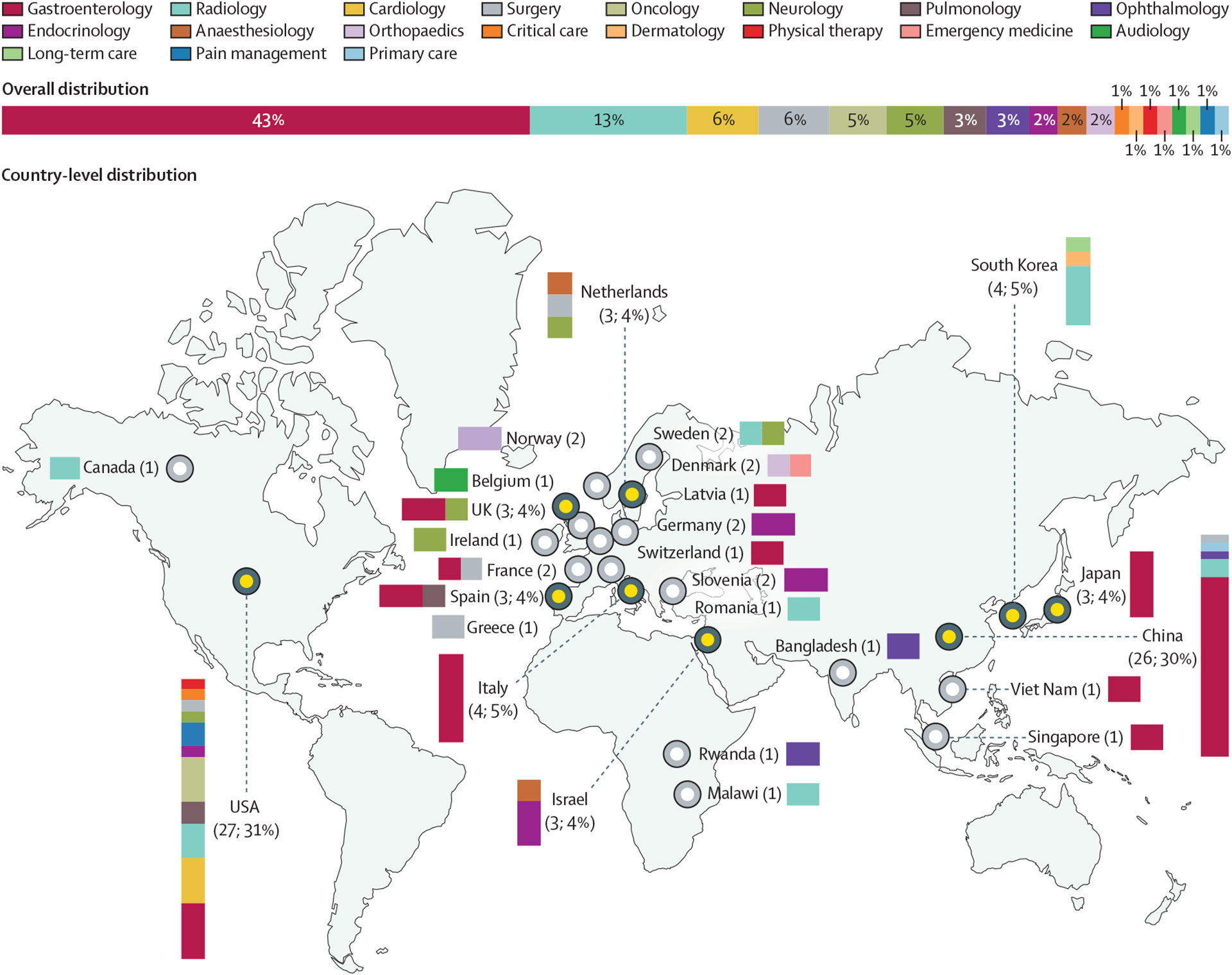
- Trials were predominantly single-centre (54 [63%] of 86) and single-country (79 [92%] of 86), with the USA conducting 27 (31%) and China 26 (30%); median final-analysis sample size was 359 patients (IQR 150–1050).
- Among 52 trials reporting operational time, 18 (35%) found a significant decrease, 13 (25%) a significant increase, and 21 (40%) no significant change.
Methods
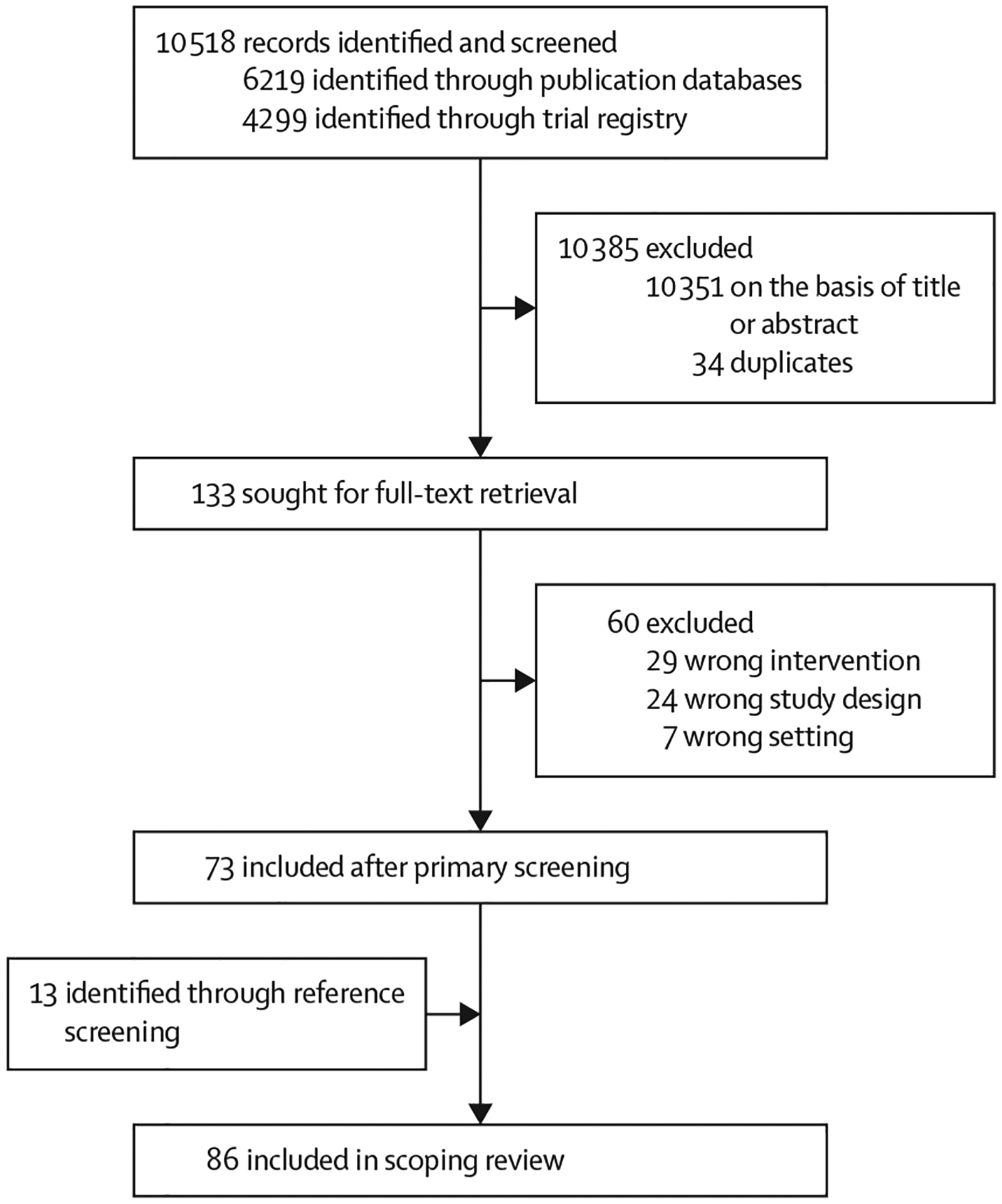
- Scoping review following PRISMA-ScR, registered with PROSPERO (CRD42022326955), searching PubMed, SCOPUS, CENTRAL, and the International Clinical Trials Registry Platform for studies published Jan 1, 2018–Nov 14, 2023.
- Inclusion required RCTs with a substantial non-linear AI component integrated into clinical practice and full-text publication in a peer-reviewed English-language journal; linear risk scores, secondary studies, abstracts, and non-integrated interventions were excluded.
- Screening and extraction were done by independent investigators, with discrepancies resolved by a third reviewer; due to heterogeneity, no formal meta-analysis was conducted and simple descriptive statistics were presented.
Limitations
- The paper states two limitations: the search was English-only, potentially excluding relevant non-English trials, and the review does not address updated trends in trial risk of bias.
- Evident from the text: the authors emphasise likely publication bias, noting that a 2023 systematic review identified 627 AI-enabled technology trials registered on ClinicalTrials.gov but only nine (1%) readily identified as published.
- Evident from the text: the predominance of single-centre trials, limited race or ethnicity reporting (22 trials, of which 18 were from the USA), and heterogeneous operational-time results raise concerns about generalisability and practicality.
Model-written summary. Check it against the paper before relying on it.
Integrity signals
Registry
Cites
Statistics
Figures
Verification
Claims the paper makes
5 Valid · 0 Not valid · 4 Not checked · 39 Own results and interpretations
Every source the paper cites for this claim was checked and supports it.
In the paper
“Of the 63 trials published since the start of 2021, 12 (19%) cited the 2020 CONSORT-AI reporting guidelines for clinical trials assessing AI interventions.16”
§ Randomised controlled trials evaluating artificial intelligence in clinical practice: a scoping review > Results
What the sources say
- Supportedcites [16] Liu X, Cruz Rivera S, Moher D, Reporting guidelines for clinical trial reports for interventions involving artificial intelligence: the CONSORT-AI extension. Nat Med 2020; 26: 1364– 74. 32908283 PMC7598943 source
The citation identifies the 2020 CONSORT-AI guidelines, rather than sourcing the citing authors’ count of later trials. The Abstract describes this paper as the CONSORT-AI reporting guideline for clinical trials evaluating AI interventions. (LLM, conf=0.93)
plain- Asserted: passes — The authors put it forward as true.
- Checkable: passes — It can be checked against evidence.
- Load-bearing: unclear — It is unclear whether the paper’s conclusions depend on it.
- Based: passes — The paper gives a reason why it holds.
- Supported
A result the paper reports from its own data — it cites no other source for it, so there is none to check. The quote shows it is in the paper.
In the paper
“Approximately half (46 [54%] of 86) of the trials had primary endpoints relating to diagnostic yield or performance, such as detection rate or mean absolute error.”
§ Randomised controlled trials evaluating artificial intelligence in clinical practice: a scoping review > Results
plain- Asserted: passes — The authors put it forward as true.
- Checkable: passes — It can be checked against evidence.
- Load-bearing: unclear — It is unclear whether the paper’s conclusions depend on it.
- Based: passes — The paper gives a reason why it holds.
A result the paper reports from its own data — it cites no other source for it, so there is none to check. The quote shows it is in the paper.
In the paper
“79 (92%) of 86 RCTs were conducted in a single country, with the USA conducting the most trials (27 [31%]), followed by China (26 [30%]).”
§ Randomised controlled trials evaluating artificial intelligence in clinical practice: a scoping review > Results
plain- Asserted: passes — The authors put it forward as true.
- Checkable: passes — It can be checked against evidence.
- Load-bearing: unclear — It is unclear whether the paper’s conclusions depend on it.
- Based: passes — The paper gives a reason why it holds.
A result the paper reports from its own data — it cites no other source for it, so there is none to check. The quote shows it is in the paper.
In the paper
“Among these trials, the median percentage of White (non-Hispanic or Latino) participants was 70·5% (range 0–98·4; IQR 35·0–81·8).”
§ Randomised controlled trials evaluating artificial intelligence in clinical practice: a scoping review > Results
plain- Asserted: passes — The authors put it forward as true.
- Checkable: passes — It can be checked against evidence.
- Load-bearing: unclear — It is unclear whether the paper’s conclusions depend on it.
- Based: passes — The paper gives a reason why it holds.
A result the paper reports from its own data — it cites no other source for it, so there is none to check. The quote shows it is in the paper.
In the paper
“24 (65%) of the 37 gastroenterology trials were conducted by only four groups (eight trials from Wuhan University, six from Wision AI, six from Medtronic, and four from Fujifilm).”
§ Randomised controlled trials evaluating artificial intelligence in clinical practice: a scoping review > Results
plain- Asserted: passes — The authors put it forward as true.
- Checkable: passes — It can be checked against evidence.
- Load-bearing: unclear — It is unclear whether the paper’s conclusions depend on it.
- Based: passes — The paper gives a reason why it holds.
21 more claims
Create a free account to see all 48 claims and every source verdict.
- It may state two separate claims as one. 14
- Probably not a substantial claim. 10
Claims other papers make about this one
Each is checked against this paper’s own text: does it say what the citing paper says it does?
The cited source says what the claim attributes to it.
In the citing paper
“This pattern is also consistent with previous findings19,22.”
From A quantitative analysis of global AI medical studies: gaps in randomized controlled trials (2026) · cites this paper as [19]
The check wasn’t confident either way, so it gives no verdict — never disputed.
In the citing paper
“The evaluation of their capacity for ongoing improvement is based on the system’s ability to incorporate model updates and integrate feedback loops.122,123”
From A foundational architecture for AI agents in healthcare (2025) · cites this paper as [122]
Experimental — accuracy not yet measuredIn the citing paper
“To the authors’ knowledge, this is the first RCT to compare a fully automated DPP to standard care and adds to the limited evidence evaluating AI interventions against established standards in medicine.38,39”
From An AI-Powered Lifestyle Intervention vs Human Coaching in the Diabetes Prevention Program: A Randomized Clinical Trial (2025) · cites this paper as [38]
In the citing paper
“To the authors’ knowledge, this is the first RCT to compare a fully automated DPP to standard care and adds to the limited evidence evaluating AI interventions against established standards in medicine.38,39”
From An AI-Powered Lifestyle Intervention vs Human Coaching in the Diabetes Prevention Program: A Randomized Clinical Trial (2025) · cites this paper as [38]
Citations
Cites
PRISMA Extension for Scoping Reviews (PRISMA-ScR): Checklist and Explanation
Tricco, A. C., Lillie, E., Zarin, W., O'Brien, K. K., Colquhoun, H., Levac, D., Moher, D., Peters, M. D. J., Horsley, T., Weeks, L., et al. (2018) · Annals of Internal Medicine · doi:10.7326/m18-0850 · Cited by 43,565
Dissecting racial bias in an algorithm used to manage the health of populations
Obermeyer, Z., Powers, B., Vogeli, C., & Mullainathan, S. (2019) · Science · doi:10.1126/science.aax2342 · Cited by 7,137 · cited 1×
“Other primary endpoints were grouped according to care management (18 [21%]), patient behaviour and symptoms (15 [17%]), and clinical decision making (7 [8%]).”
BackgroundRajpurkar, P., Chen, E., Banerjee, O., & Topol, E. J. (2022) · Nature Medicine · doi:10.1038/s41591-021-01614-0 · Cited by 3,212 · cited 1×
“…with several publications reporting that medical AI models can perform as well as or better than clinicians across a number of tasks and specialties; 1–3 however, many of these models have only been tested retrospectively, using surrogate endpoints, and outside of real-world clinical settings.”
BackgroundSelf-citationLiu, X., Faes, L., Kale, A. U., Wagner, S. K., Fu, D. J., Bruynseels, A., Mahendiran, T., Moraes, G., Shamdas, M., Kern, C., et al. (2019) · The Lancet Digital Health · doi:10.1016/s2589-7500(19)30123-2 · Cited by 1,883
Self-citationLiu, X., Cruz Rivera, S., Moher, D., Calvert, M. J., Denniston, A. K., The SPIRIT-AI and CONSORT-AI Working Group, SPIRIT-AI and CONSORT-AI Steering Group, Chan, A.-W., Darzi, A., Holmes, C., et al. (2020) · Nature Medicine · doi:10.1038/s41591-020-1034-x · Cited by 1,421
Acosta, J. N., Falcone, G. J., Rajpurkar, P., & Topol, E. J. (2022) · Nature Medicine · doi:10.1038/s41591-022-01981-2 · Cited by 1,365
Self-citationBenjamens, S., Dhunnoo, P., & Meskó, B. (2020) · npj Digital Medicine · doi:10.1038/s41746-020-00324-0 · Cited by 1,215 · cited 1×
“%] of 86) followed by academia (35 [41”
BackgroundWong, A., Otles, E., Donnelly, J. P., Krumm, A., McCullough, J., DeTroyer-Cooley, O., Pestrue, J., Phillips, M., Konye, J., Penoza, C., et al. (2021) · JAMA Internal Medicine · doi:10.1001/jamainternmed.2021.2626 · Cited by 995 · cited 1×
“5 It might not be uncommon for AI to perform worse when deployed prospectively, and the difficulty of adopting AI systems in a clinical setting can further impede any potential benefits in terms of important outcomes.”
BackgroundSeyyed-Kalantari, L., Zhang, H., McDermott, M. B. A., Chen, I. Y., & Ghassemi, M. (2021) · Nature Medicine · doi:10.1038/s41591-021-01595-0 · Cited by 928 · cited 1×
“6,7 10 To provide a clearer understanding of the AI landscape in health care, this scoping review aims to examine the state of RCTs for AI algorithms being used in clinical practice.”
BackgroundBeede, E., Baylor, E., Hersch, F., Iurchenko, A., Wilcox, L., Ruamviboonsuk, P., & Vardoulakis, L. M. (2020) · Proceedings of the 2020 CHI Conference on Human Factors in Computing Systems · doi:10.1145/3313831.3376718 · Cited by 614 · cited 1×
“6,7 10 To provide a clearer understanding of the AI landscape in health care, this scoping review aims to examine the state of RCTs for AI algorithms being used in clinical practice.”
Background
Research works printed but not linked: 1
- Mallick A, Hsieh K, Arzani B, Joshi G. Matchmaker: data drift mitigation in machine learning for large-scale systems. 2022. https://proceedings.mlsys.org/paper_files/paper/2022/file/069a002768bcb31509d4901961f23b3c-Paper.pdf (accessed March 30, 2024).
Cited by
Lekadir, K., Frangi, A. F., Porras, A. R., Glocker, B., Cintas, C., Langlotz, C. P., Weicken, E., Asselbergs, F. W., Prior, F., Collins, G. S., et al. (2025) · BMJ · doi:10.1136/bmj-2024-081554 · Cited by 957
Review of multimodal machine learning approaches in healthcare
Krones, F., Marikkar, U., Parsons, G., Szmul, A., & Mahdi, A. (2025) · Information Fusion · doi:10.1016/j.inffus.2024.102690 · Cited by 235
AI, Health, and Health Care Today and Tomorrow: The JAMA Summit Report on Artificial Intelligence
Angus, D. C., Khera, R., Lieu, T., Liu, V., Ahmad, F. S., Anderson, B., Bhavani, S. V., Bindman, A., Brennan, T., Celi, L. A., et al. (2025) · JAMA · doi:10.1001/jama.2025.18490 · Cited by 195
The integration of AI in nursing: addressing current applications, challenges, and future directions
Wei, Q., Pan, S., Liu, X., Hong, M., Nong, C., & Zhang, W. (2025) · Frontiers in Medicine · doi:10.3389/fmed.2025.1545420 · Cited by 143
“To address this limitation, future work should focus on rigorous, multi-site clinical trials that evaluate the sustained effects of AI on patient outcomes, nursing efficiency, and healthcare costs (61).”
Wenderott, K., Krups, J., Zaruchas, F., & Weigl, M. (2024) · npj Digital Medicine · doi:10.1038/s41746-024-01248-9 · Cited by 201
Generative artificial intelligence in medicine
Teo, Z. L., Thirunavukarasu, A. J., Elangovan, K., Cheng, H., Moova, P., Soetikno, B., Nielsen, C., Pollreisz, A., Ting, D. S. J., Morris, R. J. T., et al. (2025) · Nature Medicine · doi:10.1038/s41591-025-03983-2 · Cited by 119
“First, although much attention has been placed on model development, subsequent deployment in real-world settings is relatively understudied 80,152,166 .”
InfluentialEl Arab, R. A., Abu-Mahfouz, M. S., Abuadas, F. H., Alzghoul, H., Almari, M., Ghannam, A., & Seweid, M. M. (2025) · Healthcare · doi:10.3390/healthcare13070701 · Cited by 108
Ogut, E. (2025) · Clinics and Practice · doi:10.3390/clinpract15090169 · Cited by 107
Generalizability of FDA-Approved AI-Enabled Medical Devices for Clinical Use
Windecker, D., Baj, G., Shiri, I., Kazaj, P. M., Kaesmacher, J., Gräni, C., & Siontis, G. C. M. (2025) · JAMA Network Open · doi:10.1001/jamanetworkopen.2025.8052 · Cited by 143
Berkhout, W. E. M., van Wijngaarden, J. J., Workum, J. D., van de Sande, D., Hilling, D. E., Jung, C., Meyfroidt, G., Gommers, D., Buijsman, S. N. R., & van Genderen, M. E. (2025) · JAMA Network Open · doi:10.1001/jamanetworkopen.2025.22866 · Cited by 75
Avanzo, M., Stancanello, J., Pirrone, G., Drigo, A., & Retico, A. (2024) · Cancers · doi:10.3390/cancers16213702 · Cited by 110
“Techniques to enhance interpretability include visual methods like saliency maps and heatmaps, which highlight areas an image-based model considers significant for its predictions [219].”
MethodArtificial intelligence-based biomarkers for treatment decisions in oncology
Ligero, M., Nahhas, O. S. M. E., Aldea, M. D., & Kather, J. N. (2025) · Trends in cancer · doi:10.1016/j.trecan.2024.12.001 · Cited by 84
Rethinking clinical trials for medical AI with dynamic deployments of adaptive systems
Rosenthal, J. T., Beecy, A., & Sabuncu, M. R. (2025) · npj Digital Medicine · doi:10.1038/s41746-025-01674-3 · Cited by 59
Artificial intelligence for drug repurposing against infectious diseases
Singh, A. (2024) · Artificial Intelligence Chemistry · doi:10.1016/j.aichem.2024.100071 · Cited by 74
Loupy, A., Sablik, M., Khush, K. K., & Reese, P. P. (2025) · The Lancet · doi:10.1016/s0140-6736(25)00195-3 · Cited by 67
Guidelines and standard frameworks for artificial intelligence in medicine: a systematic review
Shiferaw, K. B., Roloff, M., Balaur, I., Welter, D., Waltemath, D., & Zeleke, A. A. (2024) · JAMIA Open · doi:10.1093/jamiaopen/ooae155 · Cited by 74
Reporting Guideline for Chatbot Health Advice Studies: The CHART Statement
Collaborative, T. C., Huo, B., Collins, G. S., Chartash, D., Thirunavukarasu, A. J., Flanagin, A., Iorio, A., Cacciamani, G. E., Chen, X., Liu, N., et al. (2025) · JAMA Network Open · doi:10.1001/jamanetworkopen.2025.30220 · Cited by 84
Collaborative, T. C. (2025) · BMJ Medicine · doi:10.1136/bmjmed-2025-001632 · Cited by 98
Wilhelm, C., Steckelberg, A., & Rebitschek, F. G. (2024) · The Lancet Regional Health - Europe · doi:10.1016/j.lanepe.2024.101145 · Cited by 82
Iacucci, M., Santacroce, G., Maeda, Y., & Ghosh, S. (2025) · Gastroenterology · doi:10.1053/j.gastro.2025.03.005 · Cited by 56
Mathioudakis, N., Lalani, B., Abusamaan, M. S., Alderfer, M., Alver, D., Dobs, A., Kane, B., McGready, J., Riekert, K., Ringham, B., et al. (2025) · JAMA · doi:10.1001/jama.2025.19563 · Cited by 41
A foundational architecture for AI agents in healthcare
Liu, F., Niu, Y., Zhang, Q., Wang, K., Dong, Z., Wong, I. N., Cheng, L., Li, T., Duan, L., Li, K., et al. (2025) · Cell Reports Medicine · doi:10.1016/j.xcrm.2025.102374 · Cited by 41
“122,123 AI systems that embed continuous learning processes are better equipped to adapt to emerging disease patterns, evolving treatment strategies, and changing patient outcomes.”
Morone, G., De Angelis, L., Martino Cinnera, A., Carbonetti, R., Bisirri, A., Ciancarelli, I., Iosa, M., Negrini, S., Kiekens, C., & Negrini, F. (2025) · Frontiers in Digital Health · doi:10.3389/fdgth.2025.1550731 · Cited by 41
Perumal, M. K. K., Renuka, R. R., Kumar, S. S., & Natarajan, P. M. (2025) · Frontiers in Oral Health · doi:10.3389/froh.2025.1592428 · Cited by 73
Cadamuro, J., Carobene, A., Cabitza, F., Debeljak, Ž., Bruyne, S. D., van Doorn, W. P. T. M., Johannes, E., Frans, G., Özdemir, H., Pérez, S. M., et al. (2024) · Clinical Chemistry and Laboratory Medicine (CCLM) · doi:10.1515/cclm-2024-1016 · Cited by 51
Kim, J., Maranna, S., Watson, C. A., & Parange, N. (2025) · The American Journal of Emergency Medicine · doi:10.1016/j.ajem.2025.03.029 · Cited by 49
AI solutions to the radiology workforce shortage
Jing, A. B., Garg, N., Zhang, J., & Brown, J. J. (2025) · npj Health Systems · doi:10.1038/s44401-025-00023-6 · Cited by 52
Freeman, S., Wang, A., Saraf, S., Potts, E., McKimm, A., Coiera, E. W., & Magrabi, F. (2025) · JMIR Research Protocols · doi:10.2196/75702 · Cited by 58
“Despite these benefits and technological advancements, adoption within health care organizations remains slow [6].”
Odone, A., Barbati, C., Amadasi, S., Schultz, T., & Resnik, D. B. (2025) · The Lancet Infectious Diseases · doi:10.1016/s1473-3099(25)00412-8 · Cited by 56
Stogiannos, N., Gillan, C., Precht, H., dos Reis, C. S., Kumar, A., O’Regan, T., Ellis, V., Barnes, A., Meades, R., Pogose, M., et al. (2024) · Journal of medical imaging and radiation sciences · doi:10.1016/j.jmir.2024.101717 · Cited by 35
Disparities in clinical studies of AI enabled applications from a global perspective
Yang, R., Nair, S. V., Ke, Y., D’Agostino, D., Liu, M., Ning, Y., & Liu, N. (2024) · npj Digital Medicine · doi:10.1038/s41746-024-01212-7 · Cited by 44
Li, B., & Gilbert, S. (2024) · npj Digital Medicine · doi:10.1038/s41746-024-01345-9 · Cited by 53
Recognising errors in AI implementation in radiology: A narrative review
Stogiannos, N., Cuocolo, R., D’Antonoli, T. A., dos Santos, D. P., Harvey, H., Huisman, M., Koçak, B., Kotter, E., Lekadir, K., Shelmerdine, S. C., et al. (2025) · European Journal of Radiology · doi:10.1016/j.ejrad.2025.112311 · Cited by 43
Human–large language model collaboration in clinical medicine: a systematic review and meta-analysis
Wang, G., Zhang, K., Jiang, J., Wang, C., Bi, H., Liang, H., Qi, Z., Huang, Y., Li, Y., & Yang, X. (2026) · npj Digital Medicine · doi:10.1038/s41746-026-02382-2 · Cited by 68
Factors for Patient Trust and Acceptance of Medical Artificial Intelligence
Bracic, A., Spector‐Bagdady, K., Towle, S., Zhang, R., James, C. A., & Price, W. N., II (2026) · JAMA Network Open · doi:10.1001/jamanetworkopen.2026.0815 · Cited by 45
Clinical Trial Notifications Triggered by Artificial Intelligence–Detected Cancer Progression
Mazor, T., Farhat, K., Trukhanov, P., Lindsay, J. R., Galvin, M., Mallaber, E., Paul, M. A., Hassett, M. J., Schrag, D., Cerami, E. G., et al. (2025) · JAMA Network Open · doi:10.1001/jamanetworkopen.2025.2013 · Cited by 30
The barriers to uptake of artificial intelligence in hepatology and how to overcome them
Clusmann, J., Balaguer‐Montero, M., Bassegoda, O., Schneider, C. V., Seraphin, T. P., Paintsil, E. K., Luedde, T., Pérez-López, R., Caldéraro, J., Gilbert, S., et al. (2025) · Journal of Hepatology · doi:10.1016/j.jhep.2025.07.003 · Cited by 34
RetractedGundlack, J., Negash, S., Thiel, C., Buch, C., Schildmann, J., Unverzagt, S., Mikolajczyk, R., & Frese, T. (2025) · Health Expectations · doi:10.1111/hex.70216 · Cited by 37
Reporting guideline for Chatbot Health Advice studies: the CHART statement
Huo, B., Collins, G. S., Chartash, D., Thirunavukarasu, A. J., Flanagin, A., Iorio, A., Cacciamani, G. E., Chen, X., Liu, N., Mathur, P., et al. (2025) · BMC Medicine · doi:10.1186/s12916-025-04274-w · Cited by 40
Buchan, M. L., Goel, K., Schneider, C., Steullet, V., Bratton, S. L., & Basch, E. (2024) · JCO Clinical Cancer Informatics · doi:10.1200/cci.24.00085 · Cited by 34
PROTEUS: A Prospective RCT Evaluating Use of AI in Stress Echocardiography
Upton, R., Akerman, A. P., Marwick, T. H., Johnson, C. L., Piotrowska, H., Bajre, M., Breen, M. A., Dawes, H., Dehbi, H., Descamps, T., et al. (2024) · NEJM AI · doi:10.1056/aioa2400865 · Cited by 23
Ah-Thiane, L., Heudel, P., Campone, M., Robert, M., Brillaud-Meflah, V., Rousseau, C., Blanc‐Onfroy, M. L., Tomaszewski, F., Supiot, S., Perennec, T., et al. (2025) · JCO Clinical Cancer Informatics · doi:10.1200/cci-24-00230 · Cited by 45
Multiagent AI Systems in Health Care: Envisioning Next-Generation Intelligence
Borkowski, A., & Ben-Ari, A. Y. (2025) · Federal Practitioner · doi:10.12788/fp.0589 · Cited by 48
Human-AI teaming in healthcare: 1 + 1 > 2?
Liu, P., Zhang, J., Chen, S., & Chen, S. (2025) · npj Artificial Intelligence · doi:10.1038/s44387-025-00052-4 · Cited by 40
Cai, X., Peng, C.-R., Cui, Y., Li, L., Huang, M., Zhang, H., Zhang, J., & Li, T. (2024) · International Journal of Surgery · doi:10.1097/js9.0000000000002077 · Cited by 22
Causality and scientific explanation of artificial intelligence systems in biomedicine
Boge, F. J., & Mosig, A. (2024) · Pflügers Archiv - European Journal of Physiology · doi:10.1007/s00424-024-03033-9 · Cited by 31
AI-Based EMG Reporting: A Randomized Controlled Trial
Gorenshtein, A., Weisblat, Y., Khateb, M., Kenan, G., Tsirkin, I., Fayn, G., Geller, S., & Shelly, S. (2025) · Journal of Neurology · doi:10.1007/s00415-025-13261-3 · Cited by 29
Randomized Controlled Trials Evaluating Artificial Intelligence in Cardiovascular Care
Barzilai, D. H., Sudri, K., Goshen, G., Klang, E., Zimlichman, E., Barbash, I. M., & Cohen, M. S. (2025) · JACC Advances · doi:10.1016/j.jacadv.2025.102152 · Cited by 29
An LLM chatbot to facilitate primary-to-specialist care transitions: a randomized controlled trial
Tao, X., Zhou, S., Ding, K., Li, S., Li, Y., Wu, B., Huang, Q., Chen, W., Shen, M., Meng, E., et al. (2026) · Nature Medicine · doi:10.1038/s41591-025-04176-7 · Cited by 66
“…requires overcoming two critical barriers: mitigating the systematic biases that arise when training patient-facing LLMs on local medical dialogues from resource-limited settings 26,27 , and establishing real-world evidence of their clinical utility within time-pressured hospital workflows 28–31 .”
Hirosawa, T., Suzuki, T., Shiraishi, T., Hayashi, A., Fujii, Y., Harada, T., & Shimizu, T. (2024) · International Journal of General Medicine · doi:10.2147/ijgm.s497753 · Cited by 26
Wenderott, K., Krups, J., Weigl, M., & Wooldridge, A. R. (2025) · Journal of Medical Internet Research · doi:10.2196/63649 · Cited by 36
“While current literature extensively addresses the potential of AI in overviews and opinion articles, limited empirical evidence stems from actual clinical care [11,28-30].”
Verma, V., & Kumar, D. (2025) · Letters in Drug Design & Discovery · doi:10.1016/j.lddd.2026.100341 · Cited by 26
Artificial intelligence in clinical trials of lung cancer: Current and future prospects
Zhang, Y., You, P., Liu, R., Lu, Y., Li, J., Lei, Y., Wu, S., & Zhou, H. (2024) · Intelligent Oncology · doi:10.1016/j.intonc.2024.11.003 · Cited by 19
Santacroce, G., Zammarchi, I., Nardone, O. M., Capobianco, I., Puga‐Tejada, M., Majumder, S., Ghosh, S., & Iacucci, M. (2025) · Therapeutic Advances in Gastroenterology · doi:10.1177/17562848251325525 · Cited by 23
“64 Using consistent and diverse datasets and ensuring exter-nal validation, particularly with publicly available datasets, is vital to ensure reproducibility and mitigate overfitting.”
Deshmukh, M. T., Thakre, Y., Bisen, W. H., Sankar, K., Avthankar, A., Shahade, A. K., Bhaiyya, M. L., & Kulkarni, M. B. (2025) · Analytical Chemistry · doi:10.1021/acs.analchem.5c06356 · Cited by 19
“117,118 External validation on independent data sets or with other cohorts of hospitals is, therefore, required to prove robustness.”
Artificial intelligence in primary care: innovation at a crossroads
Laranjo, L., Car, L. T., Payne, R. E., Neves, A. L., Kidd, M. R., & Miranda, J. J. (2025) · The Lancet Primary Care · doi:10.1016/j.lanprc.2025.100078 · Cited by 36
Shaw, J. (2024) · JAMA · doi:10.1001/jama.2024.22074 · Cited by 16
Campbell, E. A., Holl, F., Marwah, H. K., Fraser, H., & Craig, S. (2025) · Pediatric Research · doi:10.1038/s41390-024-03719-x · Cited by 17
Artificial intelligence-enabled electrocardiography from scientific research to clinical application
Lin, C.-S., Liu, W.-T., Chen, Y.-H., Lin, S.-H., & Lin, C. (2025) · EMBO Molecular Medicine · doi:10.1038/s44321-025-00351-y · Cited by 15
Trials for LLM-supported clinical decisions in African primary healthcare
Mateen, B. A., Menon, V., Agweyu, A., Korom, R., Omoluabi, E., McAfee, D., Shimelash, N., Rutunda, S., Rugege, C., Williams, G., et al. (2025) · Nature Medicine · doi:10.1038/s41591-025-03815-3 · Cited by 22
van Breugel, M., Greenhawt, M., Eguíluz‐Gracia, I., Torres, M. J., Anagnostou, A., & Koppelman, G. H. (2025) · Journal of Allergy and Clinical Immunology · doi:10.1016/j.jaci.2025.08.022 · Cited by 23
Zhao, J., Long, Y., Li, S., Li, X., Zhang, Y., Hu, J., Han, L., & Ren, L. (2024) · Rheumatology International · doi:10.1007/s00296-024-05681-7 · Cited by 19
Er, A. G., Aslan, A. T., Mikulska, M., & Akova, M. (2024) · Clinical Microbiology and Infection · doi:10.1016/j.cmi.2024.09.015 · Cited by 19
Generative AI - Assisted Adaptive Cancer Therapy
Derbal, Y. (2025) · Cancer Control · doi:10.1177/10732748251349919 · Cited by 15
Oikonomou, E. K., Batinica, B., Dhingra, L. S., Aminorroaya, A., Coppi, A. C., & Khera, R. (2026) · NEJM AI · doi:10.1056/aioa2500588 · Cited by 25
Ethical guidance for reporting and evaluating claims of AI outperforming human doctors
Drogt, J., Milota, M., van den Brink, A., & Jongsma, K. R. (2024) · npj Digital Medicine · doi:10.1038/s41746-024-01255-w · Cited by 20
Asselbergs, F. W., & Lüscher, T. F. (2024) · European Heart Journal · doi:10.1093/eurheartj/ehae748 · Cited by 17
Artificial Intelligence in the Management of Heart Failure
Cheema, B. S., Hourmozdi, J., Kline, A. S., Ahmad, F. S., & Khera, R. (2025) · Journal of Cardiac Failure · doi:10.1016/j.cardfail.2025.02.020 · Cited by 24
Maas, L., Contreras-Meca, C., Ghezzo, S., Belmans, F., Corsi, A., Cant, J., Vos, W. G., Bobowicz, M., Rygusik, M., Łaski, D., et al. (2025) · Journal of Medical Economics · doi:10.1080/13696998.2025.2525006 · Cited by 14
“…evaluations of AI in healthcare and the currently disproportionally low numbers of economic evaluations on AI applications in healthcare settings compared to the research published on AI developments for clinical use 48,49 with the number of trials on AI having more than doubled since 2021 50 .”
Lange, B. (2026) · Lecture Notes in Computer Science · doi:10.1007/978-3-032-01377-4_9 · Cited by 12
“16 This can lead to epistemic losses rather than gains.”
Economic Value of AI in Radiology: A Systematic Review
Molwitz, I., Ristow, I., Erley, J., D’Antonoli, T. A., Tejani, A. S., Klontzas, M. E., Huisman, M., Adam, G., Nüesch, S., & Adams, L. C. (2025) · Radiology Artificial Intelligence · doi:10.1148/ryai.250090 · Cited by 28
Agweyu, A., Mwaniki, P., Musau, W., Korom, R., Isaaka, L., Wanyama, C. W., Kiptinness, S., Adan, N., Emmanuel-Fabula, M., & Mateen, B. A. (2026) · Nature Health · doi:10.1038/s44360-026-00082-5 · Cited by 32
“Of the limited high-quality evidence available from LMICs (randomized controlled trials), we identified only one economic evaluation of an AI-based tool 26,27 , and it suggests that the technology is not cost-effective 28 .”
AI frontiers in emergency care: the next evolution of nursing interventions
Mani, Z. A., & Albagawi, B. S. (2024) · Frontiers in Public Health · doi:10.3389/fpubh.2024.1439412 · Cited by 16
Reporting guideline for chatbot health advice studies: The CHART statement
Huo, B., Collins, G. S., Chartash, D., Thirunavukarasu, A. J., Flanagin, A., Iorio, A., Cacciamani, G. E., Chen, X., Liu, N., Mathur, P., et al. (2025) · Artificial Intelligence in Medicine · doi:10.1016/j.artmed.2025.103222 · Cited by 15
Adaptive validation strategies for real-world clinical artificial intelligence
Kolbinger, F. R., & Kather, J. N. (2025) · Nature Computational Science · doi:10.1038/s43588-025-00901-x · Cited by 13
Enhanced recovery after surgery (ERAS®) society guidelines for gynecologic oncology: 2026 update
Nelson, G. S., Altman, A. D., Metcalfe, A., Fotopoulou, C., Taylor, J., Glaser, G. E., Bakkum-Gamez, J. N., Kumar, A., Meyer, L. A., Stone, R., et al. (2026) · Gynecologic Oncology · doi:10.1016/j.ygyno.2026.05.022 · Cited by 23
Tumor Metastasis: Mechanistic Insights and Therapeutic Intervention
Tang, L., Peng, S., Zhuang, X., He, Y., Song, Y., Nie, H., Zheng, C., Pan, Z., Lam, A. K.-Y., He, M., et al. (2025) · MedComm – Oncology · doi:10.1002/mog2.70012 · Cited by 13
Novel Blended Learning on Artificial Intelligence for Medical Students: Qualitative Interview Study
Oftring, Z. S., Deutsch, K., Tolks, D., Jungmann, F., & Kühn, S. (2025) · JMIR Medical Education · doi:10.2196/65220 · Cited by 22
“A scoping review by Han et al [20] generated an overview of all published randomized controlled trials on clinical AI as of November 2023 and found 84 studies.”
Ma, W., & Baran, N. (2025) · World Journal of Clinical Oncology · doi:10.5306/wjco.v16.i7.104959 · Cited by 26
Gupta, P., Pearce, A. K., Pham, T., Miller, M., Brunetti, K., Heskett, K. M., Malhotra, A., Mayampurath, A. M., & Afshar, M. (2025) · Intensive Care Medicine Experimental · doi:10.1186/s40635-025-00791-3 · Cited by 12
Current status and solutions for AI ethics in ophthalmology: a bibliometric analysis
Chen, X., Yang, Y., Yun, D., Wang, R., Lin, Y., Luo, M., Zhang, W., Yu‐Wai‐Man, P., Burton, M. J., Liang, L., et al. (2025) · npj Digital Medicine · doi:10.1038/s41746-025-01976-6 · Cited by 11
The urgency of centering safety-net organizations in AI governance
Nong, P., Maurer, E. W., & Dwivedi, R. (2025) · npj Digital Medicine · doi:10.1038/s41746-025-01479-4 · Cited by 12
Diagnostic framework to validate clinical machine learning models locally on temporally stamped data
Schuessler, M., Fleming, S. L., Meyer, S., Seto, T., & Hernandez‐Boussard, T. (2025) · Communications Medicine · doi:10.1038/s43856-025-00965-w · Cited by 17
Muller, S. H. A., van Rijssel, T. I., & van Thiel, G. J. M. W. (2025) · Drug Discovery Today · doi:10.1016/j.drudis.2025.104309 · Cited by 11
Preliminary evaluation of ChatGPT model iterations in emergency department diagnostics
Wang, J., Shue, K., Liu, L., & Hu, G. (2025) · Scientific Reports · doi:10.1038/s41598-025-95233-1 · Cited by 16
Guo, X., Wang, K., Liu, Q., Baran, N., & Ma, W. (2025) · Frontiers in Immunology · doi:10.3389/fimmu.2025.1595977 · Cited by 12
Towards deployment-centric multimodal AI beyond vision and language
Liu, X., Zhang, J., Zhou, S., van der Plas, T. L., Vijayaraghavan, A., Grishina, A., Zhuang, M., Schofield, D., Tomlinson, C., Wang, Y., et al. (2025) · Nature Machine Intelligence · doi:10.1038/s42256-025-01116-5 · Cited by 27
Artificial Intelligence and precision medicine for optimizing patient care: A comprehensive review
Khare, P. S., Shaikh, S. A., & Havelikar, U. A. (2025) · Intelligent Hospital · doi:10.1016/j.inhs.2025.100042 · Cited by 14
Hamamoto, R., Koyama, T., Takahashi, S., Yasuda, T., Kobayashi, K., Akagi, Y., Kouno, N., Sudo, K., Hirata, M., Sunami, K., et al. (2026) · Journal of Hematology & Oncology · doi:10.1186/s13045-026-01781-y · Cited by 8
“However, the accumulation of randomized trials demonstrating actual improvements in medical outcomes and safety remains limited, warranting caution when estimating implementation effects [116].”
Montagna, S., Magno, D., Ferretti, S., Stelluti, M., Gona, A., Dionisi, C., Simonazzi, G., Martini, S., Corvaglia, L., & Aceti, A. (2024) · Pediatric Pulmonology · doi:10.1002/ppul.27216 · Cited by 11
A framework for the governance of AI in healthcare for India: An exploratory model
Naik, S., & Reddy, B. (2025) · Indian Journal of Medical Ethics · doi:10.20529/ijme.2025.037 · Cited by 9
“AI applications have been trialled with success across the healthcare sector, including in biomedical research [6], diagnosis, medical interventions, public health, and healthcare administration [7].”
Cai, X., Peng, C.-R., Ding, C.-Y., Cui, Y., Gao, L., Xu, Z., Li, L., Zhang, J., & Li, T. (2025) · npj Precision Oncology · doi:10.1038/s41698-025-01125-y · Cited by 10
The impact of leadership on AI deployment study outcomes in healthcare: an integrative analysis
Li, Q., Li, P., Hao, H., Padman, R., Gao, H., Gossey, J. T., Bian, J., & Zhang, Y. (2025) · npj Digital Medicine · doi:10.1038/s41746-025-02177-x · Cited by 13
Artificial intelligence in rehabilitation: a living systematic mapping review - first release
Morone, G., REHALISE Group, Carbonetti, R., Cinnera, A. M., Malfitano, C., Bisirri, A., & Negrini, F. (2025) · European Journal of Physical and Rehabilitation Medicine · doi:10.23736/s1973-9087.25.09331-1 · Cited by 28
Yagnik, V. D., Choudhary, P. R., & Garg, P. K. (2026) · Clinical and Experimental Gastroenterology · doi:10.2147/ceg.s573930 · Cited by 10
Habli, I., Sujan, M. A., & Lawton, T. (2024) · Future Healthcare Journal · doi:10.1016/j.fhj.2024.100179 · Cited by 9
Elamin, S., Johri, S., Rajpurkar, P., Geisler, E., & Berzin, T. M. (2025) · Journal of the Canadian Association of Gastroenterology · doi:10.1093/jcag/gwae041 · Cited by 11
Self-citationCollaborative, T. C., Huo, B., Collins, G. S., Chartash, D., Thirunavukarasu, A. J., Flanagin, A., Iorio, A., Cacciamani, G. E., Chen, X., Liu, N., et al. (2025) · British journal of surgery · doi:10.1093/bjs/znaf142 · Cited by 8
Al-Jebrni, A. H., Jiang, Z., Qin, Y., Qiu, Y., Jiang, N., Li, G., Zheng, Y., Wong, T. Y., Kim, S., Jung, Y., et al. (2026) · Computational Visual Media · doi:10.26599/cvm.2026.9450530 · Cited by 11
Kueper, J. K., Liaw, W. R., Lizotte, D. J., & Tsuei, S. H. (2025) · NEJM AI · doi:10.1056/aip2401122 · Cited by 4
Metadata
- Authors
- Han, R., Acosta, J. N., Shakeri, Z., Ioannidis, J. P. A., Topol, E. J., & Rajpurkar, P.
- Affiliations
- Harvard University (US)
- Yale University (US)
- University of Toronto (CA)
- Stanford Medicine (US)
- Scripps Research Institute (US)
- Corresponding author
- Topol, Eric J
- Venue
- The Lancet Digital Health
- Publisher
- Elsevier BV
- Published
- 2024-05
- Volume
- 6
- Issue
- 5
- Pages
- e367-e373
- ISSN
- 2589-7500 (ISSN-L)
- PMC
- PMC11068159
- OpenAlex
- W4395067202
- Cited by
- 336
- References
- 51
- Citations by year
- 2026: 152 · 2025: 151 · 2024: 33
- FWCI
- 7.66
- Type
- journal article
- Language
- en
- Open access
- gold
- doi.org
- Licence
- cc-by-nc-nd
- www.elsevier.com/tdm/userlicense/1.0/ (tdm)
- www.elsevier.com/legal/tdmrep-license (tdm)
- creativecommons.org/licenses/by-nc-nd/4.0/ (vor)
- Locations
- The Lancet Digital Health (publishedVersion, cc-by-nc-nd)
- PubMed (publishedVersion)
- PubMed Central (acceptedVersion, cc-by-nc-nd)
- Funders
- NIH
- NIGMS
- Topics
- Health Sciences › Medicine › Health Informatics › Artificial Intelligence in Healthcare and Education
- Physical Sciences › Computer Science › Artificial Intelligence › AI in cancer detection
- Health Sciences › Health Professions › Health Information Management › Artificial Intelligence in Healthcare
- Keywords
- clinical implementation of AI, randomized controlled trials, deep learning, diagnostic imaging, diagnostic performance, gastroenterology, radiology, generalizability, publication bias, reporting guidelines, patient-relevant outcomes
- MeSH terms
- Deep Learning, Artificial Intelligence, Humans, Randomized Controlled Trials as Topic
About these checks
Registry, retraction, Cites and statistics results are computed, not judged, with one exception: a printed reference that no index lists is read once by a model before it counts as a citation error. Claims are extracted by a model and kept only when their quote appears verbatim in the text; each cited source is then checked, with a model’s help, for whether it says what the claim relies on. Those verdicts can be wrong — read the claim’s quote and the cited source before relying on one.
The claim verdicts this report counts are experimental: their accuracy is not yet measured.
A language model drew the claims from the paper on 2026-10-01, under version 3 of the claim definition (model deepseek-v4.1-flash, prompt extract-v3).
A second model labelled each claim on 2026-10-01 (model jev-1.13-20260917, definition revision gold-guideline-v0.2).
Cited sources are checked with a language model’s help (gpt-6-sol).
Statistics and arithmetic are recomputed, not judged.
Confidence bands are shown only for fields calibrated on our annotated test set. None is calibrated yet, so no band is shown.
What counts as a claim ›How we measure confidence ›How we check this ›
Are you an author, or do you see a problem with this page? Request a review
Data sources
Bibliographic data: Semantic Scholar, OpenAlex, Crossref.
Contains information from the Semantic Scholar Academic Graph Datasets, made available under the ODC Attribution License (ODC-BY 1.0).
Semantic Scholar’s data is described in: Kinney, R., et al. (2023). The Semantic Scholar Open Data Platform. arXiv:2301.10140.
