

Blood cholesterol and risk of dementia in more than 1·8 million people over two decades: a retrospective cohort study
Open accessThe DOI matches its Crossref record; 31 of the 32 references it cites were found in a registry or an index.
Abstract
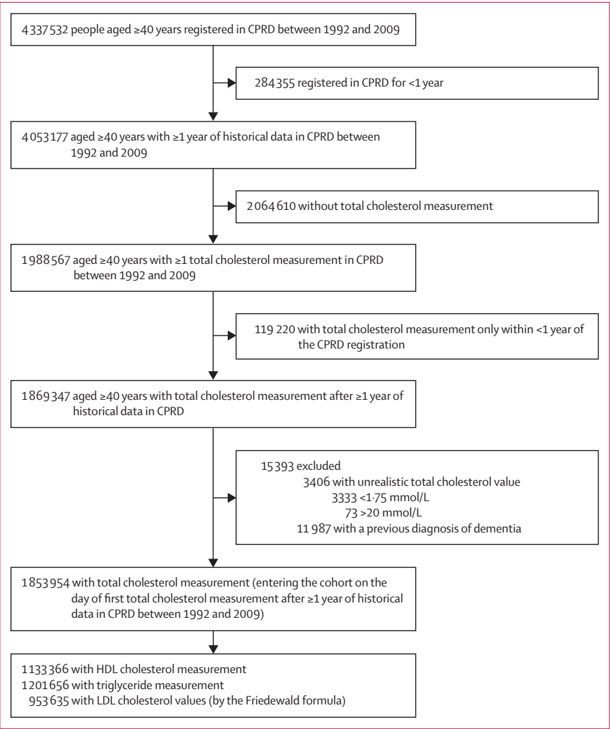
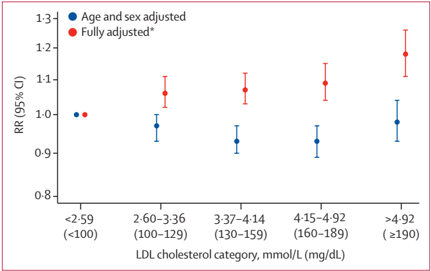
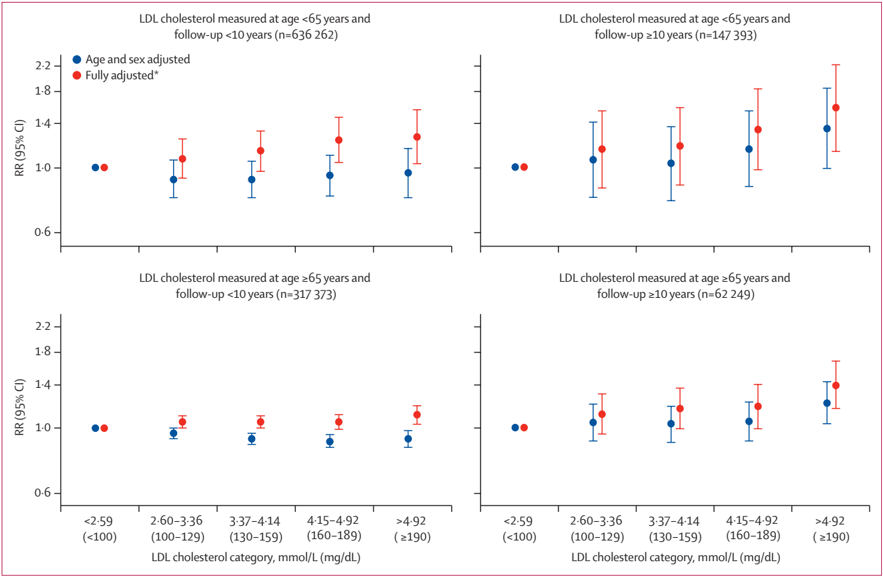
BACKGROUND: Uncertainty remains concerning the association of blood cholesterol with the risk of subsequent dementia. Using data from people with lipid measurements in the UK Clinical Practice Research Datalink (CPRD), we examined the association between blood lipid levels and dementia (both vascular and non-vascular, including Alzheimer's disease) by age at first measurement of blood lipids and duration of follow-up. METHODS: We studied a cohort from the UK CPRD of people aged 40 years or older with a first total cholesterol recording between Jan 1, 1992, and Dec 31, 2009. Follow-up was until the first record of dementia, the last data collection date, patient death or transfer out of the practice, or Jan 5, 2015, whichever was earliest. We excluded individuals with a record of dementia before the total cholesterol measurement. We used Poisson regression to examine the association between baseline total cholesterol, LDL cholesterol and HDL cholesterol, and triglycerides and incident dementia diagnosis. Analyses were stratified by age at first measurement (<65 years or ≥65 years) and duration of follow-up (<10 years or ≥10 years). Our primary focus was LDL cholesterol. We adjusted for age, sex, calendar year, country within the UK, socioeconomic status, ethnicity, smoking, alcohol, body-mass index, comorbidities, and prescriptions. FINDINGS: 1 853 954 people had a first total cholesterol recording (dementia diagnosis in 49 416 [2·7%] people), including 953 635 [51·4%] people with LDL cholesterol values for analysis (dementia diagnosis in 21 602 [2·3%] people). Overall, we found a modest positive association between LDL cholesterol and dementia, with an adjusted rate ratio (RR) of 1·05 (95% CI 1·03-1·06) per SD increase in LDL cholesterol (1·01 mmol/L or 39 mg/dL increase). Adjusted RRs per 1-SD increase in LDL cholesterol in people younger than 65 years at baseline (n=636 262) were 1·10 (95% 1·04-1·15) for dementia diagnosed in the first 10 years after measurement and 1·17 (1·08-1·27) for dementia diagnosed more than 10 years after measurement. Associations for LDL cholesterol in people aged 65 years or older at baseline (n=317 373) were weaker compared with people younger than 65 years (RR 1·03 [95% CI 1·01-1·05] for dementia diagnosed during the first 10 years of follow-up and 1·07 [1·03-1·13] for dementia diagnosed after 10 years). We observed a weaker association between total cholesterol and dementia incidence and no consistent associations for HDL cholesterol and triglycerides. INTERPRETATION: LDL cholesterol measured in mid-life (<65 years) is modestly associated with dementia risk more than 10 years later. LDL cholesterol should be added to the list of modifiable risk factors for dementia. FUNDING: The Alzheimer's Society.
Overview
The claims and statistics of this paper haven’t been checked yet.
Free: it reads the open-access text and checks the first 5 claims that cite a source we can check. Create a free account to check every claim.
Integrity signals
Registry
Cites
Statistics
Figures
Verification
Claims the paper makes
The claims and statistics of this paper haven’t been checked yet.
Free: it reads the open-access text and checks the first 5 claims that cite a source we can check. Create a free account to check every claim.
Claims other papers make about this one
Each is checked against this paper’s own text: does it say what the citing paper says it does?
The source backs part of the claim, not all of it — or backs it for a different population, condition or comparison.
In the citing paper
“Higher baseline LDL-C in a large cohort from UK general practice cohort (n=1,853,954) followed up for a median of 7.4 years, was similarly associated with higher risk of all cause dementia (RR 1.05, 1.03 -1.06 per SD increase in LDLC, 1.01 mmol/L or 39 mg/dL increase). (154)”
From Dementia prevention, intervention, and care: 2024 report of the Lancet standing Commission (2024) · cites this paper as [154]
Experimental — accuracy not yet measuredThe cited source says what the claim attributes to it.
In the citing paper
“This risk was greater in midlife, people aged <65 with high LDL-C had increased risk for dementia diagnosed within 10 years (RR 1·10, 1·04 -1·15) and over 10 years after baseline (RR 1·17, 1·08 -1·27).”
From Dementia prevention, intervention, and care: 2024 report of the Lancet standing Commission (2024) · cites this paper as [154]
Self-check
Percentages, sums and reported differences re-computed from the paper’s own numbers.
The self-check needs the paper’s full text.
Citations
Cites
1 retracted
Dementia prevention, intervention, and care: 2020 report of the Lancet Commission
Livingston, G., Huntley, J., Sommerlad, A., Ames, D., Ballard, C., Banerjee, S., Brayne, C., Burns, A., Cohen-Mansfield, J., Cooper, C., et al. (2020) · The Lancet · doi:10.1016/s0140-6736(20)30367-6 · Cited by 10,430
RetractedFriedewald, W. T., Levy, R. I., & Fredrickson, D. S. (1972) · Clinical Chemistry · doi:10.1093/clinchem/18.6.499 · Cited by 32,423
Prediction of coronary heart disease using risk factor categories
Wilson, P. W. F., D’Agostino, R. B., Levy, D., Belanger, A. M., Silbershatz, H., & Kannel, W. B. (1998) · Circulation · doi:10.1161/01.cir.97.18.1837 · Cited by 9,581
Data Resource Profile: Clinical Practice Research Datalink (CPRD)
Herrett, E., Gallagher, A. M., Bhaskaran, K., Forbes, H., Mathur, R., van Staa, T., & Smeeth, L. (2015) · International Journal of Epidemiology · doi:10.1093/ije/dyv098 · Cited by 2,667
Nichols, E., Szoeke, C. E. I., Vollset, S. E., Abbasi, N., Abd-Allah, F., Abdela, J., Aichour, M. T. E., Akinyemi, R. O., Alahdab, F., Asgedom, S. W., et al. (2019) · The Lancet Neurology · doi:10.1016/s1474-4422(18)30403-4 · Cited by 2,412
Hippisley-Cox, J., Coupland, C., & Brindle, P. (2017) · BMJ · doi:10.1136/bmj.j2099 · Cited by 1,703
Rockwood, K., Kirkland, S., Hogan, D. B., MacKnight, C., Merry, H., Verreault, R., Wolfson, C., & McDowell, I. (2002) · Archives of Neurology · doi:10.1001/archneur.59.2.223 · Cited by 516
Statins for the prevention of dementia
McGuinness, B., Craig, D., Bullock, R., & Passmore, P. (2016) · Cochrane Database of Systematic Reviews · doi:10.1002/14651858.cd003160.pub3 · Cited by 490
BMI and risk of dementia in two million people over two decades: a retrospective cohort study
Qizilbash, N., Gregson, J., Johnson, M. E., Pearce, N., Douglas, I., Wing, K., Evans, S. J. W., & Pocock, S. J. (2015) · The Lancet Diabetes & Endocrinology · doi:10.1016/s2213-8587(15)00033-9 · Cited by 475
Self-citation
Cited by
Dementia prevention, intervention, and care: 2024 report of the Lancet standing Commission
Livingston, G., Huntley, J., Liu, K. Y., Costafreda, S. G., Selbæk, G., Alladi, S., Ames, D., Banerjee, S., Burns, A., Brayne, C., et al. (2024) · The Lancet · doi:10.1016/s0140-6736(24)01296-0 · Cited by 3,860
Vascular dementia: From pathobiology to emerging perspectives
Morgan, A. E., & Auley, M. T. M. (2024) · Ageing Research Reviews · doi:10.1016/j.arr.2024.102278 · Cited by 116
Brain, J., Greene, L., Tang, E. Y. H., Louise, J., Salter, A. B., Beach, S., Turnbull, D. A., Siervo, M., Stephan, B. C. M., & Tully, P. J. (2023) · Frontiers in Epidemiology · doi:10.3389/fepid.2023.1095236 · Cited by 103
Gong, J., Harris, K., Peters, S. A. E., & Woodward, M. (2022) · EClinicalMedicine · doi:10.1016/j.eclinm.2022.101695 · Cited by 88
Tooth loss and the risk of cognitive decline and dementia: A meta-analysis of cohort studies
Li, L., Zhang, Q., Yang, D., Yang, S., Zhao, Y., Jiang, M., Wang, X., Zhao, L., Liu, Q., Lu, Z., et al. (2023) · Frontiers in Neurology · doi:10.3389/fneur.2023.1103052 · Cited by 85
“Some studies suggested a follow-up of 10 years (47, 48), so these risk factors in earlier life could be identified, patients in earlier stages of dementia be diagnosed, and reverse causation be minimized, especially in studies, except prospective cohorts.”
BackgroundWee, J., Sukudom, S., Bhat, S., Marklund, M., Peiris, N. J., Hoyos, C. M., Patel, S., Naismith, S. L., Dwivedi, G., & Misra, A. (2023) · Alzheimer's & Dementia: Diagnosis, Assessment & Disease Monitoring · doi:10.1002/dad2.12395 · Cited by 82
“39 We add to this work by including major studies published after 2020, 27,28 analyzing midlife dyslipidemia on a per unit basis, and examining the relation-shipbetweenmidlifedyslipidemiaandMCI.”
An, R., Gao, Y., Huang, X., Yang, Y., Yang, C., & Wan, Q. (2023) · International Journal of Nursing Studies · doi:10.1016/j.ijnurstu.2023.104629 · Cited by 79
Long-term risk of cardiovascular disease after traumatic brain injury: screening and prevention
Izzy, S., Grashow, R. G., Radmanesh, F., Chen, P. M., Taylor, H. A., Formisano, R., Wilson, F., Wasfy, M. M., Baggish, A. L., & ZAFONTE, R. D. (2023) · The Lancet Neurology · doi:10.1016/s1474-4422(23)00241-7 · Cited by 72
Ferguson, E. L., Zimmerman, S. C., Jiang, C., Choi, M., Swinnerton, K. N., Choudhary, V., Meyers, T. J., Hoffmann, T. J., Gilsanz, P., Oni‐Orisan, A., et al. (2023) · Neurology · doi:10.1212/wnl.0000000000207876 · Cited by 64
“6 Our results are inconsistent with this fi nding and the UK Biobank study because we found no association be-tween LDL-C and dementia in participants younger than 65 years.”
BackgroundMethodResultInfluentialBrain Lipids and Lipid Droplet Dysregulation in Alzheimer’s Disease and Neuropsychiatric Disorders
Zhao, X., Zhang, S., Sanders, A. R., & Duan, J. (2023) · Complex Psychiatry · doi:10.1159/000535131 · Cited by 54
“Both total cholesterol levels and LDL-C in midlife were found associated with an increased risk of developing dementia and AD over a decade later, although the association with total cholesterol level was much weaker than LDL-C [129].”
BackgroundInfluentialLDL cholesterol is associated with higher AD neuropathology burden independent of APOE
Wingo, A. P., Vattathil, S. M., Liu, J., Fan, W., Cutler, D. J., Levey, A. I., Schneider, J. A., Bennett, D. A., & Wingo, T. S. (2022) · Journal of Neurology, Neurosurgery & Psychiatry · doi:10.1136/jnnp-2021-328164 · Cited by 44
Poliakova, T., & Wellington, C. L. (2023) · Molecular Neurodegeneration · doi:10.1186/s13024-023-00671-y · Cited by 48
“A UK Biobank study of more than 1.8 million people over two decades revealed a modest association between dementia risk and LDL-C measured in mid-life ( 65 years) [71].”
BackgroundInfluentialPang, K., Liu, C., Tong, J., Ouyang, W., Hu, S., & Tang, Y. (2022) · Nutrients · doi:10.3390/nu14194198 · Cited by 39
“, the higher concentration of total cholesterol measured at midlife was a risk factor for late-life cognition [66], while the higher concentration of total cholesterol measured at late-life was a risk factor for late-life cognition [19–21,29,30,67].”
BackgroundBransby, L., Rosenich, E., Maruff, P. T., & Lim, Y. Y. (2023) · The Journal of Prevention of Alzheimer s Disease · doi:10.14283/jpad.2023.119 · Cited by 41
Sharp, F. R., DeCarli, C. S., Jin, L.-W., & Zhan, X. (2023) · Frontiers in Aging Neuroscience · doi:10.3389/fnagi.2023.1096206 · Cited by 33
“Blood cholesterol modestly increases the risk of dementia in a study of more than 1.8 million people over two decades (Iwagami et al., 2021), which could be due in part to its effects on brain white matter.”
BackgroundInfluentialLiu, B., Yu, L., Zhai, Q., Li, M., Li, L., Tian, F., & Chen, W. (2023) · Food & Function · doi:10.1039/d3fo00574g · Cited by 36
Ding, H., Wang, B., Hamel, A. P., Melkonyan, M., Ang, T. F. A., Au, R., & Lin, H. (2023) · Frontiers in Dementia · doi:10.3389/frdem.2023.1271680 · Cited by 32
Zhang, Y., Gao, H., Zheng, W., & Xu, H. J. (2022) · Neurobiology of Disease · doi:10.1016/j.nbd.2022.105824 · Cited by 32
Ren, Q. W., Teng, T. K., Tse, Y.-K., Tsang, C. T., Yu, S.-Y., Wu, M., Li, X., Hung, D., Tse, H., Lam, C. S. P., et al. (2024) · The Lancet Regional Health - Western Pacific · doi:10.1016/j.lanwpc.2023.101006 · Cited by 32
Tarawneh, R. (2023) · Biomolecules · doi:10.3390/biom13050830 · Cited by 29
“AD risk increases with higher levels of low-density-lipoprotein (LDL) cholesterol and lower levels of high-density-lipoprotein (HDL) cholesterol [47,48].”
BackgroundCurrent and Future Treatments of Vascular Cognitive Impairment
Ip, B. Y. M., Ko, H., Lam, B. Y. K., Au, L. W. C., Lau, A. Y. L., Huang, J., Kwok, A. J., Leng, X., Cai, Y., Leung, T. W. H., et al. (2024) · Stroke · doi:10.1161/strokeaha.123.044174 · Cited by 32
“75,109,110 To date, among the few RCTs conducted on the effects of statins on dementia prevention, only 1 study yielded positive results.”
BackgroundCooper, O., Hallett, P. J., & Isacson, O. (2022) · FEBS Journal · doi:10.1111/febs.16638 · Cited by 28
“While the concentrations of cholesterol in the cerebrospinal fluid remain unclear, increased plasma concentrations of cholesterol are found in patients with AD and related dementia, PD and amyotrophic lateral sclerosis (ALS) [76 – 83].”
BackgroundDementia Prevention in Clinical Practice
Niotis, K., Akiyoshi, K., Carlton, C., & Isaacson, R. (2022) · Seminars in Neurology · doi:10.1055/s-0042-1759580 · Cited by 28
Vascular cognitive impairment and dementia: a narrative review
Jiménez‐Ruiz, A., Aguilar‐Fuentes, V., Becerra-Aguiar, N. N., Roque-Sánchez, I., & Ruíz‐Sandoval, J. L. (2024) · Dementia & Neuropsychologia · doi:10.1590/1980-5764-dn-2023-0116 · Cited by 30
“Some common risk factors for VCI include diabetes mellitus, overweight, obesity, atrial fibrillation, elevated low-density lipoprotein, and aging (especially males >80 years old) 6,28 .”
BackgroundCardiovascular contributions to dementia: Examining sex differences and female‐specific factors
Alexander, M. W., Paterson, J., Arvanitakis, Z., Black, S. E., Casaletto, K. B., Christakis, M. K., Einstein, G., Galea, L. A. M., Harwood, L., Kirkham, A. A., et al. (2025) · Alzheimer s & Dementia · doi:10.1002/alz.70610 · Cited by 29
Rivan, N. F. M., Shahar, S., Fakhruddin, N. N. I. N. M., You, Y. X., Din, N. C., & Rajikan, R. (2022) · Frontiers in Nutrition · doi:10.3389/fnut.2022.901750 · Cited by 28
Hypercholesterolemia and the Increased Risk of Vascular Dementia: a Cholesterol Perspective
Shang, G., Shao, Q., Lv, K., Xu, W., Ji, J., Fan, S., Kang, X., Cheng, F., Wang, X., & Wang, Q. (2024) · Current Atherosclerosis Reports · doi:10.1007/s11883-024-01217-3 · Cited by 26
Pan, X., Luo, Y., Zhao, D., & Zhang, L. (2022) · BMC Geriatrics · doi:10.1186/s12877-022-03375-y · Cited by 22
“As the direct transport of lipid in plasma takes longer time to pass through the blood–brain barrier to arrive the brain, thus plasma levels might not reflect the lipid levels in the brain over a short period of time and longer periods might be required to observe clinically evident cognitive decline [5].”
BackgroundResultInfluentialKim, S. H., Han, K., Park, J., Park, D. W., Moon, J., Sim, Y. S., Kim, T., Kim, S., Sohn, J. W., Yoon, H. J., et al. (2023) · Chronic Respiratory Disease · doi:10.1177/14799731231222282 · Cited by 22
“Chronic in fl ammatory diseases, including hypertension, 4 diabetes mellitus, 5 dyslipidemia, 6 and chronic obstructive pulmonary disease (COPD), 7 are good examples of this because previous studies revealed a positive association between these diseases and dementia.”
BackgroundLipids, lipoproteins, and apolipoproteins: Associations with cognition and dementia
Rasmussen, I. J., Luo, J. M., & Frikke‐Schmidt, R. (2024) · Atherosclerosis · doi:10.1016/j.atherosclerosis.2024.118614 · Cited by 23
Niotis, K., Saperia, C., Saif, N., Carlton, C., & Isaacson, R. (2024) · Nature Mental Health · doi:10.1038/s44220-023-00191-0 · Cited by 21
Lee, Y., Kim, M. Y., Han, K., Kim, B., Park, J., Kim, G., Hur, K. Y., Kim, J. H., & Jin, S. (2022) · Scientific Reports · doi:10.1038/s41598-022-24153-1 · Cited by 21
Hassen, C. B., Machado‐Fragua, M. D., Landré, B., Fayossé, A., Dumurgier, J., Kivimäki, M., Sabia, S., & Singh‐Manoux, A. (2023) · Alzheimer s & Dementia · doi:10.1002/alz.13140 · Cited by 21
“14,34 Our panel of lipids is based on that used in the INTERHEART study 6 where the ApoB/ApoA1 ratio was a stronger risk factor than other cholesterol ratios for acute myocardial infarction.”
InfluentialYamashita, S., Kawada, N., Wang, W., Susaki, K., Takeda, Y., Kimura, M., Iwama, Y., Miura, Y., Sugano, M., & Matsuoka, R. (2023) · Lipids in Health and Disease · doi:10.1186/s12944-023-01844-w · Cited by 21
“Furthermore, 14 subjects were excluded because they had 10% or more changes in the clinical test that have been reported to be associated with cognitive function [28, 29], before and after intake and deviated from one or more of the criteria (systolic blood pressure of < 140 mmHg, diastolic blood pressure of < 90 mmHg…”
BackgroundTzou, S., Peng, C., Huang, L.-Y., Chen, F.-Y., Kuo, C., Wu, C., & Chu, T.-W. D. (2023) · Journal of the Chinese Medical Association · doi:10.1097/jcma.0000000000000999 · Cited by 19
“39 Fig.”
Pharmacists’ Knowledge of Factors Associated with Dementia: The A-to-Z Dementia Knowledge List
Ramos, H., Moreno, L., Gil‐Peinado, M., García‐Lluch, G., Sendra‐Lillo, J., & Alacreu, M. (2021) · International Journal of Environmental Research and Public Health · doi:10.3390/ijerph18199934 · Cited by 20
“In addition, LDL cholesterol measured during mid-life was modestly associated with an increased risk of dementia 10 years later [9].”
BackgroundLee, M., Lee, K. J., Kim, J., Lee, D. Y., Park, R. W., Rhee, S. Y., Cha, J. M., Yang, H., Jang, J., Jung, S., et al. (2025) · Journal of Neurology Neurosurgery & Psychiatry · doi:10.1136/jnnp-2024-334708 · Cited by 18
Bulczak, G. M., & Gugushvili, A. (2022) · PNAS Nexus · doi:10.1093/pnasnexus/pgac012 · Cited by 19
“An illustrative example is offered by a recent study of middle-aged individuals from the United Kingdom examining the association between 1 of the components of CMR, LDL cholesterol, and the risk of developing dementia more than 10 years later (48).”
MethodHakami, F., Madkhali, M. A., Saleh, E., Ayoub, R. A., Moafa, S. H., Moafa, A. K. A., Alnami, B. A., Maashi, B. I., Khubrani, S., Busayli, W. M., et al. (2023) · Cureus · doi:10.7759/cureus.44505 · Cited by 19
“Research shows that high cholesterol levels, particularly in midlife, may contribute to developing amyloid plaques and tau tangles, the hallmark brain abnormalities associated with AD [27,28].”
BackgroundTsumagari, K., Sato, Y., Shimozawa, A., Aoyagi, H., Okano, H., & Kuromitsu, J. (2022) · iScience · doi:10.1016/j.isci.2022.104832 · Cited by 15
“Accumulating evidence indicates that high cholesterol levels in middle age may increase the risk of developing dementia, including AD (Iwagami et al., 2021).”
BackgroundZheng, F., Xie, W., Li, C., Gao, D., & Liang, J. (2023) · The Journals of Gerontology: Series A · doi:10.1093/gerona/glac251 · Cited by 12
Xu, S., Liu, Y., Wang, Q., Liu, F., Xian, Y., Xu, F., & Liu, Y. (2024) · Frontiers in Immunology · doi:10.3389/fimmu.2023.1308002 · Cited by 14
Wang, Y., Li, M., Haughton, D., & Kazis, L. E. (2024) · PLoS ONE · doi:10.1371/journal.pone.0306270 · Cited by 16
Associations Between Atherosclerosis and Subsequent Cognitive Decline: A Prospective Cohort Study
Liang, J., Pan, Y., Zhang, W., Gao, D., Ma, J., Zhang, Y., Ji, M., Dai, Y., Liu, Y., Wang, Y., et al. (2024) · Journal of the American Heart Association · doi:10.1161/jaha.124.036696 · Cited by 17
Predicting dementia in people with Parkinson’s disease
Aborageh, M., Hähnel, T., Conde, P. M., Klucken, J., & Fröhlich, H. (2025) · npj Parkinson's Disease · doi:10.1038/s41531-025-00983-4 · Cited by 15
Aspirin Use and Risk of Alzheimer’s Disease: A 2-Sample Mendelian Randomization Study
Ding, P., Gorenflo, M. P., Zhu, X., & Xu, R. (2023) · Journal of Alzheimer s Disease · doi:10.3233/jad-220787 · Cited by 15
“Previousstud-ieshavereportedthatCHD,bloodpressure,andblood lipidsareassociatedwithariskofAD[6,58,59].”
Choi, M., Kim, D., Youn, Y.-J., Ryu, J., & Jeong, Y. H. (2022) · International Journal of Molecular Sciences · doi:10.3390/ijms232012296 · Cited by 13
“One report showed that individuals with higher levels of LDL and TAG in the blood had a higher risk of AD [31,32], while one study theorized that the elevated blood levels of LDL and TAG inhibit neuronal connections and promote the deposition of amyloid plaques in the brain [29].”
BackgroundVascular risk factor associations with subjective cognitive decline and mild behavioural impairment
Guan, D. X., Aundhakar, A., Farias, S. T., Ballard, C. G., Creese, B., Corbett, A., Pickering, E., Roach, P., Smith, E. E., & Ismail, Z. (2025) · Brain Communications · doi:10.1093/braincomms/fcaf163 · Cited by 14
Nordestgaard, L. T., Hanson, A., Sanderson, E. C. M., Anderson, E. L., Walker, V. M., Tybjærg‐Hansen, A., Smith, G. D., & Nordestgaard, B. G. (2025) · Alzheimer s & Dementia · doi:10.1002/alz.70638 · Cited by 14
“49,50 Observa-tionally, triglycerides have been shown to be associated with risk of dementia; 4 however, current evidence is insufficient to support a causal effect.”
Cardiovascular disease and cognitive impairment
Boytsov, S. A., & Samorodskaya, I. V. (2022) · S S Korsakov Journal of Neurology and Psychiatry · doi:10.17116/jnevro20221220717 · Cited by 13
Brimson, J. M., Prasanth, M. I., Malar, D. S., Verma, K., Plaingam, W., & Tencomnao, T. (2022) · Nutrition and Healthy Aging · doi:10.3233/nha-220161 · Cited by 13
“Increasing age [5], along with long term lack of quality sleep [6, 7], poor diet [8] leading to high cholesterol [9, 10], hypertension, and type-2 diabetes are some of the acquired risk factors in the development of AD, as well other neurogenerative diseases.”
Chang, H.-T., Chan, P., & Chiu, P. (2024) · BMC Geriatrics · doi:10.1186/s12877-024-05030-0 · Cited by 12
Association between Egg Consumption and Dementia in Chinese Adults
Igbinigie, P. O., Chen, R., Tang, J., Dregan, A., Yin, J., Acharya, D., Nadim, R., Chen, A., Bai, Z., & Amirabdollahian, F. (2024) · Nutrients · doi:10.3390/nu16193340 · Cited by 11
“Furthermore, recent population-based cohort research found a positive association between blood cholesterol levels and incident dementia [37].”
BackgroundCETP inhibitor evacetrapib enters mouse brain tissue
Phénix, J., Côté, J., Dieme, D., Recinto, S. J., Oestereich, F., Efrem, S., Haddad, S., Bouchard, M., & Munter, L. M. (2023) · Frontiers in Pharmacology · doi:10.3389/fphar.2023.1171937 · Cited by 11
“…been shown to be associated with a plethora of pathologies from cardiovascular diseases to neurodegenerative diseases including Parkinson’s disease, amyotrophic lateral sclerosis, and Alzheimer’s disease (Godoy-Corchuelo et al., 2022; Huang et al., 2019; Iwagami et al., 2021; Whitmer et al., 2005).”
BackgroundChen, Y., Yang, K., Huang, Y., Wang, X., Zhao, Y., Ping, P., Guan, S., & Fu, S. (2023) · MedComm · doi:10.1002/mco2.362 · Cited by 10
García-Zamora, M., García‐Lluch, G., Moreno, L., Pardo, J., & Cháfer‐Pericás, C. (2024) · Pharmacological Research · doi:10.1016/j.phrs.2024.107446 · Cited by 11
Cheon, S. Y., & Song, J. (2025) · Molecular Neurobiology · doi:10.1007/s12035-025-04797-6 · Cited by 12
“Therefore, the association with dementia was greater for LDL-C than for total cholesterol [36].”
Pinheiro, F. I., Araújo-Filho, I., Rêgo, A. C. M., de Azevedo, E. P., Cobucci, R. N., & Gúzen, F. P. (2024) · Ageing Research Reviews · doi:10.1016/j.arr.2024.102250 · Cited by 10
Fan, S.-M., Chiu, P., Liu, C.-H., Liao, Y., & Chang, H.-T. (2023) · Therapeutic Advances in Chronic Disease · doi:10.1177/20406223231171549 · Cited by 10
Röhr, S., Stephens, C. V., & Alpass, F. (2024) · International Journal of Geriatric Psychiatry · doi:10.1002/gps.6091 · Cited by 9
Systemic medications and dementia risk: a systematic umbrella review
Belessiotis‐Richards, C., Hayes, J., Yap, Y. F., Talwar, S., Eskinazi, M., Li, W., Ward, H., Letrondo, P. A., Morelli‐Batters, M., Bruun, A., et al. (2025) · Molecular Psychiatry · doi:10.1038/s41380-025-03129-3 · Cited by 11
Xu, P., Zhou, W., Wang, S., Wang, L., Bai, Y. Z., Xing, S., Xue, W., Li, M., Shi, J., & Wu, H. (2025) · Theranostics · doi:10.7150/thno.112661 · Cited by 11
“A large cohort study by Iwagami et al, involving over 1.8 million participants, reported that midlife LDL-c levels were associated with a higher incidence of dementia more than a decade later [16].”
InfluentialHa, J., Kwon, G. E., Son, Y., Jang, S. A., Cho, S. Y., Park, S. J., Kim, H. J., Lee, J., Lee, J., Seo, D., et al. (2024) · Psychiatry and Clinical Neurosciences · doi:10.1111/pcn.13706 · Cited by 9
“5,6 However, the whole picture seems to be more complicated than what is suggested by the fi ndings of these previous studies.”
Perfetto, S. E., Ruthirakuhan, M. T., Ryoo, S. W., Wong, Y. Y., Xiong, L. Y., Anita, N. Z., Caveney, N. A., Edgar, L. J., Newman, J. W. I., Cogo‐Moreira, H., et al. (2025) · Journal of Neurochemistry · doi:10.1111/jnc.70306 · Cited by 8
“Disruptions in cholesterol homeostasis have been associated with all-cause dementia in a general UK population (Iwagami et al. 2021).”
Associations Between High-Density Lipoprotein Cholesterol Efflux and Brain Grey Matter Volume
Giacona, J. M., Wang, J., Zhang, R., Kelley, B. J., Hajjar, I. M., Thomas, B. P., Yu, F. F., de Lemos, J. A., Rohatgi, A. K., & Vongpatanasin, W. (2024) · Journal of Clinical Medicine · doi:10.3390/jcm13206218 · Cited by 8
“However, there were major differences in assessment of lipid measures, statistical design, and study population characteristics for the present study when compared to previous investigations [11,12,45].”
BackgroundResultCao, S., Teng, L., Gao, M., Hu, S., Xiao, S., Chen, C., He, Y., Cheng, S., & Xie, X. (2024) · Heliyon · doi:10.1016/j.heliyon.2024.e27943 · Cited by 9
“Zhu et al. has explored the presence of a U-shaped relationship, which, although statistically significant, has shown a small effect size, indicating limited clinical relevance (RR 0.97,95% CI 0.96 – 0.99) [26].”
BackgroundInfluentialCoffee and tea consumption and dementia risk: The role of sex and vascular comorbidities
Hou, K., Chen, Y., Chen, T., Sun, Y., Wen, L., Yip, P., Chu, Y., Chiou, J., & Chen, J. (2024) · Journal of the Formosan Medical Association · doi:10.1016/j.jfma.2024.04.018 · Cited by 8
Blood Analytes as Biomarkers of Mechanisms Involved in Alzheimer’s Disease Progression
Baldini, A., Greco, A., Lomi, M., Giannelli, R., Canale, P., Diana, A., Dolciotti, C., Carratore, R. D., & Bongioanni, P. (2022) · International Journal of Molecular Sciences · doi:10.3390/ijms232113289 · Cited by 12
“Many studies report conflicting results related to the risk of dementia in people with high blood cholesterol [67] or low HDL-cholesterol [68] and on the balance between brain and blood cholesterol amounts [69].”
Jeong, S. H., Chung, S. J., Yoo, H. S., Jung, J. H., Baik, J. S., Sohn, Y. H., & Lee, P. H. (2024) · Alzheimer s Research & Therapy · doi:10.1186/s13195-023-01326-2 · Cited by 7
“This result suggests that, although the mechanism remains speculative, TC levels can negatively contribute to cognitive performance in obese patients with PD, similar to the inverse association between TC levels and cognition in young adults reported in previous studies [29, 30].”
ResultRural–urban differences in lipid abnormalities among middle-aged and older Indians
Chatterjee, P. B., Arora, S., Rai, P., Diwakar, L., Issac, T. G., & Sundarakumar, J. S. (2025) · BMC Public Health · doi:10.1186/s12889-025-22625-3 · Cited by 6
“Overall, these changes in lipid metabolism with aging can lead to a higher risk of metabolic disorders and cardiovascular diseases [23], cerebrovascular diseases [24] and dementia [25].”
García‐Lluch, G., Pardo, J., Moreno, L., Peña‐Bautista, C., Baquero, M., & Cháfer‐Pericás, C. (2024) · The Journal of Prevention of Alzheimer s Disease · doi:10.14283/jpad.2024.16 · Cited by 6
“Additionally, the role of LDL cholesterol in dementia seems to have a limited impact (28) and it is considered in SCORE2 for therapy recommendations but not a factor in its final score algorithm.”
Li, X., Jin, Y., Bandinelli, S., Ferrucci, L., Tanaka, T., & Talegawkar, S. A. (2024) · Journal of the American Geriatrics Society · doi:10.1111/jgs.19194 · Cited by 7
Lipid trajectories improve risk models for Alzheimer’s disease and mild cognitive impairment
Chase, B. A., Frigerio, R., Yucus, C. J., Patel, S. V., Maraganore, D. M., Sanders, A. R., Duan, J., & Markopoulou, K. (2024) · Journal of Lipid Research · doi:10.1016/j.jlr.2024.100714 · Cited by 5
Li, R., Wang, M., Song, Q., Liu, D., Jiang, L., Wen, Y., Zhang, Q., Lu, D., Duan, K., Li, Y., et al. (2025) · Sensors and Actuators B Chemical · doi:10.1016/j.snb.2025.138175 · Cited by 5
Rabl, M., Hartog, W. L., van der Flier, W. M., Pijnenburg, Y. A. L., Teunissen, C. E., Tsolaki, M., Freund‐Levi, Y., Vandenberghe, R. R., Froelich, L., Streffer, J. R., et al. (2025) · Alzheimer s & Dementia · doi:10.1002/alz.71054 · Cited by 8
Zhou, J., Zhang, X., Yin, S., Xue, S., He, Q., Chen, S., & Xue, X. (2026) · Translational Neurodegeneration · doi:10.1186/s40035-026-00537-5 · Cited by 6
“Large-scale epidemiological studies have shown that plasma cholesterol levels are significantly elevated during middle age, a pattern also observed in individuals with AD [126].”
Abhishek, M. L., Sundarakumar, J. S., Diwakar, L., & Issac, T. G. (2023) · BMJ Open · doi:10.1136/bmjopen-2023-074977 · Cited by 6
“24 Smoking is postulated to cause inflammation and oxidative stress resulting in neuronal damage.”
BackgroundTargeting of PCSK9 in the Management of Alzheimer's Disease: Expanding the New Potential Key Player
Alanazi, M., Al‐kuraishy, H. M., Hussain, N. R., Waheed, H. J., Al-Gareeb, A. I., Albuhadily, A. K., Waheeb, T. S., & Batiha, G. E. (2026) · Drug Development Research · doi:10.1002/ddr.70231 · Cited by 5
Pushpam, M., Talukdar, A., Anilkumar, S., Maurya, S. K., Issac, T. G., & Diwakar, L. (2024) · Experimental Neurology · doi:10.1016/j.expneurol.2024.114938 · Cited by 5
Solch-Ottaiano, R. J., Engler-Chiurazzi, E. B., Harper, C., Wasson, S., Ogbonna, S., Ouvrier, B., Wang, H., Prats, M., McDonald, K., Biose, I. J., et al. (2024) · Gut Microbes Reports · doi:10.1080/29933935.2024.2439490 · Cited by 5
“68,69 Although animals in this study were young and were not subject to the long-term effects of increased LDL cholesterol such as atherosclerosis and reduced blood flow, risk factors for dementia, WD-consuming animals may have been subject to the start of this process resulting in the subtle…”
Cardiovascular Diseases and Cognitive Impairments
Boytsov, S. A., & Samorodskaya, I. V. (2023) · Neuroscience and Behavioral Physiology · doi:10.1007/s11055-023-01407-7 · Cited by 7
Zhang, M., Wei, W., & Zu, H. (2025) · Cellular Signalling · doi:10.1016/j.cellsig.2025.112254 · Cited by 3
Chiu, P., Chou, H., Lin, C., Li, H., Chen, T., Chen, H., & Chang, H.-T. (2025) · Alzheimer s Research & Therapy · doi:10.1186/s13195-025-01910-8 · Cited by 6
Liu, J., Shen, Q., & Wang, X. (2026) · Journal of Human Nutrition and Dietetics · doi:10.1111/jhn.70198 · Cited by 3
Triglycerides and metabolic syndrome: from basic to mechanism – A narrative review
Prabhu, G. S., & Concessao, P. L. (2024) · Archives of Physiology and Biochemistry · doi:10.1080/13813455.2024.2426496 · Cited by 5
“Research has indicated a correlation between lipids and cognitive impairment (iwagami et al. 2021). the build-up of circulating fatty acids has been associated with increased lip-olysis resulting from the excessive activation of phospholi-pases. this condition may also serve as an indicator of…”
González, P. S., Moreno‐Fergusson, M. E., Díaz, L. I. S., Cáez‐Ramírez, G., Ramírez-Flórez, L. N., & Herrera, B. S. (2025) · Nutrients · doi:10.3390/nu17061007 · Cited by 3
“…that this is not an indicator of cognitive decline risk [79], but adheres to a recent large cohort study with more than 1.8 million people and two decades of follow-up that ratified earlier evidence and suggests including LDL cholesterol to the list of modifiable risk factors for dementia [80].”
InfluentialExploring the connection between dementia and cardiovascular risk with a focus on ADAM10
Targas, A. B. A., Victoriano, P. H. M., Garcia, M. B. B., Alexandre-Silva, V., & Cominetti, M. R. (2025) · Biochimica et Biophysica Acta (BBA) - Molecular Basis of Disease · doi:10.1016/j.bbadis.2025.167825 · Cited by 3
Hu, N., Yan, Y., Wei, S., Lv, H., Dang, L., Gao, L., Wang, J., Guo, X., Wang, J., Qu, Q., et al. (2025) · Medicina Clínica (English Edition) · doi:10.1016/j.medcli.2025.106959 · Cited by 3
Midlife dyslipidaemia as a modifiable risk factor for later-life dementia
Ishii, M. (2021) · The Lancet Healthy Longevity · doi:10.1016/s2666-7568(21)00175-6 · Cited by 3
Could hyperlipidemia be a risk factor for corticobasal syndrome? — a pilot study
Madetko‐Alster, N., Alster, P., Bartošová, T., Klempíř, J., Migda, B., Przewodowska, D., Migda, A. M., & Friedman, A. (2022) · Neurologia i Neurochirurgia Polska · doi:10.5603/pjnns.a2022.0078 · Cited by 3
Jung, W., Park, S. H., Kim, S., Lee, J., Park, J., Jeong, S., Lee, S.-Y., Han, K., & Shin, D. W. (2024) · Psychiatry Research · doi:10.1016/j.psychres.2024.116237 · Cited by 3
Krishnamurthy, S., Lu, L., Johnson, C. J., Baker, L. D., Leng, X., Gaussoin, S. A., Hughes, T. M., Ma, D., Caban‐Holt, A., Byrd, G. S., et al. (2024) · Alzheimer s & Dementia Diagnosis Assessment & Disease Monitoring · doi:10.1002/dad2.70021 · Cited by 3
Arafa, A., Kawachi, H., Kato, Y., Nosaka, S., Teramoto, M., Khairan, P., Gao, Q., Matsumoto, C., & Kokubo, Y. (2024) · Journal of the Neurological Sciences · doi:10.1016/j.jns.2024.123244 · Cited by 2
Miramontes, S., Khan, U., Ferguson, E. L., Sirota, M., & Glymour, M. M. (2025) · Alzheimer s & Dementia Translational Research & Clinical Interventions · doi:10.1002/trc2.70021 · Cited by 2
“4 Recent studies across diverse populations show conflicting findings on the relationship between serum cholesterol levels and cognitive function.”
Hu, H., Mao, J., Zhao, Y., Zhang, Y., Zhuang, C., He, J., & Yang, X. (2025) · The Journal of Prevention of Alzheimer s Disease · doi:10.1016/j.tjpad.2025.100067 · Cited by 2
“An extensive long-term study conducted by the UKB, involving almost 2 million participants, revealed an association between LDL-C and developing dementia [ 53 ].”
Alcohol Use Disorder and Dementia: A Scoping Review
Petrović, Z. K., Peraica, T., & Kozarić‐Kovačić, D. (2025) · Current Addiction Reports · doi:10.1007/s40429-025-00668-1 · Cited by 2
“LDL cholesterol is also on the list of modifiable risk factors for dementia [69].”
Mengqi, Z., Wang, Z., Zhang, K., Yang, Y., Zu, H., Yuan, X.-S., & Wei, W. (2025) · Brain Behavior and Immunity · doi:10.1016/j.bbi.2025.106150 · Cited by 2
Wang, X., Tian, S., Xiao, H., Chen, C., Ning, F., & Lin, Y. (2025) · Scientific Reports · doi:10.1038/s41598-025-30756-1 · Cited by 2
“This association appeared to differ based on the age at which measurements are taken (mid-life [ 65 years] versus later life [≥ 65 years]) and the duration of follow-up 24 .”
Association of genetic predisposition to dyslipidemia and physical activity with incident dementia
Liang, Y., Xie, S., Sheng, D., Ding, L., Yang, T., & Jia, J. (2026) · Alzheimer s & Dementia · doi:10.1002/alz.71079 · Cited by 2
Musich, M. L., Shenker, J. I., & Beversdorf, D. Q. (2026) · Journal of dementia and Alzheimer's disease · doi:10.3390/jdad3010004 · Cited by 2
Metadata
- Authors
- Iwagami, M., Qizilbash, N., Gregson, J., Douglas, I., Johnson, M., Pearce, N., Evans, S., & Pocock, S.
- Affiliations
- University of Tsukuba (JP)
- London School of Hygiene & Tropical Medicine (GB)
- Corresponding author
- Qizilbash, Nawab
- ORCID
- Venue
- The Lancet Healthy Longevity
- Publisher
- Elsevier BV
- Published
- 2021-08
- Volume
- 2
- Issue
- 8
- Pages
- e498-e506
- ISSN
- 2666-7568 (ISSN-L)
- OpenAlex
- W3184285584
- Semantic Scholar
- 03a921c2a2c27cabda66974631308adb742d487e
- Cited by
- 161
- References
- 32
- Citations by year
- 2026: 33 · 2025: 36 · 2024: 41 · 2023: 29 · 2022: 20 · 2021: 2
- FWCI
- 16.49
- Type
- journal article
- Language
- en
- Open access
- gold
- doi.org
- Licence
- cc-by-nc-nd
- www.elsevier.com/tdm/userlicense/1.0/ (tdm)
- www.elsevier.com/legal/tdmrep-license (tdm)
- creativecommons.org/licenses/by-nc-nd/4.0/ (vor)
- Locations
- The Lancet Healthy Longevity (publishedVersion, cc-by-nc-nd)
- PubMed (publishedVersion)
- LSHTM Research Online (London School of Hygiene and Tropical Medicine) (acceptedVersion)
- DOAJ (DOAJ: Directory of Open Access Journals) (submittedVersion, cc-by-sa)
- Funders
- Alzheimer's Society
- Topics
- Health Sciences › Medicine › Psychiatry and Mental health › Dementia and Cognitive Impairment Research
- Health Sciences › Medicine › Cardiology and Cardiovascular Medicine › Lipoproteins and Cardiovascular Health
- Life Sciences › Neuroscience › Cellular and Molecular Neuroscience › Alzheimer's disease research and treatments
- Keywords
- serum cholesterol, LDL cholesterol, HDL cholesterol, triglycerides, total cholesterol, dementia risk, Alzheimer's disease, vascular dementia, follow-up duration, lipid-lowering therapy, statins, fibrates, ezetimibe, nicotinic acid, cholesterol absorption inhibitors, Clinical Practice Research Datalink
- MeSH terms
- Alzheimer Disease, Humans, Lipids, Cholesterol, HDL, Cholesterol, LDL, Retrospective Studies, Triglycerides, Cohort Studies
About these checks
Registry, retraction, Cites and statistics results are computed, not judged, with one exception: a printed reference that no index lists is read once by a model before it counts as a citation error. Claims are extracted by a model and kept only when their quote appears verbatim in the text; each cited source is then checked, with a model’s help, for whether it says what the claim relies on. Those verdicts can be wrong — read the claim’s quote and the cited source before relying on one.
Statistics and arithmetic are recomputed, not judged.
Confidence bands are shown only for fields calibrated on our annotated test set. None is calibrated yet, so no band is shown.
What counts as a claim ›How we measure confidence ›How we check this ›
Are you an author, or do you see a problem with this page? Request a review
Data sources
Bibliographic data: Semantic Scholar, OpenAlex, Crossref.
Contains information from the Semantic Scholar Academic Graph Datasets, made available under the ODC Attribution License (ODC-BY 1.0).
Semantic Scholar’s data is described in: Kinney, R., et al. (2023). The Semantic Scholar Open Data Platform. arXiv:2301.10140.
