

Associations between social connections and cognition: a global collaborative individual participant data meta-analysis
Open accessThe DOI matches its Crossref record; 43 of the 46 references it cites were found in a registry or an index; 20 of the 30 sources its claims cite were checked for support.
Abstract
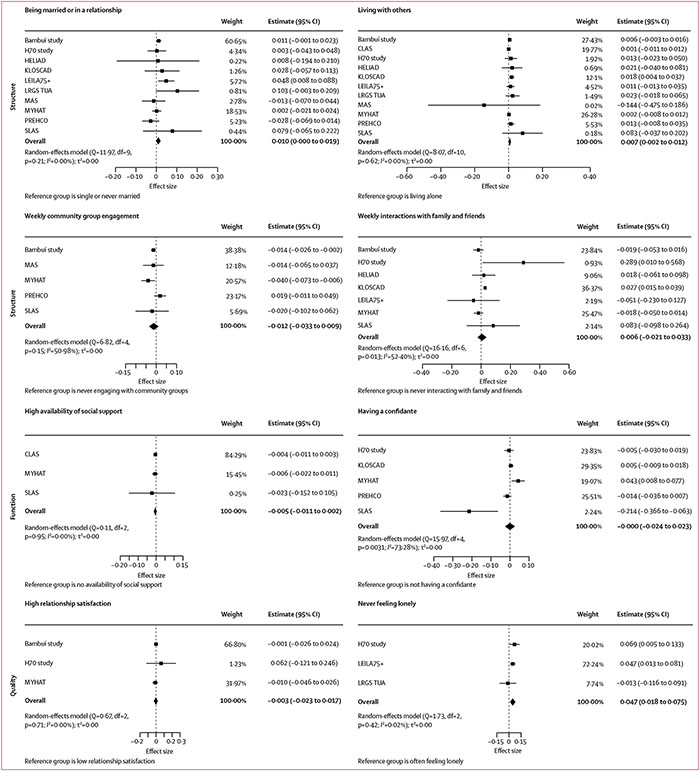
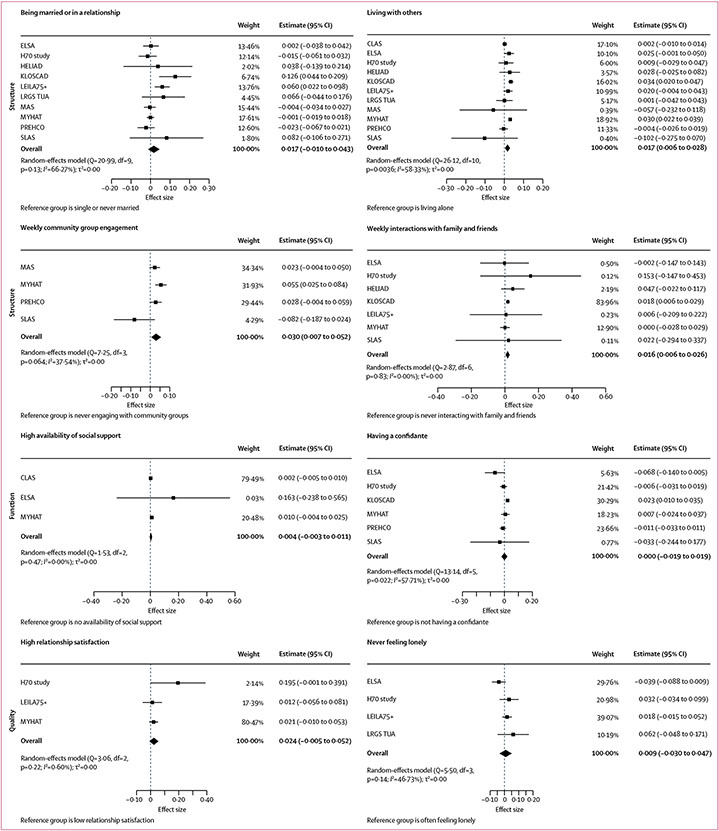
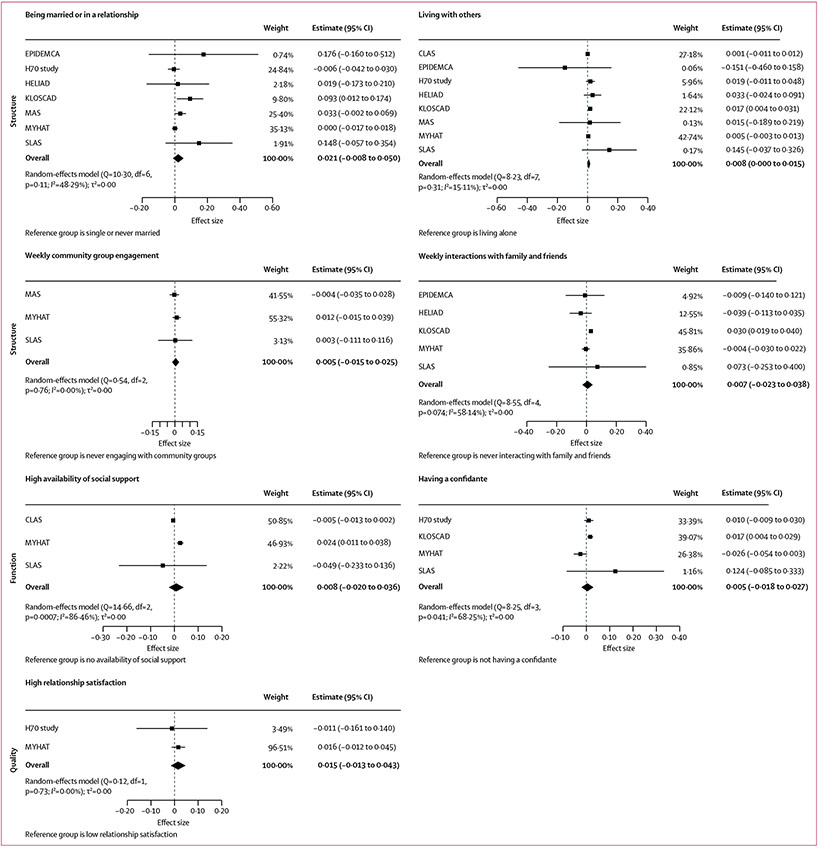
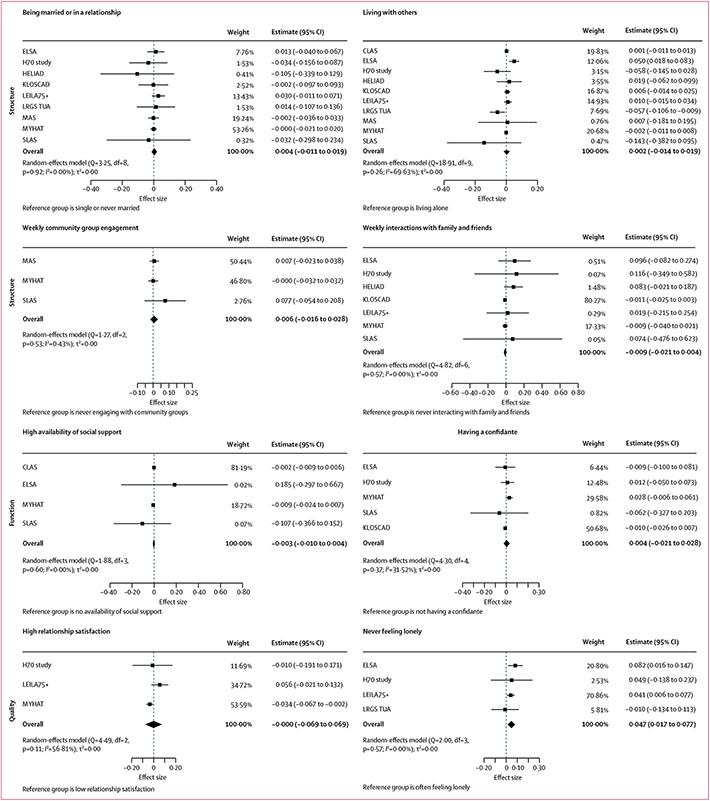
Background Poor social connections (eg, small networks, infrequent interactions, and loneliness) are modifiable risk factors for cognitive decline. Existing meta-analyses are limited by reporting aggregate responses, a focus on global cognition, and combining social measures into single constructs. We aimed to investigate the association between social connection markers and the rate of annual change in cognition (ie, global and domain-specific), as well as sex differences, using an individual participant data meta-analysis. Methods We harmonised data from 13 longitudinal cohort studies of ageing in North America, South America, Europe, Africa, Asia, and Australia. Studies were eligible for inclusion if they had baseline data for social connection markers and at least two waves of cognitive scores. Follow-up periods ranged from 0 years to 15 years across cohorts. We included participants with cognitive data for at least two waves and social connection data for at least one wave. We then identified and excluded people with dementia at baseline. Primary outcomes were annual rates of change in global cognition and cognitive domain scores over time until final follow-up within each cohort study analysed by use of an individual participant data meta-analysis. Linear mixed models within cohorts used baseline social connection markers as predictors of the primary outcomes. Effects were pooled in two stages using random-effects meta-analyses. We assessed the primary outcomes in the main (partially adjusted) and fully adjusted models. Partially adjusted models controlled for age, sex, and education; fully adjusted models additionally controlled for diabetes, hypertension, smoking, cardiovascular risk, and depression. Findings Of the 40 006 participants in the 13 cohort studies, we excluded 1392 people with dementia at baseline. 38 614 individual participants were included in our analyses. For the main models, being in a relationship or married predicted slower global cognitive decline ( b =0·010, 95% CI 0·000–0·019) than did being single or never married; living with others predicted slower global cognitive ( b =0·007, 0·002–0·012), memory ( b =0·017, 0·006–0·028), and language ( b =0·008, 0·000–0·015) decline than did living alone; and weekly interactions with family and friends ( b =0·016, 0·006–0·026) and weekly community group engagement ( b =0·030, 0·007–0·052) predicted slower memory decline than did no interactions and no engagement. Never feeling lonely predicted slower global cognitive ( b =0·047, 95% CI 0·018–0·075) and executive function ( b =0·047, 0·017–0·077) decline than did often feeling lonely. Degree of social support, having a confidante, and relationship satisfaction did not predict cognitive decline across global cognition or cognitive domains. Heterogeneity was low ( I 2 =0·00–15·11%) for all but two of the significant findings (association between slower memory decline and living with others [ I 2 =58·33%] and community group engagement, I 2 =37·54–72·19%), suggesting robust results across studies. Interpretation Good social connections (ie, living with others, weekly community group engagement, interacting weekly with family and friends, and never feeling lonely) are associated with slower cognitive decline. Funding EU Joint Programme–Neurodegenerative Disease Research grant, funded by the National Health and Medical Research Council Australia, and the US National Institute on Aging of the US National Institutes of Health.
Overview
CoChat Summary
TL;DR
In a global individual participant data meta-analysis of 13 longitudinal ageing cohorts, better social connection structure and quality—but not function—were associated with slower annual cognitive decline. Being married or in a relationship, living with others, weekly interactions, community group engagement, and never feeling lonely predicted slower decline in global cognition and/or specific domains.
Key findings
- Among 38,614 participants after excluding 1,392 with baseline dementia, being married or in a relationship predicted slower global cognitive decline than being single or never married (b=0·010, 95% CI 0·000–0·019).
- Living with others predicted slower global cognitive (b=0·007, 0·002–0·012), memory (b=0·017, 0·006–0·028), and language (b=0·008, 0·000–0·015) decline than living alone; weekly interactions with family and friends (b=0·016, 0·006–0·026) and weekly community group engagement (b=0·030, 0·007–0·052) predicted slower memory decline.
- Never feeling lonely predicted slower global cognitive (b=0·047, 95% CI 0·018–0·075) and executive function (b=0·047, 0·017–0·077) decline than often feeling lonely; social support, having a confidante, and relationship satisfaction did not predict cognitive decline.
- Heterogeneity was low (I²=0·00–15·11%) for most significant findings, except memory with living with others (I²=58·33%) and community group engagement (I²=37·54–72·19%); sex differences included faster global decline for married/partnered men but slower memory decline for married/partnered women.
Methods
- Harmonised data from 13 longitudinal cohort studies of ageing across North America, South America, Europe, Africa, Asia, and Australia; included participants with social connection data for at least one wave and cognitive data for at least two waves, excluding those with dementia at baseline.
- Primary outcomes were annual rates of change in global cognition and cognitive domain scores; baseline social connection markers included relationship status, living situation, interaction frequency, community group engagement, social support, confidante, relationship satisfaction, and loneliness.
- Two-stage individual participant data meta-analysis: within-cohort linear mixed models estimated social connection marker × time associations, then random-effects meta-analysis pooled effects; partially adjusted models controlled for age, sex, and education, and fully adjusted models additionally controlled for diabetes, hypertension, smoking, cardiovascular risk, and depression.
Limitations
- The paper states that harmonising data across studies lost granularity, precluded detailed social connection categories, and often relied on non-validated or single-item measures; few studies provided relationship satisfaction (four) or loneliness frequency (three).
- The paper states that disparities in available social connection markers prevented composite scores or mutual adjustment, models used different study groupings for each predictor–outcome pair, reverse causality was possible, and only baseline social connection data were available.
- Evident from the text: the observational design cannot establish causality, and sex-difference findings for social connection function or quality were exploratory and inconclusive.
Model-written summary. Check it against the paper before relying on it.
Integrity signals
Registry
Cites
Statistics
Figures
Verification
Claims the paper makes
18 Valid · 2 Not valid · 9 Not checked · 78 Own results and interpretations
The cited sources support only part of this claim — read each source’s verdict below.
In the paper
“Poor social connections (eg, small networks, infrequent interactions, and loneliness) are modifiable risk factors for cognitive decline.”
§ Associations between social connections and cognition: a global collaborative individual participant data meta-analysis > Abstract > Background.
What the sources say
- Partly supportedcites [1] Livingston G, Huntley J, Sommerlad A, Dementia prevention, intervention, and care: 2020 report of the Lancet Commission. Lancet 2020; 396: 413– 46. 32738937 PMC7392084 sourceExperimental — accuracy not yet measured
The Social contact section reports that higher social activity and larger social networks were associated with better late-life cognitive function, and that more frequent contact was associated with lower dementia risk. It does not establish loneliness as a risk factor for cognitive decline; it reports that loneliness was not associated with dementia risk in the cited meta-analysis. The claim also states these associations as risk factors without the paper's cautions about possible confounding and reverse causation. (LLM, conf=0.88)
plainstates a cause- Asserted: passes — The authors put it forward as true.
- Checkable: passes — It can be checked against evidence.
- Load-bearing: passes — The paper’s conclusions depend on it.
- Based: passes — The paper gives a reason why it holds.
- Partly supported
The cited sources support only part of this claim — read each source’s verdict below.
In the paper
“Socially stimulating environments promote neuroprotective mechanisms,4”
§ Associations between social connections and cognition: a global collaborative individual participant data meta-analysis > Introduction
What the sources say
- Partly supportedcites [4] Perry BL, McConnell WR, Coleman ME, Roth AR, Peng SY, Apostolova LG. Why the cognitive ‘fountain of youth’ may be upstream: pathways to dementia risk and resilience through social connectedness. Alzheimers Dement 2022; 18: 934– 41. 34482619 PMC8897512 sourceExperimental — accuracy not yet measured
In Narrative, Mechanism 1 (page unavailable), the paper proposes that cognitive enrichment from social connections may foster functional connectivity, neuronal growth, and brain repair. This supports the proposed neuroprotective pathway, but the claim’s unqualified “promote” states as established a causal effect that the paper presents as a possibility. (LLM, conf=0.83)
plainstates a cause- Asserted: passes — The authors put it forward as true.
- Checkable: passes — It can be checked against evidence.
- Load-bearing: passes — The paper’s conclusions depend on it.
- Based: passes — The paper gives a reason why it holds.
- Partly supported
The cited sources support only part of this claim — read each source’s verdict below.
In the paper
“Existing meta-analyses are limited by the use of aggregated data from studies that adjust differently for potential confounders (eg, one study did not adjust for confounders9 and another study adjusted for only demographic variables and baseline cognition10).”
§ Associations between social connections and cognition: a global collaborative individual participant data meta-analysis > Introduction
What the sources say
- Partly supportedcites [9] Boyle PA, Buchman AS, Barnes LL, Bennett DA. Effect of a purpose in life on risk of incident Alzheimer disease and mild cognitive impairment in community-dwelling older persons. Arch Gen Psychiatry 2010; 67: 304– 10. 20194831 PMC2897172 sourceExperimental — accuracy not yet measured
The Methods (Data Analysis; page unavailable) say the cognitive-decline models adjusted for age, sex, education, and baseline cognition. But the Results (Purpose in Life and Risk of AD; page unavailable) report an Alzheimer disease model that also controlled for depressive symptoms, neuroticism, social networks, and chronic medical conditions. Thus, describing this study as adjusting for *only* demographic variables and baseline cognition overstates the limitation; the paper does not itself assess the limitations of meta-analyses. (LLM, conf=0.86)
- Not checked — no full text of the sourcecites [10] Bosma H, van Boxtel MPJ, Ponds RWHM, Engaged lifestyle and cognitive function in middle and old-aged, non-demented persons: a reciprocal association? Z Gerontol Geriatr 2002; 35: 575– 81. 12491004 source
plain- Asserted: passes — The authors put it forward as true.
- Checkable: passes — It can be checked against evidence.
- Load-bearing: passes — The paper’s conclusions depend on it.
- Based: passes — The paper gives a reason why it holds.
- Partly supported
Every source the paper cites for this claim was checked and supports it.
In the paper
“Sex differences are important to investigate because women have faster cognitive decline than do men in global cognition and executive function.12”
§ Associations between social connections and cognition: a global collaborative individual participant data meta-analysis > Introduction
What the sources say
- Supportedcites [12] Levine DA, Gross AL, Briceño EM, Sex differences in cognitive decline among US adults. JAMA Netw Open 2021; 4: e210169. 33630089 PMC7907956 source
The Findings report significantly faster declines in global cognition and executive function among women than men. The Discussion reiterates this result, and the Results quantify the faster decline in executive function. (LLM, conf=0.95)
plainstates an association- Asserted: passes — The authors put it forward as true.
- Checkable: passes — It can be checked against evidence.
- Load-bearing: passes — The paper’s conclusions depend on it.
- Based: passes — The paper gives a reason why it holds.
- Supported
The cited sources support only part of this claim — read each source’s verdict below.
In the paper
“These findings are contrary to previous research showing that being in a relationship or married is associated with slower cognitive decline for men only.18”
§ Associations between social connections and cognition: a global collaborative individual participant data meta-analysis > Discussion
What the sources say
- Partly supportedcites [18] Murata C, Saito T, Saito M, Kondo K. The association between social support and incident dementia: a 10-year follow-up study in Japan. Int J Environ Res Public Health 2019; 16: 239. 30654459 PMC6352228 sourceExperimental — accuracy not yet measured
The Discussion (§4.3) says being married was a stronger protector against incident dementia for men, and the Conclusions (§5) report that support from co-residing family was protective among men but not women. The study measured incident dementia, not the rate of cognitive decline; it also does not establish that marriage or relationships were protective only for men. (LLM, conf=0.85)
plainstates an association- Asserted: passes — The authors put it forward as true.
- Checkable: passes — It can be checked against evidence.
- Load-bearing: passes — The paper’s conclusions depend on it.
- Based: passes — The paper gives a reason why it holds.
- Partly supported
44 more claims
Create a free account to see all 107 claims and to verify the 1 reference still open.
- Probably not a substantial claim. 41
- It may state two separate claims as one. 30
Self-check
Percentages, sums and reported differences re-computed from the paper’s own numbers.
Each contradiction between two passages listed here was confirmed by an independent check.
Rated minor: it would not touch a result — a value no result rests on, a p-value that stays on the same side of the significance level, or a conflict that is clerical, resolved elsewhere in the paper, or outside its own findings.
In the paper
§ Associations between social connections and cognition: a global collaborative individual participant data meta-analysis > Abstract > Methods
“Follow-up periods ranged from 0 years to 15 years across cohorts.”
§ Associations between social connections and cognition: a global collaborative individual participant data meta-analysis > Results
“Follow-up periods ranged from 2 years to 15 years across cohorts”
Rated minor: it would not touch a result — a value no result rests on, a p-value that stays on the same side of the significance level, or a conflict that is clerical, resolved elsewhere in the paper, or outside its own findings.
In the paper
§ Associations between social connections and cognition: a global collaborative individual participant data meta-analysis > Methods > Procedures
“Loneliness frequency data were available in only four studies,21,23,26,27”
§ Associations between social connections and cognition: a global collaborative individual participant data meta-analysis > Discussion
“loneliness frequency (ie, three studies)”
Rated minor: it would not touch a result — a value no result rests on, a p-value that stays on the same side of the significance level, or a conflict that is clerical, resolved elsewhere in the paper, or outside its own findings.
In the paper
§ Associations between social connections and cognition: a global collaborative individual participant data meta-analysis > Results
“the sample for the fully adjusted models (ten cohorts, n=29 718, mean 70·49 years”
§ Associations between social connections and cognition: a global collaborative individual participant data meta-analysis > Results
“17 145 [57·7%] of 29 728”
Cited works that were retracted
Works this paper cites that were later retracted, from the retraction notices publishers deposit. Major when the notice came out before this paper was published.
A note, not an issue: for example, a cited work that was retracted only after this paper was published, which its authors could not have known.
In the paper
“Livingston, 2020, Dementia prevention, intervention, and care: 2020 report of the Lancet Commission, Lancet, 396, 413, 10.1016/S0140-6736(20)30367-6”
Cited work 10.1016/s0140-6736(20)30367-6 · retracted 2023-05-01 · notice 10.1016/s2468-2667(23)00083-x · this paper published 2022-11
Citations
Cites
1 retracted
Dementia prevention, intervention, and care: 2020 report of the Lancet Commission
Livingston, G., Huntley, J., Sommerlad, A., Ames, D., Ballard, C., Banerjee, S., Brayne, C., Burns, A., Cohen-Mansfield, J., Cooper, C., et al. (2020) · The Lancet · doi:10.1016/s0140-6736(20)30367-6 · Cited by 10,430
RetractedBias in meta-analysis detected by a simple, graphical test
Egger, M., Smith, G. D., Schneider, M., & Minder, C. (1997) · BMJ · doi:10.1136/bmj.315.7109.629 · Cited by 56,722
Missing data: our view of the state of the art
Schafer, J. L., & Graham, J. W. (2002) · Psychological Methods · doi:10.1037/1082-989x.7.2.147 · Cited by 11,638
A Short Scale for Measuring Loneliness in Large Surveys: Results From Two Population-Based Studies
Hughes, M. E., Waite, L. J., Hawkley, L. C., & Cacioppo, J. T. (2004) · Research on Aging · doi:10.1177/0164027504268574 · Cited by 4,781
Statistical Analysis With Missing Data
Ghosh, S. (1988) · Technometrics · doi:10.1080/00401706.1988.10488446 · Cited by 4,576
Cognitive reserve in ageing and Alzheimer's disease
Stern, Y. (2012) · The Lancet Neurology · doi:10.1016/s1474-4422(12)70191-6 · Cited by 3,557
Huber, M., Knottnerus, J. A., Green, L., Horst, H. V. D., Jadad, A. R., Kromhout, D., Leonard, B., Lorig, K., Loureiro, M. I., Meer, J. W. M. V. D., et al. (2011) · BMJ · doi:10.1136/bmj.d4163 · Cited by 2,637
Cohort profile: The English longitudinal study of ageing
Steptoe, A., Breeze, E., Banks, J., & Nazroo, J. (2013) · International Journal of Epidemiology · doi:10.1093/ije/dys168 · Cited by 1,779
Meta-analysis of individual participant data: rationale, conduct, and reporting
Riley, R. D., Lambert, P. C., & Abo-Zaid, G. (2010) · BMJ · doi:10.1136/bmj.c221 · Cited by 1,701 · cited 1×
“We used a two-stage individual participant data meta-analysis to pool effects across studies, 34 which enables controlling for the same covariates across studies rather than relying on aggregate data that is adjusted for different sets of covariates.”
Bias and Efficiency of Meta-Analytic Variance Estimators in the Random-Effects Model
Viechtbauer, W. (2005) · Journal of Educational and Behavioral Statistics · doi:10.3102/10769986030003261 · Cited by 1,699 · cited 1×
“35 We examined heterogeneity using the I 2 and τ 2 statistics 36 and bias using Egger’s test (appendix pp 26–27) and funnel plots (appendix pp 28–31).”
Cited by
Lennon, M. J., Lam, B. C. P., Lipnicki, D. M., Crawford, J. D., Peters, R., Schutte, A. E., Brodaty, H., Thalamuthu, A., Rydberg-Sterner, T., Najar, J., et al. (2023) · JAMA Network Open · doi:10.1001/jamanetworkopen.2023.33353 · Cited by 100
Self-citationLiu, Y., Cui, J., Cao, L., Stubbendorff, A., & Zhang, S. (2023) · Journal of Affective Disorders · doi:10.1016/j.jad.2023.10.012 · Cited by 77
Joshi, P., Hendrie, K., Jester, D. J., Dasarathy, D., Lavretsky, H., Ku, B. S., Leutwyler, H. C., Torous, J. B., Jeste, D. V., & Tampi, R. R. (2023) · International Psychogeriatrics · doi:10.1017/s1041610223000923 · Cited by 89
Mahalingam, G., Samtani, S., Lam, B. C. P., Lipnicki, D. M., Lima‐Costa, M. F., Blay, S. L., Costa, E., Shifu, X., Guerchet, M., Preux, P., et al. (2023) · Alzheimer s & Dementia · doi:10.1002/alz.13072 · Cited by 67
Self-citationTeshale, A. B., Htun, H. L., Hu, J., Dalli, L. L., Lim, M. H., Neves, B. B., Baker, J. R., Phyo, A. Z. Z., Reid, C. M., Ryan, J. L., et al. (2023) · Archives of Gerontology and Geriatrics · doi:10.1016/j.archger.2023.105008 · Cited by 55
Recognition of social health: A conceptual framework in the context of dementia research
Vernooij-Dassen, M. J. F. J., Verspoor, E., Samtani, S., Sachdev, P. S., Ikram, M. A., Vernooij, M. W., Hubers, C., Chattat, R., Lenart‐Bugla, M., Rymaszewska, J., et al. (2022) · Frontiers in Psychiatry · doi:10.3389/fpsyt.2022.1052009 · Cited by 55
Self-citationDuffner, L. A., DeJong, N. R., Jansen, J. F. A., Backes, W. H., de Vugt, M. E., Deckers, K., & Köhler, S. (2023) · Ageing Research Reviews · doi:10.1016/j.arr.2023.101986 · Cited by 39
Ibanez, A., Maito, M., Botero-Rodríguez, F., Fittipaldi, S., Coronel, C., Migeot, J., Lacroix, A., Lawlor, B., Duran-Aniotz, C., Baez, S., et al. (2024) · Nature Aging · doi:10.1038/s43587-024-00648-6 · Cited by 30
Zhao, X., Xu, X., Yan, Y., Lipnicki, D. M., Pang, T., Crawford, J. D., Cheng, C., Cheng, C.-Y., Venketasubramanian, N., Chong, E., et al. (2024) · The Lancet Regional Health - Western Pacific · doi:10.1016/j.lanwpc.2024.101198 · Cited by 53
Self-citationStafford, J., Dekhtyar, S., Welmer, A., Vetrano, D. L., Grande, G., Laukka, E. J., Marseglia, A., Moulton, V., Mansfield, R., Liu, Y., et al. (2024) · The Lancet Healthy Longevity · doi:10.1016/s2666-7568(24)00046-1 · Cited by 33
Self-citationLifestyle and incident dementia: A COSMIC individual participant data meta‐analysis
Asbroeck, S. V., Köhler, S., van Boxtel, M. P. J., Lipnicki, D. M., Crawford, J. D., Costa, E., Lima‐Costa, M. F., Blay, S. L., Shifu, X., Wang, T., et al. (2024) · Alzheimer s & Dementia · doi:10.1002/alz.13846 · Cited by 30
Self-citationLee, J. H., Sutin, A. R., Hajek, A., Karaköse, S., Aschwanden, D., O’Súilleabháin, P. S., Stéphan, Y., Terracciano, A., & Luchetti, M. (2025) · Psychological Medicine · doi:10.1017/s003329172500011x · Cited by 39
Lee, J. J., Park, M. K., Kim, N., Kim, L., & Kim, G. S. (2024) · Journal of the American Medical Directors Association · doi:10.1016/j.jamda.2024.105124 · Cited by 28
Daly, T. P. (2023) · Cerebral Circulation - Cognition and Behavior · doi:10.1016/j.cccb.2023.100193 · Cited by 28
Zhang, H., Hao, M., Hu, Z., Jiang, S., Li, Y., Wang, X., & Li, X. (2025) · Alzheimer s Research & Therapy · doi:10.1186/s13195-025-01687-w · Cited by 20
Dementia Prevention Guidelines Should Explicitly Mention Deprivation
Daly, T. P. (2023) · AJOB Neuroscience · doi:10.1080/21507740.2023.2225461 · Cited by 19
Hou, J., Chen, T., & Yu, N. X. (2024) · The Journals of Gerontology Series B · doi:10.1093/geronb/gbae045 · Cited by 25
Relationships of social isolation and loneliness with healthy aging among older adults
Miao, M.-Y., Fang, F., Lyu, J., Liu, Z.-Y., Wan, Z., Qin, L.-Q., Chen, G.-C., & Wang, H.-P. (2025) · BMC Geriatrics · doi:10.1186/s12877-025-05941-6 · Cited by 22
Maddock, J., Gallo, F., Wolters, F. J., Stafford, J., Marseglia, A., Dekhtyar, S., Lenart‐Bugla, M., Verspoor, E., Perry, M., Samtani, S., et al. (2023) · Gerontology · doi:10.1159/000531969 · Cited by 17
Self-citationSocial connectedness and cognitive decline
Roth, A. R. (2022) · The Lancet Healthy Longevity · doi:10.1016/s2666-7568(22)00217-3 · Cited by 14
Lin, Z., Yin, X., Levy, B. R., Yuan, Y., & Chen, X. (2023) · American Journal of Geriatric Psychiatry · doi:10.1016/j.jagp.2024.05.005 · Cited by 19
Lennon, M. J., Rigney, G. H., Creese, B., Aarsland, D., Hampshire, A., Ballard, C. G., Corbett, A., & Raymont, V. (2024) · Journal of Neurology Neurosurgery & Psychiatry · doi:10.1136/jnnp-2024-334039 · Cited by 13
Chen, S., Chen, S., Hanewald, K., Si, Y., Bateman, H., Li, B., Xu, X., Samtani, S., Wu, C., & Brodaty, H. (2024) · The Journals of Gerontology Series A · doi:10.1093/gerona/glae128 · Cited by 12
Self-citationNagata, K., Tsunoda, K., Fujii, Y., Jindo, T., & Okura, T. (2022) · Archives of gerontology and geriatrics (Print) · doi:10.1016/j.archger.2022.104908 · Cited by 12
How well do social frailty indices predict incident dementia in older adults?
Matison, A. P., Samtani, S., Brodaty, H., Sachdev, P. S., & Reppermund, S. (2025) · The Journals of Gerontology Series B · doi:10.1093/geronb/gbaf148 · Cited by 10
Self-citationSocial isolation from childhood to mid-adulthood: is there an association with older brain age?
Lay‐Yee, R., Hariri, A. R., Knodt, A. R., Barrett-Young, A., Matthews, T., & Milne, B. J. (2023) · Psychological Medicine · doi:10.1017/s0033291723001964 · Cited by 11
Besser, L. M., Fuentes, A. J., Zhang, J., O’Shea, D. M., & Galvin, J. E. (2024) · Journal of Alzheimer s Disease · doi:10.1177/13872877241283823 · Cited by 9
Cai, Z., Papacosta, O., LENNON, L. T., Whincup, P. H., Wannamethee, S. G., Simonsick, E. M., Mathers, J. C., & Ramsay, S. E. (2024) · American Journal of Epidemiology · doi:10.1093/aje/kwae221 · Cited by 9
Reilly, S., & Harding, A. J. E. (2025) · Alzheimer s & Dementia · doi:10.1002/alz.70359 · Cited by 8
The role of social context in cognitive and neurobehavioural outcomes in epilepsy
Reyes, A., Busch, R. M., Kiriakopoulos, E. T., Oyegbile-Chidi, T. O., & Hermann, B. P. (2026) · Nature Reviews Neurology · doi:10.1038/s41582-026-01184-0 · Cited by 12
Siette, J., Chong, V., Samtani, S., Harris, C. B., Steiner-Lim, G. Z., & MacMillan, F. (2025) · BMC Public Health · doi:10.1186/s12889-025-22229-x · Cited by 9
Self-citationLiu, Y., Wang, Z., Cheng, Z., Li, Y., Wang, Q., & Liu, J. (2024) · Journal of Affective Disorders · doi:10.1016/j.jad.2024.10.117 · Cited by 7
Duffner, L. A., Deckers, K., Cadar, D., de Vugt, M. E., & Köhler, S. (2024) · Psychological Medicine · doi:10.1017/s0033291724001272 · Cited by 8
Wang, Z., Sommerlad, A., Hassiotis, A., Richards, M., & Livingston, G. (2024) · PLoS ONE · doi:10.1371/journal.pone.0302411 · Cited by 9
Shin, J., Tampi, R. R., Joshi, P., Jester, D. J., & Jeste, D. V. (2025) · International Psychogeriatrics · doi:10.1016/j.inpsyc.2025.100152 · Cited by 8
Wong, J. Y. H., & Zang, E. X. (2025) · Health & Place · doi:10.1016/j.healthplace.2025.103475 · Cited by 5
Han, J. W., Oh, D. J., Kim, T. H., Kwak, K. P., Kim, B., Kim, S. G., Kim, J. L., Moon, S. W., Park, J. H., Ryu, S., et al. (2025) · Journal of Korean Medical Science · doi:10.3346/jkms.2025.40.e326 · Cited by 6
Self-citationWang, J., Zhang, J., Lin, H., Chang, L., Tu, J., Tang, J., & Wu, J. (2024) · Current Psychology · doi:10.1007/s12144-024-06969-4 · Cited by 5
Kristanti, M. S., Vernooij-Dassen, M. J. F. J., Jeon, Y., Verspoor, E., Samtani, S., Ottoboni, G., Chattat, R., Brodaty, H., Lenart‐Bugla, M., Kowalski, K., et al. (2024) · Frontiers in Psychiatry · doi:10.3389/fpsyt.2024.1384636 · Cited by 5
Self-citationBrown, C. E. B., Richardson, K. E., Pizzirani, B., Hughes, S. D., Atkins, L., Pitt, J., Yücel, M., & Segrave, R. A. (2024) · Frontiers in Psychiatry · doi:10.3389/fpsyt.2024.1379396 · Cited by 10
What impact does hearing impairment have on cognitive health in older married couples in China?
Du, Y., Luo, Y., Ren, Z., Gram, L., Zheng, X., & Liu, J. (2024) · Social Science & Medicine · doi:10.1016/j.socscimed.2024.116999 · Cited by 8
If deprivation worsens dementia outcomes, stimulation should improve them
Daly, T. P. (2023) · Current Medical Research and Opinion · doi:10.1080/03007995.2023.2260741 · Cited by 5
He, Z., Nie, Y., Zhang, W., Liu, Y., Liu, Y., Xue, H., Ai, S., Feng, H., Zhou, Y., Zhang, J., et al. (2025) · Journal of Alzheimer s Disease · doi:10.1177/13872877251344253 · Cited by 4
Social health and prevention of dementia: Integration of human and mice studies
Vernooij-Dassen, M. J. F. J., van der Velpen, I. F., Lanooij, S. D., van der Zee, E. A., Ikram, M. A., Drinkenburg, W. H. I. M., Costanzo, A., Vernooij, M. W., Eisel, U. L. M., Melis, R. J. F., et al. (2025) · International Psychogeriatrics · doi:10.1016/j.inpsyc.2025.100054 · Cited by 4
Self-citationSu, Y., Hamatani, M., Yuki, M., Ogawa, N., & Kawahara, K. (2023) · Journal of Advanced Nursing · doi:10.1111/jan.15971 · Cited by 5
Scheerbaum, P., Graessel, E., Bösl, S., Hanslian, E., Keßler, C. S., & Scheuermann, J.-S. (2023) · Nutrients · doi:10.3390/nu15163519 · Cited by 7
Wang, X., Si, H., Li, Y., Yu, J., Zhou, W., Chen, H., & Wang, C. (2026) · Maturitas · doi:10.1016/j.maturitas.2026.108852 · Cited by 3
Addressing global diversity in dementia research with the COSMIC collaboration
Lipnicki, D. M., Vella, A. S., Jiang, J., Mewton, L. R., Matison, A. P., Mather, K. A., Thalamuthu, A., Catts, V. S., Chen, R., Husein, N. K., et al. (2025) · Neuroscience · doi:10.1016/j.neuroscience.2025.07.036 · Cited by 5
Self-citationThe Geroscience Perspective on One Health
Farrelly, C. (2025) · Oxford University Press eBooks · doi:10.1093/9780197830062.003.0013 · Cited by 4
Liu, J., Liu, D., Xie, X., Cai, C., Zhang, J.-J., Cheng, G., Hu, F., Nie, Q.-Q., Zhou, J., Zeng, D.-Y., et al. (2025) · Journal of Alzheimer s Disease · doi:10.1177/13872877251322805 · Cited by 3
Dong, C., Mather, K. A., Brodaty, H., Sachdev, P. S., Trollor, J. N., Harrison, F., Bliuc, D., Ivers, R., Rhee, J., & Dai, Z. (2025) · Nutrients · doi:10.3390/nu17050796 · Cited by 6
Self-citationVassilaki, M. E., Aakre, J. A., Lesnick, T. G., Kremers, W. K., Graff‐Radford, J., Knopman, D. S., Mosley, T. H., Windham, B. G., Griswold, M. E., Geda, Y. E., et al. (2025) · AJPM Focus · doi:10.1016/j.focus.2025.100324 · Cited by 5
The Role of Social Support for Depressive Symptoms in Dementia: A Four-Year Longitudinal Study
Blotenberg, I., Jeran, L. C., Rodriguez, F. S., Michalowsky, B., Platen, M., Teipel, S. J., Hoffmann, W. U., & Thyrian, J. R. (2025) · Innovation in Aging · doi:10.1093/geroni/igaf047 · Cited by 3
Altona, J., Wiegelmann, H., Lenart‐Bugla, M., Vernooij-Dassen, M. J. F. J., Verspoor, E., Seifert, I., Misonow, J., Szcześniak, D. M., Rymaszewska, J., Chattat, R., et al. (2024) · Frontiers in Psychiatry · doi:10.3389/fpsyt.2024.1387192 · Cited by 5
Self-citationPsychologists’ Role in Promoting Brain Health Equity in an Aging and Increasingly Diverse Society
Dotson, V. M., & Levy, S.-A. T. (2024) · Journal of Health Service Psychology · doi:10.1007/s42843-024-00112-4 · Cited by 3
Number of living siblings, social engagement, and cognitive decline among older Mexican adults
Quashie, N. T., Saenz, J. L., & Zhang, X. (2026) · Social Science & Medicine · doi:10.1016/j.socscimed.2026.119204 · Cited by 2
Chen, A., & Ang, S. (2025) · Social Science & Medicine · doi:10.1016/j.socscimed.2025.118831 · Cited by 3
Sleep Quality and Cognitive Life Expectancy in the United States
Chiu, C., Chen, C.-A., Wang, J., & Ofstedal, M. B. (2025) · Research on Aging · doi:10.1177/01640275251394993 · Cited by 2
Hsu, Y., Kostakis, K., Muhammad, S., & Ransome, Y. (2025) · Social Science & Medicine · doi:10.1016/j.socscimed.2025.118585 · Cited by 3
Simon, S. S., Cappi, C., Cabral, J. D. D., Texeira, R. G. S., Alves, G. S., & de Oliveira, B. L. C. A. (2025) · International Psychogeriatrics · doi:10.1016/j.inpsyc.2025.100138 · Cited by 4
Bartlett, L., Fair, H. L., Bindoff, A. D., Kitsos, A., Hamrah, M. S., Roccati, E., & Vickers, J. C. (2025) · Journal of Public Health · doi:10.1007/s10389-025-02412-5 · Cited by 6
Increased arterial stiffness is associated with poorer social cognition in older age
Grainger, S. A., Bailey, T. G., Vear, N. K., Mead, J. K., Bourdaniotis, X. E., Coombes, J. S., & Taylor, J. L. (2025) · Scientific Reports · doi:10.1038/s41598-025-86423-y · Cited by 2
The deprivation cascade hypothesis of dementia
Daly, T. P. (2025) · Aging and Health Research · doi:10.1016/j.ahr.2024.100219 · Cited by 4
Rodriguez, F. S., Röhr, S., Dragano, N., Schmidt, B., Becher, H., Schikowski, T., Gastell, S., Harth, V., Hoven, H., Linseisen, J., et al. (2024) · Aging Neuropsychology and Cognition · doi:10.1080/13825585.2024.2438825 · Cited by 2
Self-citationVogel, S., y Hausmann, A. O., & Zank, S. (2024) · European Journal of Ageing · doi:10.1007/s10433-024-00835-9 · Cited by 5
Lin, Z., Yin, X., Levy, B. R., Yuan, Y., & Chen, X. (2023) · medRxiv · doi:10.1101/2023.10.24.23297470 · Cited by 2
Maddock, J., Gallo, F., Wolters, F. J., et al. (2022) · medRxiv · doi:10.1101/2022.08.29.22279324 · Cited by 2
Self-citationAging and the Ethics of Longevity Science
Farrelly, C. (2026) · doi:10.1093/9780197830062.001.0001 · Cited by 2
Prevalence and correlates of neurocognitive impairment among older persons in rural Eastern Uganda
Wandera, S. O., Nolasco, M., Kawooya, S., Rubin, L. H., Nakasujja, N., & Diaz, M. M. (2026) · npj Dementia · doi:10.1038/s44400-026-00077-9 · Cited by 2
Mapping social health and dementia risk: A register-based study of older adults in Finland
Cisotto, E., Moretti, M., Silan, M., Damiens, J., Belloni, P., Korhonen, K., & Martikainen, P. (2026) · Social Science & Medicine · doi:10.1016/j.socscimed.2026.119154 · Cited by 1
Charif, M. H. E., Melhem, J. M., Asmar, K. E., Elbejjani, M., Gross, A. L., & Chaaya, M. (2026) · Social Sciences & Humanities Open · doi:10.1016/j.ssaho.2026.102485 · Cited by 1
Chen, H., Wang, X.-L., Gao, J., Li, C., Huang, Q., Zhong, W.-F., Xie, J.-H., Liu, W., Liu, D., Li, Z., et al. (2026) · American Journal of Preventive Medicine · doi:10.1016/j.amepre.2026.108294 · Cited by 1
Trajectories of social health, cognitive, and daily functioning in community-dwelling older adults
Marseglia, A., Verspoor, E., Perry, M., Vernooij-Dassen, M. J. F. J., Leoutsakos, J., Brodaty, H., Stafford, J., Ikram, M. A., Rymaszewska, J., Welmer, A., et al. (2026) · Innovation in Aging · doi:10.1093/geroni/igag010 · Cited by 2
Self-citationZammitt, D. C., Fearn, C., John, A., Lykourgos, M., Kurana, S., Hayes, O., & Stott, J. C. H. (2025) · Dementia · doi:10.1177/14713012251408694 · Cited by 1
Zehnder, C., Schmidt, M., Affolter, P., Anzeneder, S., & Benzing, V. (2025) · Mental health and physical activity · doi:10.1016/j.mhpa.2025.100747 · Cited by 2
Svec, J., Hyun, J., Lee, J. E., & Nemmers, N. L. (2025) · The Journals of Gerontology Series B · doi:10.1093/geronb/gbaf166 · Cited by 1
Kolhe, R., Bhuyar, M., Raut, A. V., Jakasania, A. H., Mundra, A., Sharma, R., Dhatrak, A. A., Bahulekar, P. V., Maliye, C. H., & Gupta, S. K. (2025) · Journal of Family Medicine and Primary Care · doi:10.4103/jfmpc.jfmpc_1655_24 · Cited by 1
McLaren, C., Pearl, R. L., Smith, G. E., & Anton, S. D. (2025) · Nutrients · doi:10.3390/nu17132075 · Cited by 5
Editorial: The potential of a multifactorial perspective on dementia
van der Velpen, I. F., Chattat, R., & Vernooij-Dassen, M. J. F. J. (2025) · Frontiers in Psychiatry · doi:10.3389/fpsyt.2025.1612550 · Cited by 1
Self-citationTrajectories of social health, cognitive, and daily functioning in community-dwelling older adultsPreprint
Marseglia, A., Verspoor, E., Perry, M., Vernooij-Dassen, M. J. F. J., Leoutsakos, J., Brodaty, H., Stafford, J., Ikram, M. A., Rymaszewska, J., Welmer, A., et al. (2025) · Research Square · doi:10.21203/rs.3.rs-6528919/v1 · Cited by 1
Self-citationVogel, S., y Hausmann, A. O., & Zank, S. (2024) · Aging & Mental Health · doi:10.1080/13607863.2024.2348616 · Cited by 2
Buchholz, M., Zöllinger, I., Thyrian, J. R., Luppa, M., Zülke, A. E., Döhring, J., Lunden, L., Sanftenberg, L., Brettschneider, C., Czock, D., et al. (2024) · Journal of Alzheimer s Disease · doi:10.3233/jad-231226 · Cited by 3
Self-citationDOSE: a lifestyle philosophy for dementia prevention informed by drug development and epidemiology
Daly, T. P. (2024) · Dementia & Neuropsychologia · doi:10.1590/1980-5764-dn-2023-0112 · Cited by 2
Loneliness Modulates Inflammation to Affect the Neurocognitive Function of Older Adults
Jin, R. R., Chan, A. K. Y., & Lee, T. M. C. (2024) · Integrated science · doi:10.1007/978-3-031-73061-0_14 · Cited by 4
White, S. R., Hall, H. K., & Summers, M. J. (2026) · Research Square · doi:10.21203/rs.3.rs-10311748/v1
Baek, S., & Yoon, J. (2026) · The Journals of Gerontology Series A · doi:10.1093/gerona/glag191
de Araújo, M. V., Pereira, D. R., & Soares, A. P. (2026) · Frontiers in Aging Neuroscience · doi:10.3389/fnagi.2026.1831374
Dog ownership and healthy brain aging: a pilot study
Potter, K., Martini, D. N., Sands, C. J., Falck, R. S., & Nagarajan, R. (2026) · PeerJ · doi:10.7717/peerj.21560 · Cited by 1
Li, J., Wang, Y., Shi, L., Zheng, Z., Wu, Y., & Jiang, N. (2026) · Journal of Applied Gerontology · doi:10.1177/07334648261470866
Miao, Y., Zhang, J., Zhu, D., Shen, Z., Feng, Y., Tarimo, C. S., Si, Y., Li, Q., Shi, L., & Wu, J. (2026) · Age and Ageing · doi:10.1093/ageing/afag234
Imagination and Idealism After the COVID-19 Pandemic
Farrelly, C. (2026) · Oxford University Press eBooks · doi:10.1093/9780197830062.003.0005
Farrelly, C. (2026) · Oxford University Press eBooks · doi:10.1093/9780197830062.003.0012
Equality and the Intersectionality of Biological Aging
Farrelly, C. (2026) · Oxford University Press eBooks · doi:10.1093/9780197830062.003.0007
The Good Life as a Constraint on Longevity Science
Farrelly, C. (2026) · Oxford University Press eBooks · doi:10.1093/9780197830062.003.0010
Philosophy and the “Framing” of Translational Science
Farrelly, C. (2026) · Oxford University Press eBooks · doi:10.1093/9780197830062.003.0002
Farrelly, C. (2026) · Oxford University Press eBooks · doi:10.1093/9780197830062.003.0003
“Fair Innings,” Women, and Longevity Science
Farrelly, C. (2026) · Oxford University Press eBooks · doi:10.1093/9780197830062.003.0008
Farrelly, C. (2026) · Oxford University Press eBooks · doi:10.1093/9780197830062.003.0009
Public Health Must Transcend Folkbiology
Farrelly, C. (2026) · Oxford University Press eBooks · doi:10.1093/9780197830062.003.0006
Farrelly, C. (2026) · Oxford University Press eBooks · doi:10.1093/9780197830062.003.0011
Metadata
- Authors
- Samtani, S., Mahalingam, G., Lam, B. C. P., Lipnicki, D. M., Lima-Costa, M. F., Blay, S. L., Castro-Costa, E., Shifu, X., Guerchet, M., Preux, P.-M., Gbessemehlan, A., Skoog, I., Najar, J., Rydberg Sterner, T., Scarmeas, N., Kim, K.-W., Riedel-Heller, S., Röhr, S., Pabst, A., Shahar, S., Numbers, K., Ganguli, M., Jacobsen, E., Hughes, T. F., Crowe, M., Ng, T. P., Maddock, J., Marseglia, A., Mélis, R., Szcześniak, D., Wiegelmann, H., Vernooij-Dassen, M., Jeon, Y.-H., Sachdev, P. S., & Brodaty, H.
- Affiliations
- UNSW Sydney (AU)
- Shanghai Jiao Tong University (CN)
- Inserm (FR)
- Sahlgrenska University Hospital (SE)
- National and Kapodistrian University of Athens (GR)
- Seoul National University (KR)
- Leipzig University (DE)
- Trinity College Dublin (IE)
- National University of Malaysia (MY)
- University of Pittsburgh (US)
- Youngstown State University (US)
- University of Alabama at Birmingham (US)
- National University of Singapore (SG)
- MRC Unit for Lifelong Health and Ageing (GB)
- Karolinska Institutet (SE)
- Wroclaw Medical University (PL)
- University of Bremen (DE)
- Radboud University Nijmegen (NL)
- The University of Sydney (AU)
- Corresponding author
- Samtani, Suraj
- ORCID
- Samtani, Suraj
- Lam, Ben Chun Pan
- Lipnicki, Darren M
- Guerchet, Maëlenn
- Preux, Pierre-Marie
- Gbessemehlan, Antoine
- Skoog, Ingmar
- Najar, Jenna
- Scarmeas, Nikolaos
- Riedel-Heller, Steffi
- Röhr, Susanne
- Pabst, Alexander
- Shahar, Suzana
- Numbers, Katya
- Ganguli, Mary
- Jacobsen, Erin
- Hughes, Tiffany F
- Crowe, Michael
- Ng, Tze Pin
- Maddock, Jane
- Marseglia, Anna
- Szcześniak, Dorota
- Wiegelmann, Henrik
- Vernooij-Dassen, Myrra
- Jeon, Yun-Hee
- Sachdev, Perminder S
- Brodaty, Henry
- Venue
- The Lancet Healthy Longevity
- Publisher
- Elsevier BV
- Published
- 2022-11
- Volume
- 3
- Issue
- 11
- Pages
- e740-e753
- ISSN
- 2666-7568 (ISSN-L)
- PMC
- PMC9750173
- OpenAlex
- W4306907395
- Cited by
- 151
- References
- 46
- Citations by year
- 2026: 58 · 2025: 41 · 2024: 33 · 2023: 16 · 2022: 3
- FWCI
- 3.99
- Type
- journal article
- Language
- en
- Open access
- gold
- doi.org
- Licence
- cc-by-nc-nd
- www.elsevier.com/tdm/userlicense/1.0/ (tdm)
- www.elsevier.com/legal/tdmrep-license (tdm)
- creativecommons.org/licenses/by-nc-nd/4.0/ (vor)
- Locations
- The Lancet Healthy Longevity (publishedVersion, cc-by-nc-nd)
- PubMed (publishedVersion)
- PubMed Central (acceptedVersion, cc-by-nc-nd)
- UNSWorks (UNSW Sydney) (submittedVersion, cc-by-nc-nd)
- LA Referencia (Red Federada de Repositorios Institucionales de Publicaciones Científicas) (submittedVersion, other-oa)
- HAL (submittedVersion, other-oa)
- Arca - Repositório Institucional da Fiocruz (submittedVersion, other-oa)
- UCL Discovery (University College London) (submittedVersion)
- Radboud Repository (Radboud University) (submittedVersion)
- Radboud Repository (Radboud University) (submittedVersion, other-oa)
- Funders
- Ministry of Science and Technology (2009BAI77B03)
- University of Pittsburgh
- Institut National de la Santé et de la Recherche Médicale
- Financiadora de Estudos e Projetos
- Alzheimer's Association
- Swedish Brain Power
- Malaysia Ministry of Higher Education (LRGS/BU/2012/UKM-UKM/K/01)
- National Institute on Aging (1RF1AG057531\u201301, 2RO1AG017644, 2RO1AG7644-01A1)
- Ministry of Health and Welfare (P30AG022838, HI09C1379, 03/1/21/17/214, A092077, R21 AG045722)
- Conselho Nacional de Desenvolvimento Científico e Tecnológico
- Forskningsrådet om Hälsa, Arbetsliv och Välfärd
- National Institutes of Health
- European Social Fund
- Fundação de Amparo à Pesquisa do Estado de Minas Gerais
- Vetenskapsrådet
- AXA Research Fund
- French National Research Agency (ANR-09-MNPS-009\u201301)
- NSW Ministry of Health (2011-873)
- NHMRC Centre of Research Excellence in Population Health Research (APP350833, APP568969, APP1169489, APP1093083)
- EU Joint Programme – Neurodegenerative Disease Research
- Riksbankens Jubileumsfond
- Topics
- Health Sciences › Medicine › Psychiatry and Mental health › Dementia and Cognitive Impairment Research
- Social Sciences › Health › Health disparities and outcomes
- Social Sciences › Psychology › Developmental and Educational Psychology › Aging and Gerontology Research
- Keywords
- social connectedness, cognitive decline, loneliness, social networks, marital status, living arrangements, sex differences, memory decline, language loss, global cognition, aging, dementia
- MeSH terms
- Cognition, Dementia, Female, Humans, Longitudinal Studies, Male, Memory Disorders, United States, Cohort Studies, Neurodegenerative Diseases
About these checks
Registry, retraction, Cites and statistics results are computed, not judged, with one exception: a printed reference that no index lists is read once by a model before it counts as a citation error. Claims are extracted by a model and kept only when their quote appears verbatim in the text; each cited source is then checked, with a model’s help, for whether it says what the claim relies on. Those verdicts can be wrong — read the claim’s quote and the cited source before relying on one.
The claim verdicts this report counts are experimental: their accuracy is not yet measured.
A language model drew the claims from the paper on 2026-10-10, under version 3 of the claim definition (model deepseek-v4.1-flash, prompt extract-v3).
A second model labelled each claim on 2026-10-10 (model jev-1.13-20260917, definition revision gold-guideline-v0.2).
Cited sources are checked with a language model’s help (gpt-6-sol).
Statistics and arithmetic are recomputed, not judged.
Confidence bands are shown only for fields calibrated on our annotated test set. None is calibrated yet, so no band is shown.
What counts as a claim ›How we measure confidence ›How we check this ›
Are you an author, or do you see a problem with this page? Request a review
Data sources
Bibliographic data: Semantic Scholar, OpenAlex, Crossref.
Contains information from the Semantic Scholar Academic Graph Datasets, made available under the ODC Attribution License (ODC-BY 1.0).
Semantic Scholar’s data is described in: Kinney, R., et al. (2023). The Semantic Scholar Open Data Platform. arXiv:2301.10140.
