

The DOI matches its Crossref record; 42 of the 43 references it cites were found in a registry or an index.
The prevalence, correlation, and co-occurrence of neuropathology in old age: harmonisation of 12 measures across six community-based autopsy studies of dementia
Open accessAbstract
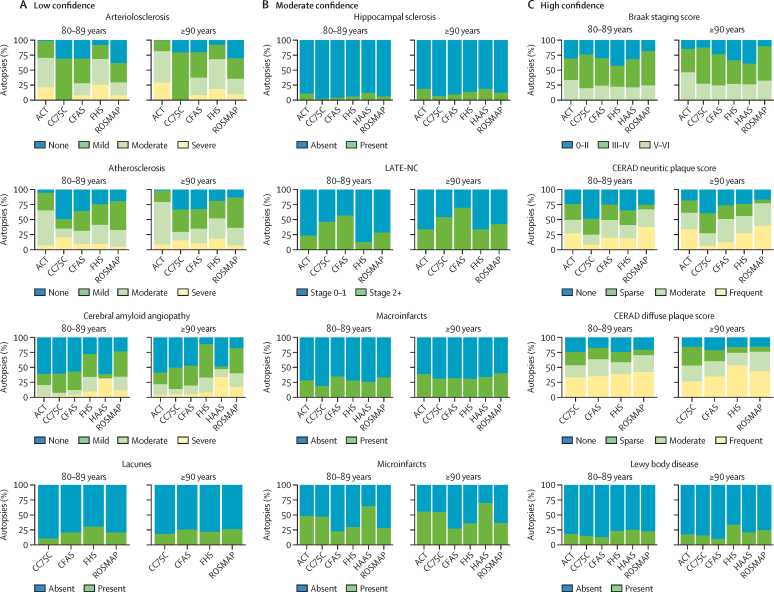
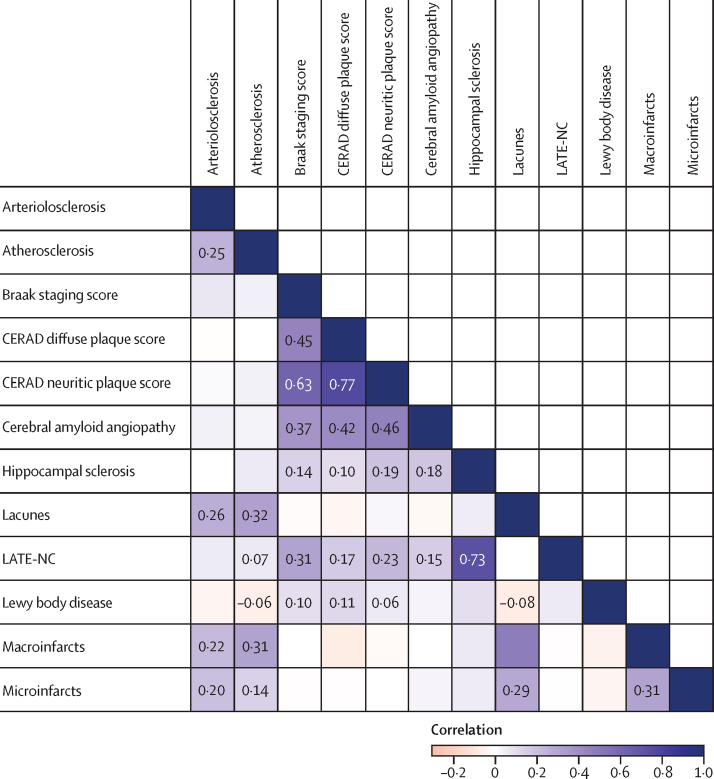
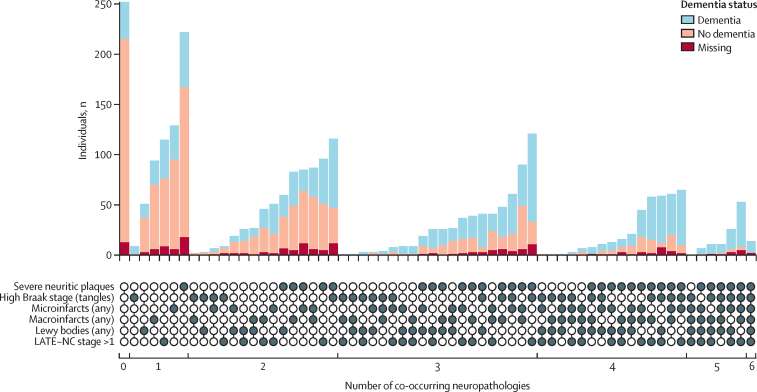
BACKGROUND: Population-based autopsy studies provide valuable insights into the causes of dementia but are limited by sample size and restriction to specific populations. Harmonisation across studies increases statistical power and allows meaningful comparisons between studies. We aimed to harmonise neuropathology measures across studies and assess the prevalence, correlation, and co-occurrence of neuropathologies in the ageing population. METHODS: We combined data from six community-based autopsy cohorts in the US and the UK in a coordinated cross-sectional analysis. Among all decedents aged 80 years or older, we assessed 12 neuropathologies known to be associated with dementia: arteriolosclerosis, atherosclerosis, macroinfarcts, microinfarcts, lacunes, cerebral amyloid angiopathy, Braak neurofibrillary tangle stage, Consortium to Establish a Registry for Alzheimer's disease (CERAD) diffuse plaque score, CERAD neuritic plaque score, hippocampal sclerosis, limbic-predominant age-related TDP-43 encephalopathy neuropathologic change (LATE-NC), and Lewy body pathology. We divided measures into three groups describing level of confidence (low, moderate, and high) in harmonisation. We described the prevalence, correlations, and co-occurrence of neuropathologies. FINDINGS: The cohorts included 4354 decedents aged 80 years or older with autopsy data. All cohorts included more women than men, with the exception of one study that only included men, and all cohorts included decedents at older ages (range of mean age at death across cohorts 88·0-91·6 years). Measures of Alzheimer's disease neuropathological change, Braak stage and CERAD scores, were in the high confidence category, whereas measures of vascular neuropathologies were in the low (arterioloscerosis, atherosclerosis, cerebral amyloid angiopathy, and lacunes) or moderate (macroinfarcts and microinfarcts) categories. Neuropathology prevalence and co-occurrence was high (2443 [91%] of 2695 participants had more than one of six key neuropathologies and 1106 [41%] of 2695 had three or more). Co-occurrence was strongly but not deterministically associated with dementia status. Vascular and Alzheimer's disease features clustered separately in correlation analyses, and LATE-NC had moderate associations with Alzheimer's disease measures (eg, Braak stage ρ=0·31 [95% CI 0·20-0·42]). INTERPRETATION: Higher variability and more inconsistency in the measurement of vascular neuropathologies compared with the measurement of Alzheimer's disease neuropathological change suggests the development of new frameworks for the measurement of vascular neuropathologies might be helpful. Results highlight the complexity and multi-morbidity of the brain pathologies that underlie dementia in older adults and suggest that prevention efforts and treatments should be multifaceted. FUNDING: Gates Ventures.
Overview
The claims and statistics of this paper haven’t been checked yet.
Run the check — free, no account needed. It reads the open-access text and checks the sources it cites.
Integrity signals
Registry
Cites
Statistics
Figures
Verification
Claims the paper makes
The claims and statistics of this paper haven’t been checked yet.
Run the check — free, no account needed. It reads the open-access text and checks the sources it cites.
Claims other papers make about this one
Each is checked against this paper’s own text: does it say what the citing paper says it does?
The cited source doesn’t support the claim as written.
In the citing paper
“One study of six community cohorts, comprising 4,354 people aged >80 years who had died in the US or UK, analysed six types of neuropathology and found 91% of people died with two or more types of neuropathology.(20)”
From Dementia prevention, intervention, and care: 2024 report of the Lancet standing Commission (2024) · cites this paper as [20]
Checked by a reasoning model — may be wrong.
Experimental — accuracy not yet measuredThe cited source says what the claim attributes to it.
In the citing paper
“Multiple neuropathologies are common in older populations and more common than Alzheimer pathology alone (see figure 1). (20)”
From Dementia prevention, intervention, and care: 2024 report of the Lancet standing Commission (2024) · cites this paper as [20]
Self-check
Percentages, sums and reported differences re-computed from the paper’s own numbers.
The self-check needs the paper’s full text.
Citations
Cites
Neuropathological stageing of Alzheimer-related changes.
Braak, H., & Braak, E. (1991) · Acta Neuropathologica · doi:10.1007/bf00308809 · Cited by 16,123
Nichols, E., Steinmetz, J. D., Vollset, S. E., Fukutaki, K., Chalek, J., Abd-Allah, F., Abdoli, A., Abualhasan, A., Abu-Gharbieh, E., Akram, T. T., et al. (2022) · The Lancet Public Health · doi:10.1016/s2468-2667(21)00249-8 · Cited by 5,575
Self-citationMirra, S. S., Heyman, A., McKeel, D., Sumi, S. M., Crain, B. J., Brownlee, L. M., Vogel, F. S., Hughes, J. P., Belle, G. V., Berg, L., et al. (1991) · Neurology · doi:10.1212/wnl.41.4.479 · Cited by 4,961
UpSet: Visualization of Intersecting Sets
Lex, A., Gehlenborg, N., Strobelt, H., Vuillemot, R., & Pfister, H. (2014) · IEEE Transactions on Visualization and Computer Graphics · doi:10.1109/tvcg.2014.2346248 · Cited by 2,340
Brain Infarction and the Clinical Expression of Alzheimer Disease<subtitle>The Nun Study</subtitle>
Snowdon, D. A. (1997) · JAMA: The Journal of the American Medical Association · doi:10.1001/jama.1997.03540340047031 · Cited by 1,590
Limbic-predominant age-related TDP-43 encephalopathy (LATE): consensus working group report
Nelson, P. T., Dickson, D. W., Trojanowski, J. Q., Jack, C. R., Boyle, P. A., Arfanakis, K., Rademakers, R., Alafuzoff, I., Attems, J., Brayne, C., et al. (2019) · Brain · doi:10.1093/brain/awz099 · Cited by 1,547
Self-citationReligious Orders Study and Rush Memory and Aging Project
Bennett, D. A., Buchman, A. S., Boyle, P. A., Barnes, L. L., Wilson, R. S., & Schneider, J. A. (2018) · Journal of Alzheimer's Disease · doi:10.3233/jad-179939 · Cited by 1,260
Self-citationMaximum Likelihood Estimation of the Polychoric Correlation Coefficient
Olsson, U. (1979) · Psychometrika · doi:10.1007/bf02296207 · Cited by 1,127
World‐Wide FINGERS Network: A global approach to risk reduction and prevention of dementia
Kivipelto, M., Mangialasche, F., Snyder, H. M., Allegri, R., Andrieu, S., Arai, H., Baker, L., Belleville, S., Brodaty, H., Brucki, S. M., et al. (2020) · Alzheimer's & Dementia · doi:10.1002/alz.12123 · Cited by 553
Self-citationTsao, C. W., & Vasan, R. S. (2015) · International Journal of Epidemiology · doi:10.1093/ije/dyv337 · Cited by 457
Cited by
Sorted by citations
Items 101–108 of 108
Cote, S. E., Ruitenberg, M. F. L., van der Geest, J. N., Frost, N. A., King, J. B., Duff, K. M., & Koppelmans, V. (2026) · Neuroimage Reports · doi:10.1016/j.ynirp.2026.100405
Laureyssen, C., Thal, D. R., & Sleegers, K. (2026) · Acta Neuropathologica · doi:10.1007/s00401-026-03085-4
Neuropathology of centenarians and supercentenarians: An autopsy study
Magaki, S., Tung, S., Sinclair, D. J., Williams, C. K., Paganini‐Hill, A., Murillo, A., Aung, S., Goldstein, J., Vulcain, D. R., Salamon, N., et al. (2026) · Neurobiology of Aging · doi:10.1016/j.neurobiolaging.2026.09.005
Morbelli, S. D., Brendel, M., Tolboom, N., Drzezga, A. E., Janelidze, S., Joie, R. L., Roccatagliata, L., Agosta, F., Arbizu, J., Boccalini, C., et al. (2026) · The EANM Journal · doi:10.1016/j.eanmj.2026.100250
Siejka, T. P., Bertram, K., Butzkueven, H., Darby, D., & Brodtmann, A. G. (2026) · Movement Disorders Clinical Practice · doi:10.1002/mdc3.70847
Astrocytes as a key structural and functional component in the development of mixed dementia
Selitsky, G. V., Сорокина, Н. Д., & Kamchatnov, P. R. (2026) · S S Korsakov Journal of Neurology and Psychiatry · doi:10.17116/jnevro20261260917
Blood-Based Biomarkers as Predictors of All-Cause Dementia
Sabia, S., Dumurgier, J., Cavaillès, C., Danilevicz, I. M., Fayossé, A., Heslegrave, A., Zetterberg, H., Mika Kivimaki, B., & Singh‐Manoux, A. (2026) · Neurology · doi:10.1212/wnl.0000000000218681
Obara, K., Mastrangelo, A., Ranieri, A., Janelidze, S., Ito, D., Yamamoto, M., Vacchiano, V., Liguori, R., Caldera, S., Riku, Y., et al. (2026) · medRxiv · doi:10.64898/2026.10.23.26366349
Metadata
- Authors
- Nichols, E., Merrick, R., Hay, S. I., Himali, D., Himali, J. J., Hunter, S., Keage, H. A. D., Latimer, C. S., Scott, M. R., Steinmetz, J. D., Walker, J. M., Wharton, S. B., Wiedner, C. D., Crane, P. K., Keene, C. D., Launer, L. J., Matthews, F. E., Schneider, J., Seshadri, S., White, L., Brayne, C., & Vos, T.
- Affiliations
- University of Washington (US)
- University of Cambridge (GB)
- Framingham Heart Study (US)
- Boston University (US)
- University of South Australia (AU)
- Icahn School of Medicine at Mount Sinai (US)
- University of Sheffield (GB)
- The University of Texas at San Antonio Health Science Center (US)
- National Institute on Aging (US)
- Newcastle University (GB)
- Rush University Medical Center (US)
- Pacific Health Research and Education Institute (US)
- Corresponding author
- Nichols, Emma
- ORCID
- Nichols, Emma
- Merrick, Richard
- Hay, Simon I
- Himali, Dibya
- Himali, Jayandra J
- Hunter, Sally
- Keage, Hannah A D
- Latimer, Caitlin S
- Scott, Matthew R
- Steinmetz, Jaimie D
- Walker, Jamie M
- Wharton, Stephen B
- Crane, Paul K
- Keene, C Dirk
- Launer, Lenore J
- Matthews, Fiona E
- Schneider, Julie
- Seshadri, Sudha
- White, Lon
- Brayne, Carol
- Vos, Theo
- Venue
- The Lancet Healthy Longevity
- Publisher
- Elsevier BV
- Published
- 2023-03
- Volume
- 4
- Issue
- 3
- Pages
- e115-e125
- ISSN
- 2666-7568 (ISSN-L)
- PMC
- PMC9977689
- OpenAlex
- W4322722320
- Cited by
- 108
- References
- 43
- Citations by year
- 2026: 35 · 2025: 37 · 2024: 26 · 2023: 10
- FWCI
- 21.99
- Type
- journal article
- Language
- en
- Open access
- gold
- doi.org
- Licence
- Locations
- The Lancet Healthy Longevity (publishedVersion, cc-by)
- PubMed (publishedVersion)
- Repository@Hull (Worktribe) (University of Hull) (publishedVersion, other-oa)
- PubMed Central (publishedVersion, cc-by)
- White Rose Research Online (University of Leeds, The University of Sheffield, University of York) (acceptedVersion)
- Apollo (University of Cambridge) (submittedVersion, cc-by)
- UniSA Research Outputs Repository (University of South Australia) (submittedVersion, other-oa)
- Adelaide Research & Scholarship (AR&S) (University of Adelaide) (submittedVersion, cc-by-nc)
- Newcastle University ePrints (Newcastle Univesity) (cc-by)
- Funders
- National Institutes of Health (AG054076, AG049607, HHSN268201500001I, AG059421, AG066524, AG033090, 75N92019D00031, N01-HC-25195)
- National Institute for Health and Care Research
- Office of Research and Development
- Nancy and Buster Alvord Endowment
- National Heart, Lung, and Blood Institute (5 R01 NS041265)
- Bill and Melinda Gates Foundation
- Alzheimer’s Research UK (N01-AG-4-2149, 5 R01 AG017155, N01-HC-05102, 1 UO1 AG19349, ARUK-PhD2017-34)
- Alzheimer’s Disease Research Center, University of Washington (P30 AG066509)
- National Institute on Aging (U19AG066567, U01AG006781)
- U.S. Department of Veterans Affairs
- National Institute of Neurological Disorders and Stroke (UF1NS125513, NS017950, AG062531)
- Medical Research Council (G0400077, G9901400, G0900582, U.1052.00.0013)
- Topics
- Health Sciences › Medicine › Psychiatry and Mental health › Dementia and Cognitive Impairment Research
- Life Sciences › Neuroscience › Cellular and Molecular Neuroscience › Alzheimer's disease research and treatments
- Life Sciences › Neuroscience › Neurology › Neurological Disease Mechanisms and Treatments
- MeSH terms
- Aged, Aged, 80 and over, Alzheimer Disease, Autopsy, Cross-Sectional Studies, Dementia, Female, Humans, Male, Prevalence, Cerebral Amyloid Angiopathy, Limbic Encephalitis, Atherosclerosis, TDP-43 Proteinopathies
About these checks
Registry, retraction, Cites and statistics results are computed, not judged, with one exception: a printed reference that no index lists is read once by a model before it counts as a citation error. Claims are extracted by a model and kept only when their quote appears verbatim in the text; each cited source is then checked, with a model’s help, for whether it says what the claim relies on. Those verdicts can be wrong — read the claim’s quote and the cited source before relying on one.
Statistics and arithmetic are recomputed, not judged.
Confidence bands are shown only for fields calibrated on our annotated test set. None is calibrated yet, so no band is shown.
What counts as a claim ›How we measure confidence ›How we check this ›
Are you an author, or do you see a problem with this page? Request a review
