

NEW AMS CHRONOLOGY FOR THE EARLY BRONZE III/IV TRANSITION AT KHIRBAT ISKANDAR, JORDAN
Open accessThe DOI matches its Crossref record; 60 of the 62 references it cites were found in a registry or an index, and 2 are not checked yet; none of the 15 sources its claims cite is checked for support yet.
Abstract
We present the first Bayesian 14 C modeling based on AMS ages from stratified sediments representing continuous occupation across the Early Bronze III/IV interface in the Southern Levant. This new high-precision modeling incorporates 12 calibrated AMS ages from Khirbat Iskandar Area C using OxCal 4.4.4 and the IntCal 20 calibration curve to specify the EB III/IV transition at or slightly before 2500 cal BCE. Our results contribute to the continuing emergence of a high chronology for the Levantine Early Bronze Age, which shifts the end of EB III 200–300 years earlier than the traditional time frame and increases the length of EB IV to about 500 years. Data from Khirbat Iskandar also help direct greater attention to the importance of sedentary communities through EB IV, in contrast to the traditional emphasis on non-sedentary pastoral encampments and cemeteries. Modeling of AMS data from Khirbat Iskandar bolsters the ongoing revision of Early Bronze Age Levantine chronology and its growing interpretive independence from Egyptian history and contributes particularly to re-examination of the EB III/IV nexus in the Southern Levant.
Checked 2026-11-24 · 2 references not checked yet
Overview
CoChat Summary
TL;DR
Bayesian modeling of 12 AMS 14C ages from a continuous EB III–EB IV stratigraphic sequence in Area C at Khirbat Iskandar, Jordan, places the EB III/IV transition at or slightly before 2500 cal BCE. The results support a high Early Bronze Age chronology, shift the end of EB III 200–300 years earlier than traditional dates, and highlight sedentary EB IV communities.
Key findings
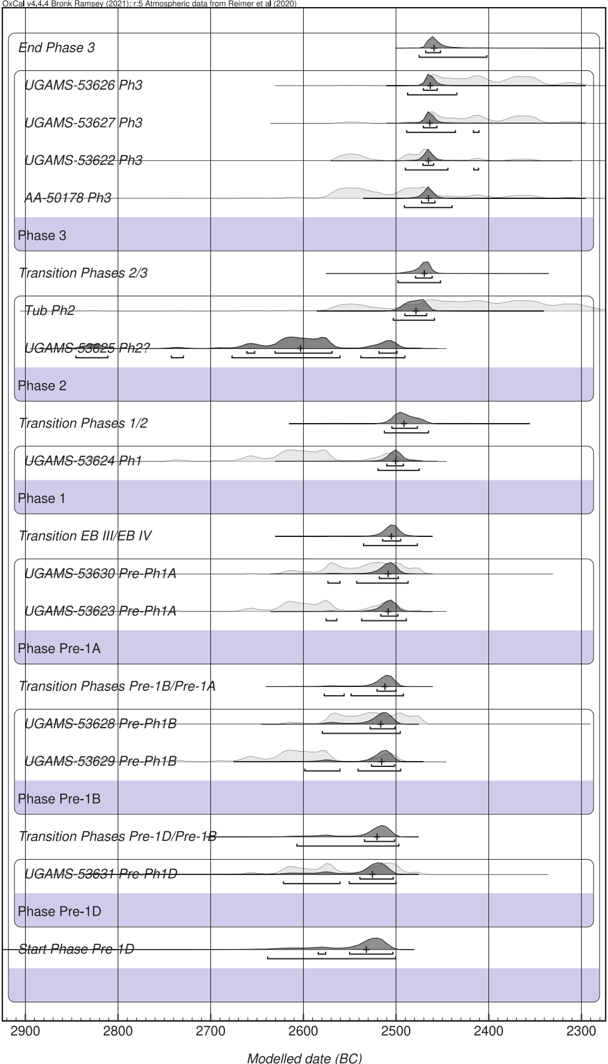
- The optimal six-phase Bayesian model (10 new seed ages plus 2 charcoal ages; A_model = 140.7) estimates the EB III/IV transition at a median 2506 cal BCE (1σ 2515–2496 cal BCE); all four models place it at or slightly before 2500 cal BCE, with medians of 2506–2514 cal BCE.
- The modeled transition is 200–300 years earlier than the traditional chronology and increases the length of EB IV to about 500 years; the revised chronology in the paper gives EB IV as 2500–2000 cal BCE and EB III as 2900–2500 cal BCE.
- Seven ages from Khirbat Iskandar Phases 1–3 fit early EB IV, parallel to Tell Abu en-Ni'aj Phases 7 and 6, and place the beginning of EB IV occupation in Area C at 2500 cal BCE; the Pre-Phase 1 ages fall at the very end of EB III, prior to 2500 cal BCE.
- The authors argue the data emphasize sedentary communities through EB IV and help disarticulate Levantine chronology from Egyptian history, including the end of the Egyptian Old Kingdom.
Methods
- The 2019 excavations at Khirbat Iskandar Area C, Squares 6 and 8, used water flotation to recover plant macroremains; 10 new seed samples were AMS-dated at the University of Georgia, plus 2 previously excavated charcoal samples from Area C, Square 2, analyzed at the University of Arizona (AA-50178) and the University of Tubingen (lab number unreported). Samples were pretreated with acid/alkali/acid, measured by EA-IRMS, combusted, graphitized, and measured by AMS.
- The 12 AMS ages were organized into six stratigraphic phases—Pre-Phase 1D, 1B, and 1A (EB III) and Phases 1, 2, and 3 (EB IV)—and ordered chronologically within phases. Calibration and Bayesian modeling used OxCal 4.4.4 and the IntCal20 curve; models were run with six phases and two phases, with and without the charcoal ages, and A_model > 60 was used to identify robust models.
- One sample, UGAMS-53625, is identified as a statistical outlier and excluded from the six-phase Bayesian models.
Limitations
- The paper states that few sites offer both stratified EB III/IV occupations and AMS datasets suitable for chronological modeling; it notes Regev et al.’s observation that no sites then existed where both EB III and EB IV/IBA had been 14C dated.
- Stated/evident: one sample (UGAMS-53625) is a statistical outlier excluded from the six-phase models, the Tubingen charcoal lab number is unreported, and the two charcoal ages are legacy samples from previously excavated Square 2 contexts.
- Evident from the text: the chronology rests on a single excavation area (Area C) at one site, based on 10 new seed ages plus 2 legacy charcoal ages; the paper does not present a formal limitations section.
Model-written summary. Check it against the paper before relying on it.
Integrity signals
Registry
Cites
Statistics
Figures
Verification
Claims the paper makes
0 Valid · 0 Not valid · 10 Not checked · 28 Own results and interpretations
A result the paper reports from its own data — it cites no other source for it, so there is none to check. The quote shows it is in the paper.
In the paper
“This new high-precision modeling incorporates 12 calibrated AMS ages from Khirbat Iskandar Area C using OxCal 4.4.4 and the IntCal 20 calibration curve to specify the EB III/IV transition at or slightly before 2500 cal BCE.”
- Also stated in: § Bayesian modeling of 10 new AMS seed ages plus two previous AMS charcoal dates from · plain
“This model places the EB III/IV transition in Area C at or slightly before 2500 cal BCE (1σ range: 2515-2496 cal BCE; median = 2506 cal BCE).”
- Also stated in: § Bayesian modeling of 10 new AMS seed ages plus two previous AMS charcoal dates from · plain
“We model the EB III/IV transition at about or slightly before 2500 cal BCE, which is 200-300 years earlier than assumed traditionally.”
§ NEW AMS CHRONOLOGY FOR THE EARLY BRONZE III/IV TRANSITION AT KHIRBAT ISKANDAR, JORDAN > Abstract
plain- Asserted: passes — The authors put it forward as true.
- Checkable: passes — It can be checked against evidence.
- Load-bearing: passes — The paper’s conclusions depend on it.
- Based: passes — The paper gives a reason why it holds.
- Also stated in: § Bayesian modeling of 10 new AMS seed ages plus two previous AMS charcoal dates from · plain
A result the paper reports from its own data — it cites no other source for it, so there is none to check. The quote shows it is in the paper.
In the paper
“This new high-precision modeling incorporates 12 calibrated AMS ages from Khirbat Iskandar Area C using OxCal 4.4.4 and the IntCal 20 calibration curve to specify the EB III/IV transition at or slightly before 2500 cal BCE.”
§ NEW AMS CHRONOLOGY FOR THE EARLY BRONZE III/IV TRANSITION AT KHIRBAT ISKANDAR, JORDAN > Abstract
plain- Asserted: passes — The authors put it forward as true.
- Checkable: passes — It can be checked against evidence.
- Load-bearing: passes — The paper’s conclusions depend on it.
- Based: passes — The paper gives a reason why it holds.
A result the paper reports from its own data — it cites no other source for it, so there is none to check. The quote shows it is in the paper.
In the paper
“Khirbat Iskandar provides a sequence of 12 AMS 14 C ages from six stratigraphic phases designated as EB III or EB IV on the basis of Area C stratigraphy and ceramic chronology (Table 2).”
§ NEW AMS CHRONOLOGY FOR THE EARLY BRONZE III/IV TRANSITION AT KHIRBAT ISKANDAR, JORDAN > RESULTS
plain- Asserted: passes — The authors put it forward as true.
- Checkable: passes — It can be checked against evidence.
- Load-bearing: passes — The paper’s conclusions depend on it.
- Based: passes — The paper gives a reason why it holds.
A result the paper reports from its own data — it cites no other source for it, so there is none to check. The quote shows it is in the paper.
In the paper
“Pre-Phase 1D includes a burned layer that appears to correlate with a destruction layer overlying the latest EB III occupation identified thus far in Area B.”
§ NEW AMS CHRONOLOGY FOR THE EARLY BRONZE III/IV TRANSITION AT KHIRBAT ISKANDAR, JORDAN > EXCAVATIONS AT KHIRBAT ISKANDAR
hedgedstates an association- Asserted: passes — The authors put it forward as true.
- Checkable: passes — It can be checked against evidence.
- Load-bearing: passes — The paper’s conclusions depend on it.
- Based: passes — The paper gives a reason why it holds.
A result the paper reports from its own data — it cites no other source for it, so there is none to check. The quote shows it is in the paper.
In the paper
“Bayesian modeling of 10 new AMS seed ages plus two previous AMS charcoal dates from Khirbat Iskandar provides a new stratigraphically-based calculation of the EB III/IV transition in the Southern Levant.”
§ NEW AMS CHRONOLOGY FOR THE EARLY BRONZE III/IV TRANSITION AT KHIRBAT ISKANDAR, JORDAN > Bayesian modeling of 10 new AMS seed ages plus two previous AMS charcoal dates from
plainstates a cause- Asserted: passes — The authors put it forward as true.
- Checkable: passes — It can be checked against evidence.
- Load-bearing: passes — The paper’s conclusions depend on it.
- Based: passes — The paper gives a reason why it holds.
21 more claims
Create a free account to see all 38 claims and to verify the 4 references still open.
- It may state two separate claims as one. 9
- Probably not a substantial claim. 5
Claims other papers make about this one
Each is checked against this paper’s own text: does it say what the citing paper says it does?
In the citing paper
“Over the last two decades, Southern Levantine Bronze Age chronology has experienced significant revision with the emergence of a radiocarbon-based”
From BAYESIAN MODELING OF A PERIPHERAL MIDDLE BRONZE AGE SETTLEMENT AT ZAHRAT ADH-DHRA‘ 1, JORDAN (2023) · cites this paper as Fall et al. 2022
In the citing paper
“The growing evidence for a high Southern Levantine Bronze Age radiocarbon chronology features a lengthened Early Bronze IV beginning by 2500 cal BCE and continuing after its traditional end about 2000 cal BCE”
From BAYESIAN MODELING OF A PERIPHERAL MIDDLE BRONZE AGE SETTLEMENT AT ZAHRAT ADH-DHRA‘ 1, JORDAN (2023) · cites this paper as Fall et al. 2022
In the citing paper
“Nevertheless, only a handful of Early Bronze IV marginal settlements (e.g., Be'er Resisim, Ein-Ziq, Nahal Refaim, Ha-Gamal) provide a modest corpus of largely charcoal radiocarbon ages that has been used to initiate a discussion of a general chronology for the period (e.g., Regev et al. 2012;Fall et al. 2022), but which is insufficient for formal modeling of occupation at any given site.”
From BAYESIAN MODELING OF A PERIPHERAL MIDDLE BRONZE AGE SETTLEMENT AT ZAHRAT ADH-DHRA‘ 1, JORDAN (2023) · cites this paper as Fall et al. 2022
Citations
Cites
Bayesian Analysis of Radiocarbon Dates
Bronk Ramsey, C. (2009) · Radiocarbon · doi:10.1017/s0033822200033865 · Cited by 8,725
The IntCal20 Northern Hemisphere Radiocarbon Age Calibration Curve (0–55 cal kBP)
Reimer, P. J., Austin, W. E. N., Bard, E., Bayliss, A., Blackwell, P. G., Bronk Ramsey, C., Butzin, M., Cheng, H., Edwards, R. L., Friedrich, M., et al. (2020) · Radiocarbon · doi:10.1017/rdc.2020.41 · Cited by 7,900
Discussion Reporting of 14 C Data
Stuiver, M., & Polach, H. A. (1977) · Radiocarbon · doi:10.1017/s0033822200003672 · Cited by 5,640
Dealing with outliers and offsets in radiocarbon dating
Bronk Ramsey, C. (2009) · Radiocarbon · doi:10.1017/s0033822200034093 · Cited by 1,204 · cited 5×
“Over roughly the last two decades, Early Bronze Age chronology has been revised drastically through site-specific and regional Bayesian radiocarbon modeling (Bronk Ramsey 2009a).”
BackgroundMethodInfluentialMethods for Summarizing Radiocarbon Datasets
Ramsey, C. B. (2017) · Radiocarbon · doi:10.1017/rdc.2017.108 · Cited by 1,179
Performance of catalytically condensed carbon for use in accelerator mass spectrometry
Vogel, J. S., Southon, J. R., Nelson, D. E., & Brown, T. A. (1984) · Nuclear Instruments and Methods in Physics Research Section B: Beam Interactions with Materials and Atoms · doi:10.1016/0168-583x(84)90529-9 · Cited by 695
The Archaeology of Society in the Holy Land
Routledge, B., & Levy, T. E. (1998) · The Classical World · doi:10.2307/4352203 · Cited by 636
Studies in the history and archaeology of Jordan
Hadidi, A., & al-ʿĀmmah, J. D. A.-Ā. (1982) · Medical Entomology and Zoology · Cited by 393
Chronology of the Early Bronze Age in the Southern Levant: New Analysis for a High Chronology
Regev, J., De Miroschedji, P., Greenberg, R., Braun, E., Greenhut, Z., & Boaretto, E. (2012) · Radiocarbon · doi:10.1017/s003382220004724x · Cited by 233 · cited 5×
“…from Tell es-Safi/Gath, in the Hebron region, model the end of its EB III occupation between 2680 and 2580 cal BCE (Shai et al. 2014), while a model of 17 AMS ages from Tel Yarmuth/Khirbet Yarmuk, in the foothills of the Shephelah, ends its EB III occupation about 2500 cal BCE (Regev et al. 2012b).”
BackgroundInfluentialHigh-Precision Bayesian Modeling of Samples Susceptible to Inbuilt Age
Dee, M. W., & Ramsey, C. B. (2014) · Radiocarbon · doi:10.2458/56.16685 · Cited by 131
Research works printed but not linked: 18
- Long JC Jr. 2010. The stratigraphy of Area C. In: Richard S, Long JC, Holdorf PS, Peterman G, editors. Final Report on the Early Bronze IV Area C Gateway and Cemeteries, Archaeological Expedition to Khirbat Iskandar and its Environs, Jordan. Volume 1. Boston: American Schools of Oriental Research. p. 37-68.
- Segal D, Carmi I. 1996. Rehovot radiocarbon date list V. 'Atiqot XXIX:79-106.
- Rast WE, Schaub RT. 2003. Bâb edh-Dhrâ: Excavations at the Town Site (1975-1981). Eisenbrauns: Winona Lake.
- D'Andrea M. 2020. About stratigraphy, pottery and relative chronology: some considerations for a refinement of archaeological periodization for the Southern Levantine EB IV. In: Richard S, editor. New horizons in the study of the Early Bronze III and Early Bronze IV in the Levant. University Park (PA): Eisenbrauns. p. 395-416.
- Holdorf PS. 2010. Comparison of EB IV radiocarbon results from Khirbat Iskandar and Bab adh-Dhra. In: Richard S, Long JC, Holdorf PS, Peterman G, editors. Final Report on the Early Bronze IV Area C Gateway and Cemeteries, Archaeological Expedition to Khirbat Iskandar and its Environs, Jordan. Volume 1. Boston: American Schools of Oriental Research. p. 267-270.
- Eisenberg E. 2012. The Early Bronze Age IV site at Sha'ar Ha-Golan. Atiqot 69(1):1-73.
- Bar S, Cohen O, Zertal A. 2013. New aspects of the Intermediate Bronze Age (IB/MBI/EBIV): Khirbet el-Meiyiteh-a fortified site on the eastern fringe of Samaria. Revue Biblique 120(2):161-181.
- Mazar A. 2012. Introduction and synthesis. In: Mazar, A, editor. Excavations at Tel Beth-Shean 1989- 1996. Volume IV: the fourth and third millennia BCE. Jerusalem: Israel Exploration Society and the Hebrew University of Jerusalem. p. 1-33.
- Olea charcoal UGAMS-53625 4070 ± 25 2662-2653 (3.8%) 2631-2570 (52.7%) 2519-2500 (11.8%) 2847-2812 (8.5%) 2744-2730 (1.3%) 2694-2687 (0.5%) 2677-2561 (67.5%) 2538-2492 (17.6%) 2604 Phase 2, Square 8S, Pail 170S, Locus 68S; Triticum dicoccum seed (Continued) New AMS Chronology for EB III/IV Transition 243 https://doi.org/10.1017/RDC.2022.22 Published online by Cambridge University Press UGAMS-53624 4070 ± 25 2662-2653 (3.8%) 2631-2570 (52.7%) 2519-2500 (11.8%) 2847-2812 (8.5%) 2744-2730 (1.3%) 2694-2687 (0.5%) 2677-2561 (67.5%) 2538-2492 (17.6%) 2604 Phase 1, Square 8S, Pail 163S, Locus 79S; Hordeum vulgare seed UGAMS-53630 4030 ± 25 2577-2557 (17.4%) 2542-2489 (50.8%) 2622-2596 (7.0%) 2585-2471 (88.4%) 2529 Pre-Phase 1A, Square 6, Pail 118, Locus 73/4; Olea europaea seed UGAMS-53623 4060 ± 25 2626-2568 (47.0%) 2525-2498 (21.3%) 2839-2815 (4.3%) 2670-2553 (61.2%) 2546-2476 (29.9%) 2586 Pre-Phase 1A, Square 8S, Pail 178S, Locus 92S; Hordeum vulgare seed UGAMS-53628 4020 ± 25 2573-2556 (15.6%) 2543-2511 (31.9%) 2506-2488 (16.4%) 2482-2476 (4.4%) 2618-2609 (1.6%) 2581-2468 (93.9%) 2527 Pre-Phase 1B, Square 6, Pail 113, Locus 73/4; Hordeum vulgare seed UGAMS-53629 4070 ± 25 2662-2653 (3.8%) 2631-2570 (52.7%) 2519-2500 (11.8%) 2847-2812 (8.5%) 2744-2730 (1.3%) 2694-2687 (0.5%) 2677-2561 (67.5%) 2538-2492 (17.6%) 2604 Pre-Phase 1B, Square 6, Pail 115, Locus 75; Hordeum vulgare seed UGAMS-53631 4050 ± 25 2622-2596 (18.1%) 2585-2566 (16.5%) 2531-2495 (33.7%) 2831-2823 (0.9%) 2664-2648 (2.4%) 2634-2473 (92.1%) 2568 Pre-Phase 1D, Square 6, Pail 136, Locus 86; Hordeum vulgare seed REFERENCES Adams MJ. 2017. Egypt and the Levant in the Early/ Middle Bronze Age Transition. In: Höflmayer F, editor. The Early/Middle Bronze Age Transition in the Ancient Near East: chronology, 14 C, and climate change. Chicago: The Oriental Institute. p. 493-515.
- Fraser J. 2017. Khirbet Um al-Ghozlan. In: Archaeology in Jordan Newsletter: 2016 and 2017 Seasons: 27-28. Amman: ACOR.
- Sharon I. 2014. Levantine chronology. In: Steiner ML, Killebrew AE, editors. The archaeology of the Levant c. 8000-332 BCE. Oxford: Oxford University Press. p. 44-65.
- D'Andrea M. 2019. The periodization of Early Bronze IV in the Southern Levant: bridging the gap between stratigraphy and absolute chronology. In: Gallo E, editor. Conceptualizing urban experiences: Tell es-Sultan and Tall al-Ḥammām Early Bronze cities across the Jordan. Proceedings of a workshop held in Palermo, G. Whitaker Foundation, Villa Malfitano, June 19, 2017. Rome: La Sapienza Studies on the Archaeology of Palestine & Transjordan 13. p. 61-78.
- Richard S. 2020. New Vistas on the Early Bronze Age IV of the Southern Levant: a case for "rural complexity" in the permanent sedentary sites. In: Richard, S editor. New horizons in the study of the Early Bronze III and Early Bronze IV in the Levant. University Park (PA): Eisenbrauns. p. 417-453.
- Palumbo G. 1991. The Early Bronze Age IV in the Southern Levant: Settlement patterns, economy and material culture of a "Dark Age." Contributi Materiali di Archeologia Orientale III (1990). Rome: Universita Degli Studi di Roma la Sapienza.
- Bechar S. 2017. The Intermediate Bronze Age (Stratum XVIII). In: Ben-Tor A, Zuckerman S, Bechar S, Sandhaus D, editors. Hazor VII-the 1990-2012 excavations-the Bronze Age, Jerusalem. p. 14-19.
- Richard S. 2010. The Area C Early Bronze IV ceramic assemblage. In: Richard S, Long JC, Holdorf PS, Peterman G, editors. Final Report on the Early Bronze IV Area C Gateway and Cemeteries, Archaeological Expedition to Khirbat Iskandar and its Environs, Jordan. Volume 1. Boston: American Schools of Oriental Research. p. 69-111.
- Golani A, Segal D. 2002. Redefining the onset of the Early Bronze Age in Southern Canaan: new 14 C evidence from Ashqelon Afridar. In: van den Brink E, Yannai E, editors. In quest of ancient settlements and landscapes. Tel Aviv: Ramot Publishing. p. 135-154.
- The architecture and stratigraphy of the tell. London: The British School of Archaeology in Jerusalem.
Cited by
Richard, S. (2024) · Journal of Ancient Near Eastern History · doi:10.1515/janeh-2022-0011 · Cited by 4
Self-citationErftenbeck, H., & Chesson, M. S. (2025) · Journal of Anthropological Archaeology · doi:10.1016/j.jaa.2025.101687 · Cited by 2
BAYESIAN MODELING OF A PERIPHERAL MIDDLE BRONZE AGE SETTLEMENT AT ZAHRAT ADH-DHRA‘ 1, JORDAN
Fall, P. L., Ridder, E., Pilaar Birch, S. E., & Falconer, S. E. (2023) · Radiocarbon · doi:10.1017/rdc.2023.99 · Cited by 1
Self-citationRichard, S., Long, J. C., & D’Andrea, M. (2023) · Harrassowitz Verlag eBooks · doi:10.13173/9783447119030.523 · Cited by 1
Self-citationBeller, J. A., Craig, C., O'Neil, H., Richardson, S. J., & Collard, M. (2025) · Documenta Praehistorica · doi:10.4312/dp.52.19
Metadata
- Authors
- Fall, P. L., Richard, S., Pilaar Birch, S. E., Ridder, E., D’Andrea, M., Long, J. C., Hedges-Knyrim, G., Porson, S., Metzger, M., & Falconer, S. E.
- Affiliations
- University of North Carolina at Charlotte (US)
- Gannon University (US)
- California State University, San Marcos (US)
- Sapienza University of Rome (IT)
- Lubbock Christian University (US)
- Vancouver Community College (CA)
- Corresponding author
- Falconer, Steven E
- Venue
- Radiocarbon
- Publisher
- Cambridge University Press (CUP)
- Published
- 2022-04
- Volume
- 64
- Issue
- 2
- Pages
- 237-252
- ISSN
- 0033-8222 (ISSN-L)
- 1945-5755
- OpenAlex
- W4224246937
- Semantic Scholar
- c647fc5a3ece473c23bd0539171c85ae4e654e5e
- Cited by
- 5
- References
- 58
- Citations by year
- 2025: 2 · 2024: 1 · 2023: 2
- FWCI
- 1.76
- Type
- journal article
- Language
- en
- Open access
- hybrid
- doi.org
- Locations
- Radiocarbon (publishedVersion, cc-by)
- IRIS Research product catalog (Sapienza University of Rome) (submittedVersion, cc-by)
- Funders
- National Science Foundation (1850259)
- Topics
- Social Sciences › Archeology › Archaeology and ancient environmental studies
- Social Sciences › Arts and Humanities › Archeology (arts and humanities) › Ancient Mediterranean Archaeology and History
- Social Sciences › Arts and Humanities › Archeology (arts and humanities) › Ancient and Medieval Archaeology Studies
- Keywords
- Southern Levant, radiocarbon chronology, stratified sediments, sedentary communities, OxCal, Egyptian chronology
About these checks
Registry, retraction, Cites and statistics results are computed, not judged, with one exception: a printed reference that no index lists is read once by a model before it counts as a citation error. Claims are extracted by a model and kept only when their quote appears verbatim in the text; each cited source is then checked, with a model’s help, for whether it says what the claim relies on. Those verdicts can be wrong — read the claim’s quote and the cited source before relying on one.
A language model drew the claims from the paper on 2026-11-24, under version 3 of the claim definition (model deepseek-v4.1-flash, prompt extract-v3).
A second model labelled each claim on 2026-11-24 (model jev-1.13-20260917, definition revision gold-guideline-v0.2).
Statistics and arithmetic are recomputed, not judged.
Confidence bands are shown only for fields calibrated on our annotated test set. None is calibrated yet, so no band is shown.
What counts as a claim ›How we measure confidence ›How we check this ›
Are you an author, or do you see a problem with this page? Request a review
How to cite
Cite CoChat for the checks on this page, and the paper for its own findings.
- This page
- CoChat. (2026). Citation check: NEW AMS CHRONOLOGY FOR THE EARLY BRONZE III/IV TRANSITION AT KHIRBAT ISKANDAR, JORDAN. https://app.cochat.ai/papers/10.1017/rdc.2022.22
- The paper
- Fall, P. L., Richard, S., Pilaar Birch, S. E., Ridder, E., D’Andrea, M., Long, J. C., Hedges-Knyrim, G., Porson, S., Metzger, M., & Falconer, S. E. (2022). NEW AMS CHRONOLOGY FOR THE EARLY BRONZE III/IV TRANSITION AT KHIRBAT ISKANDAR, JORDAN. Radiocarbon. https://doi.org/10.1017/rdc.2022.22
Data sources
Bibliographic data: Semantic Scholar, OpenAlex, Crossref.
Contains information from the Semantic Scholar Academic Graph Datasets, made available under the ODC Attribution License (ODC-BY 1.0).
Semantic Scholar’s data is described in: Kinney, R., et al. (2023). The Semantic Scholar Open Data Platform. arXiv:2301.10140.
