

AMS 14C DATING AND STABLE ISOTOPE ANALYSIS ON AN 8-KYR OYSTER SHELL FROM TAIPEI BASIN: SEA LEVEL AND SST CHANGES
Open accessThe DOI matches its Crossref record; 38 of the 38 references it cites were found in a registry or an index; none of the 52 sources its claims cite is checked for support yet.
Abstract
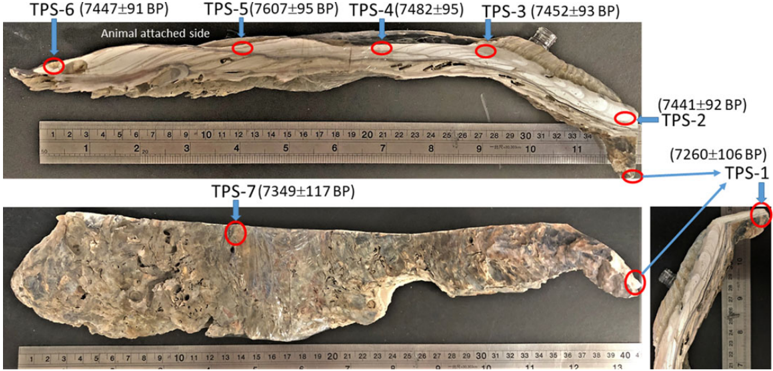
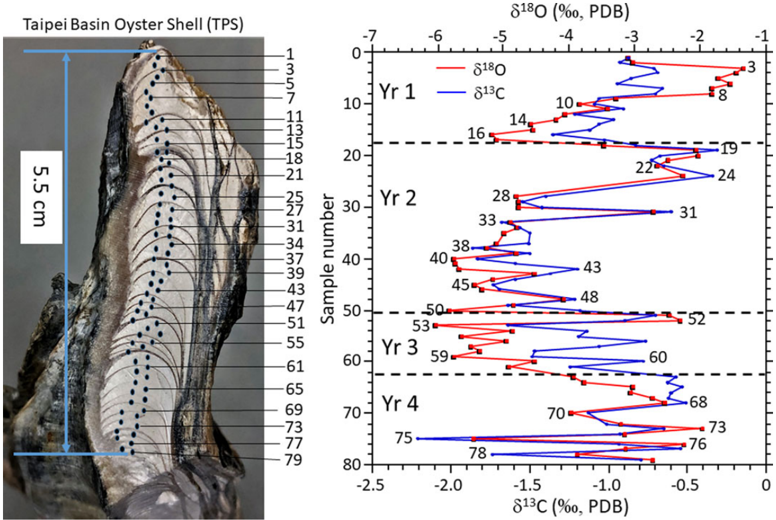
Seven accelerator mass spectrometry radiocarbon (AMS 14 C) dates (7260±106∼7607±95 BP averaged 7444±103 BP) on a giant oyster shell, collected from an ancient shore of the Taipei Basin, are similar to the LSC (liquid scintillation counting) 14 C age (7260±46 BP) of a grass sample inside the shell. The calibrated 14 C ages of the C. gigas by Marine20 are 7490±240∼7805±230 cal BP (average 7660±96 cal BP), generally agreed with the calibrated LSC 14 C ages of the grass and the oyster shell. Combined with other 14 C ages of shoreline samples in the Taipei Basin, it is evident that sea level rose from 8600 to 7600 cal BP and reached a stand higher than modern sea level. During this marine transgression, the sedimentation rate along the shoreline was very high because 14 C dating was not able to detect age differences for 4–5 m thick sediment sequences. Sixty-nine analyses of δ 18 O and δ 13 C from the oldest part of the shell exhibit clear seasonal cycles, with a 4-year period of growth in the 5.5-cm section. According to the δ 18 O values, the ancient oyster grew in a warmer-than-present shoreline environment, suggesting that the current absence of the giant oyster in Taiwan is not due to warming conditions.
Overview
CoChat Summary
TL;DR
AMS 14C dating of a 42-cm *Crassostrea gigas* shell from the Taipei Basin gives a depositional age of ~7660 cal BP and indicates early Holocene sea level rose from 8600 to 7600 cal BP, reaching 1–3 m above modern during 8090–7660 cal BP. Stable isotope profiles show four annual cycles and winter temperatures of 15–23°C around ~7660 cal BP, warmer than modern Taipei winters, suggesting the late Holocene disappearance of giant oysters in Taiwan was not caused by warming.
Key findings
- Seven AMS 14C dates on the left valve range from 7260±106 to 7607±95 BP, with a weighted average of 7444±103 BP; Marine20-calibrated ages are 7490±240 to 7805±230 cal BP, average 7660±96 cal BP. The LSC grass sample inside the shell dates to 7260±46 BP (IntCal20 8090±90 cal BP), and the LSC right valve dates to 7713±40 BP (Marine20 7925±175 cal BP), giving a depositional age of 8090–7660 cal BP for the >5-m-thick shoreline sediments.
- Sea level rose from 8600 to 7600 cal BP and reached about 1–3 m above modern sea level during 8090–7660 cal BP; the study site provides no evidence for a maximum highstand between 5000 and 7000 cal BP.
- Sixty-nine δ18O and δ13C analyses from the oldest 5.5-cm shell section show δ18O from -6.03‰ to -1.33‰ and δ13C from -2.21‰ to -0.31‰, with covariance (R² = 0.6, n = 69), four annual cycles, and Δδ18O of ~4‰. Estimated winter temperature around ~7660 cal BP was 15–23°C, warmer than the modern Taipei winter of 14–16°C, so the current absence of the giant oyster in Taiwan is not attributed to warming conditions.
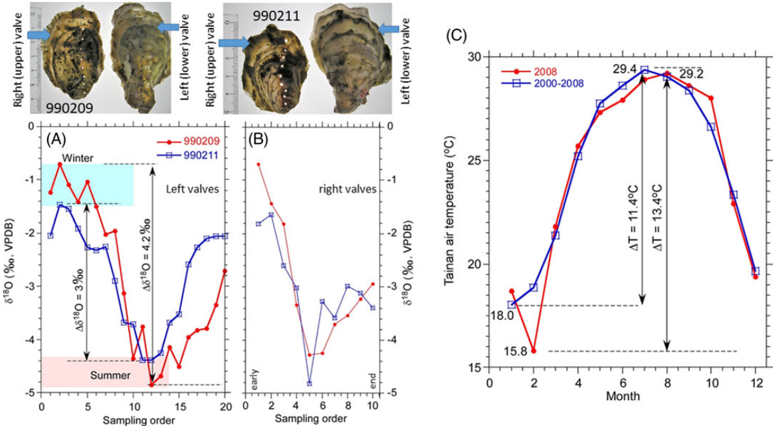
- Modern cultured oyster shells showed Δδ18O of 3–4‰, corresponding to 13–17°C seasonal change and matching Tainan’s 2008 air temperature change of 13.4°C, supporting equilibrium oxygen isotope fractionation.
Methods
- Sample material: a 42-cm-long *C. gigas* left valve from an oyster reef on the ancient eastern Taipei Basin shore, elevation -5 m a.s.l.; a grass sample inside the shell; a *Placuna placenta* shell 5 m above; two modern oyster shells from a Tainan culture pool; and two drill-core shells (BJ 18.1 and BJ 22.2).
- Dating: seven AMS 14C dates on the shell at the NTUAMS Lab using a 1.0 MV Tandetron, calibrated with Marine20 and IntCal20; LSC 14C dates from NTU; ΔR from six nearest points ranged from -105±41 to -23±42 years, weighted average -66±30 years.
- Isotopes and mineralogy: 79 subsamples were drilled from a 5.5-cm section, with 69 yielding δ18O and δ13C by isotope ratio mass spectrometry; XRD showed all samples were calcite. Sea-level and winter-temperature estimates used Eq. 4, assumed δ18Ow of -1.7‰ to -1.2‰ SMOW, and a 0.1 mm/yr subsidence rate.
Limitations
- Stated: sample limitations meant only 69 of 79 isotope subsamples yielded results; no AMS date was obtained on the grass sample; the 347-yr AMS age range exceeds the known <20-yr lifespan of *C. gigas* and is attributed to laboratory dating uncertainty and/or natural marine reservoir variation; no marine shells in the study section support the 5000–7000 cal BP highstand scenario.
- Stated: winter temperature estimates depend on the assumed δ18Ow range and salinity influence, and the large four-year winter temperature shift may be due to salinity; sea-level estimates assume a 0.1 mm/yr subsidence rate and 1–3 m water depth.
- Evident: conclusions about regional sea level and oyster disappearance rely on a single shell/site plus nearby cores, giving limited spatial and temporal coverage; calibration also depends on ΔR from six nearest points and on LSC/AMS inter-laboratory offsets.
Model-written summary. Check it against the paper before relying on it.
Integrity signals
Registry
Cites
Statistics
Figures
Verification
Claims the paper makes
0 Valid · 2 Not valid · 38 Not checked · 103 Own results and interpretations
A result the paper reports from its own data — it cites no other source for it, so there is none to check. The quote shows it is in the paper.
In the paper
“The ΔT between the winter and summer of Tainan in 2008 is 13.4 o C.”
§ AMS 14 C DATING AND STABLE ISOTOPE ANALYSIS ON AN 8-KYR OYSTER SHELL FROM TAIPEI BASIN: SEA LEVEL AND SST CHANGES > 4.1 Chronology
plain- Asserted: passes — The authors put it forward as true.
- Checkable: passes — It can be checked against evidence.
- Load-bearing: passes — The paper’s conclusions depend on it.
- Based: passes — The paper gives a reason why it holds.
A result the paper states — it cites no source for it, so there is none to check. The quote shows it is in the paper.
In the paper
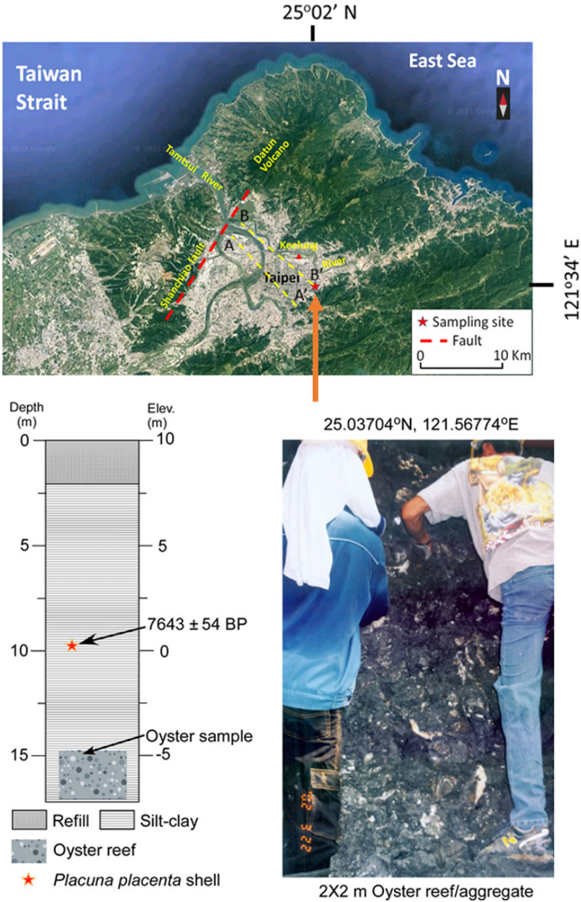
“A P. placenta shell was taken from 9.5 m deep below the ground surface and the latter has an elevation of 10 m a.s.l., which means that the P. placenta shell sample (TPS-9.5 in Table 1 and red star in the lower left panel of Figure 1) has an elevation of 0.5 m a.s.l. at the sampling time.”
§ AMS 14 C DATING AND STABLE ISOTOPE ANALYSIS ON AN 8-KYR OYSTER SHELL FROM TAIPEI BASIN: SEA LEVEL AND SST CHANGES > 2. BACKGROUND AND SAMPLE INFORMATION
plainSingle case- Asserted: passes — The authors put it forward as true.
- Checkable: passes — It can be checked against evidence.
- Load-bearing: passes — The paper’s conclusions depend on it.
- Based: passes — The paper gives a reason why it holds.
A result the paper reports from its own data — it cites no other source for it, so there is none to check. The quote shows it is in the paper.
In the paper
“The results show that the carbonate mineral in all samples is calcite.”
§ AMS 14 C DATING AND STABLE ISOTOPE ANALYSIS ON AN 8-KYR OYSTER SHELL FROM TAIPEI BASIN: SEA LEVEL AND SST CHANGES > 3.3 XRD Analysis
plain- Asserted: passes — The authors put it forward as true.
- Checkable: passes — It can be checked against evidence.
- Load-bearing: passes — The paper’s conclusions depend on it.
- Based: passes — The paper gives a reason why it holds.
A result the paper reports from its own data — it cites no other source for it, so there is none to check. The quote shows it is in the paper.
In the paper
“The comparison indicates that the calibrated 14 C ages of both LSC dated grass and oyster shell agree very well.”
§ AMS 14 C DATING AND STABLE ISOTOPE ANALYSIS ON AN 8-KYR OYSTER SHELL FROM TAIPEI BASIN: SEA LEVEL AND SST CHANGES > 4.1 Chronology
hedged- Asserted: passes — The authors put it forward as true.
- Checkable: passes — It can be checked against evidence.
- Load-bearing: passes — The paper’s conclusions depend on it.
- Based: passes — The paper gives a reason why it holds.
A result the paper reports from its own data — it cites no other source for it, so there is none to check. The quote shows it is in the paper.
In the paper
“The 347-yr age range of the AMS ages does not show any trends (Figure 2).”
§ AMS 14 C DATING AND STABLE ISOTOPE ANALYSIS ON AN 8-KYR OYSTER SHELL FROM TAIPEI BASIN: SEA LEVEL AND SST CHANGES > 4.1 Chronology
plain- Asserted: passes — The authors put it forward as true.
- Checkable: passes — It can be checked against evidence.
- Load-bearing: unclear — It is unclear whether the paper’s conclusions depend on it.
- Based: passes — The paper gives a reason why it holds.
69 more claims
Create a free account to see all 143 claims and to verify the 35 references still open.
- It may state two separate claims as one. 53
- Probably not a substantial claim. 30
Self-check
Percentages, sums and reported differences re-computed from the paper’s own numbers.
Each contradiction between two passages listed here was confirmed by an independent check.
Rated minor: it would not touch a result — a value no result rests on, a p-value that stays on the same side of the significance level, or a conflict that is clerical, resolved elsewhere in the paper, or outside its own findings.
In the paper
§ AMS 14 C DATING AND STABLE ISOTOPE ANALYSIS ON AN 8-KYR OYSTER SHELL FROM TAIPEI BASIN: SEA LEVEL AND SST CHANGES > 4.1 Chronology
“the grass age is close to the old AMS ages (e.g., TPS-3 to TPS-5 in Table 1) within uncertainties but younger than the weighted average age of the AMS dates.”
§ AMS 14 C DATING AND STABLE ISOTOPE ANALYSIS ON AN 8-KYR OYSTER SHELL FROM TAIPEI BASIN: SEA LEVEL AND SST CHANGES > 4.1 Chronology
“Thus, we have three key numbers in comparison: 8090±90 cal BP of the grass sample; 7925±175 cal BP of the LSC dated oyster shell (right valve); and the weighted average (7660±93 cal BP) of the 7 AMS ages from the left valve samples.”
Rated minor: it would not touch a result — a value no result rests on, a p-value that stays on the same side of the significance level, or a conflict that is clerical, resolved elsewhere in the paper, or outside its own findings.
In the paper
§ AMS 14 C DATING AND STABLE ISOTOPE ANALYSIS ON AN 8-KYR OYSTER SHELL FROM TAIPEI BASIN: SEA LEVEL AND SST CHANGES > 4.1 Chronology
“The calibrated ages are from 7490±240 to 7805±230 cal BP (2σ), resulting in a weighted age of 7660±96 cal BP (n = 7) (Table 1).”
§ AMS 14 C DATING AND STABLE ISOTOPE ANALYSIS ON AN 8-KYR OYSTER SHELL FROM TAIPEI BASIN: SEA LEVEL AND SST CHANGES > 4.1 Chronology
“the weighted average (7660±93 cal BP) of the 7 AMS ages from the left valve samples.”
Rated minor: it would not touch a result — a value no result rests on, a p-value that stays on the same side of the significance level, or a conflict that is clerical, resolved elsewhere in the paper, or outside its own findings.
In the paper
§ AMS 14 C DATING AND STABLE ISOTOPE ANALYSIS ON AN 8-KYR OYSTER SHELL FROM TAIPEI BASIN: SEA LEVEL AND SST CHANGES > 2. BACKGROUND AND SAMPLE INFORMATION
“This shell was dated by 14 C dating using beta counting method in the Liquid Scintillation Counting (LSC) Lab at National Taiwan University (NTU), yielding a 14 C age of 7643±54 BP (NTU-3856 in Table 1).”
§ AMS 14 C DATING AND STABLE ISOTOPE ANALYSIS ON AN 8-KYR OYSTER SHELL FROM TAIPEI BASIN: SEA LEVEL AND SST CHANGES > 2. BACKGROUND AND SAMPLE INFORMATION
“NTU-3856 shell TPS-9.5m38.62±0.267543±54 7577±62 7845±175”
Citations
Cites
Data Reduction and Error Analysis for the Physical Sciences
Bevington, P. R., Robinson, D. K., Blair, J. M., Mallinckrodt, A. J., & McKay, S. (1993) · Computers in Physics · doi:10.1063/1.4823194 · Cited by 14,824
The IntCal20 Northern Hemisphere Radiocarbon Age Calibration Curve (0–55 cal kBP)
Reimer, P. J., Austin, W. E. N., Bard, E., Bayliss, A., Blackwell, P. G., Bronk Ramsey, C., Butzin, M., Cheng, H., Edwards, R. L., Friedrich, M., et al. (2020) · Radiocarbon · doi:10.1017/rdc.2020.41 · Cited by 7,900
Compilation of stable isotope fractionation factors of geochemical interest
Friedman, I., & O'Neil, J. R. (1977) · Professional Paper · doi:10.3133/pp440kk · Cited by 2,691 · cited 3×
“The oxygen isotope equilibrium can be described by the following equation (Friedman and O ’ Neil 1977): In the meantime, the δ 13 C profiles are positively correlated with the δ 18 O profiles, which means that the shell carbonate is in isotopic equilibrium fraction with its parent water.”
Marine20—The Marine Radiocarbon Age Calibration Curve (0–55,000 cal BP)
Heaton, T. J., Köhler, P., Butzin, M., Bard, E., Reimer, R. W., Austin, W. E. N., Bronk Ramsey, C., Grootes, P. M., Hughen, K. A., Kromer, B., et al. (2020) · Radiocarbon · doi:10.1017/rdc.2020.68 · Cited by 2,161
Holocene development of the Yellow River's subaqueous delta, North Yellow Sea
Liu, J. P., Milliman, J. D., Gao, S., & Cheng, P. (2004) · Marine Geology · doi:10.1016/j.margeo.2004.06.009 · Cited by 636
Xu, X., Trumbore, S. E., Zheng, S., Southon, J. R., McDuffee, K. E., Luttgen, M., & Liu, J. C. (2007) · Nuclear Instruments and Methods in Physics Research Section B: Beam Interactions with Materials and Atoms · doi:10.1016/j.nimb.2007.01.175 · Cited by 428
Mid-Holocene sea-level highstand along the Southeast Coast of China
Zong, Y. (2004) · Quaternary International · doi:10.1016/s1040-6182(03)00116-2 · Cited by 312
Mann, R. (1979) · Journal of the Marine Biological Association of the United Kingdom · doi:10.1017/s0025315400046208 · Cited by 291
The early Holocene sea level rise
Smith, D. E., Harrison, S., Firth, C. R., & Jordan, J. T. (2011) · Quaternary Science Reviews · doi:10.1016/j.quascirev.2011.04.019 · Cited by 263
Radiocarbon marine reservoir ages in the western Pacific estimated by pre-bomb molluscan shells
Yoneda, M., Uno, H., Shibata, Y., Suzuki, R., Kumamoto, Y., Yoshida, K., Sasaki, T., Suzuki, A., & Kawahata, H. (2007) · Nuclear Instruments and Methods in Physics Research Section B: Beam Interactions with Materials and Atoms · doi:10.1016/j.nimb.2007.01.184 · Cited by 227
Bird, M. I., Fifield, L. K., Teh, T. S., Chang, C. H., Shirlaw, N., & Lambeck, K. (2007) · Estuarine, Coastal and Shelf Science · doi:10.1016/j.ecss.2006.07.004 · Cited by 201
The Worldwide Marine Radiocarbon Reservoir Effect: Definitions, Mechanisms, and Prospects
Alves, E. Q., Macario, K., Ascough, P., & Bronk Ramsey, C. (2018) · Reviews of Geophysics · doi:10.1002/2017rg000588 · Cited by 190
Punctuated eustatic sea-level rise in the early mid-Holocene
Bird, M. I., Austin, W. E. N., Wurster, C. M., Fifield, L. K., Mojtahid, M., & Sargeant, C. (2010) · Geology · doi:10.1130/g31066.1 · Cited by 181
Paleotemperatures and chlorinities from stable carbon and oxygen isotopes in shell carbonate
Mook, W. G. (1971) · Palaeogeography, Palaeoclimatology, Palaeoecology · doi:10.1016/0031-0182(71)90002-2 · Cited by 177
Chapter Eighteen The Use of Oxygen and Carbon Isotopes of Foraminifera in Paleoceanography
Ravelo, A. C., & Hillaire-Marcel, C. (2007) · Developments in Marine Geology · doi:10.1016/s1572-5480(07)01023-8 · Cited by 170
Evidence for a rapid sea-level rise 7600 yr ago
Yu, S.-Y., Berglund, B. E., Sandgren, P., & Lambeck, K. (2007) · Geology · doi:10.1130/g23859a.1 · Cited by 116
Synchronizing a sea-level jump, final Lake Agassiz drainage, and abrupt cooling 8200years ago
Li, Y. X., Törnqvist, T. E., Nevitt, J. M., & Kohl, B. (2011) · Earth and Planetary Science Letters · doi:10.1016/j.epsl.2011.05.034 · Cited by 101
Morphodynamic modelling for a tidal inlet in the Wadden Sea
Wang, Z. B., Louters, T., & de Vriend, H. J. (1995) · Marine Geology · doi:10.1016/0025-3227(95)00083-b · Cited by 89
Origin and geological evolution of the Taipei Basin, northern Taiwan
Teng, L. S. (2001) · Cited by 86
Sea level rise and submarine mass failures on open continental margins
Smith, D. E., Harrison, S., & Jordan, J. (2013) · Quaternary Science Reviews · doi:10.1016/j.quascirev.2013.10.012 · Cited by 85
Natural spat collecting in the pacific oyster crassostrea gigas(thunberg)
Arakawa, K. Y. (1990) · Marine Behaviour and Physiology · doi:10.1080/10236249009378760 · Cited by 55
Li, H., Xu, X.-M., Ku, T.-L., You, C., Buchheim, H. P., & Peters, R. (2007) · Palaeogeography Palaeoclimatology Palaeoecology · doi:10.1016/j.palaeo.2007.10.006 · Cited by 37
Self-citationZhao, M., Li, H.-C., Liu, Z.-H., Mii, H.-S., Sun, H.-L., Shen, C.-C., & Kang, S.-C. (2015) · Journal of Asian Earth Sciences · doi:10.1016/j.jseaes.2015.07.021 · Cited by 35
Self-citationPre-Bomb Marine Reservoir Variability in the Kimberley Region, Western Australia
O'Connor, S., Ulm, S., Fallon, S. J., Barham, A., & Loch, I. (2010) · Radiocarbon · doi:10.1017/s0033822200046233 · Cited by 35
Tanabe, S. (2020) · Quaternary Science Reviews · doi:10.1016/j.quascirev.2020.106575 · Cited by 31
Dämmer, L. K., de Nooijer, L., van Sebille, E., Haak, J. G., & Reichart, G. (2020) · Climate of the past · doi:10.5194/cp-16-2401-2020 · Cited by 30
Dating marine shell: A guide for the wary North American archaeologist
Hadden, C. S., Hutchinson, I., & Martindale, A. (2023) · American Antiquity · doi:10.1017/aaq.2022.82 · Cited by 29
Li, H., BISCHOFF, J., Ku, T. L., & Zhu, Z. (2003) · Quaternary Science Reviews · doi:10.1016/s0277-3791(03)00215-4 · Cited by 25
Self-citationHolocene East Asian Summer Monsoon Rainfall Variability in Taiwan
Ding, X., Zheng, L., Zheng, X., & Kao, S.-J. (2020) · Frontiers in Earth Science · doi:10.3389/feart.2020.00234 · Cited by 25
Chen, W.-S., Yang, C.-Y., Chen, S.-T., & Huang, Y.-C. (2020) · Quaternary Science Reviews · doi:10.1016/j.quascirev.2020.106369 · Cited by 22
Self-citationLi, H., Chang, Y., Berelson, W. M., Zhao, M., Misra, S., & Shen, T.-T. (2022) · Frontiers in Marine Science · doi:10.3389/fmars.2022.823793 · Cited by 16
Self-citationYang, R. J., Wang, S., Burr, G. S., Liu, J. T., & Fan, D. (2018) · Quaternary International · doi:10.1016/j.quaint.2018.07.001 · Cited by 6
Alien species alert: Crassostrea gigas (Pacific oyster)
ICES (2009) · ICES · doi:10.17895/ices.pub.5417
(1997) · Journal of Shellfish Research
(2004) · Americanae (AECID Library)
(2000) · AH-Scopus to ORCID
Dämmer, L. K., de Nooijer, L., van Sebille, E., Haak, J., & Reichart, G.-J. (2020) · doi:10.5194/cp-2020-26
Research works printed but not linked: 5
- Teng LS, Lee CT, Liew PM, Sheng-Rong Song, Shuh- Jong Tsao, Huan-Chi Liu, Chih-Hsiung Peng, 2004. On the Taipei Dammed Lake. Journal of Geographical Science 36:77-100.
- Chen W-S, Lin C-C, Yang C-C, Fei L-Y, Shea K-S, Kung H-M, Lin P-Y, Yang H-C. 2008. The temporal and spatial evolution of sedimentary sequence framework and tectonics of the Taipei Basin since the Late-Pleistocene. Bulletin of the Central Geological Survey 21:61-106. In Chinese with English abstract.
- Heaton TJ, Köhler P, Butzin M, Bard E, Reimer RW, Austin WEN, Bronk Ramsey C, Grootes PM, 916 H-C Li et al. https://doi.org/10.1017/RDC.2023.117 Published online by Cambridge University Press
- Su PJ, Chi TC, Su TW, Teng LS. 2018. Facies characteristics and depositional history of the Sungshan Formation, Taipei Basin. Western Pacific Earth Sciences 15-18:19-52.
- H-C Li et al. https://doi.org/10.1017/RDC.2023.117 Published online by Cambridge University Press
Cited by
Still being checked.
Metadata
- Authors
- Li, H.-C., Mii, H.-S., Liu, T.-K., Chen, W.-S., Kang, S.-C., Chou, C.-Y., Misra, S., Shen, T.-T., & Zhao, M.
- Affiliations
- National Taiwan University (TW)
- National Taiwan Normal University (TW)
- Ocean University of China (CN)
- Corresponding author
- Li, Hong-Chun
- Venue
- Radiocarbon
- Publisher
- Cambridge University Press (CUP)
- Published
- 2024-01-17
- Volume
- 66
- Issue
- 5
- Pages
- 904-918
- ISSN
- 0033-8222 (ISSN-L)
- 1945-5755
- OpenAlex
- W4390950767
- Cited by
- 0
- References
- 37
- FWCI
- 0.00
- Type
- journal article
- Language
- en
- Open access
- hybrid
- doi.org
- Locations
- Radiocarbon (publishedVersion, cc-by)
- Funders
- National Science and Technology Council (NSTC 111-2116-M-002-020, MOST 109-)
- Ministry of Science and Technology, Taiwan
- National Taiwan University
- Topics
- Physical Sciences › Earth and Planetary Sciences › Atmospheric Science › Geology and Paleoclimatology Research
- Social Sciences › Archeology › Archaeology and ancient environmental studies
- Physical Sciences › Earth and Planetary Sciences › Oceanography › Marine and environmental studies
- Keywords
- Crassostrea gigas, oyster shell, sea-level change, marine transgression, sea surface temperature, stable isotopes, oxygen isotopes, carbon isotopes, seasonal growth cycle, Taipei Basin, Holocene, paleoclimate
About these checks
Registry, retraction, Cites and statistics results are computed, not judged, with one exception: a printed reference that no index lists is read once by a model before it counts as a citation error. Claims are extracted by a model and kept only when their quote appears verbatim in the text; each cited source is then checked, with a model’s help, for whether it says what the claim relies on. Those verdicts can be wrong — read the claim’s quote and the cited source before relying on one.
A language model drew the claims from the paper on 2026-11-24, under version 3 of the claim definition (model deepseek-v4.1-flash, prompt extract-v3).
A second model labelled each claim on 2026-11-24 (model jev-1.13-20260917, definition revision gold-guideline-v0.2).
Statistics and arithmetic are recomputed, not judged.
Confidence bands are shown only for fields calibrated on our annotated test set. None is calibrated yet, so no band is shown.
What counts as a claim ›How we measure confidence ›How we check this ›
Are you an author, or do you see a problem with this page? Request a review
Data sources
Bibliographic data: Semantic Scholar, OpenAlex, Crossref.
Contains information from the Semantic Scholar Academic Graph Datasets, made available under the ODC Attribution License (ODC-BY 1.0).
Semantic Scholar’s data is described in: Kinney, R., et al. (2023). The Semantic Scholar Open Data Platform. arXiv:2301.10140.
