

Early seventh-millennium AMS dates from domestic seeds in the Initial Neolithic at Franchthi Cave (Argolid, Greece)
Open accessThe DOI matches its Crossref record; 43 of the 45 references it cites were found in a registry or an index, and 2 are not checked yet; none of the 24 sources its claims cite is checked for support yet.
Abstract
When, and by what route, did farming first reach Europe? A terrestrial model might envisage a gradual advance around the northern fringes of the Aegean, reaching Thrace and Macedonia before continuing southwards to Thessaly and the Peloponnese. New dates from Franchthi Cave in southern Greece, reported here, cast doubt on such a model, indicating that cereal cultivation, involving newly introduced crop species, began during the first half of the seventh millennium BC. This is earlier than in northern Greece and several centuries earlier than in Bulgaria, and suggests that farming spread to south-eastern Europe by a number of different routes, including potentially a maritime, island-hopping connection across the Aegean Sea. The results also illustrate the continuing importance of key sites such as Franchthi to our understanding of the European Neolithic transition, and the additional insights that can emerge from the application of new dating projects to these sites.
Checked 2026-11-24 · 2 references not checked yet
Overview
CoChat Summary
TL;DR
New AMS dates on carbonized *Triticum dicoccum* seeds from the Initial Neolithic at Franchthi Cave show cereal agriculture in southern Greece during the first half of the 7th millennium BC, before 6500 BC. The seed dates are about 200 years younger than charcoal dates from the same context, and a Bayesian model supports a short Final Mesolithic–Initial Neolithic gap and multiple origins for the European Neolithic.
Key findings
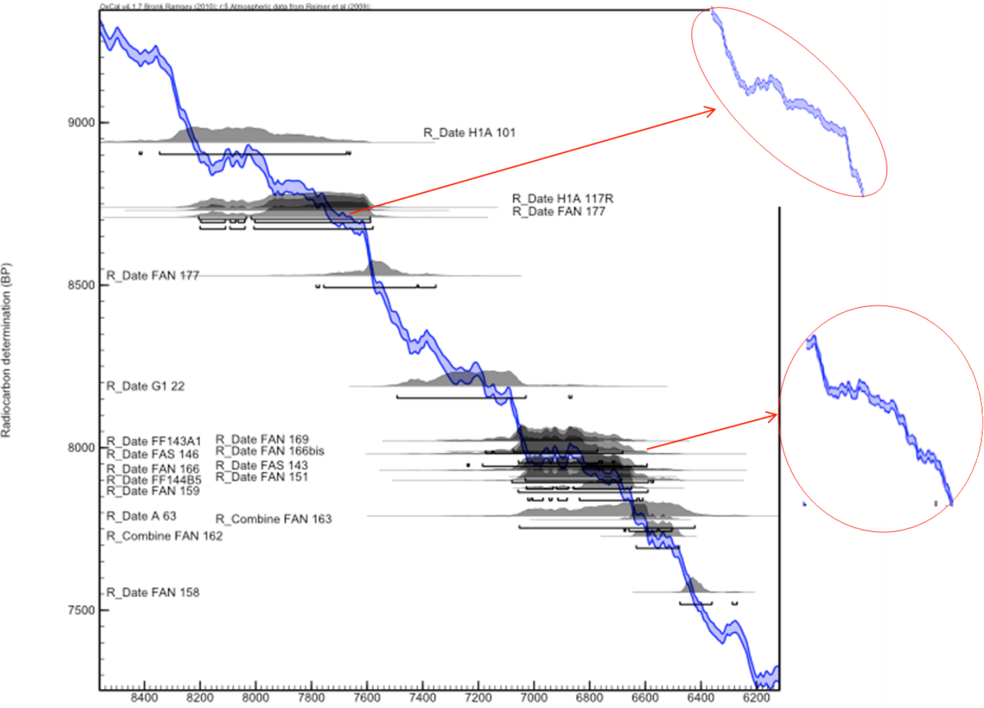
- AMS dates on *Triticum dicoccum* seeds from Initial Neolithic units FAN 163 and FAN 162 yielded 7805±40, 7740±50, 7780±40 and 7645±50 BP, calibrated to c. 6746–6429 cal BC (2σ), indicating cereal agriculture in southern Greece in the first half of the 7th millennium and occupation by farmers before 6500 BC.
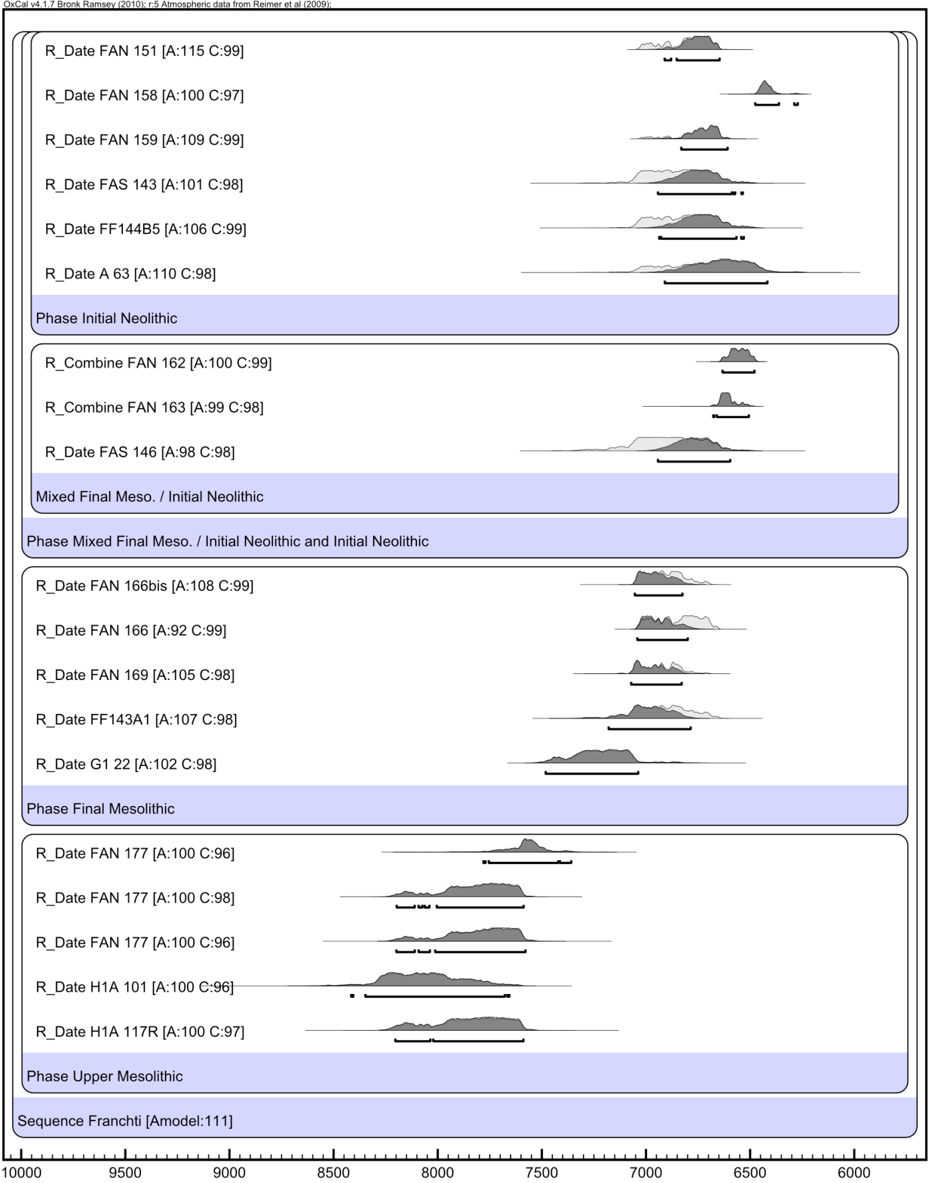
- A Bayesian model including all Upper Mesolithic, Final Mesolithic and Initial Neolithic dates was accepted (Amodel=111; without the suspiciously young FAN 158, Amodel=112), confirming diachronic differences among phases; the Final Mesolithic–Initial Neolithic gap is short, with charcoal dates suggesting around 100 years and seed dates around 200 years.
- Seed dates are about 200 years younger than charcoal dates from the same lithostratigraphic context, a difference usually attributed to the “old wood” effect; charcoal Initial Neolithic dates are very close to Final Mesolithic ones, suggesting possible Final Mesolithic contamination.
- The earliest Franchthi dates are slightly older than currently available dates from Western Anatolian sites such as Yeşilova, Ege Gübre, Ulucak, Araplı, Hoca Cesme and Uğurlu, which do not go beyond c.6500 BC, supporting a model of multiple origins rather than a direct western Anatolian origin for the southern Greek Neolithic.
Methods
- New AMS radiocarbon determinations were made on charcoal and carbonized seeds from Final Mesolithic and Initial Neolithic contexts at Franchthi Cave/Paralia; samples were pre-cleaned with ABA, oxidized to CO₂, reduced to graphite, and measured on the Artemis AMS facility (CEA, Saclay).
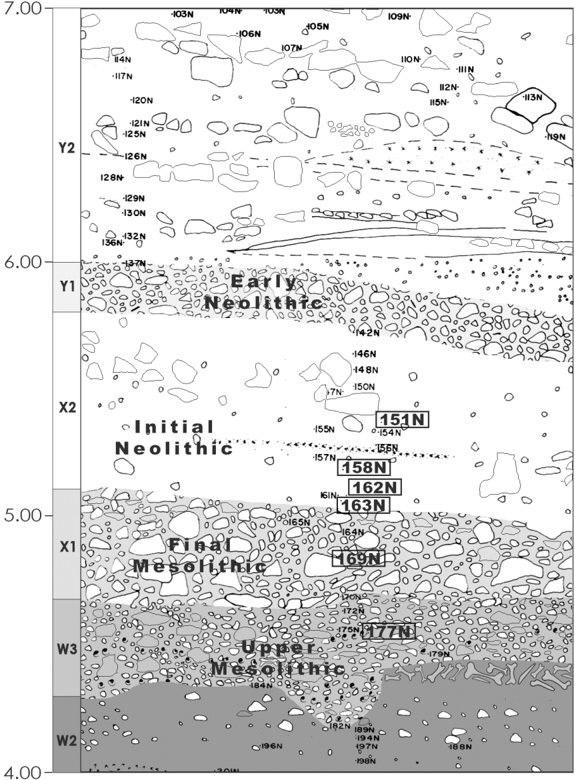
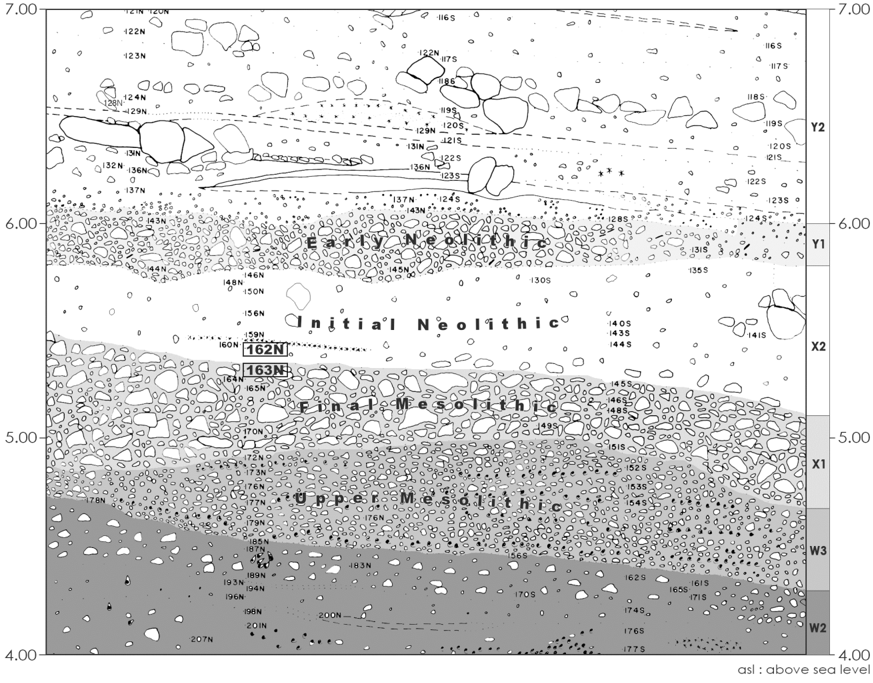
- Dated samples include three Final Mesolithic charcoal samples (FAN 169, FAN 166, FAN 166bis), three Initial Neolithic charcoal samples (FAN 159, FAN 158, FAN 151), and *T. dicoccum* seeds from units FAN 163 and FAN 162 (four seed measurements reported).
- A Bayesian chronological model was built in OxCal 4.1.7 with the IntCal09 calibration curve, nesting Upper Mesolithic, Final Mesolithic and Initial Neolithic samples in three phases within a stratigraphic sequence; an outlier test was performed.
Limitations
- The paper states that few and unsatisfactory Early Neolithic dates are available, so whether the Early Neolithic follows more or less directly at Franchthi cannot be stated; another dating program is needed, focusing on the thick Early Neolithic deposits from the Paralia rather than the shallow and largely disturbed cave deposits.
- The new dates do not solve the status, “aceramic” or “ceramic”, of the Initial Neolithic; the few sherds in the “gray clay” stratum could be intrusive or evidence for very scarce use of pots.
- The text notes a calibration plateau around 8000–7800 ¹⁴C BP, so even AMS dates with standard deviations of c. ±40 or 50 years correspond to several-hundred-year intervals after calibration (between c.7000 and 6500 cal BC at 2σ). Also evident from the text: domestic seeds are not abundant, only units with about 10 seeds of wheat could be sampled, the best potential sample (FAS 145) could not be located, and lithics from dated units show some mixing of Final Mesolithic and Initial Neolithic; charcoal dates may be contaminated by Final Mesolithic, and FAN 158 was excluded from the model as suspiciously young.
Model-written summary. Check it against the paper before relying on it.
Integrity signals
Registry
Cites
Statistics
Figures
Verification
Claims the paper makes
0 Valid · 1 Not valid · 15 Not checked · 20 Own results and interpretations
A result the paper reports from its own data — it cites no other source for it, so there is none to check. The quote shows it is in the paper.
In the paper
“Our results demonstrate that Franchthi was occupied by farmers before 6500 BC”
§ Early 7th millennium AMS dates from domestic seeds in the Initial Neolithic at Franchthi Cave (Argolid, Greece) By > Conclusion
boosted- Asserted: passes — The authors put it forward as true.
- Checkable: passes — It can be checked against evidence.
- Load-bearing: passes — The paper’s conclusions depend on it.
- Based: passes — The paper gives a reason why it holds.
- Rests on an assumption not shown here.
A result the paper reports from its own data — it cites no other source for it, so there is none to check. The quote shows it is in the paper.
In the paper
“The dates obtained on the carbonized seeds indicate without any possible doubt that cereal agriculture was practiced in southern Greece during the first half of the 7 th millennium.”
§ Early 7th millennium AMS dates from domestic seeds in the Initial Neolithic at Franchthi Cave (Argolid, Greece) By > Discussion
boostedstates a cause- Asserted: passes — The authors put it forward as true.
- Checkable: passes — It can be checked against evidence.
- Load-bearing: passes — The paper’s conclusions depend on it.
- Based: passes — The paper gives a reason why it holds.
- Rests on an assumption not shown here.
A result the paper reports from its own data — it cites no other source for it, so there is none to check. The quote shows it is in the paper.
In the paper
“However, all the archaeobotanical, archaeozoological and archaeological data concur to show that the correlations he then established with other trenches are misleading.”
§ Early 7th millennium AMS dates from domestic seeds in the Initial Neolithic at Franchthi Cave (Argolid, Greece) By > The context
boosted- Asserted: passes — The authors put it forward as true.
- Checkable: passes — It can be checked against evidence.
- Load-bearing: passes — The paper’s conclusions depend on it.
- Based: passes — The paper gives a reason why it holds.
In the paper
“A third sample, from trench A, comes from a unit (A 63) with suspected Middle Neolithic contaminations (Vitelli 1993: 37).”
§ Early 7th millennium AMS dates from domestic seeds in the Initial Neolithic at Franchthi Cave (Argolid, Greece) By > The context
What the sources say
- Not matchedcites Vitelli 1993
An author–year citation the paper’s reference list doesn’t settle. We don’t search these by name.
plainstates an associationSingle case- Asserted: passes — The authors put it forward as true.
- Checkable: passes — It can be checked against evidence.
- Load-bearing: passes — The paper’s conclusions depend on it.
- Based: passes — The paper gives a reason why it holds.
- Not matched
A result the paper reports from its own data — it cites no other source for it, so there is none to check. The quote shows it is in the paper.
In the paper
“Examination of the sections show that FAS 146 may have cross--cut the underlying rocky deposit.”
§ Early 7th millennium AMS dates from domestic seeds in the Initial Neolithic at Franchthi Cave (Argolid, Greece) By > The context
hedgedstates a possible cause- Asserted: passes — The authors put it forward as true.
- Checkable: passes — It can be checked against evidence.
- Load-bearing: passes — The paper’s conclusions depend on it.
- Based: passes — The paper gives a reason why it holds.
17 more claims
Create a free account to see all 36 claims and to verify the 2 references still open.
- It may state two separate claims as one. 12
- Probably not a substantial claim. 3
- The quote only partly states this claim. 1
Self-check
Percentages, sums and reported differences re-computed from the paper’s own numbers.
Each contradiction between two passages listed here was confirmed by an independent check.
Rated minor: it would not touch a result — a value no result rests on, a p-value that stays on the same side of the significance level, or a conflict that is clerical, resolved elsewhere in the paper, or outside its own findings.
In the paper
§ Early 7th millennium AMS dates from domestic seeds in the Initial Neolithic at Franchthi Cave (Argolid, Greece) By > Additional information
“FAN 158 GifA 80044 Charcoal 7555±40 6453-6403”
§ Early 7th millennium AMS dates from domestic seeds in the Initial Neolithic at Franchthi Cave (Argolid, Greece) By > Additional information
“6476-7271 Age too recent.One small sherd.”
Citations
Cites
IntCal13 and Marine13 radiocarbon age calibration curves 0–50,000 years cal BP
Reimer, P. J., Bard, E., Bayliss, A., Beck, J. W., Blackwell, P. G., Ramsey, C. B., Buck, C. E., Cheng, H., Edwards, R. L., Friedrich, M., et al. (2013) · Radiocarbon · doi:10.2458/azu_js_rc.55.16947 · Cited by 14,591
Bayesian Analysis of Radiocarbon Dates
Bronk Ramsey, C. (2009) · Radiocarbon · doi:10.1017/s0033822200033865 · Cited by 8,725 · cited 2×
“This approach allows the stratigraphic information from the site to be integrated as a priori to the radiocarbon likelihoods in order to determine a posteriori probabilities taking into account all the available information (Bronk Ramsey 2001, 2009).”
MethodInfluentialIntCal09 and Marine09 radiocarbon age calibration curves, 0–50,000 years cal BP
Reimer, P. J., Baillie, M. G. L., Bard, E., Bayliss, A., Beck, J. W., Blackwell, P. G., Bronk Ramsey, C., Buck, C. E., Burr, G. S., Edwards, R. L., et al. (2009) · Radiocarbon · doi:10.1017/s0033822200034202 · Cited by 4,290
Development of the Radiocarbon Calibration Program
Bronk Ramsey, C. (2001) · Radiocarbon · doi:10.1017/s0033822200038212 · Cited by 2,022
Holocene climatic instability: a prominent, widespread event 8200 yr ago
Alley, R. B., Mayewski, P. A., Sowers, T., Stuiver, M., Taylor, K. C., & Clark, P. U. (1997) · Geology · doi:10.1130/0091-7613(1997)025<0483:hciapw>2.3.co;2 · Cited by 1,189
The Neolithic Transition and the Genetics of Populations in Europe
Ammerman, A. J., & Cavalli-Sforza, L. L. (1984) · Princeton University Press eBooks · doi:10.1515/9781400853113 · Cited by 969
HJORT, C. (1990) · Boreas · doi:10.1111/j.1502-3885.1990.tb00573.x · Cited by 938
The Neolithic Transition and the Genetics of Populations in Europe.
Roberts, D. F., Ammerman, A. J., & Cavalli-Sforza, L. L. (1986) · Man · doi:10.2307/2803105 · Cited by 760
Measuring the Rate of Spread of Early Farming in Europe
Ammerman, A. J., & Cavalli-Sforza, L. L. (1971) · Man · doi:10.2307/2799190 · Cited by 450
Tracing the Origin and Spread of Agriculture in Europe
Pinhasi, R., Fort, J., & Ammerman, A. J. (2005) · PLoS Biology · doi:10.1371/journal.pbio.0030410 · Cited by 416
The Early Neolithic in Greece: The First Farming Communities in Europe
Perlès, C., & Monthel, G. (2001) · Cambridge University Press eBooks · doi:10.1017/cbo9780511612855 · Cited by 396
Self-citationWeninger, B., Alram-Stern, E., Bauer, E., Clare, L., Danzeglocke, U., Jöris, O., Kubatzki, C., Rollefson, G., Todorova, H., & van Andel, T. (2006) · Quaternary Research · doi:10.1016/j.yqres.2006.06.009 · Cited by 304
Before Civilization: The Radio-Carbon Revolution and Prehistoric Europe.
Nandris, J., & Renfrew, C. (1974) · Man · doi:10.2307/2800051 · Cited by 279
Neolithic transition in Europe: the radiocarbon record revisited
Gkiasta, M., Russell, T., Shennan, S., & Steele, J. (2003) · Antiquity · doi:10.1017/s0003598x00061330 · Cited by 213
Bocquet‐Appel, J., Naji, S., Linden, M. V., & Kozłowski, J. K. (2008) · Journal of Archaeological Science · doi:10.1016/j.jas.2008.11.004 · Cited by 186
The role of waterways in the spread of the Neolithic
Davison, K., Dolukhanov, P., Sarson, G. R., & Shukurov, A. (2005) · Journal of Archaeological Science · doi:10.1016/j.jas.2005.09.017 · Cited by 174
The early Neolithic in Greece: the first farming communities in Europe
(2002) · Choice Reviews Online · doi:10.5860/choice.40-1634 · Cited by 168
(2026) · Documenta Praehistorica · doi:10.4312/dp · Cited by 88
The lowest levels at Dikili Tash, northern Greece: a missing link in the Early Neolithic of Europe
Lespez, L., Tsirtsoni, Z., Darcque, P., Koukouli-Chryssanthaki, H., Malamidou, D., Treuil, R., Davidson, R., Kourtessi-Philippakis, G., & Oberlin, C. (2013) · Antiquity · doi:10.1017/s0003598x00048602 · Cited by 81
Mesolithic to Neolithic in Greece. Continuity, discontinuity or change of course?
Kotsakis, K. (2001) · Documenta Praehistorica · doi:10.4312/dp.28.4 · Cited by 77
Radiocarbon Dating and the Spread of Farming Economy
Clark, J. (1965) · Antiquity · doi:10.1017/s0003598x00031392 · Cited by 75
14C dating with the Gif-sur-Yvette Tandetron accelerator: Status report
Arnold, M., Bard, É., Maurice, P., & Duplessy, J. C. (1987) · Nuclear Instruments and Methods in Physics Research Section B Beam Interactions with Materials and Atoms · doi:10.1016/0168-583x(87)90218-7 · Cited by 70
Reingruber, A., & Thissen, L. (2009) · Radiocarbon · doi:10.1017/s0033822200056071 · Cited by 68
Excavations at Porto Cheli and Vicinity, Preliminary Report, II: The Franchthi Cave, 1967-1968
Jacobsen, T. W. (1969) · Hesperia The Journal of the American School of Classical Studies at Athens · doi:10.2307/147672 · Cited by 63
Journal of Archaeological Method and Theory
(2013) · Journal of Archaeological Method and Theory · doi:10.1007/10816.1573-7764 · Cited by 60
Tempi of Change: When Soloists don’t play Together. Arrhythmia in ‘Continuous’ Change
Perlès, C. (2012) · Journal of Archaeological Method and Theory · doi:10.1007/s10816-012-9164-1 · Cited by 53
Self-citationThe dynamics of neolithisation in Europe : studies in honour of Andrew Sherratt
Hadjikoumis, A., Robinson, E., & Viner-Daniels, S. (2011) · Cited by 53
Zilhão, J. (2011) · Dynamics of Neolithisation in Europe · doi:10.2307/j.ctvh1dhqm.9 · Cited by 43
The Palaeoethnobotany of Franchthi Cave. By Julie M. Hansen.
McCorriston, J. (1994) · American Journal of Archaeology · doi:10.2307/506450 · Cited by 43
From the Near East to Greece : let's reverse the focus. Cultural elements that didn't transfer
Perlès, C. (2005) · HAL · Cited by 40
Self-citationMarine Molluscan Remains from Franchthi Cave. By Judith C. Shackleton.
Reese, D. S. (1990) · American Journal of Archaeology · doi:10.2307/505129 · Cited by 37
Séfériadès, M. L. (2007) · Quaternary International · doi:10.1016/j.quaint.2006.11.008 · Cited by 34
Grèce et Balkans : deux voies de pénétration distinctes du Néolithique en Europe ?
Perlès, C. (2010) · CNRS Éditions eBooks · doi:10.4000/books.editionscnrs.15704 · Cited by 34
Self-citationFranchthi Cave and Paralia: Maps, Plans, and Sections
Jacobsen, T. W., & Farrand, W. R. (1988) · Cited by 32
Marine Molluscan Remains from Franchthi Cave: Fascicle 4, Excavations at Franchthi Cave, Greece
Shackleton, J. C. (2018) · Indiana University Press eBooks · doi:10.2307/j.ctv7vctb8 · Cited by 28
Weinberg, S. S. (1970) · Cambridge University Press eBooks · doi:10.1017/chol9780521070515.014 · Cited by 27
A Short History of Archaeological Sieving at Franchthi Cave, Greece
Diamant, S. (1979) · Journal of Field Archaeology · doi:10.1179/009346979791489366 · Cited by 20
Linden, M. V. (2011) · Oxbow Books · doi:10.2307/j.ctvh1dhqm.8 · Cited by 12
Sağlamtimur, H. (2007) · Cited by 12
RADIOCARBON DATES FROM THE OXFORD AMS SYSTEM: ARCHAEOMETRY DATELIST 34
HIGHAM, T. F. G., BRONK RAMSEY, C., BROCK, F., BAKER, D., & DITCHFIELD, P. (2011) · Archaeometry · doi:10.1111/j.1475-4754.2010.00574.x · Cited by 11
Ediacarian sponge spicule clusters from southwestern Mongolia and the origins of the Cambrian fauna
(1997) · doi:10.1130/0091-7613(1997)025
Reimer, P. J. (2009) · Radiocarbon · doi:10.1017/s0033822200034196
The Marine Shell Record from Franchthi Cave
Shackleton, J. C. (n.d.) · Marine Molluscan Remains from Franchthi Cave · doi:10.2307/j.ctv7vctb8.6
Research works printed but not linked: 23
- PERLÈS, C. 2004. Les industries lithiques taillées de Franchthi (Argolide, Grèce). Tome III : Du Néolithique ancien au Néolithique final (Excavations at Franchthi Cave, fasc. 13). Bloomington--Indianapolis: Indiana University Press.
- PERLÈS, C. 1990. Les industries lithiques taillées de Franchthi (Argolide, Grèce). Tome II: Les Industries du Mésolithique et du Néolithique initial (Excavations at Franchthi Cave, fasc. 5). Bloomington--Indianapolis: Indiana University Press.
- KYPARISSI--APOSTOLIKA, N. 2006. The beginning of the Neolithic in Thessaly, in I. Gatsov & H. Schwarzberg (ed.) Aegean -Marmara -Black Sea: the present state of research on the Early Neolithic : 59--67. Langenweissbach : Beier and Beran. LESPEZ, L., TSIRTSONI, Z., DARCQUE, P., KOUKOULI--CHRYSSANTHAKI, H., MALAMIDOU, D., TREUIL, R., DAVIDSON, R., KOURTESSI--PHILIPPAKIS, G. and OBERLIN, C. 2012. Filling the gap in northern Greece : new evidence on Early and Middle Neolithic occupation at Dikili Tash. Antiquity
- FARRAND, W. R. 2000. Depositional History of Franchthi Cave, Sediments, Stratigraphy and Chronology. With a Report on the Background of the Franchthi Project by T. W. Jacobsen (Excavations at Franchthi Cave, Greece, fasc. 12). Bloomington--Indianapolis: Indiana University Press.
- RUNNELS, C. N. 2003. The origins of the Greek Neolithic. A personal view, in A.J. Ammerman & P. Biagi (ed.) The widening harvest: looking back, looking forward: 121-- 132. Boston: Archaeological Institute of America.
- DERIN, Z., FILIZ A. & TAYFUN C. 2009. Izmir'in prehistorik Yerleşimi--Yeşilova Höyüğü 2005-- 2006 yılı Çalışmaları. Arkeoloji Dergisi 13: 1--58.
- REINGRUBER, A. & THISSEN, L. 2005. 14C database for the Aegean Catchment (Eastern Greece, Southern Balkans and Western Turkey, in Cl. Lichter (ed.) How did farming reach Europe ? Anatolian-European relations from the second half of the 7th through the first half of the 6th millennium Cal BC: 295--327 (Byzas 2). Istanbul: Deutsches archäologisches Institut Abteilung Istanbul.
- RENFREW, C. 1973. Before Civilization: The radiocarbon revolution and Prehistoric Europe. New York Knopf.
- THISSEN, L. 2000. Early Village Communities in Anatolia and the Balkans, 6500-5500 cal BC. Studies in Chronology and Culture contact. PhD thesis, Leiden University.
- Karamitrou-Mentessidi, 2013, Antiquity, 87, 336
- THEOCHARIS, D.R. 1973. Neolithic Greece, National Bank of Greece, Athens.
- ÇILINGIROGLU, A. & ÇILINGIROGLU, Ç. 2007. Ulucak, in M. Özdogan & N. Basgelen (ed.) Türkiye'de Neolitik Dönem, Yeni Kazılar, Yeni Bulgular: 361--372. Istanbul : Arkeoloji ve Sanat Tayinlari.
- PAYNE, S. 1975. Faunal change at the Franchthi Cave from 20.000 B.C. to 3.000 B.C. , in A.T. Clason (ed.) Archaeozoological Studies: 120--131. The Hague: Elsevier.
- EFSTRATIOU, N., KARETSOU, A., BANOU E., MARGOMENOU, D. 2004. The Neolithic settlement of Knossos: new light on an old picture, in G. Cadogan, E. Hatzaki & E. Vasilakis (eds), Knossos: Palace, City, State: 43--49. London, British School at Athens Studies 12.
- VITELLI, K. D. 1993. Franchthi Neolithic pottery. Vol. 1: Classification and ceramic phases 1 and 2 (Excavations at Franchthi Cave, fasc. 8). Bloomington--Indianapolis: Indiana University Press.
- WEINBERG, S.S. 1965. The Stone Age in the Aegean. Cambridge Ancient History I, Part 1: 557--672. Cambridge: Cambridge University Press.
- Binder, 2010, Transitions, ruptures et continuité durant la Preéhistoire, Actes du XXVlle Congrès préhistorique de France (Bordeaux — Les Eyzies
- RASSE, M. 2008. La diffusion du Néolithique en Europe (7000--5000 av. J.--C.) et sa représentation cartographique. M@ppemonde 90(2). Online at : (http://mappemonde.mgm.fr/num18/articles/art08205.html)
- ERDOĞU, B. 2011. A preliminary report from the 2009 and 2010 field seasons at Uğurlu on the island of Gökçeada. Anatolica XXXVII: 45--65.
- ROSE, M. 1995. Fishing at Franchthi Cave, Greece: changing environments and patterns of exploitation. Old World Archaeology Newsletter 18(3): 21--26.
- THISSEN, L. 2005. Coming to grips with the Aegean in Prehistory: an outline of the temporal framework, in Cl. Lichter (ed.) How did farming reach Europe ? Anatolian- European relations from the second half of the 7th through the first half of the 6th millennium Cal BC: 29--40 (Byzas 2). Istanbul: Deutsches archäologisches Institut Abteilung Istanbul.
- SAMPSON, A. 2005. New evidence from the early productive stages in the Aegean Basin from the 9th to the 7th millennium cal BC. , in Cl. Lichter (ed.) How did farming reach Europe ? Anatolian-European relations from the second half of the 7th through the first half of the 6th millennium Cal BC: 131--141 (Byzas 2). Istanbul: Deutsches archäologisches Institut Abteilung Istanbul.
- HANSEN, J.M. 1991. The Palaeoethnobotany of Franchthi Cave (Excavations at Franchthi Cave, Greece, fasc. 7). Bloomington and Indianapolis : Indiana University Press.
Cited by
Early farmers from across Europe directly descended from Neolithic Aegeans
Hofmanová, Z., Kreutzer, S., Hellenthal, G., Sell, C., Diekmann, Y., Díez-del-Molino, D., van Dorp, L., López, S., Kousathanas, A., Link, V., et al. (2016) · Proceedings of the National Academy of Sciences · doi:10.1073/pnas.1523951113 · Cited by 488
Extensive Farming in Estonia Started through a Sex-Biased Migration from the Steppe
Saag, L., Varul, L., Scheib, C. L., Stenderup, J., Allentoft, M. E., Saag, L., Pagani, L., Reidla, M., Tambets, K., Metspalu, E., et al. (2017) · Current Biology · doi:10.1016/j.cub.2017.06.022 · Cited by 187
Rivollat, M., Jeong, C., Schiffels, S., Küçükkalıpçı, İ., Pemonge, M.-H., Rohrlach, A. B., Alt, K. W., Binder, D., Friederich, S., Ghesquière, E., et al. (2020) · Science Advances · doi:10.1126/sciadv.aaz5344 · Cited by 173
Dong, G., Yang, Y., Han, J., Wang, H., & Chen, F. (2017) · Science China Earth Sciences · doi:10.1007/s11430-016-9037-x · Cited by 167
Long-term trends of land use and demography in Greece: A comparative study
Weiberg, E. L., Bevan, A., Kouli, K., Katsianis, M., Woodbridge, J., Bonnier, A., Engel, M., Finné, M., Fyfe, R., Maniatis, Y., et al. (2019) · The Holocene · doi:10.1177/0959683619826641 · Cited by 122
Metadata
- Authors
- Perlès, C., Quiles, A., & Valladas, H.
- Affiliations
- Université Paris Nanterre (FR)
- Centre National de la Recherche Scientifique (FR)
- ORCID
- Valladas, Hélène
- Venue
- Antiquity
- Publisher
- Cambridge University Press (CUP)
- Published
- 2013-11-22
- Volume
- 87
- Issue
- 338
- Pages
- 1001-1015
- ISSN
- 0003-598X (ISSN-L)
- 1745-1744
- OpenAlex
- W2149120554
- Cited by
- 79
- References
- 42
- Citations by year
- 2026: 3 · 2025: 3 · 2024: 3 · 2023: 6 · 2022: 7 · 2021: 5 · 2020: 10 · 2019: 7 · 2018: 5 · 2017: 14 · 2016: 8 · 2015: 4 · 2014: 4
- FWCI
- 7.78
- Type
- journal article
- Language
- en
- Open access
- green
- shs.hal.science
- Licence
- Locations
- Antiquity (publishedVersion)
- HAL (submittedVersion, cc-by-nc)
- HAL (submittedVersion, other-oa)
- Funders
- Agence Nationale de la Recherche
- Centre National de la Recherche Scientifique
- Topics
- Social Sciences › Archeology › Archaeology and ancient environmental studies
- Social Sciences › Arts and Humanities › Archeology (arts and humanities) › Archaeological and Geological Studies
- Life Sciences › Agricultural and Biological Sciences › Soil Science › Soil and Environmental Studies
- Keywords
- Neolithic transition, cereal cultivation, Franchthi Cave, Argolid, Early Neolithic, crop domestication, spread of farming, Aegean Sea, radiocarbon dating
About these checks
Registry, retraction, Cites and statistics results are computed, not judged, with one exception: a printed reference that no index lists is read once by a model before it counts as a citation error. Claims are extracted by a model and kept only when their quote appears verbatim in the text; each cited source is then checked, with a model’s help, for whether it says what the claim relies on. Those verdicts can be wrong — read the claim’s quote and the cited source before relying on one.
A language model drew the claims from the paper on 2026-11-24, under version 3 of the claim definition (model deepseek-v4.1-flash, prompt extract-v3).
A second model labelled each claim on 2026-11-24 (model jev-1.13-20260917, definition revision gold-guideline-v0.2).
Statistics and arithmetic are recomputed, not judged.
Confidence bands are shown only for fields calibrated on our annotated test set. None is calibrated yet, so no band is shown.
What counts as a claim ›How we measure confidence ›How we check this ›
Are you an author, or do you see a problem with this page? Request a review
Data sources
Bibliographic data: Semantic Scholar, OpenAlex, Crossref.
Contains information from the Semantic Scholar Academic Graph Datasets, made available under the ODC Attribution License (ODC-BY 1.0).
Semantic Scholar’s data is described in: Kinney, R., et al. (2023). The Semantic Scholar Open Data Platform. arXiv:2301.10140.
