

Effect of the probiotic strain Bifidobacterium animalis subsp. lactis , BB-12 ® , on defecation frequency in healthy subjects with low defecation frequency and abdominal discomfort: a randomised, double-blind, placebo-controlled, parallel-group trial
Open accessThe DOI matches its Crossref record, with a small difference in title or year; 49 of the 57 references it cites were found in a registry or an index; 16 of the 43 sources its claims cite were checked for support.
Abstract
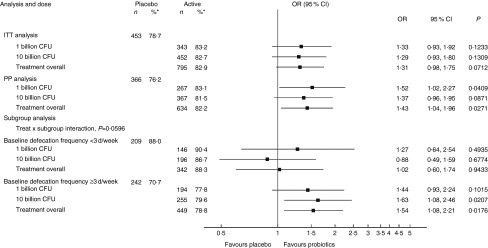
The aim of the present study was to investigate the effect of Bifidobacterium animalis subsp. lactis, BB-12®, on two primary end points - defecation frequency and gastrointestinal (GI) well-being - in healthy adults with low defecation frequency and abdominal discomfort. A total of 1248 subjects were included in a randomised, double-blind, placebo-controlled trial. After a 2-week run-in period, subjects were randomised to 1 or 10 billion colony-forming units/d of the probiotic strain BB-12® or a matching placebo capsule once daily for 4 weeks. Subjects completed a diary on bowel habits, relief of abdominal discomfort and symptoms. GI well-being, defined as global relief of abdominal discomfort, did not show significant differences. The OR for having a defecation frequency above baseline for ≥50% of the time was 1·31 (95% CI 0·98, 1·75), P=0·071, for probiotic treatment overall. Tightening the criteria for being a responder to an increase of ≥1 d/week for ≥50 % of the time resulted in an OR of 1·55 (95% CI 1·22, 1·96), P=0·0003, for treatment overall. A treatment effect on average defecation frequency was found (P=0·0065), with the frequency being significantly higher compared with placebo at all weeks for probiotic treatment overall (all P<0·05). Effects on defecation frequency were similar for the two doses tested, suggesting that a ceiling effect was reached with the one billion dose. Overall, 4 weeks' supplementation with the probiotic strain BB-12® resulted in a clinically relevant benefit on defecation frequency. The results suggest that consumption of BB-12® improves the GI health of individuals whose symptoms are not sufficiently severe to consult a doctor (ISRCTN18128385).
Overview
CoChat Summary
TL;DR
In a large randomised, double-blind, placebo-controlled trial, 4 weeks of *Bifidobacterium animalis* subsp. *lactis* BB-12® improved defecation frequency in healthy adults with low defecation frequency and abdominal discomfort, but did not significantly improve global GI well-being. The 1 and 10 billion CFU/d doses performed similarly, suggesting a ceiling effect at the lower dose.
Key findings
- For the initial defecation-frequency responder definition (above baseline for ≥50% of the time), the overall OR was 1·31 (95% CI 0·98, 1·75), P=0·071; the per-protocol analysis showed significant effects in the 1 billion group and overall (OR 1·52 and 1·43, respectively).
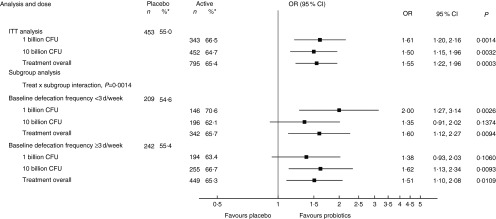
- With tightened responder criteria (increase of ≥1 d/week for ≥50% of the time), the overall OR was 1·55 (95% CI 1·22, 1·96), P=0·0003, with ORs between 1·50 and 1·61 for each dose and treatment overall.
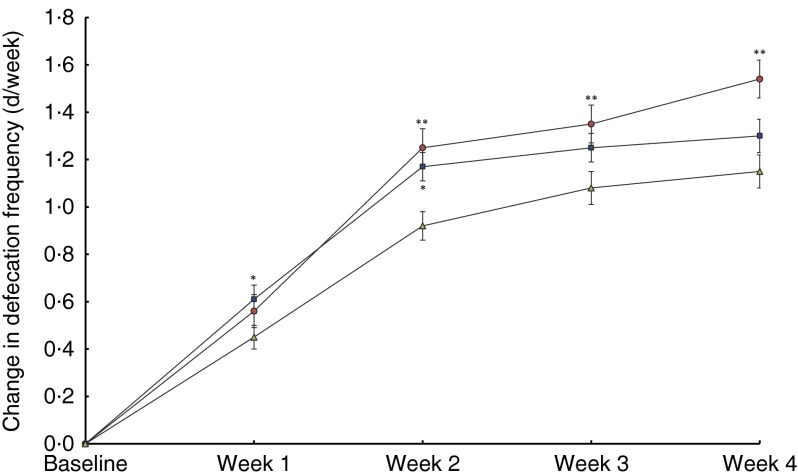
- Average defecation frequency increased in all groups, with a significant overall probiotic treatment effect (P=0·0065) and significantly higher frequency versus placebo at all weeks for probiotic treatment overall (all P<0·05); change from baseline was 1·54, 1·30 and 1·15 d/week for 1 billion, 10 billion and placebo, respectively.
- GI well-being (global relief of abdominal discomfort) showed no statistically significant differences; abdominal pain and bloating decreased in all groups without treatment differences.
Methods
- Randomised, double-blind, placebo-controlled, parallel-group trial at eight centres in France, Germany and the UK between September 2010 and December 2012, with a 2-week run-in and 4-week intervention.
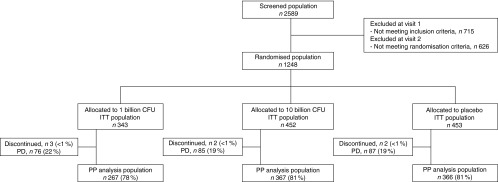
- 1248 healthy men and women aged 18–70 years with low defecation frequency (2–4 d/week) and general abdominal discomfort were randomised to 1 or 10 billion CFU/d BB-12® or matching placebo once daily; the planned sample size was 1740, but interim analyses closed the 1 billion arm after the first interim analysis and the 10 billion arm after the second.
- Primary end points were responder rates for defecation frequency and GI well-being, analysed in the intention-to-treat population using logistic regression; supportive analyses included per-protocol, GEE models for average defecation frequency, predefined subgroup analyses, and post hoc tightened responder criteria.
Limitations
- The paper states that very high placebo response rates were observed, that the initial responder definition may have been too easy to reach, and that the global assessment of GI well-being has been debated as an end point.
- The paper states that intention-to-treat analysis introduces heterogeneity by combining compliant and non-compliant subjects, that regression towards the mean may have underestimated the true probiotic effect, and that mechanisms and dose–response reasons remain unknown.
- Evident from the text: the dose arms were stopped at different interim analyses, resulting in unequal group sizes; the study population had mild symptoms not severe enough to consult a doctor, so generalisability to IBS or clinically constipated populations is uncertain.
Model-written summary. Check it against the paper before relying on it.
Integrity signals
Registry
Cites
Statistics
Figures
Verification
Claims the paper makes
11 Valid · 1 Not valid · 7 Not checked · 99 Own results and interpretations
A result the paper reports from its own data — it cites no other source for it, so there is none to check. The quote shows it is in the paper.
In the paper
“In total, 337 AE in 233 (18·7 %) subjects were recorded during the study.”
§ Effect of the probiotic strain Bifidobacterium animalis subsp. lactis, BB-12®, on defecation frequency in healthy subjects with low defecation frequency and abdominal discomfort: a randomised, double-blind, placebo-controlled, parallel-group trial > Results > Adverse events
plain- Asserted: passes — The authors put it forward as true.
- Checkable: passes — It can be checked against evidence.
- Load-bearing: passes — The paper’s conclusions depend on it.
- Based: passes — The paper gives a reason why it holds.
A result the paper reports from its own data — it cites no other source for it, so there is none to check. The quote shows it is in the paper.
In the paper
“No difference was observed between the two doses tested.”
§ Effect of the probiotic strain Bifidobacterium animalis subsp. lactis, BB-12®, on defecation frequency in healthy subjects with low defecation frequency and abdominal discomfort: a randomised, double-blind, placebo-controlled, parallel-group trial > Discussion
plain- Asserted: passes — The authors put it forward as true.
- Checkable: passes — It can be checked against evidence.
- Load-bearing: passes — The paper’s conclusions depend on it.
- Based: passes — The paper gives a reason why it holds.
A result the paper reports from its own data — it cites no other source for it, so there is none to check. The quote shows it is in the paper.
In the paper
“Tightening the criteria for being a responder to an increase of ≥1 d/week for ≥50 % of the time resulted in an OR of 1·55 (95 % CI 1·22, 1·96), P=0·0003, for treatment overall.”
- Also stated in: § Defecation frequency · plain
“Post hoc responder analysis, defining responders as subjects with an increase in defecation frequency of ≥1 d/week for at least 50 % of the time, showed a statistically significant increase in the probability of being a responder with OR between 1·50 and 1·61 for each dose and treatment overall (Fig. 3).”
§ Effect of the probiotic strain Bifidobacterium animalis subsp. lactis, BB-12®, on defecation frequency in healthy subjects with low defecation frequency and abdominal discomfort: a randomised, double-blind, placebo-controlled, parallel-group trial > Abstract
plainstates an association- Asserted: passes — The authors put it forward as true.
- Checkable: passes — It can be checked against evidence.
- Load-bearing: passes — The paper’s conclusions depend on it.
- Based: passes — The paper gives a reason why it holds.
- Also stated in: § Defecation frequency · plain
A result the paper reports from its own data — it cites no other source for it, so there is none to check. The quote shows it is in the paper.
In the paper
“For the two subgroups with different baseline defecation frequency, there was a statistically significant interaction between treatment and subgroup (P=0·0014); however, in both subgroups, rather similar and significant OR between 1·51 and 1·60 were observed for treatment overall (Fig. 3).”
§ Effect of the probiotic strain Bifidobacterium animalis subsp. lactis, BB-12®, on defecation frequency in healthy subjects with low defecation frequency and abdominal discomfort: a randomised, double-blind, placebo-controlled, parallel-group trial > Results > Defecation frequency
plainstates an association- Asserted: passes — The authors put it forward as true.
- Checkable: passes — It can be checked against evidence.
- Load-bearing: unclear — It is unclear whether the paper’s conclusions depend on it.
- Based: passes — The paper gives a reason why it holds.
A result the paper reports from its own data — it cites no other source for it, so there is none to check. The quote shows it is in the paper.
In the paper
“however, in both subgroups, rather similar and significant OR between 1·51 and 1·60 were observed for treatment overall (Fig. 3).”
§ Effect of the probiotic strain Bifidobacterium animalis subsp. lactis, BB-12®, on defecation frequency in healthy subjects with low defecation frequency and abdominal discomfort: a randomised, double-blind, placebo-controlled, parallel-group trial > Results > Defecation frequency
plainstates an association- Asserted: passes — The authors put it forward as true.
- Checkable: passes — It can be checked against evidence.
- Load-bearing: unclear — It is unclear whether the paper’s conclusions depend on it.
- Based: passes — The paper gives a reason why it holds.
42 more claims
Create a free account to see all 118 claims and to verify the 2 references still open.
- Probably not a substantial claim. 59
- It may state two separate claims as one. 34
- The quote only partly states this claim. 1
Claims other papers make about this one
Each is checked against this paper’s own text: does it say what the citing paper says it does?
In the citing paper
“daily Bifidobacterium lactis supplementation decreases WGTT and the frequency of functional GI symptoms in a dose-dependent manner in subjects suffering from irregular bowel movements and flatulence [185,211]”
From Gut microbiota role in irritable bowel syndrome: New therapeutic strategies (2016) · cites this paper as [211]
Citations
Cites
International physical activity questionnaire: 12-country reliability and validity
CRAIG, C. L., MARSHALL, A. L., SJ??STR??M, M., BAUMAN, A. E., BOOTH, M. L., AINSWORTH, B. E., PRATT, M., EKELUND, U., YNGVE, A., SALLIS, J. F., et al. (2003) · Medicine & Science in Sports & Exercise · doi:10.1249/01.mss.0000078924.61453.fb · Cited by 21,619 · cited 1×
“Before and after the intervention, subjects completed questionnaires on their physical activity level (International Physical Activity Questionnaire short form)((27)).”
BackgroundA Simple Sequentially Rejective Multiple Test Procedure
(1979) · Scandinavian Journal of Statistics · doi:10.2307/4615733 · Cited by 21,526 · cited 1×
“The main analysis for each of the two primary end points was adjusted for the α-spending during the interim analyses and for multiplicity using a closed Bonferroni–Holm procedure to ensure an overall one-sided significance level of 2·5 % for the interim looks and final analyses combined((29)).”
MethodThe functional gastrointestinal disorders and the Rome III process
Drossman, D. A. (2006) · Gastroenterology · doi:10.1053/j.gastro.2006.03.008 · Cited by 2,416
Intention-to-treat concept: A review
Gupta, S. (2011) · Perspectives in Clinical Research · doi:10.4103/2229-3485.83221 · Cited by 1,921 · cited 1×
“When the ITT and PP analyses come to essentially the same conclusions, as in the present study, confidence in the study results are generally high((34)).”
ResultRifaximin Therapy for Patients with Irritable Bowel Syndrome without Constipation
Pimentel, M., Lembo, A., Chey, W. D., Zakko, S., Ringel, Y., Yu, J., Mareya, S. M., Shaw, A. L., Bortey, E., & Forbes, W. P. (2011) · New England Journal of Medicine · doi:10.1056/nejmoa1004409 · Cited by 1,036 · cited 1×
“The sample size calculation was based on a onesided α level of 0·0125 to account for two primary end points, an assumed placebo response rate of 40 % and a treatment difference of 10 % in responder rates based on previously published studies((23,28)).”
MethodIntestinal microbiota in functional bowel disorders: a Rome foundation report
Simrén, M., Barbara, G., Flint, H. J., Spiegel, B. M. R., Spiller, R. C., Vanner, S., Verdu, E. F., Whorwell, P. J., & Zoetendal, E. G. (2013) · Gut · doi:10.1136/gutjnl-2012-302167 · Cited by 939
Self-citationThe epidemiology of irritable bowel syndrome
Card, T., Canavan, C., & West, J. (2014) · Clinical Epidemiology · doi:10.2147/clep.s40245 · Cited by 889
Whorwell, P. J., Altringer, L., Morel, J., Bond, Y., Charbonneau, D., O'Mahony, L., Kiely, B., Shanahan, F., & Quigley, E. M. M. (2006) · The American Journal of Gastroenterology · doi:10.1111/j.1572-0241.2006.00734.x · Cited by 799 · cited 1×
“Studies of probiotics for antibiotic-associated diarrhoea have shown increased effect with higher dose((41,42)), whereas a study of discomfort symptoms in IBS patients indicated a missing dose–response relationship of probiotics, as an effect was observed at a medium dose level and no effects were observed for a lower…”
BackgroundSelf-citationDesign of Treatment Trials for Functional Gastrointestinal Disorders
Irvine, E. J., Tack, J., Crowell, M. D., Gwee, K. A., Ke, M., Schmulson, M. J., Whitehead, W. E., & Spiegel, B. (2016) · Gastroenterology · doi:10.1053/j.gastro.2016.02.010 · Cited by 550
(2006) · Cited by 534
Research works printed but not linked: 1
- Uchida K, Akashi K, Kusunoki I, et al (2005) Effect of fermented milk containing Bifidobacterium lactis Bb-12 on stool frequency, defecation, fecal microbiota and safety of excessive ingestion in healthy female students – 2nd report. J Nutr Food 8, 39– 51.
Cited by
Probiotics and prebiotics in intestinal health and disease: from biology to the clinic
Sanders, M. E., Merenstein, D. J., Reid, G., Gibson, G. R., & Rastall, R. A. (2019) · Nature Reviews Gastroenterology & Hepatology · doi:10.1038/s41575-019-0173-3 · Cited by 2,059
Gut microbiota role in irritable bowel syndrome: New therapeutic strategies
Distrutti, E., Monaldi, L., Ricci, P., & Fiorucci, S. (2016) · World Journal of Gastroenterology · doi:10.3748/wjg.v22.i7.2219 · Cited by 320
Sanders, M. E., Merenstein, D., Merrifield, C. A., & Hutkins, R. (2018) · Nutrition Bulletin · doi:10.1111/nbu.12334 · Cited by 278
Update of probiotics in human world: A nonstop source of benefactions till the end of time
Zommiti, M., Feuilloley, M. G. J., & Connil, N. (2020) · Microorganisms · doi:10.3390/microorganisms8121907 · Cited by 225
“lactis, BB-12(R) Manage symptoms of occasional constipation [87]”
BackgroundLeaky Gut and the Ingredients That Help Treat It: A Review
Aleman, R. S., Moncada, M., & Aryana, K. J. (2023) · Molecules · doi:10.3390/molecules28020619 · Cited by 182
Reappraisal of probiotics’ safety in human
Sotoudegan, F., Daniali, M., Hassani, S., Nikfar, S., & Abdollahi, M. (2019) · Food and Chemical Toxicology · doi:10.1016/j.fct.2019.04.032 · Cited by 154
Hungin, A. P. S., Mitchell, C. R., Whorwell, P., Mulligan, C., Cole, O., Agréus, L., Fracasso, P., Lionis, C., Mendive, J., Philippart de Foy, J. ‐., et al. (2018) · Alimentary Pharmacology & Therapeutics · doi:10.1111/apt.14539 · Cited by 154
Self-citationDistinct microbiome composition and metabolome exists across subgroups of elite Irish athletes
O’Donovan, C. M., Madigan, S. M., Garcia-Perez, I., Rankin, A., O’ Sullivan, O., & Cotter, P. D. (2020) · Journal of Science and Medicine in Sport · doi:10.1016/j.jsams.2019.08.290 · Cited by 133
Should There Be a Recommended Daily Intake of Microbes?
Marco, M. L., Hill, C., Hutkins, R. W., Slavin, J. L., Tancredi, D. J., Merenstein, D. J., & Sanders, M. E. (2020) · Journal of Nutrition · doi:10.1093/jn/nxaa323 · Cited by 127
Wei, D., Heus, P., van de Wetering, F. T., van Tienhoven, G., Verleye, L., & Scholten, R. J. (2018) · Cochrane Database of Systematic Reviews · doi:10.1002/14651858.cd008831.pub3 · Cited by 108
“Eskesen 2015 Eskesen D, Jespersen L, Michelsen B, Whorwell PJ, MullerLissner S, Morberg CM. EHect of the probiotic strain Bifidobacterium animalis subsp lactis, BB-12(R), on defecation frequency in healthy subjects with low defecation frequency and abdominal discomfort: a randomised, double-blind,…”
BackgroundMi, H., Dong, Y., Zhang, B., Wang, H., Peter, C. C. K., Gao, P., Fu, H., & Gao, Y. (2017) · Cellular Physiology and Biochemistry · doi:10.1159/000480005 · Cited by 102
Epigenetics in depression and gut-brain axis: A molecular crosstalk
Begum, N., Mandhare, A., Tryphena, K. P., Srivastava, S., Shaikh, M. F., Singh, S. B., & Khatri, D. K. (2022) · Frontiers in Aging Neuroscience · doi:10.3389/fnagi.2022.1048333 · Cited by 106
Bifidobacterium animalis subsp. lactis HN019 Effects on Gut Health: A Review
Cheng, J., Laitila, A., & Ouwehand, A. C. (2021) · Frontiers in Nutrition · doi:10.3389/fnut.2021.790561 · Cited by 103
“Although probiotics in healthy subject generally cause no or minor changes in the gut microbiota (113); it nevertheless seems to be involved in the complex interactions of B.”
BackgroundModulation of the gut microbiota: a focus on treatments for irritable bowel syndrome
Harris, L. A., & Baffy, N. (2017) · Postgraduate Medicine · doi:10.1080/00325481.2017.1383819 · Cited by 83
“2–4 d/wk) and abdominal discomfort were randomly assigned to receive 4 weeks of treatment with a probiotic containing B animalis ssp lactis BB-12 (1 billion colony-forming units [CFUs; n = 343] and 10 billion CFUs [n = 452]) or placebo (n = 453) [81].”
MethodMiller, L. E. (2017) · Annals of Gastroenterology · doi:10.20524/aog.2017.0192 · Cited by 79
“A total of 19 studies [19-36,38] with 20 comparisons contributed data for stool frequency and 8 studies [18,21,25,26,30-32,37] with 9 comparisons contributed data for ITT.”
BackgroundResultInfluentialPediococcus acidilactici Strains Improve Constipation Symptoms and Regulate Intestinal Flora in Mice
Qiao, Y., Qiu, Z., Tian, F., Yu, L., Zhao, J., Zhang, H., Zhai, Q., & Chen, W. (2021) · Frontiers in Cellular and Infection Microbiology · doi:10.3389/fcimb.2021.655258 · Cited by 56
“The beneficial effect of the consumption of probiotics has also been examined in adults and the elderly (Zaharoni et al., 2011; Eskesen et al., 2015).”
BackgroundBotelho, P. B., Ferreira, M. V. R., Araújo, A. D. M., Mendes, M. M., & Nakano, E. Y. (2020) · Nutrition · doi:10.1016/j.nut.2020.110890 · Cited by 52
Wielgosz-Grochowska, J. P., Domański, N., & Drywień, M. E. (2022) · Nutrients · doi:10.3390/nu14163382 · Cited by 61
“Interestingly, no significant difference was noticed after administering a higher dose (ten billion rather than one billion) of probiotic BB-12 on defecation frequency [38].”
BackgroundInfluentialŠola, K. F., Vladimir‐Knežević, S., Hrabač, P., Mucalo, I., Saso, L., & Verbanac, D. (2022) · European Journal of Clinical Nutrition · doi:10.1038/s41430-022-01189-0 · Cited by 54
“resulted in a clinically relevant benefit in increasing the amount of total bifidobacteria in the human intestine [14], as well as defecation frequency and abdominal discomfort in healthy subjects with low defecation frequency, respectively [20, 21].”
BackgroundAnzawa, D., Mawatari, T., Tanaka, Y., Yamamoto, M., Genda, T., Takahashi, S., Nishijima, T., Kamasaka, H., Suzuki, S., & Kuriki, T. (2019) · Food Science & Nutrition · doi:10.1002/fsn3.1033 · Cited by 42
“Values are expressed as the mean ± standard deviation. after intake of placebo was sometimes observed in past clinical studies using B. lactis (Eskesen et al., 2015; Nishida et al., 2004).”
ResultLuan, C., Jiang, N., Zhou, X., Zhang, C., Zhao, Y., Li, Z., & Li, C. (2022) · Microbial Pathogenesis · doi:10.1016/j.micpath.2022.105446 · Cited by 40
Flach, J., van der Waal, M. B., Kardinaal, A. F. M., Schloesser, J. E. L., Ruijschop, R. M. A. J., & Claassen, E. (2018) · Cogent Food & Agriculture · doi:10.1080/23311932.2018.1452839 · Cited by 49
“Both Eskesen et al. (2015) and Pitkala et al. (2007) found a clinically relevant benefit of BB-12 supplementation (>109 CFU/d) on defecation frequency (p < 0.05, both), and both used relevant study populations.”
BackgroundInfluentialIs Stool Frequency Associated with the Richness and Community Composition of Gut Microbiota?
Kwon, H. J., Lim, J. H., Kang, D., Lim, S., Park, S. J., & Kim, J. H. (2019) · Intestinal Research · doi:10.5217/ir.2018.00149 · Cited by 33
“Several studies have reported that Bifidobacterium improves bowel movement frequency in adults with a low stool frequency, which might be helpful to patients with constipation.(27-29) These results suggest that the composition of the gut microbiota is associated with the stool frequency, and the abundance of Bifidobac…”
BackgroundKommers, M. J., Rodrigues, R. A. S., Miyajima, F., Zavala, A. A. Z., Ultramari, V. R. L. M., Fett, W. C. R., Balogun, S. O., de Oliveira, R. G., & Fett, C. A. (2019) · The Journal of Alternative and Complementary Medicine · doi:10.1089/acm.2019.0134 · Cited by 33
“31 The second questionnaire, PAC-QoL, contains 28 questions grouped into 4 subscales covering physical discomfort (questions 1–4), psychosocial discomfort (questions 5–12), worries and concerns (questions 13–23), and satisfaction (questions 24–28).”
Ba, Z., Lee, Y., Meng, H., Kris‐Etherton, P. M., Rogers, C. J., Lewis, Z. T., Mills, D. A., Furumoto, E. J., Rolon, M. L., Fleming, J. A., et al. (2021) · mSphere · doi:10.1128/msphere.00084-21 · Cited by 36
“0065) (32), despite the fact that the placebo group also had increased average defecation frequency compared to baseline.”
ResultGan, Y., Liang, J., Diao, W., Zhou, X., Mu, J., Pang, L., Tan, F., & Zhao, X. (2020) · Food Science & Nutrition · doi:10.1002/fsn3.1814 · Cited by 33
“Moreover, increasing numbers of studies indicate that probiotics (i.e., Lactobacillus and Bifidobacterium) decrease wholegut transit time and increase defecation frequency by increasing intestinal motility, as well as softening fecal consistency (Eskesen et al., 2015; Wojtyniak & Szajewska, 2017).”
BackgroundGarcia-Mansilla, M. J., Rodríguez‐Sojo, M. J., Lista, A. R., Mosqueda, C. V. A., Ruiz‐Malagón, A. J., Gálvez, J., Rodríguez‐Nogales, A., & Rodríguez, M. J. (2024) · Nutrients · doi:10.3390/nu17010155 · Cited by 33
“Increasing levels of Lactobacilli and Bifidobacteria through probiotics intake have been shown to restore and stabilize an unfavorable intestinal environment for pathogenic microorganisms [58].”
InfluentialEales, J., Gibson, P. G., Whorwell, P. J., Kellow, J. E., Yellowlees, A., Perry, R. H. J., Edwards, M., King, S., Wood, H., & Glanville, J. (2016) · Therapeutic Advances in Gastroenterology · doi:10.1177/1756283x16670075 · Cited by 32
Self-citationThe Use of Probiotic Therapy in Metabolic and Neurological Diseases
Lee, S. H. F., Ahmad, S. R., Lim, Y. C., & Zulkipli, I. N. (2022) · Frontiers in Nutrition · doi:10.3389/fnut.2022.887019 · Cited by 28
Fuke, N., Aizawa, K., Suganuma, H., Takagi, T., & Naito, Y. (2017) · International Journal of Food Sciences and Nutrition · doi:10.1080/09637486.2017.1311843 · Cited by 23
Chiu, H.-F., Fang, C.-Y., Shen, Y.-C., Venkatakrishnan, K., & Wang, C.-K. (2021) · Probiotics and Antimicrobial Proteins · doi:10.1007/s12602-020-09728-6 · Cited by 19
Dahiya, D., & Nigam, P. S. N. (2023) · Nutrients · doi:10.3390/nu15132979 · Cited by 20
“Several intervention studies in clinical trials have proved the effectiveness of probiotics in relieving gut-related disorders and discomforts caused by certain foods [18,33,40,41,46,47,51,56].”
BackgroundUnderstanding the probiotic health benefits of Bifidobacterium animalis subsp. lactis, BB-12™
Collins, F. W. J., Vera-Jimenéz, N. I., & Wellejus, A. (2025) · Frontiers in Microbiology · doi:10.3389/fmicb.2025.1605044 · Cited by 22
Lugli, G. A., Mancino, W., Milani, C., Duranti, S., Mancabelli, L., Napoli, S., Mangifesta, M., Viappiani, A., Anzalone, R., Longhi, G., et al. (2019) · Applied and Environmental Microbiology · doi:10.1128/aem.02806-18 · Cited by 16
“lactis strains, such as their protective behavior against periodontitis (18), their ability to improve GIT health in abdominal discomfort and obesity disorder states (19, 20), and the inhibition of pathogenic bacteria (21).”
BackgroundDouglas, G. L., & Voorhies, A. A. (2017) · Beneficial Microbes · doi:10.3920/bm2017.0027 · Cited by 19
Anorexia nervosa and gut microbiome: implications for weight change and novel treatments
Wei, Y., Peng, S., Lian, C., Kang, Q., & Chen, J. (2022) · Expert Review of Gastroenterology & Hepatology · doi:10.1080/17474124.2022.2056017 · Cited by 18
Augustijn, Q. J. J., Grefhorst, A., de Groen, P., Wortelboer, K., Seegers, J. F. M. L., Gül, I. S., Suenaert, P., Verheij, J., de Vos, W. M., Herrema, H., et al. (2025) · BMJ Open · doi:10.1136/bmjopen-2024-088290 · Cited by 13
Ito, D., Yamamoto, Y., Maekita, T., Yamagishi, N., Kawashima, S., Yoshikawa, T., Tanioka, K., Yoshida, T., Iguchi, M., Kunitatsu, K., et al. (2022) · Medicine · doi:10.1097/md.0000000000028858 · Cited by 12
Jiang, Z., Fang, Z.-Y., Yang, X., et al. (2025) · Phytomedicine · doi:10.1016/j.phymed.2025.156745 · Cited by 11
Jha, M., Waheed, A., Hooti, J. A., Nair, S., Najam, A., Mal, M. M., Tummala, N., Shariq, A. S., Hurairah, A., & Daniel, M. G. (2025) · Health Science Reports · doi:10.1002/hsr2.71157 · Cited by 11
Araújo, M. M., Vogado, C. D. O., Mendes, M. M., Gonçalves, V. S. S., & Botelho, P. B. (2022) · Nutrition Reviews · doi:10.1093/nutrit/nuab109 · Cited by 10
Jaagura, M., Part, N., Adamberg, K., Kazantseva, J., & Viiard, E. (2021) · Journal of Functional Foods · doi:10.1016/j.jff.2021.104899 · Cited by 14
Bifidobacterium animalis spp. lactis
Quigley, E. M. M. (2017) · Elsevier eBooks · doi:10.1016/b978-0-12-804024-9.00013-6 · Cited by 15
Probiotics: are they beneficial?
Fehily, S. R., Basnayake, C., Wright, E. K., Yao, C. K., Godsell, J. D., Gibson, P. R., & Kamm, M. A. (2024) · Internal Medicine Journal · doi:10.1111/imj.16388 · Cited by 14
Mărginean, C. M., Popescu, M., Drocaș, A. I., Cazacu, S. M., Mitruţ, R., Mărginean, I. C., Iacob, G. A., Popescu, M. S., Docea, A. O., & Mitruț, P. (2023) · Gastrointestinal Disorders · doi:10.3390/gidisord5040043 · Cited by 12
Egan, M., Bottacini, F., Motherway, M. O., Casey, P. G., Morrissey, R., Melgar, S., Faurie, J., Chervaux, C., Smokvina, T., & van Sinderen, D. (2018) · Applied Microbiology and Biotechnology · doi:10.1007/s00253-018-9413-7 · Cited by 9
Probiotics in milk and dairy foods
da Motta, A. D. S., Nespolo, C. R., & Breyer, G. M. (2022) · Elsevier eBooks · doi:10.1016/b978-0-323-85170-1.00004-x · Cited by 10
Sato, T., Honda, S., Tominaga, Y., Miyakoshi, Y., Ueda, T., & Sawashita, J. (2022) · Heliyon · doi:10.1016/j.heliyon.2022.e10614 · Cited by 7
Mechanism-Oriented Therapy of Irritable Bowel Syndrome
Malagelada, J. R., & Malagelada, C. (2016) · Advances in Therapy · doi:10.1007/s12325-016-0336-3 · Cited by 9
Commercial Strains of Lactic Acid Bacteria with Health Benefits
Tang, X., & Zhao, J. (2019) · Springer eBooks · doi:10.1007/978-981-13-7832-4_10 · Cited by 10
Prebiotics, Probiotics, and Synbiotics: A Bifidobacterial View
Morelli, L., Callegari, M. L., & Patrone, V. (2017) · Elsevier eBooks · doi:10.1016/b978-0-12-805060-6.00017-x · Cited by 9
Kiefer, A., Byrd, P. M., Tang, P., Jones, G., Galles, K., Fallico, V., & Wong, C. (2022) · Frontiers in Microbiology · doi:10.3389/fmicb.2022.966264 · Cited by 4
“, 2019), digestive (Ringel-Kulka et al., 2011; Favretto et al., 2013; Eskesen et al., 2015) and even cognitive (Stenman et al.”
BackgroundHuman Gut Microbiota and the Influence of Probiotics, Prebiotics, and Micronutrients
Pyle, S. (2021) · Elsevier eBooks · doi:10.1016/b978-0-12-819265-8.00076-0 · Cited by 8
Liu, W., Lü, N., Zhou, X., Li, Y., Xie, Y., Zheng, L., Zhu, W., Xiao, Q., Yang, N., Zuo, K., et al. (2022) · Evidence-based Complementary and Alternative Medicine · doi:10.1155/2022/4144321 · Cited by 5
Probiotics and Health: A Review
Tomar, P., Sharma, S., & Dangi, N. (2023) · Current Probiotics · doi:10.2174/2666649901666230509155058 · Cited by 4
Kumar, A., Merenstein, D. J., Tan, T., Obeng-Nyarkoh, P.-I., Hojsak, I., & D’Amico, F. (2025) · Probiotics and Antimicrobial Proteins · doi:10.1007/s12602-025-10740-x · Cited by 3
“…example, Taipale et al. found that BB-12 can reduce the risk of acute infectious diseases in healthy new-born infants, and Eskesen et al. determined that four weeks of BB-12 supplementation resulted in a clinically significant benefit on defecation frequency in elderly nursing home patients [3, 4].”
Pessotti, R. D. C., Salgaço, M. K., Agostinho, L. L., de Freitas, M. N., Bogsan, C. S. B., Guimarães, C. R. W., & Sivieri, K. (2025) · Frontiers in Nutrition · doi:10.3389/fnut.2025.1654738 · Cited by 3
TRIGGER MECHANISMS OF MICROBIOTES VIOLATIONS IN NEWBORNS AND PREVENTION OF ADVERSE EFFECTS
Klymenko, T. (2018) · Neonatology surgery and perinatal medicine · doi:10.24061/2413-4260.viii.4.30.2018.15 · Cited by 2
“Следует отметить результаты исследования, показывающих, что при использовании современных молочных смесей, обогащенных биологически активными компонентами, различия в микробиоте младенцев, получающих эти продукты или грудное молоко, не так существенны, особенно в период, когда начинается введение блюд прикорма [5].”
BackgroundJudkins, T. C., Oula, M.-L., Sims, S. M., & Langkamp‐Henken, B. (2022) · Trials · doi:10.1186/s13063-022-06410-w · Cited by 4
Zhang, Y.-K., Zhang, L., Ni, X., Zhang, S., Jiang, M.-Z., Zhang, S.-L., Xiao, G., Jiang, H., Bi, M., Wang, Y., et al. (2025) · Engineering Microbiology · doi:10.1016/j.engmic.2025.100228 · Cited by 1
Dardmeh, N., Moazzami, A. A., Yavarmanesh, M., Matin, M. M., & Noorbakhsh, H. (2025) · Journal of the Science of Food and Agriculture · doi:10.1002/jsfa.70190 · Cited by 2
Yang, W., Hao, C., Wang, N., Xie, J., Zhou, B., Yang, Z., Zheng, A., Wei, J., Li, C., Xie, C., et al. (2026) · Gut Microbes · doi:10.1080/19490976.2026.2661854 · Cited by 3
“254-256 Beyond managing side effects, this combination offers a synergistic boost to metabolic outcomes.”
Viable and Heat-Inactivated Bifidobacterium bifidum MIMBb75 Protect the Intestinal Barrier
Storr, M., & Gschwender, M. (2026) · Microorganisms · doi:10.3390/microorganisms14061349 · Cited by 1
Clinical Significance of Bifidobacteria
Riedel, C. U. (2017) · Elsevier eBooks · doi:10.1016/b978-0-12-805060-6.00013-2 · Cited by 2
Probiotics to Prebiotics and Their Clinical Use
Yamashiro, Y. (2021) · Elsevier eBooks · doi:10.1016/b978-0-12-818731-9.00162-2 · Cited by 2
Irritable bowel syndrome and probiotics place in therapeutic strategies
Aramă, Ș.-S. (2018) · Infectio ro · doi:10.26416/inf.56.4.2018.2188
Hawrelak, J. A. (2020) · Elsevier eBooks · doi:10.1016/b978-0-323-43044-9.00105-9 · Cited by 1
Effects of Bifido, Yijunkang, Siliankang, and Golden Bifid on loperamide induced constipation
Yu, J.-T., Cheng, X.-Y., Zhan, Y., Li, Y.-M., & Liu, W. (2023) · World Chinese Journal of Digestology · doi:10.11569/wcjd.v31.i9.361
Vieira, F. M. S., Pino, A. C. S., Carmo, M. C., de Santana, J. R., de Magalhães, F. S., & dos Santos, J. R. M. (2024) · Brazilian Journal of Health Review · doi:10.34119/bjhrv8n4-318 · Cited by 1
10.1016/b978-84-9113-949-2.00130-x
(2000) · Time to knit · doi:10.1016/b978-84-9113-949-2.00130-x
Hang, G., Guo, Y., & Li, W. (2026) · Current Microbiology · doi:10.1007/s00284-026-04784-7 · Cited by 1
Verdenelli, M. C., Coman, M. M., Carpi, F. M., & Silvi, S. (2026) · Nutraceuticals · doi:10.3390/nutraceuticals6020022
Yuan, Y., Yin, X., Liu, J., Jing, J., Shi, Y., Tao, S., Guo, L., Wang, D., Yuan, J., Liong, M.-T., et al. (2026) · Journal of Future Foods · doi:10.1016/j.jfutfo.2026.08.010
Bifidobacteria: biogeography, host adaptation and ecological functions
Tarracchini, C., Milani, C., Jones, C. N. L., Turroni, F., Burgess, G., Mahony, J., Hall, L. J., Ventura, M., & van Sinderen, D. (2026) · Nature Reviews Microbiology · doi:10.1038/s41579-026-01367-y
Metadata
- Authors
- Eskesen, D., Jespersen, L., Michelsen, B., Whorwell, P. J., Müller-Lissner, S., & Morberg, C. M.
- Affiliations
- Chr. Hansen (Denmark) (DK)
- Park-Klinik Weißensee (DE)
- Corresponding author
- Eskesen, Dorte
- ORCID
- Whorwell, Peter J.
- Venue
- British Journal of Nutrition
- Publisher
- Cambridge University Press (CUP)
- Published
- 2015-09-18
- Volume
- 114
- Issue
- 10
- Pages
- 1638-1646
- ISSN
- 0007-1145 (ISSN-L)
- 1475-2662
- PMC
- PMC4657032
- OpenAlex
- W2136311124
- Cited by
- 78
- References
- 57
- Citations by year
- 2026: 7 · 2025: 8 · 2024: 3 · 2023: 6 · 2022: 13 · 2021: 8 · 2020: 5 · 2019: 8 · 2018: 7 · 2017: 10 · 2016: 3
- FWCI
- 6.70
- Type
- journal article
- Language
- en
- Open access
- hybrid
- doi.org
- Locations
- British Journal Of Nutrition (publishedVersion, cc-by)
- Europe PMC (PubMed Central) (publishedVersion, cc-by)
- PubMed Central (publishedVersion, cc-by)
- PubMed (publishedVersion)
- Research Explorer (The University of Manchester) (publishedVersion, cc-by)
- Topics
- Life Sciences › Agricultural and Biological Sciences › Food Science › Probiotics and Fermented Foods
- Health Sciences › Medicine › Gastroenterology › Gastrointestinal motility and disorders
- Life Sciences › Biochemistry, Genetics and Molecular Biology › Molecular Biology › Gut microbiota and health
- Keywords
- Bifidobacterium animalis subsp. lactis BB-12, probiotics, stool frequency, abdominal discomfort, constipation, healthy adults, dose-response relationship, ceiling effect
- MeSH terms
- Adult, Bifidobacterium, Defecation, Double-Blind Method, Female, France, Germany, United Kingdom, Humans, Male, Middle Aged, Patient Compliance, Placebos, Surveys and Questionnaires, Time Factors, Abdominal Pain, Odds Ratio, Probiotics
About these checks
Registry, retraction, Cites and statistics results are computed, not judged, with one exception: a printed reference that no index lists is read once by a model before it counts as a citation error. Claims are extracted by a model and kept only when their quote appears verbatim in the text; each cited source is then checked, with a model’s help, for whether it says what the claim relies on. Those verdicts can be wrong — read the claim’s quote and the cited source before relying on one.
The claim verdicts this report counts are experimental: their accuracy is not yet measured.
A language model drew the claims from the paper on 2026-10-10, under version 3 of the claim definition (model deepseek-v4.1-flash, prompt extract-v3).
A second model labelled each claim on 2026-10-10 (model jev-1.13-20260917, definition revision gold-guideline-v0.2).
Statistics and arithmetic are recomputed, not judged.
Confidence bands are shown only for fields calibrated on our annotated test set. None is calibrated yet, so no band is shown.
What counts as a claim ›How we measure confidence ›How we check this ›
Are you an author, or do you see a problem with this page? Request a review
Data sources
Bibliographic data: Semantic Scholar, OpenAlex, Crossref.
Contains information from the Semantic Scholar Academic Graph Datasets, made available under the ODC Attribution License (ODC-BY 1.0).
Semantic Scholar’s data is described in: Kinney, R., et al. (2023). The Semantic Scholar Open Data Platform. arXiv:2301.10140.
