

Effect of the probiotic strain Bifidobacterium animalis subsp. lactis , BB-12 ® , on defecation frequency in healthy subjects with low defecation frequency and abdominal discomfort: a randomised, double-blind, placebo-controlled, parallel-group trial
Open accessThe DOI matches its Crossref record, with a small difference in title or year; 49 of the 57 references it cites were found in a registry or an index; 16 of the 43 sources its claims cite were checked for support.
Abstract
The aim of the present study was to investigate the effect of Bifidobacterium animalis subsp. lactis, BB-12®, on two primary end points - defecation frequency and gastrointestinal (GI) well-being - in healthy adults with low defecation frequency and abdominal discomfort. A total of 1248 subjects were included in a randomised, double-blind, placebo-controlled trial. After a 2-week run-in period, subjects were randomised to 1 or 10 billion colony-forming units/d of the probiotic strain BB-12® or a matching placebo capsule once daily for 4 weeks. Subjects completed a diary on bowel habits, relief of abdominal discomfort and symptoms. GI well-being, defined as global relief of abdominal discomfort, did not show significant differences. The OR for having a defecation frequency above baseline for ≥50% of the time was 1·31 (95% CI 0·98, 1·75), P=0·071, for probiotic treatment overall. Tightening the criteria for being a responder to an increase of ≥1 d/week for ≥50 % of the time resulted in an OR of 1·55 (95% CI 1·22, 1·96), P=0·0003, for treatment overall. A treatment effect on average defecation frequency was found (P=0·0065), with the frequency being significantly higher compared with placebo at all weeks for probiotic treatment overall (all P<0·05). Effects on defecation frequency were similar for the two doses tested, suggesting that a ceiling effect was reached with the one billion dose. Overall, 4 weeks' supplementation with the probiotic strain BB-12® resulted in a clinically relevant benefit on defecation frequency. The results suggest that consumption of BB-12® improves the GI health of individuals whose symptoms are not sufficiently severe to consult a doctor (ISRCTN18128385).
Overview
CoChat Summary
TL;DR
In a large randomised, double-blind, placebo-controlled trial, 4 weeks of *Bifidobacterium animalis* subsp. *lactis* BB-12® improved defecation frequency in healthy adults with low defecation frequency and abdominal discomfort, but did not significantly improve global GI well-being. The 1 and 10 billion CFU/d doses performed similarly, suggesting a ceiling effect at the lower dose.
Key findings
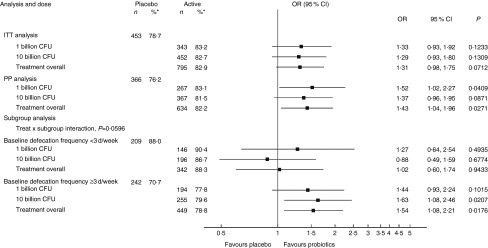
- For the initial defecation-frequency responder definition (above baseline for ≥50% of the time), the overall OR was 1·31 (95% CI 0·98, 1·75), P=0·071; the per-protocol analysis showed significant effects in the 1 billion group and overall (OR 1·52 and 1·43, respectively).
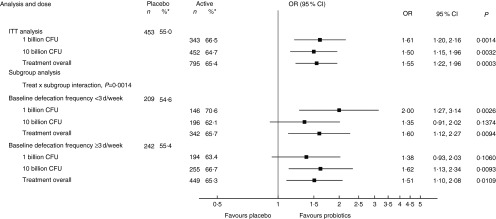
- With tightened responder criteria (increase of ≥1 d/week for ≥50% of the time), the overall OR was 1·55 (95% CI 1·22, 1·96), P=0·0003, with ORs between 1·50 and 1·61 for each dose and treatment overall.
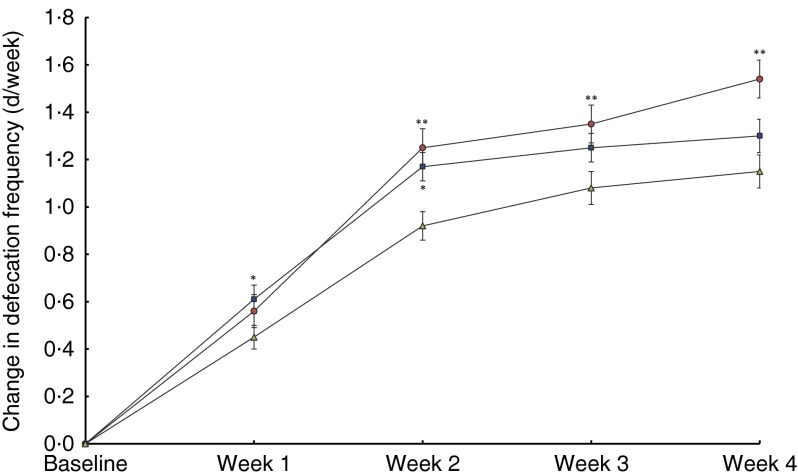
- Average defecation frequency increased in all groups, with a significant overall probiotic treatment effect (P=0·0065) and significantly higher frequency versus placebo at all weeks for probiotic treatment overall (all P<0·05); change from baseline was 1·54, 1·30 and 1·15 d/week for 1 billion, 10 billion and placebo, respectively.
- GI well-being (global relief of abdominal discomfort) showed no statistically significant differences; abdominal pain and bloating decreased in all groups without treatment differences.
Methods
- Randomised, double-blind, placebo-controlled, parallel-group trial at eight centres in France, Germany and the UK between September 2010 and December 2012, with a 2-week run-in and 4-week intervention.
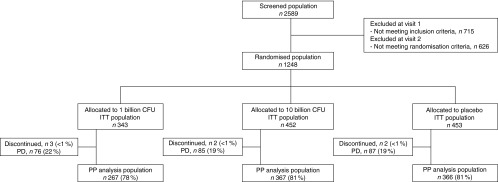
- 1248 healthy men and women aged 18–70 years with low defecation frequency (2–4 d/week) and general abdominal discomfort were randomised to 1 or 10 billion CFU/d BB-12® or matching placebo once daily; the planned sample size was 1740, but interim analyses closed the 1 billion arm after the first interim analysis and the 10 billion arm after the second.
- Primary end points were responder rates for defecation frequency and GI well-being, analysed in the intention-to-treat population using logistic regression; supportive analyses included per-protocol, GEE models for average defecation frequency, predefined subgroup analyses, and post hoc tightened responder criteria.
Limitations
- The paper states that very high placebo response rates were observed, that the initial responder definition may have been too easy to reach, and that the global assessment of GI well-being has been debated as an end point.
- The paper states that intention-to-treat analysis introduces heterogeneity by combining compliant and non-compliant subjects, that regression towards the mean may have underestimated the true probiotic effect, and that mechanisms and dose–response reasons remain unknown.
- Evident from the text: the dose arms were stopped at different interim analyses, resulting in unequal group sizes; the study population had mild symptoms not severe enough to consult a doctor, so generalisability to IBS or clinically constipated populations is uncertain.
Model-written summary. Check it against the paper before relying on it.
Integrity signals
Registry
Cites
Statistics
Figures
Verification
Claims the paper makes
11 Valid · 1 Not valid · 7 Not checked · 99 Own results and interpretations
A result the paper reports from its own data — it cites no other source for it, so there is none to check. The quote shows it is in the paper.
In the paper
“In total, 337 AE in 233 (18·7 %) subjects were recorded during the study.”
§ Effect of the probiotic strain Bifidobacterium animalis subsp. lactis, BB-12®, on defecation frequency in healthy subjects with low defecation frequency and abdominal discomfort: a randomised, double-blind, placebo-controlled, parallel-group trial > Results > Adverse events
plain- Asserted: passes — The authors put it forward as true.
- Checkable: passes — It can be checked against evidence.
- Load-bearing: passes — The paper’s conclusions depend on it.
- Based: passes — The paper gives a reason why it holds.
A result the paper reports from its own data — it cites no other source for it, so there is none to check. The quote shows it is in the paper.
In the paper
“No difference was observed between the two doses tested.”
§ Effect of the probiotic strain Bifidobacterium animalis subsp. lactis, BB-12®, on defecation frequency in healthy subjects with low defecation frequency and abdominal discomfort: a randomised, double-blind, placebo-controlled, parallel-group trial > Discussion
plain- Asserted: passes — The authors put it forward as true.
- Checkable: passes — It can be checked against evidence.
- Load-bearing: passes — The paper’s conclusions depend on it.
- Based: passes — The paper gives a reason why it holds.
A result the paper reports from its own data — it cites no other source for it, so there is none to check. The quote shows it is in the paper.
In the paper
“Tightening the criteria for being a responder to an increase of ≥1 d/week for ≥50 % of the time resulted in an OR of 1·55 (95 % CI 1·22, 1·96), P=0·0003, for treatment overall.”
- Also stated in: § Defecation frequency · plain
“Post hoc responder analysis, defining responders as subjects with an increase in defecation frequency of ≥1 d/week for at least 50 % of the time, showed a statistically significant increase in the probability of being a responder with OR between 1·50 and 1·61 for each dose and treatment overall (Fig. 3).”
§ Effect of the probiotic strain Bifidobacterium animalis subsp. lactis, BB-12®, on defecation frequency in healthy subjects with low defecation frequency and abdominal discomfort: a randomised, double-blind, placebo-controlled, parallel-group trial > Abstract
plainstates an association- Asserted: passes — The authors put it forward as true.
- Checkable: passes — It can be checked against evidence.
- Load-bearing: passes — The paper’s conclusions depend on it.
- Based: passes — The paper gives a reason why it holds.
- Also stated in: § Defecation frequency · plain
A result the paper reports from its own data — it cites no other source for it, so there is none to check. The quote shows it is in the paper.
In the paper
“For the two subgroups with different baseline defecation frequency, there was a statistically significant interaction between treatment and subgroup (P=0·0014); however, in both subgroups, rather similar and significant OR between 1·51 and 1·60 were observed for treatment overall (Fig. 3).”
§ Effect of the probiotic strain Bifidobacterium animalis subsp. lactis, BB-12®, on defecation frequency in healthy subjects with low defecation frequency and abdominal discomfort: a randomised, double-blind, placebo-controlled, parallel-group trial > Results > Defecation frequency
plainstates an association- Asserted: passes — The authors put it forward as true.
- Checkable: passes — It can be checked against evidence.
- Load-bearing: unclear — It is unclear whether the paper’s conclusions depend on it.
- Based: passes — The paper gives a reason why it holds.
A result the paper reports from its own data — it cites no other source for it, so there is none to check. The quote shows it is in the paper.
In the paper
“however, in both subgroups, rather similar and significant OR between 1·51 and 1·60 were observed for treatment overall (Fig. 3).”
§ Effect of the probiotic strain Bifidobacterium animalis subsp. lactis, BB-12®, on defecation frequency in healthy subjects with low defecation frequency and abdominal discomfort: a randomised, double-blind, placebo-controlled, parallel-group trial > Results > Defecation frequency
plainstates an association- Asserted: passes — The authors put it forward as true.
- Checkable: passes — It can be checked against evidence.
- Load-bearing: unclear — It is unclear whether the paper’s conclusions depend on it.
- Based: passes — The paper gives a reason why it holds.
42 more claims
Create a free account to see all 118 claims and to verify the 2 references still open.
- Probably not a substantial claim. 59
- It may state two separate claims as one. 34
- The quote only partly states this claim. 1
Claims other papers make about this one
Each is checked against this paper’s own text: does it say what the citing paper says it does?
In the citing paper
“daily Bifidobacterium lactis supplementation decreases WGTT and the frequency of functional GI symptoms in a dose-dependent manner in subjects suffering from irregular bowel movements and flatulence [185,211]”
From Gut microbiota role in irritable bowel syndrome: New therapeutic strategies (2016) · cites this paper as [211]
Citations
Cites
International physical activity questionnaire: 12-country reliability and validity
CRAIG, C. L., MARSHALL, A. L., SJ??STR??M, M., BAUMAN, A. E., BOOTH, M. L., AINSWORTH, B. E., PRATT, M., EKELUND, U., YNGVE, A., SALLIS, J. F., et al. (2003) · Medicine & Science in Sports & Exercise · doi:10.1249/01.mss.0000078924.61453.fb · Cited by 21,619 · cited 1×
“Before and after the intervention, subjects completed questionnaires on their physical activity level (International Physical Activity Questionnaire short form)((27)).”
BackgroundA Simple Sequentially Rejective Multiple Test Procedure
(1979) · Scandinavian Journal of Statistics · doi:10.2307/4615733 · Cited by 21,526 · cited 1×
“The main analysis for each of the two primary end points was adjusted for the α-spending during the interim analyses and for multiplicity using a closed Bonferroni–Holm procedure to ensure an overall one-sided significance level of 2·5 % for the interim looks and final analyses combined((29)).”
MethodThe functional gastrointestinal disorders and the Rome III process
Drossman, D. A. (2006) · Gastroenterology · doi:10.1053/j.gastro.2006.03.008 · Cited by 2,416
Intention-to-treat concept: A review
Gupta, S. (2011) · Perspectives in Clinical Research · doi:10.4103/2229-3485.83221 · Cited by 1,921 · cited 1×
“When the ITT and PP analyses come to essentially the same conclusions, as in the present study, confidence in the study results are generally high((34)).”
ResultRifaximin Therapy for Patients with Irritable Bowel Syndrome without Constipation
Pimentel, M., Lembo, A., Chey, W. D., Zakko, S., Ringel, Y., Yu, J., Mareya, S. M., Shaw, A. L., Bortey, E., & Forbes, W. P. (2011) · New England Journal of Medicine · doi:10.1056/nejmoa1004409 · Cited by 1,036 · cited 1×
“The sample size calculation was based on a onesided α level of 0·0125 to account for two primary end points, an assumed placebo response rate of 40 % and a treatment difference of 10 % in responder rates based on previously published studies((23,28)).”
MethodIntestinal microbiota in functional bowel disorders: a Rome foundation report
Simrén, M., Barbara, G., Flint, H. J., Spiegel, B. M. R., Spiller, R. C., Vanner, S., Verdu, E. F., Whorwell, P. J., & Zoetendal, E. G. (2013) · Gut · doi:10.1136/gutjnl-2012-302167 · Cited by 939
Self-citationThe epidemiology of irritable bowel syndrome
Card, T., Canavan, C., & West, J. (2014) · Clinical Epidemiology · doi:10.2147/clep.s40245 · Cited by 889
Whorwell, P. J., Altringer, L., Morel, J., Bond, Y., Charbonneau, D., O'Mahony, L., Kiely, B., Shanahan, F., & Quigley, E. M. M. (2006) · The American Journal of Gastroenterology · doi:10.1111/j.1572-0241.2006.00734.x · Cited by 799 · cited 1×
“Studies of probiotics for antibiotic-associated diarrhoea have shown increased effect with higher dose((41,42)), whereas a study of discomfort symptoms in IBS patients indicated a missing dose–response relationship of probiotics, as an effect was observed at a medium dose level and no effects were observed for a lower…”
BackgroundSelf-citationDesign of Treatment Trials for Functional Gastrointestinal Disorders
Irvine, E. J., Tack, J., Crowell, M. D., Gwee, K. A., Ke, M., Schmulson, M. J., Whitehead, W. E., & Spiegel, B. (2016) · Gastroenterology · doi:10.1053/j.gastro.2016.02.010 · Cited by 550
(2006) · Cited by 534
Irritable bowel syndrome: Pathogenesis, diagnosis, treatment, and evidence-based medicine
Saha, L. (2014) · World Journal of Gastroenterology · doi:10.3748/wjg.v20.i22.6759 · Cited by 500
ROME III: The Functional Gastrointestinal Disorders
Sheth, A. A. (2007) · Journal of Clinical Gastroenterology · doi:10.1097/mcg.0b013e31804bbe26 · Cited by 489
Review article: the economic impact of the irritable bowel syndrome
Canavan, C., West, J., & Card, T. (2014) · Alimentary Pharmacology & Therapeutics · doi:10.1111/apt.12938 · Cited by 458
'Gut health': a new objective in medicine?
Bischoff, S. C. (2011) · BMC Medicine · doi:10.1186/1741-7015-9-24 · Cited by 338
Gao, X. W., Mubasher, M., Fang, C. Y., Reifer, C., & Miller, L. E. (2010) · American Journal of Gastroenterology · doi:10.1038/ajg.2010.11 · Cited by 318 · cited 1×
“Studies of probiotics for antibiotic-associated diarrhoea have shown increased effect with higher dose((41,42)), whereas a study of discomfort symptoms in IBS patients indicated a missing dose–response relationship of probiotics, as an effect was observed at a medium dose level and no effects were observed for a lower…”
BackgroundDesign of Treatment Trials for Functional Gastrointestinal Disorders
Irvine, E. J., Whitehead, W. E., Chey, W. D., Matsueda, K., Shaw, M., Talley, N. J., & Veldhuyzen van Zanten, S. J. O. (2006) · Gastroenterology · doi:10.1053/j.gastro.2005.11.058 · Cited by 286
Irritable bowel syndrome: A clinical review
Soares, R. L. (2014) · World Journal of Gastroenterology · doi:10.3748/wjg.v20.i34.12144 · Cited by 266
Spiegel, B. M. R., Hays, R. D., Bolus, R., Melmed, G. Y., Chang, L., Whitman, C., Khanna, P. P., Paz, S. H., Hays, T., Reise, S., et al. (2014) · American Journal of Gastroenterology · doi:10.1038/ajg.2014.237 · Cited by 262 · cited 1×
“It is currently not clear which outcomes are most valid to use, and as the available tools are not ideal new tools are under development((15,16)).”
BackgroundHungin, A. P. S., Mulligan, C., Pot, B., Whorwell, P., Agréus, L., Fracasso, P., Lionis, C., Mendive, J., Philippart de Foy, J.-M., Rubin, G., et al. (2013) · Alimentary Pharmacology & Therapeutics · doi:10.1111/apt.12460 · Cited by 212
Self-citationWaller, P. A., Gopal, P. K., Leyer, G. J., Ouwehand, A. C., Reifer, C., Stewart, M. E., & Miller, L. E. (2011) · Scandinavian Journal of Gastroenterology · doi:10.3109/00365521.2011.584895 · Cited by 195
Ringel-Kulka, T., Palsson, O. S., Maier, D., Carroll, I., Galanko, J. A., Leyer, G., & Ringel, Y. (2011) · Journal of Clinical Gastroenterology · doi:10.1097/mcg.0b013e31820ca4d6 · Cited by 174 · cited 1×
“digestive symptoms have mainly focused on GI well-being and symptoms with mixed results((25,26,39)).”
BackgroundSIMRÉN, M., ÖHMAN, L., OLSSON, J., SVENSSON, U., OHLSON, K., POSSERUD, I., & STRID, H. (2010) · Alimentary Pharmacology & Therapeutics · doi:10.1111/j.1365-2036.2009.04183.x · Cited by 169 · cited 1×
“The sample size calculation was based on a onesided α level of 0·0125 to account for two primary end points, an assumed placebo response rate of 40 % and a treatment difference of 10 % in responder rates based on previously published studies((23,28)).”
MethodEpidemiology of Irritable Bowel Syndrome
Choung, R. S., & Saito, Y. A. (2014) · GI Epidemiology · doi:10.1002/9781118727072.ch20 · Cited by 156
Irritable bowel syndrome: a disease still searching for pathogenesis, diagnosis and therapy.
(2014) · PubMed Central · doi:10.3748/wjg.v20.i27.8807 · Cited by 132 · cited 2×
“Rather, different products or products acting on multiple pathophysiological mechanisms may be needed for targeting the different pathophysiological mechanisms behind various symptoms((45,48)).”
BackgroundLarsen, C. N., Nielsen, S., Kæstel, P., Brockmann, E., Bennedsen, M., Christensen, H. R., Eskesen, D. C., Jacobsen, B. L., & Michaelsen, K. F. (2006) · European Journal of Clinical Nutrition · doi:10.1038/sj.ejcn.1602450 · Cited by 124
Self-citationValidation of Symptom-Based Diagnostic Criteria for Irritable Bowel Syndrome: A Critical Review
Whitehead, W. E., & Drossman, D. A. (2010) · American Journal of Gastroenterology · doi:10.1038/ajg.2010.56 · Cited by 114 · cited 1×
“It can be a challenge to distinguish patients with IBS from healthy people with similar GI symptoms, as healthy people may have the same complaints, only less frequently and less severe((8,13,14)).”
BackgroundIntestinal microbiota in pathophysiology and management of irritable bowel syndrome.
(2014) · PubMed Central · doi:10.3748/wjg.v20.i27.8886 · Cited by 106
Choung, R. S., Shah, N. D., Chitkara, D., Branda, M. E., Van Tilburg, M. A., Whitehead, W. E., Katusic, S. K., Locke, G. R., & Talley, N. J. (2011) · Journal of Pediatric Gastroenterology and Nutrition · doi:10.1097/mpg.0b013e3181e67058 · Cited by 103
Ford, A. C., Bercik, P., Morgan, D. G., Bolino, C., Pintos‐Sanchez, M. I., & Moayyedi, P. (2014) · Alimentary Pharmacology & Therapeutics · doi:10.1111/apt.12573 · Cited by 102 · cited 2×
“In addition, efficacy measures still rely on patient-rated outcomes((6,30,32)).”
BackgroundGuidance on the scientific requirements for health claims related to gut and immune function
EFSA Panel on Dietetic Products, N. A. A. (. (2011) · EFSA Journal · doi:10.2903/j.efsa.2011.1984 · Cited by 99
Probiotics reduce symptoms of antibiotic use in a hospital setting: A randomized dose response study
Ouwehand, A. C., DongLian, C., Weijian, X., Stewart, M., Ni, J., Stewart, T., & Miller, L. E. (2014) · Vaccine · doi:10.1016/j.vaccine.2013.11.053 · Cited by 98 · cited 1×
“Studies of probiotics for antibiotic-associated diarrhoea have shown increased effect with higher dose((41,42)), whereas a study of discomfort symptoms in IBS patients indicated a missing dose–response relationship of probiotics, as an effect was observed at a medium dose level and no effects were observed for a lower…”
BackgroundGuyonnet, D., Schlumberger, A., Mhamdi, L., Jakob, S., & Chassany, O. (2009) · British Journal of Nutrition · doi:10.1017/s0007114509990882 · Cited by 95 · cited 3×
“digestive symptoms have mainly focused on GI well-being and symptoms with mixed results((25,26,39)).”
BackgroundResultMüller-Lissner, S. (2003) · Journal of Clinical Epidemiology · doi:10.1016/s0895-4356(03)00027-1 · Cited by 91
Self-citation(2007) · PubMed · Cited by 90
Clinical trial guidelines for pharmacological treatment of irritable bowel syndrome
Corazziari, E., Bytzer, P., Delvaux, M., Holtmann, G., Malagelada, J. R., Morris, J., Muller‐Lissner, S., Spiller, R. C., Tack, J., & Whorwell, P. J. (2003) · Alimentary Pharmacology & Therapeutics · doi:10.1046/j.1365-2036.2003.01709.x · Cited by 80 · cited 3×
“frequency the baseline value was also included((17,30)).”
BackgroundSelf-citationAlterations in the Intestinal Microbiota and Functional Bowel Symptoms
Ringel, Y., & Carroll, I. M. (2009) · Gastrointestinal Endoscopy Clinics of North America · doi:10.1016/j.giec.2008.12.004 · Cited by 73
Krogsgaard, L. R., Engsbro, A. L., & Bytzer, P. (2013) · Scandinavian Journal of Gastroenterology · doi:10.3109/00365521.2013.775328 · Cited by 66 · cited 3×
“The conditions are often undiagnosed and self-managed by the patient((8,9)) and pose a heavy burden on the individual and society.”
BackgroundIrritable bowel syndrome: a concise review of current treatment concepts
Wall, G. C., Bryant, G. A., Bottenberg, M. M., Maki, E. D., & Miesner, A. R. (2014) · World Journal of Gastroenterology · doi:10.3748/wjg.v20.i27.8796 · Cited by 56
Choung, R. S., Branda, M. E., Chitkara, D., Shah, N. D., Katusic, S. K., Locke III, G. R., & Talley, N. J. (2011) · Alimentary Pharmacology & Therapeutics · doi:10.1111/j.1365-2036.2010.04513.x · Cited by 53
Marteau, P., Guyonnet, D., Lafaye de Micheaux, P., & Gelu, S. (2013) · Neurogastroenterology & Motility · doi:10.1111/nmo.12078 · Cited by 50 · cited 3×
“digestive symptoms have mainly focused on GI well-being and symptoms with mixed results((25,26,39)).”
BackgroundResultConstipation-predominant irritable bowel syndrome: a review of current and emerging drug therapies.
Jadallah, K. A., Kullab, S. M., & Sanders, D. S. (2014) · World Journal of Gastroenterology · doi:10.3748/wjg.v20.i27.8898 · Cited by 48 · cited 1×
“Rather, different products or products acting on multiple pathophysiological mechanisms may be needed for targeting the different pathophysiological mechanisms behind various symptoms((45,48)).”
BackgroundMeance, S., Cayuela, C., Raimondi, A., Turchet, P., Lucas, C., & Antoine, J.-M. (2003) · Microbial Ecology in Health and Disease · doi:10.1080/08910600310015565 · Cited by 44
König, J., & Brummer, R. J. (2014) · Beneficial Microbes · doi:10.3920/bm2013.0033 · Cited by 42 · cited 1×
“In recent years, the gastrointestinal (GI) microbiota has been suggested to be implicated in the pathophysiology of multifactorial functional bowel disorders such as irritable bowel syndrome (IBS) and constipation, and as a consequence probiotics have been suggested as a potential means to manage symptoms of IBS and m…”
BackgroundEvolution of Clinical Trials for Irritable Bowel Syndrome: Issues in End Points and Study Design
Trentacosti, A. M., He, R., Burke, L. B., Griebel, D., & Kennedy, D. L. (2010) · American Journal of Gastroenterology · doi:10.1038/ajg.2010.12 · Cited by 42 · cited 2×
“In the past few years, it has been debated whether this outcome is the best way to evaluate treatment effect((15,46,47)), and consequently recently published guidelines no longer recommend the global rating as the primary end point in treatment trials for IBS((31,32)).”
BackgroundPharmacokinetic and pharmacodynamic considerations for the current chronic constipation treatments
Müller-Lissner, S. (2013) · Expert Opinion on Drug Metabolism & Toxicology · doi:10.1517/17425255.2013.773972 · Cited by 31 · cited 1×
“Subjects with such a low defecation frequency may be more unlikely to respond to a probiotic and require specific treatment with laxatives((35)).”
BackgroundSelf-citationRome Foundation Endpoints and Outcomes Conference 2009: Optimizing Clinical Trials in FGID
Chang, L., & Drossman, D. A. (2010) · American Journal of Gastroenterology · doi:10.1038/ajg.2010.49 · Cited by 22
Fedorak, R. N., Vanner, S. J., Paterson, W. G., & Bridges, R. J. (2012) · Canadian Journal of Gastroenterology · doi:10.1155/2012/861478 · Cited by 18 · cited 1×
“We observed very high placebo response rates in this study, although similar placebo effects have previously been reported in both healthy subjects and IBS patients((17,25,26,33)).”
ResultCamilleri, M. (2009) · The American Journal of Gastroenterology · doi:10.1038/ajg.2009.20 · Cited by 16 · cited 1×
“In the past few years, it has been debated whether this outcome is the best way to evaluate treatment effect((15,46,47)), and consequently recently published guidelines no longer recommend the global rating as the primary end point in treatment trials for IBS((31,32)).”
Background(2004) · Cited by 9
Research works printed but not linked: 1
- Uchida K, Akashi K, Kusunoki I, et al (2005) Effect of fermented milk containing Bifidobacterium lactis Bb-12 on stool frequency, defecation, fecal microbiota and safety of excessive ingestion in healthy female students – 2nd report. J Nutr Food 8, 39– 51.
Cited by
Probiotics and prebiotics in intestinal health and disease: from biology to the clinic
Sanders, M. E., Merenstein, D. J., Reid, G., Gibson, G. R., & Rastall, R. A. (2019) · Nature Reviews Gastroenterology & Hepatology · doi:10.1038/s41575-019-0173-3 · Cited by 2,059
Gut microbiota role in irritable bowel syndrome: New therapeutic strategies
Distrutti, E., Monaldi, L., Ricci, P., & Fiorucci, S. (2016) · World Journal of Gastroenterology · doi:10.3748/wjg.v22.i7.2219 · Cited by 320
Sanders, M. E., Merenstein, D., Merrifield, C. A., & Hutkins, R. (2018) · Nutrition Bulletin · doi:10.1111/nbu.12334 · Cited by 278
Update of probiotics in human world: A nonstop source of benefactions till the end of time
Zommiti, M., Feuilloley, M. G. J., & Connil, N. (2020) · Microorganisms · doi:10.3390/microorganisms8121907 · Cited by 225
“lactis, BB-12(R) Manage symptoms of occasional constipation [87]”
BackgroundLeaky Gut and the Ingredients That Help Treat It: A Review
Aleman, R. S., Moncada, M., & Aryana, K. J. (2023) · Molecules · doi:10.3390/molecules28020619 · Cited by 182
Metadata
- Authors
- Eskesen, D., Jespersen, L., Michelsen, B., Whorwell, P. J., Müller-Lissner, S., & Morberg, C. M.
- Affiliations
- Chr. Hansen (Denmark) (DK)
- Park-Klinik Weißensee (DE)
- Corresponding author
- Eskesen, Dorte
- ORCID
- Whorwell, Peter J.
- Venue
- British Journal of Nutrition
- Publisher
- Cambridge University Press (CUP)
- Published
- 2015-09-18
- Volume
- 114
- Issue
- 10
- Pages
- 1638-1646
- ISSN
- 0007-1145 (ISSN-L)
- 1475-2662
- PMC
- PMC4657032
- OpenAlex
- W2136311124
- Cited by
- 78
- References
- 57
- Citations by year
- 2026: 7 · 2025: 8 · 2024: 3 · 2023: 6 · 2022: 13 · 2021: 8 · 2020: 5 · 2019: 8 · 2018: 7 · 2017: 10 · 2016: 3
- FWCI
- 6.70
- Type
- journal article
- Language
- en
- Open access
- hybrid
- doi.org
- Locations
- British Journal Of Nutrition (publishedVersion, cc-by)
- Europe PMC (PubMed Central) (publishedVersion, cc-by)
- PubMed Central (publishedVersion, cc-by)
- PubMed (publishedVersion)
- Research Explorer (The University of Manchester) (publishedVersion, cc-by)
- Topics
- Life Sciences › Agricultural and Biological Sciences › Food Science › Probiotics and Fermented Foods
- Health Sciences › Medicine › Gastroenterology › Gastrointestinal motility and disorders
- Life Sciences › Biochemistry, Genetics and Molecular Biology › Molecular Biology › Gut microbiota and health
- Keywords
- Bifidobacterium animalis subsp. lactis BB-12, probiotics, stool frequency, abdominal discomfort, constipation, healthy adults, dose-response relationship, ceiling effect
- MeSH terms
- Adult, Bifidobacterium, Defecation, Double-Blind Method, Female, France, Germany, United Kingdom, Humans, Male, Middle Aged, Patient Compliance, Placebos, Surveys and Questionnaires, Time Factors, Abdominal Pain, Odds Ratio, Probiotics
About these checks
Registry, retraction, Cites and statistics results are computed, not judged, with one exception: a printed reference that no index lists is read once by a model before it counts as a citation error. Claims are extracted by a model and kept only when their quote appears verbatim in the text; each cited source is then checked, with a model’s help, for whether it says what the claim relies on. Those verdicts can be wrong — read the claim’s quote and the cited source before relying on one.
The claim verdicts this report counts are experimental: their accuracy is not yet measured.
A language model drew the claims from the paper on 2026-10-10, under version 3 of the claim definition (model deepseek-v4.1-flash, prompt extract-v3).
A second model labelled each claim on 2026-10-10 (model jev-1.13-20260917, definition revision gold-guideline-v0.2).
Statistics and arithmetic are recomputed, not judged.
Confidence bands are shown only for fields calibrated on our annotated test set. None is calibrated yet, so no band is shown.
What counts as a claim ›How we measure confidence ›How we check this ›
Are you an author, or do you see a problem with this page? Request a review
Data sources
Bibliographic data: Semantic Scholar, OpenAlex, Crossref.
Contains information from the Semantic Scholar Academic Graph Datasets, made available under the ODC Attribution License (ODC-BY 1.0).
Semantic Scholar’s data is described in: Kinney, R., et al. (2023). The Semantic Scholar Open Data Platform. arXiv:2301.10140.
