

A quasi-cohort trend analysis of adult obesity in Colombia
Open accessThe DOI matches its Crossref record; 57 of the 57 references it cites were found in a registry or an index; none of the 30 sources its claims cite is checked for support yet.
Abstract
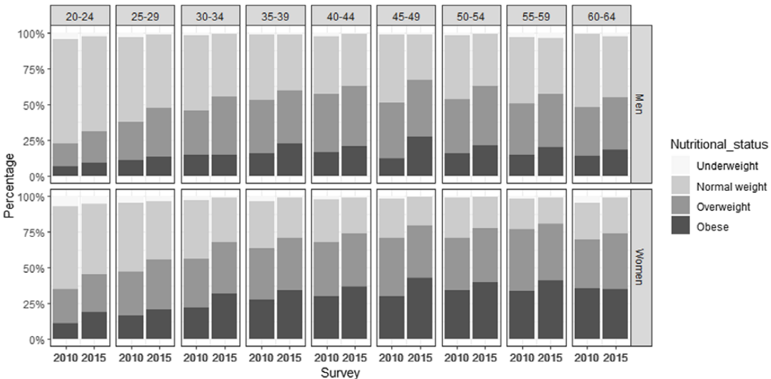
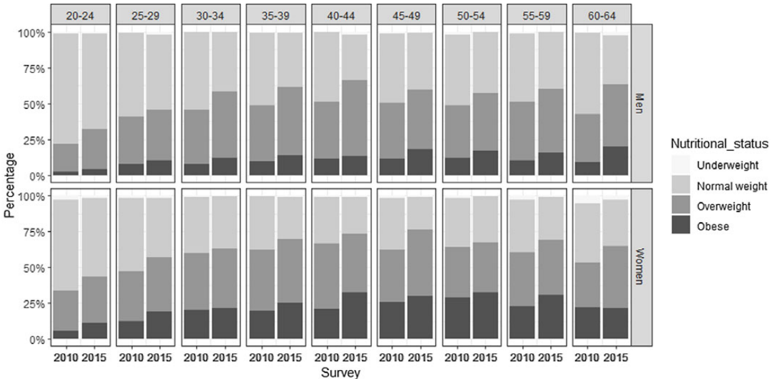
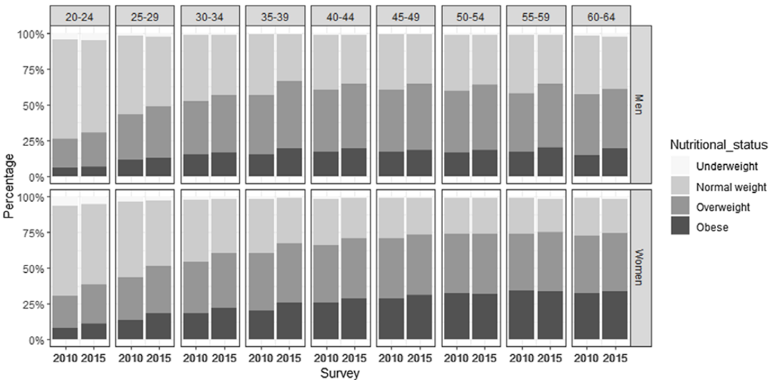
In Colombia, the prevalence of obesity has been increasing in recent years due to changes in dietary and nutritional patterns. While previous studies have focussed on describing obesity and its associated factors, they have mainly used a cross-sectional methodology. Accordingly, this study aims to conduct a descriptive quasi-cohort analysis to capture age-specific cohort trends in body mass index (BMI) according to sex and ethnicity (indigenous, Afro-Colombian, and the remaining population). The study utilised data from the National Survey of the Nutritional Situation in Colombia (ENSIN) conducted in 2005, 2010, and 2015 that included 214,136 individuals aged 20–64 years after screening. Data on ethnicity were only available from the 2010 and 2015 surveys. Overall, the prevalence of obesity increased by 6.1 percentage points (from 15.2% to 21.3%) between 2005 and 2015 (men from 10.4% to 15.7%; women from 18.2% to 25.7%). Among Afro-Colombians, obesity rose 6.6 percentage points (from 19.4% to 26.0%), again more so in women than in men (2015: 35.2% versus 17.8%). Among indigenous people, the proportion increased by 5.3 percentage points (from 13.5% to 18.8%), with women reporting highest rates (2015: 23.7% against 12.6% in men). Age- and cohort-specific results also indicate that recent adult cohorts are experiencing sharp increases in BMI, for example, while 25–29-year-old males born in 1975–1979 had a BMI of 24.2 kg/m 2, among 40–44-year-olds of the same cohort, this equalled 26.8 kg/m 2. In the case of women, these age differences in BMI among the same cohort are even greater (24.4 and 28.0 kg/m 2). In summary, the results of this study indicate that Colombia is still in the early stages of the obesity transition, urging the need to monitor obesity trends in Colombia from both an age and cohort perspective. To achieve this, longitudinal surveys or repeated cross-sectional surveys like the ENSIN could be utilised.
Overview
CoChat Summary
TL;DR
This descriptive quasi-cohort analysis of ENSIN 2005–2015 found adult obesity in Colombia rose from 15.2% to 21.3%, with women and Afro-Colombians showing higher prevalence. Successive recent cohorts experienced sharp BMI increases with age, suggesting Colombia remains in the early stages of the obesity transition.
Key findings
- Obesity prevalence among adults aged 20–64 increased by 6.1 percentage points, from 15.2% in 2005 to 21.3% in 2015; men rose from 10.4% to 15.7% and women from 18.2% to 25.7%.
- Among Afro-Colombians, obesity rose 6.6 percentage points (19.4% to 26.0%), with women at 35.2% versus men at 17.8% in 2015. Among indigenous people, obesity rose 5.3 percentage points (13.5% to 18.8%), with women at 23.7% versus men at 12.6% in 2015.
- Overweight increased from 33.8% to 38.9% (5.1 percentage points), while normal weight decreased from 47.7% to 37.8% (9.9 percentage points) between 2005 and 2015.
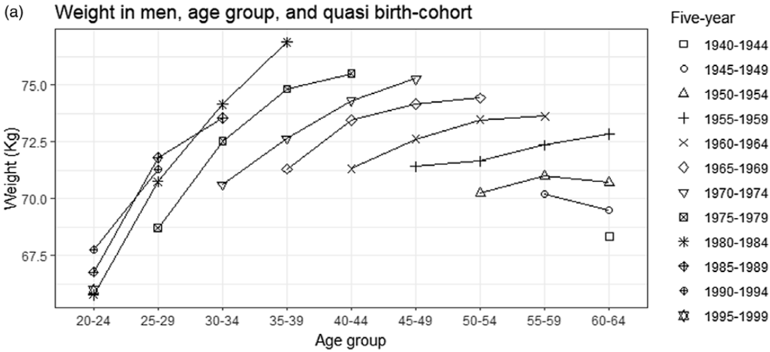
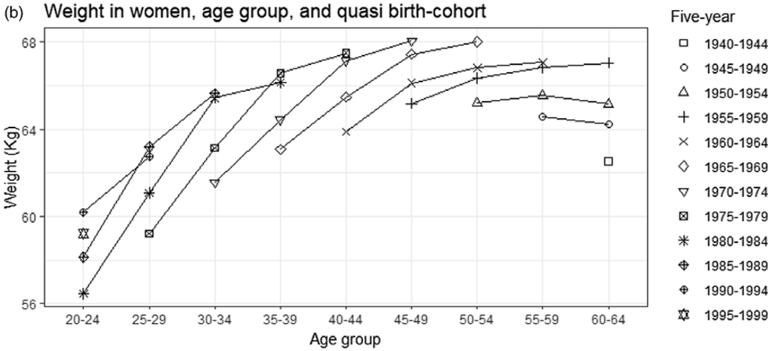
- Quasi-cohort results showed recent adult cohorts experiencing sharp BMI increases: males born 1975–1979 had a BMI of 24.2 kg/m² at ages 25–29 and 26.8 kg/m² at ages 40–44; women in the same cohort had 24.4 kg/m² and 28.0 kg/m², respectively.
Methods
- Descriptive quasi-cohort analysis using repeated cross-sectional National Survey of the Nutritional Situation (ENSIN) data from 2005, 2010, and 2015, including 214,136 individuals aged 20–64 years after screening; ethnicity data were available only for 2010 and 2015.
- Respondents were aggregated into one database and assigned quasi birth-cohorts by subtracting age from survey year; analyses used 5-year age groups, 5-year birth cohorts, sex, and ethnicity (indigenous, Afro-Colombian, and others), with BMI calculated from measured height and weight and categorized using WHO thresholds.
- Analyses were descriptive in R, including mean weight by survey year, sex, and age group; weight and height by quasi birth-cohort; BMI by age, sex, survey year, quasi birth-cohort, and ethnicity; and significance tests on mean weight by quasi birth-cohort and age group.
Limitations
- Stated: BMI is only an approximate indicator of obesity because age-, sex-, and race-specific fat level, skinfold thickness, or body shape are not controlled for; selection is also a limitation because the proportion of a cohort who already died from underweight or obesity is unknown.
- Stated: the ENSIN is cross-sectional rather than longitudinal, so it does not follow the same subjects over time; ethnicity was only available from 2010 and 2015; ENSIN 2005 and 2010 excluded the rural population of Orinoquía and Amazonia, corresponding to less than 1% of the country’s population.
- Evident from the text: 53,480 cases were excluded (20.0% of all cases in the selected age and birth-cohort range), and 68.3% of eliminated cases were men, which the authors suggest may relate to men being more likely to be employed and not at home during the survey.
Model-written summary. Check it against the paper before relying on it.
Integrity signals
Registry
Cites
Statistics
Figures
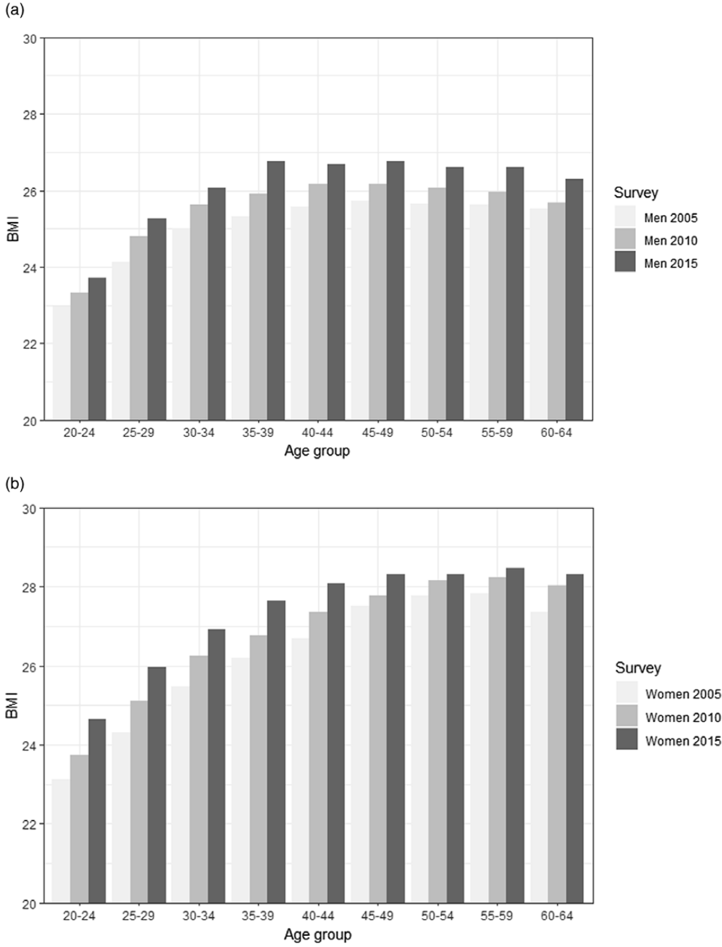
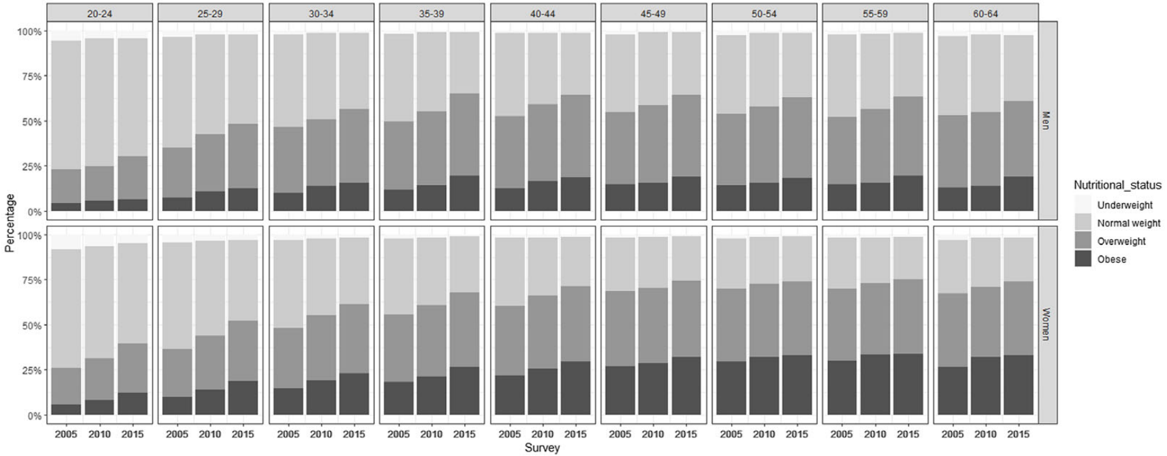
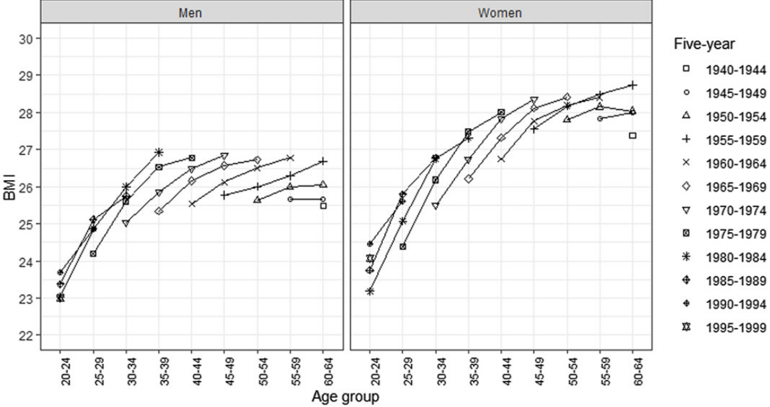
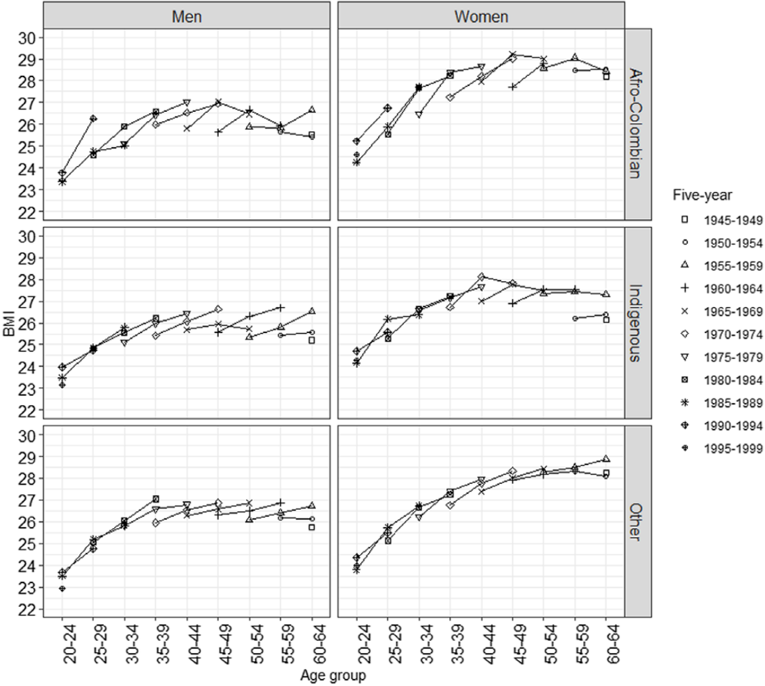
Verification
Claims the paper makes
0 Valid · 0 Not valid · 30 Not checked · 86 Own results and interpretations
A result the paper reports from its own data — it cites no other source for it, so there is none to check. The quote shows it is in the paper.
In the paper
“but whereby sex differences were still not converging”
§ A quasi-cohort trend analysis of adult obesity in Colombia > Discussion
plain- Asserted: passes — The authors put it forward as true.
- Checkable: passes — It can be checked against evidence.
- Load-bearing: passes — The paper’s conclusions depend on it.
- Based: passes — The paper gives a reason why it holds.
- Rests on an assumption not shown here.
A result the paper reports from its own data — it cites no other source for it, so there is none to check. The quote shows it is in the paper.
In the paper
“The results also clearly show that the slope of average weight changes between two five-year age groups in the same quasi-cohort is steeper in the younger quasi-cohorts.”
§ A quasi-cohort trend analysis of adult obesity in Colombia > Quasi birth-cohort analysis of average weight by age and sex
boostedstates an association- Asserted: passes — The authors put it forward as true.
- Checkable: passes — It can be checked against evidence.
- Load-bearing: passes — The paper’s conclusions depend on it.
- Based: passes — The paper gives a reason why it holds.
- Rests on 2 assumptions not shown here.
A result the paper reports from its own data — it cites no other source for it, so there is none to check. The quote shows it is in the paper.
In the paper
“In other ethnicities (mainly of mixed ethnicity), in men the highest increase in average BMI was found in the 35-39-year age group between the 1970-1974 and 1980-1984 quasi birth-cohorts (+0.8 kg/m 2 ).”
§ A quasi-cohort trend analysis of adult obesity in Colombia > BMI trends by quasi birth-cohort, age, and sex
plainstates an association- Asserted: passes — The authors put it forward as true.
- Checkable: passes — It can be checked against evidence.
- Load-bearing: unclear — It is unclear whether the paper’s conclusions depend on it.
- Based: passes — The paper gives a reason why it holds.
- Rests on 2 assumptions not shown here.
A result the paper reports from its own data — it cites no other source for it, so there is none to check. The quote shows it is in the paper.
In the paper
“The ages most affected by obesity in 2015 were 55-59-yearolds (both sexes)”
§ A quasi-cohort trend analysis of adult obesity in Colombia > Cross-sectional analysis of BMI by sex and age
plainstates an association- Asserted: passes — The authors put it forward as true.
- Checkable: passes — It can be checked against evidence.
- Load-bearing: unclear — It is unclear whether the paper’s conclusions depend on it.
- Based: passes — The paper gives a reason why it holds.
- Rests on an assumption not shown here.
A result the paper reports from its own data — it cites no other source for it, so there is none to check. The quote shows it is in the paper.
In the paper
“Afro-Colombian men reported an increase of up 1.2 kg/m 2 in the 40-44-year age group between the quasi birth-cohorts 1965-1969 and 1975-1979.”
§ A quasi-cohort trend analysis of adult obesity in Colombia > BMI trends by quasi birth-cohort, age, and sex
plainstates an association- Asserted: passes — The authors put it forward as true.
- Checkable: passes — It can be checked against evidence.
- Load-bearing: unclear — It is unclear whether the paper’s conclusions depend on it.
- Based: passes — The paper gives a reason why it holds.
- Rests on 2 assumptions not shown here.
56 more claims
Create a free account to see all 116 claims and to verify the 19 references still open.
- It may state two separate claims as one. 37
- Probably not a substantial claim. 26
Self-check
Percentages, sums and reported differences re-computed from the paper’s own numbers.
Each contradiction between two passages listed here was confirmed by an independent check.
Rated minor: it would not touch a result — a value no result rests on, a p-value that stays on the same side of the significance level, or a conflict that is clerical, resolved elsewhere in the paper, or outside its own findings.
In the paper
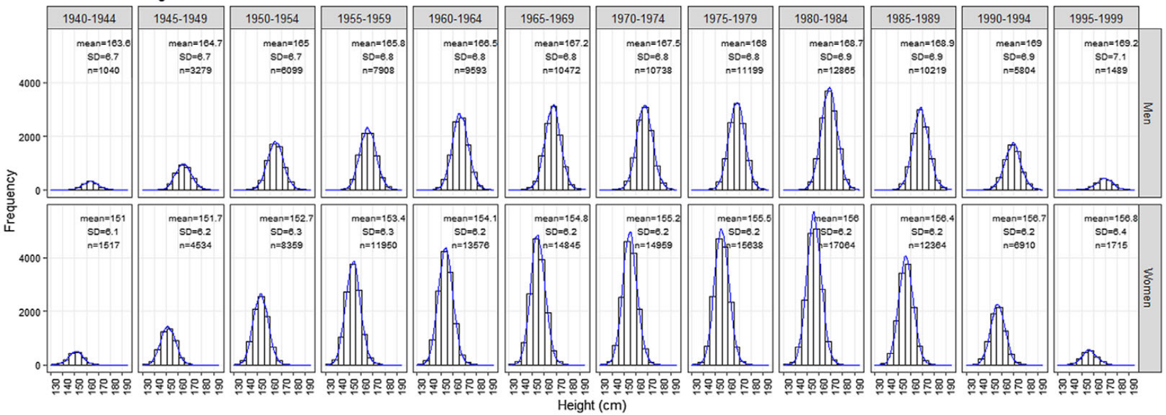
“In the case of women, height increased by 5.2 cm (154.7-159.5 cm).”
§ A quasi-cohort trend analysis of adult obesity in Colombia > Quasi-cohort analysis of average height by quasi birth-cohort and sex
Reported 5.2 · recomputed 4.8
Rated minor: it would not touch a result — a value no result rests on, a p-value that stays on the same side of the significance level, or a conflict that is clerical, resolved elsewhere in the paper, or outside its own findings.
In the paper
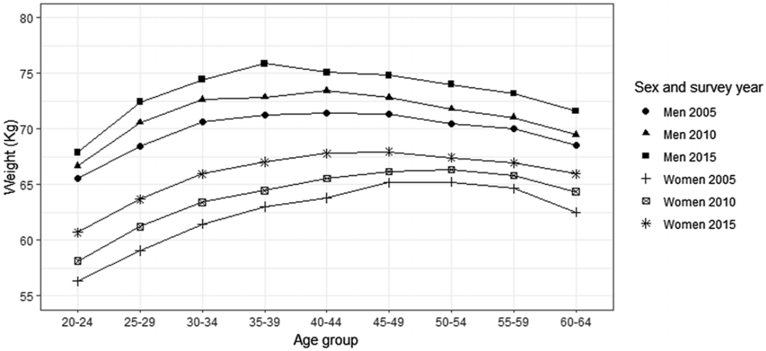
“the average weight of Colombian adult men aged 20-64 years increased from 69.7 kg to 73.2 kg (+3.5 kg, equal to an increase of 4.7%).”
§ A quasi-cohort trend analysis of adult obesity in Colombia > Cross-sectional analysis of average weight by sex and age
Reported 4.7 · recomputed 5.021521
Rated minor: it would not touch a result — a value no result rests on, a p-value that stays on the same side of the significance level, or a conflict that is clerical, resolved elsewhere in the paper, or outside its own findings.
In the paper
§ A quasi-cohort trend analysis of adult obesity in Colombia > BMI trends by quasi birth-cohort, age, and sex
“the average BMI of 55-59-year-olds born in 1960-1964 was 1.3 kg/m 2 higher”
§ A quasi-cohort trend analysis of adult obesity in Colombia > BMI trends by quasi birth-cohort, age, and sex
“than in the 1960-1964 quasi birth-cohort.”
Rated minor: it would not touch a result — a value no result rests on, a p-value that stays on the same side of the significance level, or a conflict that is clerical, resolved elsewhere in the paper, or outside its own findings.
In the paper
“Total 36715 100.00 48207 100.00 82922 100.00”
§ A quasi-cohort trend analysis of adult obesity in Colombia > Strengths and limitations of the study and ideas for future research
Reported 82922 · recomputed 84922
Rated minor: it would not touch a result — a value no result rests on, a p-value that stays on the same side of the significance level, or a conflict that is clerical, resolved elsewhere in the paper, or outside its own findings.
In the paper
“Obese 521 17.83 1190 35.52 1711 26.00”
§ A quasi-cohort trend analysis of adult obesity in Colombia > Strengths and limitations of the study and ideas for future research
Reported 35.52 · recomputed 32.522547
1 more finding
Create a free account to see every finding of this check.
Citations
Cites
Breastfeeding in the 21st century: epidemiology, mechanisms, and lifelong effect
Victora, C. G., Bahl, R., Barros, A. J. D., França, G. V. A., Horton, S., Krasevec, J., Murch, S., Sankar, M. J., Walker, N., & Rollins, N. C. (2016) · The Lancet · doi:10.1016/s0140-6736(15)01024-7 · Cited by 8,040
Body Mass Index: Obesity, BMI, and Health A Critical Review
Nuttall, F. Q. (2015) · Nutrition Today · doi:10.1097/nt.0000000000000092 · Cited by 2,284
Gorber, S. C., Tremblay, M., Moher, D., & Gorber, B. (2007) · Obesity Reviews · doi:10.1111/j.1467-789x.2007.00347.x · Cited by 1,945
Dynamics of the double burden of malnutrition and the changing nutrition reality
Popkin, B. M., Corvalan, C., & Grummer-Strawn, L. M. (2020) · The Lancet · doi:10.1016/s0140-6736(19)32497-3 · Cited by 1,709
The obesity transition: stages of the global epidemic
Jaacks, L. M., Vandevijvere, S., Pan, A., McGowan, C. J., Wallace, C., Imamura, F., Mozaffarian, D., Swinburn, B., & Ezzati, M. (2019) · The Lancet Diabetes & Endocrinology · doi:10.1016/s2213-8587(19)30026-9 · Cited by 1,193
Economic Burden of Obesity: A Systematic Literature Review
Tremmel, M., Gerdtham, U.-G., Nilsson, P., & Saha, S. (2017) · International Journal of Environmental Research and Public Health · doi:10.3390/ijerph14040435 · Cited by 1,154
Obesity and Cancer Mechanisms: Tumor Microenvironment and Inflammation
Iyengar, N. M., Gucalp, A., Dannenberg, A. J., & Hudis, C. A. (2016) · Journal of Clinical Oncology · doi:10.1200/jco.2016.67.4283 · Cited by 1,004
Obesity and female infertility: potential mediators of obesity's impact
Broughton, D. E., & Moley, K. H. (2017) · Fertility and Sterility · doi:10.1016/j.fertnstert.2017.01.017 · Cited by 845
Bozkurt, B., Aguilar, D., Deswal, A., Dunbar, S. B., Francis, G. S., Horwich, T., Jessup, M., Kosiborod, M., Pritchett, A. M., Ramasubbu, K., et al. (2016) · Circulation · doi:10.1161/cir.0000000000000450 · Cited by 522
Sex mortality differences in The United States: The role of cohort smoking patterns
Preston, S. H., & Wang, H. (2006) · Demography · doi:10.1353/dem.2006.0037 · Cited by 321
Research works printed but not linked: 8
- Estado Plurinacional de Bolivia (2017) Manual Integral de Antropometria Serie: Documentos Técnico Normativos. www. minsalud.gob.bo (accessed 16 February 2023).
- 2009, Ley 1355 de octubre 14 de 2009
- Bourges H, Bengoa JM and O'Donell AM (2000) Historia de la Nutrición en América Latina. óéhttps://www.slan.org.ve/ libros/HistoriasdelaNutriciónenAméricaLatina.pdf (accessed 16 February 2023).
- 2019, Encuesta Nacional de la Situación Nutricional-ENSIN, 2015. Documento metodológico
- 2015, Encuesta Nacional de la Situación Nutricional – ENSIN 2015. Documento metodológico
- Rivas X, Pazos S, Castillo S and Pachón H (2010) Alimentos autóctonos de las comunidades indígenas y afrodescendientes de Colombia. Archivos Latinomericanos de Nutrición 60(3). https://www.alanrevista.org/ediciones/2010/3/art-1/ (accesed 5 June 2023).
- CEPAL (2014) Los pueblos índigenas en America Latina. Avances en el último decenio y retos pendientes para la garantía de sus derechos. In Naciones unidas (Vol. 1). https://bit.ly/2QbS1DN (accessed 16 February 2023).
- 2023, Encuesta Nacional de Salud y Nutrición 2018 Presentación de resultados
Cited by
Prieto, P. A. C., Molano-Moreno, D., & Lucumí, D. (2024) · Journal of Nutritional Science · doi:10.1017/jns.2024.44 · Cited by 3
“(8) All these facts suggest of need a deeper understanding of obesity as a public health issues in these racial-ethnic groups.”
BackgroundGarcía, A. M., González-Santamaría, J., López-García, C. J., Cruz, D. A. R., & Ramírez, J. A. (2026) · Discover Education · doi:10.1007/s44217-026-02131-3
“In Colombia, data from the National Survey of Nutritional Situation (ENSIN) found that the prevalence of obesity rose from 15.2% in 2005 to 21.3% in 2015, underscoring that obesity represent a growing public health challenge [4].”
InfluentialPatterns of sex differences in cancer mortality in Colombia: a population-based analysis, 1980–2023
Espinosa, O. L., Smith, A. D., Bejarano, V., Puentes, G., Pino, L. E., Wiesner, C., de Vries, E., Cardona, A. F., & Friebel, R. (2026) · The Lancet Regional Health - Americas · doi:10.1016/j.lana.2026.101465
“46 Skin cancer presents a complex picture: absolute rates are rising in both sexes, but more rapidly among men in high-altitude regions and areas with greater ultraviolet radiation exposure, emphasising the need for occupational sun-protection programs.”
Barros, T. M., Ortiz, C. F. S., Ucros, E. A. C., Bermúdez-Mercado, E., & Vargas, S. E. V. (2026) · Nexus Multidisciplinary Research Journal · doi:10.66615/jmkck111
Gómez-Velásquez, S., Duque, A. S. S., Avendaño, S. P. M., & Sierra-Gómez, A. M. (2026) · Universidad y Salud · doi:10.22267/rus.262803.9798
Metadata
- Authors
- Castro-Prieto, P. A., Spijker, J., & Recaño, J.
- Affiliations
- Centre for Demographic Studies (ES)
- Venue
- Journal of Biosocial Science
- Publisher
- Cambridge University Press (CUP)
- Published
- 2023-06-26
- Volume
- 56
- Issue
- 1
- Pages
- 63-89
- ISSN
- 0021-9320 (ISSN-L)
- 1469-7599
- OpenAlex
- W4382011586
- Semantic Scholar
- 71303c238535dfa8d43eb22842ec4a39b32eaa74
- Cited by
- 5
- References
- 57
- Citations by year
- 2026: 4 · 2024: 1
- FWCI
- 0.87
- Type
- journal article
- Language
- en
- Open access
- hybrid
- dx.doi.org
- Locations
- Journal of Biosocial Science (publishedVersion, cc-by)
- PubMed (publishedVersion)
- Dipòsit Digital de Documents de la UAB (Universitat Autònoma de Barcelona) (submittedVersion, cc-by)
- RECERCAT (Consorci de Serveis Universitaris de Catalunya) (submittedVersion, cc-by)
- Funders
- Centres de Recerca de Catalunya
- Ministerio de Ciencia e Innovación (PID2020-113934RB-I00)
- Universitat Autònoma de Barcelona
- H2020 European Research Council (864616)
- Topics
- Health Sciences › Medicine › Public Health, Environmental and Occupational Health › Obesity, Physical Activity, Diet
- Health Sciences › Medicine › Public Health, Environmental and Occupational Health › Indigenous Health and Education
- Health Sciences › Medicine › Endocrinology, Diabetes and Metabolism › Diabetes, Cardiovascular Risks, and Lipoproteins
- Keywords
- adult obesity, obesity prevalence trends, body mass index, cohort trends, sex differences in obesity, ethnic differences in obesity, indigenous peoples, Afro-Colombians, Colombia
- MeSH terms
- Adult, Colombia, Cross-Sectional Studies, Female, Humans, Male, Middle Aged, Obesity, Cohort Studies, Body Mass Index, Prevalence
About these checks
Registry, retraction, Cites and statistics results are computed, not judged, with one exception: a printed reference that no index lists is read once by a model before it counts as a citation error. Claims are extracted by a model and kept only when their quote appears verbatim in the text; each cited source is then checked, with a model’s help, for whether it says what the claim relies on. Those verdicts can be wrong — read the claim’s quote and the cited source before relying on one.
A language model drew the claims from the paper on 2026-11-27, under version 3 of the claim definition (model deepseek-v4.1-flash, prompt extract-v3).
A second model labelled each claim on 2026-11-27 (model jev-1.13-20260917, definition revision gold-guideline-v0.2).
Statistics and arithmetic are recomputed, not judged.
Confidence bands are shown only for fields calibrated on our annotated test set. None is calibrated yet, so no band is shown.
What counts as a claim ›How we measure confidence ›How we check this ›
Are you an author, or do you see a problem with this page? Request a review
Data sources
Bibliographic data: Semantic Scholar, OpenAlex, Crossref.
Contains information from the Semantic Scholar Academic Graph Datasets, made available under the ODC Attribution License (ODC-BY 1.0).
Semantic Scholar’s data is described in: Kinney, R., et al. (2023). The Semantic Scholar Open Data Platform. arXiv:2301.10140.
